Col. Aldrich’s “Last Cæsar” (2).
Reading edition
Professor Wilkerson’s critique upon Col. Thomas B. Aldrich’s “Last Cæsar” appears to have provoked a great deal of criticism in local literary circles, and to this criticism our distinguished dramatic managers have contributed not a little. It is seldom that we pay attention to the critiques upon critiques appearing in our columns; but when gentlemen of wealth and culture take exception to matter printed in this paper, we very properly suffer their objections to be heard. Our respected fellow-townsman, Col. J. H. McVicker, the veteran theatre manager, and the oldest “first grave-digger” now on earth, complains that Professor Wilkerson, so far from correcting the error into which the poet Aldrich has fallen, involves himself in follies more labyrinthian than the Boston poet’s.
“It is my lot (whether good or evil, I will not say) to be personally acquainted with the last Cæsar,” so Col. McVicker remarked yesterday. “When I say the last Cæsar, I mean the Cæsar who last appeared in Chicago; and certainly neither Col. Aldrich’s Cæsar nor Professor Wilkerson’s has been visible in the flesh since the fall of 1885. It was at that time that the Cæsar of whom I speak appeared upon the stage of my theatre under the auspices of Lawrence Barrett. It was on a Thursday: 164the previous Monday, Barrett had come to me, and had said, ‘Can you get me a Cæsar for Thursday night? Southburn, who usually takes the part, is down with a boil on his neck; and, unless I can find a substitute, we will have to change the bill.’ I told Larry that I hated to disappoint the public, and that I would find a Cæsar, or die in the attempt. Well, I found one; and I will venture to say that if he was not the last Cæsar, he ought to have been. His name (I find upon consulting my old play-bills) was Terence O’Toole. Previously he had carried a banner in one of Kiralfy’s spectacles, and had led in the horse in the second act of ‘The Black Hussar’ at the Columbia Theatre. My stage-manager, Louis Sharpe, told me that he had known Terence for several years, having become acquainted with him when he was running the elevator at the Tremont House, and he said he had made up his mind, then, that Terence was a rising young man. Louis is a humorist, you know; but I never suspected that he would take an advantage of me.”
Col. McVicker then proceeded to tell of the ovation of which Mr. O’Toole was the recipient when he made his début that Thursday night as Cæsar; but, inasmuch as this performance was criticised in our columns at that time by a professional hired for that purpose, far be it from us to supplement that criticism with any remarks now. But we will confirm Col. McVicker’s assertion 165that Mr. O’Toole’s was the last Cæsar seen upon the Chicago stage.
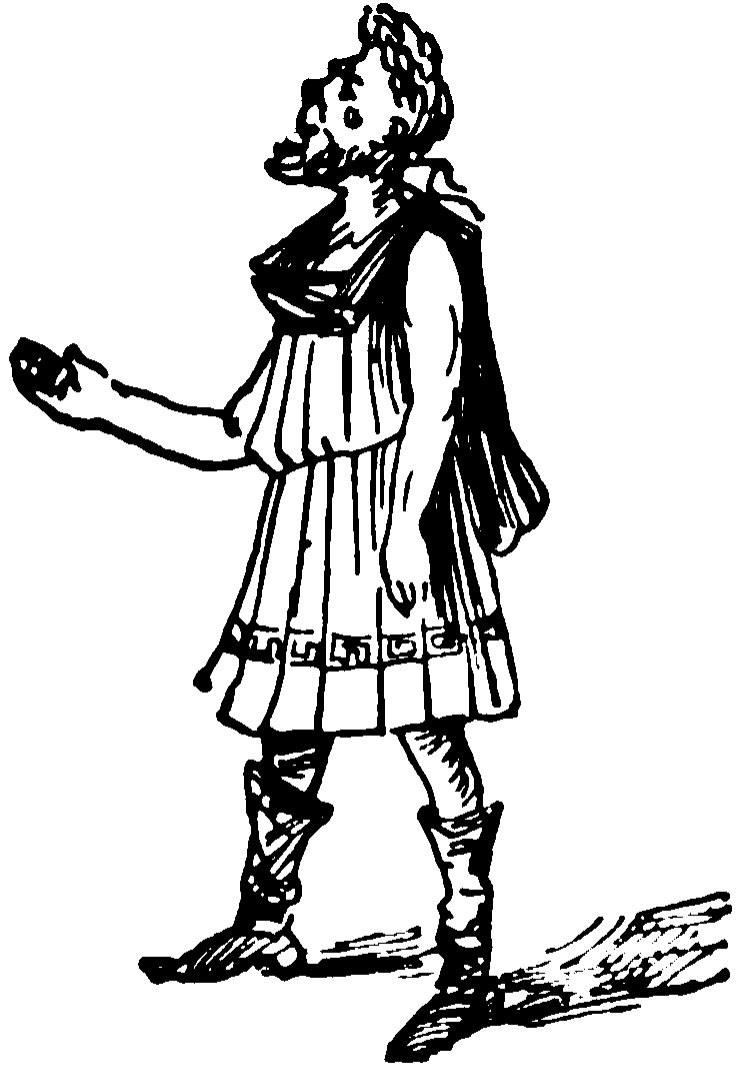
Professor Samuel Kayzer, manager of the Chicago Conservatory of Acting, calls our attention to an interesting matter—in fact, it is so interesting that we would fain lay it before the public. The professor is an accomplished linguist, and he speaks living and dead languages with equal fluency. He says that in the European colleges and universities this word “Cæsar” is pronounced “Kayzer,” and that it is the word from which the Teutonic word “kaiser,” and the Russian “czar,” or “tsar,” are derived. This pronunciation (viz., Kayzer) has been accepted, and is taught, in Harvard and in Yale, and in numerous other fashionable institutions having in view the preparation of our youth for the solemn duty of spending their fathers’ estates. The State University of Missouri, and Knox College at Galesburg, Ill., are the only prominent educational institutions in the country where young men and women are taught to pronounce “Cæsar” as if it were spelt “Seezur” instead of “Kayzer.” The preponderance of fashion and wealth is largely in favor of “Kayzer.”
166“Of course,” said the professor, “I make no boast that Col. Aldrich had me in his mind’s eye when he wrote that poem. He has never met me, nor is it likely that he has ever heard of me; although, now that this question is being agitated, I shall mail him a prospectus of my conservatory, and a programme of our recent engagement at McVicker’s theatre. Still, you will discover, if you but refer to the city directory, that I am the only Kayzer in Chicago: therefore, it follows, consecutively and logically enough, that, to whomsoever Col. Aldrich’s poem may refer, I am indeed the last Kayzer.”
Our distinguished friend, Col. William F. Poole, city librarian, and author of the famous “Index of Salem Witches, with Copious Notes,” tells us that the Sweetonius to whom Professor Wilkerson refers, is a very unreliable historian, and that, although his book is given in the catalogue of the public library, it is not issued to any reader who does not produce a certificate that he has arrived at years of discretion, and is a member of some church in good standing. Col. Poole says that he has not read the Aldrich poem, but, for all that, he stands ready to indorse any thing that Aldrich has written, or will write. Col. Poole is a great admirer of Eastern littérateurs. He comes by this strange infatuation very naturally; for he himself was born and reared in Massachusetts, and would never have come West but for his o’erweening lust 167for gold. He says that he knew Aldrich when Aldrich was a boy; that he used to find Aldrich playing marbles on Boston Common, and that, noting the precocity of the lad, he sought to woo him from his childish sports, and incline his tender mind to nobler pursuits. Many a time, Col. Poole says, he has taken the boy Aldrich upon his lap, and there, under the shade of the gingko-tree, and within a stone’s-throw of the frog-pond, has he recited to the intent child legends and tales of the Salem witches, the Roxbury flubdubs, the Chelsea hobgoblins, and other suburban supernaturals, calculated to insure to a nervous child a refreshing night’s repose. Of course, that was a good many years ago; yet Col. Poole claims the credit of having inculcated into the child those tastes and inclinations upon which the imposing superstructure of Aldrich’s noble poesy has been reared.
New literature just received: “The Dial,” “The Grocer’s Criterion,” “The Hide and Leather Journal,” “The Packer’s Monthly Garland,” “The South Water Street Review,” “The Hyde Park Herald,” “The Elite News,” “The Blue Island Voice and Optic,” “The Tanner’s Guide,” “The South Chicago Bouquet of Friendship,” “The Shingle and Clapboard Review,” and “The Wheat and Grain Journal.” For sale at all book-stores.
168