THE LIFE AND DEATH OF St. George THE NOBLE CHAMPION OF ENGLAND.
Reading edition
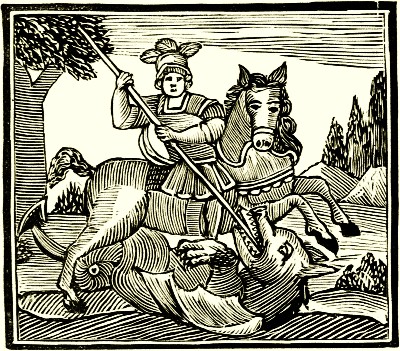
Printed and Sold in Aldermary Church Yard Bow Lane London
Although there are, as may be expected from the great popularity of this patron saint of England, very numerous illustrations of him in manuscripts, even as far back as the eleventh century, yet there seems, with the exception of the "Legenda Aurea" of Caxton and Wynkyn de Worde, to be very little early printed matter about him, although Dibdin (Ames) notices "The Lyfe of that glorious Martyr Saint George," quarto, printed by Pynson.
Alban Butler gives a very etherealized life of this saint, and says, "George is usually painted on horseback and tilting at a dragon under his feet; but this representation is no more than an emblematical figure, purporting, that by his faith and Christian fortitude he conquered the Devil, called the Dragon in the Apocalypse."
Caxton's "Legenda Aurea" ("Westmestre, 1483") gives the following account of the Cappadocian saint, and his encounter with the Dragon:—"Saynt George was a knyght and borne in capadose / On a tyme he came to the prouynce of Lybye to a cyte which is sayd Sylene / And by this cyte was a stagne or a ponde lyke a see / wherein was a dragon whyche envenymed alle the contre / And on a tyme the peple were assemblid for to slee hym / And whan they sawe hym they fledde / And whan he came nyghe the citte / he venymed the peple wyth his breeth / And therfore the peple of the citte gaue to hym euery day two sheep for to fede hym / by cause he shold doo no harme to the peple / And whan the sheep fayled there was taken a man and a sheep /
"Thenne was an ordenaunce made in the towne / that there shold be taken the chyldren and yonge peple of them of the towne by lotte / And eueryche as it fyl were he gentil or poure shold be delyuered whan the lotte fyl on hym or hyr / So it happed that many of them of the towne were thenne delyuerd / In soo moche that the lotte fyl vpon the kynges doughter / Wherrof the kyng was sory and sayd vnto the people /
"Thenne sayd he telle to me what haue ye / and why ye were / and doubte ye of no thynge / whan she sawe that he wold knowe she sayde to hym how she was delyuered to the dragon / Thenne sayd saynt george / Fayre doughter doubte ye no thynge herof / For I shall helpe the in the name of Jhesu Cryste / She said for goddes sake good knyght goo your waye / and abyde not wyth me / for ye may not delyuer me /
"Thus as they spake to gyder the dragon apperyd & came rennyng to them and saynt George was vpon his hors & drewe out his swerde & garnysshed hym wyth the signe of the Crosse / and rode hardely ageynst the dragon which came toward hym and smote hym with hys spere and hurte hym sore & threwe hym to the grounde / And after sayde to the mayde / delyuer to me your gyrdel and bynde hit about the necke of the dragon / and be not aferde / whan she had doon soo the dragon folowed hyr as it had been a make beest and debonayr / Thenne she ledde hym in to the cyte / & the peple fledde by mountayns and valeyes / and sayd / alas / alas / we shal be alle deed / Thenne saynt George sayd to them / ne doubte ye no thynge / without more byleue ye in god Jhesu Cryste / and doo you to be baptysed / and I shal slee the dragon /
"Thenne the kyng was baptysed and al his peple / and saynt george slewe the dragon and smote of his heed / And commaunded thathe shold be throwen in the feldes / and they took iiij cartes wyth oxen that drewe hym out of the cyte / Thenne were there wel fyftene thousand men baptised without wymmen and chyldren / And the kyng dyd doo make a chirche there of our lady and of saynt George / In the whiche yet sourdeth a founteyn of lyuynge water whiche heleth seek peple that drynke therof / After this the kyng offred to Saint george as moche money as there myght be nombred / but he refused alle and commaunded that it shold be gyuen to poure peple for goddes sake / and enioyned the kynge iiij thynges / that is / that he shold haue charge of the Chyrches / and that he shold honoure the preestes / and here theyr seruyce dylygently / and that he shold haue pite on the poure peple / And after kyssed the kyng and departed /"
The Chap-book version is far more marvellous, and is, as the reader will note, strangely similar, in some places, to the romance of Sir Bevis.
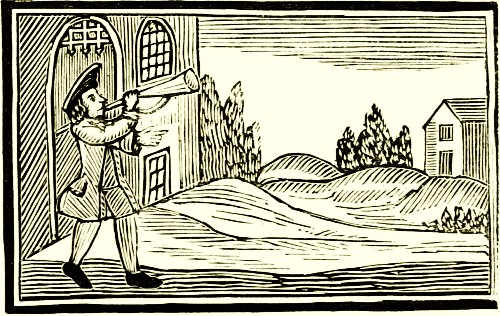
Coventry, not Cappadocia, is made his birth-place; his father was "a renowned peer named Lord Albert," and his mother was the King's daughter, who before St. George's birth dreamed her child would be a dragon. So Lord Albert went to consult the enchantress Kalyb, which he did by blowing a trumpet at the entrance of her cave, when a voice replied that his son should be as fierce as a dragon in deeds of chivalry. The mother died in childbirth, and St. George was stolen in his infancy by Kalyb, which so grieved Lord Albert that he died.
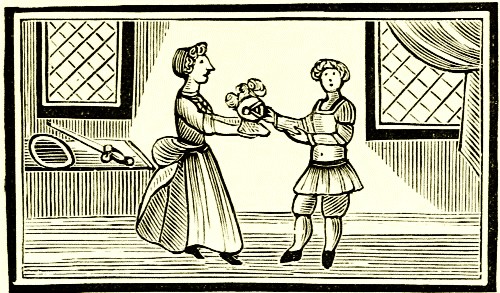
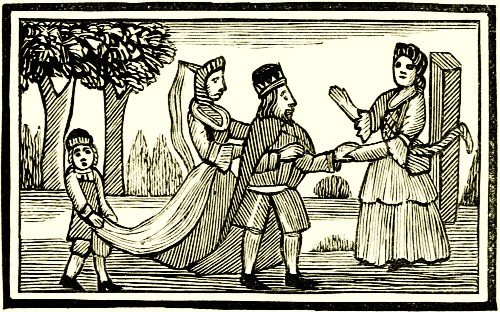
Kalyb grew very fond of the boy, and in a moment of confidence she showed him the brazen castle where the other six champions of Christendom were confined, and made him a present of some invincible armour. She also lent him her magic wand, a kindness which he requited by enclosing her in a rock. He then released the six champions, who went their several ways, and he went to Egypt. There he found the whole kingdom desolate because of a dragon which every day devoured a virgin, and had destroyed all but the king's daughter, who was that day to be given to him unless some one should slay the dragon, in which case she would be given in marriage to her deliverer. St. George, of course, undertook the adventure, and reached the place soon after the king and queen had taken leave of their daughter.
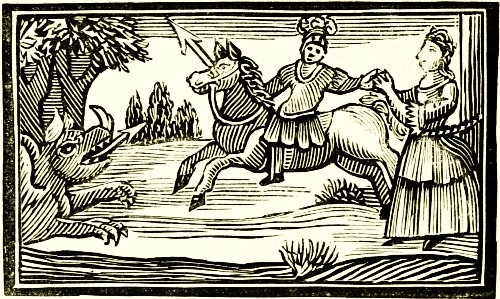
St. George held a short parley with the damsel, whose name was Sabra, when the dragon approached and the combat took place. We know its issue—St. George cut off the dragons head, released Sabra, and entered the city, but was withstood by some of the inhabitants, stirred up by Aminder, King of Morocco, in love with Sabra, whom he had to fight and overcome.
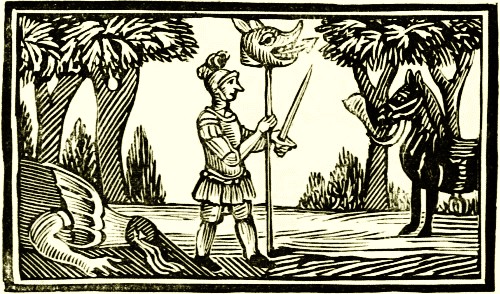
The king, however, received him graciously; but Aminder spread reports of St. George trying to convert the princess to Christianity, and the king wrote a letter to the Sultan of Persia, making St. George the bearer, asking him to slay him. On its delivery St. George was thrown into a dungeon, and when he had been there two days, they let down two hungry lions to devour him, but he killed them with an old sword he found.
He was seven years in prison, during which time Sabra had been forced by her father to marry Aminder, when one day he found an iron crowbar and effected his release, stole a horse, was stopped by and fought with a giant, whom he killed. He journeyed on till he came to where Sabra lived, changed clothes with a peasant, applied to her for alms, showed her a ring which she had given him, and was immediately recognized.
Accompanied by a servant, they fled; met with two lions, who eat the servant but did Sabra no harm, and were duly killed by St. George.
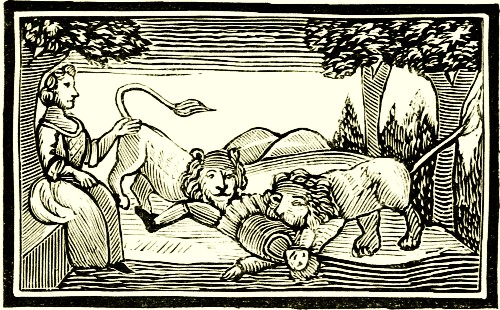
He returned to Coventry, where he was but a little while, when St. David and the other champions asked him for his assistance against the pagans who had invaded Hungary. He went with them, leaving Sabra at home, and duly overthrew the pagans. Then came messengers to him saying that Sabra, who it appears the Earl of Coventry had attempted to seduce, had stabbed and killed him, and was condemned to die unless a champion could be found to fight for her. St. George came at the right moment, fought, conquered, and freed Sabra. They now lived quietly, and three sons, Guy, Alexander, and David, were born to them, who were sent to Rome, England, and Bohemia, to be educated at the Courts of the several sovereigns. After eighteen years' absence they all returned, and after they had rested a few days a hunt was proposed, in which Sabra joined. Her horse, however, fell and threw her "into a thorny briar, which tore her tender flesh so terribly, that she found she had not long to live, whereupon calling to St. George and her sons, she very affectionately embraced them, not being able to speak, and soon died."
St. George undertook a pilgrimage to Jerusalem, and on his return home he fought with a dragon on Dunsmore Heath and slew it. "But this proved the most fatal of all his adventures, for the vast quantities of poison thrown upon him by that monsterous beast, so infected his vital spitals, that two days afterwards he died in his own house."