THE Merry Tales OF THE WISE MEN OF GOTHAM.
Reading edition
Printed and sold in Aldermary Church Yard Bow Lane London.
Tale 1.
There was two Men of Gotham, and one of them was for going to Nottingham market to buy sheep; and the other came from the Market, and both met on Nottingham Bridge.—Well met, said one to the other, Whither are you going, said he that came from Nottingham; Marry, said he that was going thither, I am going to the market to buy sheep—To buy sheep! said the other, which way will you bring them home? Marry, said the other, I will bring them over this bridge—By Robin Hood, said he that came from Nottingham, but thou shalt not—By Maid Margery, said the other, but I will—You shall not, said the one. I will, said the other.
Then they beat their staves one against the other, and then against the ground, as if a hundred sheep had been between them. Hold then there said the one. Beware of my sheep leaping over the bridge, said the other—I care not said the one—They shall all come this way, said the other—But they shall not, said the one—Then said the other, if thou make much ado, I will put my finger in thy mouth. The Devil thou wilt said the one. And as they were in contention, another Wise Man that belonged to Gotham, came from the market with a sack of meal on his horse; and seeing his neighbours at strife about sheep, and none betwixt them, said he, Ah! fools, will you never learn wit! help me to lay this sack upon my shoulder; and they did so, and he went to the side of the bridge, and shook out the meal into the river, saying, How much meal is there in the sack, neighbours? Marry, said they, none.—By my faith, replies this Wise Man, even so much wit is there in your two heads to strive for that which you have not.
Now which was the Wisest of these three, I leave you to judge.
Tale 2.
There was a man of Gotham that rode to the market with two bushels of wheat, and because his horse should not be damaged by carrying too great a burden, he was determined to carry the corn himself on his own neck and still kept riding upon the horse until the end of his journey.—Now I will leave you to judge which is the wisest, his horse or himself.
Tale 3.
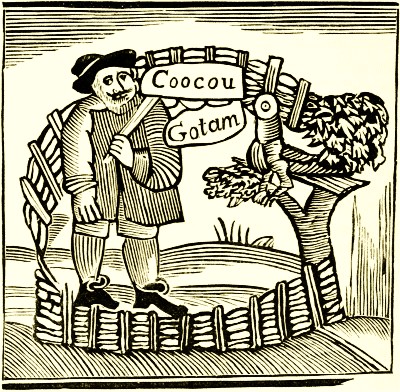
On a time the Men of Gotham fain would have pinned in the Cuckow, that she might sing all the year; all in the midst of the town they had a hedge made round in Compass, and got a cuckow, and put her into it, and said, Sing here, and you shall lack neither meat nor drink all the year—The Cuckow when she perceived herself encompassed within the hedge, flew away. A vengeance on her, said these Wise Men, we made not the hedge high enough.
Tale 4.
There was a Man of Gotham who went to Nottingham market to sell Cheese, and going down the hill to Nottingham bridge one of the cheeses fell out of his wallet, and ran down the hill. Whoreson, said the fellow, what can you run to the market alone?—I'll now send one after another; then laying down his wallet, taking out the cheeses, he tumbled them down the hill, one after another; some ran into one bush, and some into another; however he charged them to meet him in the market place—The man went to the market to meet with the cheeses, and staid till the market was almost over, then went and enquired of his neighbours, if they saw the cheeses come to market? Why, who should bring them? said one—Marry themselves, said the fellow, they knew the way very well—A vengeance on them, they run so fast I was afraid they would run beyond the market; I suppose by this time they are got as far as York:—so he immediately rode to York, but was very much disappointed; and to this day no man has ever heard of his cheeses.
Tale 5.
A Man of Gotham, bought at Nottingham market a trivet or bar iron, and going home with it, his shoulder grew weary of the carriage; he set it down, and seeing it had three feet, said Whoreson, thou hast three feet, and I but two, thou shalt bear me home, if thou wilt—so set himself down on it saying
Bare me along as I have bore thee, For if thou dost not thou shalt stand still for me.
The Man of Gotham seeing that his trevit would not move, Stand still, said he, in the Mayor's name, and follow me if thou wilt; and I can shew thee the way.—When he went home, his wife asked him where the trivet was? he told her it had three legs, and he but two, and he had taught him the ready way to his house; and therefore he might come home himself if he would. Where did you leave the trevit? said the woman. At Gotham bridge, said he. So she immediately went and fetched the trevit, otherwise she must have lost it, on account of her husband's want of wit.
Tale 6.
A certain Smith of Gotham had a large wasp's nest in the straw at the end of his forge, and there coming one of his neighbours to have his horse shod, and the wasps being exceeding busy, the man was stung by one of them; and being grievously affronted, he said, Are you worthy to keep a forge or no, to have men stung with these wasps?—O neighbour, said the smith, be content, and I shall put them from their nest presently. Immediately he took a Coulter, and heated it red hot and thrust it into the straw, at the end of the forge, and set it on fire and burnt it up.—Then said the smith, I told thee I'd fire them out of their nest.
Tale 7.
One Good Friday the Men of Gotham consulted together what to do with their white herrings, red herrings, sprats, and salt fish, and agreed that all such fish should be cast into the pond or pool in the middle of the town, that the number of them might encrease against the next year. Therefore every one that had any fish left did cast them immediately into the pond—Then said one, I have as yet gotten left so many red herrings, Well, said another, and I have left so many whitings—Another immediately cried out, I have as yet gotten so many sprats left;—And, said the last, I have as yet gotten so many salt fishes, let them go together in the great pond without distinction, and we may be sure to fare like Lords the next year—At the beginning of the next Lent they immediately went about drawing the pond, imagining they should have the fish; but were much surprised to find nothing but a great eel. Ah! said they, a mischief on this eel, for he hath eaten up our fish. What must we do with him, said one to the other. Kill him, said one. Chop him in pieces, said another. Nay, not so, said the other, let us drown him.—Be it accordingly so, replied them all.—So they immediately went to another pond, and cast the eel into the water. Lie there, said these wise men, and shift for thyself, since you may not expect any help of us—So they left the eel to be drowned.
Tale 8.
On a time the men of Gotham had forgotten to pay their rent to their landlords, so one of them said to the other, To morrow must be pay day, by whom can we send our money that is due to our landlord? upon which one of them said, I have this day taken a hare, and he may carry it, for he is very quick footed. Be it so, replied the rest, he shall have a letter and a purse to put our money in, and we can direct her the right way. When the letter was written, and the money put in a purse, they immediately tied them about the hare's neck saying, You must go to Loughboro' and then to Leicester, and at Newark is our landlord; then commend us unto him, and there is his due. The hare, as soon as she got out of their hands ran quite a contrary way—Some said, Thou must go to Loughborough—Others said, let the hare alone for she can tell a nearer way than the best of us—let her go.
Tale 9.
A Man of Gotham that went mowing in the meads, found a large grasshopper; he immediately threw down his scyth, and ran home to his neighbours, and said that the devil was there in the field, and was hopping amongst the grass. Then was every man ready with their clubs and staves, with halberts and other weapons to kill the grasshopper. When they came almost to the place where the grasshopper was, said one to the other, Let every man cross himself from the Devil, for we will not meddle with him—So they returned again and said—We were blest this day that we went no farther—O ye cowards! said he that left his scyth in the mead, help me to fetch my scyth. No, answered they, it is good to sleep in a whole skin; it is much better for thee to lose thy scyth than to marr us all.
Tale 10.
On a certain time there were twelve men of Gotham, that went to fish, and some stood on dry land. And in going home, one said to the other, We have ventured wonderfully in wading, I pray God that none of us come home to be drowned—Nay, Marry, said one to the other, let us see that, for there did twelve of us come out—Then they told themselves, and every one told eleven. Said the one to the other, There is one of us drowned. They went back to the brook where they had been fishing and sought up and down for him that was drowned, making great lamentation.
A Courtier coming by, asked what it was they sought for, and why they were sorrowful? Oh! said they, this day we went to fish in the brook; twelve of us came out together, and one is drowned—Said the Courtier, tell how many there be of you. One of them said eleven, and he did not tell himself. Well, said the Courtier, what will you give me and I will find the twelfth man. Sir, said they, all the money we have got. Give me the money, said the Courtier, and began with the first, and gave him a stroke over the shoulders with his whip, which made him groan, saying Here is one; and so he served them all, and they all groaned at the matter. When he came to the last, he paid him well, saying Here is the twelfth man.—God's blessings on thy heart, said they, for thus finding our dear brother.
Tale 11.
A Man of Gotham riding along the highway, saw a cheese, so drew his sword and pricked it with the point in order to take it up. Another man came by, and alighted, and picked it up, and rode away with it. The man of Gotham rides back to Nottingham to buy a long sword to pick up the cheese, and returning to the place where the cheese did lie, he pulled out his sword, and pricking the ground, he said, if I had this sword at the first, I should have gotten the cheese myself, but now another has got it from me.
Tale 12.
A Man of Gotham who did not love his wife, she having fair hair, her husband said divers times, He would cut it off, but durst not do it when she was awake; so resolved to do it when she was asleep: therefore one night he took up a pair of sheers and put them under his pillow, which his wife perceiving, said to one of her maids, Go to bed to my husband, for he thinks to cut off my hair to-night; let him cut off thy hair, and I will give thee as good a kirtle as ever thou didst see. The maid did so, and feigned herself asleep; which the man perceiving, cut off the maids hair and wrapped it about the sheers, and laid them under his pillow and went to sleep; then the maid arose and the wife took the hair and sheers and went into the hall, and there burnt the hair. The man had a fine horse that he loved much; and the good wife went into the stable, cut off the tail of the horse, wrapping the sheers up in it, and then laid them under the pillow again. Her husband seeing her combing her head in the morning, he marvelled very much thereat—The girl seeing her master in a deep study, said, What the Devil ails the horse in the stable, he bleeds so prodigiously? The man ran into the stable, and found the horse's tail was cut off; then going to his bed, he found the sheers wrapped up in his horse's tail. He then went to his wife, saying, I cry thee mercy, for I intended to have cut off my horses tail. Yea, said she, self do, self have—Many men think to do a bad turn but it turneth oftimes to himself.
Tale 13 is rather too broad in its humour to be reproduced.
Tale 14.
A Man of Gotham took a young buzzard, and invited four or five gentlemen's servants to the eating of it; but the old wife killed an old goose and she and two of her gossips eat up the buzzard, and the old goose was laid to the fire for the gentlemen's servants. So when they came and the goose was set before them, What is this? said one of them. A fine buzzard, said the man. A buzzard! said they, why it is an old goose, and thou art a knave to mock us; and in anger departed home.
The fellow was very sorry that he had affronted them, and took a bag, and put in the buzzard's feathers; but his wife desired him before he went to fetch her a block of wood, and in the intrim, she pulled out the buzzard's feathers, and put in the gooses. Then the man taking the bag went to the gentlemen's servants, and said, Pray be not angry with me; you shall see I had a buzzard, for here be the feathers. Then he opened the bag and shook out the goose's feathers. They said, Why thou knave, could you not be content to mock us at home but art come here to mock us? The one took a cudgel and gave him a dozen stripes, saying, Heretofore mock us no more.
Tale 15 is too silly, and not worth reproducing.
Tale 16.
"And here you may see I have Even such another, Squeaking, gibbering, of everie degree. The player fooles dear darling pigsnie He calls himselfe his brother, Come of the verie same familie." Tarlton's Horse Loade of Fooles.
Chaucer, in "The Milleres Tale," says—
"Hire shoon were laced on her legges hie; She was a primerole (primrose), a piggesnie."
Tale 17.
There was a man of Gotham who would be married, and when the day of marriage was come, they went to church. The priest said, Do you say after me. The priest said say not after me such words but say what I shall tell you—Thou dost play the fool to mock with the Holy Bible concerning Matrimony. Then the fellow said, Thou dost play the fool to mock with the Holy Bible concerning Matrimony. The priest could not tell what to say, but answered, what shall I do with this fool? And the man said, What shall I do with this fool.—So the priest departed, and would not marry him—But he was instructed by others how to do and was afterwards married—And thus the breed of Gothamites has been perpetuated even unto this day.
Tale 18.
There was a Scotchman who dwelt at Gotham, and he took a house, a little distance from London, and turned it into an inn, and for a sign he would have a Boars head; accordingly he went to a Carver, and said, Make me a Bare heed. Yes, said the Carver. Then says he, Make me a bare heed and thous have twenty pence for thy hire. I will do it, said the Carver.—So on St. Andrew's day, before Christmas the which is called Youl in Scotland, the Scot came to London for his Boar's head to set up at his door. I say, to speak, said the Scotchman, hast thou made me a bare's heed. Yes, said the Carver. Aye then thous a good fellow. He went and brought a man's head that was bare, and said here is your bare head! Aye, said the Scot, the mickle devil! is this a bare heed? Yes, said the carver. I say, said the Scotchman, I will have a bare heed, like a heed that follows the sow that has gryces. Sir, said the Carver, I don't know a sow and gryces. What! whoreson, know you not a sow that will greet and groan, and her gryces will run after and cry Aweek, aweek. O, said the Carver it is a pig—Yes said the Scotchman, let me have her heed made in timber, and set on her scalp, and let her sing, whip, whire. The Carver said he could not.—You whoreson, said he, gang as she'd sing Whip, whire.—This shews that all men delight in their fancy.
Tale 19.
In old times, during these tales, the wives of Gotham got into an alehouse, and said, They were all profitable to their husbands; which way, good gossips? said the alewife.—The first said, I tell you all, good gossips, I can brew or bake, so I am every day alike; and if I go to the alehouse, I pray to God to speed my husband, and I am sure my prayers will do him more good than my labour. Then said the second, I am profitable to my husband in saving candle in the winter; for I cause my husband and all my people to go to bed by daylight, and rise by the same.—The third said, I am profitable in sparing bread, for I drink a gallon of ale, care not how much meat and drink at home, so I go to the tavern at Nottingham and drink wine and such other things, as God sends me.—The fourth said, A man will for ever have more company in another's house than his own, and most commonly in an alehouse. The fifth said, My husband has flax and wool to spare, if I go to other folks houses to do their work.—The sixth said, I spare both my husbands wood and coals, and talk all the day at other folks fire. The seventh said, beef, mutton and pork are dear, wherefore I take pigs, hens, chickens, conies which be of a lower price.—The eighth said I spair my husband's lie and soap, for whereas I should wash once a week, I wash but once a quarter; then said the alewife, and I keep all my husband's ale that I brew from sowering, for, as I used to drink it most up, now I never leave a drop.
Tale 20.
One Ash Wednesday the Minister of Gotham would have a Collection of his parishioners, and said unto them, My friends the time is come that you must use prayer, fasting and alms; but come ye to shrift, I will tell you more of my mind; but as for prayer, I don't think that two men in the parish can say half the Pater Noster. As for fasting, ye fast still, for ye have not a meal's victuals in a year. As for alms deed, what should they do to give that have nothing to take? But as one came to shrift and confessed himself to have been drunk divers times in the year, but especially in Lent: the priest said In Lent you should most refrain from drunkenness and refrain from drink— No, not so, said the fellow, for it is an old proverb that fish would swim. Yes, said the priest—it must swim in the water; I say you mercy, quoth the fellow, I thought it should have swum in fine ale, for I have been so.—Soon after the man of Gotham came to shrift, and even the priest knew not what penance to give; he said, If I enjoin prayer, you cannot say your Pater Noster. And it is but a folly to make you fast, because you never eat a meals meat. Labour hard and get a dinner on Sunday, and I will come and partake of it—Another man he enjoined to fare well on Monday, and another on Tuesday, and one after another, that one or the other would fare well once in a week, that he might have part of their meat. And as for alms deeds the priest said, ye be beggars all except one or two so therefore bestow your alms among yourselves.
FINIS.