THE FRIAR AND BOY OR THE Young PIPER'S PLEASANT PASTIME CONTAINING
Reading edition
His witty Pranks in Relation to his Step Mother, whom he fitted for her unkind Treatment.
Part the First
Printed and sold in Aldermary Church Yard London
The father of the "boy" Jack had married a second time, and Jack's stepmother behaved most harshly to him, and half starved him.
"Nay, tho' his meat and drink was poor He had not half enough. Yet, if he seem'd to crave for more His ears she strait did cuff."
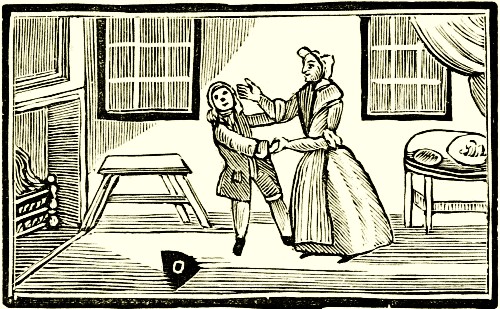
His father, however, behaved kindly, and to get the lad away, proposed he should look after the cows all day, taking his provision with him. One day, an old man came to him and begged for food, on which Jack offered him his dinner, which the old man thankfully took and eat.
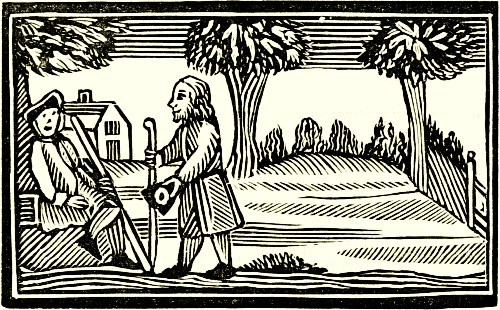
Indeed, he was so grateful that he told Jack he would give him three things, whatever he liked to choose. Jack replied—
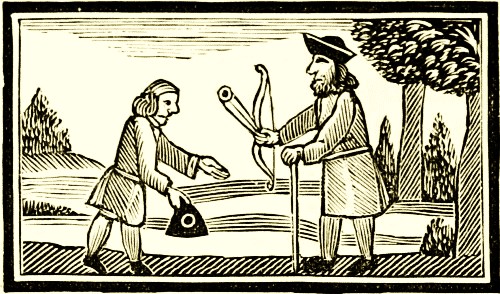
"The first thing I'd have thee bestow On me without dispute, Pray let it be a cunning bow, With which I birds may shoot. Well thou shalt have a bow, my son, I have it here in store, No archer ever yet had one Which shot so true before. Take notice well of what I say. Such virtues are in this That wink or look another way The mark you shall not miss."
Jack also asked for a pipe, and the old man said—
"A pipe I have for thee my son, The like was never known, So full of mirth and mickle joy, That whensoe'er 'tis blown, All living creatures that shall hear The sweet and pleasant sound They shan't be able to forbear But dance and skip around."
The third thing Jack chose was, that whenever his stepmother looked crossly at him, she should, against her will, behave in a rude and unseemly manner, which was also granted.
The old man left him; and at evening Jack took the cattle home, and as he went, he tried his pipe with wonderful effect.
"His Cows began to caper then, The Bulls and Oxen too, And so did five and twenty men Who came this sight to view, Along the road he piping went, The Bulls came dancing after, Which was a fit of merriment, That caus'd a deal of laughter. For why, a friar in his gown Bestrides the red cow's back, And so rides dancing thro' the town, After this young wag Jack."
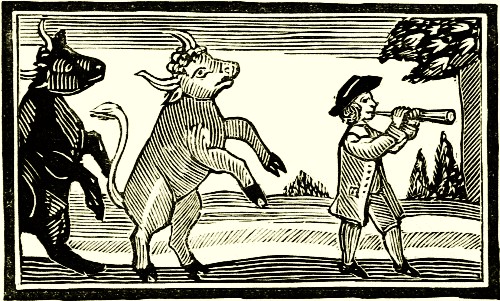
He found his father at home, and telling him how he had disposed of his dinner, the good man handed him a capon; at which his mother-in-law frowned, and, to her great disgust, her punishment was prompt, and she had to retire, Jack bantering her. She vowed vengeance, and
"A Friar whom she thought a saint, Came there to lodge that night; To whom she made a sad complaint, How Jack had sham'd her quite. Said she, For sweet St. Francis sake, To-morrow in the field, Pray thrash him till his bones you break No shew of comfort yield."
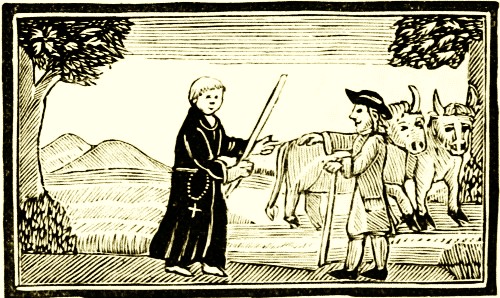
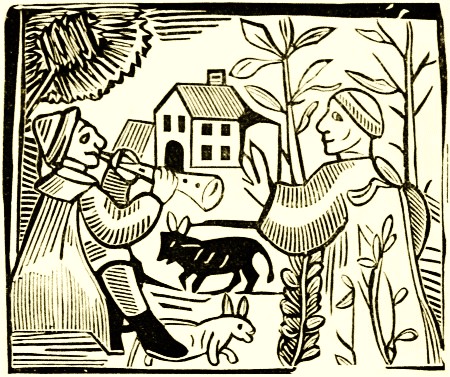
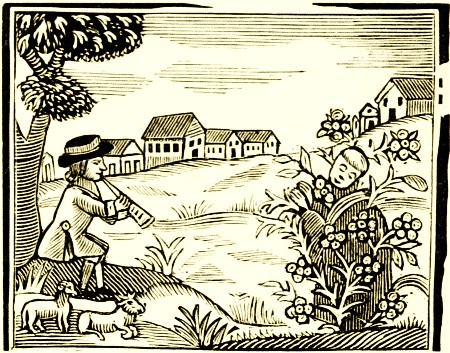
The friar went the next morning to give Jack his thrashing, but Jack begged him not to be angry, and he would show him something; so he took his bow and shot a pheasant, which fell in a thorn bush. The friar ran to secure the bird, and when well in the bush, Jack played his pipe, with woeful effects as regards the friar, who in his involuntary dancing got literally torn to pieces, till he begged Jack—
"For Good St. Francis sake, Let me not dancing die."
He naturally told his pitiful tale when he reached Jack's father's house, and the father asked him if it were true, and if so, to play the pipe and make them dance. The friar had already experienced the sensation, and
"The Friar he did quake for fear And wrung his hands withal. He cry'd, and still his eyes did wipe, That work kills me almost; Yet if you needs must hear the pipe, Pray bind me to a post."
This was done; the pipe struck up, and every one began their involuntary dance, to the delight of the father, and the great disgust of the stepmother and the friar, who
"was almost dead, While others danced their fill Against the post he bang'd his head, For he could not stand still. His ragged flesh the rope did tear, And likewise from his crown, With many bangs and bruises there The blood did trickle down."
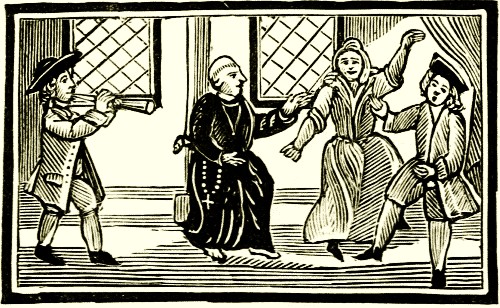
The lad led them all into the street, where every one joined in the mad scene, until his father asked him to stop. Then the friar summoned him before the proctor, and the gravity of the court was disturbed by Jack's playing his pipe at the proctor's request. All had to dance, nor would Jack desist until he had a solemn promise that he should go free. Here the First Part ends, as also does the first printed version of the romance, which is entitled, "Here begynneth a mery Geste of the Frere and the Boye, emprynted at London in Flete strete at the sygne of the sonne by Wynkyn de Worde." There is no date, and there is a copy in the public library, Cambridge. It has been reprinted both by Ritson and Hazlitt. Ritson says, "From the mention made in v. 429 of the city of 'Orlyance,' and the character of the 'Offycial,' it may be conjectured that this poem is of French extraction; and, indeed, it is not at all improbable that the original is extant in some collection of old Fabliaux."
It is a most popular Chap-book, and went through many editions. A Second Part was afterwards added, but it is coarser in its humour. The Newcastle frontispiece is extremely quaint.