THE HISTORY OF THE LIFE AND DEATH OF THAT NOBLE KNIGHT SIR BEVIS OF SOUTHAMPTON
Reading edition
Newcastle: Printed in this present Year.
According to Ebert, the French editions of this romance are very early; he quotes two, "Le livre de Beufoes de Hantonne et de la Belle Josienne sa mye. Par. Verard." no date, folio, G.L., and "Beufues Danthonne nouvellement imprimé a Paris. Par le Noir 1502," small folio, Gothic letter; whilst the British Museum possesses an earlier Italian book on the subject, "Buovo de Antona di Guidone Palladius Rezunto & reuisto. Caligula di Bazalieri. Bologna 1497," octavo, Gothic letter. The Bodleian Library possesses a very early English copy of "Sir Beuys of Hamton," "Emprynted by Rycharde Pynson in Flete-strete at the Sygne of the George," quarto, black letter; and Hazlitt says there also is a fragment of two leaves by Wynkyn de Worde, printed with the same types as the "Memorare Novissima."
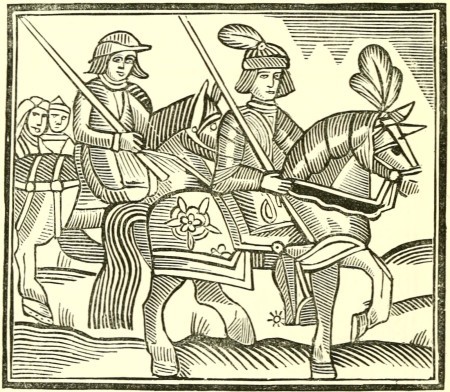
The frontispiece is an engraving belonging to an edition of 1690. Sir Bevis was born in the reign of Edgar, and his parents were Sir Guy of Southampton, and a daughter of the King of Scotland, who was desperately in love with Sir Murdure, brother of the Emperor of Almaine. She managed to keep up appearances for some years after the birth of Bevis, until her passion for Sir Murdure became uncontrollable, and she sent a message to him to come over to England and slay her husband. He obeyed, and with his men lay in wait for Sir Guy, who was hunting for a wild boar for his wife. They assaulted him, and, after a desperate resistance on his part, killed him, and Sir Murdure was received joyfully by the false wife, and duly installed in her husband's stead. Naturally, Bevis was wroth, and having expressed his opinion freely, was duly hated by his mother, who sent to Sir Sabere, her husband's brother, to privately murder him. Sir Sabere, however, dressed him in old clothes and put him to keep sheep, whilst he showed Bevis's blood-stained garments, as a token of having killed him. However, the impulsive Bevis could not brook the situation, but went to the castle, crook in hand, and with it knocked Sir Murdure under the table, and would have murdered his mother, had not better thoughts prevailed. His mother was furious, and ordered Sir Sabere and another knight to cast him into the sea, which they promised to do; but meeting with merchants of Armony, they sold Bevis to them.
The merchants presented him to the king (Ermine), who was prepossessed with his looks, and on questioning him, remembered having heard of the prowess of his father Sir Guy. "I have but one fair Daughter, said the King, and if thou wilt forsake thy God, and serve Apoline our God, thou shalt have my Daughter to Wife, and enjoy my Kingdom after me. Not so, my Lord, said Bevis, for all the Beauties in the World, I would not deny my Creator; Then, said the King, wilt thou be my Chamberlain, and when I find thy Desert, I'll dub thee a Knight, and thou shalt bear my Standard in the Field against my Foes. What you please to command me, my Lord, said he, save the denying of my God, I will do.
"Bevis was so beloved of the king that none durst speak against him; nay Josian the King's daughter was in love with him." But it happened, one Christmas Day, Bevis met sixty Saracens, who, taunting him with his religion, he encountered, and slew them all. At which the king swore he should die. But Josian on her knees begged his life, which was granted; she dressed his wounds, nursed him, and he was in as great favour as ever.
He next, after many difficulties, slew a mighty wild boar of cannibal propensities, and won great honour thereby.
Josian must have been fair indeed, for, all through the story, Bevis is perpetually getting into trouble through her fatal beauty. It now happened to have attracted King Brandmond, who sent to King Ermine demanding her hand, or he would depose him. The nobles were for yielding; but Josian suggested that if Bevis were made general, and invested with command, things would speedily be righted. This was done; he was dubbed knight, and Josian armed him, and gave him a sword, Morglay, and a wonderful steed, Arundel. He defeated Brandmond, and took him prisoner. "So Bevis returned with great Victory and was royally entertained by the King, and then Josian broke her mind to Bevis; quoth she, by Mahomed, I do desire to be thy Love: Not so, Lady, said Bevis, I'll wed no Heatheness; which words she took very scornfully." But her love prevailed, and she went to Bevis, offering to do anything, even turn Christian, could she but win his love. Sir Bevis could only act as he did—take her in his arms, and kiss her. Her speech and behaviour being reported to the king, he was mad, and wrote letters to Brandmond, to put Sir Bevis to death, and gave them to him, to be the unconscious bearer of his own death-warrant.
Meanwhile, Sir Sabere had sent his son, Terry, travelling in search of Sir Bevis, and the two met near Damas; but Bevis did not make himself known. He rode into Damas, insulted the inhabitants by asking them, "What devil do you serve here?" and pulled down their idol Mahomed, throwing it into the gutter. This naturally exasperated the Saracens, and they set upon him; but before they could secure him, two hundred of them were slain. He was brought before the king, who read the letters of which he was the bearer. Bevis, finding he had only himself to trust to, went Berserk again and killed sixty more Saracens, was overpowered and thrown into a dungeon with two dragons, which, however, he slew with the truncheon of a spear he opportunely found, "and then he was at rest awhile."
Josian's fatal beauty was to bring trouble. "Father, said Josian where is Bevis? He reply'd he is gone to his own country. At this Time came King Jour, Intending for to wed Josian which he obtained. And Ermine gave Jour, Arundel and Morglay, which belonged to Bevis; this Josian could in no way avoid."
Bevis's captors thought they would go and see him, and as he had been in prison seven years, fed only on bread and water, they thought he would be weak; but he killed them all, and seizing on a horse, escaped. He met with a giant whom he slew, and then proceeded on his search for Josian. He met a poor palmer who told him that in that castle opposite lived King Jour and his wife, the fair Josian. They exchanged clothes, and Bevis entered the castle. He saw and conversed with Josian, who did not know him; but when Arundel heard him speak, he "broke seven Chains asunder, and neighed;" and then Josian recognized him. The sequel may be imagined. King Jour was sent off on an imaginary errand, and Josian and Bevis eloped, taking with them the chamberlain Boniface. They were pursued, and hid in a cave, where, Bevis being absent hunting for their sustenance, two lions entered, killed and eat Boniface, and then meekly laid their heads in Josian's lap. On Bevis's return, she called out to him the state of things, when he told her to let the lions loose, and he killed them.
They then continued their journey, until they were stopped by Ascapart, "an ugly Giant, who was thirty Foot high, and a Foot between his Eyebrows; he was bristled like a Swine, and his Blubber Lips hung on one side." Naturally he had to be fought and overcome, and on his life being spared, he promised to be a faithful servant. They reached the shore, where they wanted to take ship, but, being unable to procure a boat, they first had to fight and slay many Saracens, and then Ascapart waded to the ship, carrying Sir Bevis and Josian, and tucking Arundel under his arm. They reached the land of Colen, where the bishop was a relation of Bevis. Josian was baptized, but Ascapart refused the rite.
"Bevis being in bed heard a Knight cry, I rot, I rot, at which Noise Bevis wondered; and the next Morning he ask'd what was the Cause of that Noise; He was a Knight, they said, that coming through the street, the Dragon met him and cast her Venom upon him, whereof he rotted and died." Bevis could not stand this, but sought and encountered the dragon, which he slew, after the hardest of his many fights.
Then he set about recovering his lost inheritance, and sailed for England, landing near Southampton. But no sooner was his back turned than the Earl of Milo, having got rid of Ascapart by stratagem, married Josian; but she strangled him in bed, whereupon she was sentenced to be burned. Ascapart, however, had broken prison, joined Bevis, and they together arrived just in the nick of time to save Josian.
Sir Bevis and Sir Sabere then seriously took Sir Murdure in hand, defeated him, and boiled him in a cauldron of pitch and brimstone; which treatment had such an effect on the mother of Sir Bevis, that she threw herself from the top of her castle and broke her neck. Sir Bevis then, somewhat tardily, married Josian, and went to do homage to Edgar; but the king's son, having been refused Arundel at any price, went to take him by force, and had his brains kicked out by the horse. Sir Bevis was banished, and having left his estates in the hands of his uncle Sabere, started on his journey, when Josian, whilst passing through a forest, was taken ill and delivered of twins. She had requested her husband, Terry, and Ascapart to leave her alone for a time; so the former two went one way, and the latter another. But when Sir Bevis and Terry returned, they found the two boys, but not the mother, who had been carried off by Ascapart. Bevis left his children with a forester, with strict injunctions to return them to one Bevis of Hampton in seven years' time; but Sabere and twelve knights tracked and slew the villain Ascapart, and restored Josian to her husband. They redeemed the children; and then, finding there was war between the kings Ermine and Jour, Bevis naturally helped his father-in-law, and captured Jour, whose ransom was "twenty Tun of Gold and three hundred White Steeds."
King Ermine turned Christian, and before his death crowned his grandson Guy King of Armony, and knighted his grandson Miles. Not unnaturally King Jour hated Sir Bevis, and beseiging him in Armony, was of course overcome and slain, and Bevis took possession of his kingdom, and converted all the inhabitants to Christianity.
But his troubled life was drawing to a close. King Edgar had disinherited Sabere's wife, so he, Bevis, and Josian, with their two sons Guy and Miles, marched to London with a great army, fought the king, slew two thousand of his men, and then went back to Southampton. The king wisely parleyed with them, and ultimately agreed to marry his eldest daughter to Miles, whom he created Earl of Cornwall; after which they all separated and went home. Bevis and Josian retired to the late King Jour's capital of Mambrant, where both he and Josian fell sick, and died the same day. "They were solemnly interred in one Grave, by Guy their Son, who raised a stately Tomb over them, to the everlasting Memory of so gallant a Knight, and his most royal and constant Lady.
So I conclude his famous Acts here penn'd, For Time and Death brings all Things to an End."