THE HISTORY OF THE BLIND BEGGER OF BEDNAL GREEN.
Reading edition
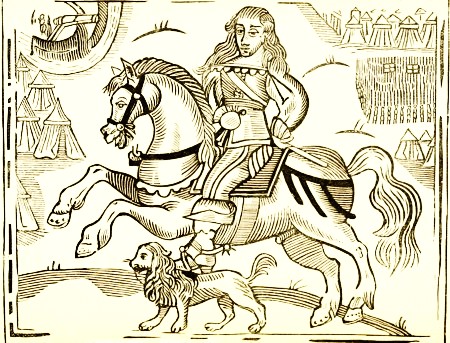
Young Monford Riding to the Wars where he unhapily lost his Eyesight
Licensed and Enterd according to Order
Printed for T. Norris, at the Looking-Glass on London Bridge.
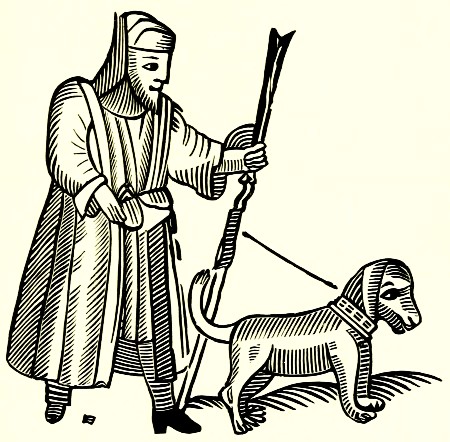
The illustrations to this very scarce Chap-book are evidently of earlier date than 1715, to which it is assigned, and, with the exception of the one of the blind beggar and his dog, have probably very little to do with the letter-press. The frontispiece is more likely to represent "Prince Rupert and his dogge Pudle" than "Young Monford Riding to the Wars." The ballad is well known, and extremely popular in England; it was written in the reign of Elizabeth, to commemorate the tradition of Henry de Montfort, a son of Simon de Montfort, the famous Earl of Leicester, founder of the House of Commons, who was slain at the battle of Evesham, August 4, 1265. His son, Henry, who was left for dead on the field, was found, according to the ballad, by a baron's daughter, who had come to search for her father, but finding young Montfort half dead and deprived of sight by his wounds, she "was moved with pitye and brought him awaye."
"In secret she nurst him, and swaged his paine, While hee through the realme was beleev'd to be slaine; At length his faire bride she consented to bee, And made him glad father of prettye Bessee. And now lest oure foes oure lives sholde betraye, Wee clothed ourselves in beggar's arraye; Her jewelles shee sold, and hither came wee; All our comfort and care was our prettye Bessee."
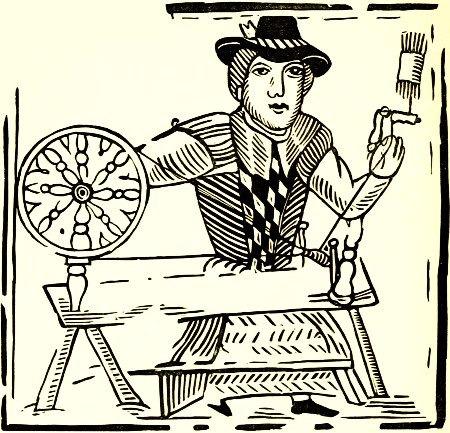
The Chap-book differs somewhat in detail from the ballad. It places the time in the wars with France, and the scene itself in France, whither Monford went, accompanied by his wife in man's attire. He was wounded and blind, and was discovered on the field by his wife and servant, and on his recovery to health they all returned to England; but his relations, for some unknown reason, treated him very coldly, and this their high spirits could not brook, so it ended in their settling down at Bethnal Green, where she spun and he turned beggar.
Here a professional beggar named Snap introduced himself to him, and "invited him to their Feasts, or Rendezvouse in White chappel, whither he having promised to come, and they between them tipp'd off four black Pots of Hum, they at that time parted." His wife took him to the "rendezvouse," where he not only thoroughly enjoyed himself, but the beggars presented him with a dog trained to the business.
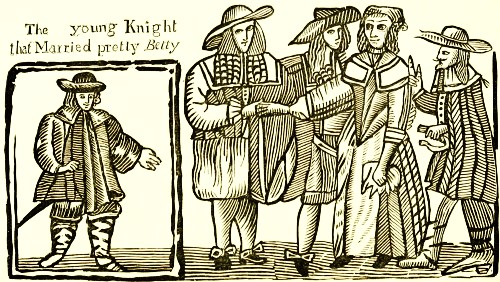
Soon after this pretty Betty was born, and at fifteen years of age was a marvel of beauty, and a paragon of accomplishments. Betty then left her parents, and obtained a situation at an inn at Rumford, where she found plenty of lovers, all of whom, except the knight, withdrew their pretensions to her hand when they heard she was only the daughter of a blind beggar. The knight, however, was constant, and they had just set out together to see old Monford, when the knight's uncle came up, and, having followed them, created a scene at the beggar's residence, when, to end it, Monford proposed to give angel for angel with the knight's uncle, as a fortune for the young people. The uncle's servant was sent for coin, and the two old gentlemen set themselves to their task of dropping angels against each other; but the beggar kept producing cats' skins filled with gold, and beat the knight's uncle. This money was made up to £3000 by Monford, who also gave Bessie "a hundred more to buy her a gown." Monford declared his pedigree; everybody was pleased and happy, and the young couple were duly married.
The young Knight that Married pretty Betty