THE Life and Death OF FAIR ROSAMOND CONCUBINE TO King Henry the Second Shewing her being poisoned by Queen Eleanor.
Reading edition
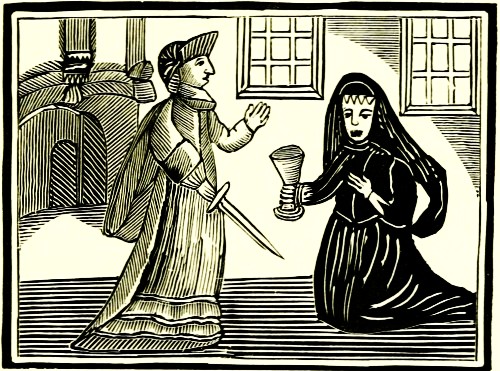
Printed and sold in Aldermary Church Yard, London
Perhaps the earliest book about this frail beauty is "The Life and Death of Fair Rosamond, King Henry the Seconds Concubine, and how she was Poysoned to death by Queen Elenor. Printed for F. Coles" (circa 1640); but afterwards her story became very popular, and numerous editions were published. She has more than once been made the subject of a drama. There is one, however, by John Bancroft, which is replete with historical recollections. It is called "Henry the Second, King of England; with the death of Rosamond. A Tragedy Acted at the Theatre Royal, by their Majesties Servants. Printed for Jacob Tonson, at the Judges Head in Chancery Lane near Fleet Street 1693." Thackeray's "poor Will Mountfort" wrote the "epistle dedicatory;" Dryden wrote the epilogue. Betterton played King Henry II.; Doggett took the part of Bertrand, a priest; whilst Queen Eleanor and Rosamond were respectively represented by Mrs. Barry and Mrs. Bracegirdle!
The history of the "Rosa Mundi" is not told to advantage in this Chap-book, but its facts are mainly in accordance with the popular tradition; and probably the stratagem used by Queen Eleanor to effect an entrance into her rival's bower, i.e. by sending a sham postman, may be as correct as the generally received notion of the ball of silk being dropped and unrolled, thus betraying the place of her seclusion.
'Hic jacet in Tumba Rosa Mundi, non Rosa Munda Non redolet, sed olet, quæ redolere solet.'
But the latter possibly is the Epitaph that was fix'd in the Quire of the Church before the Body was remov'd. Mr. Leland, I think, saw the Stone himself, and he tells us that when her Coffin was open'd they found her Bones in it, and a very sweet smell came from it."