THE HISTORY OF Adam Bell, Clim of the Clough. AND William of Cloudeslie.
Reading edition
Who were three Archers good enough The best in the North Country.
Newcastle: printed in this present year.
The story is briefly as follows:—Of the three outlaws, only one, William of Cloudeslie, was married, and he longed to see his wife and children at Carlisle. He went, was welcomed by his wife, but was betrayed to the sheriff by an old woman whom he had kept out of charity over seven years. His house was surrounded, and, as no entrance could be forced, it was set on fire. William let down his wife and children out of a back window, and at last he was compelled to sally forth in order to escape being burnt. He was overcome and captured, and sentenced to be hanged next day. A little boy heard of this, and ran and told Adam Bell and Clim, who went to Carlisle, and, in spite of fearful odds against them, rescued William when on his road to execution. They performed prodigies of valour, killed the justice, and sheriff, and hundreds of the citizens, and finally got clear off. William's wife joined them, and, fearful of the consequences of their deeds, they set off at once to London to sue for pardon from the king. At first he would not hear of it, but at the queen's intercession he relented and pardoned them, just before a letter arrived from Carlisle narrating their evil doings. The pardon could not be recalled, but the king, having heard of their wonderful shooting, determined that they should beat all his archers or die. William did so, by cleaving a hazel wand at four hundred paces, and then shooting an apple off his son's head at a hundred and twenty paces. The king was so struck with these marvellous feats that—
"Now God forbid, then said the King, That thou should shoot at me. I give thee Eighteen pence a Day, And my Bow shalt thou bear, Yea, over all the North Country, I make thee Chief Keeper. Ill give thee Thirteen pence a Day, Said the Queen, by my fay Come fetch the payment when thou wilt No man shall say thee Nay. William, I make thee Gentleman, Of Clothing and of Fee, Thy Brethren of my Bedchamber For they are lovely to see. Your Son, for he's of tender age, Of my Cellarists shall be; And when he comes to Man's Estate Better preferr'd shall be; And William bring your wife, said she, I long full sore to see; She shall be chief Gentlewoman To govern my Nursery."
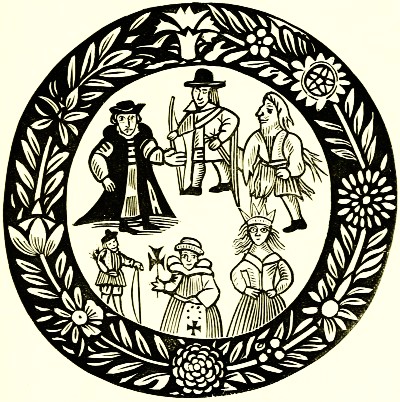
It will be seen from the foregoing short description, that the frontispiece has nothing to do with the book. It is very evidently belonging to some history of Robin Hood, as he is represented in the centre at the top, having on one side either the Bishop of Carlisle or the Abbot of St. Mary's, and on the other the beggar, tinker, or shepherd who thrashed him, while at the bottom are Little John, Friar Tuck, and Maid Marian.