THE HISTORY OF JACK and the GIANTS
Reading edition
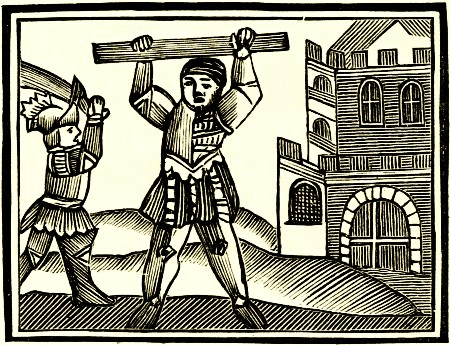
Printed and Sold in Aldermary Church Yard. Bow Lane. London
The origin of this romance is undoubtedly Northern.
The Edda of Snorro contains a similar story to that of the Welsh Giant. Thor and the giant Skrimner were travelling together, and when they slept, Skrimner substituted a rock, as Jack did a billet, for his person. Thor smote it with his mighty hammer, and the giant asked whether a leaf had fallen from a tree. Again he smote, and this time the giant suggested an acorn had fallen. Yet still one mightier blow than all, but the provoking Skrimner thought it was only some moss fallen on his face.
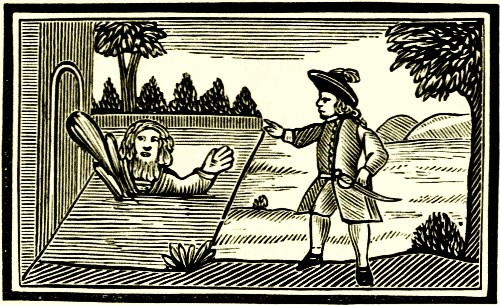
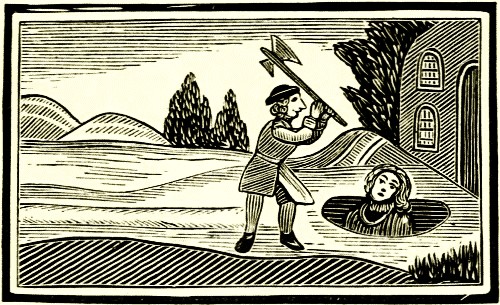
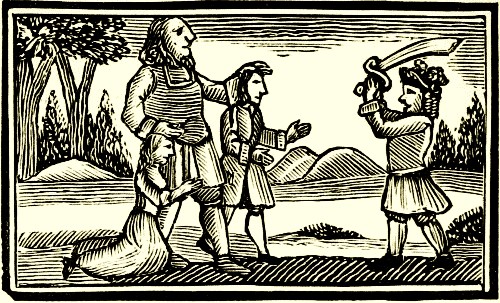
This romance used to be a never-failing source of delight to children, but a long version of it is now seldom found. The Chap-books give two parts, and all agree in their story. The date is laid in King Arthur's time, and Jack was the son of a wealthy farmer near Land's End in Cornwall, and he was of great strength and extremely subtle. The country at that time seems to have been under the terrorism of a race of giants, and Jack's mission was their destruction. For the greater part, as we shall see, they were a very simple and foolish race, very ferocious, but with no brains, and they fell an easy prey to the astute Jack. He tried his 'prentice hand on a fine specimen, the Giant Cormoran, eighteen feet high and three yards in circumference, who dwelt on the Mount of Cornwall. Jack's preparations were simple. He took a horn, a pickaxe, and a shovel, and with the two latter dug a pit twenty-two feet deep, and covered it over; then he blew his horn. The Giant came out and fell into the pit, when Jack killed him with his axe (Plates Nos. 1 and 2). This earned him his sobriquet of the Giant-Killer. The Giant Blunderbore, hearing of this feat, vowed vengeance, and meeting Jack in a lonely part of Wales, he carried him on his shoulders to his castle, locked him in an upper room, and started off to invite a brother giant to supper. But, alas for the blindness of these huge dunderheads! two strong cords had been left most imprudently in Jack's room, in which he made running nooses, and, as the giants were unlocking the gates, he threw the ropes over their heads and strangled them, cut off their heads, and delivered their captives.
In Flintshire he met with an abnormal specimen, a giant with two heads; and, as perhaps they were "better than one," this giant was crafty, pretended friendship, and took Jack home with him to sleep. Luckily for Jack, the giant had a bad habit of soliloquy, and he overheard him say—
"Tho' here you lodge with me this night, You shall not see the morning's light. My club shall dash your brains out quite."
"Forewarned is forearmed;" so Jack substituted a billet of wood for himself, which the giant duly belaboured, and, being utterly astounded at seeing Jack alive and well in the morning, asked him how he slept—whether he had been disturbed? "No," said the self-possessed Jack; "a rat gave me three or four flaps with his tail."
Crafty Jack, however, made the foolish giant destroy himself, as follows:—"Soon after the Giant went to breakfast on a great bowl of hasty pudding, giving Jack but little quantity; who being loath to let him know he could not eat with him, got a leather bag, putting it artfully under his coat, into which he put his pudding, telling the Giant he would shew him a trick; so taking a large knife he ripped open the bag which the Giant thought to be his belly, and out came the hasty pudding; which the Welsh Giant seeing, cried out, Cot's plut, hur can do that hurself; and taking up the knife he ripped open his belly from top to bottom, and out dropped his tripes and trullibubs, so that he immediately fell down dead."
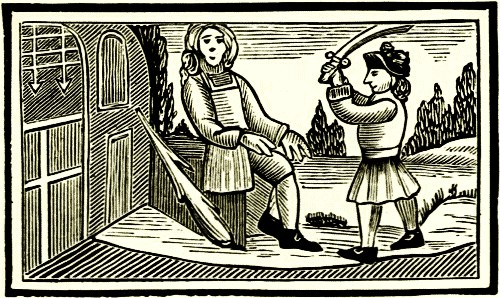
In the Second Part Jack turns professional giant-slaughterer, and of course these overgrown simpletons had no chance against Jack's magic paraphernalia. They had to give up their prisoners (Plate 4); they were cut in pieces without seeing their assailant (Plate 3); their very weight sometimes proved their destruction—notably one Thundel, who will always live in memory as the talented author of
"Fe, fa, fum I smell the blood of an Englishman, Be he alive, or be he dead, I'll grind his bones to make me bread."
This Thundel was beguiled on to a drawbridge, which broke with his weight (see frontispiece, Newcastle edition), and, floundering in the moat, fell an easy prey. But Jack's supreme effort was masterly, and well rewarded him. A hermit told him of a giant, one Galligantus, who lived in an enchanted castle, in which, by the aid of a conjuror and two fiery dragons, he had imprisoned a duke's daughter, transforming her into a deer. Could Jack resist this charming adventure? Impossible. Clad in his invisible coat, he got into the castle, found that the way to break the enchantment was to blow a certain trumpet, did so—an act which had the effect of temporarily depriving the giant and sorcerer of their presence of mind, a fact which Jack took advantage of by decapitating Galligantus; at which sight the conjuror mounted in the air, and disappeared in a whirlwind. The two dragons, considering these proceedings equivalent to a notice of ejectment, promptly took their departure; whilst a quantity of beasts and birds resumed their former shapes of knights and ladies, and the castle vanished.
Needless to say, King Arthur prevailed on the duke to reward Jack with his daughter's hand, and he himself gave him "plentiful estate;" so there is very little reason to doubt the announcement which closes this veracious history, that "he and his Lady lived the residue of their days in joy and content.