Chapter IX · (continued 2)
Reading edition
In the Bill which was founded on the resolutions the term of apprenticeship was limited to six years for the plantation negroes, and four for all others. The Bill passed the House of Lords with slight opposition; and on the 28th of August, 1833, it received the Royal Assent. It does not appear that William IV. urged any plea of conscience against signing this Act of Emancipation, although in his early days he had been, in common with all the Royal Family, except the Duke of Gloucester, opposed to the abolition of the slave trade. The Act was to take effect on the 1st day of August, 1834, on which day slavery was to cease throughout the British colonies. All slaves who at that date should appear to be six years old and upwards were to be registered as "apprentice labourers" to those who had been their owners. All slaves who happened to be brought into the United Kingdom, and all apprentice labourers who might be brought into it with the consent of their owners, were to be absolutely free. The apprentices were divided into three classes. The first class consisted of "predial apprentice labourers," usually employed in agriculture, or the manufacture of colonial produce, on lands belonging to their owners, and these were declared to be attached to the soil. The second class, consisting of the same kind of labourers, who worked on lands not belonging to their owners, were not attached to the soil. The third class consisted of "non-predial apprenticed labourers," and embraced mechanics, artisans, domestic servants, and all slaves not included in the other two classes. The apprenticeship of the first was to terminate on the 1st of August, 1840; and of the "non-predial" on the same day in 1838. The apprentices were not obliged to labour for their employers more than forty-five hours in any one week. Voluntary discharges were permitted; but, in that case, a provision was made for the support of old and infirm apprentices. An apprentice could free himself before the expiration of the term, against the will of his master, by getting himself appraised, and paying the price. No apprentices were to be removed from the colony to which they belonged, nor from one plantation to another in the same colony, except on a certificate from a justice of the peace that the removal would not injure their health or welfare, or separate the members of the same family. Under these conditions the apprentices were transferable with the estates to which they were attached. Their masters were bound to furnish them with food, clothing, lodging, and other necessaries, according to the existing laws of the several colonies, and to allow them sufficient provision ground, and time for cultivating it, where that mode of maintenance was adopted. All children under six years of age when the Act came into operation, and all that should be born during the apprenticeship, were declared free; but if any children were found destitute, they could be apprenticed, and subjected to the same regulations as the others. The Act allowed governors of colonies to appoint stipendiary magistrates, with salaries not exceeding £300 a year, to carry the provisions of the law into effect. Corporal punishment was not absolutely abolished, but it could be inflicted only by the special justices, who were authorised to punish the apprentices by whipping, beating, imprisonment, or addition to the hours of labour. The corporal punishment of females was absolutely forbidden in all circumstances. The quantity of punishment was restricted, and the hours of additional labour imposed were not to exceed fifteen in the week.
The sum of twenty millions was divided into nineteen shares, one for each of the colonies, proportioned to the number of its registered slaves, taken in connection with the market price of slaves in that colony, on an average of eight years, ending with 1830. But no money was payable in any colony until it should have been declared by an Order in Council that satisfactory provision had been made by law in such colony for giving effect to the Emancipation Act. Two of them were so perverse as to decline for several years to qualify for the reception of the money; but others acted in a different spirit. Believing that the system of apprenticeship was impolitic, they declined to take advantage of it, and manumitted their slaves at once. Antigua was the first to adopt this wise course. Its slaves were all promptly emancipated, and their conduct fully justified the policy; for on Christmas Day, 1834, for the first time during thirty years, martial law was not proclaimed in that island. Thus, the effect of liberty was peace, quietness, and confidence. Bermuda followed this good example, as did also the smaller islands, and afterwards the large island of Barbadoes; and their emancipation was hailed by the negroes with religious services, followed by festive gatherings. Jamaica, and some other islands, endeavoured to thwart the operation of the new law, as far as possible, and took every advantage in making the apprentices miserable, and wreaking upon them their spite and malice. They met with harsher treatment than ever, being in many instances either savagely ill-used or inhumanly neglected. Considering their provocations, it was generally admitted that they behaved on the whole very well, enduring with patience and resignation the afflictions which they knew must come to an end in a few years. The total number of slaves converted into apprentices on the 1st of August, 1834, was 800,000. The apprenticeship did not last beyond the shorter time prescribed, and on the 1st of August, 1838, there was not a slave in existence under the British Crown, save only in the island of Mauritius, which was soon required by instructions from the Home Government to carry the Act into effect.
Much inconvenience and misery were caused during the year by the trades unions and their strikes. In several places the workmen combined in order to enforce a rise of wages, and a more equitable distribution of the profits derived from their labour. The striking commenced on the 8th of March, when the men employed by the London gas companies demanded that their wages should be increased from twenty-eight shillings to thirty-five shillings a week, with two pots of porter daily for each man. On the refusal of this demand they all stopped working; but before much inconvenience could be experienced their places were supplied by workmen from the country. On the 17th of March an event occurred which caused general and violent excitement among the working classes. At the Dorchester Assizes six agricultural labourers were tried and convicted for being members of an illegal society, and administering illegal oaths, the persons initiated being admitted blindfold into a room where there was the picture of a skeleton and a skull. They were sentenced to transportation for seven years. Their case excited the greatest sympathy among the working population throughout the kingdom. In London, Birmingham, and several other large manufacturing towns immense meetings were held to petition the king in favour of the convicts. In the midst of this excitement the manufacturers of Leeds declared their determination not to employ any persons in their factories who were members of trades unions. The consequence was that in that town three thousand workmen struck in one day. On the 15th of April there was a riot at Oldham, where, in consequence of the arrest of two members of a trade union, a factory was nearly destroyed, and one person killed, the mob having been dispersed by a troop of lancers. Several of the rioters were arrested and sentenced to terms of imprisonment varying from six to eighteen months. On the 21st of April a meeting of the trades unions took place at Copenhagen Fields, to adopt a petition to the Home Secretary praying for a remission of the sentence on the Dorchester convicts. They marched to the Home Office through the leading thoroughfares, numbering about 25,000, in order to back up their deputation, which, however, Lord Melbourne refused to receive, though he intimated to them that their petition should be laid before the king if presented in a proper manner. The multitude then went in procession to Kennington Common. On the 28th 13,000 London journeymen tailors struck for higher wages. The masters, instead of yielding, resolved not to employ any persons connected with trades unions, and after a few weeks the men submitted and returned to their work.
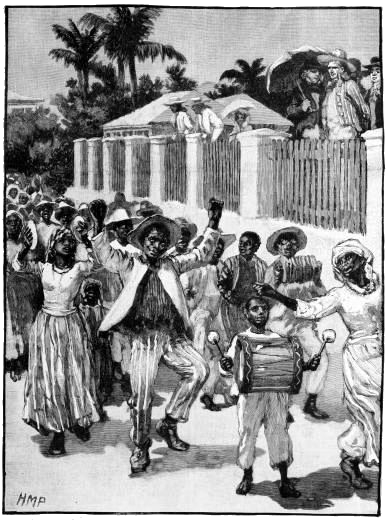
SLAVERY EMANCIPATION FESTIVAL IN BARBADOES. (See p. 368.)
[See larger version]
The conduct of the trades unions excited a great deal of angry feeling amongst the wealthier classes; and the Government were vehemently condemned for not putting down the combination with a strong hand. It was said that the mischief they created was well known; that though their interference with trade, "their atrocious oaths, impious ceremonies, desperate tyranny, and secret assassinations had been brought under their observation," Ministers could not be stirred to any exhibition of energy for the protection of the manufacturer, the workman, or the public. On the 28th of April the Duke of Newcastle had brought the trades unions under the consideration of the House of Lords, and questioned Ministers as to their neglect respecting the disturbances these combinations occasioned. Lord Grey contented himself with a quiet expression of regret for their existence, and of a hope that they would die out if let alone; meanwhile, the Government were ready to put down disorderly meetings. This apparent indifference called forth indignant protests from the Marquis of Londonderry and Lord Eldon. The Lord Chancellor declared that the meetings were illegal, and that they were likely to produce great mischief; adding, "Of all the worst things, and of all the most pernicious devices that could be imagined for the injury of the interests of the working classes, as well as of the interests of the country at large, nothing was half so bad as their existence." He also stated that there could not remain the shadow of a doubt of the justice of the conviction of the Dorchester labourers. Strikes and combinations, however, continued during the summer. At the Chester Assizes, on the 5th of August, two men were indicted for the murder of a manufacturer during a strike in 1831. It appeared on evidence that the deceased had excited the ill feeling of the trades unions of the place, where he had a mill, in which he gave employment to a great number of people. Two of his own workmen had agreed to assassinate him for the sum of £3 6s. 8d. each, paid by the union. They shot him as he was passing through a lane to his mills. Being found guilty, they were executed. On the 18th of the same month the workmen employed by the builders of London struck to the number of 10,000, including the artisans at the Government works. This course was adopted in consequence of a combined declaration of the master-builders, requiring them to abandon their connection with trades unions.
Meanwhile in Ireland, where Lord Anglesey had been succeeded by Lord Wellesley and Mr. Stanley by Mr. Littleton, O'Connell was openly agitating for a Repeal of the Union. His conduct was much resented by Lord Grey's followers, and at a meeting at Hull Mr. M. D. Hill challenged the good faith of the Irish party, and declared that an Irish member, who spoke with great violence against the Coercion Bill, had secretly urged the Ministers to force it through in its integrity. O'Connell brought the statement before the House early in the Session, when it was unnecessarily confirmed by Lord Althorp, who said that he had good reason to believe it to be true. After a violent scene, he further admitted that Sheil was one of the members to whom he referred. Mr. Sheil denied the imputation so passionately that, on the motion of Sir F. Burdett, both he and Lord Althorp were taken into custody by the Serjeant-at-Arms. They were released on submitting to the authority of the House, and a committee, after examining into the matter and collecting no evidence of value, were glad to avail themselves of an apology tendered by Hill and to bring the incident to a close.
On the 22nd of April Mr. O'Connell brought forward a very comprehensive motion. It was for a select committee to inquire and report on the means by which the destruction of the Irish Parliament had been effected; on the results of the Union upon Ireland, and upon the labourers in husbandry and operatives in manufactures in England; and on the probable consequences of continuing the Legislative Union between Great Britain and Ireland. This motion originated a debate on the Repeal question which lasted four days. O'Connell himself spoke for six hours. The debate was chiefly memorable for a speech of Mr. Spring-Rice, in defence of the Union, which also occupied six hours in the delivery. He concluded by proposing an amendment to the effect that an Address should be presented to the king by both Houses of Parliament, expressing their determination to maintain the Legislative Union inviolate. In a very full House the amendment was carried by an overwhelming majority, the numbers being for, 523; against, 38. Mr. Spring-Rice's speech served the Government materially, while by the Conservatives it was regarded as "a damper" to their own hopes.
The chiefs of the Tory party were at this time sanguine in their expectation of being speedily called to office. Their hopes were founded mainly upon the dissensions that were known to exist in the Cabinet. These dissensions were first revealed by O'Connell's motion for a committee to inquire into the conduct of Baron Smith, when presiding as a judge in criminal cases, and especially with reference to a charge addressed by him to the grand jury of Dublin, in which he said: "For the last two years I have seldom lost an opportunity for making some monitory observations from the Bench. When the critical and lawless situation of the country did not seem to be generally and fully understood, I sounded the tocsin and pointed out the ambuscade. Subsequent events deplorably proved that I had given no false alarm. The audacity of factious leaders increased from the seeming impunity which was allowed them; the progress of that sedition which they encouraged augmented in the same proportion, till on this state of things came, at length, the Coercion Bill at once to arrest the mischief, and consummate the proof of its existence and extent." As there was no doubt that these shafts were aimed at O'Connell, this last charge afforded him a fair opportunity of putting a stop to the abuse by bringing the conduct of the talented but eccentric judge before Parliament; for, as there was no political case in the calendar, there was no excuse for the attack. Mr. Littleton declared it impossible to refuse his consent to the motion. Mr. Stanley, Lord Althorp, and Lord John Russell expressed a similar view. Sir James Graham briefly but warmly dissented from his colleagues. He had come down to the House with the understanding that they meant to oppose the motion. He for one still retained his opinion, and had seen no reason to change it. As one who valued the independence of the judges and his own character, he must declare that if the motion were carried, and if, as its result, an Address was presented to the Crown for the removal of Baron Smith, it would be a highly inexpedient—nay, more, a most unjust proceeding. The present would be the most painful vote he had ever given, since he felt it incumbent upon him to sever himself from those friends with whom during a public life of some duration he had had the honour of acting; but feeling as he did the proposition to be one dangerous in itself, he conceived he would be betraying the trust committed to him if he did not declare against it. Baron Smith was ably defended by Mr. Shaw, by Sir J. Scarlett, and Sir Robert Peel. On a division, the motion for a committee of inquiry was carried by 167 to 74, Sir James Graham and Mr. Spring-Rice voting in the minority. Next morning Sir James tendered his resignation as First Lord of the Admiralty, which was declined, and in the following week the vote was rescinded by a majority of six.
Thus the Cabinet was evidently fast breaking up, when Mr. Littleton introduced his Tithe Bill. Its object was much the same as Mr. Stanley's Act of 1832 for the Compulsory Commutation of Tithe. This last Act had been a failure, and Mr. Littleton was compelled to ask Parliament to grant the sum of £1,000,000 to pay the arrears. He hoped to remedy its defects by reducing the number of people who were liable to tithe, and then, after the 1st of November, to commute the tithe into a land tax, payable to the State, to reduce its amount by one-fifth, and to allow any person having a substantial interest in the estate to redeem the residue of it, after five years had expired, on easy terms. After a number of stormy debates the progress of the measure seemed assured, when Lord John Russell went out of his way to express his views in favour of the appropriation of the surplus revenues of the Irish Church to secular purposes. Stanley wrote to Graham the laconic note, "Johnny has upset the coach." Indeed, the declaration was the more indiscreet because the Cabinet was hopelessly divided on the point.
On the 27th of May Mr. Ward brought forward a motion upon this subject. In an able speech he reviewed the state of Ireland, and remarked that since 1819 it had been necessary to maintain there an army of 22,000 men, at a cost of a million sterling per annum, exclusive of a police force that cost £300,000 a year. All this enormous expense and trouble in governing Ireland he ascribed to the existence of a religious establishment hostile to the majority of the people; he therefore moved that "the Protestant episcopal establishment in Ireland exceeds the spiritual wants of the Protestant population; and that, it being the right of the State to regulate the distribution of Church property in such a manner as Parliament may determine, it is the opinion of this House that the temporal possessions of the Church of Ireland, as now established by law, ought to be reduced."
The motion was seconded by Mr. Grote. When he had concluded, Lord Althorp rose and moved that the House should be adjourned until the 2nd of June. The differences in the Cabinet had now reached their crisis. It was fully expected that Mr. Ward's motion would be carried, and Ministers differed as to whether the principle involved in it should be rejected or accepted; the majority were for accepting it, whereupon Mr. Stanley, Sir James Graham, Lord Ripon, and the Duke of Richmond resigned their offices. They were succeeded by Mr. Spring-Rice, as Colonial Secretary; Lord Auckland, as First Lord of the Admiralty; the Earl of Carlisle, as Lord Privy Seal; Mr. Abercromby, as Master of the Mint. Mr. Poulett Thompson became President of the Board of Trade, and the Marquis of Conyngham Postmaster-General.
On the following day, which was the anniversary of the king's birthday, the Irish prelates, headed by the Archbishop of Armagh, presented an address to his Majesty, complaining of the attacks on the Irish Church, deprecating the threatened innovations, and imploring his protection. The king was greatly moved by this appeal. Breaking through the usual restraints, he delivered an extemporaneous answer, in which, among other things, he said, "I now remember you have a right to require of me to be resolute in defence of the Church." He assured the bishops that their rights should be preserved unimpaired, and that if the interior arrangements of the Irish Church required any amendment—which, however, he greatly doubted—he hoped it would be left to the bishops to correct them, without the interference of other parties. He was now completing his 69th year, and he must prepare to leave the world with a conscience clear in regard to the maintenance of the Church. Tears ran down his cheeks while, in conclusion, he said, "I have spoken more strongly than usual, because of the unhappy circumstances that have forced themselves upon the observation of all. The threats of those who are the enemies of the Church make it the more necessary for those who feel their duty to that Church to speak out. The words which you hear from me are, indeed, spoken by my mouth, but they flow from my heart."
These words, indiscreet as they were, and calculated to embarrass the Ministers, were regarded as in the highest degree precious by the bishops and clergy, and the whole Tory party. With the utmost despatch they were circulated far and wide, with the design of bringing public feeling to bear against Mr. Ward's motion. In the meantime, great efforts were made by the Government to be able to evade the motion. Its position at this time appeared far from enviable, and there was a general impression that it could not long survive. The new appointments did not give satisfaction. The Cabinet was said to be only patched up in order to wear through the Session. It was in these discouraging circumstances that Lord Althorp had to meet Mr. Ward's motion on Monday, the 2nd of June. In order to avoid a dissolution and a general election, the results of which might turn upon the existence of the Irish Church, it was necessary that Mr. Ward's motion should be defeated. He refused to withdraw it, because he apprehended the speedy dissolution of the Ministry, and he wished the decision of the House of Commons on the Irish Church question to be recorded, that it might stand in the way of a less liberal Administration. The anticipated contest in the Commons that evening excited extraordinary interest. The House was surrounded by a crowd anxious to obtain admittance or to hear the result, while within it was so thronged with members that the Ministers found it difficult to get to their seats. Rarely has there been so full a House, the number of members being 516. When Mr. Ward had spoken in favour of his motion, Lord Althorp rose to reply. He announced that a special commission of inquiry had been already issued, composed of laymen, who were to visit every parish in Ireland, and were to report on the means of religious instruction for the people; and that, pending this inquiry, he saw no necessity for the House being called upon to affirm the principles of Mr. Ward's motion. He would, therefore, content himself by moving the previous question. This was carried by an overwhelming majority, the numbers being 396 to 120.
But a month only elapsed when fresh differences arose in the Cabinet leading to further resignations, and ending in the retirement of Lord Grey from public life. Again Ireland was the rock on which the Cabinet struck and went to pieces. The Irish Coercion Act, which had been passed for one year only, was to be renewed, with modifications, for which purpose a Bill was introduced into the Lords about the middle of June. A large number of the Liberal members of England and Scotland, as well as Ireland, required the omission of the clauses enabling the Lord-Lieutenant to suppress public meetings by proclamation—a power which Lord Wellesley was induced by his meddlesome advisers, Mr. Littleton and Lord Brougham, to declare he did not require. His opinion, however, was overruled in the Cabinet, and they agreed to support the Bill as it stood. Lord Althorp had very reluctantly yielded the point, more especially as the necessity for the extra-constitutional powers was denied by the Irish executive and by the Lord Chancellor. Mr. Littleton, the Irish Secretary, having indiscreetly made O'Connell aware of the division in the Cabinet, and of the fact that several of its members were supporting the clause contrary to their convictions, the Irish leader used the knowledge thus obtained with tremendous effect. While sitting under the fierce invectives of his opponent, Lord Althorp felt his position to be intolerable. On quitting the House, after a long and harassing discussion, on the 7th of July, he wrote to the Prime Minister, announcing this fact. Next morning there was a conference, after which Lord Grey transmitted to the king his resignation, with that of Lord Althorp; and on the recommendation of Lord Grey, Lord Melbourne was appointed to the office of Prime Minister, being succeeded in the Home Office by Lord Duncannon; while Lord Althorp, relieved from his obligation with regard to the Coercion Bill, consented to resume the post he had just resigned.
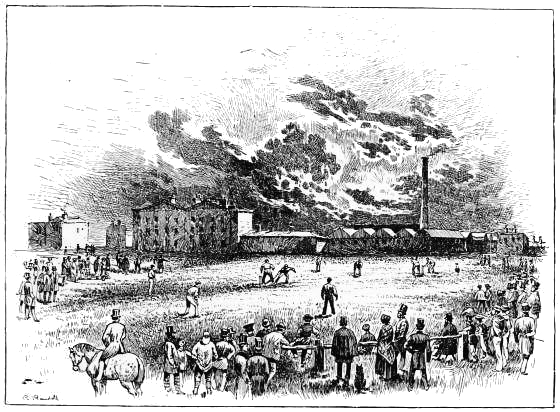
KENNINGTON COMMON, LONDON, ABOUT 1840.
[See larger version]
On the 9th of July Earl Grey made a statement in the Lords, when the Duke of Wellington disclaimed all personal hostility in the opposition he had been obliged to give to his Government. The Lord Chancellor pronounced an affecting eulogium on the great statesman who was finally retiring from his work, and expressed his own determination to remain in office. Lord Grey's popular Administration had lasted three years, seven months, and twenty-two days, which exceeded the term of his predecessor, the Duke of Wellington, by nearly a year and a half. Lord Grey, from the infirmities of age, declining health, and weariness of official life, had wished to retire at the close of the previous Session, but was prevailed upon by his colleagues to remain in office. In delivering his farewell speech he was listened to with profound attention, and at one moment was so overpowered by his feelings that he was compelled to sit down, the Duke of Wellington considerately filling up the interval by presenting some petitions.
Earl Grey had lived to witness the triumphant realisation of all the great objects for which throughout his public life he had contended, sometimes almost without hope. Catholic Emancipation had been yielded by his opponents as a tardy concession to the imperative demand of the nation. In the debates on that question in the House of Lords, Lord Grey was said to have excelled all others, and even himself. The long dormant question of Parliamentary Reform was quickened into life by the electric shock of the French Revolution of 1830, when the Duke of Wellington, with equal honesty and rashness, affirmed that the existing system of representation enjoyed the full and entire confidence of the country. This declaration raised a storm before which he was compelled to retire, in order to make way for a statesman with keener eye and firmer hand, to hold the helm and steer the vessel in that perilous crisis of the nation's destiny. Throughout the whole of that trying time Earl Grey's wisdom, his steadfastness, the moral greatness of his character, and the responsibility of his position, made him the centre of universal interest, and won for him the respect and admiration of all parties in the nation. Baffled again and again in the struggle for Reform, undismayed by the most formidable opposition, not deterred or disheartened by repeated repulses, he renewed his attacks on the citadel of monopoly and corruption, till at last his efforts were crowned with victory. And well did he use the great power for good which the Reform Parliament put into his hands. The emancipation of the slaves, the reform of the Irish Church, and the abolition of the gigantic abuses of the Poor Law system, were among the legislative achievements which he effected. His foreign policy, in the able hands of Lord Palmerston, was in harmony with his own domestic policy—bold, just, moderate, true to the cause of freedom abroad, while vigilantly guarding the national honour of his own country. By his vigorous diplomacy he had saved Belgium from being overwhelmed by the Dutch, and at the same time kept her independent of France. A capable Sovereign had been provided for her in Leopold of Saxe-Coburg, the widowed husband of Charlotte of England. Finally, when the Dutch declined to give way to the remonstrances of the Western Powers, a joint Anglo-French expedition was dispatched, which compelled the citadel of Antwerp to capitulate on December 23rd, 1832. Nevertheless, such was the obstinacy of the Dutch that the question remained unsettled on the fall of the Grey Ministry. Lord Palmerston's foreign policy was equally noteworthy in other quarters of the globe. If he could do little for the revolution in Poland, he could at least preserve constitutionalism in the Peninsula, where it was threatened by Dom Miguel in Portugal, and, after the death of Ferdinand in 1833, by Don Carlos in Spain. On the 22nd of April, 1834, Palmerston, in concert with Talleyrand, now French Minister in London, drew up the Quadruple Treaty, by which the two Powers undertook to deliver the Peninsula from the Absolutist pretenders. Its effect for the time being was remarkable; they both fled from the country, and constitutionalism was restored.