Chapter VIII · (continued 2)
Reading edition
Another ground of attack upon the Government at the opening of the Session was their conduct in not bringing up Mr. O'Connell for judgment. It was alleged that they had entered into a corrupt compromise with the great Irish agitator, in order to avert his hostility and secure his support at the elections. This was indignantly denied both by Mr. Stanley and Lord Plunket. They contended that as the Act expired with the Parliament, so did the conviction, and that Mr. O'Connell could not be legally punished. This was the opinion of the law officers of the Crown in Ireland, an opinion in which the English law officers concurred. Mr. Stanley said:—"Not only was there no collusion or compromise, but I should have been most glad if Mr. O'Connell could have been brought up for judgment; but then we have been told that we ought not to have dissolved Parliament, because by so doing Mr. O'Connell had escaped. Now, no man can be more sensible than I am of the importance of showing to the people of Ireland that if Mr. O'Connell chooses to go beyond the law, he is not above the law; but, without meaning the slightest disrespect to Mr. O'Connell, I must say that if I put on the one hand the success of a great and important measure like the Reform Bill, and on the other the confinement of Mr. O'Connell in his Majesty's gaol of Kilmainham for three, six, or nine months, I must say that what became of Mr. O'Connell was as dust in the balance. Besides, the impression of the supremacy of the law was made upon the people by the fact of the verdict having been obtained against him, and an immediate change was wrought in the system of agitation, which, indeed, ceased. Such being the case, the question of what might be the personal consequences to any individual by the dissolution became of still less importance than it was before."
JEDBURGH ABBEY. (After the Painting by Sir George Reid, P.R.S.A.)
[See larger version]
On the 24th of June Lord John Russell proposed his second edition of the Reform Bill, which did not substantially differ from the first. His speech on this occasion was a perfect contrast to the one with which he had introduced the measure at first. There was no longer any hesitation or timidity. He was no longer feeling his way doubtfully on an untried path, or navigating without compass along a dangerous coast. He boldly launched out to sea, with his eye steadily fixed on the north star, certain of his course and confident of the issue. The discussions of the previous Session had thrown a flood of light upon the whole question. Sustained by the enthusiasm of the people, and animated by the sympathy of the majority around him on the Ministerial benches, he spoke as if a greater and more vigorous mind had taken possession of his frame. He was strong in argument, cutting in sarcasm, defiant in tone, powerful in declamation. Borne by the power of public opinion to a higher and more commanding position, and proudly conscious of the elevation, he seemed ashamed of the petty proposals of former years, and felt his heart as well as his intellect expanding to the greatness of the new position. The Bill was read a first time without opposition, the discussion being expressly reserved by Sir Robert Peel for the second reading, which was fixed for the 4th of July. In the meantime the Irish Bill was brought in by Mr. Stanley on the 30th of June, Messrs. O'Connell and Sheil complaining bitterly of the difference existing, to the disadvantage of Ireland, between the proposed plans of Reform for the two countries. On the following day the Lord Advocate brought in the Bill relating to Scotland. On the 4th of July Lord John Russell moved the second reading of the English Reform Bill. A debate of three nights followed, containing little or no novelty in the argument, nothing but a wearisome repetition of points that had been discussed all over the country, hundreds of times, during the last few months. The most interesting feature was the attitude of Sir Robert Peel, who unfortunately placed himself in the front of the battle against Reform, in which he proved himself so able a general that all enlightened friends of the country lamented his false position. It was remarked, however, that he confined himself to a criticism of details.
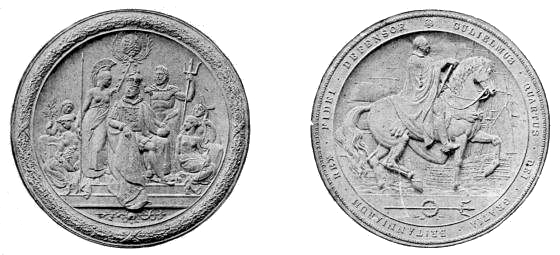
GREAT SEAL OF WILLIAM IV.
The division on the second reading took place on the 6th of July, when the numbers were—for the Bill, 367; against it, 231; majority, 136. This result was a sufficient vindication of the appeal made to the country. The nation had now spoken constitutionally as to the evils of the old system of representation and unmistakably expressed its determination to have it reformed. The measure might be delayed in the Commons by vexatious opposition; but if it were to be defeated it must be by the House of Lords, and it required some boldness in the majority of that assembly to take upon itself to hinder the other branch of the legislature from effecting its own reform. The Bill now went into committee, when the case of each borough which it was proposed to disfranchise came under separate consideration. In Schedule A were placed, alphabetically, all the boroughs which had less than 2,000 of population, and these were to be disfranchised. When Appleby, the first on the list, came under consideration, there was a keen contest as to the actual numbers then in the town, and the question turned upon the census by which the committee were to be guided. By the census of 1821 the place would be disfranchised, but the inhabitants affirmed that by the census of 1831, then in progress, they were shown to have more than the requisite number; and Sir Robert Peel contended strenuously that they should wait for the more correct information. Mr. Wynn having moved a general resolution that the consideration of the schedules should be postponed till the result of the census was published, Sir Robert Peel said, with great show of reason, "After having obtained so large a majority as 136 on the principle of the Bill, Government would have acted wisely, even for the interests of the measure itself, to have postponed going into details till they were in possession of better documents on which to proceed. They know what is coming; they are aware of the event which is casting its shadow before—namely, that the boroughs will be overtaken by the population returns of 1831. In another fortnight these returns would be laid before the House; and though his Majesty's Ministers now proceed expressly on the doctrine of a population of 2,000 and 4,000, they are guilty of the inconceivable absurdity of proceeding on the returns of 1821, when they can so soon be in possession of the census of 1831." The House, however, determined, by a majority of 118, to proceed upon the old census. A series of tiresome debates upon the details of each particular borough proceeded from day to day, and lasted for two months, the Ministry invariably carrying their points by triumphant majorities. The tone of the discussion was acrimonious, as might naturally be expected from the weighty personal interests involved. Sir Edward Sugden solemnly declared that he considered the tone and manner, as well as the argument, of the Attorney-General as indicating that they were to be dragooned into the measure. In the opinion of Sir Charles Wetherell all this was "too capricious, too trifling, too tyrannical, and too insulting to the British public, to carry with it the acquiescence either of the majority within or the majority without the House." The ill-temper and factious obstruction of the Opposition greatly damaged the Tory party out of doors and exasperated the people against them.
During the passage of the Bill through committee three important proposals were made—the first by Lord Chandos, that tenants paying fifty pounds per annum for their holdings should have a vote in the counties. This was known as "the Chandos clause" of the Reform Bill, which was carried on the 18th of August by a majority of 84, the numbers being 232 and 148. Mr. Hume proposed that the colonies should be represented in the House of Commons; but the motion was negatived without a division. Mr. Hunt, the celebrated Radical Reformer, moved that all house-holders paying rates and taxes should have votes; but, strange to say, household suffrage had in the committee but a single supporter, Mr. Hunt himself, who upon a division constituted the minority. Mr. Hume asked only nineteen members to represent 100,000,000 of inhabitants, including our Indian empire, to which he would give four representatives. It was certainly a small demand, but as a representation of our colonies and dependencies it was ludicrously inadequate.
At length, after every clause of the Bill, and every word and every place in each of the schedules had been the subjects of all possible motions and discussions—after a warfare which, for animosity and duration, was unparalleled in our Parliamentary history, the Bill was read a third time on the 21st of September, and passed by a majority of 109, the numbers being 345 to 236. The result was received with loud and long-continued cheering by the Reformers in the House. The anxious and impatient multitude in the streets caught up the sounds of triumph with exultant enthusiasm; the acclamations of all classes of the people rang throughout the agitated metropolis. The news spread like wildfire through the country, and was everywhere received with ringing of bells and other demonstrations of joy. As soon as the Bill passed an illumination of London was proposed, and an application was made to the Lord Mayor, in order to obtain his sanction, which was granted. The illumination was extensive, and those who refused to comply had their windows broken by the populace. In many places the people, whose patience had been so severely tested, began to lose their self-control, and were betrayed into riotous conduct. Mr. Macaulay, and other leading Reformers in Parliament, had warned the Opposition of this danger, and it turned out that their apprehensions were not altogether visionary.
At length, on the 22nd of September, Lord John Russell, attended by Lord Althorp, and a great body of the most distinguished Reformers, appeared at the bar of the House of Lords, and handed the English Reform Bill to the Lord Chancellor, praying the concurrence of their Lordships. This scene has been made the subject of a great historical painting. The Bill, without any opposition or remark from any Conservative peer, was read a first time on the motion of Earl Grey, and ordered to be read a second time on Monday week. The debate on the second reading commenced on the 3rd of October, with a speech from Lord Grey—grave, elaborate, earnest, and impressive; simple, yet dignified. He described his own efforts in regard to Parliamentary Reform, spoke of the changes which had of necessity attended his opinions on the subject, and of the circumstances which, at the close of his long career, when the conservative spirit is naturally strongest in every man, had led him to endeavour to put in practice the theories and speculations of his youth and manhood. Lord Eldon described the progress of the debate from day to day in letters to members of his family. Lord Dudley and Lord Haddington quite surprised and delighted the zealous old man—they spoke so admirably against the Bill. Lord Carnarvon delivered a most excellent speech; but Lord Plunket's speaking disappointed him. The fifth night of the debate was occupied by the lawyers. Lord Eldon—following Lord Wynford and Lord Plunket—solemnly delivered his conscience on this momentous occasion. He was ill and weak, and being an octogenarian, he might be said to be speaking on the edge of the grave. He expressed his horror of the new doctrines which had been laid down with respect to the law of the country and its institutions. He could not consent to have all rights arising out of Charters, and all the rights of close boroughs, swept away. Boroughs, he contended, were both property and trust. Close corporations had as good a right to hold their charters under the Great Seal as any of their lordships had to their titles and their peerages. He said that he was a freeman of Newcastle-upon-Tyne; he had received his education in the corporation school of that town on cheap terms, as the son of a freeman; he had a right to it; and he had hoped that, when his ashes were laid in the grave, he might have given some memorandum that the boys there, situated as he was, might rise to be Lord Chancellors of England, if, having the advantage of that education, they were honest, faithful, and industrious. The closing night of the debate brought out the two most illustrious law lords in the House, who had long been rivals and competitors in the arenas of professional and political life—Lord Brougham and Lord Lyndhurst. Each was holding back in order to have the opportunity of replying to the other; but Lord Lyndhurst managed to have the last word, the more excitable Lord Chancellor having lost patience, and flung himself into the debate. He implored the House on his knees to pass the Bill. But the coup de théâtre miscarried, owing to the obvious anxiety of his friends lest he should be thought to be suffering from too much mulled port.
The last night's debate continued till between six and seven o'clock on the morning of Saturday, the 8th of October. It was a night of intense anxiety, both in the House and out of doors. The space about the throne was crowded with foreigners and members of the other House. There was a number of ladies, peeresses, and their daughters, sitting there the whole night, manifesting their excitement in every way consistent with decorum. Palace Yard and the space all round the House was thronged with people waiting to hear the result of the division. The night was wet, however, and the debate was so protracted that the crowd had dispersed before morning. This was a matter of consolation to the Opposition peers, who dreaded a mobbing. It was now broad daylight, and no sound was heard outside except the rolling of the carriages of the peers, who passed up Parliament Street as quietly as if they had come from disposing of a road Bill. The fate of the Bill was that day decided, for it, 158; against it, 199—leaving a majority of 41. "The night was made interesting," wrote Lord Eldon, "by the anxieties of all present. Perhaps, fortunately, the mob on the outside would not wait so long."
The result produced intense excitement, and led to rioting and outrage in the metropolis, and in some of the provincial towns. In London, the Duke of Wellington, the Duke of Cumberland, and the Marquis of Londonderry, were assaulted in the street, and rescued with difficulty from the fury of the mob. Lord Londonderry, who had signalised himself during the debate by the violence of his opposition, was struck senseless from his horse by a shower of stones at the gate of the palace, amidst cries of "Murder him! Cut his throat!" Persons respectably dressed, and wearing ribbons round their arms, took the lead on these occasions, giving orders, and rushing from the crowd. The houses of the Duke of Newcastle, Lord Bristol, and all other anti-Reform peers, had been visited by the mob, and left without glass in their windows. All the shops in town were shut. "The accounts from Derbyshire, Nottinghamshire, and other places," wrote Lord Eldon, "are very uncomfortable. I heard last night that the king was frightened by the appearance of the people outside of St. James's."
Although the division took no one by surprise, as the rejection of the Bill by the Lords was expected, yet the shock to society was very violent. The Funds suddenly fell, and there was that feeling of vague anxiety in the public mind which often portends some great calamity. At Derby they broke open the gaol and demolished the property of the anti-Reformers of the place. At Nottingham there was serious rioting, which ended in the utter destruction by fire of the ancient castle, once the property of the Duke of Newcastle, who had given violent offence by his rash declaration with regard to his voters at Newark, "that he had a right to do what he pleased with his own." The popular fury, however, soon subsided, and the public mind regained tranquillity, in the full assurance that the carrying of the Bill was only a question of time, and that the popular cause must ultimately triumph. What most materially contributed to the restoration of public confidence was the fact that the king, alarmed at the prospect of a revolution, implored the Ministers to retain their places, and to shape their Bill so as to disarm their opponents; and on the following Monday, in the House of Commons, Lord Ebrington moved a vote of confidence in the Government, to the effect that, while the House lamented the present state of a measure in favour of which the opinion of the country had been so unequivocally expressed, and which had been matured after the most anxious and laborious discussions, they felt imperatively called upon to reassert their firm adherence to its principles and leading provisions, and their unabated confidence in the integrity, perseverance, and ability of the Ministers, who, in introducing it and conducting it so well, had consulted the best interests of the country. This motion was carried by the large majority of 131; the numbers being 329 to 198. Thus supported by the Commons, the Ministers retained their places; and the king, on the 20th of October, prorogued Parliament in person, in a Speech which the Lords might take as the king's answer to their vote, telling them in effect that by their obstinate bigotry they were setting themselves in antagonism to the two other estates of the realm, and that in their conduct and position lay the real danger to the Constitution. His Majesty said: "To the consideration of the important question of the Reform of the House of Commons the attention of Parliament must necessarily again be called at the opening of the ensuing Session; and you may be assured of my unaltered desire to promote its settlement by such improvements in the representation as may be found necessary for securing to my people the full enjoyment of their rights, which, in combination with those of the other orders of the State, are essential to the support of our free Constitution."
In the trying circumstances in which they were placed, Lord Grey and his colleagues displayed a firmness and courage which entitled them to the everlasting gratitude of the country. The pluck of Lord John Russell in particular had quite an inspiriting effect on the nation. Replying to a vote of thanks to him and Lord Althorp, which had been passed by the Birmingham Political Union, the noble Paymaster of the Forces used an antithetical expression, which has become historical, and which, considering that the faction to which he alluded was the majority of the order to which he himself belonged, must be admitted to be one of extraordinary boldness. He said: "I beg to acknowledge with heartfelt gratitude the undeserved honour done me by 150,000 of my countrymen. Our prospects are now obscured for a moment, and I trust only for a moment. It is impossible that the whisper of faction should prevail against the voice of the nation."
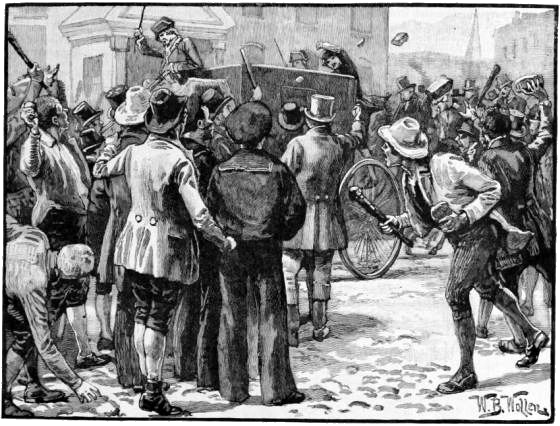
ATTACK ON SIR CHARLES WETHERELL AT BRISTOL. (See p. 340.)
[See larger version]
Encouraged by language like this from Ministers of the Crown, the voice of the nation became louder and more menacing every day. Meetings, attended by vast multitudes of angry and determined men, were held in Liverpool, Glasgow, Edinburgh, and most of the large towns, especially where the democratic element was predominant. The worst and most destructive of the riots was at Bristol. The recorder of Bristol was Sir Charles Wetherell, noted for his vehemence in opposing Reform. Considering the excitement and desperation that had been recently exhibited throughout the kingdom, it was scarcely prudent for Sir Charles Wetherell to appear in Bristol at all on that occasion. At all events, he should have entered the city privately, and discharged the duties of his office as quietly as possible. Instead of that, he made a public and pompous entry into the city on the 20th of October, accompanied by the magistrates and a cavalcade of the Tory gentry. This offensive pageant was naturally followed by a mob of disorderly characters, hissing and groaning. They soon began to throw stones and brickbats, especially when the respectable citizens at the commercial rooms received their polemical recorder with three cheers. The mansion-house was assailed with a shower of missiles. The mayor having called upon them in vain to retire, the Riot Act was read, but the military were not called out to enforce it. Instead of dispersing, the mob overpowered the constables and drove them back, forced open the doors of the mansion-house, smashed the furniture, and armed themselves with the iron rails which they tore up from the front of the building. Sir Charles Wetherell and the magistrates providentially escaped by a back door, and the recorder made an undignified retreat from the city. The military were at length called out, and after some time the disturbance seemed to be quelled, and the dragoons, who had been much fatigued, retired for the night. Bristol, it is said, has always been distinguished for a bad mob. On the next day the rioters proceeded to the mansion-house, broke open its cellars, and regaled themselves with the contents. The military were again brought out to quell the now intoxicated rioters; but there was no magistrate there to give orders, and the troops were marched back to the barracks. The mob then proceeded in detached parties, each having a work of destruction assigned to it. One party went to the bridewell, broke open the doors, liberated the prisoners, and then set the building on fire. Another went to the new gaol and performed a similar operation there. The Gloucester county prison was next broken open and consigned to the flames. The principal toll-houses about the city shared the same fate. The bishop's palace was pillaged and burned to the ground. Becoming more maddened as they proceeded, their passions raging more furiously at the sight of the conflagration as it spread, the mob resolved that no public building should be left standing. The mansion-house, the custom-house, the excise office, and other public buildings were wrapt in flames, which were seen bursting forth with awful rapidity on every side. The blackened and smoking walls of buildings already burned were falling frequently with terrific crashing, while Queen's Square and the adjoining streets were filled with a maniacal multitude, yelling in triumph and reeling with intoxication; many of them lying senseless on the pavement, and not a few consumed in the fires which they had raised. In addition to the public buildings, forty-two dwelling-houses and warehouses were burned. The loss of property was estimated at half a million sterling. This work of destruction was commenced on Sunday, and carried on during the night. The sky was reddened with the conflagration, while the military (who had been sent into the country to avoid irritating the people) and the paralysed authorities looked on helplessly from a distance at the progress of destruction. On Monday morning, however, they recovered from their consternation, and resolved to make an effort to save the city. The magistrates ordered the military to act, and under the command of an officer of the 14th, the dragoons charged the rioters in earnest. A panic now seized the mob, who fled in terror before the flashing swords of the troops and the trampling hoofs of their horses, some of them so terror-stricken that they rushed for safety into burning houses. The number of persons killed and wounded during this terrible business was ascertained to be 110, and it is supposed that many more that were never heard of lost their lives in the burning houses. The ringleaders were tried in December, when many persons were convicted, of whom three underwent the punishment of death.
Early in the following year the mayor and the commanding officer, Colonel Brereton, were brought to trial for neglect of duty. The mayor was acquitted, as not having been adequately supported by the military; but Colonel Brereton's humanity led to the most painful consequences. His trial began on the 9th of January following, and lasted four days, during which, as the proofs against him accumulated, he was overwhelmed with agony of mind. On the night of the 12th he did not visit, as was his custom, the chamber of his two motherless daughters. He was heard walking for hours about his room during that night, and in the morning, when the court assembled, it was announced that the prisoner had shot himself through the heart.
This tragedy produced a painful sensation through the whole community. The facts brought to light at the trial had the effect of dissociating the Bristol outrages from the cause of Reform, with which they had no real connection. Still the leading anti-Reformers were extremely obnoxious to the people; and as men's minds became more and more heated, in reiterating demands for national rights, withheld by a faction, extreme opinions grew into greater favour. For example, a national political union was formed in London, and held a great meeting, at which Sir Francis Burdett presided. This body issued a manifesto, in which they demanded annual Parliaments, universal suffrage, and vote by ballot. This was a legitimate demand; but they broached more disputable topics when they proclaimed "that all property honestly acquired is sacred and inviolable; that all men are born equally free, and have certain natural and inalienable rights; that all hereditary distinctions of birth are unnatural, and opposed to the equal rights of man, and ought to be abolished; and that they would never be satisfied with any laws that stopped short of these principles." The union was proclaimed by Lord Melbourne, but continued to assemble. Altogether, the country was in a most dangerous crisis in the autumn of 1831.
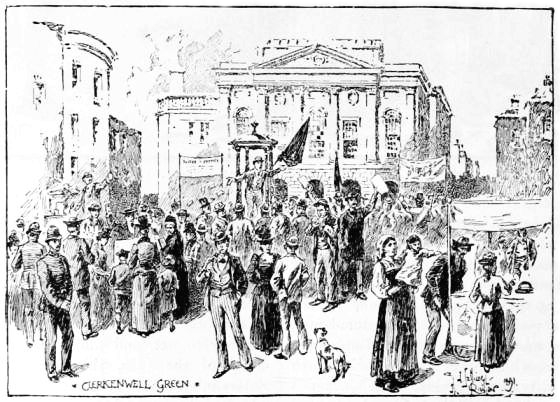
CLERKENWELL GREEN, LONDON.
[See larger version]
FOOTNOTE: