Chapter II · (continued 2)
Reading edition
Whilst the latter scenes of this great tragedy were passing, in Britain a new Parliament assembled on the 24th of November, and amongst its first acts were, before Christmas, to vote one hundred thousand pounds to the Marquis of Wellington, and two hundred thousand pounds for the relief of sufferers in Russia. And thus closed the remarkable year of 1812.
The year 1813 opened in Great Britain with high hopes. The defeat of Napoleon in Russia, and the destruction of his army, opened prospects of at length seeing this ambitious and unprincipled man, who had drenched all Europe in blood, brought down and removed from the scene. Lord Liverpool had for some time predicted that one day a British army would march into Paris, and encamp on the Bois de Boulogne, and now it really seemed probable. The nations of the north and centre of Europe were mustering to follow the aggressor home, and Lord Wellington, in Spain, was daily advancing towards the southern frontiers of France by victory after victory. True, there was much yet to be done, and enormous calls on the wealth of Britain had yet to be made; and at this time, whilst Great Britain and all Europe were engaged in this mighty contest, the people of the United States, instead of sympathising with the grand occasion, were doing all they could to divide our attention and weaken our hands. There were warm debates in Parliament on the American question, but Government carried addresses expressing approbation of the course which Great Britain had taken in regard to the United States. But this annoying quarrelsomeness of the Americans tended necessarily to raise the amount of the Budget, already too much swelled by the aids to Russia and our contest in Spain. The supplies demanded were seventy-two million pounds—more than had been granted in any former year. Amongst the ways and means were a fresh loan of twenty-one million pounds, and vote of credit for six million pounds. It was, however, some consolation that the nation at last saw the beginning of the end.
Before pursuing the immediate story of Buonaparte and his pursuers from the North, we will narrate the progress of Lord Wellington during this year. It was a favourable circumstance for him that, although he continued to receive no little trouble, impediment, and discouragement from the proud and thankless Spaniards, the turn of affairs in the North compelled Napoleon to withdraw some of his best troops and his best general from that country to aid him in his new campaign against Russia, Sweden, and Germany. He had altogether two hundred and seventy thousand men in Spain, in one quarter or other, to oppose the small Anglo-Spanish army in the south, and the miscellaneous army under Lord Wellington, amounting only to about seventy thousand men. He therefore withdrew one hundred and fifty skeletons of battalions from Spain—amounting, nevertheless, to only about twenty thousand men—as a means of disciplining his young conscripts. What was of far more consequence, he withdrew Soult, the only general that occasioned Wellington much trouble. The nominal Commander-in-Chief of the French armies in Spain was King Joseph, but the real commanders were Marshal Jourdan and Generals Clausel and Foy in the north, General Reille at Valladolid, Drouet at Madrid, and Suchet at Toledo.
The Spaniards had at length made Lord Wellington Commander-in-Chief of the Spanish armies, but this appointment was little more than nominal, for the Spanish generals continued as froward and insubordinate as ever; and the Spanish Government was poorer than ever, its remittances from the South American colonies, which were asserting their independence, being stopped. Wellington's dependence, therefore, continued to rest on his army of British and Portuguese—sixty-three thousand infantry and six thousand cavalry.
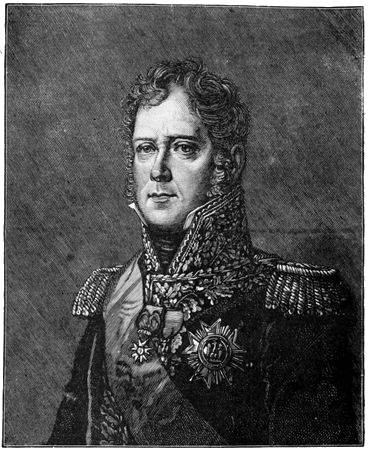
MARSHAL NEY.
[See larger version]
About the middle of May Wellington entered Spain, leading the centre division himself, the right being commanded by General Hill, and the left by Sir Thomas Graham, the victor of Barrosa. As they advanced, the French hastily retreated towards Valladolid, thence towards Burgos; and by the 12th of June, Wellington being close on that city, they blew up the fortifications of the castle, and retreated beyond the Ebro, which they hoped to be able to defend. But Wellington left them no time to fortify themselves. On the 14th he crossed the Ebro; on the 16th he was in full march after them towards Vittoria, for they found the Ebro no defence, as they had not time to blow up the bridges. On the 16th and 17th Major-General Alten harassed their rear, and dispersed a whole brigade in the mountains, killing considerable numbers, and taking three hundred prisoners. On the 19th they found the French army, commanded by Joseph Buonaparte, with Jourdan as his second and adviser, drawn up under the walls of Vittoria. It was so placed as to command the passages of the river Zadora, and the three great roads from Madrid, Bilbao, and Logroño. Their left extended to the heights of La Puebla, and behind this, at the village of Gomecha, was posted a reserve. The position was remarkably strong, and commanded by the hills interesting to Englishmen as those where the Black Prince, in his day, had defeated the French army at Najera, commanded by the gallant Duguesclin. Wellington took till the morning of the 21st to reconnoitre the position and to concentrate his army for the attack.
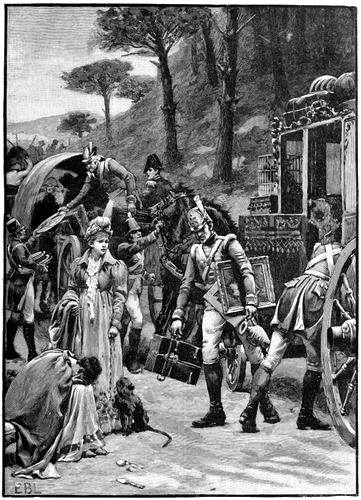
FLIGHT OF KING JOSEPH BUONAPARTE FROM VITTORIA. (See p. 58.)
[See larger version]
In the morning of that day—a fine and sunny day—Hill leading on our right drove the French from the heights of La Puebla. This was not done without a severe struggle. The Spanish general, Morillo, led on his brigade bravely, and was wounded. Colonel the Hon. G. Cadogan, in the action on the heights, was also mortally wounded, but refused to quit the field, and was carried to an elevation where he could watch the progress of the battle while he lived. General Hill then pushed the French across the river Zadora and the defiles and heights beyond to the village of Subijana de Alava, which he took possession of, and the French left fell back on Vittoria. The other divisions, under Lord Dalhousie, Sir Thomas Picton, and General Cole, also crossed the river at different bridges or fords, and everywhere drove the French before them. The scene from the heights, which were crowded with people, was one of the most animating ever beheld; the British everywhere advancing amid the roar of cannon and musketry, the French retiring everywhere on Vittoria. In the meantime, our left, under Sir Thomas Graham, having a considerable number of Spanish and Portuguese troops in it, advanced to the heights beyond the Zadora, along the Bilbao road, and carried the village of Gamara Mayor, while the Spanish division of Longa carried that of Gamara Monor. Both the Spanish and Portuguese troops behaved admirably. While Major-General Robertson's brigade carried Gamara Mayor, Colonel Halkett's, supported by that of General Bradford, carried the village of Abechuco. Here a determined effort was made by the French to recover this post, but they were driven back by Major-General Oswald, with the fifth division.
These points being all gained, the French were not left long in possession of Vittoria. They were pushed out of the town, and the whole united army joined in chasing them along the road towards Pampeluna. So complete was the rout that, according to Wellington's dispatch, they left behind them all their baggage, ammunition, every gun but one, and a howitzer.
So close were they upon King Joseph, that a party of the British, under Captain Wyndham, came upon him in his carriage, and fired through the window. Joseph had the good fortune to escape to horse, and gallop off, but his carriage fell into the hands of the British, and it was found crammed with the most precious spoil of the churches and palaces of Spain. Amongst his baggage, which also was taken, were found some of the finest paintings of the Spanish masters, rich plate, including a splendid dinner-service, a gorgeous wardrobe, and a number of his women, for he was a perfect Sybarite in luxury and voluptuousness. No such scene was witnessed, except on the defeat of some Eastern army. The officers had gorged themselves with the spoils of Spain, and here they were left, amid crowds of wives and mistresses, monkeys, poodles, parrots, silks, satins, and jewellery. The officers and soldiers had run for it, with nothing but their arms and their clothes on their backs, and all along the roads leading from the city was one vast crowding, jostling mass of waggons, loaded with all sorts of rich spoils, splendid dresses, and wines, and money, and fine ladies in the most terrible hurry and fright. Sheep, cattle, lambs, like a great fair, were left behind, and became the booty of the pursuers. There was a vigorous bursting open of packages, and rich wardrobes of both officers and ladies were soon fluttering in the winds—gorgeous uniforms on the backs of common soldiers and Portuguese camp-followers—fine silks and satins, and laces and gold chains, on the persons and necks of common women. The military chest was seized, and the soldiers freely helped themselves to its contents. Lord Wellington says that the troops got about a million of money. Planks were placed from waggon to waggon, and a great auction was going on everywhere, the lucky captors converting everything possible—even the heavy Spanish dollars—into gold, as more convenient for carriage. The inhabitants of the city made rich bargains, besides managing to help themselves plentifully in the scramble.
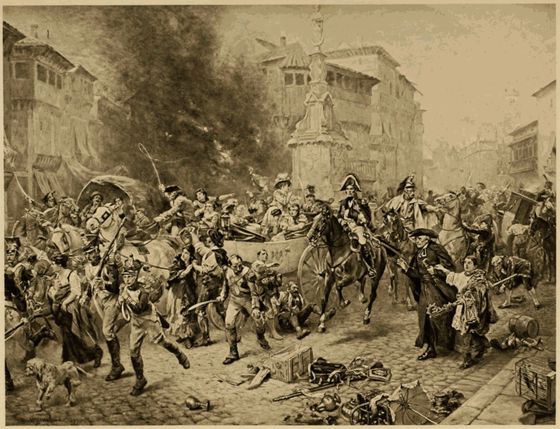
THE FLIGHT OF THE FRENCH THROUGH THE TOWN OF VITTORIA, JUNE 21st, 1813.
FROM THE PAINTING BY ROBERT HILLINGFORD.
[See larger version]
The army of Joseph dispersed at full speed, and as our cavalry could not pursue them across the hedges and ditches, they managed to escape, and made their way to Pampeluna in one wild, chaotic herd. On the field they profess to have left eight thousand men in killed and wounded, but their loss was far greater. They left, also, one hundred and fifty-one pieces of brass ordnance, four hundred and fifteen caissons, more than forty thousand rounds of ammunition, nearly two million musketball cartridges, forty thousand six hundred and sixty-eight pounds of gunpowder, fifty-six forage waggons, and forty-four forge waggons. The allied army had killed, British, five hundred and one; Portuguese, one hundred and fifty; Spaniards, only eighty-nine: wounded, British, two thousand eight hundred and seven; Portuguese, eight hundred and ninety-nine; Spanish, four hundred and sixty-four. Lord Wellington reported the conduct of almost every officer engaged as admirable. King Joseph did not stop till he was safe, for a time, within the strong walls of Pampeluna, but the garrison there would not admit the rabble herd of fugitives, but sent them off like enemies; and they were forced to continue their flight into the Pyrenees.
News of this most extraordinary defeat acted on the French, on all sides, like the concussion of some violent explosion. They fell back and fled in confusion before any enemy appeared. General Clausel, who was advancing from Logroño with fifteen thousand men, fled back to Saragossa with such precipitation, and thence through the central Pyrenees into France, that he left all his artillery and most of his baggage on the road. The same was the case with General Foy, who fled from Bilbao to Bayonne in hot haste, with General Graham at his heels. Except at San Sebastian and Pampeluna, where the garrisons were soon besieged, the French were scarcely to be found in Spain, except those with Suchet in the south-east.
Pampeluna and San Sebastian being invested, Lord Wellington proceeded with his main army to occupy the passes of the Pyrenees. These, Wellington, in his dispatches, says amounted to about seventy, and, in the service of securing these, he complains that he was left very much without the necessary supplies for his army. The British Government had, from some cause—he supposed to send them against the Americans—reduced the number of convoys, and many of our store-ships were taken by the French frigates and privateers. It was, as much as ever, in vain to expect the Spaniards to do anything to supply the deficiency, after all that the English had done for them. As fast as they got rid of the French, they busied themselves in making war on the clergy and putting them down. Wellington was, therefore, continually obliged to arrest his marches to wait for provisions. Notwithstanding, by the 7th of July he had driven Joseph Buonaparte through the mountains into France, chased Clausel beyond Tudela on the Ebro, and taken his post on the very edge of France. Buonaparte, alarmed at the progress of Wellington, displaced Jourdan as incapable, and sent back Soult to do what neither he, nor Ney, nor Marmont, nor Massena had been able to do before they were necessarily displaced—that is, arrest the onward march of Wellington into France.
Soult hurried southward, collecting fresh forces to repel the conquering invader, and issued a proclamation, telling the French soldiers that they had at length taught the English to fight, and they must show them that they were still their superiors. Whilst Wellington was superintending the sieges of San Sebastian and Pampeluna, Soult advanced, having gathered an army of nearly seventy thousand men, and, on the 25th of July, he suddenly attacked our outposts simultaneously in the passes of Roncesvalles and of Maya. Both these passes converged into one leading to Pampeluna, where Soult hoped to raise the siege. He himself led on thirty thousand fresh men up the Roncesvalles pass against Generals Cole and Picton, who had about ten thousand to oppose him. He compelled them to retreat to some greater elevations, but with considerable loss, and he hoped there to have them joined by General D'Erlon, who had ascended the Maya pass, with thirteen thousand men, against General Stewart, who had only four or five thousand men to oppose him. The conflict there had been terrible; the British fighting and giving way only step by step against the superior force. The awful struggle went on, five thousand feet above the plains of France, amid clouds and fogs. Stewart did not fall back till he had sixteen hundred of his small force killed and wounded, and the defiles were actually blocked up with the slain.
Matters were at this pass when Lord Wellington, who had heard of the attack, at his headquarters at Lezaco, two days before, came galloping up on the morning of the 27th. He found Soult only two leagues from Pampeluna, and saw him so near that he could plainly discern his features. Wellington caused his own presence to be announced to his two bodies of troops, and they answered the announcement with loud cheers. That day the troops of Soult were pushed backwards by a regiment of the Irish, and a body of Spanish infantry, at the point of the bayonet. The next day, the 28th, the French were driven down still farther. On the 29th both armies rested, but on the 30th the fight was renewed with fury; but Picton and Dalhousie, being sent across the mountains in opposite directions, managed to turn both flanks of Soult, and the French fled precipitately as far as Olaque. There the pursuing troops fell in with the right of the French, which had been worsted by Hill. In the darkness the French continued their flight, and the next morning were found in full retreat for France. The British gave chase, and made many prisoners, taking much baggage. These battles, which have been named "The Battles of the Pyrenees," Wellington describes as some of the most severe that he ever saw. He states the loss of the British in killed at one thousand five hundred, but in killed and wounded at six thousand. The French, he says, admitted that they had lost fifteen thousand men, and he therefore gave them credit for the loss being much more. On one occasion Wellington surprised Soult, and had so laid his plans for surrounding him that he felt sure of capturing him; but three drunken British soldiers, rambling carelessly beyond the outposts, were taken, and let out the secret of Wellington being hidden close at hand, behind the rocks, and thus saved the French commander. A second time he was saved by the Spanish generals, Longa and Barcenas, not being at their posts in a narrow defile near St. Estevan, where he could only pass by a slender bridge. Still the British were at his heels, and committed dreadful havoc on his troops in this pass. On the 2nd of August there was a fresh encounter with Soult's forces near the town of Echalar, where they were again beaten, and driven from a lofty mountain called Ivantelly. Soult retired behind the Bidassoa, and concentrated his routed forces; and Wellington, having once more cleared the passes of the Pyrenees of the French, gave his army some rest, after nine days of incessant and arduous action, where they could look out over the plains of France, which they were ere long to traverse. But the army had not much rest here. The French made determined efforts to raise the siege of San Sebastian, while Wellington was as active in endeavouring to force Pampeluna to capitulate. Unfortunately he had still scarcely any proper men or tools for siege-work. He had long urged on the Government the formation of companies of sappers and miners. But, after eighteen months, they had formed only one company, whilst, as Wellington informed the Government, there was no French corps d'armée which had not a battalion of them. This first British company of sappers and miners came out on the 19th of August, and were immediately set to work. Sir George Collier sent his sailors to assist, and on the 31st Wellington considered that he had made sufficient breach for storming. But that morning Soult sent across the Bidassoa a strong body of French to attack the besiegers. These were met by a division of eight thousand Spaniards, who allowed the French to ascend the heights of San Marcial, on which they were posted, and then, with a shout, charged with the bayonet down hill, at which sight the French instantly broke, and ran for it. They were pursued to the river, in which many plunged, and were drowned. In the afternoon Soult sent over again fifteen thousand men, having put across a pontoon bridge. These, under the eye and encouragement of Lord Wellington, were charged again by the Spaniards, and routed as before; many again rushing into the river, and the rest, crushing upon the bridge, broke it down, and perished in great numbers also. The Portuguese troops likewise met and defeated another detachment of French, who had come by another way. These were supported by British troops, under General Inglis, and with the same result. Wellington was highly delighted to see the Spaniards thus, at length, doing justice to their native valour under British discipline, and praised them warmly. Soult is said to have lost two thousand men.
While this was going on, the town of San Sebastian was stormed by the British. Sir Thomas Graham conducted the assault, which was led on by the brigade of General Robinson, bravely supported by a detachment of Portuguese under Major Snodgrass. The place was captured; the French were driven through it to the castle standing on a height, in which they found refuge. Seven hundred prisoners were taken. The British lost two thousand men in the assault—a loss which would have been far greater had a mine, containing one thousand two hundred pounds of gunpowder, exploded, but which was fortunately prevented by the falling in of a saucisson. Many less would have fallen, however, had General Graham allowed shells to be thrown into the town, which he would not, on account of the inhabitants. But the French had not only prepared this great mine, but exploded various other appliances for setting the town on fire. In fact they showed no care for the people or the town. When driven to the castle, after a murderous street fight—in which they picked off our men from behind walls and windows, killing Sir Richard Fletcher, the commanding engineer, and wounding Generals Robinson, Leith, and Oswald, besides slaughtering heaps of our men—they continued to fire down the streets, killing great numbers of the inhabitants besides our soldiers. Yet, after all, they charged Lord Wellington with not only throwing shells into the town, but with setting it on fire, and plundering it. His lordship indignantly repelled these accusations in his letter to his brother, Sir Henry Wellesley. He declares that he himself had been obliged to hasten to his headquarters at Lezaco, on the morning of the 31st of August, but that he saw the town on fire in various places before our soldiers entered it; in fact, the French had set it on fire in six different places, and had their mine exploded scarcely a fragment of the town would have been left, or a single inhabitant alive. The lenity shown to the town by Wellington and Graham, who acted for him, was not used towards their calumniators in the castle. It was stoutly bombarded, and being soon almost battered to pieces about the ears of the defenders, the French surrendered on the 8th of September, two thousand five hundred in number; but the siege of both town and fort had cost the allies four thousand men in killed and wounded. Had the town been, as the French represented, bombarded like the castle, some thousands of English and Portuguese lives would have been spared, but at the expense of the inhabitants.
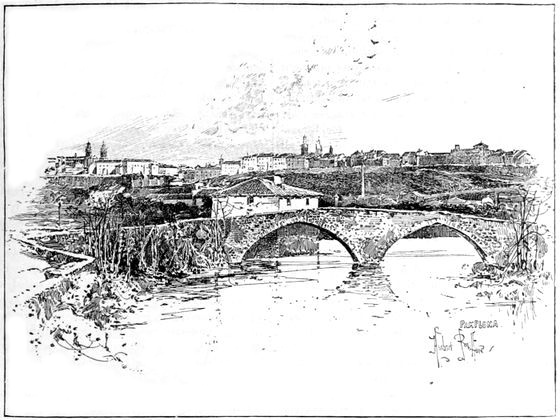
PAMPELUNA.
[See larger version]
Lord Wellington, early in October, called down his troops from their cold and miserable posts in the mountains, and marched them over the Bidassoa, and encamped them amongst the French hills and valleys of La Rhune. The last division moved across on the 10th of November, the town of Pampeluna having surrendered on the 31st of October. This was a very agreeable change to the troops; but, before crossing, his lordship issued the most emphatic orders against plundering or ill-using the inhabitants. He told them, and especially the Spanish and Portuguese, that though the French had committed unheard-of barbarities in their countries, he would not allow of retaliation and revenge on the innocent inhabitants of France; that it was against the universal marauder, Buonaparte, and his system, that the British made war, and not against the people of France. But the passions of the Portuguese and Spaniards were too much excited against their oppressors, and they burnt and plundered whenever they had opportunity. On this, Wellington wrote sternly to the Spanish general, Freyre. "Where I command," he said, "no one shall be allowed to plunder. If plunder must be had, then another must have the command. You have large armies in Spain, and if it is wished to plunder the French peasantry, you may then enter France; but then the Spanish Government must remove me from the command of their armies. It is a matter of indifference to me whether I command a large or a small army; but, whether large or small, they must obey me, and, above all, must not plunder." To secure the fulfilment of these orders, he moved back most of the Spanish troops to within the Spanish frontiers. The strictness with which Lord Wellington maintained these sentiments and protected the inhabitants produced the best results. The folk of the southern provinces, being well inclined to the Bourbons, and heartily wearied of seeing their sons annually dragged away to be slaughtered in foreign countries for Buonaparte's ambition, soon flocked into camp with all sorts of provisions and vegetables; and they did not hesitate to express their wishes for the success of the British arms.
Under sharp fighting, Wellington crossed the Nivelle on the 10th of November, and proposed to go into cantonments at St. Jean de Luz, on the right bank of the Nivelle; but he did not find himself in a position to obtain supplies there, and he therefore crossed the Nive, and occupied the country between that river and the Adour. Soult made desperate efforts to drive the enemy back; but he was compelled to fall back on his entrenched camp in front of Bayonne; and Wellington went into winter-quarters about the middle of December, but quarters extremely uncomfortable. Their late conflicts, between the 9th and 13th of December, had been made in the worst of weather, and they had marched over the most terrible roads. During these conflicts they had lost six hundred and fifty killed, and upwards of one thousand wounded and five hundred missing. The French had lost three times that number. But the French were at home amid their own people; while the allies were in a hostile country, suffering every species of want. At this moment Britain was sending clothes, arms, and ammunition to the Germans, the Sclavonians, and Dutch; but her own gallant army, which had chased the French out of Spain, and which had to maintain the honour of Great Britain by advancing towards Paris, was suffered to want everything, especially great-coats and shoes, in that severe season. Wellington had earnestly implored a reinforcement of twenty thousand men, but it did not arrive.
In the south-east of Spain the motley army of British and Sicilians had done sufficient to keep the attention of Suchet engaged, so that he could not quit that post to follow and assist Soult against the main British army. Lord Wellington had instructed Sir George Murray to embark his troops at Alicante, and, sailing to Tarragona, endeavour to make himself master of it; if he found the French too strong in that quarter to enable him to effect his purpose, he was to re-embark, return to Valencia, and then attack the French lines on the Xucar before Suchet could make the long march which would be necessary to support them. Murray had had his army weakened by the withdrawal of two thousand troops by Lord William Bentinck, very unnecessarily, to Sicily; but he undertook these manœuvres, and might have succeeded in capturing Tarragona, but, alarmed at a rumour of Suchet and General Mathieu having combined their forces, and being in march against him, he abandoned the place panic-stricken, and, in spite of the indignant remonstrances of Admiral Hallowell, embarked his troops in the utmost precipitation. Lord William Bentinck arrived on the 17th of June, immediately after the embarkation, but not in time to save nineteen pieces of artillery, which Murray had abandoned in the trenches. Lord Bentinck battered down Fort Balaguer, and then sailed away to Alicante, leaving the Spanish general exposed to the enemy, but he saved himself by escaping into the mountains. For this conduct, Sir George Murray on his return to England was tried by court-martial, and gently reprimanded, but nothing more.
Lord William Bentinck, after having retired to Alicante, once more returned to Tarragona, and made himself master of that place. Attempting further advantages in this country, he was compelled to fall back on Tarragona with considerable loss. He then returned to Sicily, and General Clinton took the command of the forces, and strengthened the defences of the post. At the same time news arrived of the retreat of Buonaparte from Russia and the rising of Germany, which compelled Suchet to disarm his German regiments, and march them into France under guard. He had also to send some of his best French troops to recruit Buonaparte's decimated army, and the Italian ones to resist the Austrians in Italy, who were once more in motion through the Alps. In these circumstances the campaign in the south-east of Spain closed for the year.
During the winter of 1812 and the spring of 1813 Buonaparte was making the most energetic exertions to renew the campaign against Russia and the German nations that were now uniting with the Czar. He called out new conscriptions, and enforced them with the utmost rigour; the militia were drafted extensively into the regular army, and the sailors, whose service had been annihilated by the victorious seamen of Great Britain, were modelled into regiments, and turned into soldiers. He sent for part of his forces from Spain; and in the spring he was enabled to present himself in Germany at the head of three hundred and fifty thousand men. But this was a very different army from that which he had led into and lost in Russia—an army of practised veterans, familiar with victory through a hundred fights. It was necessarily but ill-disciplined, and much more full of the sense of wrong in having been dragged from home and its ties than of any thirst of glory. The cavalry was especially defective, and had lost the commander who gave it such spirit by his own example. Disgusted by the insolence and sarcasms of Buonaparte, and believing that his career was about to end, Murat quitted his command on the 16th of January, 1813, and hastened to Naples, where he was not long in opening negotiations with Great Britain and the other Powers for the acknowledgment of his kingdom as one independent of France, and ranking with the other established Powers of Europe. Nor was this the only alarming circumstance. Bernadotte was at the head of an army of Swedes against him—Bernadotte whom he had driven by the same insolent and unbearable domination into the arms of his enemies, and whom he now denounced as a renegade Frenchman who had renounced his country. The truth, however, was that Bernadotte had been adopted by a new country, and was bound to defend it.
Next came the declaration of war by the King of Prussia, which Buonaparte styled a treachery; but, on the contrary, the King of Prussia had only preserved faith towards his oppressor and insulter too long. Not only all Prussia, but all Germany was on fire to throw off the detested yoke of the oppressor, and Frederick William would have been a traitor to his people and to common sense to have hesitated. Yet he proposed terms of a mutual settlement. To place himself in a position of independent treaty, he suddenly left Berlin on the 22nd of January, and made his way to Breslau, where he was out of the reach of French arms, and in certainty of the arrival, at no very distant date, of Russian ones. He invited, however, the French ambassador to follow him, and he there proposed an armistice, on the conditions that the French should evacuate Dantzic and all the other Prussian fortresses on the Oder, and retire behind the Elbe, on which the Czar had promised that he would stop the march of his army beyond the Vistula. But Buonaparte treated the proposition with contempt; he was determined to give up nothing—to recover everything.
Immediately on the rejection of his terms Frederick William concluded a treaty with Alexander on the 28th of February, and Austria was invited to join the league. Alexander had joined his army himself on the 22nd of December, and had marched along with it through that horrible winter. On the 1st of March Prussia concluded its alliance with Alexander, offensive and defensive. On the 15th Alexander arrived at Breslau, and there was an affecting meeting of the two sovereigns, who had been placed in outward hostility by the power of Buonaparte, but who had never ceased to be friends at heart. The King of Prussia was moved to tears. "Courage, my brother," said Alexander; "these are the last tears that Napoleon shall cause you."
The next day the war against France was proclaimed, and for the righteous cause of restoring the independence of the nations. Prussia, and indeed all Germany, had now been trampled on sufficiently to crush the effeminacy out of all classes—to rouse the true soul of liberty in them. Men of every rank offered themselves as the defenders and avengers of their country; the students at this moment not only sung, but aided freedom. The volunteers were formed into Black Bands, and others assumed the dress and arms of the Cossacks, who had won much admiration. They were disciplined in the system of Scharnhorst, and soon became effective soldiers. A leader was found for them after their own heart—the brave and patriotic Blucher, who had been reserving himself for this day, and Scharnhorst and Gneisenau, better tacticians than himself, were appointed to assist him, and carry out all the strategic movements; whilst Blucher, never depressed by difficulties, never daunted by defeat, led them on with the cheer from which he derived his most common appellation of Marshal Forwards—"Forwards! my children, forwards!" All classes hastened to contribute the utmost amount possible to the necessary funds for this sacred war. The ladies gave in their gold chains and bracelets, their diamonds and rubies, and wore as ornaments chains and bracelets of beautifully wrought iron.
Austria stood in a hesitating position. On the one hand, she felt reluctant to join the Allies and assist in destroying the throne of the Emperor's son-in-law; but at the same time she was anxious to strengthen her own position by giving more strength to her neighbour, Prussia. For this purpose Austria offered her mediation for a peace on terms that would restore Prussia to a more becoming position, and such proposals of mediation were made by the Austrian Minister to Great Britain. But these entirely failed. On the one hand, Napoleon would concede nothing, but declared that he would entirely annihilate Prussia, and would give Silesia to Austria for her assistance in the war; on the other hand, Great Britain declared that there could be no peace unless France disgorged the bulk of her usurpations.
On the 15th of April Buonaparte quitted Paris, for the last time as a permanent abode; on the 16th he was at Mainz, and on the 25th at Erfurt. Before quitting Paris he had appointed Maria Louisa regent in his absence. This he deemed a stroke of policy likely to conciliate the Emperor of Austria. But the Empress's power was merely nominal. She could appear at the Council board, but it was only as the instrument of the Emperor; he carried all active power along with him, and ruled France from his camp. He had still upwards of fifty thousand troops in the garrisons of Prussia, commanded by Eugene, the Viceroy of Italy; and he advanced at the head of three hundred thousand men. Eugene Beauharnais had been compelled necessarily to evacuate Dantzic, Berlin, and Dresden as the Russians and Prussians advanced, and to retreat upon the Elbe. In the month of May Bernadotte, according to concert, crossed over to Stralsund with thirty-five thousand men, and awaited the reinforcements of Russians and Germans which were to raise his division to eighty thousand men, with which he was to co-operate with the Allies, and protect Hamburg. The Allies, under Tetterborn, Czernicheff, and Winzengerode, spread along both sides of the Elbe, the Germans rising enthusiastically wherever they came. Hamburg, Lübeck, and other towns threw open their gates to them. The French general, Morand, endeavouring to quell the rising of the people of Lüneburg, was surprised by the Russians, and his detachment of four thousand men was cut to pieces, or taken prisoners. Eugene marched from Magdeburg to surprise Berlin, but was met at Möckern, defeated, and driven back to Magdeburg. Such was the success of the Allies, and the exulting support of the people, that even Denmark and Saxony began to contemplate going over to the Allies. Blucher entered Dresden on the 27th of March, driving Davoust before him, who blew up an arch of the fine bridge to cover his retreat. The Emperor of Russia and King of Prussia entered the city soon afterwards, and were received by the inhabitants with acclamations. On the 28th of April died the old Russian general, Kutusoff, at Bautzen, and was succeeded by General Wittgenstein.
At the approach of the new French levies, Eugene Beauharnais retreated from Magdeburg, and joined them on the Saale. The Allies and Napoleon now lay face to face, the Allies cutting off his advance towards Leipsic and thence to Dresden. He resolved to make a determined attack upon them, and demoralise them by a blow which should make him master of Leipsic, Dresden, and Berlin at once, and give its impression to the whole campaign. In the skirmishes which took place previous to the general engagement at Weissenfels and Poserna on the 29th of April and the 1st of May, Buonaparte gained some advantages; but in the latter action his old commander of the Imperial Guard, Marshal Bessières, was killed. His death was deeply lamented, both by his men, who had served under him from the very commencement of Buonaparte's career, and by Buonaparte himself.
The first great battle was destined to be fought on the very ground where Gustavus Adolphus fell, 1632. Buonaparte marched upon Leipsic, expecting to find the Allies posted there; but he was suddenly brought to a stand by them at Lützen. The Allies, who were on the left bank of the Elster, crossed to the right, and impetuously attacked the French, whose centre was at the village of Kaya, under the command of Ney, supported by the Imperial Guard, and their fine artillery drawn up in front of the town of Lützen; the right wing, commanded by Marmont, extending as far as the defile of Poserna, and the left stretching from Kaya to the Elster. Napoleon did not expect to have met the Allies on that side of Leipsic, and was pressing briskly forward when the attack commenced. Ney was first stopped at Gross-Görschen. Had Wittgenstein made a decided charge with his whole column, instead of attacking by small brigades, he would assuredly have broken the French lines. But Buonaparte rode up, and galloped from place to place to throw fresh troops on the point of attack, and to wheel up both of his wings so as to enclose, if possible, both flanks of the Allies. The conflict lasted some hours, during which it was uncertain whether the Allies would break the centre of the French, or the French would be able to outflank the Allies. Blucher was late on the field; the officer who was sent overnight to him with orders from Wittgenstein is said to have put them under his pillow and slept on them till roused by the cannon. At length, after a desperate attack by Napoleon to recover the village of Kaya, out of which he had been driven, the Allies observing that the firing of Macdonald and Bertrand, who commanded the two wings, was fast extending along their flanks, skilfully extricated themselves from the combat, and led back their columns so as to escape being outflanked by the French. Yet they did not even then give up the struggle for the day. The Allied cavalry made a general attack in the dark, but it failed from the mighty masses of the French on which they had to act. The Allies captured some cannon, the French none. The loss of the Allies was twenty thousand men, killed and wounded: that of the French was equally severe. Seven or eight French generals were killed or wounded. On the side of the Allies fell General Scharnhorst—an irreparable loss, for no man had done more to organise the Prussian landwehr and volunteers. The Prince Leopold of Hesse-Homburg and the Prince of Mecklenburg-Strelitz, both allied to the royal family of England, were slain, and Blucher himself was wounded; but he had his wounds dressed on the field, and would not quit it till the last moment.
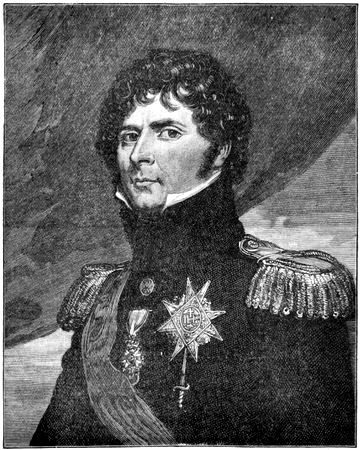
BERNADOTTE (KING OF SWEDEN).
[See larger version]
Napoleon, who had every need of success to regain his former position in the opinion of France, sent off in all haste to Paris the most exaggerated account of the battle of Lützen, as one of the most decisive victories that he had ever won, and that it had totally scattered the Allies, and neutralised all the hopes and schemes of Great Britain. The Empress went in procession to Notre Dame, where Te Deum was celebrated by Cardinal Maury, who drew the most extravagant picture of Napoleon's invincible genius. The same false statements were sent also to every friendly Court in Europe, even to Constantinople. The stratagem had its effect. The wavering German princes, who were ready to go over to their own countrymen, still ranged their banners with the French. The King of Saxony had gone to Prague as a place whence he might negotiate his return to the ranks of his own fatherland; but he now hastened back again, and was in Dresden on the 12th of May with Napoleon, who conducted him in a kind of triumph through his capital, parading his adhesion before his subjects who had hailed the Allies just before with acclamations. The Saxon king, in fresh token of amity to Napoleon, ceded to him the fortress of Torgau, much to the disgust of his subjects.
But the Allies had only fallen back behind the Elbe, and taken up a strong position at Bautzen, on the Spree, about twelve leagues from Dresden, whilst an army under Bülow covered Berlin. No sooner did the Allies fall back to the right bank of the Elbe than Davoust attacked Hamburg on the 9th of May with five thousand men, and vowed vengeance on the city for having admitted the Allies. To their surprise the citizens found themselves defended by a body of Danes, from Altona, who were the allies of France, but had been just then thinking of abandoning Napoleon. But the fate of the battle of Lützen changed their views, and they retired in the evening of that day, leaving Hamburg to the attacks of the French. Bernadotte, not having received the promised reinforcements, did not venture to cover Hamburg. Davoust entered the place like a devil. He shot twelve of the principal citizens, and drove twenty-five thousand of the inhabitants out of the city, pulled down their houses, compelling the most distinguished men of the town to work at this demolition and at raising the materials into fortifications. The people had long been subjected by the French to every possible kind of pillage and indignity; no women, however distinguished, had been allowed to pass the gate without being subjected to the most indecent examinations. But now the fury of the French commander passed all bounds. He levied a contribution of eighteen millions of dollars: and not satisfied with that, he robbed the great Hamburg bank, and declared all his doings to be by orders of the Emperor.
Napoleon, reinforced by a number of French, Bavarian, Würtemberg, and Saxon troops, moved off to attack the Allies at Bautzen, on the 19th of May. He had detached Lauriston and Ney towards Berlin to rout Bülow, but they were stopped by Barclay de Tolly and Yorck at Königswartha and at Weissig, and compelled to retreat. On the 21st Ney combined with Napoleon, and they made a united attack on Blucher's position on the fortified heights of Klein and Klein-Bautzen. In this battle German fought against German, the Bavarians against Bavarians, for they took both sides, such was the dislocated state of the nation. It was not till after a long and desperately-fought battle that the Allies were compelled to give ground, and then they retired, without the loss of a single gun, and posted themselves strongly behind the fortress of Schweidnitz, so famous in the campaigns of Frederick of Prussia.
In this battle the Allies lost in killed and wounded ten thousand men, the French not less than fifteen thousand. The French generals Bruyères, Kirchner, and Duroc were amongst the killed. Duroc had long been one of the most intimate friends and attendants of Buonaparte, who was so much cut up by his loss that for the first time in all his terrible campaigns he became unable to attend to further details, but answered every call for orders with "Everything tomorrow!" When he came to find that not a gun, not a prisoner was left behind by the Germans and Russians, Napoleon seemed to comprehend the stern spirit in which they were now contending, and exclaimed, "How! no result after such a massacre? No prisoners? They leave me not even a nail!" He advanced to Breslau, various slight conflicts taking place on the way, and on the 1st of June he entered that city, the princesses of Prussia removing thence into Bohemia.
An armistice was now demanded by the Allies—it is said at the instance of Austria, who desired to act as mediator—and gladly assented to by Napoleon, who was desirous of completing his preparations for a more determined attack. The armistice was signed on the 4th of June at the village of Pleisswitz.
At the time of this armistice, Napoleon, by the great battles of Lützen and Bautzen, had recovered his prestige sufficiently to induce the German Confederates of the Rhine to stand by him; but he was by no means what he had been. The opinion of his invincibility had been irreparably damaged by the Russian campaign, and the success in these battles was not of a character to give confidence to his own army. They saw that the Allies had lost all superstitious fear of him. To assist in the negotiations of this armistice, Buonaparte sent for his two ablest heads, Fouché and Talleyrand, whom he had so long thrown from him for their sound advice. If Buonaparte could have heard, too, what was really going on in France, what were the growing feelings there, he would have been startled by a most ominous condition of things. But he had thoroughly shut out from himself the voice of public opinion, by his treatment of the press and of liberty, and he now was to suffer for it. Great Britain, on the 14th of June, had concluded an alliance with Russia and Prussia, and promised to send ample materials of assistance, even an army to the north of Prussia; and many British officers of the highest rank repaired to the headquarters of the Allies. When Great Britain was asked to take part in this negotiation she refused, declaring it useless, as Napoleon would not grant the only demands which the Allies ought to make.
Austria professed great friendliness to Napoleon, and he thought that she would not like to break with him on account of the Empress. But Austria, on the 27th of June, signed an engagement with Russia and Prussia, at Reichenbach, in Silesia, binding herself to break with him if he did not concede the terms which they demanded. These were to restore Illyria and the whole of Austrian Italy; to reinstate the Pope; to leave Poland to the three Powers who had formerly possessed themselves of it, and to renounce Spain, Holland, Switzerland, and the Confederation of the Rhine. Buonaparte treated these demands as sheer madness; but he was nearly mad himself when Talleyrand and Fouché, and still more, his best military counsellors, advised him at least to fall back to the left bank of the Rhine, and make that the boundary of France. He offered to annihilate the Grand Duchy of Warsaw, giving up the whole of Poland to Russia—such was his gratitude to the Poles!—to restore Illyria to Austria, but to cut down Prussia still more by pushing the Rhenish Confederation to the Oder.
His terms were rejected with disdain. Yet he had a last interview with Metternich, in which he hoped to terrify him by a dread of the future preponderance of Russia; but, seeing that it made no impression, he became incensed, and adopted a very insolent tone towards the Austrian Minister. "Well, Metternich," he demanded, "how much has England given you to induce you to play this part towards me?" Metternich received the insult in haughty silence. Buonaparte, to try how far the diplomatist still would preserve his deference towards him, let his hat fall: Metternich let it lie. This was a sign that the Austrian had taken his part; it was, in fact, the signal of war. Yet, at the last moment, Napoleon suddenly assumed a tone of conciliation, and offered very large concessions. He had heard the news of the defeat of Vittoria. But it was too late. The Congress terminated on the 10th of August, and the Allies refused to re-open it. On the 12th of August, two days after the termination of the armistice, Austria declared herself on the side of the Allies, and brought two hundred thousand men to swell their ranks. This redoubtable force was commanded by her general, Prince von Schwarzenberg.
Immediately after the termination of the armistice the Russians and Prussians joined the great army of the Austrians, which had been concentrated at Prague. Their plan was to fall upon Buonaparte's rear. Full of activity, that unresting man had been busy, during the whole armistice, in defending his headquarters at Dresden by fortifications. He had cut down all the trees which adorned the public gardens and walks, and used them in a chain of redoubts and field-works, secured by fosses and palisades. He was in possession of the strong mountain fortresses of the vicinity, as well as those of Torgau, Wittenberg, Magdeburg, and others, so that the valley of the Elbe was in his hands; and he had a bridge of boats at Königstein, extending his communications to Stolpe: thus guarding against an attack on the side of Bohemia. In the beginning of August he assembled two hundred and fifty thousand men in Saxony and Silesia. Of these, sixty thousand lay at Leipsic under Oudinot, and one hundred thousand in different towns on the borders of Silesia, under Macdonald; he himself lay at Dresden with his Imperial Guard. Eugene Beauharnais he had dispatched to Italy, where he had forty thousand men. Besides these, he had a reserve of Bavarians, under General Wrede, of twenty-five thousand men.
Besides the grand army of the Allies, of two hundred thousand, marching from Bohemia, one hundred and twenty thousand Austrians, and eighty thousand Russians and Prussians, Blucher lay on the road to Breslau with eighty thousand; the Crown Prince of Sweden, near Berlin, with thirty thousand Swedes and sixty thousand Prussians and Russians; Walmoden lay at Schwerin, in Mecklenburg, with thirty thousand Allies; and Hiller, with forty thousand Austrians, watched the army of Italy.
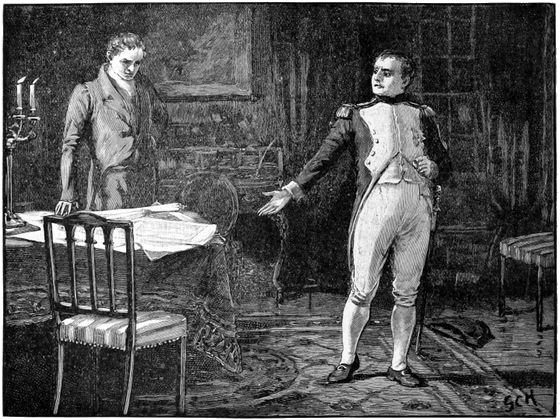
NAPOLEON'S INTERVIEW WITH METTERNICH. (See p. 67.)
[See larger version]
Whilst these gigantic armies were drawing towards each other, in the early part of August, for what was afterwards called "the grand battle of the peoples," the weather seemed as though it would renew its Russian miseries on the French. They had to march in constantly deluging rains, up to the knees in mud, and to risk their lives by crossing flooded rivers. Amid these buffetings of the elements the conflict began, on the 21st of August, between Walmoden and Davoust, at Vellahn. A few days afterwards, in a skirmish with Walmoden's outposts at Gadebusch, Korner, the youthful Tyrtæus of Germany, fell.
The plan of the campaign is said to have been laid down by Bernadotte, and adopted, after some slight revision, by General Moreau. That general, whom the jealousy of Buonaparte had expelled from France, and who had retired to America, now returned in the hope of seeing the fall of Buonaparte effected, and peace and a liberal constitution given to his country. He came not to fight against France, but against Buonaparte. The plan showed that they who devised it knew Napoleon's art of war. It was to prevent him from attacking and beating them in detail. Whichever party was first assailed was to retire and draw him after them, till the other divisions could close round him, and assail him on all sides. Blucher was the first to advance against Macdonald and Ney. As had been foreseen, Buonaparte hastened to support these generals with the Imperial Guard and a numerous cavalry, under Latour-Maubourg. But Blucher then retired, and, crossing the Katzbach, sat down near Jauer, so as to cover Breslau. The purpose was served, for Schwarzenberg, accompanied by the sovereigns of Russia and Prussia, as well as by Moreau, had rushed forward on Dresden, driving St. Cyr and twenty thousand men before them, who took refuge in Dresden. The Allies were at his heels, and on the 25th of August began to attack the city. They hoped to win it before Buonaparte could return, in which case they would cut off his line of communication with France—stopping the advance both of his supplies and reinforcements. But the very next day, whilst they were in vigorous operation against the city, and had already carried two redoubts, Buonaparte was seen advancing in hot haste over the bridges into Dresden. Warned of its danger, he had left Macdonald to defend himself, and now led his troops across the city and out at two different gates upon the enemies. The battle continued that day, and was resumed the next, by Buonaparte pushing forward immense bodies of troops from different gates, and concentrating them on the Allies. The attempt to take the city in Buonaparte's absence had failed, and now they saw themselves in danger of being enclosed by Murat—who had again been induced to join the Emperor—on the Freiberg road, and by Vandamme on the road to Pirna, by the Elbe. They were, therefore, compelled to fall back, and the withdrawal soon proved a flight. Napoleon pursued them hotly amid torrents of wind and rain, and made great slaughter, especially of the Austrians, who were seized with a panic of the enemy who had so often beaten them. Seven or eight thousand French were killed and wounded; but of the Allies, chiefly Austrians, more than twenty thousand were killed or disabled. During the engagement Moreau had both his legs shot away by a cannon ball, and died in a few days.
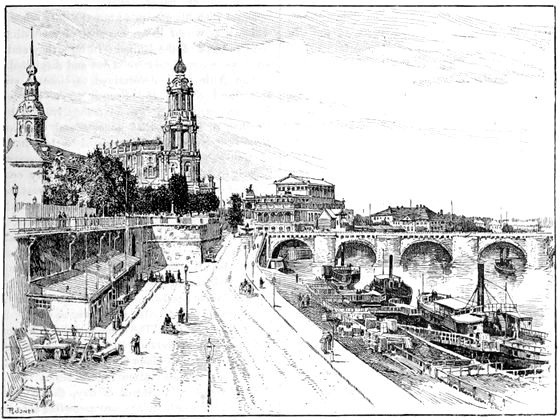
VIEW IN DRESDEN.
[See larger version]
Buonaparte continued the pursuit of the Allies as far as Pirna, whence, owing to indisposition, he returned to Dresden; but Vandamme, Murat, Marmont, and St. Cyr pushed forward by different ways to cut off the route of the fugitives into the mountains of Bohemia. Vandamme, however, having passed Peterswald, beyond which he had orders not to proceed, was tempted to try for Töplitz, where the Allied sovereigns lay, and take it. In doing this he was enclosed, in a deep valley near Kulm, by Ostermann and other bodies of the Allies, completely routed, and taken prisoner, with Generals Haxo and Guyot, the loss of two eagles, and seven thousand prisoners. This was on the 29th of August.
On the 26th Blucher had nearly annihilated the division of Macdonald. No sooner did he learn the return of Buonaparte to Dresden than he wheeled round upon Macdonald, taking him by surprise, and driving his troops into the rivers Katzbach and Neisse, swollen by the rains. The battle raged the most fiercely near Wahlstadt, and, on the subsidence of the floods, hundreds of corpses were seen sticking in the mud. A part of the French fled for a couple of days in terrible disorder along the right bank of the Neisse, and were captured, with their general, by the Russian commander, Langeron.
The same fate befell the troops of Ney, who had been sent to dislodge Bernadotte and Bülow before Berlin. He was beaten at Dennewitz on the 6th of September, with a loss of eighteen thousand men and eighty guns. Macdonald had lost on the Katzbach many thousands slain or dispersed, eighteen thousand prisoners, and a hundred and three guns. His army was nearly annihilated. Between this period and the end of September the French generals were defeated in every quarter: Davoust by Walmoden; another body of French by Platoff, on the 29th; Jerome by Czernicheff, on the 30th; and Lefebvre by Thielemann and Platoff, at Altenburg.
These defeats, which were gradually hemming Napoleon round by his enemies in Dresden, were the direct result of the active aid of Great Britain to the Allies. Sir Charles Stewart, the brother of Lord Castlereagh, had been dispatched to the headquarters of the Allies. By means of the abundant supplies of arms and money, the population of Hanover was raised; Bernadotte was kept firm to his support of the Coalition; and, by Sir Charles, he was also urged to march on Leipsic, and be present at the final conflict. Brigadier-General Lyon was sent to head the troops in Hanover; and the Duke of Cambridge to conduct the civil government of the country. Money was supplied in abundance, in addition to military stores. Two millions were advanced to the Crown Prince of Sweden for his army, two millions more to the Russians and Prussians, and another half million to Russia to equip its fleet in the Baltic. Without these vast supplies the combined armies could not have kept their ground.
From the 24th of September till the commencement of October Buonaparte continued to maintain himself at Dresden, though the Allies were fast gathering round him. Occasionally he made a rush from the city, and on one occasion pursued Blucher as far as Nollendorf, beyond Kulm; but these expeditions only served to exhaust his troops, without producing any effect on the enemy. As he chased one body on one side, others were closing up on other sides. Seeing that he could not remain long at Dresden, and that Bernadotte and Bülow had quitted the neighbourhood of Berlin, he suddenly conceived the design of marching rapidly on that city, and taking up his headquarters there; but this scheme met with universal disapprobation from his officers, and he was compelled to abandon it. He then continued for days, and even weeks, in a state of listless apathy, for hours together mechanically making large letters on sheets of paper, or debating some new schemes with his generals; but the only scheme to which they would listen was that of retreating to the left bank of the Rhine. In fact, they and the army were completely worn out and dispirited.
The Allies now determined to close in on all sides, and compel the French to a surrender. But Buonaparte, after some manœuvres to bring Blucher to action—that general and the Crown Prince of Sweden having crossed to the left bank of the Elbe—found it at length necessary to retreat to Leipsic. He reached that city on the 15th of October, and learned, to his great satisfaction, that whilst his whole force would be under its walls within twenty-four hours, the Austrians were advancing considerably ahead of the Prussians; and he flattered himself that he should be able to beat the Austrians before the other Allies could reach them.
Leipsic is nearly surrounded by rivers and marshy lands, and only, therefore, accessible by a number of bridges. The Pleisse and the Elster on the west, in various divisions, stretch under its walls; on the east winds far round the Parthe; on the south only rise some higher lands. On the 16th of October, at break of day, the Austrians attacked the southern or more accessible side with great fury, headed by Generals Kleist and Mehrfeldt, and were opposed by Poniatowski and Victor. Buonaparte was soon obliged to send up Souham to support these generals. Lauriston also was attacked by Klenau at the village of Liebertvolkwitz. After much hard fighting, Buonaparte ordered up Macdonald, who broke through the Austrian line at the village of Gossa, followed by Murat; Latour-Maubourg and Kellermann galloped through with all their cavalry. Napoleon considered this as decisive, and sent word to the King of Saxony that the battle was won, and that poor dupe and unpatriotic king set the church bells ringing for joy. But a desperate charge of Cossacks reversed all this, and drove back the French to the very walls of the town. In the meantime, Blucher had attacked and driven in Marmont, taking the village of Machern with twenty pieces of cannon and two thousand prisoners. On the side of the Pleisse Schwarzenberg pushed across a body of horse, under General Mehrfeldt, who fell into the hands of the French; but another division, under General Giulay, secured the left bank of the Pleisse and its bridges, and had he blown them up, would have cut off the only avenue of retreat for the French towards the Rhine. Night fell on the fierce contest, in which two hundred and thirty thousand Allies were hemming in one hundred and thirty-six thousand French; for the Allies this time had adopted Buonaparte's great rule of conquering by united numbers.
The next day the battle paused, as by mutual consent; and as it was evident that the French must eventually retreat, this day should have been spent in preparing temporary bridges to cross the rivers; but, as at Moscow, the presence of mind of Buonaparte seemed to have deserted him. He dispatched General Mehrfeldt to the Allied monarchs, to propose an armistice, on condition that he would yield all demanded at the previous Conference—Poland, and Illyria, the independence of Holland, Spain, and Italy, with the evacuation of Germany entirely. Before he went Mehrfeldt informed him that the Bavarians had gone over in a body to the Allies. But in vain did Buonaparte wait for an answer—none was vouchsafed. The Allied monarchs had mutually sworn to hold no further intercourse with the invader till every Frenchman was beyond the Rhine.
On the morning of the 19th the battle recommenced with fury. The French were now fighting close under the walls of the town, and Napoleon, posted on an eminence called Thonsberg, watched the conflict. Till two o'clock the fight raged all along the line, round the city; and neither party seemed to make any advance. At length the Allies forced their way into the village of Probstheide, and threw the French on that side into great confusion. Ney, on the north side, was also fearfully pressed by Blucher and the Crown Prince of Sweden, and was compelled to retreat under the walls. On a sudden, as the Russians advanced also against Ney, the Saxons—ten thousand in number—went over to them with a shout. They were sent to the rear, but their cannon was at once turned against the enemy. By evening it was clear that the French could not hold their position another day. Schwarzenberg announced to the Allied sovereigns that victory was certain, and they knelt on the field and returned thanks to God. The French knew this better than their opponents, for in the two days they had fired two hundred and fifty thousand cannon-balls, and had only about sixteen thousand cartridges left, which would not serve for more than two hours, much of their artillery having been sent to Torgau. The retreat, therefore, commenced in the night. There was only one bridge prepared, of timber, in addition to the regular stone bridge, over which one hundred thousand men must pass, with the enemy at their heels. To add to the misery, the temporary bridge soon broke down. Napoleon took a hasty leave of the King and Queen of Saxony, ordered Poniatowski to defend the rear, and himself made for the bridge. It was not without much difficulty, and considerable alarm lest he should be surrounded and taken, that he and his suite got across. Then there was a terrible scene of crushing and scrambling; and the enemy, now aware of the flight, were galloping and running from all sides towards the bridge, to cut off the fugitives. Soon after Buonaparte had got over, the bridge was blown up by the French officer in charge of the mine already made, and twenty-five thousand men were left to surrender as prisoners in the town. Amongst these were Marshals Macdonald and Poniatowski; but, disdaining to surrender, they sprang, with their horses, into the Pleisse—to swim. Macdonald escaped, but Poniatowski, though he crossed the Pleisse, was again nearly cut off, and plunging into the deep and muddy Elster, was drowned. No braver man perished in these tragic campaigns; both Allies and French in Leipsic followed his remains to the tomb, in sincere honour of his gallantry. The triumph of the Allied monarchs was complete. They met in the great square of the city, and felicitated each other. The King of Saxony was sent, without any interview, under a guard of Cossacks to Berlin, and at the General Congress he was made to pay dearly in territory for his besotted adhesion to the invader of Germany. In this awful battle the French lost three hundred guns. The slain on both sides amounted to eighty thousand, and thousands of the wounded lay for days around the city, exposed to the severe October nights, before they could be collected into lazarettos; and the view of the whole environs of Leipsic, covered with dead, was fearful.
On the 23rd of October Napoleon reached Erfurt, whose fortifications afforded him the means of two days' delay, to collect his scattered forces. As they came straggling in, in a most wretched condition, and without arms, his patience forsook him, and he exclaimed, "They are a set of scoundrels, who are going to the devil! I shall lose eighty thousand before I get to the Rhine!" In fact, he had only eighty thousand men left, besides another eighty thousand in the garrisons in the north of Germany—thus also lost to him. Of his two hundred and eighty thousand men, had utterly perished one hundred and twenty thousand. He sent orders to those in the garrisons to form a junction in the valley of the Elbe, and so fight their way home; but this was not practicable; and in a few months they all surrendered, on conditions. He here dismissed such of the Saxons and Baden troops as remained with him, and offered the same freedom to the Poles; but these brave men—with a generosity to which the betrayer of their country had no claim—refused to disband till they had seen him safe over the Rhine. Murat, with less fidelity, took his leave again, on the plea of raising troops on the frontiers of France to facilitate Napoleon's retreat, but in reality to get away to Naples and make terms for himself.
Before Buonaparte quitted Erfurt he learned that his late allies, the Bavarians, with a body of Austrians under General Wrede, were marching to cut off his line of retreat to the Rhine, and that another body of Austrians and Prussians were marching from near Weimar, on the same point, with the same object. He left Erfurt on the 25th of October, amid the most tempestuous weather, and his rear incessantly harassed by the Cossacks. He met Wrede posted at Hanau, but with only forty-five thousand men, so that he was able to force his way, but with a loss of six thousand, inflicting a still greater loss on the Austro-Bavarians, of nearly ten thousand. On the 30th of October Napoleon reached Frankfort, and was at Mainz the next day, where he saw his army cross, and on the 7th of November he left for Paris, where he arrived on the 9th. His reception there was by no means encouraging. In addition to the enormous destruction of life in the Russian campaign, the French public now—instead of the reality of those victories which his lying bulletins had announced—saw him once more arrive alone.
When the advanced guard of the Allies came in sight of the Rhine, over which the last of the hated invaders had fled, they raised such shouts of "The Rhine! the Rhine!" that those behind rushed forward, supposing that it was a call to action; but they soon learned the true cause, and joined in a mighty acclamation, that proclaimed the haughty and sanguinary oppressor driven out, and the soil of Germany at length freed from his licentious and marauding legions. It turned out that they had left behind them one hundred and forty thousand prisoners, and seven hundred and ninety-one guns. On the 2nd of November Hanover was again delivered to Great Britain; the Duke of Brunswick, who had maintained his stern hatred to Buonaparte, also returned to his patrimonial domains; the kingdom of Westphalia dissolving like a dream, the different portions of Jerome's ephemeral realm reverted to its former owners. The Confederacy of the Rhine was at an end, the members of it hastening to make peace with the Allies, and save as much of their dominions as they could. Bernadotte, immediately after the defeat of Buonaparte at Leipsic, entered Denmark, and overran the country of that ally of France. The Danish army speedily consented to an armistice, by which it was agreed that the Swedes should occupy Holstein and a part of Schleswig till the French were expelled from all the Danish fortresses. It was already stipulated as the price of his co-operation, that the Crown Prince should receive Norway to add to the Swedish Crown.
Holland rose in exultation on the news of the overthrow of Buonaparte at Leipsic. His dominion over that country had been a bitter thraldom. Its sons had been dragged yearly, by conscription, to his great slaughter-houses called battle-fields in distant regions. Their trade had been crushed by his Continental system; their colonies seized by Great Britain; their mercantile sources thus dried up—in fact, he had squeezed the wealth and the life out of Holland as out of a sponge, and hordes of French officials maintained an insolent dominance all over the country. At news of the Russian disasters, the Dutch had risen to throw off this hateful and ruinous yoke; but the French forces in Holland had then been sufficient to put them down, and to severely punish them for the attempt. But the necessities in Germany had nearly drained Holland of French troops, and they now rose once more joyfully at Amsterdam, on the 15th of November, and at the Hague on the 16th. They received the most prompt assurances of assistance from Great Britain. A man-of-war was immediately put at the service of the Prince of Orange, and after a nineteen years' exile he embarked on the 25th, and entered Amsterdam on the 1st of December as King of Holland, amid the most enthusiastic acclamations. An army of twenty-five thousand men was soon enrolled; the Allies were at hand; the French authorities fled, after laying hands on all the booty they could carry off; and with the exception of the fortress of Bergen-op-Zoom, the country was speedily cleared of them.
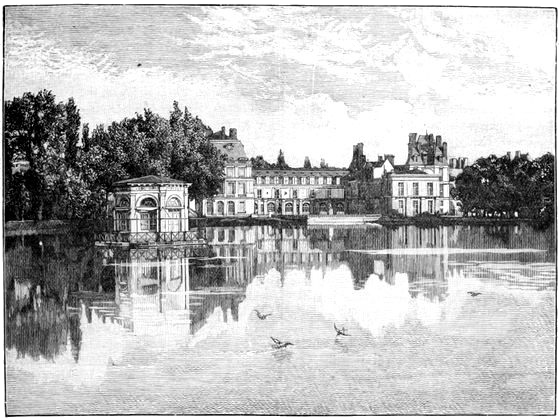
THE PALACE OF FONTAINEBLEAU
[See larger version]
The Swiss acted a more cautious part. Fearful that Napoleon might yet, by some other wonderful chance, regain his power, they summoned a Diet, passed an order for the neutrality of the cantons, and issued an order calling on the Allies to respect this, and not attempt to march troops through their country. This would have suited Buonaparte extremely well, as it would have closed his eastern frontiers to the Austrians, who were marching that way under Count Bubna; but the Austrians informed the Swiss authorities that they should certainly march through; and the Allied sovereigns dispatched Count Capo d'Istria and Herr Lebzeltern to Zurich to state that the power of France over Switzerland was at an end, and to desire them to send deputies to meet them, and to establish an independent government for Switzerland. Thus assured, the greater part of the cantons sent their deputies to Zurich, who proclaimed the restoration of national independence, and gave free consent for the armies of the Allies to march through the country.
Whilst all the countries which Buonaparte, at such an incalculable cost of life and human suffering, had compelled to the dominion of France were thus re-asserting their freedom, Buonaparte, in Paris, presented the miserable phantom of a vanished greatness. He called on the Senate to vote new conscriptions, telling them that theirs had been made by him the first throne of the universe, and they must maintain it as such; that without him they would become nothing. But the Allies were now entering France at one end, and Wellington was firmly fixed in the other; ere long the insulted nations would be at the gates of Paris, and the Senate and people demanded peace. Buonaparte refused to listen, and the Senate voted the conscription of three hundred thousand men, knowing that there was no longer any authority in the country to raise them. La Vendée, and all the Catholic South, were on the verge of insurrection; Murat, in Naples, was ready to throw off his last link of adhesion to Buonaparte; and the defeated usurper stood paralysed at the approach of his doom.
It was natural that this mighty turn in affairs on the Continent should be watched in Great Britain with an interest beyond the power of words. Though this happy country had never felt the foot of the haughty invader, no nation in Europe had put forth such energies for the overthrow of the usurper; none had poured forth such a continual flood of wealth to arm, to clothe, to feed the struggling nations, and hold them up against the universal aggressor. Parliament met on the 4th of November, and, in the speech of the Prince Regent and in the speeches in both Houses, one strain of exultation and congratulation on the certain prospect of a close to this unexampled war prevailed. At that very moment the "Corsican upstart" was on his way to Paris, his lost army nearly destroyed, the remains of it chased across the Rhine, and himself advancing to meet a people at length weary of his sanguinary ambition, and sternly demanding peace.
Lord Castlereagh, in recounting the aid given by Great Britain to the sovereigns of the Continent in this grand effort to put down the intolerable military dominance of Buonaparte, drew a picture of expenditure such as no country had presented since the commencement of history. He said that the nations of the north of Europe were so exhausted by their former efforts, that not one of them could move without our aid; that this year alone we had sent to Russia two million pounds; to Prussia two million pounds; to Austria one million pounds in money, and one hundred thousand stand of arms; to Spain two million pounds; to Portugal one million pounds; to Sicily four hundred thousand pounds. By these aids Russia had been able to bring up men from the very extremities of the earth, and Prussia to put two hundred thousand men into the field. We had sent during the year five hundred thousand muskets to Spain and Portugal, and four hundred thousand to other parts of the Continent. There was something sublime in the contemplation of one nation, by the force of her wealth and her industry, calling together the armies of the whole world to crush the evil genius of the earth.
But Lord Castlereagh called on Parliament to maintain the same scale of expenditure and exertion till the great drama was completed. He estimated that there would still be wanted for 1814 four million pounds for the Peninsula, and six million pounds for Germany. He stated that our army in all quarters of the world amounted to two hundred and thirty thousand men, and that it was probable that we should have occasion to send from fifteen thousand to twenty thousand men to Holland, which, he recommended, should be raised by drafts from the militia. Of seamen, one hundred and forty thousand, and thirty-one thousand marines were voted, as it was resolved to chase the flag of the troublesome Americans from the seas. All these proposals were assented to without hesitation, and with the warmest encomiums on the achievements of Lord Wellington in Spain and the south of France, Parliament adjourned on the 26th of December till the 1st of March, 1814.
At the opening of the year 1814 Buonaparte was busy endeavouring to make good some of his false steps, so as to meet the approaching Allies with all possible strength. He made haste to liberate the captive Pope, and thus remove one of the causes of the hostility of the Italians to him, for in Italy the Austrians were bearing hard on his Viceroy, Eugene, who had but about forty-five thousand men there, whilst Murat, at Naples, so far from supporting the claims of Napoleon, was endeavouring to bargain with the Allies for the kingdom of Naples. Buonaparte, at the commencement of the year, sent Cardinal Maury and the Bishops of Evreux and Plaisance to Pius VII. at Fontainebleau. But even in such pressing circumstances Buonaparte could not make a generous offer. He endeavoured to bargain for the cession of a part of the Papal territories, on condition of the surrender of the rest. But Pius, who had always shown great spirit, replied that the estates of the Church were not his to give, and he would not give his consent to their alienation. Foiled on this point, Buonaparte then sent word that the Pope should be unconditionally liberated. "Then," said Pius, "so must all my cardinals." This was refused, but he was permitted to go alone, and a carriage and guard of honour were given him. Before departing, Pius called together the cardinals, seventeen in number, and commanded them to wear no decoration received from the French Government, and to assist at no festival to which they should be invited. He then took his leave, on the 24th of January, and reached Rome on the 18th of May. Thus ended the most foolish of all the arbitrary actions of Napoleon. The folly of it was so obvious that he disclaimed having ordered the seizure of the Pope, but he showed that this was false by keeping him prisoner more than five years.
Another matter which he was eager to set right was the captivity of the King of Spain. He had one hundred thousand of his best disciplined and most seasoned troops in Spain, and he was anxious to get them out to meet the approaching Allies. Besides this, he was equally anxious to render the stay of Wellington in the south of France indefensible. To effect these purposes, he determined not only to liberate Ferdinand of Spain, but to send him home under the conditions of a treaty, by which a full exchange of prisoners should be effected, and the continuance of the British there be declared unnecessary. Nay, he did all in his power to embroil the Spaniards with their deliverers, the British. By a treaty Buonaparte recognised Ferdinand VII. and his successors as King of Spain and the Indies, and Ferdinand, on his part, bound himself to maintain the integrity of his empire, and to oblige the British immediately to evacuate every part of Spain. The contracting powers were to maintain their maritime rights against Great Britain; and whilst Buonaparte surrendered all fortresses held by him in Spain, Ferdinand was to continue to all the Spaniards who had adhered to King Joseph the rights, privileges, and property they had enjoyed under him.
Could this treaty have been carried out, Buonaparte would at once have obtained his one hundred thousand veterans from Spain, and completely paralysed the army of Lord Wellington. The Duke de San Carlos conveyed the treaty to Spain. He was instructed to inquire into the state of the Regency and the Cortes, whether they were really so infected with infidelity and Jacobinism as Napoleon had represented; but, whether so or not, he was to procure the ratification of the treaty by these bodies, and Ferdinand undertook to deal with them himself when once safe upon the throne. San Carlos travelled eastward into Spain, and visited the camp of Suchet, who very soon communicated to General Capons, who was co-operating with General Clinton, that there was peace concluded between Spain and France, and that there was no longer any use for the British. Capons was very ready to act on this information and enter into a separate armistice with Suchet; but fortunately for both Spain and the British, neither the Regency nor the Cortes would sign the treaty so long as the king was in durance in France.
Lord Wellington had been duly informed of the progress of these manœuvres, and they had given him great anxiety; nor were these the only causes of anxiety which affected him. The British Ministry were so much absorbed with the business of supporting the Allies in their triumphant march after Buonaparte, that they seemed to think the necessity of Lord Wellington's exertions at an end. At the close of 1813 they recalled Sir Thomas Graham and some of his best battalions to send them into Holland. They appeared to contemplate still further reductions of the Peninsular army, and Lord Wellington was obliged to address them in very plain terms to impress them with the vital necessity of maintaining the force in this quarter unweakened. He reminded them that thirty thousand British troops had kept two hundred thousand of Buonaparte's best troops engaged in Spain for five years; that without this assistance Spain and Portugal would have long ago been completely thrown under the feet of the invader, and the Allies of the North would have had to contend against the undivided armies and exertions of Napoleon; that to render his own army inefficient would be at once to release one hundred thousand veterans such as the Allied armies had not had to deal with. This had the proper effect; and as soon as Wellington had obtained the necessary supplies, he resumed his operations to drive Soult from under the walls of Bayonne.
Early in February he commenced his operations, and carried them forward with a vigour most extraordinary. He drove Soult from all his entrenchments before Bayonne, and again on the 27th he routed him at Orthez and pursued him to the banks of the Adour. This was a sharply contested field, the British having nearly three hundred killed and two thousand wounded; but the loss of the French was far heavier, for they flung down their arms and ran, and there was a great slaughter of the fugitives. The towns of Bayonne and Bordeaux being now left uncovered by the French, Wellington sent bodies of troops to invest them. Bordeaux opened its gates on March 8th, and proclaimed Louis XVIII. Lord Wellington had issued orders that the British should take no part in any political demonstrations, but should leave all such decisions to the Allies, who would settle by treaty what dynasty should reign. He himself followed Soult to Tarbes, where he expected that he would give battle; but Soult was anxious for the arrival and junction of Suchet, who was advancing from Spain with upwards of twenty thousand men. Soult, therefore, retreated to Toulouse, which he reached on the 24th of March.
Lord Wellington came up with him on the 9th of April, in the meantime having had to get across the rapid Garonne, with all his artillery and stores, in the face of the French batteries. The next morning, the 10th, being Easter Sunday, Wellington attacked Soult in all his positions. These were remarkably strong, most of his troops being posted on well-fortified heights, bristling with cannon, various strongly-built houses being crammed with riflemen; while a network of vineyards and orchards, surrounded by stone walls, and intersected by streams, protected his men, and rendered the coming at them most difficult. The forces on both sides were nearly equal. Soult had about forty-two thousand men, and Wellington, besides his army composed of British, Germans, and Portuguese, had a division of fifteen thousand Spaniards. The difficulties of the situation far out-balanced the excess of about three thousand men on the British side; but every quarter was gallantly attacked and, after a severe conflict, carried. Soult retired into Toulouse, and during the ensuing night he evacuated it, and retreated to Carcassonne. The loss of the Allies in killed was six hundred, and about four thousand wounded. Soult confessed to three thousand two hundred killed and wounded, but we may calculate his total loss at little less than that of the Allies, although his troops had been protected by their stone walls and houses.
On the 12th of April Wellington entered Toulouse amid the acclamations of the people. But Lord Wellington was accused by the French of fighting the battle five days after the abdication of Buonaparte, and therefore incurring a most needless waste of life. The fact was, that it was not till the afternoon of the 12th of April that Colonel Cooke and the French Colonel, St. Simon, arrived at Toulouse, bringing the official information that Buonaparte had abdicated at Fontainebleau on the 4th. Thus it happened that the battle was fought a week before the knowledge of the peace was received. Moreover, we have the evidence of Soult's own correspondence, that on the 7th of April, after he had heard of the entrance of the Allies into Paris, he was determined to fight another battle, and for the very reason that the Allies had entered Paris. When the English and French colonels arrived at Soult's camp with the same news that they had communicated to Wellington, Soult refused to submit to the Provisional Government until he received orders from Napoleon; nor did he acknowledge this Government till the 17th, when Wellington was in full pursuit of him towards Castelnaudary. On the 18th a convention was signed between Wellington and Soult, and on the following day a like one was signed between Wellington and Suchet. On the 21st Lord Wellington announced to his army that hostilities were at an end, and thanked them "for their uniform discipline and gallantry in the field, and for their conciliatory conduct towards the inhabitants of the country."
In preparing to meet the invasion of the Allies Napoleon had to encounter the most formidable difficulties. In Russia and in this German campaign he had seen the bulk of his veteran army dissipated—nay, destroyed. After all his years of incessant drafts on the life-blood of France, six hundred thousand men could not be readily replaced. To replace a fourth of that number with well-disciplined troops was impossible. He could draw none from Germany, for his boasted Confederation of the Rhine had disappeared as a summer cloud, and the very princes on whom he had relied were marching against him in the vast army of the Allies. He could draw none from Italy; for there Eugene Beauharnais was contending, with only about forty-five thousand men, against the much more numerous Austrians; whilst his brother-in-law, Murat, his dashing cavalry general, was gone over to the enemy. Poland would send him no more gallant regiments, for he had grievously deceived the Poles; and his trusted ally of Denmark lay trodden under foot by his former companion-in-arms, Bernadotte. When he turned his eyes over France, which had so long sent forth her hordes to desolate Europe at his bidding, he beheld a prospect not much more cheering. The male population, almost to a man, was drained off, and their bones lay bleaching in the torrid sands of Egypt and Syria, the rugged sierras of Spain and Portugal, in the fens of Holland and the sandy flats of Belgium, on many a heath and plain in Germany, and far away amid the mocking snows of frozen Muscovy. The fields of "la belle France" were being cultivated by old men, by women, and mere boys. Those who had been so long buoyed up under the loss of husbands, fathers, and children, by the delusive mirage of the glory of the "grand nation," now cursed the tyrant whose insane ambition had led such millions of the sons of France to the great slaughter-house of war. The conscriptions, therefore, were very little attended to. Besides this, Buonaparte was well aware that there remained a strong leaven of Jacobinism in Paris and the large towns, and he was afraid of calling out city guards to set at liberty other soldiers, lest, in the hour of his absence and weakness, they should rise and renounce his authority.
Finding that there remained no other means of reinforcing his army, he drained the garrisons all over France, and drew what soldiers he could from Soult and Suchet in the south. He was busy daily drilling and reviewing, and nightly engaged in sending dispatches to urge on the provinces to send up their men. The Moniteur and other newspapers represented all France as flying to arms; but the truth was they looked with profound apathy on the progress of the Allies. These issued proclamation after proclamation, assuring the people that it was not against France that they made war, but solely against the man who would give no peace either to France or any of his neighbours; and the French had come to the conclusion that it was time that Buonaparte should be brought to submit to the dictation of force, as he was insensible to that of reason.
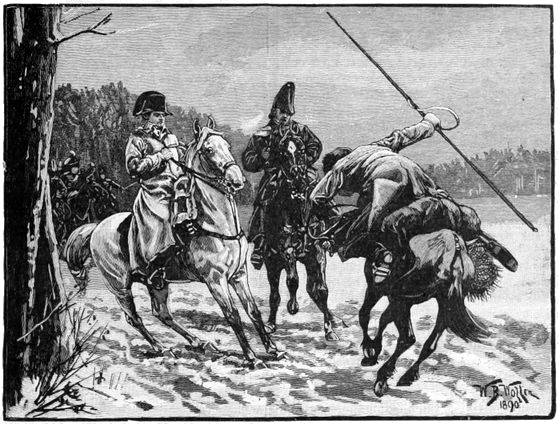
ATTEMPT OF THE COSSACKS TO CAPTURE NAPOLEON AT BRIENNE. (See p. 78.)
[See larger version]
On the 25th of January Buonaparte conferred the Regency again on Maria Louisa, appointed King Joseph his lieutenant in Paris—the poor man who could not take care of the capital which had been conferred on him—and quitted Paris to put himself at the head of his army. This army, in spite of all his exertions, did not exceed eighty thousand men; whilst the Allies were already in France with at least a hundred and fifty thousand, and fresh bodies marching up in succession from the north. He arrived the next day at Châlons, where his army lay, commanded by Marmont, Macdonald, Victor, and Ney. The Austrians, under Schwarzenberg, had entered France on the 21st of December by the Upper Rhine, and directed their march on Lyons. On the 19th of January, a few days before Buonaparte quitted Paris, they had already taken Dijon, and were advancing on Lyons, where, however, they received a repulse. Blucher, at the head of forty thousand men, called the Army of Silesia, about the same time entered France lower down, between Mannheim and Coblenz, at four different points, and pushed forward for Joinville, Vitry, and St. Dizier. Another army of Swedes, Russians, and Germans, under the Crown Prince of Sweden, was directed to assist in clearing Holland and Belgium, as the Crown Prince naturally wished to take no part in the invasion of his native soil. Whilst, therefore, Bernadotte remained to protect Belgium, Sir Thomas Graham, who, with General Bülow, had cleared Holland of the French, except such as occupied the fortress of Bergen-op-Zoom, remained to invest that stronghold, and Bülow and Winzengerode entered France by its northern frontier.
As Blucher was, as usual, much ahead of the other divisions of the Allies, Buonaparte resolved to attack him before he could form a junction with Schwarzenberg. Blucher, informed of his purpose, concentrated his forces at Brienne, on the Aube, fourteen miles below Bar. Brienne is only a small village, having but two streets, one of them ascending to the château—occupied as a military academy, where Napoleon himself received his military education—the other leading to Arcis-sur-Aube. Blucher had quartered himself in the château, and was at dinner with his staff, on the 27th of January, when he was astonished to find that Buonaparte was already upon him. The château being surrounded by a woody park, Napoleon had approached under cover of it, and suddenly driven in two thousand Russians posted there, and was rushing on to capture the general and all his staff. A most miserable look-out must have been kept by the Prussian outposts. Blucher and his generals, startled by the terrible uproar, had just time to escape by a postern, and by leading their horses down a flight of steps. Recovered, however, from their surprise, the Russians turned on the French, and were soon supported by the Prussians. The Cossacks galloped forward, and nearly succeeded in capturing Buonaparte at the head of his troops. One man was laying hands on the Man in the Grey Coat, when Gourgaud shot him with a pistol. Buonaparte gained possession of Brienne, but, like Moscow, it was burned over his head, and it was not till eleven o'clock at night that Blucher, who had only twenty thousand men engaged, retired, and took up a position at La Rothière. It could scarcely be styled a victory, yet Napoleon proclaimed it a brilliant one, asserting that he had taken fifteen thousand prisoners and forty pieces of cannon, when he had taken no cannon whatever, and only a hundred prisoners.
Immediately after this engagement Blucher was joined by part of the grand army, under the Prince of Würtemberg; he therefore determined to attack Napoleon, and on the 1st of February drew out his forces. Napoleon would have declined the engagement; but he had the deep river Aube in his rear, and only the bridge of Lesmont by which to pass it. He preferred, on this account, to risk the battle, rather than retreat in such circumstances. Blucher attacked at once from the villages of La Rothière, Dienville, and Chaumont. The battle was severely contested for the whole day, the Prince of Würtemberg greatly distinguishing himself in it. In the end Buonaparte was wholly defeated, lost four thousand prisoners and seventy-three guns, and must have been captured himself, had not the Austrians, by surprising slowness, allowed him to escape over the bridge. He then retreated towards Troyes, where he was joined by his Imperial Guard; but his losses had been very heavy. Had Blucher and Schwarzenberg, who had now met, marched on united, they must have been in Paris in a very short time; but, with the German fatality of dividing, they had no sooner experienced the benefit of a powerful union than they called a council at the château of Brienne, and agreed to separate again. Blucher, joining to his own the divisions of Yorck and Kleist, proceeded towards Paris by the Marne, and Prince Schwarzenberg followed the course of the Seine.
Buonaparte saw his opportunity, and, making a movement by a body of troops on Bar-sur-Seine, he alarmed Schwarzenberg, who thought he was intending to attack him in full force, and therefore changed his route, separating farther from Blucher. This point gained, Buonaparte marched after Blucher. That general had driven Macdonald from Château Thierry, and had established his headquarters at Vertus. Sacken was in advance as far as Ferté-sous-Jouarre, and Yorck at Meaux, much nearer Paris than Buonaparte himself. Paris was in great alarm. But Napoleon, taking a cross-country road, and dragging his artillery by enormous exertions over hedges, ditches, and marshes, came upon Blucher's rear, to his astonishment, at Champaubert. Driving in the Russians, Napoleon defeated him, taking two thousand prisoners, and most of his artillery; and being thus posted between Sacken and Blucher, he first attacked and defeated Sacken, destroying or squandering five thousand men—about one-fourth of his division—and then turned to attack Blucher himself, who was marching rapidly up to support Sacken. Blucher, finding himself suddenly in face of the whole army of Buonaparte, in an open country, fell back, but conducted his retreat so admirably that he cut his way through two strong bodies of French, who had posted themselves on the line of his march, and brought off his troops and artillery safe to Châlons. Napoleon then turned against Schwarzenberg, and on the 17th of February he met and defeated him at Nangis. Such were the immediate consequences of the folly of dividing the Allied forces. In these movements Napoleon displayed a military ability equal to that of any part of his career.
The Parisians were now afforded proofs that Napoleon was once more victorious. The prisoners, banners, and cannon which he had taken were sent forward rapidly to the capital, and ostentatiously paraded through the streets. Meanwhile, the Allies were so alarmed, that the sovereigns wrote to Buonaparte, expressing their surprise at his attacks, as they had ordered their Plenipotentiaries to accept the terms offered by his ambassador, Caulaincourt. These terms had indeed been offered by Caulaincourt, Duke of Vicenza, at a Congress held at Châtillon-sur-Seine on the 5th of February, and which was still sitting; but the Allies had never, in fact, accepted them, and now, as he was again in the ascendant, Napoleon was not likely to listen to them. He therefore left the letter unanswered till he should have thoroughly defeated the Allies, and then he would dictate his reply.