Chapter XV · (continued 2)
Reading edition
The safety of the prisoners diffused universal joy throughout the camps of the two generals; but there was one thing necessary, in their opinion, in which the Government concurred, in order to give the crowning proof of our complete triumph, and to restore the unquestionable supremacy of our power, and compel the respect and fidelity of the neighbouring provinces. This was the signal punishment of Cabul for the atrocities that had been perpetrated there. The hostile chiefs were now as eager to conciliate, as submissive in their tone as they had been cruel and arrogant. Even Akbar Khan professed the greatest friendship for the British, and repudiated the acts that had been done in his name, at the same time restoring to his friends Captain Bygrave, the last prisoner he had in his possession. The Afghans had a maiden fortress in the town of Istalif, which is built upon two ridges of the spur of Hindoo Koosh, which forms the western boundary of the beautiful valley of Kohistan. There, in its fortified streets and squares, as in a safe asylum, they had collected their treasures and their women. The sagacious Havelock suggested that the capture of this place, believed to be impregnable, would be a great stroke of policy. General M'Caskill, therefore, made a rapid march upon it, and after a desperate struggle, in which Havelock greatly distinguished himself, the place was stormed in gallant style, the Afghans in every direction giving way before our attacking columns.
The fate of Cabul was now to be decided. Some mark of just retribution should be left upon it, and General Pollock determined to destroy the great bazaar, where the mangled remains of our murdered envoy had been exposed to the insults of the inhabitants. The buildings were therefore blown up with gunpowder, the design being to allow the work of destruction to extend no further. But it was impossible to restrain the troops. "The cry went forth that Cabul was given up to plunder. Both camps," wrote Major Rawlinson, "rushed into the city, and the consequence has been the almost total destruction of most parts of the town, except the Gholom Khana quarter and the Bala Hissar. Numbers of people—about 4,000 or 5,000—had returned to Cabul, relying on our promises of protection, rendered confident by the comparative immunity they had enjoyed during the early part of our sojourn here, and by the appearance ostentatiously put forth of an Afghan Government. They had many of them re-opened their shops. These people have been now reduced to utter ruin; their goods have been plundered, and the houses burnt over their heads. The Hindoos in particular, whose numbers amount to some 500 families, have lost everything they possessed, and they will have to beg their way to India in the rear of our columns." Meanwhile General Nott had retaken Ghuznee.
Having thus accomplished their mission, the two armies returned in triumph to India. Lord Ellenborough was delighted, though he only thwarted his generals. He was now at Simla, in the very house whence his predecessor had issued his proclamation for the restoration of Shah Sujah, which had been the cause of all our disasters. On the 1st of October, the anniversary of the day when, two years before, he had reversed the policy of Lord Auckland, he issued a proclamation from the same room. It is a well-written State paper, ably reviewing the situation of Indian affairs and clearly announcing the future policy of our Indian Government. It is historically important, and deserves to be permanently recorded in the history of England:—"The Government of India directed its army to pass the Indus, in order to expel from Afghanistan a chief believed to be hostile to British interests, and to replace upon his throne a Sovereign represented to be friendly to those interests and popular with his former subjects. The chief believed to be hostile became a prisoner, and the Sovereign represented to be popular was replaced upon his throne; but after events which brought into question his fidelity to the Government by which he was restored, he lost by the hands of an assassin the throne he had only held amidst insurrections, and his death was preceded and followed by still existing anarchy.[4] Disasters unparalleled in their extent, unless by the errors in which they originated, and by the treachery by which they were completed, have in one short campaign been avenged upon every scene of past misfortune; and repeated victories in the field, and the capture of the cities and citadels of Ghuznee and Cabul, have again attached the opinion of invincibility to the British arms. The British armies in possession of Afghanistan will now be withdrawn to the Sutlej. The Governor-General will leave it to the Afghans themselves to create a government, amidst the anarchy which is the consequence of their crimes. To force the Sovereign upon a reluctant people would be as inconsistent with the policy as it is with the principles of the British Government, tending to place the arms and resources of that people at the disposal of the first invader, and to impose the burden of supporting a Sovereign without the prospect of benefit from his alliance. The Governor-General will willingly recognise any Government approved by the Afghans themselves, which shall appear desirous and capable of maintaining friendly relations with neighbouring States. Content with the limits Nature appears to have assigned to its empire, the Government of India will devote all its efforts to the establishment and maintenance of general peace, to the protection of the sovereigns and chiefs, its allies, and to the prosperity and happiness of its own faithful subjects."
Had Lord Ellenborough rested satisfied with this proclamation, all would have been well; but he issued another proclamation which at once shocked the religious feelings of the people of England by its profanity, and covered him with ridicule by its absurdity. He meant it to be a great stroke of policy; but it was simply a foolish and gratuitous concession to an idolatrous priesthood, while it exasperated the pride and fanaticism of the Mahometans. This was the celebrated Somnath Proclamation. Its authenticity was at first gravely doubted in India, but when, at length, it was placed beyond doubt, there was an outburst of censure and ridicule such as never before overwhelmed a Governor-General of India. "My brothers and my friends," it ran, "Our victorious army bears the gates of the Temple of Somnath in triumph from Afghanistan, and the despoiled tomb of Sultan Mahomed looks upon the ruins of Ghuznee. The insult of 800 years is at last avenged. The gates of the Temple of Somnath, so long the memorial of your humiliation, are become the proudest record of your national glory, the proof of your superiority in arms over the nations beyond the Indus. To you, princes and chiefs of Sirhind, of Rajwarra, of Malwa, and of Guzerat, I shall commit this glorious trophy of successful war. You will yourselves, with all honour, transmit the gates of sandal wood through your respective territories to the restored Temple of Somnath." One might have supposed that the princes, chiefs, and people of India thus addressed by the supreme representative of a Christian nation were all pure Hindoos; and that the temple from which the gates had been carried away, 800 years before, was still in their possession; whereas it was in ruins, and the sacred ground on which it stood was trodden by Mahometans. Even if the temple had been standing and occupied by the ancient idols, the Hindoo priests would have regarded the gates as polluted by being so long in the possession of unbelievers. Viewed as the reversal of a national humiliation the act was equally absurd. It could be no gratification to a subjugated race to have restored to them by a foreign Power a trophy that had been carried away 800 years before. Worst of all, the gates were discovered to be spurious copies of the originals. The Temple of Somnath was never restored, and the gates were consigned to an armoury.
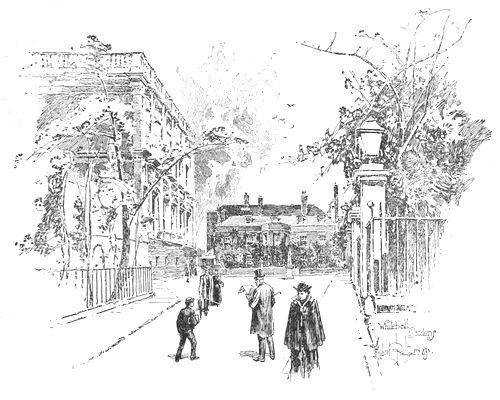
WHITEHALL GARDENS, LONDON.
[See larger version]