Chapter IV · (continued 2)
Reading edition
There was a number of lady dramatists of this period. Mrs. Cowley wrote "The Runaway," "The Belle's Stratagem," "More Ways than One," etc.; Mrs. Brooke, Miss Marshall, Mrs. Lennox, and Miss Sophia Lee, all wrote successful plays; Mrs. Sheridan, the author of the Eastern story, "Nourjahad," was the writer of the successful comedies of "The Discovery" and "The Dupe." But the chief dramatist of this period was Richard Brinsley Sheridan, her son (b. 1751; d. 1816). He was equally distinguished as a politician, an orator, and a critic. Like Murphy, Macklin, and Cumberland, he was an Irishman. His dramas placed him at the head of all the writers for the stage of his time. They abounded with humour, wit, the smartest action, and knowledge of life and human nature. His splendid comedy of "The Rivals," written when he was not twenty-five, did not at first augur much success; but "The Duenna," which appeared the same year, carried with it at once the highest public favour; and his "School for Scandal," acted in 1777, raised his reputation to the utmost. He also wrote the farces of "The Critic," "The Trip to Scarborough," and "St. Patrick's Day." All these were issued before 1780, and after that he was too much involved in political affairs to renew this style of writing. Amongst his other labours for the theatre was the adaptation of "Pizarro," one of Kotzebue's numerous plays. Sheridan first appeared before the world as the translator of "Aristænetus."
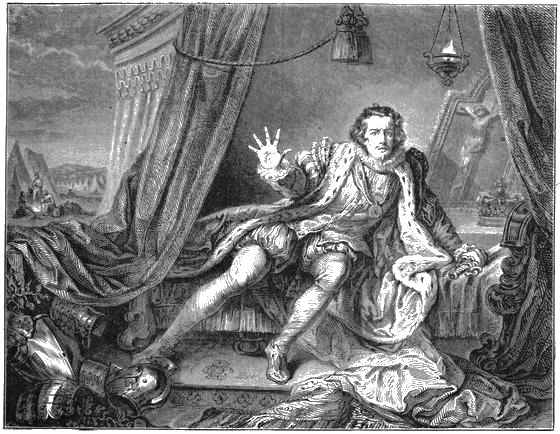
DAVID GARRICK AS RICHARD III. (After Hogarth.)
[See larger version]
Comedy and farce occupied the middle portion of the reign, but neither of them rose to the height of Sheridan. In tragedy, Murphy's "Arminius," Godwin's "Antonio," and Madame D'Arblay's "Edwy and Elgiva," were the best. Amongst the comedies, Holcroft's "Road to Ruin," Morton's "Speed the Plough," Mrs. Inchbald's "Wives as they Were, and Maids as they Are," and Colman's "Sylvester Daggerwood," were the most popular.
In the latest period scarcely any acting dramas were produced. Amongst the unacted tragedies, or such as were acted with no great success—being better fitted for private study—were Coleridge's "Remorse" and "Zapolya;" Shelley's "Prometheus Unbound" and "The Cenci;" Byron's "Cain," "Manfred," "Sardanapalus," etc.; Maturin's "Bertram," "Manuel," and "Fredolpho;" Joanna Baillie's "Plays on the Passions," "The Family Legend"—the last acted with some success at Edinburgh, through the influence of Sir Walter Scott, in 1810—Charles Lamb's "John Woodvill," Milman's "Fazio," and Walter Savage Landor's "Count Julian," "Andrea of Hungary," "Giovanni of Naples," "Fra Rupert," "The Siege of Ancona," etc., all masterly dramas, constituting a blaze of dramatic genius which, had it been adapted to the stage, would have given it a new grandeur at the close of this reign.
The new spring in poetry broke forth as brilliantly in this reign as that in prose. In the earlier portion of it, indeed, this was not so visible. The school of Pope seemed still to retain its influence. This school had produced a host of imitators, but little real genius since Pope's time. Almost the only exception to this mediocrity was Collins, whose odes were full of fire and genius. He died just before this period, and Gray, Shenstone, and Goldsmith opened it with many of the exterior characteristics of that school. But, in truth, notwithstanding the mere fashion of their compositions, there were in them unmistakable evidences of new life. Shenstone was the least vigorous and original of the three, but his "Schoolmistress" possessed a natural charm that still gains it admirers. He belongs, however, rather to the past period than this, for he died but three years after the accession of George III., and had ceased to write some time before. Gray's "Elegy in a Country Churchyard" showed that he had deep feeling and a nice observation of nature; and his "Long Story" that he possessed real humour—a quality abounding in his prose, but, except in this piece, little visible in his poetry. His odes are extremely vigorous, but somewhat formal. His "Bard," his "Ode on Eton College," and his "Fatal Sisters," are all full of beauty, but somewhat stilted. In the "Fatal Sisters" he introduced a subject from the "Scandinavian Edda" to the English reader, but in a most un-Scandinavian dress.
Goldsmith was in his poetry, as in his prose, simple, genuine, and natural. His "Deserted Village" and "Traveller" were in the metre of Pope, but they were full of the most exquisite touches of pathos, of truth, and liberty; they were new in spirit, though old in form. Charles Churchill, the satirist, was full of flagellant power. He has been said to have formed himself on Dryden; but it is more probable that his models were Lucian and Juvenal. He was a bold and merciless chastiser of the follies of the times. He commenced, in the "Rosciad," with the players, by which he stirred a nest of hornets. Undauntedly he pursued his course, attacking, in "The Ghost," the then all-powerful Dr. Johnson, who ruled like a despot over both literary men and their opinions. These satires, strong and somewhat coarse, were followed by "The Prophecy of Famine," an "Epistle to Hogarth," "The Conference," "The Duellist," "The Author," "Gotham," "The Candidate," "The Times," etc. In these Churchill not only lashed the corruptions of the age, but the false principles of nations. He condemned the seizure of other countries by so-called Christian powers, on the plea of discovery. It was only to be lamented that Churchill, who was a clergyman, in censuring his neighbour's vices did not abandon his own.
Amongst other authors of the time, then very popular, but now little read, were Armstrong, author of "The Art of Preserving Health;" Akenside, of "The Pleasures of Imagination;" Wilkie, of "The Epigoniad;" and Glover, of the epic of "Leonidas." Falconer's "Shipwreck" and Beattie's "Minstrel" are poems much more animate with the vitality of grace and feeling. Then there were Anstey, with his "Bath Guide," half descriptive and half satiric; Stephenson's "Crazy Tales;" Mason's "Isis," a satire on the University of Oxford, and his tragedies of "Elfrida" and "Caractacus," which, with other poems by the same author, enjoyed a popularity that waned before more truly living things. Then there were the brothers Joseph and Thomas Warton. Both of these deserve to be mentioned amongst our first-rate prose writers—Joseph for his excellent "Essay on the Genius and Writings of Pope," and Thomas for his "History of English Poetry," and this is merely a fragment, coming down only to the reign of Queen Elizabeth. But that which, at this period, produced a thorough reform of our poetry was the publication of "The Reliques of Ancient English Poetry," by Bishop Percy. These specimens of poetry went back beyond the introduction of the French model into England—to the times when Chaucer, and still earlier poets, wrote from the instincts of nature, and not from scholastical or fashionable patterns. In particular, the old ballads, such as "Chevy Chace," "The Babes in the Wood," and the like, brought back the public taste from the artificial to the natural. The simple voice of truth, pathos, and honest sentiment was at once felt by every heart, and the reign of mere ornate words was over. After the Reliques came "The Border Minstrelsy" of Scott and completed the revolution. These ancient ballads, in both Percy and Scott, were found, in many instances, to be founded on precisely the same facts as those of the Swedes and Danes, collected seventy years before, thus showing that they were originally brought into Great Britain by the Scandinavians—a proof of their high antiquity. A similar return to nature was going on in Germany and the North of Europe, showing that the very collection of Percy's "Reliques" originated in some general cause, and that cause, no doubt, was the universal weariness of the artificial style which had so long prevailed in literature.
About this time two publications occurred, which produced long and violent controversies—those of the pretended "Poems of Rowley," by Chatterton, and "Ossian's Poems," by Macpherson. Chatterton, who was the articled clerk of an attorney at Bristol, a mere youth, pretended that he had discovered Rowley's poems in the muniment room of the Church of St. Mary Redcliffe, Bristol. These poems, written on yellow parchment, and in a most antiquated style, by a boy of sixteen, were palmed upon the world as the genuine productions of one Thomas Rowley, and took in many well-known authors and literary antiquaries, very wise in their own conceit. As the productions of a boy of that age these poems are marvellous, and nothing besides which Chatterton, in his short, neglected life, produced approached them in merit. This, too, was the case with Macpherson, who professed to have collected the poems of Ossian, an old bard of Morven, in the Highlands, and simply translated them into English. He was warmly accused of having written them himself; but as Chatterton, so Macpherson, steadily denied the authorship of the poems thus introduced, and as in Chatterton's case, so in Macpherson's, no other compositions of the professed collector ever bore any relation to these in merit. There can now be very little doubt that Macpherson founded his Ossianic poems on real originals to some extent; but that Chatterton, if he received Rowley's poems from Rowley, did so by inspiration.
For some time after the revival of true poetry the old forms still hung about what in spirit was new. The last of the old school of any note may be said to have been Dr. Johnson and Dr. Darwin. Johnson was too thoroughly drilled into the dry, didactic fashion of the artificial past, he was too bigotedly self-willed to be capable of participating in the renovation. In fact, he never was more than a good versifier, one of that class who can win prizes for University themes on the true line and square system of metrical composition. His "London," a mere paraphrase of the third book of "Juvenal," and "The Vanity of Human Wishes" are precisely of that stamp. Johnson lived at the time of Chatterton's appearance, but he completely ignored him, and he ridiculed the simplicity of the poems introduced by Bishop Percy by absurd parodies on them, as—
I put my hat upon my head, And walked into the Strand; And there I met another man, With his hat in his hand.
And,
If the man who turnips cries, Cries not when his father dies, 'Tis a sign that he had rather Have a turnip than his father.
As for the poems of Ossian, he made a violent attack upon them in his "Tour to the Western Isles."
Dr. Erasmus Darwin assumed the hopeless task of chaining poetry to the car of science. He was a physician of Derby, and, like Sir Richard Blackmore, "rhymed to the rumbling of his own coach wheels;" for we are told that he wrote his verses as he drove about to his patients. His great poem is the "Botanic Garden," in which he celebrates the loves of the plants, and his "Economy of Vegetation," in which he introduces all sorts of mechanical inventions. Amongst the rest he announces the triumphs of steam in sonorous rhymes—
Soon shall thy arm, unconquered Steam! afar Drag the slow barge, or drive the rapid car.
And he celebrates the compass in equally imposing heroics—
Hail, adamantine steel! magnetic lord! King of the prow, the ploughshare, and the sword! True to the pole, by thee the pilot guides His steady helm amid the struggling tides; Braves, with broad sail, the immeasurable sea; Cleaves the dark air, and asks no star but thee!
This style of verse was thought very magnificent by Anna Seward, of Lichfield, who was intimate with Darwin when he lived there in his earlier career, and who herself was a poetess of some pretension. Miss Seward, however, showed better judgment in being amongst the first to point out the rising fame of Southey and Scott. The verse of Darwin brought Pope's metre to the highest pitch of magniloquence; and the use of the cæsura gives it a perfectly Darwinian peculiarity.
The poets who most retained the robes of the past, without disguising the divine form within, were the Rev. George Crabbe and Cowper. The poetry of Crabbe, all written in the metre of Pope, is, nevertheless, instinct with the very soul of nature. It chooses the simplest, and often the least apparently lofty or agreeable topics, but it diffuses through these, and at the same time draws from them, a spirit and life that are essentially poetry. Nothing at the time that it appeared could look less like poetry. The description of a library, the dirty alleys, the pothouses, the sailors, and monotonous sea-shores in and about a maritime borough, struck the readers of the assumed sublime with astonishment and dismay. "Can this be poetry?" they asked. But those who had poetry in themselves—those in whom the heart of nature was strong, replied, "Yes, the truest poetry." Nature smiles as the rude torch flickers past, and shows its varied forms in its truest shape. In his "Tales of the Hall" Crabbe entered on scenes which are commonly deemed more elevated; he came forward into the rural village, the rectory, and the manor-house; but everywhere he carried the same clear, faithful, analytical spirit, and read the most solemn lessons from the histories and the souls of men. Crabbe has been styled the Rembrandt of English poetic painting; but he is not merely a painter of the outward, he is the prober of the inward at the same time, who, with a hand that never trembles, depicts sternly the base nature, and drops soothing balm on the broken heart.
William Cowper (b. 1731; d. 1800) combined in his verse the polish of Pope with the freedom and force of Churchill. He possessed the satirical strength of Churchill with a more gentle and Christian spirit. In Cowper broke forth the strongest, clearest sense that had distinguished any writer in prose or verse for generations. He painted nature like a lover, but with the truth of a great artist, and he flagellated the vices of society in the very highest quarters with unshrinking boldness; at the same time, with equal intrepidity, he advanced the assertions of a perfect faith in the religion of the Gospel, in the face of the hardest scepticism of the age.
It is a curious fact, that whilst Cowper was haunted by the most agonising terrors of a nervous temperament, even to despair, his poetry breathes the most consolatory tone. Whilst his mind was often wandering in insanity, there is no composition so sane and so sound in intellectual substance as his. Though seldom indulging in high flights of imagination, yet his verse frequently rises into a richness and nobility of voice nearly equal to the prophetic. The "Lines on his Mother's Picture" exhibit the deep feeling of Cowper, and the ballad of "John Gilpin" the genuine mirth which often bubbled up in a heart so racked and tried with melancholy.
Contemporary with Cowper was Mrs. Tighe, the author of "Psyche," an allegorical poem, in which the beauty of the sentiment made acceptable that almost exploded form of composition. But there was at this period a number of writers who had much more false than true sentiment. The euphuism of the reign of Queen Elizabeth broke forth in another fashion. A kind of poetical club was formed at Batheaston, the residence of Lady Miller, near Bath. She and her guests, amongst whom was Miss Seward, wrote verses, which they published under the title of "Poetical Amusements." A still more flaunting school set themselves up amongst the English at Florence, one of whom, a Mr. Robert Merry, dubbed himself "Della Crusca," whence the clique became known as the "Della Cruscan School." Amongst the members of it figured Mrs. Piozzi, the widow of Thrale the brewer, Boswell, Johnson's biographer, Mary Robinson, the younger Colman, and Holcroft, the dramatist, with others of less name. They addressed verses to each other in the most florid and extravagant style under the names of "Rosa Matilda," "Laura Maria," "Orlando," and the like. The fashion was infectious; and not only were the periodicals flooded by such silly mutual flatteries, but volumes were published full of them. Gifford, the editor of the Quarterly Review, and translator of Juvenal, attacked this frenzy in a satire called the "Baviad," and continued the attack in the "Mæviad," which, however, was more particularly a censure on the degraded condition of the drama. This put an end to the nuisance, and Gifford won great fame by it; though, on referring to his two celebrated satires, we are surprised at their dulness, and are led to imagine that it was their heaviness which crushed these moths of literature. Gifford had himself a great fame in his day, which was chiefly based on his formidable position as editor of the Quarterly Review.
But whilst Gifford was thus demolishing an outbreak of bad taste, a much more remarkable evidence that those who lay claim to good taste frequently have it not was given by the appearance of several new plays and other documents attributed to Shakespeare. The chief of these was "Kynge Varrtygerne," a tragedy, edited by Samuel Ireland. Numbers of persons of high name and pretension, as Dr. Parr, Boswell, Pye, the laureate, Chalmers, the editor of an issue of "British Poets," Pinkerton, a writer of all sorts of things, etc., became enthusiastic believers and admirers of these pretended discoveries. They turned out to be impudent forgeries by the son of the editor, named William Henry Ireland, and are in reality such trash that they are a melancholy proof of how little value, from some learned persons, is the adoration of Shakespeare. Malone, in an "Inquiry" into the authenticity of these writings, in 1796, completely exposed their spuriousness. Pinkerton, one of their most zealous advocates, himself perpetrated a similar forgery of a volume of Scottish poems, issued as ancient ones. He enjoyed the particular patronage of Horace Walpole.
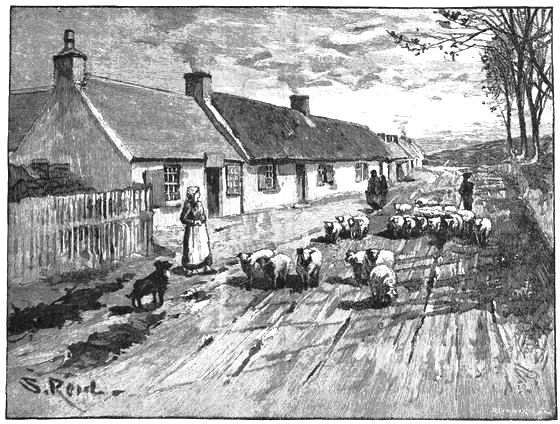
EXTERIOR OF THE COTTAGE AT ALLOWAY IN WHICH BURNS WAS BORN.
[See larger version]
A number of satires and other poems appeared at this time which deserve only a mere mention. These are "The Pursuits of Literature," by Thomas James Mathias; "Anticipation," by Richard Tickell, being an anticipation of the king's Speech, and the debates of Parliament; "An Heroic Epistle to Sir William Chambers," by Mason, under the assumed name of Malcolm Macgregor; "The Rolliad," also a political satire, in 1785. To this succeeded "Probationary Odes," from the same party. These were eclipsed by the publications of Dr. John Wolcot, under the name of Peter Pindar, who for twenty years kept the public laughing by his witty and reckless effusions, in which the king especially was most unmercifully ridiculed. Wolcot had the merit of discovering Opie, the painter, as a sawyer in the neighbourhood of Truro, and pushing him forward by his praises. Of the Royal Academicians he was a relentless enemy, and to them addressed several odes, of the most caustic and damaging kind. Later on came the inimitable poems of the "Anti-Jacobin," written by Canning, Hookham Frere, and others, among which it is sufficient to recall the "Needy Knife-grinder," and the satires on the Addington Administration. But now there came a voice from Scotland that filled with envy the crowd of second-rate poets of London, and marked the dawn of a new era. A simple but sturdy peasant—with no education but such as is extended to every child in every rural parish of Scotland; "following the plough along the mountain side," laboriously sowing and reaping and foddering neat; instead of haunting drawing-rooms in bob-tailed coat and kid gloves, dancing on the barn-floor, or hob-nobbing with his rustic chums at the next pot-house—set up a song of youth, of passion, of liberty and equality, so clear, so sonorous, so ringing with the clarion tones of genius and truth, that all Britain, north and south, stood still in wonder, and the most brazen vendor of empty words and impudent pretensions to intellectual power owned the voice of the master, and was for a moment still. This master of song was Robert Burns (b. 1759; d. 1796). Need we say more? Need we speak of the exquisite beauty of the "Cotter's Saturday Night"?—of the fun of "Tam o' Shanter"?—of the satiric drollery of his laughter at antiquarian and other pretenders?—of the scathing sarcasms on sectarian cant in "Holy Willie's Prayer," and a dozen other things?—of the spirit of love and the spirit of liberty welling up in his heart in a hundred living songs?—of the law of man's independence and dignity stamped on the page of eternal memory in the few words—"A man's a man for a' that"? Are not these things written in the book of human consciousness, all the world over? Do not his fellow-countrymen sing them and shout them in every climate under heaven? At the time when they appeared the poems of Robert Burns clearly showed that true poetry was not altogether extinct, and effectually put an end to that fatal rage of imitation of the artificial school of Johnson and Pope which then prevailed.
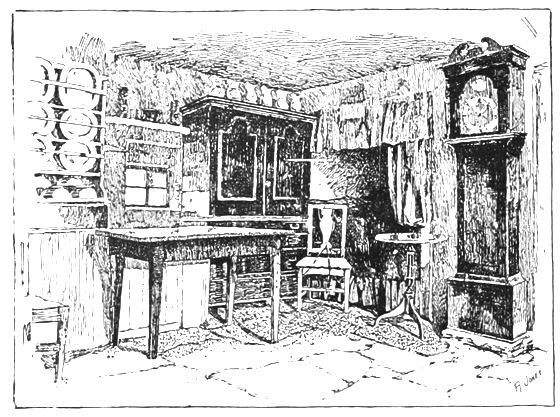
INTERIOR OF BURNS'S COTTAGE AT ALLOWAY.
(From a Photograph by G. W. Wilson & Co.)
[See larger version]
Then came the Lake school, so called because the poets lived more or less amongst the lakes of Westmoreland and Cumberland; but which would have been more correctly called the natural school, in contradistinction to the artificial school which they superseded. The chief of these were Wordsworth, Coleridge, and Southey. Wordsworth and Coleridge had travelled in Germany, when few Englishmen travelled there, and all of them had more or less imbibed that spirit of intense love of natural beauty and of mental philosophy which prevails in Germany. In Southey this evaporated in ballads of the wild and wonderful, with a strong tinge of Teutonic diablerie. In Wordsworth and Coleridge these elements sank deeper, and brought forth more lasting fruits. But there was another cause which went greatly to the formation of Wordsworth's poetic system. He was thoroughly indoctrinated by his early friends, Charles Lloyd and Thomas Wilkinson, members of the Society of Friends, with their theory of worship and psychology. They taught him that the spirit of God breathes through all nature, and that we have only to listen and receive. This system was enunciated in some of his lyrical poems, but it is the entire foundation of his great work, the "Excursion." In his earliest poems William Wordsworth (b. 1770; d. 1850) wrote according to the manner of the time, and there is nothing remarkable in them; but in his "Lyrical Ballads," the first of which appeared in 1798, there was an entire change. They were of the utmost simplicity of language, and some of them on subjects so homely that they excited the most unmeasured ridicule of the critics. In particular, the Edinburgh Review distinguished itself by its excessive contempt of them. The same fate awaited his successive publications, including his great work, the "Excursion;" and the tide of scorn was only turned by a series of laudatory criticisms by Professor Wilson, in Blackwood's Magazine, after which the same critics became very eulogistic.
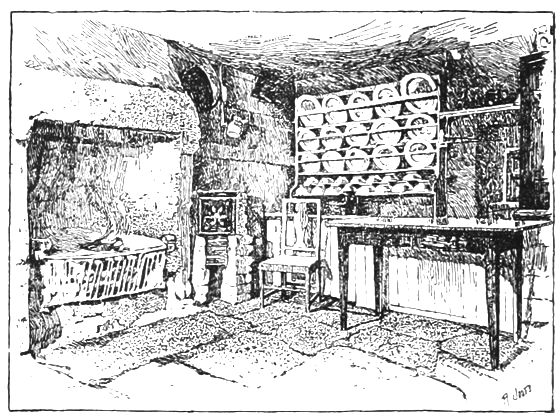
INTERIOR OF BURNS'S COTTAGE AT ALLOWAY.
(From a photograph by G. W. Wilson & Co.)
[See larger version]
Samuel Taylor Coleridge (b. 1772; d. 1834) published his earliest poems in association with his friends, Wordsworth, Charles Lloyd, and Charles Lamb. But his contributions, especially of the "Ancient Mariner," soon pointed them out as belonging to a genius very different. In his compositions there is a wide variety, some of them being striking from their wild and mysterious nature, some for their elevation of both spirit and language, and others for their deep tone of feeling. His "Geneviève," his "Christabel," his "Ancient Mariner," and his "Hymn in the Vale of Chamouni," are themselves the sufficient testimonies of a great master. In some of his blank verse compositions the tone is as independently bold as the sentiments are philosophical and humane. Besides his own poetry, Coleridge translated part of Schiller's "Wallenstein," and was the author of several prose works of a high philosophical character. Southey was as different from Coleridge in the nature of his poetical productions as Coleridge was from Wordsworth. In his earliest poems he displayed a strong resentment against the abuses of society; he condemned war in his poem on "Blenheim," and expressed himself unsparingly on the treatment of the poor. His "Botany Bay Eclogues" are particularly in this vein. But he changed all that, and became one of the most zealous defenders of things as they are. His smaller poems are, after all, the best things which he wrote; his great epics of "Madoc," "Roderick, the Last of the Goths," "The Curse of Kehama," and "Thalaba," now finding few readers. Yet there are parts of them that must always charm.
Since the appearance of the Waverley Novels the poetry of Scott has been somewhat depreciated, but his metrical romances, if not of the highest class of poetry, are always fresh, from their buoyancy and the scenery in which they are laid. They are redolent of the mountain heather and summer dews; and the description of the sending of the "fiery cross" over the hills, and the battle in "Marmion," as well as other portions, are instinct with genuine poetic vigour. Campbell, who won an early reputation by his "Pleasures of Hope," is more esteemed now for his heroic ballads "Hohenlinden," "The Battle of the Baltic," and his "Mariners of England;" Moore, for his "Irish Melodies," than for his "Lalla Rookh;" Byron, for his "Childe Harold," rather than for his earlier love tales of the East, or his later dramatic poems. Amongst the very highest of the poets of that period stands Percy Bysshe Shelley (b. 1792; d. 1822), the real poet of spiritual music, of social reformation, and of the independence of man. Never did a soul inspired by a more ardent love of his fellow-creatures receive such a bitter portion of unkindness and repudiation. John Keats, of a still more delicate and shrinking temperament, also received, in return for strains of the purest harmony, a sharp judgment, in no degree, however, equal to the severity of that dealt out to Shelley. In his "Ode to a Grecian Urn," and his "Lamia," Keats left us examples of beauty of conception and felicity of expression not surpassed since the days of Shakespeare. In his "Hyperion" he gave equal proof of the strength and grandeur to which he would have attained.
The distinguished poets still thronging the close of this period would require voluminous space to particularise their works: the vigorous and classic Savage Landor; the graceful, genial Leigh Hunt; Charles Lamb, quaint and piquant; Rogers, lover equally of art and nature; John Wilson, tender, but somewhat diffuse; Hogg, the Ettrick Shepherd, linked in perpetual memory with his "Kilmeny" and the "Bird of the Wilderness;" Allan Cunningham; MacNeill; Grahame, author of "The Sabbath;" James Montgomery, amongst the very few successful poets of religion; Tennant, author of "Anster Fair;" Kirke White, Sotheby, Maturin, Procter (Barry Cornwall), Milman, Joanna Baillie, Miss Mitford, Mrs. Hemans, Mrs. Howitt, Richard Howitt, Elliott the Corn-Law Rhymer, whose most beautiful poems had been for twenty years steadily ignored by the whole English press, till they were accidentally discovered by Sir John Bowring.
In all those arts which increase the prosperity of a nation England made the most remarkable progress during this reign. A number of men, springing chiefly from its working or manufacturing orders, arose, who introduced inventions and improvements in practical science, which added, in a most wonderful degree, to the industrial resources of the country. Agriculture at the commencement of the reign was in a sluggish and slovenly condition, but the increase of population, and the augmented price of corn and cattle, led to numerous enclosures of waste lands, and to improvements both in agricultural implements and in the breeds of sheep and cattle. During the thirty-three years of the reign of George II. the number of enclosures averaged only seven per annum, but in the first twenty-five years of the reign of George III. they amounted to forty-seven per annum. During that period the number of enclosures was one thousand one hundred and eighty-six, the number each year rapidly increasing. The value of the produce also stimulated the spirit of improvement in tillage as well as enclosure. Many gentlemen, especially in Northumberland, Kent, Norfolk, and Suffolk, devoted themselves to agricultural science. They introduced rotation of crops instead of fallows, and better manuring, and also cultivated various vegetables on a large scale in the fields which before had generally been confined to the garden, as turnips, carrots, potatoes, cabbage, parsnips, etc. Their example began to be followed by the ordinary class of farmers, and the raising of rents greatly quickened this imitation. At the opening of the reign the rental of land did not exceed ten shillings per acre on an average; the rental of the whole kingdom in 1769 being sixteen million pounds, according to Arthur Young, but in a few years it was nearly doubled. This gentleman, who has left us so much knowledge of the agricultural state of the kingdom in his "Tours of Survey," tells us that, northward especially, the old lumbering ploughs and other clumsy instruments were still in use, instead of the improved ones, and that there was, therefore, a great waste of labour, both of man and beast, in consequence. But still improvement was slowly spreading, and already Bakewell was engaged in those experiments which introduced, instead of the old large-headed and ill-shaped sheep, a breed of superior symmetry, which at once consumed less food and yielded a heavier carcase. It was at first contemptuously said by the old race of farmers and graziers, that Bakewell's new herd of sheep was too dear for any one to purchase and too fat for any one to eat. As he was pursuing his improvements in Leicestershire, Culley prosecuted similar ones in Northumberland in both sheep and cattle.
Under the management of these enlightened men the disproportionate mass of bone was reduced, and flesh increased, and the whole figure assumed a regular and handsome contour. The quality of the meat was as greatly improved.
Under the operation of the Corn Laws the price of wheat rose to one hundred and fifty-six shillings a quarter in 1801, and the enclosure of waste lands kept pace accordingly; and upwards of a million of acres were enclosed every ten years. From 1800 the amount of enclosure in ten years was a million and a half of acres. The rapid increase of population, through the growth of manufactures, and the introduction of canals, as well as the fact that the people at large began to abandon the use of oats and rye in bread, and to use wheat, promoted the growth of that grain immensely. In 1793 Sir John Sinclair established the Board of Agriculture, which was incorporated, and received an annual grant from Parliament. The indefatigable Arthur Young was elected its secretary, and agricultural surveys of the kingdom were made. The reports of these were published, adding greatly to a comprehension of the real state of cultivation. In 1784 Young had commenced the publication of the "Annals of Agriculture," by which invaluable information was diffused, and new prizes were offered by the Board for improvements, and great annual sheep-shearings were held at Woburn and Holkham, by the Duke of Bedford and Mr. Coke, afterwards Lord Leicester, which tended to stimulate the breed of better sheep. The king himself had his model farms, and introduced merino sheep from Spain. It was long, however, before the better modes of ploughing could be introduced amongst the farmers. The Scots were the first to reduce the number of the horses which drew the plough, using only two, whilst in England might still be seen a heavy, clumsy machine drawn by from four to six horses, doing less work, and that work less perfectly.
On the arrival of peace the fall of agricultural prices ruined great numbers who had pushed their speculations and land purchases beyond their legitimate means; but the Corn Laws again buoyed up both farmers and landlords, and the progress of improvement continued. Draining strong lands, manuring light ones with lime and marl, and the introduction of artificial grasses, added incalculably to the produce of the country. Turnips enabled the farmer to maintain his cattle and sheep in high condition during the winter, and the introduction of the Swedish turnip and mangel-wurzel extended this advantage till rye, rye-grass, sainfoin, and clover became plentiful. Before the end of the reign rentals had doubled, and lands, even in hilly districts, where it had been supposed that nothing but oats would grow, and where the reapers were often obliged to shake the snow from the corn as they cut it, were seen producing good wheat, and, from the better system of husbandry, at a much earlier period of autumn.
With the reign of George III. began the real era of civil engineering. With respect to our highways there had been various Parliamentary enactments since the Revolution of 1688; but still, at the commencement of George III.'s reign, the condition of the greater part of our public roads was so dreadful as now to be almost incredible. Acts of Parliament continued to be passed for their amendment, but what was their general state we learn from the invaluable "Tours" of Arthur Young. He describes one leading from Billericay to Tilbury, in Essex, as so narrow that a mouse could not pass by any carriage, and so deep in mud that chalk-waggons were continually sticking fast in them, till so many were in that predicament that the waggoners put twenty or thirty of their horses together to pull them out. He describes the same state of things in almost every part of the country—in Norfolk, Suffolk, Wiltshire, and Lancashire. Some of them had ruts four feet deep by measure, and into these ruts huge stones were dropped to enable waggons to pass at all; and these, in their turn, broke their axles by the horrible jolting, so that within eighteen miles he saw three waggons lying in this condition. Notwithstanding, from 1785 to 1800 no fewer than six hundred and forty-three Acts of Parliament regarding roads were passed. But scarcely a penny of the money collected at the toll-bars went to the repair of the roads, but only to pay the interest of the debt on their original construction. Whatever was raised was divided amongst the members of the body known as the trustees for the original fund; and though many Acts of Parliament limited this interest, means were found for evading the restriction.
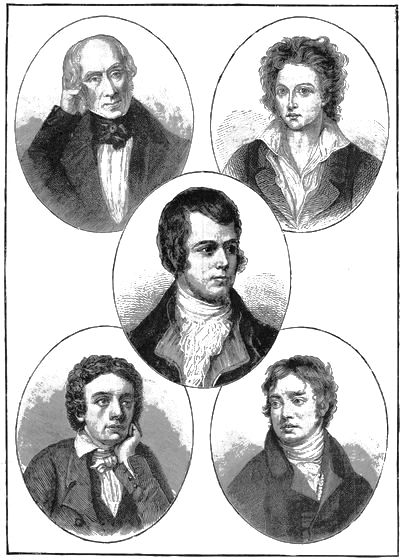
WILLIAM WORDSWORTH. PERCY BYSSHE SHELLEY. ROBERT BURNS. JOHN KEATS. SAMUEL TAYLOR COLERIDGE.
[See larger version]
In Lancashire and Cheshire the principal roads were paved; but as there grew a necessity for more rapid transit of mails and stage-coaches, we find, from a tour by Adam Walker to the Lakes in 1792, that a better system had been introduced; the paved roads were in many places pulled up, and the stones broken small; and he describes the roads generally as good, or wonderfully improved since the "Tours" of Arthur Young. Except in the county of Derby, the highways were excellent, and broken stones were laid by the roadsides ready for repairs.
But it was not till the days of Telford and Macadam that the system of road-making received its chief improvements. The reform in roads commenced in Scotland. Those which had been cut through the Highlands after the Rebellions of 1715 and 1745, chiefly under the management of General Wade, set the example, and showed the advantage of promoting communication, as well as of enabling the military to scour the mountains. In 1790 Lord Dare introduced the practice of laying out roads by the spirit-level, and they were conducted round hills instead of being carried over them. In 1802 a Board of Commissioners for Roads and Bridges in Scotland was established, and Thomas Telford was appointed the engineer. This able man had now a full opportunity for showing his knowledge of road-making. He laid out the new routes on easy inclines, shortened and improved the old routes by new and better cuttings, and threw bridges of an excellent construction over the streams. Where the bottom was soft or boggy he made it firm by a substratum of solid stones, and levelled the surface with stones broken small. Attention was paid to side-drains for carrying away the water, and little was left for the after-plans of Macadam. Yet Macadam has monopolised the fame of road-making, and little has been heard of Telford's improvements, although he was occasionally called in where Macadam could not succeed, because the latter refused to make the same solid bottom. This was the case in the Archway Road at Highgate. Macadam's main principle of road-making was in breaking his material small, and his second principle might be called the care which he exercised in seeing his work well done. For these services he received two grants from Parliament, amounting to ten thousand pounds, and the offer of knighthood, the latter of which he would not accept for himself, but accepted it for his eldest son.
Telford, under the commission for Scotland, thoroughly revolutionised the roads of that country. From Carlisle to the extremity of Caithness, and from east to west of Scotland, he intersected the whole country with beautiful roads, threw bridges of admirable construction over the rivers, and improved many of the harbours, as those of Banff, Peterhead, Fraserburgh, Fortrose, Cullen, and Kirkwall. The extent of new road made by him was about one thousand miles, and he threw one thousand two hundred bridges over rivers, some of them wild mountain torrents.
The next step in the increase of means of traffic was the construction of canals. The rivers had previously been rendered more navigable by removing obstructions, deepening channels, and making good towing-paths along their banks; but now it was projected to make artificial rivers. In this scheme, Richard Brindley, under the patronage of the Duke of Bridgewater, was the great engineer; and his intrepid genius dictated to him to carry these canals over hills by locks, over rivers by aqueducts, and through the heart of hills by tunnels. These enterprises at that moment appeared, to the ordinary run of civil engineers, as rash experiments, which were sure to prove abortive. As all new ideas are, these ideas, now so commonplace, were ridiculed by the wise ones as little short of madness. Mr. Brindley's first great work was the formation of the Duke of Bridgewater's canal, from Worsley to Manchester. In this he at once proved all his plans of locks, tunnels, and aqueducts. He conducted his canal by an aqueduct over the river Irwell, at an elevation of thirty-nine feet; and those learned engineers who had laughed at the scheme as "a castle in the air," might now see boats passing over the river at that height with the greatest ease, while other boats were being drawn up the Irwell against the stream and under the aqueduct with five times the labour. At Worsley the canal was conducted into the very heart of the coal-mine by a tunnel, with branches, which conducted the boats up to the different parts of the mine, so that the coal could be loaded on the spot where it was dug. The immediate effect of this canal was to reduce coals in Manchester to half the former price; and the canal being extended so as to connect it with the Mersey, at Runcorn, it reduced the freight of goods from Manchester to Liverpool to the same extent, from twelve shillings to six shillings per ton, the land carriage having been forty shillings. Brindley was next engaged to execute the Grand Trunk Canal, which united the Trent and Mersey, carrying it through Birmingham, Chesterfield, and to Nottingham. This was commenced in 1766, and exhibited further examples of his undaunted skill, and, as he had been laughed at by the pedants of the profession, he now in his turn laughed at their puny mediocrity. One of his tunnels, at Harecastle Hill, in Staffordshire, was two thousand eight hundred and eighty yards long, twelve feet wide, nine high, and in some parts seventy yards below the surface of the ground. This tunnel, after half a century's use, was found too confined for the traffic, and a new one, much wider, was made by Telford. By this time the art of tunnelling had made great progress, and whilst Brindley required eleven years to complete his tunnel, Telford made his much larger one in three. Many causes intervened to check for a time the progress of canals, so that from 1760 to 1774 only nineteen Acts were passed for them; but in the two years of 1793 and 1794 no fewer than thirty-six new Bills were introduced to Parliament, with others for extending and amending rivers, making altogether forty-seven Acts, the expenditure on the canals of these two years' projection amounting to five million three hundred thousand pounds. The work now went on rapidly, and investments in canal shares exhibited at that day, in miniature, the great fever of railway speculation at a later period. Lines of canals were made to connect the Thames, the Tweed, the Severn, and the Mersey; so that the great ports of London, Liverpool, Hull, and Bristol were connected by them, and put into communication with nearly all the great inland manufacturing towns. In 1779 a ship-canal was completed from the Forth to the Clyde—a work proposed as early as the reign of Charles II. This canal, thirty-five miles in length, had thirty-nine locks, which carried the canal to a height of one hundred and fifty-six feet above the sea, and it crossed the river Kelvin by an aqueduct eighty-three feet from the bed of the river to the top of the masonry. A few years later a much larger ship-canal united Gloucester to the Severn, and wonderfully increased the trade and growth of that city.
Telford succeeded to Brindley, with all his boldness and skill, and with much extended experience. He executed the Ellesmere canal, which occupied a length of upwards of a hundred miles, connecting the rivers Severn, Dee, and Mersey. In the construction of this canal Telford introduced a bold, but successful, novelty. In aqueducts, instead of puddling their bottoms with clay, which was not proof against the effects of frost, he cased them with iron, and adopted the same means when he had to pass through quicksands or mere bog. Some of Telford's aqueducts were stupendous works. The Chirk aqueduct passed, at seventy feet above the river, on ten arches of forty feet span, and cost twenty thousand eight hundred and ninety-eight pounds. The aqueduct over the Dee passed at a height of one hundred and twenty-one feet above low water, and consisted of a great trough of cast-iron plates, supported on eighteen piers, and having a towing-path of cast-iron, supported on cast-iron pillars. This aqueduct took ten years in building, and cost, with its embankments, forty-seven thousand pounds. Tunnels much larger than that at Harecastle Hill were executed. That at Sapperton, on the Thames and Severn canal, executed by Mr. Whitworth, was nearly two miles and a half long, ran two hundred and fifty feet below the summit of the hill, and was large enough for boats of seventy tons burden. This was completed in 1788. These daring enterprises led to the design of a tunnel under the Thames, from Gravesend to Tilbury; but this was abandoned for want of capital. In 1804 a like attempt was made at Rotherhithe, but stopped from the same cause, and was not completed till 1843 by Sir Mark Isambard Brunel. Between 1758 and 1801 no fewer than sixty-five Acts of Parliament were passed for making or extending canals. At the end of that period canals extended over upwards of three thousand miles, and had cost upwards of thirteen millions sterling. In fact, the bulk of canal work was done by this time, though not some few works of great importance. The Leeds and Liverpool canal, begun in 1770, but not completed till 1816, opened up connection with a vast manufacturing district; and the Rochdale, Huddersfield, and Hull canals gave access for the Baltic traffic into the heart of Lancashire. The Paddington and Regent's Canals wonderfully promoted the intercourse between the interior and the metropolis. In the Highlands, the Caledonian Canal, connecting the string of lakes between Inverness and the Atlantic, gave passage to ships of large burden. At the end of this reign the aggregate length of canals in England and Wales was two thousand one hundred and sixty miles; in Scotland, two hundred and twelve; in Ireland, two hundred and fifty; total, two thousand six hundred and twenty-two miles. The attention paid to roads and canals necessitated the same to bridges; and during this reign many new structures of this kind were erected, and much improvement attained in their formation. In 1776 a totally new kind of bridge was commenced at Coalbrook Dale, and completed in 1779; this was of cast-iron, having a single arch of one hundred feet span, and containing three hundred and seventy-eight and a half tons of metal. Telford greatly improved on this idea, by erecting an iron bridge over the Severn, at Buildwas, in 1796, having an arch of one hundred and thirty feet span.
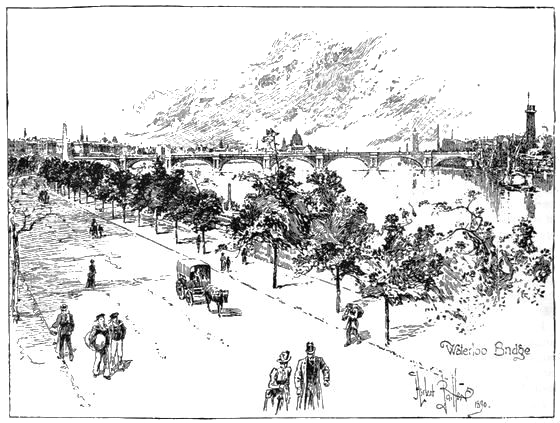
WATERLOO BRIDGE, LONDON, IN 1890.
[See larger version]
Half the London bridges were built, or rebuilt, during this period. Waterloo Bridge was begun in 1811, and completed by its designer and architect, John Rennie, on the 18th of June, 1817, having cost upwards of a million sterling. It is not only the longest of the Thames bridges, but was pronounced by Canova the finest bridge in the world, and is justly universally admired. Rennie built Southwark Bridge, an iron one, at a cost of eight hundred thousand pounds, and completed it in 1819, its erection occupying five years. Sir John Rennie, his son, built the new London Bridge from the designs of his father; but this was not begun till six years after the death of George III., nor finished till 1831, at a cost of five hundred and six thousand pounds.
Iron suspension bridges were also introduced towards the end of this reign. Chain bridges had been erected in China for nearly two thousand years, and rope bridges in India and South America still earlier. In England a foot-bridge of iron chains was erected at Middleton, over the Tees, in the middle of the eighteenth century. In 1816 a bridge of iron wire was thrown across the Gala Water; and another, on a different principle, the following year, was erected over the Tweed, at King's Meadows. But now much greater and more complete works of the kind were to be executed. Captain (afterwards Sir Samuel) Brown introduced many improvements into these structures. He substituted iron ropes for hempen ones, thereby forming cable-chains, like those used in Wales on quarry tram-roads, and these he applied to suspension bridges. In 1819 he was commissioned to construct an iron suspension bridge over the Tweed, near Kelso, called the Union Bridge, which he completed in 1820, at a cost of five thousand pounds. In 1827 the first suspension bridge was thrown over the Thames by Mr. William Tierney Clarke; and in 1818 Telford commenced his great work of throwing a suspension bridge over the Menai Strait, near Bangor, which he completed in 1825. The main opening of this stupendous work is five hundred and sixty feet wide, and one hundred feet above high-water mark. The length of the roadway of the bridge is one thousand feet. The cost was one hundred and twenty thousand pounds. This was Telford's chef-d'œuvre. But the same neighbourhood was destined to see a more stupendous structure span the Strait from the Welsh shore to Anglesey. This was the tubular railway bridge, connecting the London and Holyhead line, within view of Telford's elegant suspension bridge. This was erected by Robert Stephenson, from his own design, greatly improved by suggestions from William Fairbairn of Manchester. It was completed in October, 1850, at a cost of six hundred and twenty-five thousand eight hundred and sixty-five pounds. Further description of this great work is not proper here, as it belongs to a later date, but it seemed fit to mention it in passing, as an evidence of the progress of the engineering science in the reign of Victoria.
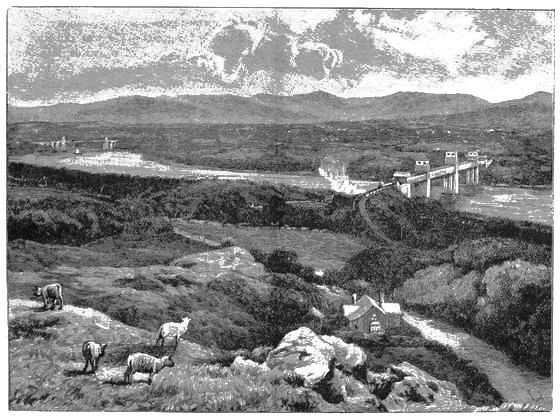
MENAI SUSPENSION AND TUBULAR BRIDGES. (From a Photograph by Hudson.)
[See larger version]
Great improvements were made during this reign in the harbours, especially by Telford and Rennie. Telford's harbour work in Scotland we have already mentioned; Rennie's formations or improvements of harbours were at Ramsgate, London, Hull, and Sheerness; he also built the Bell Rock Lighthouse, on the same principle as the Eddystone Lighthouse, built by Smeaton, a self-taught engineer, just before the accession of George III.
The mechanical invention, however, destined to produce the most extraordinary revolution in social life was that of railways, which during this reign were progressing towards the point where, combined with the steam-engine, they were to burst forth into an activity and strength astonishing to the whole world. Tram-roads—that is, roads with lines of smooth timber for the wheels of waggons to run upon—had been in use in the Newcastle collieries for a century before. In 1767, at the Coalbrook Dale Iron Works, iron plates were substituted for wood, and by this simple scheme one horse could, with ease, draw as much as ten on an ordinary road. In 1776 iron flanges, or upright edges, were used at the collieries of the Duke of Norfolk, near Sheffield, and after this time they became common at all collieries, both above and below ground. In 1801 an iron railway, by a joint-stock company, was opened from Wandsworth to Croydon. Three years before iron railways had been introduced to convey the slates from Lord Penrhyn's quarries, in Carnarvonshire, to the Menai Strait for shipment, and they were attached to canals for the conveyance of goods to and from them. At the end of this reign there were two hundred and twenty-five miles of iron railroads in the neighbourhood of Newcastle-on-Tyne, and upwards of three hundred miles in the single county of Glamorgan.
Before the termination of the reign there were active preparations for putting steam-engines on all iron railroads. So early as 1758, Watt, who afterwards did so much in the construction of steam-engines, had an idea that locomotive engines might be put on such roads. In 1770 such an engine was actually made and worked by John Theophilus Cugnot, in Paris, but he had not discovered sufficient means of controlling it. In 1802 Messrs. Trevethick and Vivian exhibited such an engine running along the streets in London. In 1805 the same gentlemen again exhibited one of their engines working on a tram-road at Merthyr Tydvil, drawing ten tons of iron at the rate of five miles an hour; and in 1811 Mr. Blenkinsop was running an engine on the Middleton Colliery, near Leeds, drawing a hundred tons on a dead level at the rate of three and a half miles an hour, and going at the rate of ten miles when only lightly loaded. Blenkinsop had made the wheels of his engines to act by cogs on indented rails; for there was a strong persuasion at that period that the friction of plain wheels on plain rails would not be sufficient to enable the engine to progress with its load. The folly of this idea had already been shown on all the colliery lines in the kingdom, and by the engine of Trevethick and Vivian at Merthyr. The fallacy, however, long prevailed. But during this time Thomas Gray was labouring to convince the public of the immense advantages to be derived from steam trains on railways. In five editions of his work, and by numerous memorials to Ministers, Parliament, lord mayors, etc., he showed that railroads must supersede coaches for passengers, and waggons and canals for goods. He was the first projector of a general system of railroads, laid down maps for comprehensive general lines for both England and Ireland, invented turn-tables, and very accurately calculated the cost of constructing lines. For these services he was termed a madman, and the Edinburgh Review recommended that he should be secured in a strait jacket. In his "Life of George Stephenson" Dr. Smiles takes exception to the statement that Thomas Gray was the originator of railways, and transfers that term to Stephenson. Let us be correct; Gray was the projector, Stephenson the constructor of railways. But it is not to be supposed that Gray had sold five editions of his work without Stephenson, and perhaps every engineer, having read and profited by it. Yet, so little had Stephenson any idea of the real scope and capacity of railways, that it was not till five years after the running of his engines on such lines, by Dr. Smiles's own showing, that he ever imagined such a thing as their becoming the general medium of human transit. He tells us Mr. Edward Pease suggested to him to put an old long coach on the Darlington and Stockton line, attached to the luggage trucks, and see if people might not wish to travel by it. Gray had demonstrated all this long before. He stood in the place of the architect, Stephenson only of the builder who carries out the architect's design. Seven years only after the death of George III. the railway line between Manchester and Liverpool was commenced, and from its successful opening, on the 15th of September, 1830, dates the amazing development of the present railway system.
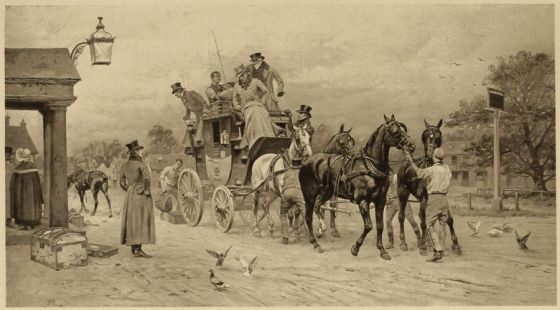
"A HUNDRED YEARS AGO."
FROM THE PAINTING BY GEORGE WRIGHT
By permission of E. W. Savory, Ltd.
[See larger version]
The earliest idea of a steam-engine was that given by the Marquis of Worcester, in his "Century of Inventions," in 1663, which idea he obtained from De Caus, and reduced to action in London. The next step was to Papin's Digester, and then to Savery's so-called "Atmospheric Engine." This, improved by Newcomen in 1711, was introduced to drain mines in all parts of the kingdom, but especially in the coal-mines of the north and midland counties, and the copper mines of Cornwall. By its means many mines long disused through the accumulation of water were drained and made workable, and others were sunk much deeper. Smeaton, in 1769, greatly improved this engine, which, from its rapid working of a horizontal beam, was called by the miners a "Whimsey," as having a whimsical look. Watt, then a student in the University of Glasgow, commenced a series of experiments upon it, which, between 1759 and 1782, raised the engine to a pitch of perfection which made it applicable not only to draining water out of mines, but, by the discovery of the rotatory motion, enabled it to propel any kind of machinery, spin cotton, grind in mills of all kinds, and propel ships and carriages. Watt was greatly aided in his efforts by Mr. Matthew Boulton, and their engines were manufactured at Soho Works, near Birmingham. They did not, however, enjoy the fruits of their patents for protecting their inventions without many most unprincipled attempts to invade their rights by masters of mines and others, by which they were involved in very harassing law-suits. The first application of the steam-engine to the machinery of a cotton-mill was at Papplewick, in Nottinghamshire, in 1785, and the first mill built for the employment of machinery driven by an engine was in Manchester, in 1789. The first application of the engine to propel a vessel was at Dalswinton, on the Clyde, in 1788, the boat being constructed by Patrick Miller, James Taylor, and William Symington. In the following year these inventors made a second experiment on the Forth and Clyde Canal at the Carron Works, with perfect success, the vessel going at the rate of nearly seven miles an hour. Symington was probably the real machinist in this firm, and in 1802 he made a tug-boat on the Forth and Clyde Canal, under the patronage of Lord Dundas, which was worked extremely well by its engine. In 1807 Fulton followed up these experiments by launching a steam-boat on the Hudson, in America, after having in vain solicited the patronage of the British and French Governments for his enterprise. The proposal of Fulton, submitted to the Academy of Paris, was received with a burst of laughter, and Napoleon abandoned the project in deep disgust at having been, as he supposed, made a dupe of by Fulton. We have pointed out on the preceding page the period of the first application of the steam-engine to railways.
By the marvellous aids of canals and steam-engines manufacturing power became most immensely augmented in all directions, but especially in the spinning and weaving of cotton goods. The machines invented by Wyatt and Paul in 1733, and improved by Arkwright in 1767, if not invented anew, without knowledge of Wyatt and Paul's plan of spinning by rollers—a moot point; the spinning-jenny with seven spindles, invented by James Hargreaves, a weaver near Blackburn, in 1767; and the mule-jenny, combining the working of the machines of Arkwright and Hargreaves, by Samuel Crompton, in 1779, completely superseded spinning cotton yarn by hand. These machines were first worked by water power, but steam power was used after the steam-engine had been invented; and the growth of cotton-spinning became rapid beyond conception, spreading over all Lancashire and the midland counties in a marvellous manner. The cotton-mills of Robert Peel, in Lancashire and Staffordshire; of the Strutts, at Belper, in Derbyshire; of Dale, at New Lanark; of Robinson, at Papplewick; and Arkwright, at Cromford, which raised these gentlemen to vast wealth, being only the leviathans amongst swarming concerns of less dimensions.
To these, in 1785, the Rev. Dr. Edmund Cartwright introduced a loom for weaving by water or steam power, which soon superseded hand-loom weaving. In 1803 Mr. H. Horrocks greatly improved this, and from this germ has grown up the system of weaving cottons, silks, and woollens by machinery. Add to this the application of similar machinery to calico-printing, and the like to weaving of lace, invented by Robert Frost, of Nottingham, or by a working mechanic of that town named Holmes, which afterwards received many improvements, and we have the varied means by which the manufacturing power of England was raised far above that of all the world; and which, reaching other countries in spite of legislative impediments, soon established similar manufactures in France, Belgium, Germany, Switzerland, and America. In Great Britain alone the importation of raw cotton was increased from 4,764,589 lbs. in 1771 to 151,000,000 lbs. in 1818; and such was the spread of trade of all kinds from the use of machinery, that our exports of manufactured goods in 1800, when the European nations were incapacitated for manufacturing by Napoleon's general embargo, amounted to £116,000,000.
Almost every other manufacture shared in this surprising impulse from machinery and the spirit of invention. It was an age of new creations and of unprecedented energies. In 1763 Josiah Wedgwood, of the Staffordshire Potteries, commenced that career of improvement in the biscuit, form, and printing of porcelain which constituted a new era in the art. At that time the French fine pottery was so much superior to the English that it was extensively imported. In fact, it was a period when taste in every department of art was at the lowest ebb. Wedgwood, being a good chemist, not only improved the body of his earthenware, but, being a man of classical taste, introduced a grace and elegance of form before unknown to British pottery. He invented a new kind of composition so hard and marble-like that it resisted both fire and acids; and in this he moulded statuettes, cameos, and medallions from the Greek originals, of great beauty. Sir William Hamilton having brought over from Italy a quantity of antique vases, etc., Wedgwood benefited by them to introduce fresh forms and colouring in his wares, and probably on this account called his pottery-works Etruria. He had the aid of Mr. Chisholm, a practical chemist, in his researches into the best composition and colours for his porcelain, and his improvements laid the foundation of the great pottery trade of Staffordshire.
Many improvements were made also in the glass manufacture during this reign, and more would undoubtedly have been made but for the very heavy duties upon it to help to support the ruinous wars of the period. In 1760, the first year of the reign, crown glass is said to have been introduced. In 1763 the first glass plates for looking-glasses and coach-windows were made at Lambeth. In 1779 flint-glass was first made; and about that time plate-glass. The duties on different kinds of glass at that date were about one hundred and forty thousand pounds per annum. So oppressive were those duties that, in 1785, the St. Helens Plate-glass Company petitioned Parliament, stating that, in consequence of the weight of taxation, notwithstanding an expenditure of one hundred thousand pounds, they had not been able to declare a dividend.
The introduction of the steam-engine, railroads, and canals enabled the coal-miners during this reign to extend the supply of coals enormously. In 1792 the coal-mines of Durham and Northumberland alone maintained twenty-six thousand two hundred and fifty persons, and employed a capital of three million one hundred and thirty thousand pounds—a very small amount of both people and money as compared with the workers and capital engaged in the trade since the expansion of the manufacturing and steam systems. The coal-fields of Durham and Northumberland extend to nearly eight hundred square miles, but the beds in Northumberland, Durham, Yorkshire, the Midland Counties, South of Scotland, and Ireland, are still immense and not yet fully explored. Fresh strata are discovered as steam power enables us to go deeper. In 1817 Sir Humphry Davy perfected his safety-lamp, which, by means of a simple wire gauze, enabled the miner to work amid the most explosive gases. These lamps, however, were not able to protect the colliers from their own carelessness, and most horrible destruction, from time to time, took place amongst them from neglect.
With the reign of George III. commenced a series of improvements in the manufacture of iron, which have led not only to a tenfold production of that most useful of metals, but to changes in its quality which before were inconceivable. Towards the end of the reign of George II. the destruction of the forests in smelting iron-ore was so great as to threaten their extinction, and with it the manufacture of iron in Britain. Many manufacturers had already transferred their businesses to Russia, where wood was abundant and cheap. It was then found that coke made from coal was a tolerable substitute for charcoal, and, in 1760, the very first year of the reign of George III., the proprietors of the Carron Works in Scotland began the use of pit-coal. Through the scientific aid of Smeaton and Watt, they applied water-, and afterwards steam-power, to increase the blast of their furnaces to make it steady and continuous, instead of intermitting as from bellows; and they increased the height of their chimneys. By these means, Dr. John Roebuck, the founder of these works, became the first to produce pig iron by the use of coal. This gave great fame to the Carron Works, and they received large orders from Government for cannon and cannon-balls. It was some time, however, before enough iron could be produced to meet the increasing demand for railroads, iron bridges, etc.; and so late as 1781 fifty thousand tons were imported annually from Russia and Sweden.
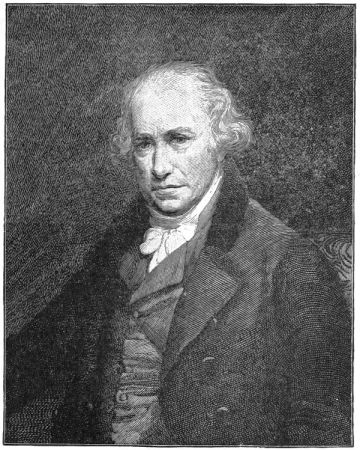
JAMES WATT. (After the Portrait by Sir W. Beechey, R.A.)
[See larger version]
The employment of pit-coal had not reached perfection, and in 1785 the Society of Arts offered a premium for the making of fine bar iron with pit-coal. This object was accomplished by Mr. Cort, an iron-founder of Gloucestershire, by exposing the pig iron on the hearth of a reverberatory furnace to the flame of pit-coal. This process was improved into what was called puddling, in puddling or reverberatory furnaces. Cort also introduced the drawing out of iron between cylindrical rollers; but he became ruined in his experiments, and other iron-masters of more capital came in to reap the profit. Many years passed before a pension was conferred on some of his children for his services. In 1755 the whole population of Carron was only one thousand eight hundred and sixty-four; in 1795 the workmen alone employed in the works were one thousand, the population four thousand, when the foundry had five blast furnaces, sixteen air furnaces, three cupola furnaces, and consumed one hundred and thirty-six tons of coals daily. It supplied to the Government eleven thousand tons annually of cannon, mortars, shot, shells, etc.; to the East India Company six thousand tons; and to all customers together twenty-six thousand tons. The growth of the iron trade in Great Britain, through these improvements, may be seen from the fact that in 1802 there were one hundred and sixty-eight blast furnaces, producing two hundred and twenty thousand tons of iron; in 1820 the annual production of iron was four hundred thousand tons; in 1845 the production was calculated at twice that amount—that is, in twenty-five years the production had doubled itself. In 1771 the use of wire ropes, instead of hempen ones, was suggested by M. Bougainville, and this was made a fact by Captain Brown, in 1811. Before this, in 1800, Mr. Mushet, of Glasgow, discovered the art of converting malleable iron, or iron ore, into cast steel; and in 1804 Samuel Lucas, of Sheffield, further extended the benefit by the discovery of a mode of converting any castings from pig iron at once into malleable iron, or cast steel, so that knives, forks, snuffers, scythes, and all kinds of articles, were converted into steel, "without any alterative process whatever between the blast furnace and the melting-pot." In 1815 it was calculated that two hundred thousand persons were employed in manufacturing articles of iron, the annual value of which was ten million pounds.
With the war the manufacture of guns and arms of all kinds was greatly increased, and several important improvements were made in the construction of gun-barrels and their breeches. All kinds of cutlery were improved, but, at the same time, both Government, by contractors, and foreign countries, by merchants, were imposed on by articles that had more show than use, to the serious injury of the British reputation. Knives and razors were sent out of mere iron, and our pioneers and sappers and miners were often supplied with axes, picks, and shovels more resembling lead than iron.
Great attention during this reign was devoted to the manufacturing of clocks and watches. To such eminence had the English manufacture of watches arrived, that in 1799 it was calculated that the value of watches and marine chronometers alone manufactured in and around London amounted to a million of money yearly. In 1762 John Harrison claimed the reward offered by Act of Parliament for a chronometer which would ascertain the longitude within sixty, forty, or thirty miles. For the least accurate of these the reward was ten thousand pounds, for the next more accurate fifteen thousand pounds, and for the best twenty thousand pounds. Harrison produced a chronometer which, after two voyages to the West Indies, entitled him to the highest prize, but a fresh Act of Parliament was passed, refusing him more than two thousand five hundred pounds until he had made known the principle of his invention, and assigned his chronometer for the public use. Even when these new terms were complied with he was only to receive ten thousand pounds, and the remainder on the correctness of the chronometer having been sufficiently tested. Harrison very justly complained of these new stipulations, and of the delays thus interposed; but in 1767, nine years before his decease, he obtained the full amount of the premium. In 1774 a premium of five thousand pounds was offered by Act of Parliament for a chronometer that should ascertain the longitude within one degree of a great circle, or sixty geographical miles; seven thousand five hundred pounds for one that would ascertain the longitude within two-thirds of that distance; and ten thousand pounds for one that would ascertain it within half a degree. This called out the efforts of various competitors—Harrison, Meadge, Kendal, Coombe, and numbers of others. In 1777 Meadge produced two, which were submitted to the test of the Astronomer-Royal, Dr. Maskelyne, and pronounced unfavourably upon; but Meadge petitioned Parliament against this decision, and, on the report of a committee on his chronometers, he was awarded a premium of two thousand five hundred pounds.
In 1783 the English carriage-builders, who had before been considered inferior in elegance to the French makers, began to receive large orders from Paris itself. In 1759 Walter Taylor and son introduced machinery for cutting blocks, sheaves, and pins for ships. Saw-mills were also introduced into Great Britain, in 1767, by Mr. Dingley, of Limehouse.
In the art of printing, the process of stereotyping (originally invented by William Ged) was re-invented by Mr. Tulloch, in 1780. In 1801 lithography was introduced into England from Germany, but was not much used till Mr. Ackermann began to employ it, in 1817. In 1814 steam was first applied to printing in the Times office.
The art of coining received, like other things, a new facility and perfection from the application of the steam-engine. Messrs. Boulton and Watt, at the Soho Works, set up machinery, in 1788, which rolled out the metal, cut out the blanks, or circular pieces, shook them in bags to take off the rough edges, and stamped the coins—in higher perfection than ever before attained—at the rate of from thirty to forty thousand per hour.
To this prolific reign belongs also the discovery of coal-gas. In 1792 William Murdoch, an engineer, lighted his own house with it in Redruth, in Cornwall. The same gentleman illuminated the Soho Works of Messrs. Boulton and Watt with it at the Peace of Amiens, in 1802; and in the year 1804 some of the cotton mills in Manchester began to use it. In 1807 it was used in Golden Lane, in London; in 1809 Mr. Winsor, a German, lit up Pall Mall with it; and in 1813 the first chartered gas company was established in London, and gas soon spread through all the large towns.
In astronomy, Herschel discovered the planet Uranus in 1781; in 1802 he published, in the "Philosophical Transactions," his catalogue of five hundred new nebulæ and nebulous stars; and in 1803 announced his discovery of the motion of double stars round each other. In chemistry, Sir Humphry Davy, in 1807, extracted their metallic bases from the fixed alkalies; in 1808 demonstrated the same fact as it regarded the alkaline earths; in 1811 discovered the true nature of chlorine; in 1815 invented his safety lamp; and in 1817 (as already mentioned) brought it to perfection. In 1804 Leslie published discoveries of the nature and properties of heat; in 1808 Dalton announced his atomic theory; and in 1814 Wollaston completed its development and proof.
Amongst the fine arts, the first to which we direct attention, that is, music, was warmly patronised by the Royal Family, and therefore maintained the status which it had acquired in the last reign, though it produced no great original genius. Church music continued to be cultivated, and the anthems of Kent, published in 1773, and those of Nares, published in 1778, were of much merit. To these we may add the services and anthems of Doctors Hayes, Dupuis, Arnold, Cooke, Ayrton, and of Mr. Battishill. The "Shunamite Woman," an oratorio by Arnold, appeared at a later date, as well as the anthems and services of Dr. Whitfield.
In the early part of the reign the English operas of Augustine Arne, "Artaxerxes" and "Love in a Village"—the former principally a translation from Metastasio—were much admired. For the rest, there were numbers of lovers and professors of the art, both in sacred, operatic, and glee music. The Catch Club was formed in 1761, and zealously supported, as well as the Concerts of Ancient Music in 1776. Under the patronage of this society, and particularly of his Majesty, took place the celebrated Handel "Commemoration" in Westminster Abbey, in May and June of 1784. During the early part of the reign, too, appeared several distinguished works in this department. At the head of these stood the "Histories of Music," by Sir John Hawkins and Dr. Burney; Dibdin's "Musical Tour;" Dr. John Browne's "Dissertation on Poetry and Music;" the "Letters" of Jackson, of Exeter; and Mason's "Essays on Church Music." In the later portion of the reign there was much love of music, but little original composition, except for the stage, where Arnold, Shield, Storace, and Dibdin produced the most delightful compositions. Arnold's "Castle of Andalusia," "Inkle and Yarico," "The Surrender of Calais," and "The Mountaineers;" and Shield's "Rosina," "The Poor Soldier," "The Woodman," and "The Farmer," are universally admired. The sea songs of Charles Dibdin are as imperishable as the British navy, to which they have given a renown of its own. He wrote about one thousand four hundred songs, thirty dramatic pieces, "A Musical Tour," and a "History of the Stage," and was allowed, after all, to die in deep poverty, after charming the world for half a century. During the latter part of the reign music was in much esteem, and musical meetings in various parts of the country—in London, the opera, Ancient Concerts, and performances by foreign composers, such as Handel's "Messiah," Beethoven's "Mount of Olives," Mozart's opera of "Don Giovanni," etc.—were flocked to, but little native genius appeared.
During this reign architecture was in a state of transition, or, rather, revolution, running through the Palladian, the Roman, the Greek, and into the Gothic, with a rapidity which denoted the unsettled ideas on the subject. At the commencement of the reign James Paine and John Carr were the prevailing architects. Worksop Manor, since pulled down, and Keddlestone, in Derbyshire, were the work of Paine; but Robert Adam, an advocate for a Roman style, completed Keddlestone. Carr built Harewood House, and others of a like character, chiefly remarkable for Grecian porticos attached to buildings of no style whatever. The Woods, of Bath, employed a spurious Grecian style in the Crescent in that city, Queen's Square, the Pounds, etc., which, however, acquired a certain splendour by their extent and tout ensemble. To these succeeded Robert Taylor, the architect of the Bank of England and other public buildings, in a manner half Italian, half Roman. Sir William Chambers, of more purely Italian taste, has left us Somerset House as a noble specimen of his talent. Robert and James Adam erected numerous works in the semi-Roman semi-Italian style, as Caenwood House, at Highgate, Portland Place, and the screen at the Admiralty. In Portland Place Robert Adam set the example of giving the space necessary for a great metropolis. James Wyatt, who succeeded Chambers as Surveyor-General in 1800, destined to leave extensive traces of his art, commenced his career by the erection of the Pantheon, London, in the classical style, and then took up the Gothic style, which had begun to have its admirers, and in which James Essex had already distinguished himself by his restoration of the lantern of Ely Cathedral, and in other works at Cambridge. Wyatt was employed to restore some of the principal colleges at Oxford, and to do the same work for the cathedral of Salisbury and Windsor Castle. In these he showed that he had penetrated to a certain extent into the principles of that order of architecture, but was far from having completely mastered them. A greater failure was his erection of Fonthill Abbey, for Beckford, the author of "Vathek," where he made a medley of half an abbey, half a castle, with a huge central church tower, so little based on the knowledge of the Gothic architects that in a few years the tower fell. Wyatt, however, was a man of enterprising genius. Co-temporary with Wyatt, George Dance made a much less happy attempt in Gothic in the front of Guildhall, London; but he built Newgate and St. Luke's Hospital in a very appropriate style. One of the most elegant erections at this period was the Italian Opera House, by a foreigner, Novosielsky, in 1789. Nor must we omit here the publication of John Gwynn's "London and Westminster Improved," in 1766, by which he led the way to the extensive opening up of narrow streets, and throwing out of fresh bridges, areas, and thoroughfares, which have been since realised, or which are still in progress.
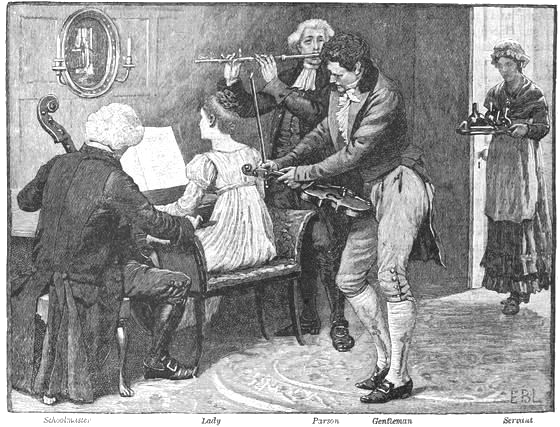
Schoolmaster Lady Parson Gentleman Servant
COSTUMES AT THE END OF GEORGE III.'S REIGN.
[See larger version]
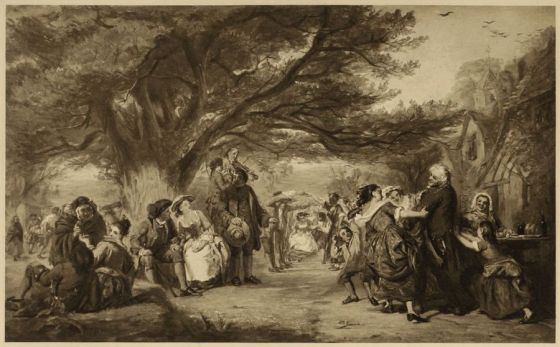
A VILLAGE MERRYMAKING.
FROM THE PAINTING BY W. P. FRITH, R.A., IN THE VICTORIA AND ALBERT MUSEUM, SOUTH KENSINGTON.
[See larger version]
Sir John Soane, who had been a pupil of Dance, Holland, and Sir William Chambers, introduced a more purely Greek style, and his achievements may be seen in Dulwich Gallery and Trinity Church, Marylebone. The most eminent disciples of this school were William Wilkins and Sir Robert Smirke. Wilkins was a servile copyist, and the National Gallery is the chief monument of his skill, or want of it. Sir Robert Smirke was of a higher order, and his erection of Covent Garden Theatre, the Mint, the Post Office, the College of Physicians, the law courts at Gloucester, Lowther Castle, etc., speak for themselves. Nash, the contemporary and successor of these architects, has left us abundance of his Græco-Romano-Italian medleys in the church in Langham Place, Regent's Park, and Buckingham Palace. The great merit of Nash was, that, like the brothers Adam, he gave us space, and showed, as in Regent's Park, what was needed for an immense metropolis. Towards the end of the reign Gothic architecture was more cultivated, and one of Wyatt's last works was Ashridge House, in Buckinghamshire, a vast and stately Gothic pile, imposing in general effect, but far from pure in style. Still less so was Eaton Hall, in Cheshire, built by William Pordon; but the real Anglo-Gothic was now receiving the true development of its principles by the works of James Bentham, Carter, John Britton; and, finally, Thomas Rickman, in 1816, published his "Attempt to Discriminate the Styles of English Architecture," which placed these principles perspicuously before the public.
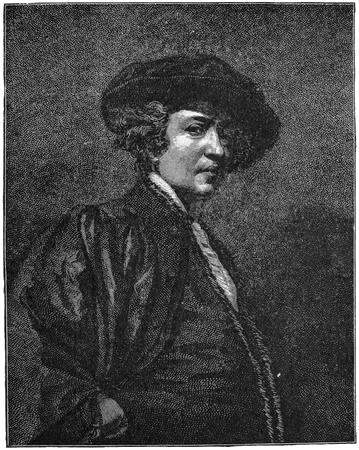
SIR JOSHUA REYNOLDS. (After the Portrait by Himself.)
[See larger version]
Under Sir Joshua Reynolds a perfect revolution in the art of painting, as practised in England, was effected. He threw aside past traditional fashions, and returned to nature; and his portraits at once excited the consternation of the painters of the day, and placed him in the very first rank of artists. In 1768 was established the Royal Academy, and amongst its foreign members were Benjamin West and Angelica Kauffmann. West produced all his great works in England, and, however much they may now be criticised, they showed an advance on past art in England, and had the merit of introducing modern costume for modern heroes, as in the "Death of General Wolfe," contrary to the advice of even Reynolds himself. Barry made a spasmodic attempt to lead the public back to what he deemed the classical, but in vain; and the successive appearance of Wilson, Gainsborough, and Opie, in different styles, but all genuinely English, established the public in its attachment to the true English school. Wilson, during his lifetime, indeed, was neglected, and died in poverty; but the next generation made the amende to his fame, though too late for his own enjoyment of it. To Paul Sandby we owe the origin of the water-colour school, which afterwards grew so extensive and so rich in production. Amongst eminent painters of this portion of the reign we must mention Wright of Derby, Mortimer, Stubbs and Sawrey, animal painters, and Copley, who, though an American by birth, produced most of his works in England.
Of water-colour painters who extended the fame of the school were Payne, Cozens, Glover, Girtin, and Turner; but Turner soon deserted water for oil. In 1804 the Water-Colour Society was established, and Turner was not amongst its numbers, having already gone over to oil-painting; but there were Varley, Barrett, Hills, Rigaud, and Pocock. Wild and Pugin were exhibitors of architectural drawings at its exhibitions. Afterwards came Francia, Westall, Uwins, De Wint, Mackenzie, Copley Fielding, Robson, Prout, Gandy, and Bonington. In their rear, but extending beyond the reign, appeared a brilliant host.
In general art the names of Fuseli, Northcote, and Stothard stand eminent, and were the foremost contributors to Alderman Boydell's celebrated Shakespeare Gallery. There were also Hoppner, Beechey, Morland; in Scotland, Sir William Allan and Sir Henry Raeburn. In caricature Gillray was a worthy successor to Hogarth.
In 1805 a great step in British painting was made by the establishment of the British Institution; and in 1813 this institution opened the National Gallery. The annual exhibitions soon became enriched by the consummate works of Hilton, Etty, Haydon, Briggs, Sir Thomas Lawrence (in elegant portraits), Phillips, Shee, Carpenter, Harlow, Wilkie, Mulready, Turner, Calcot, Collins, Landseer, Martin, Danby, Howard, Cooper, Leslie, and Hone. No age in England had produced so illustrious a constellation of painters, as varied in character as they were masterly in artistic power.
The art of sculpture, like that of painting, took a new spring in this reign, but the early part of it was encumbered by the tasteless works of Wilton, Read, and Taylor. It remained for the genius of Banks, Nollekens, Bacon, Baily, Behnes, and Chantrey, to place sculpture on its proper elevation in England.
To the art of engraving Woollett and Strange gave a first-rate eminence, and were successfully followed by Browne, Byrne, Rosker, and Major. In mezzotint M. Ardell admirably rendered the portraits of Sir Joshua Reynolds; and Smith, Green, Thomas, and Watson also excelled in this class of engraving. In engravings for books Heath and Angus stand pre-eminent; and Boydell's "Shakespeare" spread the taste, though his illustrations were chiefly done in the inferior style of dot engraving. In line engraving the names of Sharp, Sherwin, Fittler, Anker Smith, Neagle, Lowry, Turrell, Scott, and others, are of high repute. In landscape engraving no names, in the middle period of the reign, stood more prominent than those of Middiman, Watt, Angus, Milton, Pouncey, Peak, and Taylor.
There arose a second school of mezzotint engravers, the chief of whom were Earlom, Reynolds, Daniell, Sutherland, and Westall. The strange but intellectual Blake was both painter and his own engraver, in a style of his own. Towards the end of the reign flourished, chiefly in architectural illustrations, Le Keux, John and Henry, pupils of Bazire, Roffe, Ransom, and Scott; in landscape, William and George Cooke, William and Edward Finden, Byrne, and Pye; in portrait, Charles and James Heath, John Taylor, Skelton, Burnet, Bromley, Robinson, Warren, and Lewis.
In wood engraving, Thomas Bewick, of Newcastle-on-Tyne, revived the art, and threw such fascination into it by the exquisite tail-pieces in his "Natural History," that his name will always be associated with this style of engraving.
Of the coinage of this reign little is to be said. It was of the most contemptible character till Boulton and Watt, as already mentioned, struck the copper pence in 1797 in a superior style. In 1818 was issued a gold and silver coinage, which was entrusted to a foreign artist, Pistrucci, and which was turned out of very unequal merit. Flaxman would have produced admirable designs, and there was a medallist of high talent, Thomas Wyon, who would have executed these designs most ably. In fact, the best part of the silver coinage was produced by Wyon, from the designs of Pistrucci.
In the early portion of the reign the manners and customs differed little from those described in the preceding one. There was great dissipation, and even coarseness of manners, amongst the nobility and gentry. It was the custom to drink to intoxication at dinners, and swearing still garnished the language of the wealthy as well as of the low. Balls, routs, the opera, the theatre, with Vauxhall and Ranelagh, filled up the time of the fashionable, and gaming was carried to an extraordinary extent. Amongst our leading statesmen Charles Fox was famous for this habit. Duelling was equally common, and infidelity amongst fashionable people was of notorious prevalence. George III. and his queen did what they could to discourage this looseness of morals, and to set a different example; but the decorum of the Court was long in passing into the wealthy classes around it. An affluent middle class was fast mingling with the old nobility, and this brought some degree of sobriety and public decency with it. Amongst the lower classes dog-, cock-, and bull-fights were, during a great part of the reign, the chief amusements, and the rudest manners continued to prevail, because there was next to no education. Wesley, Whitefield, and their followers, were the first to break into this condition of heathenism. Robberies and murders abounded both in town and country, and the police was of a very defective character. For the most part there was none but the parish constable. The novels of Fielding and Smollett are pictures of the rudeness and profligacy of these times. The resources in the country of books and newspapers were few, and the pot-house supplied the necessary excitement. The clergy were of a very low tone, or were non-resident, and the farmers, getting rich, aped the gentlemen, followed the hounds, and ended the day with a carouse.
Gradually, however, a more refined tone was diffusing itself. The example of the head of the nation had not been without its effect. The higher classes abandoned Ranelagh and Vauxhall to the middle and lower classes, if they did not abandon their theatre, opera, and rout. But the theatres, too, became more decorous, and the spread of what had been called Methodism began to reach the higher classes through such men as Wilberforce, and such women as the Countess of Huntingdon and Hannah More. The most palpable drawback to this better state of sentiment and manners was the profligacy of the Prince of Wales and his associates. But towards the end of the reign a decided improvement in both manners and morals had taken place. The momentous events passing over the world, and in which Great Britain had the principal agency, seemed to have rooted out much frivolity, and given a soberer and higher tone to the public mind. The spread of a purer and more humane literature baptised the community with a new and better spirit; art added its refinements, and religion its restraints. The efforts to introduce education amongst the people had begun, and the lowest amusements of dog-fighting, cock-fighting, and bull-baiting were discouraged and put down. The new birth of science, art, literature, and manufactures was accompanied by a new birth of morals, taste, and sentiment, and this, happily, was a true birth; and the growth of what was then born has been proceeding ever since.
In the opening of the reign the gentlemen retained the full-skirted coat, with huge cuffs, the cocked-hats and knee-breeches of the former period. Pigtails were universal, and the more foppish set up their hair in a high peak, like the women. The ladies had their hair turned up on frames half a yard high, and this hairy mountain was ornamented with strings of pearls or diamonds, or surmounted with a huge cap edged with lace. They wore their waists as long as possible, with a peaked stomacher, and hanging sleeves of Mecklenburg lace. Their gowns were of the richest silks, satins, and brocades, their skirts flowing; and the fan was an indispensable article.
In the army the cocked-hat and pigtail at first prevailed, but these were soon dismissed, as well as the great jack-boots of the cavalry. With the employment of the Hessian soldiers in the American war, and afterwards on the Continent, there prevailed amongst English gentlemen the Hessian boot; instead of the queue, cropped hair and close-fitting small hats became the vogue. Powdering became profuse, both amongst ladies and gentlemen, till Pitt taxed it, when it vanished, except from the heads of particularly positive old gentlemen and servants.
During the French war, when the Paris fashions were intercepted, much variety in the fashion of dress took place amongst both gentlemen and ladies; but before the peace had arrived the most tasteless costumes had become general, and the waists of both sexes were elevated nearly to their shoulders. The tight skirts and short waists of the ladies gave them the most uncouth aspect imaginable; and the cut-away coats and chimneypot hats of the gentlemen were by no means more graceful. The military costume had undergone an equally complete revolution, and with no better success.
The changes in furniture were not remarkable. During the French war a rage for furniture on the classic model had taken place; but on the return of peace Paris fashions were restored. Rosewood superseded mahogany, and a more easy and luxurious style of sofa and couch was adopted. There came also Pembroke tables, Argand lamps, register stoves, Venetian and spring blinds, a variety of ladies' work-tables and whatnots; and a more tasteful disposition of curtains and ornamental articles purchased on the Continent.