Chapter VII · (continued 2)
Reading edition
Lord Anglesey replied to these sharp rebukes with great spirit. "Up to this moment," he said, "I have been left entirely in ignorance, not only as to your intentions with regard to this country, but also as to your sentiments regarding my policy. They are now developed, and I shall know how to act." He then entered into details of all the occurrences alluded to, in order to show "how entirely his Majesty had been misinformed." Having done so, he added, "If those who arraign my conduct will obtain information from an uninterested source, I feel the most perfect confidence that I shall obtain the applause of my Sovereign, and the goodwill and good opinion of his Majesty's Ministers with whom I serve." He denied that the Government had lost its power, that the Association had usurped its functions, or that the laws were set at defiance. He asserted, on the contrary, that the law was in full vigour; and if it authorised, or expediency demanded, the suppression of the Catholic Association and of the Brunswick Clubs, and the disarming of the yeomanry at the same time, he would undertake to effect it almost without the loss of a life. But he did not think such a course expedient, and he deprecated the teasing system of attacking every minor offence, of which the issue upon trial would be doubtful, and which would produce irritation without effecting a salutary lesson and permanent good. He had no object, he said, in holding his post but that of pleasing his king and serving his country; and if, in his zealous and unwearied efforts to effect the latter object, he had incurred the displeasure of the king and lost his Majesty's confidence, he ought not to remain in Ireland. He was therefore ready to depart whenever they found it convenient to recall him. The Duke became testy under this resistance and antagonism. In replying to the last letter he becomes more personal in his accusations. "I might," said the Premier, "at an earlier period have expressed the pain I felt at the attendance of gentlemen of your household, and even of your family, at the Roman Catholic Association. I could not but feel that such attendance must expose your Government to misconstruction. I was silent because it was painful to mention such things; but I have always felt that if these impressions upon the king's mind should remain—and I must say that recent transactions have given fresh cause for them—I could not avoid mentioning them to you in a private communication, and to let you know the embarrassment which they occasion."
The Viceroy rejoined with unabated spirit, replying to all the fresh matter introduced by the Duke in a lofty tone of self-justification. There is caustic irony in the following allusion to the king, as an apology for his conciliatory policy:—"I have, in fact, been most anxious to imitate, as far as my humble faculties would permit, the example of his Majesty himself during his visit to Ireland, and have scrupulously attended to the king's benign and paternal admonition, when his Majesty quitted the kingdom, to inculcate good fellowship and cordiality among all classes, and to promote conciliation." It is dangerous to use the argumentum ad hominem with a king—still more so to make his conduct the object of sarcastic allusions; and it was evident that Lord Anglesey could not long remain in the position of a representative of his Majesty. There was certainly an animosity against him in the highest quarters, which appeared in the construction put upon the accidental dropping in of his son and some of his household, from curiosity, to witness, as they thought unnoticed, the debates of the Association—a circumstance which he had long ago explained, and with which he thought it particularly unfair that he should be now upbraided.
This memorable controversy between the Prime Minister and the Lord-Lieutenant of Ireland, exhibiting a painful conflict of opinion and feeling between the two personages more particularly charged with the government of the country in the midst of a dangerous crisis, was brought to a close by a letter from the Duke of Wellington on the 28th of December. The following is a copy:—
"London, December 28, 1828.
"MY DEAR LORD ANGLESEY,—I have been very sensible, since I received your last letter, that the correspondence which that letter terminated had left us in a relation towards each other which ought not to exist between the Lord-Lieutenant and the king's Minister, and could not continue to exist without great inconvenience and injury to the king's service. I refrained from acting upon this feeling till I should be able to consult with my colleagues, and I took the earliest opportunity which the return to town of those who were absent afforded to obtain their opinion, which concurred with my own. Under these circumstances, having taken the king's pleasure upon the subject, his Majesty has desired me to inform you that he intends to relieve you from the Government of Ireland. I will shortly notify the arrangements which will become necessary in consequence.
"Believe me, ever yours most sincerely, (Signed) "WELLINGTON. "His Excellency the Marquis of Anglesey, K.G."
The marquis answered that he had received his letter, informing him of the king's intention to release him from the Government of Ireland, and that he held himself in readiness to obey his Majesty's commands the moment he received them. He did receive them, on the 10th of January, in a formal letter of recall from the Home Secretary.
The removal of this popular and "chivalrous" Viceroy caused universal expressions of grief among the Roman Catholic party. In the Association, O'Connell and Sheil spoke in the most glowing terms of his character and his administration. He quitted Ireland on the 19th of January, 1829, followed from the Castle gates to the pier at Kingstown by an immense concourse of people. In a letter to Dr. Curtis Lord Anglesey gave an extraordinary parting advice for a chief ruler of Ireland, "Agitate—agitate—agitate!" He was succeeded by the Duke of Northumberland, a man not at all likely to trouble his chief with controversy about anything. His appointment, however, brought back the Conservative aristocracy to the Castle, and had a soothing effect on the Protestant mind, while his administration was mild towards the other party.
While these matters were going on in Ireland, Mr. Peel was applying his mind, in the most earnest manner, to the removal of the difficulties that stood in the way of Emancipation.
The chief difficulty was the king. At the commencement of the month of January, 1829, his Majesty had not yet signified his consent that the whole subject of Ireland, including the Catholic question, should be taken into consideration by his confidential servants. In his interview with the Duke of Wellington in the course of the autumn the king had manifested much uneasiness and irritation, and had hitherto shown no disposition to relax the opposition which (of late years, at least) he had manifested to the consideration by his Government of the claims of the Roman Catholics. In all the communications which Mr. Peel had with the king on this subject, his determination to maintain the existing laws was most strongly expressed. In November, 1824, the king wrote, "The sentiments of the king upon Catholic Emancipation are those of his revered and excellent father; and from these sentiments the king never can, and never will, deviate." All subsequent declarations of opinion on his part were to the same effect; and the events which were passing in Ireland, "the systematic agitation, the intemperate conduct of some of the Roman Catholic leaders, the violent and abusive speeches of others, the acts of the Association, assuming the functions of government, and, as it appeared to the king, the passiveness and want of energy in the Irish executive, irritated his Majesty, and indisposed him the more to recede from his declared resolution to maintain inviolate the existing law."
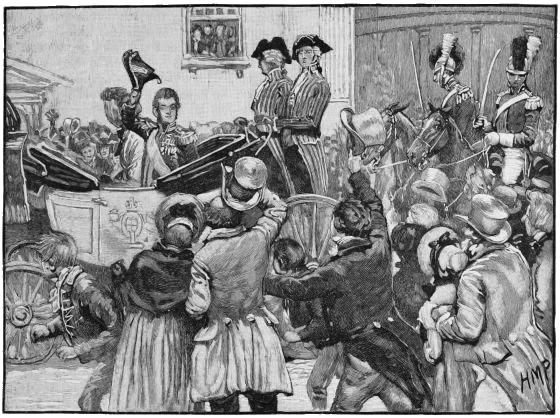
LORD ANGLESEY LEAVING IRELAND: SCENE AT KINGSTOWN. (See p. 292.)
[See larger version]
In the early part of January, 1829, the Duke of Wellington had an interview with the Archbishop of Canterbury, the Bishop of London, and the Bishop of Durham, for the purpose of laying before them the state of affairs in Ireland, in the hope of convincing them that the interests of the Church required the settlement of the Catholic question. It was thought that a favourable opinion expressed by them would have had great influence on the mind of the king; but the Duke's arguments utterly failed to convince them. They informed him that they could not lend their sanction to the proposed course of proceeding, but must offer a decided opposition to the removal of Roman Catholic disabilities. On New Year's Day the Bishop of Oxford wrote to Mr. Peel, that he had just returned from Addington, and that he found the three bishops decidedly hostile to all concessions, refusing to consent to them in any form. He considered that matter, therefore, as settled. Mr. Peel now began to feel that the difficulties in the way of Emancipation were almost insuperable. There was the declared opinion of the king, of the House of Lords, and of the Church, all decidedly hostile to the proposed measure. What the Home Secretary chiefly apprehended at that moment was, that the king, hearing the result of the Duke's conference with the bishops, would make some public and formal declaration of his resolution to maintain, as a matter of conscience and religious obligation, the existing laws; and would then take a position in reference to the Catholic question similar to that in which his father had stood, and which it might be almost impossible for him, however urgent the necessity, afterwards to abandon.
The meeting of Parliament was approaching, and it was necessary to come to some final decision. Sir Robert Peel had a thorough conviction that if the Duke of Wellington should fail in overcoming the king's objections, no other man could succeed. It might have been that the high and established character of Earl Grey, his great abilities, and great political experience, would have enabled him to surmount these various difficulties. In addition to these high qualifications, he had the advantage of having been the strenuous and consistent advocate of the Roman Catholic cause; the advantage also of having stood aloof from the Administrations of Mr. Canning and Lord Ripon, and of having strong claims on the esteem and respect of all parties, without being fettered by the trammels of any. Sir Robert Peel had, however, the strongest reasons for the conviction that Lord Grey could not have succeeded in an undertaking which, in the supposed case of his accession to power, would have been abandoned as hopeless by the Duke of Wellington, and abandoned on the ground that the Sovereign would not adopt the advice of his servants. The result of the whole is thus summed up by Sir Robert Peel:—"Being convinced that the Catholic question must be settled, and without delay; being resolved that no act of mine should obstruct or retard its settlement; impressed with the strongest feelings of attachment to the Duke of Wellington, of admiration of his upright conduct and intentions as Prime Minister, of deep interest in the success of an undertaking on which he had entered from the purest motives and the highest sense of public duty, I determined not to insist upon retirement from office, but to make to the Duke the voluntary offer of that official co-operation, should he consider it indispensable, which he scrupled, from the influence of kind and considerate feelings, to require from me."
The Home Secretary once more submitted his views to the Duke, in a memorandum dated January 12th, that was written with a view to being submitted to the king, in which he put the inevitable alternative of a Cabinet united in the determination to carry Catholic Emancipation, or a Cabinet constructed on exclusively Protestant principles; and he came to the conclusion that no Cabinet so constructed could possibly carry on the general administration of the country. The state of the House of Commons appeared to him to be an insuperable obstacle to the successful issue of that experiment. Since the year 1807 there had been five Parliaments, and in the course of each of these, with one exception, the House of Commons had come to a decision in favour of the consideration of the Catholic question. The present Parliament had decided in the same manner. A dissolution, were it practicable, would not result in an election more favourable to the Protestant interest, if an exclusively Protestant Government were formed. Even should there be an increase of anti-Catholic members in England, it would not compensate for the increased excitement in Ireland, and the violent and vexatious opposition that would be given by fifty or sixty Irish members, returned by the Catholic Association and the priests. Then there would be the difficulty about preserving the peace in Ireland. During the last autumn, out of the regular infantry force in the United Kingdom, amounting to about 30,000 men, 25,000 men were stationed either in Ireland or on the west coast of England, with a view to the maintenance of tranquillity in Ireland, Great Britain being then at peace with all the world. What would be the consequence should England be involved in a war with some foreign Power? Various other considerations were urged, upon which Mr. Peel founded his advice to the king, which was—that he should not grant the Catholic claims, or any part of them, precipitately and unadvisedly, but that he should, in the first instance, remove the barrier which prevented the consideration of the Catholic question by the Cabinet, and permit his confidential servants to consider it in all its relations, on the same principles on which they considered any other question of public policy, in the hope that some plan of adjustment could be proposed, on the authority and responsibility of a Government likely to command the assent of Parliament and to unite in its support a powerful weight of Protestant opinion, from a conviction that it was a settlement equitable towards Roman Catholics and safe as it concerned the Protestant Establishment.
The paper was communicated to the king by the Duke of Wellington, who wrote, on the 17th of January, that he entirely concurred in the sentiments and opinions contained in it; and, referring to Mr. Peel's request to be allowed to retire from the Government, the Duke said:—"I tell you fairly, I do not see the smallest chance of getting the better of these difficulties, if you should not continue in office. Even if I should be able to obtain the king's consent to enter upon the course which it will probably be found the wisest to adopt—which it is almost certain that I shall not if I should not have your assistance in office,—the difficulties in Parliament will be augmented tenfold in consequence of your secession, while the means of getting the better of them will be diminished in the same proportion. I entreat you, then, to reconsider the subject, and to give us and the country the benefit of your advice and assistance in this most difficult and important crisis."
The Duke brought this letter to Mr. Peel, who read it in his presence, and then at once told him that he would not press his retirement, but would remain in office, and would propose, with the king's consent, the measures contemplated by the Government for the settlement of the Catholic question. Immediately after this decision was taken he attended a meeting of the Cabinet and announced his determination to his colleagues. One of these, Lord Ellenborough, could not refrain from writing to express his admiration of his conduct, dictated by true statesmanlike wisdom; adding that he had acted nobly by the Government, and in a manner which no member of it would forget. On the day that the king got the paper, those of the Ministers who had uniformly voted against the Catholic question had each a separate interview with the king, and individually expressed their concurrence in the course Mr. Peel recommended. The Ministers were—the Duke of Wellington, Lord Lyndhurst, Lord Bathurst, Mr. Goulburn, and Mr. Herries. The king, after this interview, intimated his consent that the Cabinet should consider the whole state of Ireland, and submit their views to him, not pledging himself, however, to adopt them, even if they should concur unanimously in the course to be pursued. The king was not convinced by Mr. Peel's arguments. He admitted it to be a good statement, but denied that it was an argumentative one.
Parliament was opened by commission on the 5th of February, 1829. The state of Ireland was the chief topic of the Royal Speech. The existence of the Catholic Association was referred to as inimical to the public peace; and its suppression was recommended, as a necessary preliminary to the consideration of the disabilities affecting the Roman Catholics. This part of the Speech excited much interest, as preluding the great contest of the Session. On the 4th Mr. Peel had written to the Vice-Chancellor of Oxford, resigning his seat for the University, which he had won from Canning on the strength of his anti-Catholic principles. He need not have resigned, but he acted the more honourable part. Having offered himself for re-election, he was opposed by Sir Robert Inglis, who, after a contest which lasted three days, during which 1,364 votes were polled, was elected by a majority of 146. As one of the most numerous convocations ever held in Oxford had, in the previous year, by a majority of three to one, voted against concession to the Roman Catholics, it was a matter of surprise that the Home Secretary was not defeated by a larger majority. He secured a seat with some difficulty at Westbury. On the 10th, Mr. Peel, while still member for Oxford, introduced the first of the three measures intended for the pacification of Ireland—a Bill for the suppression of the Catholic Association. As it was known to be an essential condition of granting Emancipation, there was little opposition to it either in Parliament or in Ireland. By it the Lord-Lieutenant was empowered to disperse the meetings of any association he thought dangerous to the public peace. The Bill quickly passed both Houses, and in a few days received the Royal Assent. Anticipating the action of the executive, the Association, on the 12th of February, dissolved itself, with the unanimous concurrence of the bishops, Mr. Sheil stating at the meeting that he was authorised to throw twenty-two mitres into the scale.
In the Royal Speech his Majesty recommended that, when this special object was accomplished, Parliament should take into their deliberate consideration the whole condition of Ireland, and that they should review the laws which imposed disabilities upon Roman Catholics, to see whether their removal could be effected "consistently with the full and permanent security of our establishments in Church and State, with the maintenance of the Reformed religion established by law, and of the rights and privileges of the bishops and of the clergy of this realm, and of the churches committed to their charge."
Great was the excitement when, in pursuance of this recommendation, Mr. Peel introduced the Emancipation Bill on the 5th of March. Everywhere the Protestant press teemed, and the Protestant pulpit rang, with denunciations of Wellington and Peel as arch-traitors. From the highest pinnacle of popularity the Duke fell to the lowest depth of infamy; the laurels won in so many glorious fields were withered by the furious breath of popular execration. Petitions were poured into the House of Commons from all parts of the United Kingdom, and "the pressure from without" was brought to bear against the two Ministers, who were considered the chief delinquents, with a force and vehemence that would have deterred a man of weaker nerves than the Duke of Wellington; but he felt that he had a duty to discharge, and he did not shrink from the consequences. Nor did Mr. Peel. His speech, in introducing the measure, went over the ground he had often traversed in privately debating the question with his friends. Matters could not go on as they were. There must be a united Cabinet to carry on the king's Government effectually. It must be united either on the principle of Catholic Emancipation or Catholic exclusion. It must either concede the Catholic claims, or recall existing rights and privileges. This was impossible—no Government could stand that attempted it; and if it were done, civil war would be inevitable. The House of Commons, trembling in the nice balance of opinion, had at length inclined to concession. Ireland had been governed, since the Union, almost invariably by coercive Acts. There was always some political organisation antagonistic to the British Government. The Catholic Association had just been suppressed; but another would soon spring out of its ashes if the Catholic question were not settled. Mr. O'Connell had boasted that he could drive a coach-and-six through the former Act for its suppression; and Lord Eldon had engaged to drive "the meanest conveyance, even a donkey cart, through the Act of 1829." The new member for Oxford (Sir Robert Inglis) also stated that twenty-three counties in Ireland were prepared to follow the example of Clare. "What will you do," asked Mr. Peel, "with that power, that tremendous power, which the elective franchise, exercised under the control of religion, at this moment confers upon the Roman Catholics? What will you do with the thirty or forty seats that will be claimed in Ireland by the persevering efforts of the agitators, directed by the Catholic Association, and carried out by the agency of every priest and bishop in Ireland?" Parliament began to recede; there could be no limit to the retrogression. Such a course would produce a reaction, violent in proportion to the hopes that had been excited. Fresh rigours would become necessary; the re-enactment of the penal code would not be sufficient. They must abolish trial by jury, or, at least, incapacitate Catholics from sitting on juries. Two millions of Protestants must have a complete monopoly of power and privilege in a country which contained five millions of Catholics, who were in most of the country four to one—in some districts twenty to one—of the Protestants.
The chief speakers on the other side were Sir Robert Inglis, Mr. Bankes, and Mr. Sadler. They contended that the evils on which the Home Secretary had dwelt—the disturbed state of Ireland, the difficulty of governing the empire with a divided Cabinet, the impossibility of getting on with a House of Commons which left the Administration in a minority—would not be removed or prevented by Emancipation. Ever since the first relaxation of the penal code, concession but added fuel to the fire of agitation. What, then, was to be expected from throwing open the portals of the legislature to the Catholic body? What but this—that the advanced work thus gained would become the salient angle from which the fire would be directed on the body of the fortress; and the work of agitation, having its leaders in both Houses of Parliament, would be carried on with increased vigour, for the purpose of overthrowing the Protestant Establishment, the severance of the Union, and the dismemberment of the empire? The manner of the concession would encourage the policy of aggression. It was not, they asserted, produced by the gradual and quiet growth of public opinion. "It was the victory of force, driving former enemies into desertion by intimidation. It openly told the Catholic agitators that they were too strong for the Government of Great Britain; that whatever they asked would be conceded, even to the giving up of the Constitution, provided only it was asked with sufficient clamour and violence. The solid ground of right had been abandoned for the selfish and tortuous path of expediency—expediency, the pretext for so many crimes. In France expediency destroyed the church—expediency murdered the king."
Leave was given to bring in the Bill by a majority of 188; the numbers being 348 for the motion, and 160 against it. This astounding result was the signal for pouring into the House a flood of Protestant petitions, which, in the interval between the first and second reading, amounted to nearly 1,000; but an organisation like the Brunswick Clubs could easily get up any number of petitions. Considering the number of parishes in England, it is surprising, not that the number was so great, but that it was not greater. On the 18th the second reading was carried by a majority of 353 to 180; and on the 30th the third reading by a majority of 320 to 142, giving a majority of 178.
The same day it was carried by the Home Secretary to the House of Lords, accompanied by an unusual number of members. In introducing the measure in the Upper House the Duke of Wellington spoke with great force, and with all the directness and simplicity for which he was remarkable. One memorable passage deserves to be recorded in this history:—"It has been my fortune," said the Duke, "to have seen much of war—more than most men. I have been constantly engaged in the active duties of the military profession from boyhood until I have grown grey. My life has been passed in familiarity with scenes of death and human suffering. Circumstances have placed me in countries where the war was internal—between opposite parties in the same nation; and rather than a country I loved should be visited with the calamities which I have seen—with the unutterable horrors of civil war—I would run any risk, I would make any sacrifice, I would freely lay down my life. There is nothing which destroys property and prosperity as civil war does. By it the hand of man is raised against his neighbour, against his brother, and against his father! The servant betrays his master; and the master ruins his servant. Yet this is the resource to which we must have looked—these are the means which we must have applied—in order to have put an end to this state of things, if we had not embraced the option of bringing forward the measure for which I hold myself responsible."
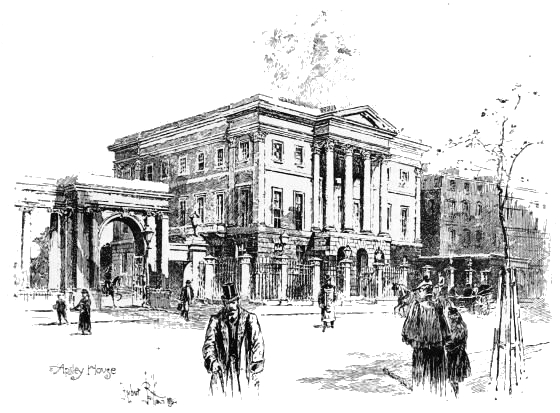
APSLEY HOUSE, HYDE PARK CORNER, LONDON.
[See larger version]
The Archbishop of Canterbury moved the rejection of the Bill; and was supported by the Archbishops of York and Armagh, the Bishops of London, Durham, and Salisbury; Lords Winchilsea, Berkeley, Tenterden, and Eldon. The chief defenders of the measure were Lords Grey, Lansdowne, Plunket, Goderich, and Lyndhurst. On a division, the second reading was carried by 217 against 112. On the 10th of April the Bill was read a third time, by a majority of 104; the numbers being 213 for it, and 109 against it. The sweeping majorities in the Lords were still more astounding than those in the Commons; and they spread the utmost consternation through the ranks of the Conservatives, who felt as if the very foundations of society were giving way, and the pillars of the Constitution were falling. The Lords had hitherto thrown out the Emancipation Bills as fast as they came to them, by majorities varying from forty to fifty. Lord Eldon was their prophet, and the old Conservative peers had followed his guidance implicitly for a quarter of a century; but during that time a generation of hereditary legislators had grown up, who had as thorough a contempt for the ex-Chancellor's antiquated prejudices as he had for their youth and inexperience. Lord Eldon had, however, some compensation for being thus deserted in the House of Peers by many of his followers, and having his authority as a statesman disregarded, as well as for the marked neglect of him by the Ministry, in the sympathy and confidence of the distressed king, who was shocked beyond measure at the conduct of the House of Lords. When a reluctant consent was wrung from his Majesty to have the measure brought forward by the Cabinet, he felt, after all, that he was doing nothing very rash; he had the strongest assurance that the Bill would never pass the Lords. He told Lord Eldon that, after the Ministers had fatigued him by many hours' conversation on the painful subject, he simply said, "Go on." But he also produced copies of letters which he had written, in which he assented to their proceeding with the Bill, adding, certainly, very strong expressions of the pain and misery the consent cost him. In his perplexity he evidently wished to avail himself of Eldon's casuistry to get out of the difficulty by retracting; but the latter was constrained to tell him "it was impossible to maintain that his assent had not been expressed, or to cure the evils which were consequential."
The large majorities in the House of Lords were to be ascribed chiefly to the unparalleled influence of the Duke of Wellington. But the public at the time were little aware of the difficulties that great man had to deal with in overcoming the opposition of the king, who was much under the influence of the Duke of Cumberland. When the storm of Conservative violence reached its height, after the rejection of Peel in Oxford, and his return, not without a struggle, for Westbury; and when, on the 3rd of March, he gave notice that he would draw the attention of the House to the clause of the Royal Speech referring to Ireland, the king, greatly excited and alarmed, sent the same evening to desire that the Prime Minister, the Home Secretary, and the Chancellor should wait upon him next day. He had already seen the Chancellor once, and the Duke twice separately. The king received his three Ministers, when they presented themselves at the palace, kindly but gravely; he looked anxious and embarrassed while he requested them to make him acquainted with the details of their Bill. It was explained to him that it would relieve Roman Catholics from the necessity of making a declaration against the doctrine of transubstantiation; whilst it so far modified in their case the oath of supremacy, as to omit all notice of the king's authority in things spiritual. "What!" he exclaimed, "do you mean to alter the ancient law of supremacy?" It was to no purpose he was shown that the alteration applied only to Roman Catholics, who would be dispensed from swearing what they could not believe; but he appealed to his own coronation oath, in reference to which he could not recognise the dispensing power of his Ministers. The king was condescending in the extreme. He seemed deeply grieved at the dilemma to which they had been brought. He acknowledged that possibly he had gone too far on former occasions, though he had acted entirely through misapprehension. But now he trusted that they would see, with him, that it had become a point of conscience, and that there was no alternative left him except to withdraw his assent. In the most respectful manner they acquiesced in his Majesty's determination, allowing, without a murmur, that he had a perfect right to act as he proposed. But when he went on further to ask what they intended to do, the Duke's answer was explicit: they must retire from his Majesty's service, and explain to Parliament that unexpected obstacles had arisen to the accomplishment of the policy which they were engaged to pursue. To this Mr. Peel added, that as the Bill for the suppression of the Catholic Association had been carried on the understanding that other and more comprehensive measures would follow, it would be necessary to make Parliament generally aware of the causes which operated to prevent the bringing forward of those measures. The king heard all this to an end, without attempting to interrupt, or argue with, his Ministers. He admitted, on the contrary, that it was impossible for them to take any other course, and then bade them farewell, kissing each of them on both cheeks. They set off from Windsor immediately, and arrived at Lord Bathurst's, where their colleagues were waiting dinner for them. They made a full report of all that had occurred, and announced that the Government was at an end. The party broke up, believing themselves to be out of office; but early next morning, before any decisive steps had been taken, a special messenger arrived at Apsley House with a letter from the king. It was guardedly expressed, for it went no further than to state that his Majesty had found greater difficulties than he expected in forming a new Cabinet, and was therefore desirous that the present Ministry should go on. The moment was critical, and the position of the Government delicate and in some sense insecure. No doubt, his Majesty's letter might be read as implying an abandonment of the objections which he had taken to the policy of his Ministers overnight, but it was certainly capable of a different interpretation. It appeared, therefore, to the Duke, that before proceeding further it would be necessary to come to a clear understanding with the king as to his Majesty's real intentions, and Mr. Peel concurring in this opinion, the Duke was requested to write to the king on the subject. He did so, with all the candour and loyalty which were natural to him; and the result was an unequivocal declaration from the Sovereign that he would accept the measures of his Ministers as his own.
With Lord Eldon, however, he held different language, complaining bitterly of the difficulties in which the Ministers had involved him. He is represented as struggling desperately in meshes from which he found it impossible to extricate himself; and, as usual with weak minds, he threw all the blame of his misery on others. In reference to an interview, Lord Eldon remarks: "I was not sent for afterwards, but went on Thursday, the 9th of April, with more addresses. In the second interview, which began a little before two o'clock, the king repeatedly—and with some minutes intervening between his repeated declarations, musing in silence in the interim—expressed his anguish, pain, and misery that the measure had ever been thought of, and as often declared that he had been most harshly and cruelly treated—that he had been treated as a man whose consent had been asked with a pistol pointed to his breast, or as obliged, if he did not give it, to leap down from a five-pair-of-stairs window. What could he do? What had he to fall back upon?" After relating much more in the same strain, Lord Eldon adds: "Little more passed, except occasional bursts of expression, 'What can I do? What can I now fall back upon? What can I fall back upon? I am miserable, wretched. My situation is dreadful; nobody about me to advise with. If I do give my consent, I will go to the baths after all, and from thence to Hanover. I'll return no more to England. I'll make no Roman Catholic peers; I will not do what this Bill will enable me to do. I'll return no more. Let them get a Catholic king in Clarence! [I think he also mentioned Sussex.] The people will see that I did not wish this.' There were the strongest appearances, certainly, of misery. He more than once stopped my leaving him. When the time came that I was to go, he threw his arms around my neck, and expressed great misery. I left him at about twenty minutes or a quarter before five. I certainly thought when I left him that he would express great difficulty, when the Bill was prepared for the Royal Assent, about giving it." The writer adds, sarcastically:—"I fear that it seemed to be given as a matter of course." Next day, Lord Eldon wrote to his daughter: "The fatal Bill received the Royal Assent yesterday afternoon. After all I had heard in my visits, not a day's delay. God bless us and His Church." At Windsor, on the 13th of April, the king pronounced over the Bill that he so hated the words—"Le Roy le veult."
The number of Catholics in Britain at the time of passing the Relief Bill was estimated by themselves at nearly 1,000,000, scattered, in various proportions, through England, Scotland, and Wales. Of these, 200,000 were resident in London. The most Catholic counties in England were Lancashire, Staffordshire, Warwickshire, Worcestershire, Cheshire, Northumberland, Durham, Norfolk, Suffolk, and Kent. In Ireland the Roman Catholics were estimated at five millions and a half; and the Protestants, of all denominations, at one million and three-quarters. By the removal of the disabilities eight English Catholic peers were enabled to take their seats by right in the House of Lords. The Catholic baronets in England were then sixteen in number. In Ireland there were eight Roman Catholic peers; in Scotland, two. The system of religious exclusion had lasted 271 years, from the passing of the Acts of Supremacy and Uniformity in 1559.
During the excitement that followed the passing of the Emancipation Act incessant attacks were made upon the character of the Duke of Wellington. Perhaps the most violent of these was published in the Standard by the Earl of Winchilsea, one of the most ardent of the anti-Catholic peers, who charged the Premier with disgraceful conduct. The offence was contained in a letter addressed by Lord Winchilsea to Mr. Coleridge, secretary to the committee for establishing the King's College, London. He said he felt rather doubtful as to the sincerity of the motives which had actuated some of the prime movers in that undertaking, "when he considered that the noble duke at the head of his Majesty's Government had been induced on this occasion to assume a new character, and to step forward himself as the public advocate of religion and morality." He then proceeded:—"Late political events have convinced me that the whole transaction was intended as a blind to the Protestant and High Church party; that the noble duke, who had, for some time previous to that period, determined upon breaking in upon the Constitution of 1688, might the more effectually, under the cloak of some outward show of zeal for the Protestant religion, carry on his insidious designs for the infringement of our liberties, and the introduction of Popery into every department of the State." The Duke having obtained from Lord Winchilsea an avowal of the authorship, demanded a retractation or apology, which was refused. The matter was then referred to friends, and a hostile meeting was agreed upon. "It is," says Mr. Gleig, "a curious feature in this somewhat unfortunate occurrence, that when the moment for action arrived it was found that the Duke did not possess a pair of duelling-pistols. Considering the length of time he had spent in the army, and the habits of military society towards the close of the last century, that fact bore incontestable evidence to the conciliatory temper and great discretion of the Duke. Sir Henry Hardinge, therefore, who acted as his friend, was forced to look for pistols elsewhere, and borrowed them at last—he himself being as unprovided as his principal—from Dr. Hume, the medical man who accompanied them to the ground. The combatants met in Battersea Fields, now Battersea Park. Lord Winchilsea, attended by the Earl of Falmouth, having received the Duke's fire, discharged his pistol in the air. A written explanation was then produced, which the Duke declined to receive unless the word 'apology' was inserted; and this point being yielded, they separated as they had met, with cold civility."
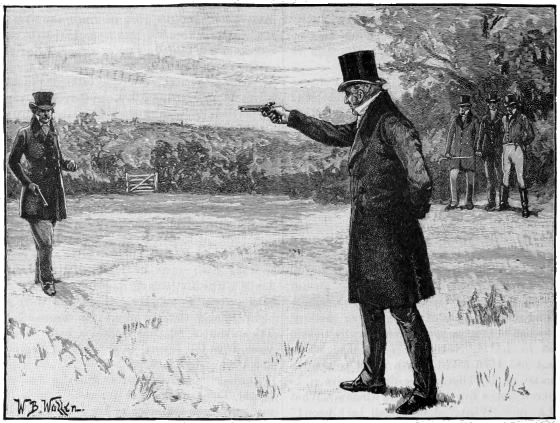
THE DUKE OF WELLINGTON'S DUEL WITH LORD WINCHILSEA. (See p. 300.)
[See larger version]
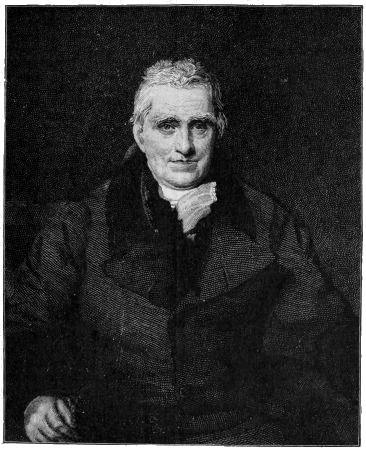
LORD ELDON. (After the Portrait by Sir Thomas Lawrence.)
[See larger version]
A third Bill yet remained to be carried, in order to complete the Ministerial scheme of Emancipation, and supply the security necessary for its satisfactory working. This was the Bill for disfranchising the forty-shilling freeholders, by whose instrumentality, it may be said, Emancipation was effected. It was they that returned Mr. O'Connell for Clare; it was they that would have returned the members for twenty-three other counties, pledged to support his policy. It is true that this class of voters was generally dependent upon the landlords, unless under the influence of violent excitement, when they were wrested like weapons from their hands by the priests, and used with a vengeance for the punishment of those by whom they had been created. In neither case did they exercise the franchise in fulfilment of the purpose for which it was given. In both cases those voters were the instruments of a power which availed itself of the forms of the Constitution, but was directly opposed to its spirit. Disfranchisement, however, in any circumstances, was distasteful to both Conservative and Liberal statesmen. Mr. Brougham said he consented to it in this case "as the price—almost the extravagant price"—of Emancipation; and Sir James Mackintosh remarked that it was one of those "tough morsels" which he had been scarcely able to swallow. The measure was opposed by Mr. Huskisson, Lord Palmerston, and Lord Duncannon, as not requisite, and not calculated to accomplish its object. But although Mr. O'Connell had repeatedly declared that he would not accept Emancipation if the faithful "forties" were to be sacrificed, that he would rather die on the scaffold than submit to any such measure, though Mr. Sheil had denounced it in language the most vehement, yet the measure was allowed to pass through both Houses of Parliament without any opposition worth naming; only seventeen members voting against the second reading in the Commons, and there being no division against it in the Lords. Ireland beheld the sacrifice in silence. Mr. O'Connell forgot his solemn vows, so recently registered, and, what was more strange, the priests did not remind him of his obligation. Perhaps they were not sorry to witness the annihilation of a power which landlords might use against them and which agitators might wield in a way that they could not at all times control. There had been always an uneasy feeling among the prelates and the higher clergy at the influence which Mr. O'Connell and the other lay agitators had acquired, because it tended to raise in the people a spirit of independence which rendered them sometimes refractory as members of the Church, and suggested the idea of combination against their own pastors, if they declined to become their leaders in any popular movement. The popular leaders in Ireland, however, consoling themselves with the assurance that many of the class of "bold peasantry" which they had glorified would still enjoy the franchise as ten-pound freeholders, consented, reluctantly of course, to the extinction of 300,000 "forties." They considered the danger of delay, and the probability that if this opportunity were missed, another might not occur for years of striking off the shackles which the upper classes of Roman Catholics especially felt to be so galling.
When Emancipation was carried, the Catholics did not forget the claims of Mr. O'Connell, who had laboured so hard during a quarter of a century for its accomplishment. A testimonial was soon afterwards got up to reward him for his services. Mr. C. O'Laughlin, of Dublin, subscribed £500; the Earl of Shrewsbury 1,000 guineas, and the less grateful Duke of Norfolk the sum of £100. The collection of the testimonial was organised in every district throughout Ireland, and a sum of £50,000 sterling was collected. Mr. O'Connell did not love money for its own sake. The immense sums that were poured into the coffers of the Catholic Association were spent freely in carrying on the agitation, and the large annuity which he himself received was mainly devoted to the same object. One means, which had no small effect in accomplishing the object, was the extremely liberal hospitality which was kept up, not only at Derrynane Abbey, but at his town residence in Merrion Square; and he had, besides, a host of retainers more or less dependent upon his bounty.
There was one irritating circumstance connected with the Emancipation Act: the words, "thereafter to be elected," were introduced for the purpose of preventing O'Connell from taking his seat in virtue of the election of 1828. The Irish Roman Catholics considered this legislating against an individual an act unworthy of the British Senate—and, as against the great Catholic advocate, a mean, vindictive, and discreditable deed. But it was admitted that Wellington and Peel were not to blame for it; that on their part it was a pacificatory concession to dogged bigotry in high places. Mr. Fagan states that Mr. O'Connell was willing to give up the county of Clare to Mr. Vesey Fitzgerald, and to go into Parliament himself for a borough, adding that he had absolutely offered 3,000 guineas to Sir Edward Denny for the borough of Tralee, which had always been regularly sold, and was, in point of fact, assigned as a fortune under a marriage settlement. Mr. Vesey Fitzgerald, however, rather scornfully rejected the offer, and Mr. O'Connell himself appeared in the House of Commons on the 15th of May, to try whether he would be permitted to take his seat. In the course of an hour, we are told, the heads of his speech were arranged, and written on a small card. The event was expected, and the House was crowded to excess. At five o'clock the Speaker called on any new member desiring to be sworn to come to the table. O'Connell accordingly presented himself, introduced by Lords Ebrington and Duncannon. He remained for some time standing at the table, pointing out the oaths he was willing to take, namely, those required by the new Act, and handing in the certificate of his return and qualifications. His refusal to take the oaths of supremacy and abjuration having been reported to the Speaker, he was directed to withdraw, when Mr. Brougham moved that he should be heard at the bar, to account for his refusal. But on the motion of Mr. Peel, after a long discussion, the consideration of the question was deferred till the 18th. The Times of the next day stated that the narrative of the proceeding could convey but an imperfect idea of the silent, the almost breathless attention with which he was received in the House, advancing to and retiring from the table. The benches were filled in an unusual degree with members, and there was no recollection of so large a number of peers brought by curiosity into the House of Commons. The Speaker's expression of countenance and manner towards the honourable gentleman were extremely courteous, and his declaration that he "must withdraw," firm and authoritative. Mr. O'Connell, for a moment, looked round as one who had reason to expect support, and this failing, he bowed most respectfully, and withdrew.
On Monday, the 18th of May, O'Connell took his seat under the gallery. Seldom, if ever before, were there in the House so many strangers, peers, or members. The adjourned debate was resumed, and it was resolved that he should be heard at the bar. To the bar he then advanced, accompanied by his solicitor, Mr. Pierce Mahony, who supplied him with the books and documents, which had been arranged and marked to facilitate reference. His speech on that occasion is said to have been one of the most remarkable for ability and argument he ever delivered. It should be observed that his claim to enter the House without taking the oaths was supported from the first by the opinion of Mr. Charles Butler, an eminent English barrister, and a Roman Catholic; but law and precedent were against him, and he could not be admitted. The House ordered the Speaker to make out a new writ for Clare.
Thus baffled, he returned to Dublin, where he met with an enthusiastic reception. A meeting was held the next day to make arrangements for insuring his return for Clare. On the 1st of June O'Connell started for Ennis. All the towns he passed through turned out to cheer him on, with green boughs and banners suspended from the windows. He arrived at Nenagh in the night, and the town was quickly illuminated. Having travelled all night, he retired to rest at Limerick; and while he slept the streets were thronged with people anxious to get a glance at their "Liberator." A large tree of Liberty was planted before the hotel, with musicians perched on the branches playing national airs. The Limerick trades accompanied him in his progress towards Ennis, where his arrival was hailed with boundless enthusiasm, and where a triumphal car was prepared for him. Thus terminated a progress, during which he made twenty speeches, to nearly a million of persons. On the 30th of July O'Connell was a second time returned for Clare, on this occasion without opposition, and the event was celebrated with the usual demonstrations of joy and triumph.
Thus was O'Connell driven into a new course of agitation. He did not conceal, even in the hour of his triumph, that he regarded Catholic Emancipation as little more than a vantage ground on which he was to plant his artillery for the abolition of the Legislative Union. After the passing of the Emancipation Act he appealed as strongly as ever to the feelings of the people. "At Ennis," he said, "I promised you religious freedom, and I kept my word. The Catholics are now free, and the Brunswickers are no longer their masters; and a paltry set they were to be our masters. They would turn up the white of their eyes to heaven, and at the same time slily put their hands into your pockets.... What good did any member ever before in Parliament do for the county of Clare, except to get places for their nephews, cousins, etc.? What did I do? I procured for you Emancipation." "The election for Clare," he said, "is admitted to have been the immediate and irresistible cause of producing the Catholic Relief Bill. You have achieved the religious liberty of Ireland. Another such victory in Clare, and we shall attain the political freedom of our beloved country. That victory is still necessary to prevent Catholic rights and liberties from being sapped and undermined by the insidious policy of those men who, false to their own party, can never be true to us, and who have yielded not to reason, but to necessity, in granting us freedom of conscience. A sober, moral, and religious people cannot continue slaves—they become too powerful for their oppressors—their moral strength exceeds their physical powers—and their progress towards prosperity is in vain opposed by the Peels and Wellingtons of society. These poor strugglers for ancient abuses yield to a necessity which violates no law, and commits no crime; and having once already succeeded by these means, our next success is equally certain, if we adopt the same virtuous and irresistible means." His new programme embraced not only the Repeal of the Union, but the restoration of the franchise to the "forties."
The Roman Catholic prelates, however, seem to have been satisfied with the achievement of Emancipation, and to have received the boon in a very good spirit. There was one of their number who, more than all the rest, had contributed to the success of the work. This was Dr. Doyle, so well known as "J.K.L.," unquestionably the most accomplished polemical writer of his time. In January, 1830, the Catholic bishops assembled in Dublin, to deliberate, according to annual custom, on their own duties and the interests of their Church. Dr. Doyle, at the close of these deliberations, drew up a pastoral, to which all the prelates affixed their signatures. It gave thanks to God that the Irish people not only continued to be of one mind, labouring together in the faith of the Gospel, but also that their faith was daily becoming stronger, and signally fructifying among them. Having drawn a picture of the discord that had prevailed in Ireland before Emancipation, the pastoral went on to say that the great boon "became the more acceptable to this country, because among the counsellors of his Majesty there appeared conspicuous the most distinguished of Ireland's own sons, a hero and a legislator—a man selected by the Almighty to break the rod which had scourged Europe—a man raised by Providence to confirm thrones, to re-establish altars, to direct the councils of England at a crisis the most difficult; to stanch the blood and heal the wounds of the country that gave him birth." The pastoral besought the people to promote the end which the legislature contemplated in passing the Relief Bill—the pacification and improvement of Ireland. It recommended that rash and unjust oaths should not be even named among them, and deprecated any attempt to trouble their repose by "sowers of discord or sedition." The bishops rejoiced at the recent result of the protracted struggle, not more on public grounds than because they found themselves discharged from a duty which necessity alone allied to their ministry—"a duty imposed on us by a state of times which has passed, but a duty which we have gladly relinquished, in the fervent hope that by us or our successors it may not be resumed."
The success of the Duke of Wellington in carrying Emancipation was fatal to his Government. Almost to a man the Tories fell from him, and he found no compensation in the adhesion of the Whigs. The latter were glad that their opponents had been induced to settle the question, a result which they had long desired, but had not the power to accomplish. Their gratitude, however, for this great service to the public was not sufficiently warm to induce them to enlist under the banner of the Duke of Wellington, though they were ready to come to his assistance, to protect his Government for a time against the violent assaults of the party whose feelings and prejudices he had so grievously outraged. All parties seem, indeed, to have been exhausted by the violence of the struggle, and there was no desire to attempt anything important in the way of legislation during the remainder of the Session. There was nothing extraordinary in the Budget, and it was accepted without much objection. The subject of distress among the operatives gave rise to a debate which occupied two days, and a motion for inquiry into its causes was rejected. The trade which suffered most at the time was the silk trade. It was stated that, in 1824, there were 17,000 looms employed in Spitalfields; now there were only 9,000. At the former period wages averaged seventeen shillings a week, now the average was reduced to nine shillings. By the manufacturers this depression was ascribed to the relaxation of the prohibitory system, and the admission of foreign silks into the home market. On the other hand, Ministers, and the advocates of Free Trade, ascribed the depression to the increase of production, and the rivalry of the provincial towns of Congleton, Macclesfield, and Manchester. That the general trade had increased was shown by the vast increase in the quantity of raw silk imported, and in the number of spindles employed in the silk manufacture. The Government was firm in its hostility to the prohibitory system, and would not listen to any suggestion for relief, except a reduction in the duties on the importation of raw silk, by which the demand for the manufactured article might be augmented. While these discussions were going on in Parliament the silk-weavers were in a state of violent agitation, and their discontent broke forth in acts of lawlessness and destructive outrage. They were undoubtedly in a very miserable condition. It was ascertained that there were at Huddersfield 13,000 persons, occupied in a fancy trade, whose average earnings did not exceed twopence-halfpenny a day, out of which they had to meet the wear and tear of looms, etc. The artisans ascribed this reduction to the avarice of their employers, and they avenged themselves, as was usual in those times, by combination, strikes, and destruction of property. In Spitalfields bands of weavers entered the workshops and cut up the materials belonging to refractory masters. The webs in thirty or forty looms were sometimes thus destroyed in a single night. The same course was pursued at Macclesfield, Coventry, Nuneaton, and Bedworth, in which towns power-looms had been introduced which enabled one man to do the work of four. The reign of terror extended to Yorkshire, and in several places the masters were compelled to succumb, and to accept a list of prices imposed by the operatives. In this way the distress was greatly aggravated by their ignorance. What they demanded was a restrictive system, which it was impossible to restore. The result obtained was simply a reduction of the duties on raw silk.
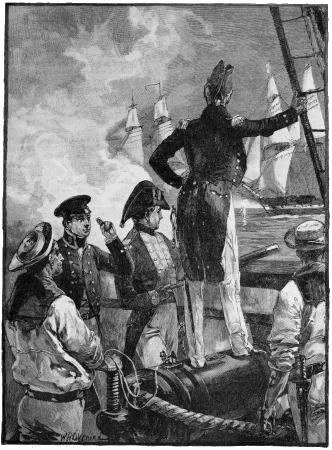
CAPTAIN WALPOLE INTERCEPTING THE DUKE OF SALDANHA'S SHIPS. (See p. 306.)
[See larger version]
An attempt was made during the Session to mitigate the evils of the Game Laws, and a Bill for legalising the sale of game passed the Commons with extraordinary unanimity. In the House of Lords the Bill met with determined opposition. In vain Lord Wharncliffe demonstrated the demoralising and disorganising effects of the Game Laws. Lord Westmoreland was shocked at a measure which he declared would depopulate the country of gentlemen. He could not endure such a gross violation of the liberty of the aristocratic portion of the king's subjects; and he thought the guardians of the Constitution in the House of Commons must have been asleep when they allowed such a measure to pass. Lord Eldon, too, who was passionately fond of shooting, had his Conservative instincts aroused almost as much by the proposal to abolish the monopoly of killing hares and pheasants, as by the measure for admitting Roman Catholics into Parliament. The Bill was read a second time, by a majority of ten; but more strenuous exertions were called forth by the division, and the third reading of this Bill to mitigate an iniquitous system was rejected by a majority of two. Lord Eldon's familiarity with the principles of equity did not enable him to see the wrong of inflicting damage to the amount of £500,000 a year on the tenant farmers of the country, by the depredations of wild animals, which they were not permitted to kill, and for the destruction caused by which they received no compensation.
On the 24th of June Parliament was prorogued by commission. The Royal Speech expressed thanks for the attention that had been given to the affairs of Ireland, and the settlement of the Catholic question, which the king hoped would tend to the permanent tranquillity of that country, and to draw closer the bonds of union between it and the rest of the empire. It was announced that diplomatic relations had been renewed with the Porte, for which ambassadors from England and France had taken their departure. But it was with increased regret that his Majesty again adverted to the condition of the Portuguese monarchy. He repeated his determination to use every effort to reconcile conflicting interests, and to remove the evils which pressed so heavily on a country the prosperity of which must ever be an object of his solicitude. The condition of that country was, indeed, most deplorable under the lawless despotism of Dom Miguel, who, on the abdication of his brother Dom Pedro in favour of Doña Maria da Gloria, had been appointed regent, but had subsequently assumed the royal title, and driven his niece from the country. He overruled the decisions of the courts of justice regarding political prisoners, and inflicted the punishment of death by his own mere arbitrary order, when only transportation had been decreed by the judges. He crowded the prisons with the most distinguished supporters of constitutional government, confiscated their property, and appropriated it to his own use. Yet this monster would have been acknowledged by the Duke of Wellington. Had the Duke been free to follow the dictates of his own judgment, he would have at once resumed the diplomatic relations which had been broken off between the two states. But Britain was committed to the young queen by the policy of the preceding Administration; and the Duke, though he believed that policy to be unwise, could not break through it in a moment. It was not without difficulty, however, that Britain maintained her neutrality between the contending parties. The Portuguese refugees endeavoured, under various false pretences, to avail themselves of British hospitality, for the purpose of conveying arms and ammunition, and bodies of troops into Portugal, to restore the queen. They asserted that they were sending them to Brazil, but really conveyed them to Terceira, one of the Azores, where Doña Maria had been proclaimed. The consequence was that 4,000 Portuguese troops, which were lying at Plymouth, were ordered to disband, and Captain Walpole, with a squadron, was sent to watch the Portuguese ships in the Atlantic, in order to avoid the imputation of violating the neutrality. His orders were to proceed to the Azores, to intercept any vessels arriving at those islands, and "should they persist, notwithstanding, in hovering about or making any attempt to effect a landing, you are then to use force to drive them away from the neighbourhood." Walpole intercepted four vessels, containing a force of 650 men under the command of the Duke of Saldanha. They declined to bring-to, whereupon he fired a shot which killed one man and wounded another. Saldanha thereupon declared that he considered himself Walpole's prisoner, and turned his vessels towards Europe. Walpole, in great perplexity, followed him, until he was within 500 miles of Scilly, when they parted company and Saldanha went to Havre. These proceedings were regarded with indignation in Great Britain, the enemies of the Government asserting that, in spite of their declarations of neutrality, they had proved themselves partisans of Dom Miguel. Debates were raised in both Houses, Lord Palmerston in the Commons making his first great speech in condemnation of the Duke's foreign policy. It is significant that Wellington should have written to Lord Aberdeen in a private letter: "In respect to Portugal you may tell Prince Polignac that we are determined that there shall be no revolutionary movement from England or any part of the world."
Parliament having been prorogued, the members retired to their respective counties and boroughs, many of them out of humour with themselves and with the Government which they had heretofore supported, and meditating revenge. An endeavour was made in the course of the summer to renew the political connection between the Duke of Wellington and Mr. Huskisson. The friends of the existing Administration felt the weakness of their position, deprived of their natural support, and liable to be outvoted at any time. The Tories had become perfectly rabid in their indignation, vehemently charging the Duke with violation of public faith, with want of statesmanship, with indifference to the wishes and necessities of the people, and with a determination to govern the country as if he were commanding an army. Their feelings were so excited that they joined in the Whig cry of Parliamentary Reform, and spoke of turning the bishops out of the House of Lords. It was to enable the Premier to brave this storm that he was induced by his friends to receive Mr. Huskisson at his country house. The Duke was personally civil, and even kind, to his visitor; but his recollections of the past were too strong to permit of his going farther. In the following Session negotiations were made with the other Canningites, but without success, as they had thrown in their lot with the Whigs.
The year 1829 was distinguished by disturbances in Ireland, as well as distress in England. The 12th of July, the anniversary of the battle of the Boyne, was celebrated with unusual manifestations of defiance by the Orangemen. The country seemed armed for civil war. In the county Clare there was a conflict between the Protestants and Catholics, in which one man was killed, and seven or eight wounded on each side. In Armagh there was a fight, in which ten men lost their lives. In the county Fermanagh 800 Roman Catholics, armed with scythes and pitchforks, turned out and attacked the Protestants, killing four persons and wounding seven. The same party rose in Cavan, Monaghan, and Leitrim, threatening something like civil war. In Tipperary society was so convulsed that the magistrates met, and called upon the Government for a renewal of the Insurrection Act, and for the passing of a law rendering the possession of fire-arms a transportable offence.
Such was the state of affairs at home and abroad during the recess of 1829. The Government hoped that by the mollifying influence of time the rancour of the Tory party would be mitigated, and that by the proposal of useful measures the Whig leaders would be induced to give them their support, without being admitted to a partnership in power and the emoluments of office. But in both respects they miscalculated. The Duke met Parliament again on the 4th of February, 1830. It was obvious from the first that neither was Tory rancour appeased nor Whig support effectually secured. The Speech from the Throne, which was delivered by commission, was unusually curt and vague. It admitted the prevalence of general distress. It was true that the exports in the last year of British produce and manufacture exceeded those of any former year; but, notwithstanding this indication of an active commerce, both the agricultural and the manufacturing classes were suffering severely in "some parts" of the United Kingdom. There was no question about the existence of distress; the only difference was as to whether it was general or only partial. In the House of Lords the Government was attacked by Earl Stanhope, who moved an amendment to the Address. He asked in what part of the country was it that the Ministers did not find distress prevailing? He contended that the kingdom was in a state of universal distress, likely to be unequalled in its duration. All the great interests—agriculture, manufactures, trade, and commerce—had never at one time, he said, been at so low an ebb. The Speech ascribed the distress to a bad harvest. But could a bad harvest make corn cheap? It was the excessive reduction of prices which was felt to be the great evil. If they cast their eyes around they would see the counties pouring on them spontaneously every kind of solicitation for relief; while in towns, stocks of every kind had sunk in value forty per cent. The depression, he contended, had been continuous and universal ever since the Bank Restriction Act passed, and especially since the suppression of small notes took effect in the beginning of the previous year. Such a universal and continued depression could be ascribed only to some cause pressing alike upon all branches of industry, and that cause was to be found in the enormous contraction of the currency, the Bank of England notes in circulation having been reduced from thirty to twenty millions, and the country bankers' notes in still greater proportion. The Duke of Wellington, in reply, denied that the Bank circulation was less than it had been during the war. In the former period it was sixty-four millions, including gold and silver as well as paper. In 1830 it was sixty-five millions. It was an unlimited circulation, he said, that the Opposition required; in other words, it was wished to give certain individuals, not the Crown, the power of coining in the shape of paper, and of producing a fictitious capital. Capital was always forthcoming when it was wanted. He referred to the high rents paid for shops in towns, which were everywhere enlarged or improved, to "the elegant streets and villas which were springing up around the metropolis, and all our great towns, to show that the country was not falling, but improving." After the Duke had replied, the supporters of the amendment could not muster, on a division, a larger minority than nine. In the House of Commons the discussion was more spirited, and the division more ominous of the fate of the Ministry. The majority for Ministers was only fifty-three, the numbers being 158 to 105. In the minority were found ultra-Tories, such as Sir Edward Knatchbull, who had proposed an amendment lamenting the general distress, Mr. Bankes, Mr. Sadler, and General Gascoigne, who went into the same lobby with Sir Francis Burdett, Lord John Russell, Mr. Brougham, Mr. Hume, and Lord Althorp, representing the Whigs and Radicals; while Lord Palmerston, Mr. Huskisson, Mr. Charles Grant, and Sir Stratford Canning represented the Canning party. No such jumble of factions had been known in any division for many years.
The Liberals seem to have been strongly inclined to the opinion that the Duke of Wellington, having won the great victory of Emancipation, should retire from the field—that he was not fit to lead the van of progress in Parliament. "The Prime Minister of England," exclaimed Sir Francis Burdett, "is shamefully insensible to the suffering and distress which are painfully apparent throughout the land. When, instead of meeting such an overwhelming pressure of necessity with some measure of relief, or some attempt at relief, he seeks to stifle every important inquiry—when he calls that a partial and temporary evil which is both long-lived and universal,—I cannot look on such a mournful crisis, in which the public misfortune is insulted by Ministerial apathy, without hailing any prospect of change in the system which has produced it. What shall we say to the ignorance which can attribute our distress to the introduction of machinery and the application of steam, that noble improvement in the inventions of man to which men of science and intelligence mainly ascribe our prosperity? I feel a high and unfeigned respect for that illustrious person's abilities in the field, but I cannot help thinking that he did himself no less than justice when he said, a few months before he accepted office, that he should be a fit inmate for an asylum of a peculiar nature if he ever were induced to take such a burden upon his shoulders." On the other hand the Opposition was nearly as disorganised as the Government, until Lord Althorp was selected to lead it in the Commons.
On the 12th of February Sir James Graham moved for the reduction of the salaries of all persons holding offices under Government, in proportion to the enhanced value of money produced by the Bank Restriction Act, which added to the weight of all fixed payments while it lowered wages and the price of provisions. "Hence," he said, "the miserable state to which the people of this country were now reduced, and the necessity for rigid, unsparing economy; and in that system of economy one great source of retrenchment must be the reduction of the salaries of those who had their hands in the public purse. Justice requires, necessity demands it." Ministers did not dare to resist this motion openly. They evaded it by an amendment, which was unanimously adopted, for an Address to the king, requesting him to order an inquiry to be made into all the departments of the Civil Government, with a view of reducing the number of persons employed in the various Services, and the amount of their salaries. On the 15th Mr. Hume attempted to carry retrenchment into the Army and Navy, moving a resolution to the effect that the former should be reduced by 20,000 men, and the latter by the sum of a million and a half. All the reductions he proposed would have effected a saving of eight millions annually. But neither the Whigs nor the Canning party were disposed to go such lengths. The motion was, therefore, defeated, the minority consisting solely of Radical reformers, who mustered fifty-seven on the division. Another assault on the Government was led on by Mr. Poulett Thompson, who moved for the appointment of a Committee for a Revision of the system of Taxation with a view to saving expense in the mode of collecting the revenue. The motion was resisted by Mr Peel on the ground that such important duties should not be delegated to a fraction of the members of the House. The motion was rejected by a large majority. A few days later, however, Ministers sustained a damaging defeat in the Committee of Supply on the Navy estimates. Two young men, who had been public servants for a few months only, Mr. R. Dundas and Mr. W. S. Bathurst, Junior Commissioners of the Navy, had been pensioned off on the reduction of their offices, the one with £400 and the other with £500 a year. The arrangement was attacked as a gross job and defended upon principle, and Ministers after mustering all their strength were beaten by a majority of 139 to 121, on the motion that those pensions should be struck off. Several other motions, brought forward with a view of effecting retrenchments, were rejected by the House. This movement in the direction of financial reform, no doubt, received an impulse from the resentment of the leading Whigs, whose claims to take part in the Government were ignored by the Duke. But this remark does not apply to the efforts of Mr. Attwood and Mr. Baring, who moved that instead of a gold standard there should be a gold and silver standard, and that the Act for prohibiting the issue of small notes should be repealed. They strengthened their case by an appeal to the facts of the existing distress and commercial depression arising from a restricted currency. On the part of the Government, however, it was argued that a double standard of gold and silver would cause a loss of five per cent, to creditors if debtors were to pay in the silver standard—that the whole country would be a scene of confusion and ruin—that silver never was in practice the standard of the country, and that it never had been actually in a state to be used as a legal tender. Latterly the law had enacted that it should not be a legal tender beyond twenty-five pounds. By weight, indeed, it was a legal tender to any amount, but practically it had become so depreciated that there was no such thing as a standard by weight. Mr. Attwood's resolutions on the currency were negatived without a division.
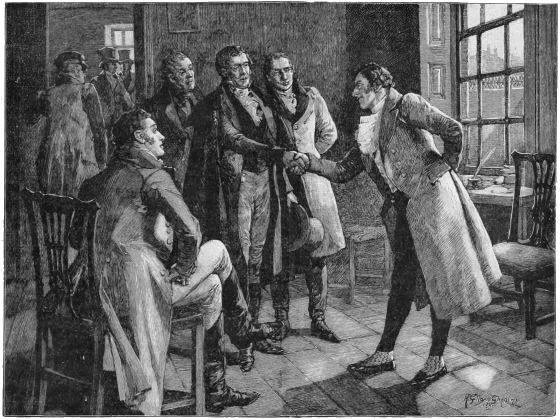
MR. ALEXANDER'S LEVES IN KING'S BENCH PRISON. (See p. 310.)
[See larger version]
Though the Duke of Wellington defended him-self against the persevering attacks of the financial reformers, he was busy making retrenchments in every department of the Public Service. So effectually did he employ the pruning-hook, that although the income of the previous year had fallen short of the estimate of the Chancellor of the Exchequer by £560,000, he was able to present to the House this year a surplus of £3,400,000 available for the reduction of taxation, still leaving an excess of income over expenditure of £2,667,000 applicable to the reduction of debt. There was, consequently, a large remission of taxation, the principal item of which was the beer duty, estimated at £3,000,000. At the same time, in order to enable the Chancellor of the Exchequer to meet these reductions, an addition of one shilling a gallon was made to the duty on English spirits and of twopence on Irish and Scottish spirits. This Budget helped to clear the political atmosphere and brought a brief gleam of popularity to the Government. The Duke got full credit for an earnest desire to economise, and it was acknowledged by the Liberal party that he had given the most important financial relief that the nation had experienced since the establishment of peace. Notwithstanding, however, the general satisfaction, and the loud popular applause, the pressure of distress was not sensibly alleviated. The burden indeed was somewhat lightened, but what the nation wanted was greater strength to bear financial burdens, a revival of its industrial energies, and facilities for putting them forth with profit to themselves and to the country. Remissions of taxation were but the weight of a feather, compared to the losses sustained by the action of the currency. For while the reductions only relieved the nation to the extent of three or four millions, it was estimated that the monetary laws, by cutting off at least fifty per cent. from the remuneration of all branches of industry, commercial and agricultural, had reduced the incomes of the industrial classes to the extent of a hundred and fifty millions yearly.
Among the other causes which contributed to the unpopularity of the Duke of Wellington and the weakness of his Administration was the prosecution by the Attorney-General of Mr. Alexander, the editor of the Morning Journal. A series of articles had appeared in that paper, which were considered so virulent and libellous, so far surpassing the bounds of fair discussion, that the Duke felt under the same necessity of ordering a prosecution that he had felt to fight the duel with Lord Winchilsea. It was regarded as an inevitable incident of his position, one of the things required to enable him to carry on the king's Government. He obtained a victory, but it cost him dear: a sentence of fine and imprisonment was inflicted upon his opponent, and the Morning Journal was extinguished; but, in the temper of the times, the public were by no means disposed to sympathise with the victor in such a contest. On the contrary, the victory covered him with odium, and placed upon the head of the convicted the crown of martyrdom. Mr. Alexander was visited daily in the King's Bench prison by leading politicians, and a motion was made in the House of Commons with a view to incriminate the Government who ordered the prosecution. In another instance also, but of a nature less damaging, the Government received a warning of its approaching downfall. Mr. Peel, anxious to mitigate the severity of the criminal code, and to render it less bloody, proposed to inflict the penalty of death only on persons committing such forgeries as could not by proper precautions be guarded against. It was a step in the right direction, but one too hesitating, and stopping short of the firm ground of sound policy. Sir James Mackintosh, therefore, on the third reading of the Bill, moved a clause for the abolition of the penalty of death in all cases of forgery, which was carried by a majority of 151 against 138. Thus the Session wore on, in a sort of tantalising Parliamentary warfare, with no decisive advantages on either side till the attention and interest of Parliament and the nation were absorbed by the approaching dissolution of George IV. and the dawning light of a new reign.
For many years the king had been scarcely ever free from gout, but its attacks had been resisted by the uncommon strength of his constitution. Partly in consequence of the state of his health, and partly from his habits of self-indulgence, he had for some time led a life of great seclusion. He became growingly averse from all public displays and ceremonials, and was impatient of any intrusions upon his privacy. During the spring of 1829 he resided at St. James's Palace, where he gave a ball to the juvenile branches of the nobility, to which the Princess Victoria and the young Queen of Portugal were invited. His time was mostly spent within the royal domain at Windsor, where his outdoor amusements were sailing and fishing on Virginia Water, or driving rapidly in a pony phaeton through the forest. He was occasionally afflicted with pains in the eyes and defective vision. The gout attacked him in the hands as well as in the feet, and towards the end, dropsy—a disease which had been fatal to the Duke of York, and to his sister, the Queen of Würtemberg—was added to his other maladies. In April the disease assumed a decisive character; and bulletins began to be issued. The Duke of Clarence was at Windsor, and warmly expressed his sympathy with the royal sufferer. The Duke of Cumberland, and nearly all the Royal Family, expressed to Sir William Knighton their anxiety and fears as to the issue. This devoted servant was constantly by the side of his master. On the 27th of May Sir William wrote to Lady Knighton: "The king is particularly affectionate to me. His Majesty is gradually breaking down; but the time required, if it does not happen suddenly, to destroy his originally fine constitution, no one can calculate upon." We are assured that Sir William took every opportunity of calling his Majesty's attention to religious subjects, and had even placed unordered a quarto Bible, of large type, on the dressing-table, with which act of attention the king was much pleased, and frequently referred to the sacred volume. A prayer was appointed for public use during his Majesty's indisposition, which the Bishop of Chichester read to him. "With the king's permission," wrote this learned prelate, "I repeated it on my knees at his bedside. At the close, his Majesty having listened to it with the utmost attention, three times repeated 'Amen,' with the greatest fervour and devotion. He expressed himself highly gratified with it, and desired me to convey his approbation of it to the Archbishop of Canterbury."
About a week before the king died the physician delicately announced to him the inevitable catastrophe, when he said, "God's will be done." His sufferings were very great, and during the paroxysms of pain his moans were heard even by the sentinels in the quadrangle. On the night of the 25th of June his difficulty of breathing was unusually painful, and he motioned to his page to alter his position on the couch. Towards three o'clock he felt a sudden attack of faintness, accompanied by a violent discharge of blood. At this moment he attempted to raise his hand to his breast, and ejaculated, "O God, I am dying!" Two or three seconds afterwards he said, "This is death." The physicians were instantly called, but before they arrived the breath of life was gone. A post mortem examination showed ossification of the heart, which was greatly enlarged, and adhering to the neighbouring parts. The liver was not diseased; but the lungs were ulcerated, and there were dropsical symptoms on the skin, on various parts of the body. The king was an unusually large and, at one time, well-proportioned man; but he afterwards became very corpulent. He died on the 26th of June, in the sixty-eighth year of his age and the eleventh of his reign, having been Prince Regent for ten years. During his last illness the bulletins had been unusually deceptive. The king was anxious to put away the idea of dissolution from his own mind, and unwilling that the public should know that his infirmities were so great; and it was said that he required to see the bulletins and to have them altered, so that he was continually announced as being better till the day of his death. His message to both Houses on the 24th of May, however, put an end to all delusion on the subject. He wished to be relieved from the pain and trouble of signing Bills and documents with his own hand. A Bill was therefore passed to enable him to give his assent verbally, but it was jealously guarded against being made a dangerous precedent. The stamp was to be affixed in the king's presence, by his immediate order given by word of mouth. A memorandum of the circumstances must accompany the stamp, and the document stamped must be previously endorsed by three members of the Privy Council; the operation of the Act was limited to the existing Session. The three Commissioners appointed for affixing his Majesty's signature were Lord Farnborough, General Sir W. Keppel, and Major-General A. F. Barnard.
Mr. Walpole has summed up the character of George IV. in words alike of terrible conciseness and of unmitigating truth—" He was a bad son, a bad husband, a bad father, a bad subject, a bad monarch, and a bad friend."