Chapter V
Reading edition
THE REIGN OF GEORGE IV.
Accession of George IV.—Meeting of Parliament—General Election—Opening of the New Session—Dulness of Affairs—Brougham on Education—Queen Caroline—Omission of her Name from the Liturgy—She rejects the King's Proposals, and arrives in England—Attempts at a Compromise—The King orders an Inquiry—The Secret Committee—The Bill of Pains and Penalties—Arrival of the Queen in the House of Lords—Discussions on the Form of Procedure—Speeches of Denman and the Attorney-General—Evidence for the Prosecution—Brougham's Speech—Abandonment of the Bill—General Rejoicings—Violence of Party Feeling—Popularity of the Queen—Her Claim to be crowned refused—The Queen's Attempt to enter the Abbey—Indiscretion of the Act—The Coronation and the Banquet—The subsequent Scramble—Death of the Queen—Departure of her Body—The King's Visit to Ireland—A Royal Oration and its enthusiastic Reception—The King and Lady Conyngham—Changes in the Government—Discontent of Eldon—Wellesley in Ireland—Alarming State of the Country—Canning's Speech on Catholic Emancipation—Parliamentary Reform—Agricultural Distress and Finance—Eldon's Outbreak on the Marriage Bill—Suicide of Lord Londonderry—Scene at his Funeral—Visit of George IV. to Scotland—Loyalty of Sir Walter Scott—Account of the Festivities—Peel's Letter to Scott—Return of the King—Canning takes the Foreign Office and Leadership of the House of Commons—Huskisson joins the Cabinet—The Duke of Wellington sent to Verona—His Instructions—Principles of the Holy Alliance—The Spanish Colonies—French Intervention in Spain—The Duke's Remonstrances with the French King—His Interview with the Czar—The Congress of Verona—Failure of Wellington to prevent Intervention in Spain—Vindication of Canning's Policy in the Commons—He calls the New World into Existence.
George III. expired on the 29th of January, 1820. Although it was Sunday, both Houses of Parliament met according to the requisition of the statute, 6 Anne c. 7. Lord Eldon merely appeared on the woolsack; and, as soon as prayers were read, the House of Peers was adjourned. The same day a council was held at Carlton House, when the usual ceremonies were observed, as upon the commencement of a new reign, although George IV. had been virtually king during the period of the Regency. On this occasion the Ministers delivered up the emblems of their different offices, and were all graciously reappointed. Lord Eldon, in a letter to his daughter, felicitates himself on having been thus placed "in the very singular situation, that of a third Chancellorship." But Lord Campbell remarks that he was probably not aware that one of his predecessors had been Chancellor five times. His immediate successor had been four times Chancellor, and Lord Cottenham three times. "It is amusing," says Lord Campbell, "to observe how he enhances the delight he felt at the commencement of this third Chancellorship by protestations that he was reluctantly induced again to accept the worthless bauble, lest, by declining it, he should be chargeable with ingratitude." The Chancellor made similar protestations of reluctance and humility when George IV., grateful for his services in connection with the prosecution of the queen, pressed upon him accumulated honours; giving him, at the same time, two additional steps in the peerage, as Viscount Encombe and Earl of Eldon—honours which, he said, he had repeatedly declined to accept when offered by George III.
Parliament again met for a few days, but only to vote Addresses of condolence and congratulation, as a dissolution had been determined on. The Marquis of Lansdowne pointed out that there was not the usual reason for a dissolution which occurred upon a demise of the Crown; but Lord Eldon explained that, at common law, the Parliament died with the Sovereign in whose name it was called; and although, by the statute of William III., it could sit six months longer, it was liable to be dissolved sooner; and constitutionally it ought to be dissolved as soon as public business would allow; so that noble lords who started any business to delay the dissolution would be obstructing the due exercise of the Royal Prerogative. He, as Lord Commissioner, therefore, concluded the Session by delivering the Royal Speech, which deplored the loss of a Sovereign, the common father of all his people, and praised the prudence and firmness with which the Lords and Commons had counteracted the designs of the disaffected.
The general election was, on the whole, favourable to the Government; the forces of Conservatism being roused into activity by the violent democratic tendencies of the times, and by the threats of revolution. The new Parliament met on the 21st of April. Mr. Manners Sutton was re-elected Speaker. A week was occupied in swearing in the members, and the Session was opened on the 27th by a Speech from the king, the vagueness of which gave no ground for an amendment to the Address in either House. In the old roll of members one illustrious name was found, borne by a statesman who was never more to take his seat in the House. Henry Grattan expired (June 4) soon after the Session commenced. Sir James Mackintosh, in moving a new writ for Dublin, which Grattan had represented for many years, observed "that he was, perhaps, the only man recorded in history who had obtained equal fame and influence in two assemblies differing from each other in such essential respects as the English and Irish Parliaments."
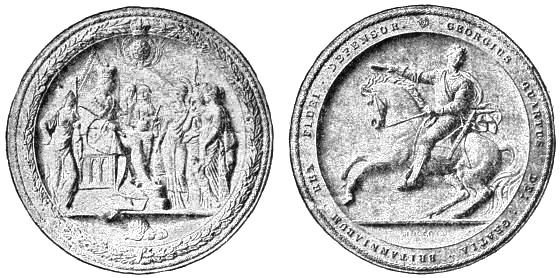
GREAT SEAL OF GEORGE IV.
The Session promised for some weeks to be very dull; no subjects more stirring being brought forward or announced than the settlement of the Civil List, the discharge of insolvent debtors, the suppression of Sunday newspapers, and the reading of the Athanasian Creed. To one of those subjects, the Civil List, Lord Eldon thus jocosely alluded in a letter to his daughter:—"Our royal master seems to have got into temper again, as far as I could judge from his conversation with me this morning. He has been pretty well disposed to part with us all, because we would not make additions to his revenue. This we thought conscientiously we could not do in the present state of the country, and of the distresses of the middle and lower orders of the people. To which we might add, too, that of the higher orders."
But there was one subject of general and permanent interest brought under the notice of the House of Commons. Mr. Henry Brougham made an important speech on the great and difficult subject of Popular Education, which he continued to advocate, with so much power and success, throughout the whole of his lengthened and brilliant career. He stated that there were then twelve thousand parishes or chapelries in England; of these three thousand five hundred had not a vestige of a school, and the people had no more means of education than the Hottentots or Kaffirs. Of the remainder, there were five thousand five hundred unendowed, depending entirely on the casual and fleeting support of the parents of the children attending them. The number of children receiving education at all the schools, week-day and Sunday, was seven hundred thousand. Estimating the number educated at home at fifty thousand, the whole number then under instruction would be seven hundred and fifty thousand—about one-fifteenth of the entire population. In Scotland the proportion at that time was about one-tenth; in Holland and Prussia the same; in Switzerland one-eighth. France was then at the bottom of the scale, only one-twenty-eighth of the population being under instruction. Mr. Brougham proposed a school-rate for England, according to the American plan.
The indisposition of Parliament to attend to the ordinary business of the legislature, however important and pressing any portion of it might be considered in other circumstances, may be easily accounted for. One subject engrossed the minds of all men at this time, and agitated the nation to a depth and extent altogether unprecedented in our history. The story of Caroline of Brunswick is one of the saddest and most romantic in the annals of the Queens of England. When the Prince Regent became king, his wife, as a matter of course, became the rightful Queen of England. But her husband had resolved that she should not be queen; and, rather than not have his way in this, he was ready to imperil his throne. She was as fully entitled to enjoy the well-defined rank and position that devolved upon her by the laws of the country, as he was to wear his crown, without regard to personal character. He would break the marriage tie, if he could; but, failing that, he was determined to degrade the queen by bringing against her the foulest charges of immorality. She might, indeed, have escaped a trial on these charges if she had consented to remain abroad, and had agreed to forego any title that would have connected her with the Royal Family of England. Till the death of George III., who had always been her steady friend, she had been prayed for in the liturgy as the Princess of Wales. There was now no Princess of Wales, and the king insisted that she should not be prayed for at all. His Ministers, against their own convictions—against what they well knew to be the almost unanimous feeling of the nation—weakly yielded to the arbitrary will of their licentious Sovereign. They and their apologists attempted to uphold this conduct by alleging that she was prayed for under the words, "the rest of the Royal Family." But Mr. Denman, who defended her, afterwards observed with more truth that the general prayer in which she was embraced was, "For all that are desolate and oppressed." The moment the news of this outrage reached the queen, she resolved, with characteristic spirit and determination, to come at once to England and assert her rights in person. The Ministers flattered themselves that this was a vain boast, and that, conscious of guilt, her courage would fail her.
On the 3rd of May George received addresses at Carlton House, and on the 10th he held his first levee since his accession to the Throne, at which nearly eighteen hundred persons of distinction were present, who testified their attachment to his person in the most gratifying manner. The families of the great political party that formed and supported his Government affected to treat the queen's pretensions with a quiet disdain that evinced their confidence in the unbounded loyalty of the nation. But their eyes were soon opened; and in a few weeks Ministers sat abashed upon the Treasury benches as if conscious that they were driving the vessel of the Constitution upon a rock, subservient to the tyranny of their master. The Liberal party were vehement in their denunciations, and the leading Whigs, whether from policy or a sense of duty, came forward as the champions of the queen's rights. The people were all enthusiastic in her favour, and wild with excitement.
On the 1st of June her Majesty arrived at St. Omer, intending to embark at Calais without delay for England. She wrote a letter to the Prime Minister, the Earl of Liverpool, commanding him to prepare a palace in London for her reception; another to Lord Melville, to send a yacht to carry her across the Channel to Dover; and a third to the Duke of York, repeating both demands, and complaining of the treatment she had received. Two days later Lord Hutchinson, with Mr. Brougham, who was her legal adviser, arrived with a proposition from the king, offering her fifty thousand pounds a year for life if she would remain on the Continent, and relinquish her claims as Queen of England. The queen instantly and indignantly rejected the offer, and started for England with all haste, having dismissed her foreign suite, including Bergami, her chamberlain, and the prime cause of the scandal that attached to her name. She would not even be dissuaded by Mr. Brougham, who most earnestly implored her to refrain from rushing into certain trouble and possible danger; or, at least, to delay taking the step until Lord Hutchinson should have received fresh instructions. She was peremptory, and sailed at once for Dover, accompanied by Lady Anne Hamilton and Alderman Wood, landing on the 6th of June. As this event was quite unexpected by Government, the commandant, having had no orders to the contrary, received her with a royal salute. The beach was covered with people, who welcomed her with shouts of enthusiasm. From Dover to London her journey was a continued ovation. In London the whole population seemed to turn out in a delirium of joy and triumph, which reached its climax as the procession passed Carlton House. No residence having been provided for her by the Government, she proceeded to the house of Alderman Wood in Audley Street.
The danger of civil war was felt to be so great that earnest attempts were made to conciliate the queen, and to effect a compromise. Mr. Wilberforce was very zealous in this matter. He wrote to the king, entreating him to restore the queen's name to the liturgy. This was a vital point. The Ministry had expressed their intention to resign if this must be done. Mr. Wilberforce headed a deputation from the House of Commons, who proceeded to her residence, in full court costume. He describes her manner as "extremely dignified, but very stern and haughty." He got no thanks from either party for his attempts at negotiation. He was very much abused by Cobbett and other writers on the popular side. Mr. Brougham and Mr. Denman met the Duke of Wellington and Lord Castlereagh on the 15th of June to discuss an adjustment; when it was laid down, as a preliminary, that the queen must not be understood to admit, nor the king to retract, anything; and that the questions to be examined were—the future residence of the queen; her title, when travelling on the Continent; the non-exercise of certain rights of patronage in England; and the income to be assigned to her for life. This fourth topic the queen desired might be altogether laid aside in these conferences; and the differences which arose upon the first proposition prevented any discussion on the second and third. They suggested that her Majesty should be officially introduced by the king's Ministers abroad to foreign Courts, or, at least, to the Court of some one state which she might select for her residence; and that her name should be restored to the liturgy, or something conceded by way of equivalent, the nature of which, however, was not specified by her negotiators. It was answered that, on the subject of the liturgy, there could be no change of what had been resolved; that, with respect to her residence in any foreign state, the king, although he could not properly require of any foreign Power to receive at its Court any person not received at the Court of England, would, however, cause official notification to be made of her legal character as queen; and that a king's yacht, or a ship of war, should be provided to convey her to the port she might select. These conditions were wholly declined by the queen, and on the 19th of June the negotiations were broken off. On the 22nd two resolutions were passed by the House of Commons, declaring their opinion that, when such large advances had been made toward an adjustment, her Majesty, by yielding to the wishes of the House, and forbearing to press further the propositions on which a material difference yet remained, would not be understood as shrinking from inquiry, but only as proving her desire to acquiesce in the authority of Parliament.
All attempts at negotiation having failed, sealed green bags were laid upon the table of the House of Lords and of the House of Commons, with a message from the king to the effect that in consequence of the arrival of the queen he had communicated certain papers respecting her conduct, which he recommended to their immediate and serious attention. The bags contained documents and evidence connected with a commission sent in 1818 to Milan and other places to investigate charges—or rather to collect evidence to sustain charges which had been made against the Princess of Wales. The principal of these charges was that she had been guilty of adultery with a person named Bergami, whom she had employed as a courier, and afterwards raised to the position of her chamberlain and companion. The commission was under the direction of Sir John Leach, afterwards Vice-Chancellor.
The Crown had resolved to proceed against the queen by a Bill of Pains and Penalties, the introduction of which was preceded by the appointment of a secret committee, to perform functions somewhat analogous to those of a grand jury in finding bills against accused parties. Mr. Brougham earnestly protested against the appointment of a secret committee, which was opposed by Lords Lansdowne and Holland. The course was explained and defended by the Lord Chancellor, who said that the object of Ministers in proposing a secret committee was to prevent injustice towards the accused; that committee would not be permitted to pronounce a decision; it would merely find, like a grand jury, that matter of accusation did or did not exist; such matter, even if found to have existence, could not be the subject of judicial proceeding, strictly so called. The offence of a queen consort, or a Princess Consort of Wales, committing adultery with a person owing allegiance to the British Crown would be that of a principal in high treason, because by statute it was high treason in him; and as accessories in high treason are principals, she would thus be guilty of high treason as a principal; but as the act of a person owing no allegiance to the British Crown could not be high treason in him, so neither could a princess be guilty of that crime merely by being an accessory to such a person's act. Yet although, for this reason, there could be no judicial proceeding in such a case, there might be a legislative one; and the existence or non-existence of grounds for such legislative proceeding was a matter into which it would be fit that a secret committee should inquire. In no case could injustice be done, because that committee's decision would not be final. There might be differences of opinion about the best mode of proceeding, but, for God's sake, said the Lord Chancellor, let it be understood that they all had the same object in view, and that their difference was only about the best mode of procedure.
Mr. Canning, who had been on terms of intimacy with her Majesty, declined to take any part in the proceedings, declaring that nothing would induce him to do anything calculated to reflect upon the honour and virtue of the queen. The queen intimated to the Lord Chancellor that she meant to come in person to the House of Lords when her case should next be discussed there. He answered that he would not permit her to enter without the authority of the House, for which she must previously apply. She then desired that he would deliver a message to the House in her name, which he declined, stating that "the House did not receive messages from anybody but the king, unless they were sent as answers to Addresses from the House." The petition was presented by Lord Dacre, on which occasion the Lord Chancellor declared that he had no objection to its being submitted to the consideration of the House, adding that "he would sooner suffer death than admit any abatement of the principle that a person accused is not therefore to be considered guilty." Mr. Brougham and Mr. Denman were then called in to support the petition, which prayed that their lordships would not prosecute a secret inquiry against her. The powerful pleading of these two orators had an immense effect upon the public mind. On the following day Lord Grey moved that the order for the appointment of a secret committee should be discharged. His motion was negatived by a majority of one hundred and two to forty-seven. This was the first division on the proceedings against the queen, and so large a majority naturally gave great confidence to the Government. The secret committee accordingly set to work, opened the green bag, and examined the charges. On the 4th of July they brought in their report, which stated "that allegations supported by the concurrent testimony of a great number of persons in various situations of life, and residing in different parts of Europe, appeared to be calculated so deeply to affect the character of the queen, the dignity of the Crown, and the moral feeling and honour of the country, that it was indispensable that they should become the subject of a solemn inquiry, which would best be effected in the course of a legislative proceeding." On the 5th Lord Liverpool introduced the Bill of Pains and Penalties against her Majesty, which, having recited in the preamble that she carried on an adulterous intercourse with Bergami, her menial servant, enacted "that she should be degraded from her station and title of queen, and that her marriage with the king should be dissolved." Counsel were again heard against that mode of proceeding, a second reading was set down for the 17th of August, when the preamble was to be proved, and the trial to begin.
The memorable 17th of August arrived, and the curtain was raised on a new act in the great drama, on which the whole nation gazed with the deepest interest, and with feverish anxiety. The queen left her residence in St. James's Square, and proceeded to the House of Lords in her new state carriage, which the people were with difficulty dissuaded from unyoking, that they might draw it themselves. As she passed Carlton House, the crowd gave three cheers, and also at the Treasury. The soldiers on guard at the former place, and at the House of Lords, presented arms when she arrived. The queen's carriage was preceded by Alderman Wood's, and followed by one of her Majesty's travelling carriages, in which were the Hon. Keppel Craven and Sir William Gell, her chamberlains. The way from Charing Cross to Westminster Abbey was crowded, and all the windows of the houses on each side were filled with people, particularly with ladies. Such was the enthusiasm of the people, that the barrier erected at St. Margaret's Church was insufficient to keep them back, and the dense mass forced their way through, and reached Palace Yard shortly after the queen. Sir T. Tyrwhitt, as Gentleman Usher of the Black Rod, attended by the officers of the House, received the queen at the private entrance which had been prepared for her. She entered at the door near the throne, supported by Lord A. Hamilton, and attended by Lady A. Hamilton. She was dressed in white, but wore a black lace shawl. Her demeanour was in the highest degree dignified. On her entrance the peers all rose, and she was pleased to salute them in return.
The Duke of Leinster, in pursuance of his intention to oppose the Bill in all its stages, moved that the order of the day be rescinded. The motion was negatived by a majority of two hundred and sixty to forty-one; the number of peers present being three hundred and one. Lord Carnarvon denounced the Bill of Pains and Penalties as a measure unnecessary and unconstitutional. It was a species of ex post facto and illegitimate mode of proceeding against an individual, an unprecedented anomaly in the law. In one of the cases which they had adduced as the best precedent, the sentence passed on the criminal was that he should be boiled to death! Far better to have drawn a veil over the transactions, than to have searched the Alps, the Apennines, and the ocean for evidence against the queen. The measure had excited the disgust of every honest man in the kingdom.
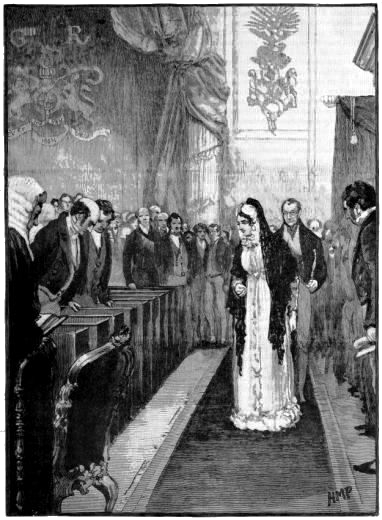
QUEEN CAROLINE ENTERING THE HOUSE OF LORDS. (See p. 208.)
[See larger version]
Lord Grey moved that it should be referred to the judges to determine whether adultery committed out of the country with a foreigner amounted to high treason. The motion was carried. The judges retired, and, after an absence of twenty minutes, returned, with their decision announced by Chief Justice Abbott, which was, that the crime in question was not punishable as high treason, under the Statute of Edward III. Counsel on both sides were admitted; Brougham and Denman, for the queen, sitting on the right of the bar, and the Attorney- and Solicitor-General on the left. Mr. Brougham prayed to be heard against the principle of the Bill. Permission was granted, and he addressed their lordships in a strain of impressive eloquence, demonstrating that the mode of proceeding now adopted was in the highest degree unjust to his illustrious client. He concluded by imploring their lordships to retrace their steps, and thus become the saviours of their country.
Next morning Mr. Denman spoke nearly two hours for the queen, strongly maintaining her right of recrimination against the king, who, when seeking for a divorce, should come into court with clean hands. He commented on the several clauses of the Bill as he went along. He said the person who framed it had worked himself up into an ebullition of moral zeal, and used expressions for the full support of which the bribes and schemes of the prosecutors would produce witnesses. Referring to a former investigation, he called the attention of the House to the letter of Mrs. Lisle, in 1806, when flirting and familiarity were the worst things alleged against her Royal Highness. On the subject of familiarity he referred to a note addressed by a waiter to the Prince of Wales—"Sam, of the Cocoanut Coffeehouse, presents his compliments to his Royal Highness, and begs" so and so. That illustrious person remarked, "This is very well to us, but it won't do for him to speak so to Norfolk and Arundel." He concluded by apologising to the queen for putting even the hypothesis of her guilt, which he never could believe would be established; and whatever might be enacted by means of suborned perjury or foul conspiracy, he never would pay to any one who might usurp her situation the respect to which the laws of God and man entitled her alone.
On the third day Lord King moved that the Bill was not one of State necessity or expediency. This gave occasion to Lord Liverpool, then at the head of the Government, to express his sentiments upon the measure. He declared upon his honour and in his conscience that, if the Bill passed, he believed the king would not marry again. But if the charges against the queen were proved, it was absolutely impossible not to conclude with an enactment for a divorce. Earl Grey replied to Lord Liverpool, and called upon their lordships, from respect for their own character, not to persevere with the measure before them.
The Attorney-General, Sir R. Gifford, was then called in, when he proceeded to state the case against the queen. He traced her Majesty's conduct from the time at which she left England, in 1814. Her suite consisted of Lady Charlotte Lindsay and Lady Elizabeth Forbes, and the Hon. Keppel Craven; Sir William Gell and a Mr. Fitzgerald as chamberlains, with Captain Hash as equerry; Dr. Holland as physician; and other persons, in various capacities. She went first to Brunswick, her native place, and thence to Milan, where she remained three weeks. There Bartolomeo Bergami was received into her service as a courier, having been a servant in a similar capacity to a General Picco. The princess went next to Rome, and thence to Naples, where she arrived on the 8th of November, 1814. Her adopted child, William Austin, then only six or seven years of age, to whom she was particularly attached, had been in the habit of sleeping in a bed in the same room with her, while, according to the domestic arrangements that had been adopted, Bergami slept, among other menial servants, at a distance. On the 9th of November, three weeks after his appointment, an apartment was assigned to Bergami near her own bedroom, and communicating with it by means of a corridor. The surprise occasioned by this alteration was increased when the princess directed that the child Austin should no longer sleep in her room. There was an air of hurry, agitation, and embarrassment about her manner which awakened suspicion, which was increased in the morning, according to the story of the witnesses, when they found that her own bed had not been occupied, and instead of summoning her female attendants at the usual time, she remained in the apartment of Bergami until a late hour. Her recent arrival at Naples naturally induced persons of consequence to pay their respects to her, but she was not accessible. The Attorney-General thought their lordships could have no doubt that "this was the commencement of that most scandalous, degrading, and licentious intercourse which continued and increased." The natural effect of this was that Bergami assumed airs of importance, and became haughty and arrogant with the other servants. A few days afterwards the princess gave a masked ball to the person then filling the Neapolitan throne. She first appeared as a Neapolitan peasant, but soon retired to assume another character, taking the courier with her, for the purpose of changing her costume. She then came forth as the genius of history, in a dress, or rather want of dress, of a most indecent and disgusting kind. The Attorney-General referred to a number of facts of a similar kind to those already detailed; also to instances of indelicacy and indecency, in which the queen was said to have indulged in the presence of her attendants and of strangers. On the fourth day, after the conclusion of his address, he proceeded to call his witnesses, and for more than a month the House was occupied in hearing their evidence.
The case against the queen closed on the 7th of September. An adjournment took place to allow time for the preparation of her defence, which was opened on the 3rd of October by Mr. Brougham, in a magnificent oration, justly celebrated as one of the finest specimens of British forensic eloquence. It concluded as follows:—
"It was always," said Mr. Brougham, "the queen's sad fate to lose her best stay, her strongest and surest protection, when danger threatened her; and by a coincidence most miraculous in her eventful history, not one of her intrepid defenders was ever withdrawn from her without that loss being the immediate signal for the renewal of momentous attacks upon her honour and her life. Mr. Pitt, who had been her constant friend and protector, died in 1806. A few weeks after that event took place, the first attack was levelled at her. Mr. Pitt left her as a legacy to Mr. Perceval, who became her best, her most undaunted, her firmest protector. But no sooner had the hand of an assassin laid prostrate that Minister, than her Royal Highness felt the force of the blow by the commencement of a renewed attack, though she had but just been borne through the last by Mr. Perceval's skilful and powerful defence of her character. Mr. Whitbread then undertook her protection; but soon that melancholy catastrophe happened which all good men of every political party in the State, he believed, sincerely and universally lamented. Then came with Mr. Whitbread's dreadful loss the murmuring of that storm which was so soon to burst with all its tempestuous fury upon her hapless and devoted head. Her child still lived, and was her friend; her enemies were afraid to strike, for they, in the wisdom of the world, worshipped the rising sun. But when she lost that amiable and beloved daughter, she had no protector; her enemies had nothing to dread; innocent or guilty, there was no hope, and she yielded to the entreaty of those who advised her residence out of this country. Who, indeed, could love persecution so steadfastly as to stay and brave its renewal and continuance, and harass the feelings of the only one she loved so dearly by combating such repeated attacks, which were still reiterated after the echo of the fullest acquittal? It was, however, reserved for the Milan Commission to concentrate and condense all the threatening clouds which were prepared to burst over her ill-fated head; and as if it were utterly impossible that the queen could lose a single protector without the loss being instantaneously followed by the commencement of some important step against her, the same day which saw the remains of her venerable Sovereign entombed—of that beloved Sovereign who was, from the outset, her constant father and friend—that same sun which shone upon the monarch's tomb ushered into the palace of his illustrious son and successor one of the perjured witnesses who were brought over to depose against her Majesty's life.
"Such, my lords," continued Mr. Brougham, "is the case now before you; and such is the evidence by which it is attempted to be upheld. It is evidence inadequate to prove any proposition, impotent to deprive the subject of any civil right, ridiculous to establish the least offence, scandalous to support a charge of the highest nature, monstrous to ruin the honour of the Queen of England. What shall I say of it, then, as evidence to support a judicial act of legislature—an ex post facto law? My lords, I call upon you to pause. You stand on the brink of a precipice: if your judgment shall go out against the queen, it will be the only act that ever went out without effecting its purpose; it will return to you upon your heads. Save the country! save yourselves!
"Oh! rescue the country—save the people of whom you are the ornaments, but severed from whom you can no more live than the blossom that is severed from the root and tree on which it grows. Save the country, therefore, that you may continue to adorn it; save the Crown, which is threatened with irreparable injury; save the aristocracy, which is surrounded with danger; save the altar, which is no longer safe when its kindred throne is shaken. You see that when the Church and the Throne would allow of no church solemnity in behalf of the queen, the heartfelt prayers of the people rose to Heaven for her protection. I pray Heaven for her; and here I pour forth my fervent supplications at the Throne of Mercy, that mercies may descend on the people of the country, higher than their rulers have deserved, and that your hearts may be turned to justice."
The examination of the witnesses for the defence continued till the 24th of October, and then powerful speeches were delivered by the Attorney-General, Sir Robert Gifford, and by the Solicitor-General, Mr. Copley. The speech of the former was considered so effective, that William Cobbett threw off one hundred thousand copies of an answer to it. Sir Archibald Alison, the Tory historian, admits that it was not the evidence for the prosecution that told against the queen, "for it was of so suspicious a kind that little reliance could be placed on it, but what was elicited on cross-examination from the English officers on board the vessel which conveyed her Majesty to the Levant—men of integrity and honour, of whose testimony there was not a shadow of suspicion. Without asserting that any of them proved actual guilt against her Majesty, it cannot be disputed that they established against her an amount of levity of manner and laxity of habits, which rendered her unfit to be at the head of English society, and amply justified the measures taken to exclude her from it."
On the 6th of November the second reading of the Bill was carried by a majority of twenty-eight, the numbers being one hundred and twenty-three to ninety-five, which the Government considered equivalent to a finding of guilty. It appears from these numbers that a large proportion of their lordships abstained from voting. The Bishops had an insuperable objection to the divorce clause; but in committee it was sustained by a majority of one hundred and twenty-nine to sixty-two, the Opposition having nearly all voted for the clause, with a view of defeating the Bill in its last stage. Consequently, for the third reading, on the 10th of November, the majority was only nine, the numbers being one hundred and eight to ninety-nine. Upon this announcement Lord Liverpool rose and said, that upon so slender a majority he could not think of pressing the measure further, and so he begged leave to withdraw the Bill. The truth is, he had no option. It had not the slightest chance of passing through the Lower House, where ignominious defeat awaited the Government.
The intelligence of this result was received by the public with transports of joy. London was illuminated for three successive nights; Edinburgh, Dublin, Manchester, Liverpool, and all the great towns followed the example. "For several days," says Alison, "the populace in all the cities of the empire seemed to be delirious with joy. Nothing had been seen like it before since the battle of Waterloo; nothing approaching to it after since the Reform Bill was passed." Meetings were immediately called in every direction to present addresses both to the king and queen: to the former, to congratulate him on the escape of his illustrious consort, and to call upon him to dismiss his present Ministers; and to the latter, to congratulate her on the restoration of those dignities from which she had been so long excluded. Not only public meetings of citizens and civic bodies, but trades of all kinds assembled and adopted addresses expressing their exultation at her triumph, and tendering their homage.
The members of the Government were scarcely less rejoiced at getting rid of the matter than the nation was at their defeat. The most thinking men of their party became greatly alarmed at the state of public feeling, and were in constant dread of a revolution. The most violent language was used by the democratic leaders, and the press abounded with libels against the Government, whose chief members were hooted and pelted as they passed through the streets. This alarming state of things had arrived at its height towards the end of September. The Duke of York, who was then at Brighton, was violent against the queen. He felt confident that the troops must be called out, and he thought he could trust them. On them alone he depended for the preservation of the Throne. The king, at this time, rarely showed himself to any of his subjects. His conduct was an excitement to popular hatred. Mr. W. H. Freemantle, who was well informed as to all that was going forward in the highest quarters, describes the condition of things in letters to the Duke of Buckingham. "You have no idea," he says, "of the state of the town. The funds fell to-day. As to the king forming a Government, after the resignation of all his present servants, with the avowed object of persecuting the queen, it would be impossible; it would be making her the popular object and throwing the country in a flame. Be assured that the king on this subject is no less than mad!" "In the months of October and November," observes the Duke of Buckingham, "it became evident that the frenzy outside the Houses of Parliament was exerting its influence within its walls. The aspect of affairs looked blacker every hour." "Matters here are in a critical state," writes Lord Sidmouth to Mr. Bathurst on the 27th of October. "Fear and faction are actively and not unsuccessfully at work; and it is possible that we may be in a minority, and that the fate of the Government may be decided." Plumer Ward, in his diary, has this entry under date of November 2nd:—"Called upon (Wellesley) Pole. He was at breakfast, and we had a long chat. He thought everything very bad—Ministers, Opposition, king, queen, country—and, what was more, no prospect of getting right. All ties were loosened. Insolence and insubordination out of doors; weakness and wickedness within. 'The Whigs,' he said, 'were already half Radicals, and would be entirely so if we did not give way.' I said his brother, the Duke of Wellington, felt this too, but would not give way nevertheless. Meantime, the king was as merry as a grig. At first he had been annoyed, but was now enjoying himself at Brighton."
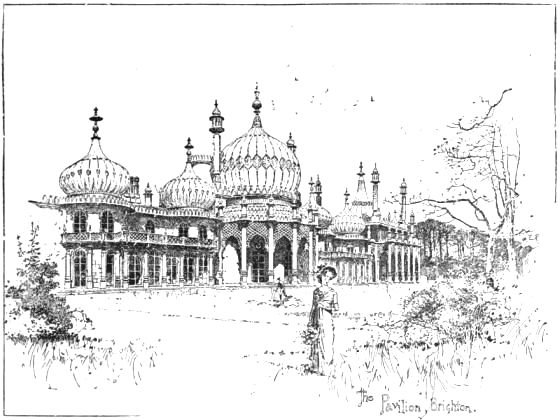
THE PAVILION, BRIGHTON.
[See larger version]
The Duke of Buckingham justly remarks that the task of the Government was from the first an up-hill one, "which nothing but their devotion to their master's service made them continue; but when a thousand unmistakable signs foretold a rebellion if they persevered, they had no alternative but to put an end to the thing with all convenient despatch." The truth is, in this case, victory would have been ruin to the victors. By beating a timely retreat they saved the monarchy. The Tory leaders, however, consoled themselves that they had so damaged the queen's character that even the chiefs of the great Whig families would not wish to have her at the head of the female aristocracy, or to have their wives and daughters at her court. They said: "The stout lady in the magnificent hat and feathers was very well as a source of Ministerial embarrassment; but, much as some of them pretended to decry the evidence against her that was elicited during her trial, they took especial care not to allow her anything resembling an intimacy with their wives or daughters." She was, however, visited after the trial by her son-in-law, Prince Leopold, and by the Duke of Sussex; and for some time the carriages of the highest ladies in the land were at her door. Grateful to Providence for the deliverance she had experienced from the hands of her persecutors, she went in state to St. Paul's to return public thanks to God. But even in this she was subjected to humiliation. An application had been made to have a sermon preached on the occasion, and Archdeacon Bathurst solicited the honour of delivering an appropriate discourse, but the authorities of the Cathedral refused his request, and the ceremony consisted merely of the reading of the morning service. The Bishop of Llandaff stigmatised the service as "a mockery of a religious solemnity, at which every serious Christian must shudder."
It was arranged that the coronation should take place early in the summer of 1821, and the queen, who in the interval had received an annuity of £50,000, was resolved to claim the right of being crowned with the king. She could hardly have hoped to succeed in this, but her claims were put forth in a memorial complaining that directions had not been given for the coronation of the queen, as had been accustomed on like occasions, and stating that she claimed, as of right, to celebrate the ceremony of her royal coronation, and to preserve as well her Majesty's said right as the lawful right and inheritance of others of his Majesty's subjects. Her memorial was laid before the Privy Council, and the greatest interest was excited by its discussion. The records were brought from the Tower: the "Liber Regalis" and other ancient volumes. The doors continued closed, and strangers were not allowed to remain in the adjoining rooms and passages. The following official decision of the Privy Council was given after some delay:—"The lords of the committee, in obedience to your Majesty's said order of reference, have heard her Majesty's Attorney- and Solicitor-General in support of her Majesty's said claim, and having also heard the observations of your Majesty's Attorney- and Solicitor-General thereupon, their lordships do agree humbly to report to your Majesty their opinions, that as it appears to them that the Queens Consort of this realm are not entitled of right to be crowned at any time, her Majesty the queen is not entitled as of right to be crowned at the time specified in her Majesty's memorials. His Majesty, having taken the said report into consideration, has been pleased, by and with the advice of the Privy Council, to approve thereof." The queen's subsequent applications, which included a letter to the king, were equally unsuccessful.
The Government determined to make the most formidable preparations for the preservation of the peace, and for putting down a riot, should it occur. Troops were seen directing their march from all quarters to the metropolis, and there was not a village in the vicinity which did not display the plumed helmet. George IV., always excessively fond of show and pomp, was resolved that the ceremonial of his coronation should outshine anything in history. The nation entered into the spirit of the occasion, and the metropolis was full of excitement. As early as one o'clock on the morning of the 19th of July, Westminster, the scene of this magnificent pageant, presented a dazzling spectacle. Even at that early hour, those who were fortunate enough to obtain places were proceeding to occupy them. From Charing Cross two streams of carriages extended, one to the Abbey and the other to Westminster Hall. The streets were crowded with foot passengers eager to secure seats on the platforms erected along the way, or some standing-place. All distinctions of rank were lost in the throng of eager expectants; judges, bishops, peers, commanders, wealthy citizens, richly dressed ladies, all mingled in the moving masses that converged towards the great centre of attraction.
At an early hour a crowd was assembled at the queen's residence in South Audley Street. Lady Anne Hamilton, "faithful found among the faithless, faithful only she," arrived a few minutes before five o'clock. Soon afterwards the gate was thrown open, and a shout was raised, "The queen! the queen!" She appeared in her state coach, drawn by six bays, attended by Lady Hood and Lady Anne Hamilton, Lord Hood following in his own carriage. Having arrived at Dean's Yard Gate, it was found that the entrance for persons of rank was Poet's Corner; thither the coachman went, but there he found there was no thoroughfare. After several stoppages she was conducted to the Poet's Corner, and arriving at the place where the tickets were received, Lord Hood demanded admission for the queen. The doorkeeper said that his instructions were to admit no person without a peer's ticket. Lord Hood asked, "Did you ever hear of a queen being asked for a ticket before? This is your queen. I present to you your queen. Do you refuse her admission?" She also said that she was his queen, and desired permission to pass. The doorkeeper answered that his orders were peremptory. Lord Hood then tendered one ticket which he had, and asked the queen whether she would enter alone. After a short consultation she declined, and it was resolved that, having been refused admission to the cathedral church of Westminster, she should return to her carriage. As she quitted the spot, some persons in the doorway laughed derisively, and were rebuked by Lord Hood for their unmannerly and unmanly conduct.
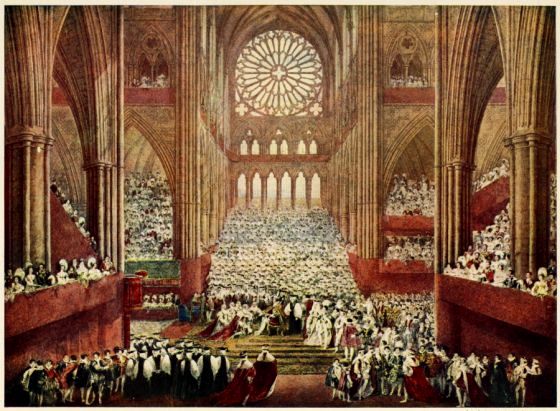
Reproduced by André & Sleigh, Ltd., Bushey, Herts.
THE CORONATION OF KING GEORGE IV. IN WESTMINSTER ABBEY: THE CEREMONY OF THE HOMAGE.
FROM THE PAINTING BY PUGIN AND STEPHANOFF, IN THE VICTORIA AND ALBERT MUSEUM, SOUTH KENSINGTON.
[See larger version]
It was a melancholy thing to see the Queen of England bandied about from door to door, in the throng of curious and anxious spectators; cheered by some, laughed at by others, and an object of pity to her friends, making vain efforts to obtain admission to witness the glory of her worthless husband, repulsed at every point by the lowest officials, and compelled to return home discomfited and humiliated. By indiscreet and foolish acts like this she injured her position, and degraded herself to an extent that her husband, powerful and malignant as he was, never could have done. She and her friends counted upon the devotion of the people to her cause, which they hoped would have borne down all impediments and broken through all barriers. But it was felt that in attempting to intrude herself in that way at the risk of marring a great national festival, and causing tumult and possibly bloodshed, she had forgotten her own dignity; her conduct shocked the public sense of propriety, and went far to forfeit popular sympathy. She became deeply sensible of this fact while waiting for admission, and with all her attempts at hilarity, her laughter and gaiety of manner ill concealed the deep, self-inflicted wounds of her spirit, which were never healed. Now completely disenchanted, robbed of the fond illusion which had hitherto affected her perception of things, and viewing her situation in the cold morning light of stern reality, a chill of despondency came over her, and thenceforth settled heavily upon her spirit.
The coronation was a magnificent ceremonial, and during the proceedings in the Abbey, Westminster Hall was being prepared for the banquet. There were three tables on each side, each table having covers for fifty-six persons, and each person having before him a silver plate. The other plate was entirely of gold. The dishes served up were all cold, consisting of fowls, tongues, pies, and a profusion of sweetmeats, with conserves and fruit of every kind. At twenty minutes to four o'clock the gates were thrown open to admit the procession on its return. Seen from the opposite end of the hall, the effect was magnificent as the procession passed under the triumphal arch. On the entrance of the king he was received with loud and continued acclamations. His Majesty being seated at the banquet, the first course came with a grand procession, which the king seemed to regard with great satisfaction. The Duke of Wellington, as Lord High Constable, the Marquis of Anglesey, as Lord High Steward, and the Deputy Earl Marshal, Lord Howard of Effingham, mounted on horses, and attended by their pages and grooms, advanced to the foot of the platform; the horsemen stopped while the clerks of the kitchen advanced to the royal table, and took the dishes from the gentlemen pensioners. Then the whole procession moved back, the horsemen backing their chargers with the greatest precision, amidst loud applause. The first course having been removed, a flourish of trumpets was heard at the bottom of the hall, the great gates were instantly thrown wide open, and the champion, Mr. Dymoke, made his appearance under the Gothic archway, mounted on his piebald charger, accompanied on the right by the Duke of Wellington, and on the left by Lord Howard of Effingham, and attended by trumpeters and an esquire. The usual challenges were given. Some other ceremonies having been gone through, the king's health was proposed by one of the peers, and drunk with acclamation. The National Anthem was then sung, after which the king rose and said, "The king thanks his peers for drinking his health and does them the honour of drinking their health and that of his good people." Shortly afterwards his Majesty quitted the hall and returned to his palace in his private carriage, attended by his usual body-guard.
From the sublime to the ridiculous is but a step. A scene followed the king's departure which seems almost incredible. After the service of the second course, the numerous attendants, singers, and even ladies and gentlemen began to press round the royal table, as if prepared for a scramble to possess its contents. The crowd of spectators pressed nearer and nearer. For a moment only covetous eyes were cast on the spoils, as if each were afraid to begin the plunder; but, at last, a rude hand having been thrust through the first ranks, and a golden fork having been seized, this operated as a signal to all, and was followed by a "general snatch." In a short time all the small portable articles were transferred to the pockets of the multitude. The Lord High Chamberlain, hearing of the attack, hastened to the rescue, and with the greatest difficulty saved the more important articles of plate, and had them conveyed to Carlton Garden. Then followed a scene unparalleled in the annals of coronations. The crowds in the galleries had beheld with envy the operations at the banquet. They were very hungry, and very thirsty, and seeing now that Westminster Hall was "liberty hall," they rushed down different stairs and passages, and attacked the viands and the wine. A raging thirst was the first thing to be satisfied, and in a few minutes every bottle on the table was emptied. A fresh supply was soon obtained from the cellarettes. When the ravening selfishness of the hungry crowd was satisfied, the gentlemen recovered their politeness, and began to think of the ladies. Groups of beautiful women then found their way to the tables, and every effort was made to afford them the refreshment of which they stood so much in need. In the meantime, the plunderers took advantage of the confusion to enrich themselves with trophies, breaking and destroying the table ornaments to obtain fragments of things too cumbrous to carry away. Thus, baskets, flowerpots, vases, and figures were everywhere disappearing, and these were followed by glasses, knives, forks, salt-spoons, and, finally, the plates and dishes. The last were engraved with the royal arms and the letters "Geo. IV.," and were therefore specially coveted as memorials. The dirty state of the articles, however, was rather out of keeping with the costly dresses; but the ladies and gentlemen got over the difficulty by wrapping up the articles in their pocket-handkerchiefs. Having thus secured all the spoils they could, they made all possible haste to their carriages. At a subsequent period, it was with the greatest difficulty that the royal plate could be kept from being carried away by the multitude outside when the barriers were removed.
After the coronation, the queen resided at Brandenburgh House, determined to lead a life of dignified retirement. But the violent agitation and excitement, and the terribly painful mortification to which she was subjected in her ill-advised attempt to form part of the coronation pageant, were too much for her constitution. As soon as it was evident that her end was approaching, much public sympathy was excited, and the vicinity of her residence was incessantly thronged with persons of all classes making anxious inquiries about her health, and solicitous for her restoration. On the 4th of August, when her professional advisers were receiving instructions about the disposition of her property, one of them suggested the propriety of sending a messenger to Italy to seal up her papers, in order to prevent them from falling into the hands of her enemies. "And what if they do?" she exclaimed; "I have no papers that they may not see. They can find nothing, because there is nothing, nor ever has been, to impeach my character." One of them said that he was aware of that, but her enemies might put there what they did not find. She replied, "I have always defied their malice, and I defy it still." Nevertheless, it was her conscious failure in her efforts to make the public believe this, coupled with the public humiliation to which she had been subjected, that bowed down her spirit at last, and gave the victory to her enemies. She had painted their characters in vivid colours in her private diary, and might have transmitted their punishment to posterity had she ordered it to be preserved and published; but she gave directions to have it destroyed, and it was burnt in her presence by one of her foreign maids. After suffering intensely for four or five days, she sank into a stupor, from which she never woke, and on the 7th of August, after an entire absence of sense and faculty for more than two hours, expired Caroline of Brunswick, Queen Consort of George IV., in the fifty-fourth year of her age. She had by her bedside in her last hours her faithful friends and constant attendants, Lord and Lady Hood, and Lady Anne Hamilton; Alderman Wood, who had been devoted to her interests from the first, was also present, as well as her legal and medical advisers.
The king, who had set out on his long-premeditated visit to Ireland, leaving his wife on her death-bed, was already at Holyhead when he received the tidings of her decease. From that port Lord Londonderry wrote a note to the Lord Chancellor, in which he said, "I add this private note to the letter which the king has directed me to write, to say that his Majesty is quite well, and has evinced, since the intelligence of the queen's death was received, every disposition to conform to such arrangements and observances as might be deemed most becoming upon an occasion which cannot be regarded in any other light than as the greatest of all possible deliverances, both to his Majesty and to the country. The king feels assured that the events to which my letters refer, once in your hands, will be sifted to the bottom and wisely decided; and to the advice he may receive there will be every disposition on his Majesty's part to conform; but where papers connected with his daughter, as well as other branches of his family, are in question, your lordship will estimate the deep interest the king takes in your giving the whole your best consideration."
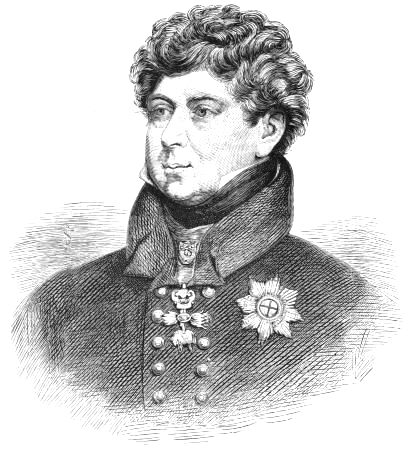
GEORGE IV.
[See larger version]
The king rejoiced too soon. The announcement to the public of the queen's death was the knell of the popularity which he had recently acquired. There was an immediate and powerful reaction in the public mind against the king, which was strengthened by the ungracious measures adopted in connection with her funeral. There was a clause in her will to this effect:—"I desire and direct that my body be not opened, and that three days after my death it be carried to Brunswick for interment; and that the inscription on my coffin be, 'Here lies Caroline of Brunswick, the injured Queen of England.'" The Government were very anxious to have the corpse sent out of the kingdom immediately, in order that its presence might not interfere with the festivities in Ireland; they therefore wished to have the remains dispatched at once to Harwich for embarkation. Lady Hood appealed in vain to Lord Liverpool for some delay on the ground that the queen's ladies were not prepared to depart so soon, at the same time protesting against any military escort. The military guard was an ostensible honour; but its real object was to prevent popular manifestations detrimental to the Government in connection with the funeral. The friends of the queen could not even learn by what route the body would be conveyed. It should have gone through the City, where the Lord Mayor and Corporation announced their intention of following the hearse; but to prevent that honour, it was ordered that the corpse should be sent round by the New Road to Romford. The funeral passed from Hammersmith to Kensington Church without obstruction; there the conductors were turning off from the way to the City, in order to get into the Bayswater Road, when they were met by a loud cry of wrath and execration from the multitude. In a few minutes the road was dug up, barricaded, and rendered impassable. The Life Guards and the chief magistrate of Bow Street appeared, and seeing the impossibility of forcing a passage, they ordered the cortège to proceed on the direct route through the City, amidst thundering shouts of victory that might have appalled the king had he heard them. In the meantime the multitude had been rushing through the parks in mighty surging masses, now in one direction and now in another, according to the varying reports as to the course the procession was to take. Orders had been issued from the Government that it should go through the Kensington gate of Hyde Park, but the people closed the gates, and assumed such a fierce and determined attitude of resistance that the authorities were again compelled to give way, and again the popular shouts of victory sounded far and wide. Peremptory orders were given by the Government to pass up the Park into the Edgware Road, either by the east side or through Park Lane. In the effort to do this the line of procession was broken, the hearse was got into the Park, and hurried onwards to Cumberland Gate; but the people had outrun the military, and again blocked up the way in a dense mass. Here a collision ensued: the populace had used missiles; the military were irritated, and having had peremptory orders, they fired on the people, wounding many and killing two. But the people, baffled for the moment, made another attempt. At Tottenham Court Road the Guards found every way closely blocked up, except the way to the City. In this way, therefore, they were compelled to move, amidst the exulting shouts of the multitude. Seeking an outlet to the suburbs at every turn in vain, the procession was forced down Drury Lane into the Strand. The passage under Temple Bar was accompanied by the wildest possible excitement and shouts of exultation. The Corporation functionaries assembled in haste and accompanied the funeral to Whitechapel. On the whole way to Romford, we read, that not only the direct, but the cross roads, were lined with anxious spectators. The shops were closed, the bells were tolling, mourning dresses were generally worn, and in every direction symptoms abounded of the deep feeling excited by the death of the queen. The funeral cortège rested for the night at Colchester, the remains being placed in St. Peter's Church. There the plate with the inscription "injured Queen" was taken off, and another substituted. At Harwich the coffin was unceremoniously conveyed to the Glasgow frigate. At length the remains arrived at their last resting-place in a vault beneath the cathedral at Brunswick.
Sir Francis Burdett once wrote a letter of a single sentence to his friend Lord Cloncurry, as follows:—"Dear Lord Cloncurry, I should like to know what you think would allay Irish agitation? Yours truly, F. B." It would have taken a volume to answer this question, and perhaps, after all, Sir Francis Burdett would not have been satisfied. George IV. thought that his visit would have had that effect, and appearances for a time seemed to justify his sanguine anticipations. The visit had been long meditated. He set out on a yachting excursion soon after the coronation, and arrived at Plymouth on the 1st of August amidst the huzzas of an immense concourse of people. On the following day the royal squadron departed for Ireland, and anchored in the bay at Holyhead on the 7th. The news of his approach threw the people of Dublin into a paroxysm of joy, to which the newspapers of the day gave expression in the most extravagant terms. The blessing that awaited them seemed too great to be realised. Never had they comforted their hours of despondency or flattered themselves in seasons of imagined felicity, with anything approaching to the reality which fortune was about to shower upon them. The king's name, they declared, was more to them than a tower of strength; it had effected what neither patriots, philosophers, nor moralists could ever accomplish.
As the king was to land privately and to proceed to the Viceregal Lodge in Phœnix Park without entering the city, it was uncertain whether he would come by Dunleary or Howth. There was an idea that he would land at the former place on Sunday, the 12th of August, and immense crowds lined the coast during the day, watching for the approach of the steamer. They were disappointed, for his Majesty arrived at Howth about five o'clock. He was accompanied by the Marquis of Londonderry, the Marquis of Thomond, Lord Mount Charles, Lord Francis Conyngham, and Mr. Freeling, Secretary to the Post Office, England. A small ship-ladder, covered with carpeting, was fixed to facilitate his landing. This he ascended without assistance, and with great agility. As the narrow pier was crowded to excess, he found himself jammed in by a mass of people, who could not be displaced without throwing numbers of them into the water. Though he had reason to be displeased with the want of proper arrangements, he bore the inconvenience with good humour; indeed, his Majesty was very jolly, owing to copious draughts of Irish whisky punch with which he had drowned sorrow, during the voyage, for the loss of the queen. On seeing Lord Kingston in the crowd, he exclaimed, "Kingston, Kingston, you black-whiskered, good-natured fellow, I am happy to see you in this friendly country." Having recognised Mr. Dennis Bowles Daly, he cordially shook hands with that gentleman, who at the moment was deprived of a gold watch, worth sixty guineas, and a pocket-book, by one of the light-fingered gentry. The king also shook hands with numbers of the persons present who were wholly strangers to him. At length his Majesty managed to get into his carriage, and as he did so, the cheers of the multitude rent the air. He turned to the people, and, extending both his hands, said, with great emotion, "God bless you all. I thank you from my heart." Seemingly exhausted, he threw himself back in the carriage; but on the cheering being renewed, he bent forward again, and taking off his cap, bowed most graciously to the ladies and those around him. One of the horses became restive on the pier, but a gentleman, regardless of personal danger, led him till he became manageable. The cavalcade drove rapidly to town, and proceeded by the Circular Road to the Park. On the way there was a constant accession of horsemen, who all rode uncovered. When they came to the entrance of the Park, the gentlemen halted outside the gate, not wishing to intrude, when the king put out his head and said, "Come on, my friends." On alighting from his carriage he turned round at the door, and addressed those present in nearly the following words:—"My lords and gentlemen, and my good yeomanry,—I cannot express to you the gratification I feel at the warm and kind reception I have met with on this day of my landing among my Irish subjects. I am obliged to you all. I am particularly obliged by your escorting me to my very door. I may not be able to express my feelings as I wish. I have travelled far, I have made a long sea voyage; besides which, particular circumstances have occurred, known to you all, of which it is better at present not to speak; upon those subjects I leave it to delicate and generous hearts to appreciate my feelings. This is one of the happiest days of my life. I have long wished to visit you; my heart has been always with the Irish; from the day it first beat I have loved Ireland. This day has shown me that I am beloved by my Irish subjects. Rank, station, honours, are nothing; but to feel that I live in the hearts of my Irish subjects is to me exalted happiness. I must now once more thank you for your kindness, and bid you farewell. Go and do by me as I shall do by you—drink my health in a bumper; I shall drink all yours in a bumper of good Irish whisky." Mr. W. H. Freemantle, writing to the Duke of Buckingham, says, "I don't know whether you have heard any of the details from Ireland, but the conduct of the Irish is beyond all conception of loyalty and adulation, and I fear will serve to strengthen those feelings of self-will and personal authority which are at all times uppermost in 'the mind.' The passage to Dublin was occupied in eating goose-pie and drinking whisky, of which his Majesty partook most abundantly, singing many joyous songs, and being in a state on his arrival to double in sight even the number of his gracious subjects assembled on the pier to receive him. The fact was that he was in the last stage of intoxication: however, they got him to the Park." But whatever happened on board ship, and whether or not the king was "half-seas over," he acquitted himself so as to excite the boundless admiration of his Irish subjects, and the visit, which lasted twenty-two days, was an unqualified success from the spectacular point of view.
If the scandalous gossip of the Court may be trusted, the king did not allow affairs of State, or public displays, or the death of the queen to wean him even for a week from his attachment to Lady Conyngham. Mr. Freemantle, a rather cynical commentator on public affairs, wrote as follows:—"Lady C. has been almost constantly at the Phœnix Park, but has not appeared much in public." Again, the same writer remarks, "I never in my life heard of anything equal to the king's infatuation and conduct towards Lady Conyngham. She lived exclusively with him during the whole time he was in Ireland at the Phœnix Park. When he went to Slane, she received him dressed out as for a drawing-room; he saluted her, and they then retired alone to her apartments. A yacht is left to bring her over, and she and the whole family go to Hanover. I hear the Irish are outrageously jealous of her, and though courting her to the greatest degree, are loud in their indignation at Lord C. This is just like them. I agree in all you say about Ireland. As there is no chance of the boon being granted, no lord-lieutenant could have a chance of ingratiating himself, or of fair justice done him, with the king's promises and flattery."
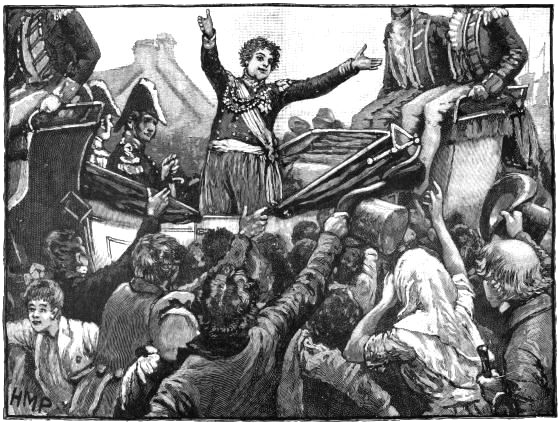
LANDING OF GEORGE IV. AT HOWTH. (See p. 218.)
[See larger version]
The king had a stormy and rather perilous passage across the Channel. Mr. Freemantle sarcastically alludes to the feelings of the royal passenger in connection with this voyage:—"The king in his journey home overtook Lord and Lady Harcourt, now the bosom friends of Lady Conyngham, stopped them, got out of his carriage, and sat with them for a quarter of an hour on the public road, recounting all his perilous adventures at sea, and flattering reception in Ireland. Lady Harcourt told me his pious acknowledgment for his great escape of being shipwrecked was quite edifying, and the very great change in his moral habits and religious feelings was quite astonishing, and all owing to Lady Conyngham." On his return to London, after a visit to Hanover, the king devoted himself to a life of seclusion for a considerable time, during which it appears that the Marchioness of Conyngham maintained an ascendency over him most damaging to his character and Government. She had not only made the royal favour tributary to the advancement of her own family, but she meddled in political affairs with mischievous effect. "Had it been confined to mere family connections," writes Robert Huish, "no voice, perhaps, would have been raised against it; but when the highest offices in the Church were bestowed on persons scarcely previously heard of—when political parties rose and fell, and Ministers were created and deposed to gratify the ambition of a female—then the palace of the king appeared as if surrounded by some pestilential air. The old hereditary counsellors of the king avoided the Court, as alike fatal to private probity and public honour. The entrance to Windsor Castle was, as it were, hermetically sealed by the enchantress within to all but the favoured few. The privilege of the entrée was curtailed to the very old friends of the king, and even the commonest domestics in the castle were constrained to submit to the control of the marchioness. The Court of George IV. certainly differed widely from that of Charles II., although the number and reputation of their several mistresses were nearly the same in favour and character; but George IV. had no confiscations to confer on the instruments of his pleasures."
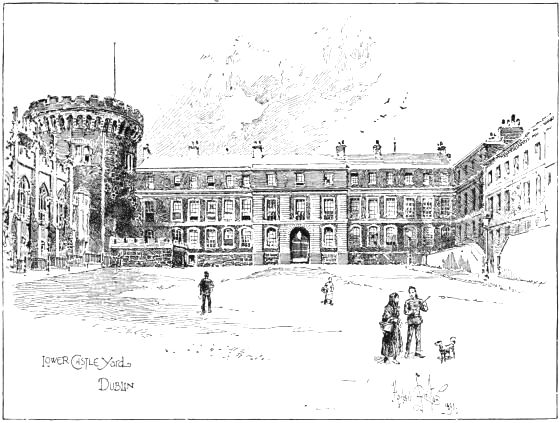
LOWER CASTLE-YARD, DUBLIN. (From a Photograph by W. Lawrence.)
[See larger version]
Thus passed the winter of 1821-22. Parliament met on the 5th of February, 1822, for the transaction of business, and was opened by the king. In his Speech from the Throne he expressed regret for the agricultural distress that prevailed in England; and he had the unpleasant task imposed upon him of referring to a state of things in Ireland the reverse of what might have been expected from his conciliation policy—"a spirit of outrage" that had led to daring and systematic violations of the law which he submitted to the consideration of Parliament. In the House of Lords the Address was adopted without opposition. In the Commons amendments were proposed by Sir Francis Burdett and Mr. Hume, which were rejected by large majorities. The state of Ireland was the first subject that occupied the attention of the legislature. A salutary change had been effected in the executive of that country. Lord Talbot, the late Viceroy, was a man of narrow and exclusive spirit, wedded to the régime of Protestant ascendency. But according to a system of counterpoise which had been adopted in the Irish Government, his influence was checked by his Chief Secretary, Mr. Charles Grant, a man of large mind, enlightened principles, and high character. This system tended to keep the rival parties in a state of conflict, and naturally weakened the authority of the Government. A modification in the English Cabinet led to corresponding changes in Ireland. The spirit of discontent among the commercial classes in England induced Lord Liverpool to enter into a compromise with the Grenville-Wynn party, and the Marquis of Buckingham, its chief, was created a duke; Lord Sidmouth retired from the Home Office, and was succeeded by Mr. Peel; the Marquis Wellesley became Lord-Lieutenant of Ireland; while Mr. Plunket, a man of Liberal politics and transcendent abilities, was appointed Irish Attorney-General in the room of Mr. Saurin, the champion of unmitigated Protestant ascendency. The Liberal tendencies of these statesmen were to some extent counteracted by the appointment of Mr. Goulburn, the determined opponent of the Catholic claims, as Chief Secretary. Lord Liverpool, however, defended the appointment on the ground that a man's opinions on the Catholic question should not disqualify him for office in Ireland, "it being understood that the existing laws, whatever they may be, are to be equally administered with respect to all classes of his Majesty's subjects, and that the Roman Catholics are in any case to enjoy their fair share of the privileges and advantages to which they are by law entitled."
This coalition was considered a matter of great importance, not as giving strength to the Administration of Lord Liverpool, to which it brought only a few votes in the House of Commons, but as indicating a radical change of policy towards Ireland. Lord Eldon was by no means satisfied with the changes. "This coalition," he writes, "I think, will have consequences very different from those expected by the members of administration who have brought it about. I hate coalitions." No doubt they ill suited his uncompromising spirit; and any connection with Liberal opinions must have been in the highest degree repugnant to the feelings of one who believed that the granting of Catholic Emancipation would involve the ruin of the Constitution.
Very strong hopes were entertained by the Liberal party from the Administration of Lord Wellesley, but it was his misfortune to be obliged to commence it with coercive measures, always the ready resource of the Irish Government. The new Viceroy would have removed, if possible, the causes of public disturbance; but, in the meantime, the peace must be preserved and sanguinary outrages must be repressed, and he did not shrink from the discharge of his duty in this respect on account of the popular odium which it was sure to bring upon his Government. Mr. Plunket, as Attorney-General, was as firm in the administration of justice as Mr. Saurin, his high Tory predecessor, could be. The measures of repression adopted by the legislature were certainly not wanting in severity. The disorders were agrarian, arising out of insecurity of land tenure, rack rents, and tithes levied by proctors upon tillage, and falling chiefly upon the Roman Catholic population, who disowned the ministrations of the Established Church. The remedies which the Government provided for disturbances thus originating were the Suspension of the Habeas Corpus Act and the renewal of the Insurrection Act. By the provisions of the latter the Lord-Lieutenant was empowered, on the representation of justices in session that a district was disturbed, to proclaim it in a state of insurrection, to interdict the inhabitants from leaving their homes between sunset and sunrise, and to subject them to visits by night, to ascertain their presence in their own dwellings. If absent, they were considered idle and disorderly, and liable to transportation for seven years! These measures encountered considerable opposition, but they were rapidly passed through both Houses, and received the Royal Assent a week after Parliament met. Under these Acts a number of Whiteboys and other offenders were tried and convicted, several hanged, and many transported. Lord Wellesley must have felt his position very disagreeable between the two excited parties. To be impartial and just was to incur the hostility of both. Possibly he became disgusted with the factions that surrounded him. Whether from this cause, or from an indolent temper, or from the feeling that he was hampered and restrained, and could not do for the country what he felt that its well-being required, or from ill health, it is certain that he became very inactive. A member of the Cabinet writes about him thus:—"I find the Orange party are loud in their abuse of Lord Wellesley, for shutting himself up at the Phœnix Park, lying in bed all day, seeing nobody, and only communicating with Secretary Gregory by letter. Indeed, I believe that the latter is more than he often favours Secretaries Peel and Goulburn with." In another letter, the same Minister, Mr. Wynn, complains of his total neglect of his correspondence with England. This, he said, was inexcusable, because those on whom the chief responsibility rested had a right to know his views upon the state of Ireland, in order to be able to meet the Opposition during the sitting of Parliament. This was written towards the end of April, and at that time the Government had not for a month heard a syllable from him on the agitated questions of tithes, magistracy, and police. The state of Ireland, indeed, became every day more perplexing and alarming. A revolutionary spirit was abroad, and all other social evils were aggravated by famine, which prevailed in extensive districts in the south and west. The potato crop, always precarious, was then almost a total failure in many counties, and left the dense population, whose existence depended upon it, totally destitute. The cry of distress reached England, and was responded to in the most generous spirit. Half a million sterling was voted by Parliament, and placed at the disposal of Lord Wellesley, to be dispensed in charitable relief and expended on public works for the employment of the poor. In addition to this, the English people contributed from their private resources the sum of three hundred thousand pounds for the relief of Irish distress. On the 30th of May there was a ball given for the same object, in the King's Theatre, London, which produced three thousand five hundred pounds.
The disabilities under which the Roman Catholics laboured were a constant source of irritation in Ireland; the agitation upon the subject was becoming every day more formidable. Mr. Plunket was anxious to bring forward the question in the House of Commons, but he was urged by his colleagues to postpone it, from an apprehension that the time was not yet come to give it a fair consideration: the Cabinet was divided, the Chancellor was obstinate, and the king vacillating, if not double-minded. "As to the conduct of the king," writes Mr. Freemantle, a member of the Government, "it is inexplicable. He is praising Lord Liverpool on all occasions, and sending invitations to nobody but the Opposition. With regard to Ireland, I am quite satisfied the great man is holding the most conciliatory language to both parties—holding out success to the Catholics, and a determination to resist them to the Protestants."
Mr. Canning had been offered the Governor-Generalship of India. Before his departure, he was resolved, if possible, to make a breach in the system of Parliamentary exclusiveness. On the 29th of March he gave notice of a motion to bring in a Bill for the admission of Roman Catholic peers to seats in Parliament, and on the following day supported it by a speech of great power of argument and brilliant eloquence, illustrating his position very happily from the case of the Duke of Norfolk, and his official connection with the ceremonial of the coronation. He asked, "Did it ever occur to the representatives of Europe, when contemplating this animating spectacle—did it occur to the ambassadors of Catholic Austria, of Catholic France, or of states more bigoted in matters of religion—that the moment this ceremony was over the Duke of Norfolk would become disseized of the exercise of his privileges amongst his fellow peers?—that his robes of ceremony were to be laid aside and hung up until the distant (be it a very distant!) day when the coronation of a successor to his present most gracious Sovereign might again call him forth to assist at a similar solemnisation?—that, after being thus exhibited to the eyes of the peers and people of England, and to the representatives of the princes and nations of the world, the Duke of Norfolk—highest in rank amongst the peers—the Lord Clifford, and others like him, representing a long line of illustrious ancestry, as if called forth and furnished for the occasion, like the lustres and banners that flamed and glittered in the scene, were to be, like them, thrown by as useless and trumpery formalities?—that they might bend the knee and kiss the hand, that they might bear the train or rear the canopy, might discharge the offices assigned by Roman pride to their barbarian ancestors—
'Purpurea tollant aulæa Britanni;'
but that with the pageantry of the hour their importance faded away?—that as their distinction vanished their humiliation returned?—and that he who headed the procession of peers to-day could not sit among them as their equal on the morrow?"
The debates were very animated, and excited the liveliest interest. The Bill was read the first time by a majority of five. On the 10th of May the House divided on the second reading, which was carried by a majority of twelve, the numbers being, for the Bill, two hundred and thirty-five; noes, two hundred and twenty-three. The exertions made to defeat this Bill were extraordinary. There were twenty-seven pairs of members who appeared in the House. The Duke of York canvassed against it in all directions with the utmost zeal and activity. It was felt that if it passed into law, the admission of Roman Catholics into the Lower House must follow as a matter of course. The Bill, however, was thrown out by the Lords.
This Session is memorable for the introduction of the subject of Parliamentary Reform by Lord John Russell. His plan was to add one hundred members to the House—sixty for counties and forty for large towns. He argued that this enlargement of the representation was rendered just and politic by increasing intelligence among the people, especially the middle classes, of whom large numbers were unrepresented in Parliament. His motion was negatived, on the 29th of April, by two hundred and sixty-nine to one hundred and sixty-four, Mr. Canning having led the opposition of the Conservatives, and defended the Constitution as it stood. The motion, in fact, was premature, though in the previous Session he had procured the disfranchisement of the corrupt borough of Grampound—a victory which the Lords sought to neutralise by transferring the seat to the county of York, instead of to one of the great unrepresented cities.
The complaints of agricultural distress prevalent in England, with the sudden reaction from war prices at the establishment of peace, had become so loud and general this year that Parliament undertook to find a remedy. An agricultural committee had been appointed to inquire into the subject, and had produced a report which was far from satisfactory. On the 29th of April the House of Commons resolved itself into a committee to consider the report. Three different schemes were proposed for the relief of the farmers and landlords—the first by the Marquis of Londonderry, the second by Mr. Ricardo, and the third by Mr. Huskisson. There was no scarcity of produce in England; on the contrary, it was very abundant, and the evil that oppressed the farmers was excessive cheapness, by which they were disabled from paying the high rents and heavy taxation entailed by the war. Some of the remedies proposed were sufficiently radical in their character. The most natural was the reduction of taxation by means of retrenchment in the public expenditure. Some proposed that the tithes should be alienated from the Church, and used for the purpose of reducing the national burdens. The largest party insisted upon the reduction of the interest of the National Debt, which was defended as an equitable measure on the ground of the increased value of the currency since the passing of Peel's Bill for the resumption of cash payments. The plan of relief proposed by Lord Londonderry consisted of the repeal of the annual malt tax, and the loan of a million by Exchequer Bills to the landed interest upon the security of warehoused corn.
Mr. Vansittart introduced some financial measures which effected a material saving. He proposed a plan for reducing the interest of the Navy Five per Cents. to four per cent. Holders not signifying their dissent were to have one hundred and five pounds in a New Four per Cent. stock, and persons dissenting were to be paid off in numerical order. By this scheme an annual saving to the public of one million one hundred and forty thousand pounds would be effected; besides a further saving of upwards of ninety thousand pounds of annual charge, which would be gained by similar reduction of the Irish Five per Cents. The high prices of the public funds obviated all difficulty in the execution of this financial operation, and the holders of the Five per Cent. stock found it expedient to acquiesce in the Minister's terms. The dissentients were in number only one thousand seven hundred and seventy-eight, and the stock held by them amounted to two million six hundred and fifteen thousand nine hundred and seventy-eight pounds, not a fifteenth part of the Five per Cent. capital. Another operation related to what was called "The Dead Weight Annuity." The amount of military and naval pensions and civil supernumeraries was about five millions annually. Accordingly Mr. Vansittart brought forward an amended scheme for relieving the immediate pressure of this dead weight by extending it over a longer term of years than the natural lives of the annuitants. For this purpose an annuity of two million eight hundred thousand pounds was appropriated out of the existing revenue for forty-five years, invested in trustees for the discharge of the then payments, which for that year were estimated at four million nine hundred thousand pounds, subject to a yearly diminution by deaths. It was computed that, according to the ordinary duration of human life, the annuities for the lives of the then holders would be equal to the annuity of two million eight hundred thousand pounds for forty-five years. The trustees were therefore empowered to sell from time to time such portions of this annuity as would provide the funds required for the payment of the dead weight, according to a computation made of the amount which would probably be due in each year. The Bank of England became the contractor for a portion of the annuity. There was no novelty of principle in the project; it was only the old one of anticipating distant resources by throwing the burden of the existing generation on the next. It had the further disadvantage of incurring a useless expense for management; whereas the Sinking Fund, amounting at the time to about five millions, might have been applied to existing exigencies, and a real saving effected.
A question was opened in the House of Commons, on a motion of Mr. Western, which often subsequently occupied its attention. It referred to the effect on prices of Mr. Peel's Act of 1819 for the resumption of cash payments. According to the views of Mr. Western and Mr. Attwood, the value of money had been enormously increased by the resumption of payments in specie by the Bank, and its necessary preliminary, a diminution of the circulation. Prices had in consequence fallen; rents, taxes, annuities, and all fixed payments become more onerous. These views were opposed by Huskisson, Peel, and Ricardo, and, on the motion of the first-named, a resolution was carried, by one hundred and ninety-four to thirty, "That this House will not alter the standard of gold or silver in fineness, weight, or denomination."
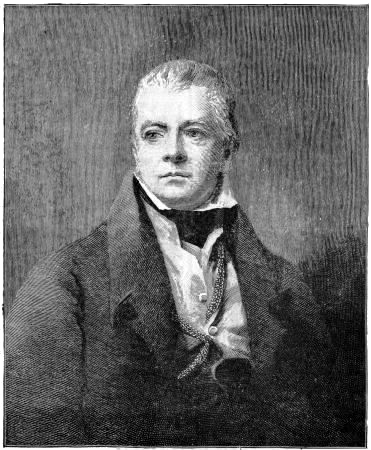
SIR WALTER SCOTT. (After the Portrait by Sir Henry Raeburn.)
[See larger version]
Marriage is one of the fundamental principles of the social system. The law of marriage, therefore, ought to be plain and simple, intelligible to all, and guarded in every possible way against fraud and abuse. Yet the marriage laws of the United Kingdom were long in the most confused, unintelligible, and unsettled state, leading often to ruinous and almost endless litigation. A new Marriage Act was passed in the Session now under review, which, like many Acts of the kind, originated in personal interests affecting the aristocracy. It was said to have mainly arisen out of the marriage of the Marquis of Donegal with Miss May, who was the daughter of a gentleman celebrated for assisting persons of fashion with loans of money. The brother of the marquis sought to set this marriage aside, and to render the children illegitimate, in order that he might himself, should the marquis die without lawful issue, be heir to his title and estates. In law the marriage was invalid; but it was now protected by a retrospective clause in the new Act. By the Marriage Act of 1754 all marriages of minors certified without the assent of certain specified persons were declared null. A Bill was passed by the Commons giving validity to marriages which, according to the existing law, were null, and providing that the marriages of minors, celebrated without due notice, should not be void, but merely voidable, and liable to be annulled only during the minority of the parties, and at the suit of the parents or guardians.
On the 20th of June, when the Bill was in committee of the Peers, the Lord Chancellor urged his objection to the retrospective clause, as unsettling the rights of property. The report being brought up on the 25th, he repeated his objections, and moved that the retrospective clause should be omitted. The motion was negatived. On the 2nd of July, the day fixed for the third reading, his brother, Lord Stowell, made a similar motion, which was also defeated. The Lord Chancellor moved the insertion of a clause for giving validity to deeds, assignments and settlements made by persons having claims on any property affected by the Bill. The Marquis of Lansdowne opposed this clause, which, he said, would give the Bill the effect of declaring children legitimate and yet disinheriting them—"of peopling the House of Lords with titled beggars." This clause having been negatived on a division, the Lord Chancellor proposed another to the same effect, with the addition of the words, "for good and valuable consideration." This also was rejected by a majority. This was too much for the temper of Lord Eldon, so long accustomed to have his way in that House. Irritated at being repeatedly thwarted in his efforts, on declaring the numbers he exclaimed with vehemence, "My lords, ten days ago I believed this House possessed the good opinion of the public, as the mediator between them and the laws of the country; if this Bill pass to-night, I hope in God that this House may still have that good opinion ten days hence. But to say the best of this measure, I consider it neither more nor less than a legal robbery, so help me God! I have but a short time to remain with you, but I trust it will be hereafter known that I used every means in my power to prevent its passing into law." Thenceforth the Lord Chancellor became sulky with his colleagues, feeling himself dragged on by their too rapid progress. He was very reluctant to attend their Cabinet meetings, and absented himself whenever he could make any excuse. In reply to a summons from Mr. Peel, the Home Secretary, to attend a meeting on the Alien Act, he answered that he could not possibly attend, adding, "My absence, however, can be of little, and possibly of no consequence." The Session ended on the 6th of August; the Parliament being prorogued by the king in person.
Lord Londonderry, wearied with the labours of the Session, had retired to his country seat at North Cray Farm, near Bexley, in Kent, to recruit his strength, and prepare to take his part as the representative of England at the forthcoming Congress of Verona, which was to be held in October. There, on the 12th of August, he committed suicide by cutting the carotid artery with a penknife. Lord Eldon, in a letter on the subject, says:—"I learn, upon the best authority, that for two or three days he was perfectly insane; and the medical men attribute that fact to the operation upon his head of the unceasing attention to business which the last harassing Session (to him) called for." The disease would appear to have been coming on some time before; he had got the idea that he was beset by secret enemies—that he was the object of conspiracies. He was full of apprehension of being waylaid in the Park, and he felt that his life was every hour in danger. His mind gave way under the pressure of these morbid fears, and he put an end to his existence in the fifty-third year of his age. Impartial history, we think, will come to the conclusion that, with intellectual abilities not much above mediocrity, he owed his success as a statesman, in a great measure, to his fixity of purpose, and to his audacity, courage, and perseverance in adhering to his line of action in the midst of the most formidable difficulties; while the strength of his will was aided by a commanding person, an imperturbable temper, extreme affability, and winning frankness of manner. Of the policy of the Government in which he bore so long a leading part, it must be said that it was narrow, exclusive, jealous of popular rights, favourable to despotism abroad and at home, devoted to the interests of the Throne and the aristocracy, at the expense of social order and national progress. Such, at all events, was the impression of the majority of the nation, and the detestation in which the London populace held his character as a statesman was painfully evinced by the shouts of exultation which followed his coffin into Westminster Abbey, where it was deposited between the remains of Fox and Pitt. This conduct greatly shocked Lord Eldon. "This morning," he writes, "I have been much affected by attending Lord Londonderry to his grave. The concourse of people between St. James's Square and the Abbey was very great; the great bulk of them behaving decorously, some behaving otherwise; but I protest I am almost sorry to have lived till I have seen in England a collection of persons so brutalised as, upon the taking the coffin at the Abbey door out of the hearse, to have received it with cheering for joy that L. was no more. Cobbett and the paper called the Statesman have, by the diabolical publications he and that paper have issued, thus demoralised these wretches."