Chapter III · (continued 3)
Reading edition
Amid this melancholy manifestation of a convicted, yet dogged, treason against the people on the part of their rulers, many motions for reform and improvements in our laws were brought forward. On the part of Mr. Sturges Bourne, a committee brought in a report recommending three Bills for the improvement of the Poor Law: one for the establishment of select vestries, one for a general reform of the Poor Law, and one for revising the Law of Settlement. On the part of Henry Brougham, a Bill was introduced for appointment of commissioners to inquire into the condition of the charities in England for the education of the poor. There were many attempts to reform the Criminal Law, in which Sir Samuel Romilly especially exerted himself. One of these was to take away the penalty of death from the offence of stealing from a shop to the value of five shillings, another was to prevent arrests for libel before indictment was found, and another, by Sir James Mackintosh, to inquire into the forgery of Bank of England notes. There was a Bill brought in by Mr. Wynn to amend the Election Laws; and one for alterations in the Law of Tithes, by Mr. Curwen; another by Sir Robert Peel, father of the great statesman, for limiting the hours of labour in cotton and other factories; a Bill to amend the Law of Bankruptcy, and a Bill to amend the Copyright Act, by Sir Egerton Brydges; and finally a Bill for Parliamentary Reform, introduced by Sir Francis Burdett, and supported by Lord Cochrane, subsequently the Earl of Dundonald. All of these were thrown out, except the Select Vestries Bill, Brougham's Bill to inquire into the public charities, a Bill for rewarding apprehenders of highway robbers and other offenders, and a Bill granting a million of money to build new churches. The cause of Reform found little encouragement from the Parliamentary majorities of the Sidmouths, Liverpools, and Castlereaghs. This list of rejections of projects of reform was far from complete; a long succession followed. The Scots came with a vigorous demand, made on their behalf by Lord Archibald Hamilton, for a sweeping reform of their burghs. Municipal reform was equally needed, both in Scotland and England. The whole system was flagrantly corrupt. Many boroughs were sinking into bankruptcy; and the elections of their officers were conducted on the most arbitrary and exclusive principles. The Scots had agitated this question before the outbreak of the French Revolution, but that and the great war issuing out of it had swamped the agitation altogether. It was now revived, but only to meet with a defeat like a score of other measures quite as needful. Lord Archibald Hamilton asked for the abolition of the Scottish Commissary Courts in conformity with the recommendation of a commission of inquiry in 1808; General Thornton called for the repeal of certain religious declarations to be made on taking office; and Dr. Phillimore for amendment of the Marriage Act of 1753; and numerous demands for the repeal of taxes of one kind or another all met the same fate of refusal.
The death of the Princess Charlotte left the prospect of the succession to the Crown equally serious. Of the numerous sons and daughters of George III. not one had legitimate issue. It might be necessary soon to look abroad in Germany or in Denmark for an heir to the Crown. This consideration led to a number of royal marriages during the earlier part of this year. The first of these marriages was not of this description. It was that of the Princess Elizabeth, his Majesty's third daughter, to the Landgrave and Hereditary Prince of Hesse-Homburg, on the 7th of April. As the princess was already nearly eight-and-forty, no expectation of issue in that quarter was entertained. On the 13th of April Lord Liverpool brought down a message from the Regent to the Peers, and Lord Castlereagh to the Commons, announcing treaties of marriage in progress between the Duke of Clarence and the Princess Adelaide Louisa, of Saxe-Meiningen; and also between the Duke of Cambridge and the Princess Augusta Wilhelmina, of Hesse, youngest daughter of the Landgrave of Hesse. The House of Commons was also asked to add an additional ten thousand pounds a year to the allowance of the Duke of Clarence, and six thousand pounds a year each to those of the Dukes of Cumberland and Cambridge, and to that of the Duke of Kent, if he, too, should marry. Ministers intimated that it had been the intention to ask much larger sums, but they found that it was necessary to reduce the sum asked for the Duke of Clarence. It was a matter of notoriety that the duke had already a large family by the actress, Mrs. Jordan, and probably the feeling of the House was influenced by his desertion of that lady; but there was a stout opposition and the sum was reduced to six thousand pounds. Loud acclamations followed the carrying of this amendment, and Lord Castlereagh rose and said, after the refusal of the sum asked, he believed he might say that the negotiation for the marriage might be considered at an end. The next day the duke sent a message declining the sum granted; yet, after all, his marriage took place. The Duke of Cumberland was already married to the Princess Frederica Sophia, the daughter of the Duke of Mecklenburg-Strelitz, who had been divorced from Frederick Louis, Prince of Prussia. The Duke of Cumberland was one of the most unpopular men in the whole kingdom, for there were rumours of very dark passages in his life, and Parliament had rejected an application for an additional allowance on his marriage; and it now rejected this application amid much applause. The sum asked for the Duke of Cambridge was carried, but not without considerable opposition. The spirit of reform was in the air.
On the 13th of May came down a message, announcing the approaching marriage of the Duke of Kent with the daughter of the Duke of Saxe-Coburg-Saalfeld, Victoria Maria Louisa, sister of Prince Leopold, and widow of Emich Charles, the Prince of Leiningen. The princess was already the mother of a son and daughter. The nation was extremely favourable to this match. The Duke of Kent was popular, and the more so that he had always been treated with unnatural harshness by his father. He had been put under the care of an old martinet general in Hanover, who had received a large annual allowance with him, and kept him so sparely that the poor youth ran away. He had been then sent to Gibraltar, where the severe discipline which he had been taught to consider necessary in the army brought him into disgrace with the garrison. But towards the public at large his conduct had been marked by much liberality of principle.
It was deemed necessary, before the end of the Session, which would close the term of Parliament, to renew the Alien Act. It had been renewed in 1814, and again in 1816, each time for two years. On the last occasion it had been vehemently opposed, and as determined an opposition was now manifested against its renewal. From the 5th of May to the 29th the fight was continued, every opportunity and advantage which the forms of Parliament afforded being resorted to to delay and defeat it; but on the 29th it passed the Commons by ninety-four votes against twenty-nine. It was introduced into the Lords on the 1st of June by Lord Sidmouth. But it had been discovered that, by an Act of the Scottish Parliament of 1685, all foreigners holding shares in the Bank of Scotland to a certain amount became thereby naturalised; and, by the Act of Union, all subjects of Scotland became naturalised subjects of England. A clause, therefore, was introduced by the Lords to obviate this, and passed; but on the Bill being sent down to the Commons it was struck out; and Ministers were compelled to allow the Bill without this clause to pass, and to introduce their separate Bill, which was passed on the 9th of June.
Ministers were in haste to close and dissolve Parliament in order to call a new one before the very probable demise of the king—for though they had provided that in case of the decease of the queen the Parliament should not reassemble, this did not apply to the decease of the king; and should this take place before the day fixed for the assembling of the new Parliament, the old Parliament—even though formally dissolved—would reassemble: therefore, on the 10th of June—the very day after the passing of the supplementary Alien Bill—the Prince Regent came down to the House of Lords, prorogued Parliament, and then immediately the Lord Chancellor pronounced it dissolved. The members of the Commons were taken by surprise. No such sudden dismissal had taken place since 1625, when Charles I. dismissed his Oxford Parliament after a single week's session. On the return to their own House the Speaker was proceeding, as usual, to read the Royal Speech, but he was reminded by Mr. Tierney that there was no Parliament in existence, and by Lord Castlereagh that, by so doing, he might render himself liable to a Præmunire, and he therefore desisted and the members withdrew.
The elections for the new Parliament were carried on with much vigour, and there were upwards of a hundred contested ones. In some cases the contest was extremely violent, considering the death of the king was almost daily expected, and that the term of the Parliament must necessarily be a short one. In Westminster there were no less than six candidates. Lord Cochrane was about to depart for Chili to take the command of the naval forces of that state, and therefore did not offer himself again. There were Sir Francis Burdett again, the Honourable Douglas Kinnaird, Sir Murray Maxwell, Sir Samuel Romilly, Major Cartwright, and Mr. Henry Hunt, commonly called Orator Hunt. Of these Sir Murray Maxwell was a Tory, and received severe treatment. Major Cartwright and Hunt obtained very little support, and soon withdrew from the contest. The members returned were Romilly and Burdett, a Whig and a Radical. For London were returned four new members, all Whigs, Wood, Wilson, Waithman, and Thorpe. Brougham patriotically stood for Westmoreland, to break, if possible, the influence of the Lowther family; but he was compelled to retire on the fourth day, and two of the Lowther family were returned. A hundred and ninety new members were returned, and the Opposition gained considerably by the election. An acute observer, well accustomed to party battles, remarked that Government did not appear much beloved, and that they had almost spent all their war popularity; and they were not destined to recover it in the coming year.
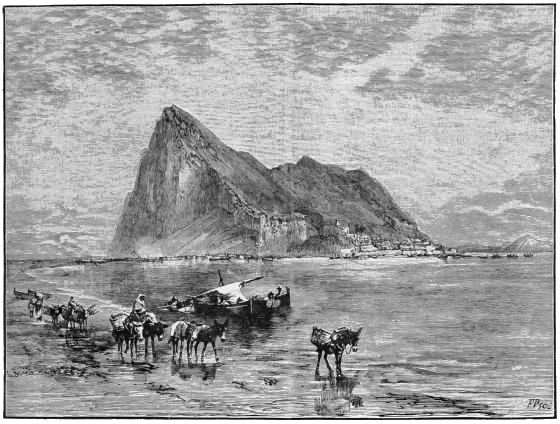
GIBRALTAR.
[See larger version]
Scarcely were the elections over when a strike took place amongst the working cotton-spinners in Manchester. Food was dear, and the rate of wages was not in any proportion to the dearness. The men who turned out paraded the streets, and, as is generally too much the spirit of strikes, endeavoured forcibly to compel the workmen of other factories to cease working too. The magistrates, on the 1st of September, issued a proclamation, that they were determined to resist such attempts, and to punish the offenders. Sir John Byng, the same who had favoured the endeavours of Oliver in Yorkshire, commanded the forces there, and every precaution was taken to secure the factories still in work. On the very next day the spinners were joined by a great mob from Stockport, and they endeavoured to break into Gray's mill, in Ancoat's Lane, and force the men to cease. But there was a party of soldiers placed within in expectation of the attack, and they fired on the assailants, and killed one man and wounded two others. The troops then dispersed the mob, which was said to have amounted to at least thirty thousand men. This ended the strike and the rioting for the time. The coroner's jury pronounced the death of the man justifiable homicide, and Ministers congratulated themselves on the speedy end of the disturbance. But the elements of fresh ones were rife in the same districts. The country was by no means in the prosperous condition that they had represented it.
In the autumn the great Congress of Sovereigns assembled at Aix-la-Chapelle. We have already anticipated their chief object—the final evacuation of France by the Allied troops, and the settlement of compensations. They assembled about the middle of September, and remained together till the middle of November. Their business conferences, however, did not commence till the 30th of September. With regard to the evacuation of France, we need only state that it was greatly promoted by the exertions of the Duke of Wellington. Robert Owen was there to endeavour to enlist the Sovereigns in his schemes of social reform, but did not make any proselytes amongst the crowned heads, though the Czar Alexander told him he fully entered into his views, as he was generally accustomed to tell all reformers and religious professors, leaving them in the pleasing delusion that they had won him to their opinions. Clarkson was there to engage them to sanction the suppression of the slave trade, but with as indifferent a result. This was the closing scene of the great European drama, which opened with the French Revolution and terminated with the capture of Buonaparte. The Congress of Aix-la-Chapelle may be regarded as the recital of the epilogue.
The year 1818 did not close without one more brush of war. This was in India. There had not been much quiet, even after the destruction of Tippoo Sultan and the power of Mysore. When the Earl of Moira (afterwards Marquis of Hastings) succeeded, as Governor-General, to Earl Minto, in 1813, he found the country still disturbed in different directions, particularly on the north-west frontiers. The Burmese engaged his immediate attention, and then the Nepaulese, who were not quietened till after two campaigns. But there was a far more troublesome enemy than either of these in the field. These were the Pindarrees, a multitude of horsemen made up of the scum of Hindostan—men who had either lost caste, or never had any—who formed themselves into flying bands, and with the swiftness of the wind rushed down on the cultivated districts, and swept all before them—cattle, sheep, money, jewels, everything that could be made prey of. The two most celebrated chiefs of the Pindarrees were Kureem and Cheetoo, but Cheetoo managed to put down Kureem, and became the one great and formidable head of these robbers. In 1811 he rode at the head of twenty-five thousand cavalry. In 1814, whilst our troops were engaged in Nepaul, the Pindarrees, under Cheetoo, crossed the Nerbudda, the Godavery, and advanced to the Kistnah, ravaging the whole of the Deccan and the neighbouring territories; and in spite of our forces under Major Frazer in one direction, and Colonel Doveton in another, they effected their retreat across the Nerbudda again, loaded with enormous booty. In 1816 they made a still more extensive incursion, ten thousand of them descending into the Madras Presidency as far as Guntoor, and though Colonel Doveton exerted himself to come up with them, it was in vain. In twelve days Cheetoo's marauders had plundered three hundred and ninety villages in the Company's territory, put to death one hundred and eighty-two people, wounded five hundred and five, and tortured in various ways three thousand six hundred.
It was now found that our pretended Mahratta allies, the Peishwa, Scindiah, and other chiefs, were in league with Cheetoo, and unless this conspiracy were broken the most fearful devastations might be expected on our states. The Governor-General represented this to the authorities at home, and recommended that the Pindarrees should be regularly hunted down and destroyed. In the course of 1816 he received full authority to execute this scheme. At the end of October he posted Lieutenant-Colonel Walker along the southern bank of the Nerbudda, to prevent the Pindarrees from crossing into the Company's territories; but as the line of river thus to be guarded was one hundred and fifty miles in length, the force employed was found insufficient against such adroit and rapid enemies. In November Cheetoo dashed across the river between Lieutenant-Colonel Walker's posts, and his forces dividing, one part made a rapid gallop through forests, and over rivers and mountains, right across the continent, into the district of Ganjam, in the northern Circars, hoping to reach Juggernaut and plunder the temple of its enormous wealth. But this division was met with in Ganjam by the Company's troops, and driven back with severe loss. The other division descended into the Deccan, as far as Beeder, where it again divided: one portion being met with by Major Macdonald, who had marched from Hyderabad, was completely cut up, though it was six thousand strong. The other body struck westward into Konkan, under a chief named Sheik Dulloo, and then, turning north, plundered all the western coast, and escaped with the booty beyond the Nerbudda, though not without some loss at the hands of the British troops on that river.
As it was now clearly useless to endeavour to prevent these desperate hordes from crossing the Nerbudda, it was determined to march into their own retreats beyond that river, and regularly hunt them down. Sir John Malcolm, one of our ablest officers, who has left us a most graphic account of these transactions, had just now returned from England, and he was appointed, with Major-General Marshall, to this service. Not only Cheetoo, but Kureem, was again on foot; and Sir John learnt that Cheetoo was posted near the camp of the Holkar Mahrattas, and had received a lac and sixty thousand rupees from the Peishwa. By this time he had advanced as far as Agra, but on this information he fell back on Oojein, where Sir Thomas Hislop lay with another body of troops. On the 21st of December, 1817, Holkar's army and Cheetoo's army made a united attack on the British at Mahidpore, on the banks of the Seepra. They were received with a murderous slaughter, and fled, leaving seventy pieces of artillery, all they had, and a great quantity of arms. They fled in confusion to Rampoora, a fortified town in Malwa. The British on their part had suffered severely, having one hundred and seventy-four killed, and six hundred and four wounded. Amongst these were thirty-five officers wounded, half of them severely.
Sir John Malcolm and Captain Grant pursued the fugitives along the banks of the Seepra, killing numbers, and seizing immense booty, including elephants and numerous camels. He left them no time to reassemble, but advanced rapidly on the capital of Holkar, joined by reinforcements from the Bombay army under Major-General Sir William Keir. Alarmed at this vigorous action, the Holkar Mahrattas hastily concluded peace, gave up all their forts, and placed their territories under British protection. Some Pathan chiefs attempted to resist, trusting to the defences of Rampoora; but General Brown soon stormed that place, and the whole country of the Holkar Mahrattas was reduced to obedience. No respite was granted to the Pindarrees. Cheetoo was followed from place to place by the Gujerat army under Sir William Keir, and sought refuge in vain amongst the hills and jungles of Malwa and along the Nerbudda. At length, in January, 1818, Cheetoo's last camp was surprised and cut to pieces. After seeking refuge amongst various tribes, Cheetoo was ultimately found in the jungle near the fort of Aseerghur, torn to pieces by a tiger, his horse grazing not far off, safe, and a bag on his saddle containing his remaining jewels and two hundred and fifty rupees. And thus ended the existence of the long formidable hosts of the Pindarrees.
Whilst this extirpation of the Pindarrees had been going on, the cholera broke out at Jessore, in the low lands of the Delta of the Ganges. This fatal disease has been supposed by medical men to receive its force, if not its origin, from the want of salt in this unhealthy district. Salt being one of the monopolies of the East India Company, it was not permitted, though abundant in Madras, to be carried into Bengal except on payment of a duty of two hundred per cent. The natives, therefore, who subsisted on a rice diet, not being able to procure this necessary antiseptic, frequently fell victims to the terrible scourge of cholera. From this centre, where it may fairly be said to have raged in perpetuity, it now spread rapidly up the course of the Ganges, the Jumna, and their confluent rivers, and if the British impost on salt had anything to do with the prevalence of the epidemic, a severe retribution now fell upon those who profited by it. The Marquis of Hastings, the Governor-General, was posted in Bundelcund with his army, when it appeared there and swept away thousands. The very men attending on the Governor-General at dinner dropped down behind his chair and died. To seek a healthier region, he marched eastward, but all the way the pest pursued him, and when he reached the healthy station of Erich, on the right bank of the Betwah river, towards the end of November, one-tenth of the force had fallen under its ravages. The scourge did not stop there, but for a number of years continued to spread at an amazing speed, and eventually overspread Europe with its horrors.
During the time that Malcolm, Keir, Hislop, and other officers were running down the Pindarrees, Major-General Smith, who had received reinforcements at Poonah, was performing the same service against Bajee Rao, the Peishwa who had furnished Cheetoo with funds. He marched from Poonah at the end of November, 1817, accompanied by Mr. Mountstuart Elphinstone. They encountered the army of the Peishwa on the Kistnah, where his general, Gokla, had posted himself strongly in a ghaut. The pass was speedily cleared, and the army of the Peishwa made a rapid retreat. The chase was continued from place to place, the Peishwa dodging about in an extraordinary manner, till, at length, he managed to get behind General Smith, and, passing between Poonah and Seroor, he was joined by his favourite Trimbukjee, whom he had long lost sight of, with strong reinforcements of both horse and infantry. General Smith, so soon as he could discover the route of the Peishwa, pursued it, but soon after the Mahrattas showed themselves again in the vicinity of Poonah. To secure that city from the Peishwa's arms, Captain F. F. Staunton was dispatched from Seroor on the last day of the year with six hundred sepoys, three hundred horse, and two six-pounders; but he was not able to reach Poonah. The very next day, the 1st of January, 1818, he found his way barred by the whole army of the Peishwa, consisting of twenty thousand horse and several thousand foot. Could they have remained a little longer, General Smith, who was on the track of the Peishwa, would have been up to support them. But in the night of the 2nd of January, having no provisions, Staunton fell back, carrying with him all his wounded and his guns, and reached Seroor by nine o'clock on the morning of the 3rd of January.
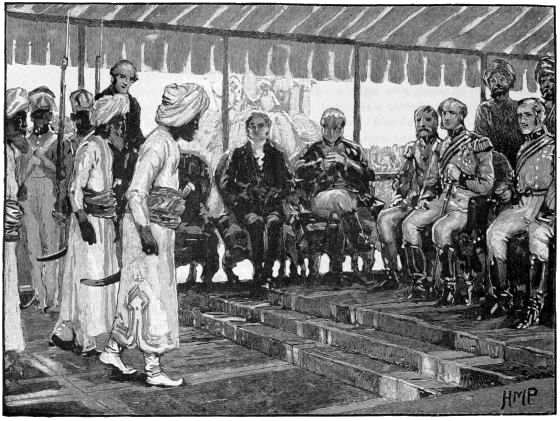
SURRENDER OF THE PEISHWA. (See p. 141.)
[See larger version]
That very day General Smith reached Corregaum in force, and at this apparition the Peishwa fled back towards the sources of the Kistnah, whence he had descended. Not only General Smith, but Brigadier-General Pritzler and Colonel Boles kept up the pursuit, advancing from different quarters, as the slippery Mahratta chief turned and manœuvred. At length weary of the chase, they determined to reduce Satara, his capital, and then each of his strong forts and towns one after another, thus depriving him of supplies, and leaving him no place of refuge or subsistence. Satara surrendered to General Smith on the 10th of February, the same day that he appeared before it. As one place after another fell, Gokla, the Peishwa's general, made an effort to arrest this process of reduction, and this enabled General Smith to attack him on the 20th of February, at Ashtee, where he completely routed him. Gokla himself was killed, and the Peishwa only escaped by abandoning his palanquin and mounting a horse. General Smith and Lieutenant Warrand were wounded, but not a man was killed on the British side. Great booty was taken, including twelve elephants and fifty-seven camels.
The remnant of the Mahratta army fled northwards, pursued and continually reduced by the British. At the same time the reduction of the towns and forts was steadily going on, and every day the fugitive Peishwa became more and more involved in the toils of his enemies. He endeavoured to escape into Nagpore, but on the banks of the Wurda he was met, on the 1st of April, by Colonel Scott and driven back, only to fall into the hands of Colonel Adams, who attacked him near Soonee with only one regiment of native cavalry and some horse artillery, and gave him a thorough defeat, taking five guns, three elephants, and two hundred camels. More than a thousand Mahrattas fell, and the Peishwa himself narrowly escaped, his palanquin, which he had abandoned, being found shot through. Bajee Rao now endeavoured to get to the north-east into Malwa, but he was stopped by General Sir Thomas Hislop, who was advancing from that quarter towards the Deccan. At length, his forces dispersed, his towns in possession of the British, his way on all sides cut off, the Peishwa came in and surrendered himself to Sir John Malcolm, on the 3rd of June, 1818, on promise of good treatment. Sir John granted him eight lacs of rupees per annum, on condition that he resigned the title of Peishwa for ever, and surrendered all his possessions. This was confirmed by the Supreme Government at Calcutta. Thus was the existence of the Pindarrees, and the power of the Mahrattas, broken up, and the Rajah of Satara restored. He was a minor, but on reaching the age of twenty-one, which was in the year 1821, he was invested with the government of his dominions. These included a district of about eleven thousand square miles, and produced a net revenue of fifteen million rupees. Out of this, however, three lacs per annum were reserved for chiefs who had become subjects of the Company, and three more lacs were alienated. As for Trimbukjee, whose crimes and murders had determined the British to secure him at any cost, he was discovered, after a long quest, in the neighbourhood of Nassick, by Captain Swanston, and carried to Tannah, the prison from which he had escaped. He was thence transferred to Calcutta, and finally to the rock of Chunar, near Benares. The last success of this war was the reduction of the fortress of Aseerghur, one of the most formidable strongholds in India, which had undergone some most arduous sieges.
None of the princes who accepted our protection benefited more than Scindiah. He was relieved from the insolence of haughty military chieftains, who commanded his armies, and left him as little free will as they left to his subjects quiet possession of their property. He was enabled to disband his vast armies, and reduce them to thirteen thousand infantry and nine thousand horse. His disbanded soldiers returned home, and became tillers of the land lately running into jungle, by which, and other influences of peace, his revenue was nearly doubled. All the districts wrested from him by the Pindarrees were restored to him; he lost only the mischievous fortress of Aseerghur. Sir John Malcolm cleared the country of the swarms of Arabs, and of Mekranees from Beluchistan, who had acquired a most formidable ascendency in the armies of the Indian chiefs; and these chiefs were informed that again to employ these mercenary ruffians, or to allow them to remain on their territories, would be regarded as a declaration of hostility by the British Government. Similar changes were introduced into the territories of the dethroned Peishwa by the Honourable Mountstuart Elphinstone, who resided at Poonah; and by the conquest of the Poonah territory, by the treaty of Mundissoor, made by Sir John Malcolm after his great victory at Mahidpore, and by exchanges made with the Guicowar of Baroda, and other arrangements, the British dominions were now linked together in one broad and continuous expanse, from Calcutta to Bombay, and from Bombay to Madras, as by the former Mahratta war they had been established between Madras and Calcutta.
If we were to believe figures, and the returns of exports and imports, and of duties paid, we must set down the opening of the year 1819 as considerably prosperous. This was the view which Ministers took of the condition of Great Britain when they met the new Parliament on the 14th of January. The speculations that had been carried on during 1818 had swelled the revenue, and given an impression of growing commerce, which unfortunately did not exist. The results of these speculations in imports of raw material, especially of cotton, and in extensive exports of manufactures to countries not yet sufficiently reinvigorated to purchase, had produced numerous and heavy failures during the latter part of the past year, and these still continued, in strange contrast to the self-congratulating language of Ministers. In nothing was the fall of price so great as in cotton, and those who had bought largely suffered in proportion. These bankruptcies were not confined to Great Britain; they extended to New York, and to southern ports of the United States, where the same speculation had been going on largely.
Besides the flattering assurances of the steady improvement in commerce and manufactures, and, consequently, in the revenues, the Regent's Speech, read, as usual, by the Lord Chancellor, justly congratulated the country on the successful termination of the Pindarree war by the Marquis of Hastings. It informed the two Houses that a new treaty had been entered into with the United States for adjusting the different points at issue between the two nations, not settled by the treaty of peace, and also for regulating the commerce between them. It announced the results of the Congress at Aix-la-Chapelle, and stated that some new measures were needed for the care of his Majesty's person in consequence of the death of the queen. The Address, in both Houses, was carried almost pro formâ. Mr. Manners Sutton was elected Speaker of the Commons by acclamation.
The new arrangements for the care of the king's person came on first for discussion. On the 25th of January Lord Liverpool introduced a Bill to make the Duke of York guardian of his Majesty's person in place of the late queen. This question was decided with little debate. On the 4th of February a message was brought down from the Regent informing the House of Commons that, in consequence of the demise of her Majesty, fifty-eight thousand pounds became disposable for the general purposes of the Civil List; and recommending that the claims of her late Majesty's servants to the liberality of the House should be considered. Lord Castlereagh moved that the House should go into committee on this subject, as, besides the fifty-eight thousand pounds, there was another sum of one hundred thousand pounds, which had been appropriated to the maintenance of the establishment at Windsor. It was understood that Ministers would propose to reduce the sum for the establishment at Windsor to fifty thousand pounds, but that they would recommend that ten thousand pounds, which her Majesty had received in consideration of her charge of the king, should be transferred to the Duke of York. Mr. Tierney objected to the charge of fifty thousand pounds for the maintenance of the establishment at Windsor. He said he could not conceive how this money was to be spent, or on whom, for certainly it could not be on the king, who, he understood, was in that state of mental and bodily debility which made it necessary that as few persons as possible should be about him, and that his regimen was so very simple that it could cost next to nothing.
On the 22nd the Commons went into committee on this subject, and Mr. Tierney then proposed that both the establishment at Windsor and the salary to the Duke of York should be paid out of the Privy Purse or other private funds of the Crown. There was a private property belonging to the Crown of one hundred and forty thousand pounds a year, and surely this was sufficient to defray the charge of the necessary care of the king's person. He reminded the House also of the sums which had been voted for the royal family since 1811. Besides fifty thousand pounds a year set apart for the debts of the Prince Regent, he had a privy purse of sixty thousand pounds a year, besides an additional grant of ten thousand pounds a year made since. The king had also a privy purse of sixty thousand pounds a year, with an additional revenue of ten thousand pounds from the Duchy of Lancaster. Surely, out of all these sums, there must be ample means of taking care of the king's person. To all these second statements Mr. Peel—afterwards the Sir Robert who began his political career in the ranks of high Toryism—replied that the Duke of York would accept no salary which came from the Privy Purse, and he quoted Sheridan and Adam, old friends of the Prince Regent, and staunch Whigs, who had zealously advocated the sacredness of the Privy Purse. When the vote was taken for the disposal of the sum for the Windsor establishment, it was carried by two hundred and eighty against one hundred and eighty-six, a sufficient proof that in the new Parliament the Government possessed a strong majority. On the 25th the proposal to confer on the Duke of York ten thousand pounds per annum, for this charge of his own father's person, was also carried by a still larger majority—two hundred and forty-seven against one hundred and thirty-seven. In the debate, Denman and Brougham opposed the vote, and Canning supported it. In the House of Peers Lords Grey, Lansdowne, and other Whig peers opposed the vote of the ten thousand pounds to the Duke of York. And truly, in private life, it would not have seemed very filial conduct for a man, already possessing a large income, to require a great annual payment for discharging the simple duty of seeing that his aged father, a gentleman also of ample means, was well looked after.
A great portion of the present Session was occupied with discussing the return to cash payments, which, by the Act of Parliament, ought to take place on the 5th of July of this year. It appears that no less than fifty debates and conversations in both Houses took place on this important subject during the Session. Very soon after the meeting of Parliament a secret committee of each House was appointed to inquire into the state of the Bank. These committees were, however, so managed, by delivering to the members lists of suitable persons for such committees, that scarcely any but Ministerial men were voted, though these votes were given by ballot. In the Commons this result was so evident that the Opposition declined to vote at all. The first reports of the committees went rather to close more strictly than to open the issue of gold by the Bank. It had been paying in gold its notes issued previous to January, 1817. This payment it was proposed to stop, as, at present, evidently injurious to the interests of the country. Mr. Peel, on moving for a Bill for this purpose, stated that the gold at the present price was fast finding its way abroad, and was as rapidly absorbed in re-minting a gold coinage for France. It appeared that during the first half of 1818 gold to the value of no less than one hundred and twenty-eight million francs had been coined at the French mint, of which three-fourths were derived from the gold coinage of England. A Bill was accordingly passed to stop payment altogether in gold till the necessary preparations were made by a fresh Bill. Still, the condition of the Bank was represented as flourishing. Its liabilities were stated in January, 1819, as amounting to thirty-three million eight hundred and ninety-four thousand five hundred and eighty pounds; its assets, including the debt due from Government, fifty-three million seven hundred and eighty-three thousand seven hundred pounds. The total Bank surplus appeared to be nineteen million eight hundred and eighty-nine thousand one hundred and twenty pounds; and its surplus, independent of the Government debt, and therefore available for current use, was five million two hundred and two thousand three hundred and twenty pounds. The committees adopted the scheme broached by Mr. Ricardo in his "Proposals for an Economical and Secure Currency," published in 1816. This was that the Bank, in the first instance, should not pay for its notes in gold coin, but in ingots of a certain weight, its fineness being attested by a stamp; and this degree of purity should be regulated from time to time till the gold descended to the Mint price of three pounds seventeen shillings and tenpence-halfpenny per ounce. When the Mint gold at length reached this rate of value, then the payment in coin was to be begun. Resolutions to this effect were moved by the Earl of Harrowby on the 21st of May, and they received the approval, not only of the Ministerial side, but of the leading Opposition members, Lords Grenville, Lansdowne, and King.
In the House of Commons similar resolutions were moved on the 24th by Mr. Robert Peel, who, on this occasion, made the first of those candid admissions of new views which he afterwards repeated on the question of Catholic Emancipation, and finally on the abolition of the Corn Laws. This eminent statesman, though beginning his career in the ranks of Conservatism, had a mind capable of sacrificing prejudice to truth, though it was certain to procure him much obloquy and opposition from his former colleagues. He now frankly admitted that the evidence produced before the secret committee of the Commons, of which he had been a member, had greatly changed his views regarding the currency since in 1811 he opposed the resolutions of Mr. Horner, the chairman of the Bullion Committee. He now believed the doctrines of Mr. Horner to be mainly sound, and to represent the true nature of our monetary system; and, whilst making this confession, he had only to regret that he was compelled by his convictions to vote in opposition to the opinions of his venerated father. Several modifications were proposed during the debate, but there appeared so much unanimity in the House that no alterations were made, and the resolutions passed without a division. The resolutions were to this effect:—That the restrictions on cash payments should continue till the 1st of May, 1822; that, meanwhile, the House should make provision for the gradual payment of ten millions of the fourteen millions due from the Government to the Bank; that, from the 1st of February, 1820, the Bank should take up its notes in gold ingots, stamped and assayed in quantities of not less than sixty ounces, and at a rate of eighty-one shillings per ounce. After the 1st of October of the same year the rate of gold should be reduced to seventy-nine shillings and sixpence per ounce; and again on the 1st of May, 1821, the price should be reduced to seventy-seven shillings and tenpence halfpenny per ounce; and at this rate of gold, on the 1st of May, 1822, the Bank should finally commence paying in the gold coin of the realm. Bills to this effect were introduced into both Houses by the Chancellor of the Exchequer and Mr. Peel, and were readily passed; and such was the flourishing condition of the Bank that it did not wait for the full operation of the Act, but commenced paying in coin to any amount on the 1st of May, 1821.
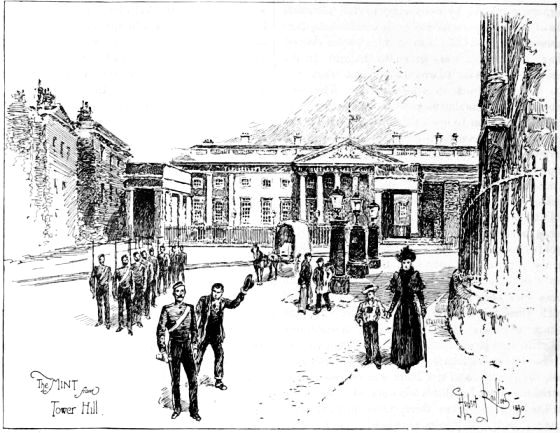
THE MINT, LONDON.
[See larger version]
The select committee of the Commons appointed at the instance of Lord Castlereagh, to inquire into the state of the national income and expenditure, now presented its report on the 3rd of June, and it was agreed to. The Chancellor of the Exchequer stated on its authority that, since 1815, taxation had been reduced eighteen million pounds per annum; that in 1816 the revenue of Great Britain and Ireland had been consolidated, and that, at that time, the interest of the Debt of Ireland, including the Sinking Fund provided for its reduction, exceeded the entire revenue of that part of the United Kingdom by one million nine hundred thousand pounds. He then announced that supplies for the present year would be required to the amount of twenty million five hundred thousand pounds; that the existing revenue would only furnish seven million pounds towards this; and that it would be necessary to have recourse to the Sinking Fund to make up the deficiency of thirteen million five hundred thousand pounds. This Sinking Fund was fifteen million five hundred thousand pounds, so that it would leave only two million pounds; but as it was necessary to have a tolerable surplus in hand to meet exigencies, it was proposed to raise this reserve fund to five million pounds by fresh taxes to the amount of three million pounds.
On this basis Mr. Vansittart, the Chancellor of the Exchequer, on the 9th of June, produced his Budget. Including the interest on the Debt, the whole annual expenditure amounted to seventy-six million, seventy-four thousand pounds—an ominous peace expenditure. Instead, therefore, of the supplies, aided by the draft from the Sinking Fund, leaving a surplus of two million pounds, a fresh loan of twelve million pounds—besides the three million pounds of new taxes on malt, tobacco, coffee, cocoa, tea, British spirits, pepper, and foreign wool was needed. By the hocus-pocus of Exchequer accounts this was made to look like a reduction of the Debt instead of an increase of it; but the country saw with dismay that three years after the peace the incubus of past war was still adding to its burden. Mr. Tierney, on the 18th, moved for a committee to inquire into the state of the nation, but this was negatived by three hundred and fifty-seven votes against one hundred and seventy-eight; and a motion of Sir Henry Parnell on the 1st of July for extensive retrenchments was got rid of in the same manner.
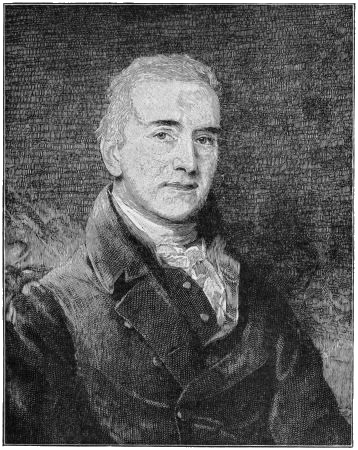
SIR SAMUEL ROMILLY.
[See larger version]
But amid the discouragements of monetary legislation, which showed that it would require a determined contest to compel Ministers to retrench, there were symptoms of a spirit of legal and social reform amongst Parliamentary men generally which augured the approach of better times. Mr. Sturges Bourne obtained the passing of his long-advocated Poor Law Bill; but Bills for regulating settlements, and for preventing the misapplication of the poor rates, were thrown out. A Bill was passed to regulate the treatment of children in cotton factories, and to limit the hours of their employment. Mr. Brougham's Act for inquiry into the charitable foundations of England was extended, with the support of Government, so as to apply to educational as well as to all kinds of charities, except such as had special visitors, or were maintained by private subscriptions. Sir James Mackintosh also took up the humane track of labour occupied so nobly by the late Sir Samuel Romilly. On the 2nd of March he moved for the appointment of a select committee to take into consideration the subject of capital punishment as regarded felonies. This was eminently needed, for the penal laws during the reign of George III. were truly Draconian. Notwithstanding a strong opposition by Ministers, the motion was carried, amid much cheering, and on the 6th of July Sir James Mackintosh introduced the report, which was ordered to be printed. Government, as if to wipe out their disgrace in resisting so humane a measure, now proposed an inquiry into the condition of gaols and other places of confinement, and into the best method of employing and reforming delinquents during their imprisonment. Some reforms were made in Scottish law. The old rights of trial by battle, and of appeals of murder, felony, or mayhem, were abolished as rendered unnecessary by the full exercise of the institution of jury, and as belonging only to a barbarous age. The severity of the Scottish law against duels was mitigated, that law pronouncing forfeiture of all movable property, and banishment against all persons sending, or even carrying, a challenge to fight a duel. The principle of that law was sound, but its severity was its own defeat. A more questionable Bill was one carried, after much opposition, called the Foreign Enlistment Bill, which was intended to check the aid of Englishmen in assisting the Spanish South American colonists in throwing off the oppressive government of the mother country. Numbers of Englishmen were engaged on the side of independence, and this Bill was vainly intended to put an end to that generous aid.
The Scottish burgh question was brought forward again this Session. The magistrates of the burgh of Aberdeen having been elected, in 1817, in the same corrupt manner as those of Montrose had been in 1816, the Court of Session had declared the election illegal. The burgh of Montrose was found to have been disfranchised; but this was not the case with Aberdeen, and the magistrates applied to Government to grant a warrant for a new election, or rather a re-election of themselves. This the Government, in the face of the decision of the Court of Session, as well as of a numerously signed petition from the burgesses praying that the election should be by open poll, issued. On the 1st of April Lord Archibald Hamilton moved an address to the Prince Regent, praying for a copy of this warrant. It was strenuously resisted by Ministers, but the motion was lost by only a small majority. On the 6th of May Lord Archibald Hamilton renewed his motion in another form—namely, that the petitions which had been presented from Scottish burghs on the subject of Reform should be submitted to a committee of inquiry. He showed that out of sixty-six royal burghs thirty-nine had voted for Reform; that these thirty-nine contained a population of four hundred and twenty thousand souls, whilst the remaining twenty-seven contained only sixty thousand. The preponderance was so great that, in spite of the opposition of Ministers, the House took another view of the matter, and Lord Archibald's motion was carried, though only by one hundred and forty-nine votes against one hundred and forty-four.
The question of Catholic Emancipation was brought forward on the 3rd of May, by Grattan: it was the last time that he did so, but he had the satisfaction of seeing that the question was rapidly advancing, for it was lost by only two votes. A fortnight afterwards Lord Donoughmore introduced a similar motion, in the hope of surmounting this small difference, but, after a long debate, he found the majority increased against it by thirty-nine votes. The closing contest of the Session was for Parliamentary Reform. Sir Francis Burdett brought on his annual motion, on the 1st of July, for the eighteenth time, but was defeated by one hundred and fifty-three votes against fifty-eight. He was seconded by Mr. George Lamb, younger brother of Lord Melbourne, who, however, did not go the length of annual parliaments and universal suffrage. Even at that day, Joseph Hume was for moderate reform, and Lord John Russell was alarmed at anything further than Triennial Parliaments, and the transferring the franchise from certain corrupt boroughs to others not yet represented. Such were the feeble ideas of Reform amongst its self-constituted leaders. Parliament was prorogued, on the 13th of July, by the Prince Regent in person.
During this first Session of the new Parliament Ministers had carried matters with a high hand, imagining that they had a majority which would enable them to resist popular opinion, as they had done since the conclusion of the war. But the progress of the Session did not warrant this conclusion. They were defeated in several very important contests, and before the Session came to an end were made to feel that they had greatly declined in public confidence. In the severe debate of the 18th of May, on the motion of Mr. Tierney for a Committee of Inquiry into the state of the nation, they had a majority of more than two to one. But this was very different on the 3rd of June, when they only carried their Foreign Enlistment Bill by a majority of thirteen. On the question of the resumption of cash payments, the conversion of Mr. Peel to the principles of Horner was a rude shock to the Cabinet, and shrewd men prognosticated that, the entire system of Mr. Vansittart being thus overturned, he must retire. Then came not merely partial conversions, or near approaches to defeat, but actual defeats. Such were those on Sir James Mackintosh's motion for inquiry into the criminal laws, and on Lord Archibald Hamilton's for Scottish burgh Reform. The question of Catholic Emancipation had approached to a crisis, and a majority of only two against it was, in truth, a real defeat. The consequence was that the conviction of the insecurity of Ministers was not only shared by men of impartial judgment, but by themselves. Towards the end of the Session Lord Liverpool himself was found writing to a friend, that unless the measure for the return to cash payments raised the confidence of the public in them, they must soon go out:—"I am quite satisfied that, if we cannot carry what has been proposed, it is far better for the country that we should cease to be a government. After the defeats we have already experienced during this Session, our remaining in office is a positive evil. It confounds all ideas of government in the minds of men. It disgraces us personally, and renders us less capable every day of being of any real service to the country, either now or hereafter. If, therefore, things are to remain as they are, I am quite sure that there is no advantage, in any way, in our being the persons to carry on the public service. A strong and decisive effort can alone redeem our character and credit, and is as necessary for the country as it is for ourselves."
This appeal did something to strengthen them, but not permanently. The fact that Parliament might terminate any day from the death of the king did much to keep members in remembrance of their constituents; but the great cause of Ministerial decay of popularity was that the circumstance and spirit of the times demanded more liberal legislation than such men as Liverpool, Sidmouth, and Eldon could comprehend, much less originate. The manufacturing districts were especially in a depressed condition. The efforts which had been made to force a trade had failed. The excessive exportation of manufactured goods had resulted exactly as Brougham had prognosticated: the foreign markets had been glutted before the people were capable of buying, and the fall in prices had been ruinous. The equally great importation of raw material to continue the supply of fabrics for which the demand was inadequate, had made matters worse. The bankruptcies during the first half of this year were double the average number, credit was severely shaken, and numbers of workmen were thrown out of employment or reduced to very low wages. Wheat, though not so high as a year or two ago, averaged eighty shillings per quarter. The consequence was a renewed political action, and meetings were called by the workmen in various parts of the manufacturing districts to consider both their unsatisfactory position and the governmental as well as commercial causes of it. The Corn Laws were justly denounced as one potent cause of their sufferings, and the popular leaders of Reform were called upon to assist them in getting rid of it. So early as the 18th of January a meeting of this character was held at Manchester. Application had been made to the borough-reeve to summon a meeting to petition Parliament for this object, but he declined, the Manchester authorities of that day standing strangely aloof from the people in their endeavours for relief from this enactment, which was as inimical to their own interests as manufacturers, as it was to the comfort of their work-people.
Refused in this quarter, the people proceeded to hold a meeting without such sanction, and invited Mr. "Orator" Hunt to go down and take the chair. Perhaps they could not have selected a more unsafe guide on the occasion, for personal vanity was Hunt's besetting sin. Hunt, instead of encouraging the very constitutional object of the meeting—to petition Parliament for the repeal of the obnoxious law—treated the petitioning that House as ridiculous, and persuaded the excited people to put their sentiments into the form of a remonstrance to the Prince Regent. The meeting then dispersed quietly; but Hunt found occasion to keep himself in the public eye there a little longer. Some officers of the 7th Hussars, who were posted at Manchester, treated him rudely as he appeared at the theatre, asserting that when "God Save the King" was called for, he hissed. Whether he did so or not, the conduct of the officers answered his purpose of making political capital; he wrote to the Commander-in-Chief, the Duke of York, and then sent his letter to the newspapers. Still more, he wrote to Samuel Bamford to support him in a scheme which was particularly calculated to produce riot and bloodshed, and in this case Bamford did not exercise his usual good sense. At Hunt's suggestion—to select a dozen stout fellows, and appear on the evening of the following Monday in the pit of the theatre, armed with stout cudgels, to inflict a summary chastisement on the officers in case of a second demonstration of their feelings—Bamford appeared at the time appointed with ten stout, picked fellows, with knotty cudgels, marching along the streets to the theatre. The object was immediately perceived by the people, who crowded to the door of the theatre, completely filling the space in front. But the manager was too prudent to open his theatre in such circumstances. He announced that there would be no performance that evening. Hunt was, therefore, disappointed of a catastrophe in the theatre; but he drove up in a carriage, mounted the box, and addressed the crowd in very exciting tones, declaring that the magistrates desired nothing so much as an opportunity of letting loose the bloody butchers of Waterloo upon them—meaning the 7th Hussars. It was not his fault that all went off quietly.
In May the gingham-weavers of Carlisle and that neighbourhood held a similar gathering, and in June meetings were held on Hunslet Common, near Leeds, at Glasgow, Ashton-under-Lyne, and other places. The meeting at Glasgow, on the 16th of June, was held on the Green, and amounted to thirty or forty thousand people. They complained of the low wages for cotton-weaving, and proposed a petition to the Prince Regent, praying that he would enable them to get over to Canada, promising that all such as received that favour should repay the outlay by yearly instalments. But the bulk of the assembly protested against emigration, asserting that the remedy for their distresses lay in annual parliaments, universal suffrage, and the consequent reduction of taxation; and they proposed that they should march up to London in a body, and present their petition to the Prince Regent in person. At Ashton the chair was taken by the Rev. Joseph Harrison, and the strange creature called Dr. Healey, of whom Bamford gives an extraordinary account in his "Life of a Radical," made a most wild and seditious harangue. At a great meeting at Stockport, on the 28th of the same month, a very different personage presided. This was Sir Charles Wolseley, of Wolseley Park, in Staffordshire. Sir Charles said that he had been engaged in the outbreak of the French Revolution, and had assisted in the taking of the Bastille, and that he would spend his last drop of blood, if it were necessary, in destroying the Bastilles of his own country. The acquisition of such an advocate of Reform was not likely to be received with apathy. Sir Charles was invited to preside at a similar meeting at New Hall, near Birmingham, on the 12th of July. At this meeting he was elected "legislatorial attorney and representative" for that town. This was a circumstance that excited the alarm of Government. They immediately issued warrants for the apprehension both of Sir Charles and of Dr. Harrison for seditious expressions used at the Stockport meeting. Sir Charles was arrested at his own house, at Wolseley Park; and Harrison was taken on the platform of a public meeting, at Smithfield, in London, on the 21st of July, at which Hunt was presiding. On conveying Harrison to Stockport, the constable who arrested him was attacked by the mob, and a pistol was fired at him, the ball of which lodged in his body.
Circumstances appeared now to be growing serious. Meetings were held in defiance of the strict measures of Government throughout the manufacturing districts; and at Blackburn it was announced at such a gathering, on the 5th of July, that the women had also formed themselves into "Sister Reform Associations," and these called on their own sex everywhere to imitate their example, so as to co-operate with the men, and to instil into the minds of their children a hatred of tyrannical rulers. The men, at the same time, made another advance in the Reform agitation; this was drilling-a movement which gave great alarm to the magistrates of Lancashire, who wrote from various quarters to apprise Government of it. It was a circumstance that might well excite suspicion that something more than Reform was intended. But when it came to be explained by the parties themselves, it turned out to mean nothing more than that the Reformers in the neighbourhood of Manchester were intending to hold a great meeting in order to elect a representative, as the people of Birmingham had done, and that they wished to assemble in the utmost order and quiet. But the very means employed by them to avoid confusion, and enable them to meet and disperse with decorum, were just those most calculated to excite the fears of a magistracy and Ministry already suspicious.
The great meeting had been intended to take place on the 9th of August; and on the 31st of July an advertisement appeared in the Manchester Observer calling on the inhabitants to meet on the 9th in the area near St. Peter's Church for the purpose of electing a representative to Parliament, as well as for adopting Major Cartwright's plan of Parliamentary Reform. This immediately drew from the magistrates a notice that such a meeting would be illegal, and that those who attended it would do so at their peril. The working men on this announced that the meeting would not take place, and a requisition was presented to the borough-reeve and constables, requesting leave to hold such a meeting. It was refused; and on its refusal the people proceeded with their original design, only appointing the 16th as the day of meeting, with Hunt in the chair.
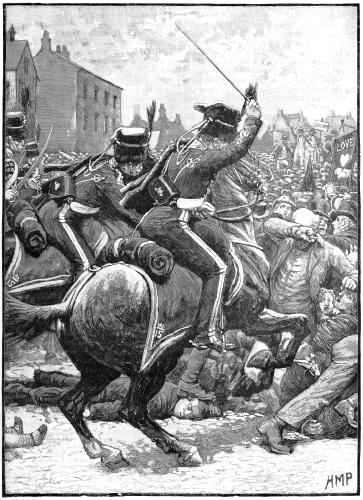
THE PETERLOO MASSACRE: HUSSARS CHARGING THE PEOPLE. (See p. 151.)
[See larger version]
This was taking a bold step in defiance of the authorities, and orderly and peaceable conduct was, more than ever, necessary. On the morning of the day proposed there was little appearance of any stir amongst the artisans of the town, and it does not seem that they took any or much part in the assembly, but that it was made up of the parties marching in from the country and towns around. During the forenoon of this day, Monday, the 16th of August, large bodies came marching in from every quarter, so that by twelve o'clock it was calculated that eighty or a hundred thousand such people were congregated in and around the open space designated. Some of them had disregarded the injunctions of the general committee, and had gone extensively armed with sticks. Bamford soon heard that his eccentric friend, called "the quacking" Dr. Healey, of whom his narrative gives some ludicrous recitals, had headed the band from Lees and Saddleworth, with a black flag borne behind him, on which stared out in great white letters, "Equal Representation or Death" on the one side, and on the other, "Love," with a heart and two clasped hands—but all white on their black ground, looking most sepulchral and hideous. Presently loud shouts indicated that Hunt was approaching, who came, preceded by a band of music, seated in an open barouche, with a number of gentlemen, and on the box a woman, who, it appeared, had been hoisted up there by the crowd, as the carriage passed through it.
The platform for the chairman and speakers consisted of a couple of waggons boarded over, and Hunt and his friends had some difficulty in reaching it through the dense crowd, the attendant bands continuing to play "God Save the King," and "Rule Britannia," till they were safely placed on the platform, when the music ceased, and Hunt, having been called to the chair, took off his white hat, and was commencing his address, when there was a strange movement in the throng, and a cry, "The soldiers are upon us!" and this was the fact. The magistrates had met in great numbers on the previous Saturday, and had determined to seize the ringleaders; but instead of doing this as they might have done, at their several localities when drilling, or on their way to the town, they left this to be done after these vast numbers were assembled, and by the aid of the soldiers, which was certain to produce serious consequences. We have the statements of these magistrates themselves, as laid before Parliament, and of Sir William Jolliffe, M.P., lieutenant of the 15th Hussars, and personally engaged on the occasion. The reason assigned by them was, that they waited to see "what the complexion of the meeting might be;" but, if this was the case, they might as well have waited till some disorder took place, which they did not, but sent the soldiers into the crowd, whilst peacefully and in an orderly manner standing to listen to the chairman. Had they waited to the end, they would undoubtedly have seen the immense crowd disappear as quietly as it had come. But the magistrates were clearly excited by their fears. They had assembled a great constabulary and military force. Two hundred special constables had been sworn in; six troops of the 15th Hussars lying in the barracks were held in readiness; a troop of Horse Artillery with two guns; the greater part of the 31st Regiment of Infantry; several companies of the 88th Regiment; the Cheshire Yeomanry, nearly four hundred men, who had ridden in that very morning; and about forty Manchester Yeomanry, chiefly master manufacturers. These were troops enough to storm a town, much more to defend it from an unarmed multitude. The whole of this force, except the Manchester Yeomanry, was put under the command of Colonel L'Estrange, of the 31st Regiment, in the absence of Sir John Byng, the general of the district, but who had his headquarters at Pontefract, and who, it appeared, had received no information of these military preparations, or of the imagined need of them.
We have the accounts of what took place from both sides—from the magistrates and the people. Mr Hulton, the chairman of the bench of magistrates, made the following statements in evidence, on the trial of Hunt, at York. He said that the warrants for the apprehension of the leaders of this movement were not given to Nadin, the chief constable, till after the meeting had assembled, and that he immediately declared that it was impossible for him to execute them without the protection of the military; that orders were at once issued to the commander of the Manchester Yeomanry, and to Colonel L'Estrange, to come to the house where the magistrates sat. The yeomanry arrived first, coming at a quick trot, and so soon as the people saw them they set up a great shout. The yeomanry advanced with drawn swords, and drew up in line before the inn where the magistrates were. They were ordered to advance with the chief constable to the hustings, and support him in executing the warrants. They attempted to do this, but were soon separated one from another in the dense mob, and brought to a stand. In this condition, Sir William Jolliffe also giving evidence, said that he then, for the first time, saw the Manchester troop of yeomanry. They were scattered, singly or in small groups, all over the field, literally hemmed in and wedged into the mob, so that they were powerless either to make an impression, or to escape; and it required only a glance to discover their helpless condition, and the necessity of the hussars being brought to their rescue. The hussars now coming up, were, accordingly, ordered to ride in and disperse the mob. The word "Forward" was given, and the charge was sounded, and the troop dashed in amongst the unarmed crowd. Such a crowd never yet stood a charge of horse. There was a general attempt to fly, but their own numbers prevented them, and a scene of terrible confusion ensued. "People, yeomen, constables," says Sir William Jolliffe, one of these hussars, "in their confused attempts to escape, ran one over another, so that by the time we had arrived at the midst of the field, the fugitives were literally piled up to a considerable elevation above the level of the ground."
Surely, both magistrates and soldiers might now have been satisfied. A defenceless multitude have no means of resistance, and, doing their best to get away, might have been left to do so without further molestation, which would be equally brutal in the magistrates, and cowardly in the soldiers. But neither of these parties seems to have thought so on this unhappy occasion. The magistrates issued no orders to desist, and the soldiers, by the confession of one of their officers, went on striking with the flats of their swords at the impeded people, who were thrown down in their vain efforts to get away, and piled in struggling heaps on the field. Mr. Hulton confessed that he walked away from the window after he had let loose the horse-soldiers on the people. "He would rather not see any advance of the military." He was, in fact, so tender-hearted that he did not mind the people—men, women, and children, met to exercise their political rights—being trodden down under the iron hoofs of horses, and cut down by the sword, so long as he did not see it.
Hunt, and about a dozen of his friends, were seized on the platform. Bamford and some others, who had escaped, were afterwards taken. The streets were then cleared by the infantry. Such was the celebrated Manchester massacre, in which the actual wounds inflicted by the soldiers do not appear to have been many. About seventy people were carried to the infirmaries, or went there, to have their wounds dressed—a considerable number for severe cuts and fractured limbs; and six lives were lost, including a special constable run over by the cavalry, and a Manchester Yeoman, who was struck from his horse by a brickbat, aimed by a man whom he was pursuing.
The Ministers and the Prince Regent, indeed, fully approved of the conduct of these magistrates, and that was to be expected, for neither of these parties ever evinced much sympathy for the people, and consequently received very little regard in return. There was a disposition to rule by the high hand in both the Prince and the Cabinet, which eventually brought them into extreme odium, and warned them that very different times were approaching. On the reassembling of Parliament Lord Sidmouth made the most candid statement of the full and entire approbation of himself and his colleagues of this cruel and dastardly transaction. He said that the news of the event reached town on the Tuesday night; and that it was followed on the Wednesday by two gentlemen from Manchester, one of them a magistrate, to give the Government the most minute particulars regarding it; that a Cabinet Council was immediately summoned, at which the two Manchester gentlemen attended, and entered into the fullest details of all that had taken place; and that the Attorney-General and Solicitor-General, then present, gave it as their opinion that the proceedings were perfectly justified by the necessity of the case. The statement of all particulars was then dispatched to the Prince Regent, who was yachting off Christchurch, and, on the 19th, the Prince replied, by the hand of Sir Benjamin Bloomfield, expressing his "high approbation and commendation of the conduct of the magistrates and civil authorities at Manchester, as well as of the officers and troops, both regular and yeoman cavalry, whose firmness and effectual support of the civil power preserved the peace of the town on that most critical occasion." To most people this appeared to be giving commendation, not for preserving, but for disturbing the peace of the town; but Lord Sidmouth, having received this sanction, addressed letters, on the 21st, to the Lords-Lieutenant of Lancashire and Cheshire, the Earls of Derby and Stamford, requesting them to convey to the magistrates of the two counties, who were present at Manchester on the 16th, "the great satisfaction derived by his Royal Highness from their prompt, decisive, and efficient measures for the preservation of the public tranquillity." Hunt and his confederates were charged with high treason; but, on the circumstances being examined, they were found not to bear out this charge, and Hunt and his friends were indicted only for a treasonable conspiracy; and true bills to the extent of this mitigated charge were proved against Hunt and nine others at the summer assizes for the county of Lancaster.
Great meetings were held in various towns and counties to condemn the whole proceedings, and addresses were sent up and presented to the Prince Regent which were, in fact, censures of his own conduct, and were not, therefore, received in a becoming manner. To one from the Common Council of London he replied that he received it with regret, and that those who drew it up knew little or nothing of the circumstances which preceded or attended the Manchester meeting. The fact was, that they knew these a great deal better than he did. Similar addresses were sent up from Westminster, York, Norwich, Bristol, Liverpool, Birmingham, Leeds, Sheffield, and many other towns. A meeting of the county of York was calculated at twenty thousand persons, and amongst them was the Earl Fitzwilliam, Lord-Lieutenant of the West Riding, who had also signed the requisition to the high-sheriff. For this conduct he was summarily dismissed from his lord-lieutenancy. Scarcely less offence was given by the Duke of Hamilton, Lord-Lieutenant of the county of Lanark, who sent a subscription of fifty pounds to the committee for the relief of the Manchester sufferers, expressing, at the same time, his severe censure of the outrage committed on the 16th of August. Of course, the Ministerial party in town and country did all in their power to counteract this strong and general expression of disapprobation. In Scotland and the North of England the squirearchy got up associations for raising troops of yeomanry, as in direct approval of the savage conduct of the Manchester Yeomanry. In the immediate neighbourhood of the scene of outrage the conflict of opinion between the two parties ran high. Numbers of the Manchester Yeomanry were indicted for cutting and maiming in St. Peter's Field, with intent to kill; but these bills were thrown out by the grand jury at the Lancaster assizes. An inquest at Oldham, on the body of one of the men killed, was also the scene of a fierce and regular conflict for nine days, that was put an end to by an order from the Court of King's Bench. But even men who were accustomed to support Ministers generally were startled by their conduct on this occasion. Mr. Ward, afterwards Lord Dudley and Ward, in one of his letters written from Paris at the time, but not published till a later date, says:—"What do reasonable people think of the Manchester business? I am inclined to suspect that the magistrates were in too great a hurry, and that their loyal zeal, and the nova gloria in armis tempted the yeomanry to too liberal a use of the sabre—in short, that their conduct has given some colour of reason to the complaints and anger of the Jacobins. The approbation of Government was probably given as the supposed price of support from the Tories in that part of the country."
But the Government was, at that juncture, very far from being a wise Government. Parliament was called together on the 23rd of November, and opened by the Prince Regent in person. In his Speech he spoke of the unsettled state of the country, and recommended measures of repression. The Addresses were in the same tone, and they were commented upon with great warmth by the Opposition, and amendments moved. Zealous debates took place in both Houses, especially in the Commons, where the discussion continued two evenings, and till five o'clock on the third morning. The Addresses, however, were carried in the Lords by one hundred and fifty-nine to thirty-four, and in the Commons by three hundred and eighty-one to one hundred and fifty. The Prince Regent sent down a mass of papers to both Houses relating to the condition of the disturbed districts, and a host of Bills, founded on these, were introduced. In the Lords, on the 29th of November, the Lord Chancellor Eldon introduced one in keeping with his alarms, namely, "An Act to prevent delay in the administration of justice in cases of misdemeanour." This was followed by three others, introduced by Lord Sidmouth; one to prevent the training of persons to the use of arms, and to the practice of military evolutions and exercises, another to prevent and punish blasphemous and pernicious libels. Amongst others, Hone was again at work, and ridiculing the despotically-spirited Ministers in his "Political House that Jack Built." The third was to authorise justices of the peace, in certain disturbed counties, to seize and detain arms collected and kept for purposes dangerous to the public peace. These were to continue in force till 1822. Not thinking he had yet done enough, on the 17th of December Lord Sidmouth brought into the Peers another Bill more effectually to prevent seditious meetings and assemblies, which he proposed should continue in force five years. In the Commons, in addition to all this, on the 3rd, Lord Castlereagh had introduced a Bill for imposing stamp duties and other regulations on newspapers, to prevent blasphemous and seditious libels, as if Sidmouth's Bill on that subject had not fettered the press sufficiently. All these Bills were passed, notwithstanding the strongest remonstrances by the Opposition as so many infringements of the Constitution, and they became known as Sidmouth's and Castlereagh's Six Acts.
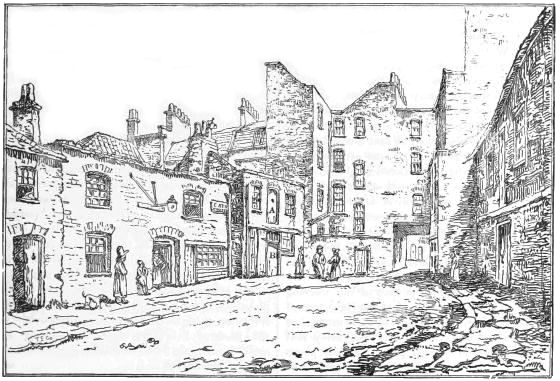
VIEW OF CATO STREET, LONDON, SHOWING THE STABLE AT WHICH THE CONSPIRATORS WERE CAPTURED. A, LOFT; B, STABLE-DOOR. (From a print published in 1820.)
[See larger version]
These enactments, unaccompanied by any others the object of which was to relieve the distress of the people, only tended still more to exasperate the feelings of the working classes. In fact, nothing had been so obvious as the effect of the proceedings of Government of late in disturbing that peace which they professed themselves so desirous to preserve. They, in truth, were the real agitators. The passing of the Six Acts only made the popular resentment the deeper, and whilst this tended to render the more prudent Reformers cautious, it stimulated the lowest and most unprincipled of them to actual and deadly conspiracy. The general conspiracy believed in by Ministers never existed, but a conspiracy was actually on foot in London, which again was found to have been, if not originally excited, yet actively stimulated, by the agents of Government. The details of this transaction, and of the concluding scene of the Manchester outrage, namely, the trial of Hunt and his associates, necessarily lead us about two months beyond the death of George III., which took place on the 29th of January, 1820. In November, 1819, whilst Government were framing their Six Acts, the more completely to coerce the people, they were again sending amongst them incendiaries to urge them to an open breach of the laws in order to furnish justifications for their despotic policy. The leading miscreant of this class was a man named Edwards, who kept a small shop at Eton for the sale of plaster casts. Some of the emissaries appeared at Middleton, the place of Bamford's abode, but he was in prison awaiting his trial with Hunt and the rest, and the people tempted were too cautious to listen to these agents of Government. But in London these agents found more combustible materials, and succeeded in leading into the snare some who had been long ready for any folly or crime. Chief amongst these was Thistlewood, who had been a lieutenant in the army, a man who had, or conceived that he had, suffered injustice at the hands of Ministers, and who had wrought up his temper to the perpetration of some desperate deed. Bamford when in London, in 1816, had found Thistlewood mixed up with the Spenceans, and to be met with any day at their places of resort—the "Cock," in Grafton Street, the "Mulberry Tree," in Moorfields, the "Nag's Head," Carnaby Market, No. 8, Lumber Street, Borough, and a public-house in Spa Fields, called "Merlin's Cave." At these places they might be found, amidst clouds of tobacco-smoke and the fumes of beer, discussing remedies for the miserable condition of the people. At the latter place Thistlewood was often to be found with the Watsons, Preston, and Castles, who was employed to betray them. From this spot they issued for their mad attempt on the Tower on the 2nd of December of that year. Thistlewood was one of those seized on that occasion, but was acquitted on his trial. Not warned by this, he no sooner got abroad than he sent a challenge to Lord Sidmouth, for which he was arrested, and sentenced to a year's imprisonment. He issued from gaol still more embittered against Sidmouth and his colleagues, and resolved on striking some mortal blow at them. He did not lack comrades of a like fiery and abandoned stamp, and they determined on a scheme for cutting off the whole Cabinet together. The detestable deed was to be perpetrated in the autumn of 1819, a time when the public mind, especially that of the working classes, was so embittered against the Government. They did not, however, succeed in their intentions, and it was at this crisis of unwilling delay that the man Edwards became privy to their plans. In November he carried the important, and, as he hoped, to him profitable secret to Sir Herbert Taylor, who was attached to the establishment of the king at Windsor, and by him he was introduced to Lord Sidmouth. This minister and his colleagues, with that fondness for the employment of spies, and for fomenting sedition instead of nipping it in the bud, immediately engaged Edwards, on good pay, to lead forward the conspirators into overt action. It was not enough for them that, by adding another witness or two to Edwards, they would be able to produce the most complete proof of the treason of these men—they rather luxuriated in the nursing of this plot, and thus ripening it into something bloody and horrible; and in this they succeeded.
The Christmas holidays necessarily postponed the plans of the conspirators by the Ministers going out of town, and the deaths of the king and of the Duke of Kent produced further impediments by preventing the regular Cabinet meetings. At one moment the plan appeared to be in jeopardy from the Ministers being in danger of dismissal for their refusal to procure the new king a divorce; but all these hindrances only the more enabled Edwards to ply his arts, and stimulate his victims to their destruction. So thoroughly had he brought them to this point, that, on the 19th of February, they came to the resolution to assassinate the Ministers each at his own house, as they could not get them all together; but at this moment Edwards brought them word that the Ministers were going to have a Cabinet dinner the next day. To make sure, they sent out for a newspaper, and finding that it was so, Thistlewood remarked that as there had not been a Cabinet dinner for a long time, there would be fourteen or sixteen there, and it would be a fine haul to murder them all together. The dinner was to be at the house of Lord Harrowby, and it was planned that one of the conspirators should call with a note, and then the rest should rush in and put the Ministers all to death, and bring away the heads of Sidmouth and Castlereagh in bags provided for that purpose. They were then to fire the cavalry barracks by throwing fire-balls into the straw-sheds, and the people rising, as they hoped, on the spread of the news, they were to take the Bank and the Tower.
The Ministers being duly informed of all, the preparations for the dinner were carried on ostensibly as though nothing was suspected. On the 23rd of February, when the evening had arrived, carriages began to collect about the house of Lord Harrowby, and the scouts who were sent out to see that there were no soldiers or police stationed there, reported all right. But the carriages were driving to the house of the Archbishop of York, which adjoined Lord Harrowby's, and this had deceived the conspirators. The Ministers had remained at home to dine, and then had assembled at Lord Liverpool's to await the news of the result. The police, conducted by the spies, meanwhile reached the rendezvous of the conspirators, which was a stable in Cato Street, near the Edgware Road. The soldiers had orders to be in readiness, and surround the place immediately, and assist in securing the desperadoes. But it seems that the soldiers were not ready at the moment, and on the police entering the stable they found that the conspirators were in the hayloft over it. They were proceeding up the ladder to the loft, and Smithers, one of the police, had just entered it, when Thistlewood, seeing that they were betrayed, stabbed the man to the heart, blew out the light, and made his escape. There was a confused firing of pistols in the dark, and the soldiers coming up, nine of the conspirators were secured, with a quantity of arms and ammunition; but fourteen were said to have succeeded in escaping.
The next morning London was thrown into consternation by the announcement of this conspiracy, and by a reward of one thousand pounds being offered in the Gazette for the apprehension of Thistlewood. He was captured before eight o'clock that morning, whilst in bed, at the house of a comrade, in Moorfields. But his arrest did not diminish the wild alarms which not only seized the capital but the country. This was immediately believed to be only the centre of that universal conspiracy of which Government had taken so much pains to propagate an impression. People everywhere were arming for the defence of their own neighbourhoods, and magistrates and yeomanry were turning out by night to keep watch against a surprise, whilst people in town took great care to lock and barricade their houses against the invisible foe. Thistlewood and nine others were put upon their trial on the 13th of April, and, after a trial of three days, he and eight of them were pronounced guilty, and himself and four of the most desperate were condemned to death; the others were sentenced to transportation for life; but one man, who was proved to have been amongst them without being aware of their object, was pardoned. Thistlewood and the four others were executed on the 1st of May. The next day Alderman Wood moved in the House of Commons for an inquiry into the conduct of Edwards, but it was rejected by a large majority. On the 19th he again returned to the subject, and supported his motion by producing depositions from many persons brought before him as a magistrate, demonstrating, in the plainest manner, that Edwards had recommended to them the murder of Ministers and the destruction of Parliament, had furnished plans for these objects, and had done all in his power to seduce needy men into these measures. He proved, also, from the same depositions, that Edwards himself had been living for six weeks in great affluence in the house of a schoolmaster in St. George's Street, Hanover Square, who was not aware of the occupation of Edwards till the wretch himself informed him of it. Alderman Wood called on Parliament to act on this unquestionable evidence, and purge itself of any sanction of such disgraceful transactions. But Ministers again resisted all inquiry, and their friends openly defended them in the use of such means, even ridiculing Alderman Wood, and those who supported his motion, for supposing that Lord Sidmouth would proceed against Edwards through any depositions furnished by magistrates. The motion was, of course, thrown out.
Before these discussions took place, an attempt had been made by similar means to lead the people of Scotland into insurrection. Emissaries appeared in the towns and villages informing the people that there were preparations made for a general rising, and they were ordered to cease all work and betake themselves to certain places of rendezvous. On the morning of Sunday, the 2nd of April, the walls of Glasgow were found placarded everywhere by a proclamation, ordering all persons to cease labour and turn out for a general revolution. The next morning the magistrates called out the military, and they were drawn up in the streets in readiness for the appearance of an insurrection, but none took place. The people were all in wonder, and assembled to see what would happen; but there appeared not the slightest disposition to make any disorder, and some of the cotton mills were at work as though nothing was expected to take place. But still, the mischief had not altogether failed. Some fifty poor ignorant men had been decoyed out of Glasgow to near Kilsyth, on the assurance that four or five thousand men would there join them, and proceed to take the Carron Ironworks and thus supply themselves with artillery. These poor dupes were met on the road, on some high ground on Bonnymuir, by a detachment of armed men sent out against them, and, after some resistance, during which some of them were wounded, nineteen were made prisoners and the rest fled. Other arrests were made in different parts of Scotland, and they were tried in the following July and August; but so little interest was felt in this attempt, or in the details of what was called "the Battle of Bonnymuir," that three only were punished and the rest discharged.
There remain only the trials of Hunt and his associates in the meeting at Manchester to close the events which arose out of circumstances originating under the reign of George III. These took place at York spring assizes, whither they had been prudently removed out of the district where both parties were too much inflamed for a fair verdict to be expected. During the time that they lay in prison the conduct of Hunt had greatly disgusted his humble associates. He showed so much love of himself that Bamford says he began to think that he could never have really loved his country. The Government had found it necessary a second time to lower its charge against the Manchester prisoners. At first it was high treason, then it subsided to treasonable conspiracy, and now, at last, it was merely "for unlawful assembling for the purpose of moving and inciting to hatred and contempt of the Government." Of this they were all convicted, and were confined in different gaols for various periods, and were called upon to give substantial security for good behaviour in future before being set at liberty. Hunt was imprisoned for three years in Ilchester gaol. It is only justice to him to state that though, during this imprisonment, he was continually sending to the newspapers complaints of ill treatment, he was instrumental in making known to the public some flagrant malpractices going on in the gaol, and which, through these exposures, were afterwards corrected.
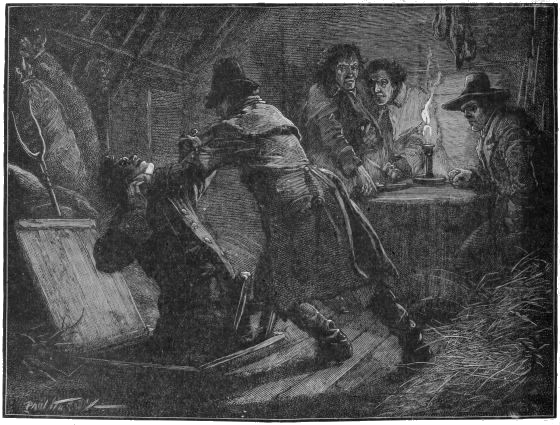
SURPRISE OF THE CATO STREET CONSPIRATORS. (See p. 155.)
[See larger version]
The trial of Sir Charles Wolseley and Dr. Harrison for their speeches at the meeting for Reform at Stockport in June, 1819, terminated also in their conviction and imprisonment for eighteen months, as well as the giving of security for their future good behaviour on liberation.
With these inglorious events closed the long reign of George III. Indeed, he had passed away before they were brought to their conclusion. He died on the 29th of January, 1820, in the eighty-second year of his age, and the sixtieth of his reign. Only six days previously had died his fourth son, the Duke of Kent, in his fifty-third year. But the duke had not departed without leaving an heir to the Throne in the Princess Victoria, who was born on the 24th of May, 1819. Could the old king have been made sensible of these events, there were others which showed that his line, which of late had appeared likely to die out in one generation, notwithstanding his numerous family, was again giving signs of perpetuation. On the 26th of March, 1819, a son had also been born to the Duke of Cambridge, and a son to the Duke of Cumberland on May 27th of the same year, afterwards King of Hanover.
A VILLAGE HOLIDAY OF THE OLDEN TIME.
(FROM THE PAINTING BY F. GOODALL, R.A., IN THE NATIONAL GALLERY OF BRITISH ART.)
[See larger version]