Chapter III · (continued 2)
Reading edition
The new year of 1815 was commenced by a heavy fire along the whole of this defence from thirty-six pieces of cannon, the immediate effect of which was to drive the Americans, in a terrible panic, from their guns, and walls composed of cotton bales and earth. Why an immediate advance was not made at this moment does not appear. It would probably have placed the whole of the American defences in the hands of the British troops, and driven the Americans into the city. But even then little advantage would have been gained, for the news of the contest was bringing down riflemen in legions from the country all round, and the British, struggling in bogs, and exposed at every fresh advance, must be mowed down without a chance of retaliating.
In a little time the Americans, recovering their spirits, returned to their guns, and plied them so well that they soon knocked the breastworks of sugar and treacle casks to pieces. As nothing would tempt the Americans to show themselves from behind their cotton bales and embankments, after maintaining this murderous position for two whole nights and days, Pakenham drew back his men, sacrificing some of his guns, and formed a scheme of sending a detachment across the river to turn the batteries and then play them upon the enemy. But for this purpose it was necessary to cut a canal across the tongue of land on which the army stood, in order to bring up the boats required to carry the troops over the river. Major-General Lambert had arrived with reinforcements, so that against the American twenty thousand Pakenham had now about eight thousand men. All worked at the canal, and it was finished on the 6th of January. Colonel Thornton was to carry across the river one thousand four hundred men, and surprise the great flanking battery of eighteen or twenty guns, whilst Sir Edward Pakenham advanced against the lines in front. A rocket was to be thrown up by Pakenham when he commenced his assault, and Thornton was at that instant to make a rush on the battery and turn it on the enemy. But they had not sufficiently calculated on the treacherous soil through which they cut their canal. Thornton found it already so sludged up that he could only get boats through it sufficient to carry over three hundred and fifty men, and this with so much delay that, when Pakenham's rocket went up, he was still three miles from the battery—and that in broad daylight—which he ought already to have taken. Unaware of this, Pakenham advanced against the chain of forts and ramparts. He had ordered ladders and fascines to be in readiness for crossing the canal, but by some gross neglect it was found that they were not there, and thus the whole of the British troops were exposed to the deadly fire of the American batteries and musketry. No valour was of any use in such circumstances; but Sir Edward cheered on the few but brave-hearted troops till the ladders and fascines could arrive; but ere this happened, Pakenham was killed. Generals Gibbs and Keane took the place of the fallen commander, and still cheered on their men; but it was only to unavailing slaughter: the American marksmen, under cover, and with their rifles on rest, picked off the British soldiers at their pleasure. Gibbs was soon killed and Keane disabled by a wound. In such circumstances the troops gave way and retired, a strong reserve protecting the rear; but out of gun-shot there was no further danger, for the Americans were much too cunning to show their heads beyond the protection of their defences.
Meanwhile, Colonel Thornton, though delayed, and with only a handful of men, still pushed on towards the battery, surprised the Americans, who expected no attack in that quarter, and carried it against overwhelming numbers. When about to turn the captured guns against the enemy, a messenger came in haste to say that Pakenham had fallen, and the attacking force had retired. But Thornton would not retrace his steps without carrying off a good quantity of the artillery, amongst which was a howitzer, inscribed, "Taken at the surrender of Yorktown, 1781." On his return to the main body, which he did without any pursuit—for even so small a band the Americans did not venture to pursue—it was found that he had had but three men killed and forty wounded, he himself being amongst the latter.
On the 18th of January, 1815, commenced the final retreat of the British to their ships. They were allowed to march away without molestation, taking all their guns and stores with them, except ten old ship guns of no value, which they rendered useless before they abandoned them. Andrew Jackson, afterwards President of the United States, commanded in this defence of New Orleans, and loud were the boastings of his prowess all over the States, when, in fact, he had not risked a man. His merit was to have shown what excellent shots his countrymen were, and how careful they were to keep out of the reach of shot themselves. So far as the British were concerned, they had shown not only their unparalleled bravery, but also, as on many such occasions, their great want of prudence. This sacrifice of life would have been spared by a single and much more effectual blockade, and the most lamentable part of the business was, that all the time peace had been made, though the news of it had not reached them.
But General Lambert did not retire far without striking another blow. His predecessor had failed to take New Orleans, but he had brought away the troops in excellent order, and he passed over in Sir Alexander Cochrane's squadron and attacked and took the important forts of Mobile, at the confluence of the Mobile, Tombigbee, and Alabama rivers—the territories around which have since grown into States. This was a basis for important operations on those shores; but they were rendered unnecessary by the peace.
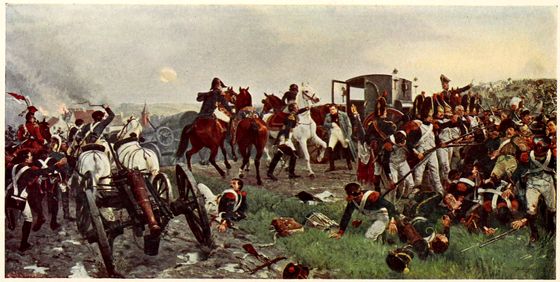
By permission of the Corporation of Liverpool.
ON THE EVENING OF THE BATTLE OF WATERLOO.
BY ERNEST CROFTS, R.A. FROM THE PAINTING IN THE WALKER ART GALLERY.
[See larger version]
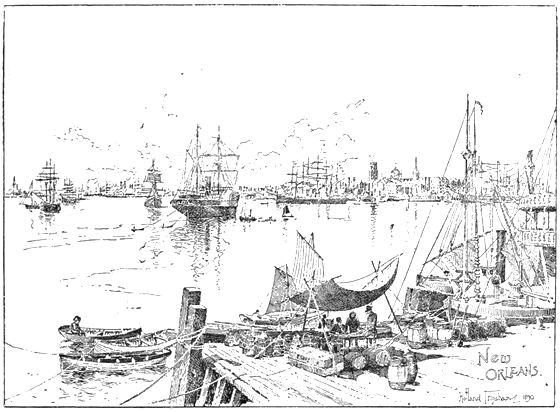
NEW ORLEANS.
[See larger version]
When peace was made in Europe, the United States became anxious for peace too. Madison had begun the war in the ungenerous hope of wresting Canada from Great Britain, because he thought her too deeply engaged in the gigantic war against Napoleon to be able to defend that colony. He believed that it would fall an easy prey; that the Canadians must so greatly admire the model republic that they would abandon monarchy at the first call, and that he should thus have the glory of absorbing that great world of the north into the American Republic. In all this, he and those who thought with him found themselves egregiously deceived. The Canadians showed they were staunchly attached to Great Britain, and the attempts at invasion were beaten back by the native militia and by our handful of troops with the greatest ease. Meanwhile, the blockade of the east, and the seizure of the merchant shipping, drove the New England and other eastern States to desperation. Throughout this war Great Britain made a uniform declaration of a preference for peace, but her offers were regularly rejected so long as Napoleon was triumphant. The United States, professing the utmost love of freedom, were the blind and enthusiastic worshippers of the man who was trampling the liberties of all Europe under his feet. It was not till the last moment—not till he had been defeated in Russia, driven by Britain out of Spain, routed and pursued out of Germany, and compelled to renounce the Imperial Crown of France—that the American Government began to understand the formidable character of the Power which it had so long and so insolently provoked, and to fear the whole weight of its resentment directed against its shores. It is certain that, had Britain been animated by a spirit of vengeance, it had now the opportunity, by sending strong fleets and a powerful army to the coast of America, to ravage her seaboard towns, and so utterly annihilate her trade as to reduce her to the utmost misery, and to precipitate a most disastrous system of internal disintegration. The New England States, in 1814, not only threatened to secede, but stoutly declared that they would not furnish another shilling towards paying the expenses of the war. They even intimated an idea of making a separate peace with Britain. In Massachusetts especially these menaces were vehement. Governor Strong spoke out plainly in the Legislative Chamber of that State. Madison endeavoured to mollify this spirit by abandoning his Embargo and Emancipation Acts, but this was now too late, for the strict blockade of the British, in 1814, rendered these Acts perfectly dead.
To procure peace, Madison now sought the good offices of the Emperor Alexander of Russia with Great Britain, and these offices were readily accepted, for the latter had never willingly gone into or continued this unnatural war. A Congress was appointed at Gothenburg, and thence transferred to Ghent. There, on the 24th of December, 1814, a loose and indefinite peace was concluded, in which every principle on which the war had been begun was left to be settled by commissioners; and some of which—such was the difficulty of negotiating with the Americans—were not settled for many years. On these points alone were the two Powers agreed—that all hostilities between the contracting parties and the Indians should be put an end to, and that both parties should continue their efforts for the suppression of the slave-trade. Such was the joy of the north-eastern States of America at the peace that the citizens of New York carried the British envoy, sent to ratify the treaty, in triumph through the streets.
When the Bourbons had entered Paris in 1814 they had shown the utmost liberality towards those who had driven them from France and had murdered those of their family on the throne and nearest to it. They did not imitate the summary vengeance of Napoleon, whose Government, in 1812, had put to death not only General Mallet, who had endeavoured to restore the Bourbons, but also thirteen of his accomplices, on the plain of Grenelle. When Louis XVIII. returned, there were numbers of the bloody Revolutionists who had voted for, and some who had acted in, the frightful atrocities of the Revolution—many who had urged on the sufferings, the indignities, and the death of Louis XVI., Marie Antoinette, the Princess Elizabeth, the Princess Lamballe, and the worst form of death of the unhappy Dauphin. Yet no vengeance was taken, and numbers of these people were allowed to reside unharmed in Paris. Having been now again driven forth, and seen the readiness with which those who had sworn to maintain their Government had taken their oaths and betrayed them, it might have been expected that there would have been some severe punishments. But the natural mildness of Louis XVIII., and the wise counsels of Wellington and Talleyrand, produced a very different scene. Never, after such provocations, and especially to the sensitive natures of Frenchmen, was so much lenity shown. In the proclamation of Louis XVIII. of the 24th of July, nineteen persons only were ordered for trial, and thirty-eight were ordered to quit Paris, and to reside in particular parts of France, under the observation of the police, till their fate should be decided by the Chambers. Of the nineteen threatened with capital punishment, with trial before a military tribunal, only Ney and Labédoyère suffered; another, Lavalette, was condemned, but escaped by changing dresses with his wife in prison. It was also stated that such individuals as should be condemned to exile should be allowed to sell their property in France, and carry the proceeds with them. Yet more clamour was raised by the Buonapartists about the deaths of Ney and Labédoyère than had been made in any executions by the Imperial or the Revolutionary parties over whole hecatombs of innocent persons. As for Ney and Labédoyère, their treason had been so barefaced and outrageous that no reasonable person could expect anything but summary punishment for them. Ney had declared to Louis XVIII. that he would bring Buonaparte to him in a cage, and then carried over his whole army at once to the Emperor. Labédoyère had been equally perjured after the most generous forgiveness of his former treasons, and he had been particularly active in stimulating the Parisians to make a useless resistance to the Allies approaching Paris, by stating that the Bourbons were preparing a most sanguinary proscription. Both officers knew that they had no hope of life, no plea of protection, and they fled in disguise. Yet vehement reproaches were cast on the Duke of Wellington for having, as the Buonapartists asserted, broken the 12th article of the Convention of Paris, by which the city was surrendered to the Allied armies. Madame Ney, after the seizure and condemnation of her husband, went to the Duke, and demanded his interference on the Marshal's behalf, as a right on the ground of this article, which she interpreted as guaranteeing all the inhabitants, of whatever political creed or conduct, from prosecution by the restored Government. It was in vain that Wellington explained to her that this article, and indeed the whole Convention, related solely to the military surrender, and not to the political measures of the Government of Louis, with which the Duke had publicly and repeatedly declared that he had no concern, and in which he would not interfere. When the Commissioners from the Provisional Government had waited on him, so early as the 2nd of July, at Estrées, and claimed exemption for political offenders, he showed them the proclamation of Louis, dated Cambray, the 28th of June, making exceptions to the general amnesty, and distinctly told them that he had no orders to interfere with the measures of the Bourbon Government. To this the Commissioners had nothing to object, and they thus clearly understood that the British commander would not take any part in political, but merely in military measures. Nevertheless, when Ney was executed, the clamour was renewed that Wellington had betrayed him. We now anticipate, somewhat, to dispose of this calumny, for there never was a party so recklessly addicted to charging their enemies with breach of faith as that of Buonaparte and his followers. The foul charge was so industriously disseminated over Europe, that Wellington, at Paris, on the 19th of November, 1815, issued a memorial on the subject, which he first caused to be sent to all the Allied Powers and then to be published. In this most decisive document he stated that the Convention of Paris related exclusively to the military occupation of the place, and was never intended, and could not be intended, to prevent either the existing French Government, the Provisional, or any French Government that might succeed it, from acting towards political offenders as it might deem proper. He had refused before to enter into a question of settling the Government. To make this clear, he quoted the 11th article, providing for the non-interference of the Allied army with property; and the 12th:—"Seront pareillement respectées les personnes et les propriétés particulières; les habitants, et en général tous les individus qui se trouvent dans la capitale, continueront à jouir de leur droits et libertés sans pouvoir être inquiétés, ou recherchés en rein, relativement aux fonctions qu'ils occupent ou avaient occupées, à leur conduite, et à leur opinions politiques." Labédoyère was shot on the 19th of August, 1815, and Ney on the 7th of December.
It remains only to notice the terminating scene of the once gay Murat, Buonaparte's gallant leader of cavalry in so many campaigns, and finally King of Naples. In consequence of plans that he had laid with Buonaparte in Elba, Murat rose on the 22nd of March of this year, and pushed forward with the intention of driving the Austrians out of Upper Italy. But Austria was well aware of what had been in progress, and, though Murat proclaimed the independence of Italy, the Italians fled from him rather than joined him. On the Po he was met by the Austrians, under General Fremont, fifty thousand strong, and defeated. He retreated rapidly towards Naples again, suffering other discomfitures, and at the same time receiving a notice from Lord William Bentinck that, as he had broken his convention with the European Powers, Britain was at war with him. To keep the Neapolitans in his interest, he drew up a liberal Constitution, on the 12th of May, amid the mountains of the Abruzzi, and sent it to Naples, where his queen, Caroline Buonaparte, proclaimed it. It was of no avail; the people, instead of assisting him, were ready to rise against him, and his soldiers every day rapidly deserted and went to their homes.
Murat hastened in disguise to Naples to consult with his wife, who had as much courage and more judgment than he had; but this availed him nothing. On the 20th of May his generals signed a convention with the Austrians at Casa Lanza, a farmhouse near Capua, to surrender Capua on the 21st, and Naples on the 23rd, on condition that all the Neapolitan officers who took the oath of allegiance to King Ferdinand should retain their respective ranks, honours, and estates. At this news Murat fled out of Naples, and, with a very small attendance, crossed over in a fisherman's boat to the island of Ischia, and his wife went on board the vessel of Commodore Campbell, which, however, she was only able to effect by a guard of three hundred English sailors and marines, for the lazzaroni were all in insurrection. Commodore Campbell, having received Caroline Buonaparte, her property and attendants on board his squadron, then sailed to Gaeta, where were the four children of Murat, took them on board, and conveyed them altogether to Trieste, the Emperor of Austria having given Madame Murat free permission to take up her residence in Austria, under the name of the Countess of Lipano.
Well had it been for Murat could he have made up his mind to seek the same asylum; for it appears clear that it would have been granted him, for he was no longer dangerous. But he clung convulsively to the fortunes of Napoleon, and making his way in a small coasting vessel, he followed him to France, and reached the port of Fréjus on the 28th or 29th of May, where Buonaparte had landed on his return from Elba. From this place Murat wrote to Buonaparte through Fouché, offering his services to him; but Buonaparte, who would have been duly sensible of the services of Murat had he succeeded in holding Italy against the Austrians, and thus acting as an important divider of the efforts of the Austrians, was equally sensible of the little value of Murat as a mere individual, defeated, and having lost Italy. He refused to give him a word of reply. Murat accordingly lay in concealment with his followers, vainly hoping for a word of encouragement, till the news of the utter defeat of Buonaparte at Waterloo came upon him like the shock of an earthquake. The south of France was no longer a place for any who had been prominent amongst the retainers of Buonaparte; some of Murat's followers made haste to escape from the search and the vengeance of the Royalists. As for Murat himself, he wrote again to Fouché, imploring his good offices with the Allies to obtain him a passport for England. Receiving no response to this, Murat condescended to write a most imploring letter to Louis XVIII., but he had no time to wait for the slow progress of diplomatic life—he fled and, after many adventures, reached Corsica. There he was allowed to remain, and a few weeks would have brought him the assurance of entire freedom from enmity on the part of the Allies. But, unfortunately, by this time the shock of the utter overthrow and captivity of Buonaparte following on his own misfortunes, had overturned his intellect. He conceived the insane idea of recovering Naples by the same means that Buonaparte had for a while recovered Paris. A large number of Neapolitan and Corsican refugees encouraged him in the mad project.
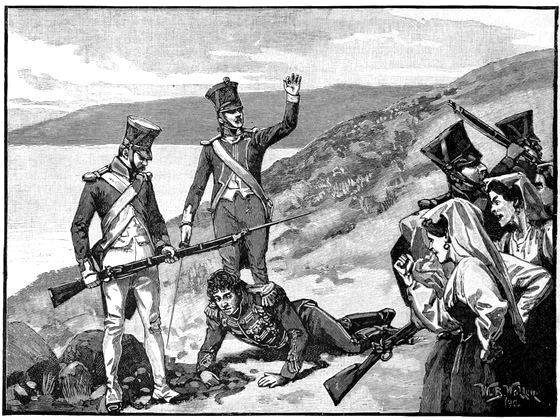
CAPTURE OF MURAT. (See p. 117.)
[See larger version]
On the 8th of October Murat landed near Pizzo, on the Calabrian coast—a coast more than any other in Italy fraught with fierce recollections of the French. His army now consisted of only twenty-eight men; yet, in his utter madness, he advanced at the head of this miserable knot of men, crying, "I am your king, Joachim!" and waving the Neapolitan flag. But the people of Pizzo, headed by an old Bourbon partisan, pursued him, not to join, but to seize him. When they began firing on him, he fled back to his vessels; but the commander, a man who had received the greatest benefits from him, deaf to his cries, pushed out to sea, and left him. His pursuers were instantly upon him, fired at him, and wounded him; then rushing on him, they knocked him down and treated him most cruelly. Women, more like furies than anything else, struck their nails into his face and tore off his hair, and he was only saved from being torn to pieces by the old Bourbon and his soldiers, who beat off these female savages and conveyed him to the prison at Pizzo. The news of his capture was a great delight to Ferdinand. He entertained none of the magnanimity of the Allies, but sent at once officers to try by court-martial and, of course, to condemn him. Some of these officers had been in Murat's service, and had received from him numerous favours, but not the less readily did they sentence him to death; and on the 13th of October, 1815, he was shot in the courtyard of the prison at Pizzo—with characteristic bravery refusing to have his eyes bound, and with characteristic vanity bidding the soldiers "save his face, and aim at his heart!"
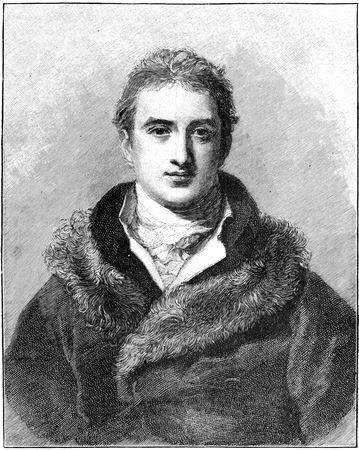
LORD CASTLEREAGH.
[See larger version]
The Congress of Vienna, interrupted by the last razzia of Buonaparte, now resumed its sittings, and the conditions between France and the Allies were finally settled, and treaties embodying them were signed at Paris by Louis XVIII. on the 20th of November. France was rigorously confined to the frontier of 1790, losing the additions conferred on it by the first Treaty of Paris; and to prevent any danger of a recurrence of the calamities which had called the Allies thus a second time to Paris, they were to retain in their hands seventeen of the principal frontier fortresses, and one hundred and fifty thousand of their soldiers were to be quartered, and maintained by France, in different parts of the kingdom. The term of their stay was not to exceed five years, and that term might be curtailed should the aspect of Europe warrant it. The Allied sovereigns also insisted on the payment of the enormous expenses which had been occasioned by this campaign of the Hundred Days—the amount of which was estimated at seven hundred millions of francs. This sum, however, was not to be exacted at once, but to be paid by easy instalments.
There was one restitution, however, which the Allies had too delicately passed over on their former visit to Paris—that of the works of art which Napoleon and his generals had carried off from every town in Italy, Germany, and the Netherlands, during their wars. As has been already stated, museums had been freely pillaged by Buonaparte or by his orders. Accordingly, there was now a great stripping of the Louvre, and other places, of the precious pictures and statues which the hands of the greatest marauder that the world had ever seen had accumulated there. The "Horses of the Sun," from St. Mark's, Venice, the "Venus di Medici," the "Apollo Belvedere," the "Horses of the Car of Victory," which Buonaparte had carried away from Berlin, and many a glorious painting by the old masters, precious books, manuscripts, and other objects of antiquity, now travelled back to their respective original localities, to the great joy of their owners, and the infinite disgust of the French, who deemed themselves robbed by this defeat of robbery.
Louis XVIII., having raised an army of thirty thousand men, thought that he could protect himself, and was anxious that France might be spared the expense of supporting the one hundred and fifty thousand men. Accordingly, one-fifth of the army was withdrawn in 1817. In the following year a Congress was held, in the month of September, at Aix-la-Chapelle, at which the Emperors of Russia and Austria and the King of Prussia attended; on the part of France, the Duke of Richelieu; and of Great Britain, the Duke of Wellington and Lord Castlereagh, when it was determined that a complete evacuation of France might and should take place by the 20th of November, when the three years terminated. At this Congress it was determined also that, besides the seven hundred million francs for the charges incurred by the Allied armies, another seven hundred millions should be paid in indemnification of damages to private individuals in the different countries overrun by France. These and other items raised the total to be paid by France for Napoleon's outbreak of the Hundred Days to about sixty million pounds sterling.
Great Britain, which had amassed so vast a debt in aiding the Continental sovereigns against Napoleon, played the magnanimous to the last. She gave up her share of the public indemnities, amounting to five million pounds, to the King of Holland and the Netherlands, to enable him to restore that line of fortresses along the Belgian frontiers which our Dutch king, William III., had planned, and which Joseph II. of Austria had suffered to fall to decay, thus rendering invasion from France especially easy. Nor was this all: she advanced five million pounds to enable the different sovereigns to march their troops home again, as she had advanced the money to march them up, the money demanded of France not being ready. Truly might Napoleon, in St. Helena, say that England, with her small army, had no business interfering in Continental wars; that "with our fleet, our commerce, and our colonies, we are the strongest power in the world, so long as we remain in our natural position; but that our gains in Continental wars are for others, our losses are for ourselves, and are permanent."
Here, then, our history of the political transactions of the reign of George III. terminates. That reign really terminated in 1811, with the appointment of the Regency, which continued the ruling power during the remainder of his life. From that date it is really the history of the Regency that we have been prosecuting. But this was necessary to maintain the unity of the narrative of that most unexampled struggle which was involving the very existence of every nation in Europe. Of all this the poor old, blind, and deranged king knew nothing—had no concern with it. The reins of power had fallen from his hands for ever: his "kingdom was taken from him, and given to another." He had lived to witness the rending away of the great western branch of his empire, and the sun of his intellect went down in the midst of that tempest which threatened to lay in ruins every dynasty around him. We have watched and detailed that mighty shaking of the nations to its end. The events of the few remaining years during which George III. lived but did not rule, were of a totally different character and belong to a totally different story. They are occupied by the national distresses consequent on the war, and the efforts for reform, stimulated by these distresses, the first chapter of which did not close till the achievement of the Reform Bill in 1832.
The Government and Parliament which, with so lavish a hand, had enabled the Continental monarchs to fight their battles, which had spent above two thousand millions of money in these wars, of which eight hundred millions remained as a perpetual debt, with the perpetual necessity of twenty-eight millions of taxation annually to discharge the interest—that burden on posterity which Napoleon had, with such satisfaction, at St. Helena, pronounced permanent—this same Government and Parliament, seeing the war concluded, were in great haste to stave off the effects of this burden from the landed aristocracy, the party which had incurred it, and to lay it upon the people. They saw that the ports of the world, once more open to us, would, in exchange for our manufactures, send us abundance of corn; and, that the rents might remain during peace at the enormous rate to which war prices had raised them, they must keep out this foreign corn. True, this exclusion of foreign corn must raise the cost of living to the vast labouring population to a ruinous degree, and threatened fearful convulsions from starving people in the manufacturing districts; but these considerations had no weight with the land-holding Government and its Parliamentary majority. In 1814 they were in haste to pass a Corn Law excluding all corn except at famine prices; but the lateness of the season, and an inundation of petitions against it, put it off for that Session. But in 1815 it was introduced again and carried by a large majority. By this all corn from abroad was excluded, except when the price was eighty shillings per quarter. By this law it was decreed that the people who fought the battles of the world, and who would bear the bulk of the weight of taxation created by these wars, were never, so long as this law continued, to eat corn at less than four pounds per quarter. This was, in fact, not only a prohibition of cheap bread, but a prohibition of the sale of the labours of the people to foreign nations to the same extent. It was an enactment to destroy the manufacturing interest for the imagined benefit of land-owners; and it was done on this plea, as stated by Mr. Western, one of the leading advocates of the Bill—"That, if there is a small deficiency of supply, the price will rise in a ratio far beyond any proportion of such deficiency: the effect, indeed, is almost incalculable. So, likewise, in a surplus of supply beyond demand, the price will fall in a ratio exceeding almost tenfold the amount of such surplus." The avowed object, therefore, was to prevent the manufacturing population from reaping the benefit of that Continental peace which they had purchased at such a cost, and consequently to repress the growth of their trade to the same degree. Mr. Tooke, in his "History of Prices," confirms this view of the matter, asserting that "the price of corn in this country has risen from one hundred to two hundred per cent., and upwards, when the utmost computed deficiency of the crops has not been more than between one-sixth and one-third below an average, and when that deficiency has been relieved by foreign supplies." Mr. Western candidly showed that, to the farmer, years of deficiency were the most profitable, from this principle of enormous rise from a small cause; that if the produce of an acre of wheat in a good year is thirty-three bushels at six shillings, the amount realised would be only nine pounds eighteen shillings; but, if the produce were reduced by an unfavourable season one-sixth, and the price raised from six shillings to twelve shillings, the produce of twenty-seven and a half bushels would realise sixteen pounds ten shillings, the difference being profit!
The effect was immediately shown by a rapid rise of prices, wheat becoming one hundred and three shillings a quarter. But this did not satisfy the land-owners, and Mr. Western, in 1816, introduced no less than fourteen resolutions to make more stringent the exclusion of foreign corn. It was openly declared "that excessive taxation renders it necessary to give protection to all articles, the produce of our own soil, against similar articles, the growth of foreign countries." Mr. Barham declared that "the country must be forced to feed its own population. No partial advantage to be derived from commerce could compensate for any deficiency in this respect. The true principle of national prosperity was an absolute prohibition of the importations of foreign agricultural produce, except in extreme cases;" and on this ground it was proposed to exclude foreign rape-seed, linseed, tallow, butter, cheese, etc.
Some of the most eminent land-owners were clear-sighted and disinterested enough to oppose these views with all their power. The Dukes of Buckinghamshire and Devonshire, the Lords Carlisle, Spencer, Grey, Grenville, Wellesley, and many members of the Commons, voted and protested energetically against them; and the additional restrictions were not carried. But enough had been done to originate the most frightful sufferings and convulsions. We shall see these agitations every remaining year of this reign. The Prince Regent, in his opening speech, in 1816, declared "manufactures and commerce to be in a flourishing condition." But Mr. Brougham at once exposed this fallacy. He admitted that there had been an active manufacturing and an unusual amount of exportation in expectation of the ports of the world being thrown open by the peace; but he declared that the people of the Continent were too much exhausted by the war to be able to purchase, and that the bulk of these exported goods would have to be sold at a ruinous reduction—at almost nominal prices; and then would immediately follow a stoppage of mills, a vast population thrown out of employment, and bread and all provisions made exorbitantly dear when there was the least power to purchase. All this was speedily realised. British goods were soon selling in Holland and the north of Europe for less than their cost price in London and Manchester. Abundant harvests defeated in some degree the expectations of the agriculturists, and thus both farmers and manufacturers were ruined together; for, the check being given to commerce, the manufacturing population could purchase at no price, and, in spite of the harvest, the price of wheat was still one hundred and three shillings per quarter. Many farmers, as well as manufacturers, failed; country banks were broken, and paper-money was reduced in value twenty-five per cent.; and a circumstance greatly augmenting the public distress was the reduction of its issues by the Bank of England from thirty-one millions to twenty-six millions.
The year 1816 was a most melancholy year. Both agricultural and manufacturing labourers rose in great masses to destroy machinery, to which, and not to the temporary poverty of the whole civilised world, exhausted by war, they attributed the glut of manufactured goods, and the surplus of all kinds of labour. In Suffolk and Norfolk, and on the Isle of Ely, the agricultural labourers and fen-men destroyed the threshing-machines, attacked mills and farms, pulled down the houses of butchers and bakers, and marched about in great bands, with flags inscribed "Bread or blood!" In Littleport and Ely shops and public-houses were ransacked, and the soldiers were called out to quell the rioters, and much blood was shed, and numbers were thrown into prison, of whom thirty-four were condemned to death, and five executed. The colliers and workers in the iron mines and furnaces of Staffordshire and Warwickshire, as well as in the populous districts of South Wales, were thrown out of work, and the distress was terrible. The sufferings and consequent ferments in Lancashire were equally great. In Nottinghamshire, Leicestershire, and Derbyshire, the Luddites broke out again, as they had done in 1812, and by night demolished the stocking-frames and the machinery in the cotton-mills. Great alarm existed everywhere, and on the 29th of July a meeting was called at the "City of London" Tavern to consider the means of relieving the distress, the Duke of York taking the chair, the Dukes of Kent and Cambridge, the Archbishop of Canterbury, the Bishop of London, the Chancellor of the Exchequer, and others attending. Many palliatives were proposed, but Lord Cochrane and other reformers declared that the only effectual remedy would be the abolition of the Corn Law. Soup-kitchens were recommended, but in Scotland these were spurned at as only insults to the sufferers; at Glasgow the soup-kitchen was attacked, and its coppers and materials destroyed; and at Dundee the people helped themselves by clearing a hundred shops of their provisions.
During the whole of these scenes the attitude of Government was not merely indifferent, but absolutely repulsive. At no time had so cold and narrow-spirited a Ministry existed. The names of Castlereagh, Liverpool, Sidmouth, and Lord Eldon as Lord Chancellor, recall the memory of a callous Cabinet. They were still dreaming of additional taxation when, on the 17th of March, they were thunderstruck by seeing the property-tax repealed by a majority of forty. The Prince Regent had become utterly odious by his reckless extravagance and sensual life. The abolition of the property-tax was immediately followed by other resistance. On the 20th of March a motion of disapprobation of the advance of the salary of the Secretary to the Admiralty, at such a time, from three to four thousand pounds a-year was made, but lost. On this occasion Henry Brougham pronounced a most terrible philippic against the Prince Regent, describing him as devoted, in the secret recesses of his palace, to the most vicious pleasures, and callous to the distresses and sufferings of others! Mr. Wellesley Pole described it as "language such as he had never heard in that House before."
Not only in Parliament, but everywhere the cry for Reform rose with the distress. Hampden Clubs were founded in every town and village almost throughout the kingdom, the central one being held at the "Crown and Anchor" in the Strand, London, its president being Sir Francis Burdett, and its leading members being William Cobbett, Major Cartwright, Lord Cochrane, Henry Hunt, and others. The object of these clubs was to prosecute the cause of Parliamentary reform, and to unite the Reformers in one system of action. With the spirit of Reform arose, too, that of cheap publications, which has now acquired such a vast power. William Cobbett's Political Register, on the 18th of November, 1816, was reduced from a shilling and a halfpenny to twopence, and thence-forward became a stupendous engine of Reform, being read everywhere by the Reformers, and especially by the working-classes in town and country, by the artisan in the workshop, and the shepherd on the mountain. The great endeavour of Cobbett was to show the people the folly of breaking machinery, and the wisdom of moral union.
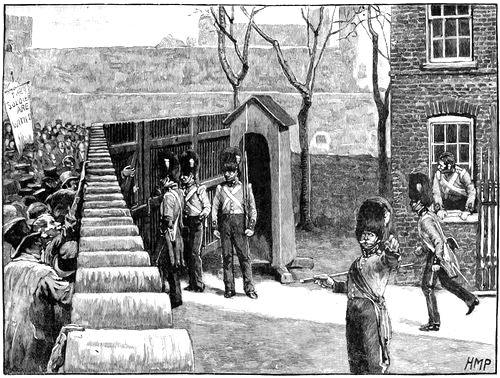
THE MOB OF SPENCEANS SUMMONING THE TOWER OF LONDON. (See p. 121.)
[See larger version]
It is only too true, however, that many of the Hampden Clubs entertained very seditious ideas, and designs of seizing on the property of the leading individuals of their respective vicinities. Still more questionable were the doctrines of the Spenceans, or Spencean Philanthropists, a society of whom was established in London this year, and whose chief leaders were Spence, a Yorkshire schoolmaster, one Preston, a workman, Watson the elder, a surgeon, Watson the younger, his son, and Castles, who afterwards turned informer against them. Mr. "Orator" Hunt patronised them. They sought a common property in all land, and the destruction of all machinery. These people, with Hunt and Watson at their head, on the 2nd of December, met in Spa Fields. The Spenceans had arms concealed in a waggon, and a flag displayed declaring that the soldiers were their friends. The crowd was immense, and soon there was a cry to go and summon the Tower. Mr. Hunt and his party appear to have excused themselves from taking part in this mad movement. The mob reached the Tower, and a man, supposed to be Preston, summoned the sentinels to surrender, at which they only laughed. The mob then followed young Watson into the City, and ransacked the shop of Mr. Beckwith, a gunsmith, on Snow Hill, of its firearms. A gentleman in the shop remonstrated, and young Watson fired at him and severely wounded him. Young Watson then made his escape, but his father was secured and imprisoned; and the Lord Mayor and Sir James Shaw dispersed the mob on Cornhill, and took one of their flags and several prisoners. Watson the elder was afterwards tried and acquitted; but a sailor who was concerned in the plunder of the gunsmith's shop was hanged. A week after this riot the Corporation of London presented an Address to the Throne, setting forth the urgent necessity for Parliamentary reform.
These events were a little diversified by the storming of Algiers on the 27th of August. In 1815 the Government of the United States of America had set the example of punishing the piratical depredations of the Algerines. They seized a frigate and a brig, and obtained a compensation of sixty thousand dollars. They do not appear to have troubled themselves to procure any release of Christian slaves, or to put an end to the practice of making such slaves; and, indeed, it would have been rather an awkward proposal on the part of North Americans, as the Dey might have demanded, as a condition of such a treaty, the liberation of some three millions of black slaves in return. But at the Congress of Vienna a strong feeling had been shown on the part of European Governments to interfere on this point. It was to the disgrace of Great Britain that, at the very time that she had been exerting herself so zealously to put an end to the negro slave trade, she had been under engagements of treaty with this nest of corsairs; and Lord Cochrane stated in Parliament this year that only three or four years before it had been his humiliating duty to carry rich presents from our Government to the Dey of Algiers. But in the spring of this year it was determined to make an effort to check the daring piracies of Tunis, Algiers, and Tripoli. Lord Exmouth was sent to these predatory Powers, but rather to treat than to chastise; and he effected the release of one thousand seven hundred and ninety-two Christian slaves. From Tunis and Tripoli he obtained a declaration that no more Christian slaves should be made. The Dey of Algiers refused to make such concession till he had obtained the permission of the Sultan. Lord Exmouth gave him three months to determine this point, and returned home. A clause in the treaty which he had made with Algiers ordered that Sicily and Sardinia should pay nearly four hundred thousand dollars for the ransom of their subjects; they accordingly paid it. This clause excited just condemnation in England, as actually acknowledging the right of the Algerines to make Christian slaves.
But the matter was not to be thus peacefully ended. Before Lord Exmouth had cleared out of the Mediterranean, the Algerines—not in any concert with their Government but in an impulse of pure fanaticism—had rushed down from their castle at Bona on the Christian inhabitants of the town, where a coral fishery was carried on chiefly by Italians and Sicilians, under protection of a treaty made by Britain, and under that of her flag, and committed a brutal massacre on the fishermen, and also pulled down and trampled on the British flag, and pillaged the house of the British vice-consul.
Scarcely had Lord Exmouth reached home when he was ordered forth again to avenge this outrage, and he sailed from Plymouth on the 28th of July, 1816, with a fleet of twenty-five large and small ships. At Gibraltar he was joined by the Dutch Admiral Van Cappellan with five frigates and a sloop, to which were added a number of British gunboats. On the 27th of August Lord Exmouth sailed right into the formidable harbour of Algiers, and dispatched a messenger to the Dey, demanding instant and ample recompense for the outrage; the delivery of all Christian slaves in the kingdom of Algiers; the repayment of the money received by the Dey for the liberation of Sicilian and Sardinian slaves; the liberation of the British consul—who had been imprisoned—and of two boats' crews detained; and peace between Algiers and Holland. The messenger landed at eleven o'clock, and two hours were given the Dey to prepare his answer. The messenger remained till half-past two o'clock, and no answer arriving, he came off, and Lord Exmouth gave instant orders for the bombardment. The attack was terrible. The firing from the fleet, which was vigorously returned from the batteries in the town and on the mole, continued till nine in the evening. Then most of the Algerine batteries were knocked literally to pieces, but the firing did not cease till about eleven. No sooner was the assault over than a land wind arose and carried the fleet out of the harbour, so that the vessels were all out of gunshot by two o'clock in the morning. A wonderful spectacle then presented itself to the eyes of the spectators in the fleet. Nine Algerine frigates, a number of gunboats, the storehouses within the mole, and much of the town were in one huge blaze, and by this they could see that the batteries remained mere heaps of ruins. The next morning Lord Exmouth sent in a letter to the Dey with the offer of the previous day, saying, "If you receive this offer as you ought, you will fire three guns." They were fired. The Dey made apologies, and signed fresh treaties of peace and amity, which were not of long endurance. But within three days one thousand and eighty-three Christian slaves arrived from the interior, and were received on board and conveyed to their respective countries.
We must return from victory abroad to discontent at home. On the 28th of January, 1817, the Prince Regent opened the fifth Session of Parliament. In his speech he expressed indignation at "the attempts which had been made to take advantage of the distresses of the country for the purpose of exciting a spirit of sedition and violence;" and he declared himself determined to put down these attempts by stern measures. The seconder of the Address in the Commons had the good sense to believe that the demagogues and their acts would die of themselves. Certainly, if the demagogues had no cause on which to base their efforts, those efforts must have proved fruitless; and the wisdom of Government consisted in seriously inquiring whether there were such causes. To attempt to insure peace by smothering distress is the old remedy of tyrants, and is like heaping fuel on fire to put it out. Whilst this debate was proceeding, a message arrived from the Lords to announce that the Regent, on his return from the House, had been insulted, and some missile thrown through the windows of his carriage. The House agreed upon an Address to the Regent on this event, and then adjourned.
The next day the debate was resumed. It appeared that the Prince had been hooted at, and a stone, or other missile, flung through the window of the carriage. The Ministerial party endeavoured to raise the occurrence into an attempt on the Prince's life; the Opposition hinted at the expression of public disgust with the tone which Government was assuming towards the distresses of the people, called zealously for stringent reductions of expense, and moved an amendment to that very effect. But the Government had yet much to learn on this head; and Lord Sidmouth announced that the Prince Regent in three days would send down a message on the disaffection of the people. It would have been wise to have added to this measure a recommendation of serious inquiry into the causes of this disaffection, for disaffection towards a Government never exists without a cause; but the Government had carried on matters so easily whilst they had nothing to do but to vote large sums of money for foreign war that they had grown callous, and had been so much in co-operation with arbitrary monarchs that they had acquired too much of the same spirit; and they now set about to put down the people of England as they, by means of the people of England, had put down Buonaparte. It was their plan to create alarm, and under the influence of that alarm to pass severe measures for the crippling of the Constitution and the suppression of all complaints of political evil.
In the debate on this subject, George Canning, who on many occasions had shown himself capable of better things, breathed the very language of Toryism. He declared the representation of Parliament perfect, and treated the most moderate proposals for Reform as only emanations from the mad theories of the Spenceans. The message of the Prince Regent came down on the 3rd of February, ordering certain papers to be laid before the House, "concerning certain practices, meetings, and combinations in the metropolis, and in different parts of the kingdom, evidently calculated to endanger the public tranquillity, to alienate the affections of his Majesty's subjects from his Majesty's person and Government, and to bring into hatred and contempt the whole system of our laws and institutions." Lord Sidmouth endeavoured to guard the House of Peers against the belief that the insult to the Regent had any share in the origination of this message, but the House of Lords, in its Address, directly charged this event as an additional proof of the public disaffection. Unfortunately, the Regent had two Houses of Parliament only too much disposed to make themselves the instruments of such vengeance. The message was referred to a secret committee in each House, and on the 18th and 19th of February they respectively made their reports. Both went at great length into the affair of the Spa Fields meeting, and the proceedings and designs of the Spenceans were made to represent the designs of the working classes all over the kingdom; that such men as Thistlewood, who not long after suffered for his justly odious conduct, were conspicuous among the Spenceans, and that there had been an affray in Spa Fields, were circumstances to give ample colouring to the reports of these committees. The Lords' report stated—"It appears clear that the object is, by means of societies, or clubs, established, or to be established, in all parts of Great Britain, under pretence of Parliamentary reform, to infect the minds of all classes of the community, and particularly of those whose situation most exposes them to such impressions, with a spirit of discontent and disaffection, of insubordination, and contempt of all law, religion, and morality; and to hold out to them the plunder of all property as the main object of their efforts, and the restoration of their natural rights; and no endeavours are omitted to prepare them to take up arms, on the first signal, for accomplishing their designs."
The country societies were pointed out "as principally to be found in the neighbourhood of Leicester, Loughborough, Nottingham, Mansfield, Derby, Chesterfield, Sheffield, Blackburn, Manchester, Birmingham, Norwich, Glasgow, and its vicinity; but," it added, "they extend, and are spreading in some parts of the country, to almost every village." The report of the Commons went over much the same ground, dwelling particularly on the Hampden Clubs as avowed engines of revolution. It dwelt on the acts and activity of the leaders, of the numbers which they had seduced and were seducing, the oaths which bound them together, and the means prepared for the forcible attainment of their objects, which were the overthrow of all rights of property and all the national institutions, in order to introduce a reign of general confusion, plunder, and anarchy.
Now, though in some obscure and ignorant parts of the country there were clubs which contemplated the foolish idea of seizing on neighbouring properties, the committees must have been very ill-informed to have drawn any such conclusion as to the Hampden Clubs, which were organised for Parliamentary reform under the auspices of Sir Francis Burdett, Major Cartwright, Lord Cochrane, Cobbett, and others. Most of these persons had large properties to be sacrificed by the propagation of any such principles, and the great topics of Cobbett's Register, the organ through which he communicated with the people, were the necessity of refraining from all violence, and of rising into influence by purely political co-operation. But these reports answered the purposes of the Government, and they proceeded to introduce, and succeeded in passing, four Acts for the suppression of popular opinion. The first was to provide severe punishment for all attempts to seduce the soldiers or sailors from their allegiance; the second to give safeguards to the person of the Sovereign, but which did not include the most effectual of all—that of making him beloved; the third was to prevent seditious meetings, and gave great power to the magistrates and police to interfere with any meeting for the mildest Reforms; the fourth was the old measure of suspension of the Habeas Corpus Act, which armed the magistrates with the fearful authority to arrest and imprison at pleasure, without being compelled to bring the accused to trial. The last of these Acts was not passed till the 29th of March, and it was to continue in force only till the 1st of July. But in the meantime events took place which occasioned its renewal.
Within a few days after the first passing of this Act, that is, in the first week of March, a body of weavers—said by the Government to amount to ten thousand men, but by a more competent authority, Samuel Bamford, the author of the "Life of a Radical," not to have exceeded four or five thousand—met in St. Peter's Field, at Manchester, and commenced a march southward. The intention was to proceed to London, to present to the Prince Regent, in person, a petition describing their distress. Bamford had been consulted, and had condemned the project as wild, and likely to bring down nothing but trouble on the petitioners. He believed that they were instigated by spies sent out by Government in order to find an opportunity of justifying their arbitrary measures. Suspicious persons had been trying him. But the poor, deluded people assembled, "many of them," says Bamford, "having blankets, rugs, or large coats rolled up, and tied knapsack-like on their backs. Some had papers, supposed to be petitions, rolled up, and some had stout walking-sticks." From their blankets, they afterwards acquired the name of Blanketeers. The magistrates appeared and read the Riot Act, and dispersed the multitude by soldiers and constables; but three or four hundred fled in the direction of their intended route, and continued their march, pursued by a body of yeomanry. By the time that they reached Macclesfield, at nine o'clock at night, they amounted to only one hundred and eighty; yet many of them persisted in proceeding, but they continually melted away, from hunger and from the misery of lying out in the fields on March nights. By the time that they reached Leek they were reduced to twenty, and six only were known to pass over the bridge at Ashbourne.
This was an attempt as constitutional as it was ignorantly and hopelessly planned by suffering people; but more criminal speculations were on foot. A second report of the Lords' secret committee, recommending the renewal of the suspension of the Habeas Corpus Act, stated that a general insurrection was planned to take place at Manchester, on the 30th of March—to seize the magistrates, to liberate the prisoners, burn the soldiers in their barracks, and set fire to a number of factories; and that such proposals were really in agitation is confirmed by Bamford and other of the Radical leaders. The report says that the design was discovered by the vigilance of the magistrates, a few days before its intended taking place; but it is far more probable that the magistrates had received some intimation of what was in progress from those who had misguided the ignorant multitude. Bamford tells us that both he and his friends had been applied to to engage in the design, but they had condemned it as the work of incendiaries, who had availed themselves of the resentment of the Blanketeers at their treatment, to instigate them to a dreadful revenge. The truth was, a number of spies in the pay of Government, with the notorious Oliver at their head, were traversing the manufacturing districts of Derbyshire, Nottinghamshire, Yorkshire, and Lancashire, to stimulate the suffering population into open insurrection, that they might be crushed by the military. Bamford and the more enlightened workmen at once saw through the snare, and not only repulsed the tempters, but warned their fellows against their arts. The failure of the first design, however, did not put an end to the diabolical attempt on the part of the spies. They recommended the most secret meetings for the purpose; that another night attack should be prepared for Manchester, and that Ministers should be assassinated. Such proposals were again made to Bamford and his friends, but they not only indignantly repelled them, but sought safety for their own persons in concealment, for continual seizures of leading Reformers were now made.
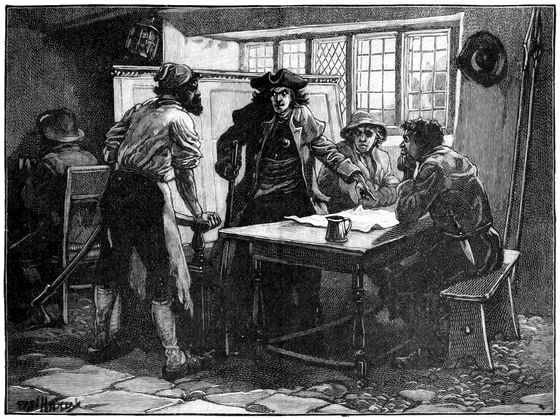
THE "NOTTINGHAM CAPTAIN" AND THE AGITATORS AT THE "WHITE HORSE." (See p. 126.)
[See larger version]
Disappointed in this quarter, the odious race of incendiary spies of Government tried their arts, and succeeded in duping some individuals in Yorkshire, and many more in Derbyshire. That the principal Government spy, Oliver, was busily engaged in this work of stirring up the ignorant and suffering population to open insurrection from the 17th of April to the 7th of June, when such an outbreak took place in Derbyshire, we have the most complete evidence. It then came out, from a servant of Sir John Byng, commander of the forces in that district, that Oliver had previously been in communication with Sir John, and no doubt obtained his immediate liberation from him on the safe netting of his nine victims. In fact, in a letter from this Sir John Byng (then Lord Strafford), in 1846, to the Dean of Norwich, he candidly admits that he had received orders from Lord Sidmouth to assist the operations of Oliver, who was, his lordship said, going down into that part of the country where meetings were being frequently held, and that Oliver, who carried a letter to Sir John, was to give him all the information that he could, so that he might prevent such meetings. Here, as well as from other sources, we are assured that Oliver only received authority to collect information of the proceedings of the conspirators, and by no means to incite them to illegal acts. We have also the assurance of Mr. Louis Allsop, a distinguished solicitor of Nottingham, that Oliver was in communication with him on the 7th of June, immediately on his return from Yorkshire, and informed him that a meeting was the same evening to take place in Nottingham, and he and another gentleman strongly urged him to attend it, which Oliver did. Mr. Allsop says that Oliver had no instructions to incite, but only to collect information. All this has been industriously put forward to excuse Ministers. But what are the facts? We find Oliver not only—according to evidence which came out on the trials of the unfortunate dupes at Derby—directly stimulating the simple people to insurrection, but joining in deluding them into the persuasion that all London was ready to rise, and that one hundred and fifty thousand from the east and west of the capital only waited for them. We find him not only disseminating these ideas throughout these districts from the 17th of April to the 27th of May, but also to have concerted a simultaneous rising in Yorkshire, at Nottingham, and in Derbyshire, on the 6th of June. Thornhill-lees, in Yorkshire, was on the verge of action, and ten delegates, including Oliver, were arrested. In Derbyshire the insurrection actually took place.
What immediately follows shows that Oliver had planned and brought to a crisis, by his personal exertions, this unhappy rising. On Sunday, the 8th of June, Jeremiah Brandreth, a framework-knitter of Nottingham, appeared with some others at a public-house called the "White Horse," in the village of Pentrich, in Derbyshire. This village is about fourteen miles from Nottingham, and about a mile from the small market town of Ripley. It is in a district of coal and iron mines, and is near the large iron foundry of Butterley. The working people of the village, and of the neighbouring village of South Wingfield, were chiefly colliers, workers in the iron mines or iron foundry, or agricultural labourers—a race little informed at that day, and therefore capable of being readily imposed on. This Brandreth had been known for years as a fiery agitator. He was a little, dark-haired man, of perhaps thirty years of age. He had been much with Oliver, and was one of his most thorough dupes, ready for the commission of any desperate deed. He had acquired the cognomen of the "Nottingham Captain," and now appeared in an old brown great-coat, with a gun in his hand, and a pistol thrust into an apron, which was rolled round his waist as a belt.
Two of the workmen from Butterley Foundry entered the "White Horse," which was kept by a widow Wightman, whose son George was deep in the foolish conspiracy into which Oliver and this his blind, savage tool, the Nottingham Captain, were leading him. They found Brandreth with a map before him, and telling them there was no good to be done, they must march up to London and overthrow the Government. He said all the country was rising; that at Nottingham the people had already taken the castle and seized the soldiers in their barracks, and were waiting for them. This shows that he had come straight from Oliver, who, on the 7th, was at Nottingham, attending the meeting there, and who knew that the meeting in Yorkshire had been prevented. Yet he had allowed the people of Nottingham to believe that the Yorkshire men were coming, according to agreement, in thousands; and he allowed Brandreth to go and arouse Derbyshire, under the belief that Nottingham that night would be in the hands of the insurgents. On Monday night, the 9th of June, Brandreth and a knot of his colleagues proceeded to muster their troop of insurgents for the march to Nottingham. They roused up the men in their cottages, and, if they refused to go, they broke in the doors with a crowbar, and compelled them to join them. Most of these unwilling levies slipped away in the dark on the first opportunity. At South Wingfield he assembled his forces in an old barn, and then they proceeded through the neighbourhood demanding men and guns. An old woman had the courage to tap the "captain" on the shoulder, and say—"My lad, we have a magistrate here;" and many of the men thought Brandreth must be mad or drunk. At the farm of widow Hetherinton he demanded her men and arms, and when she stoutly refused him, he put the gun through the window and shot one of her men dead. As the day dawned, Brandreth and his infatuated troop appeared before the gates of Butterley Foundry, and demanded the men; but Mr. Goodwin, the manager, had been apprised of their approach, and had closed the gates. Brandreth had planned to take Butterley Foundry, and carry away not only the men but a small cannon kept there; but Mr. Goodwin went out and told Brandreth he should not have a man for any such insane purpose, and seeing an old man that he well knew, Isaac Ludlam, who bore a good character, and had been a local preacher amongst the Methodists, he seized him by the collar and pushed him into the foundry court, telling him not to be a fool, but stay at home. Ludlam, however, replied, "he was as bad as he could be," rushed out, and went on—to his death; for he was one of those that were executed.
All this time it was raining heavily, and Brandreth, daunted by the weather, or by the courageous conduct of the manager, gave the word to march. The manager calculated that there were only about a hundred of them at this point; but they were soon after joined by another troop from Ripley, and they took two roads, which united about three miles farther on, collecting fresh men by the most direful threats. When they reached Eastwood, a village three or four miles farther on the road to Nottingham, they were said to amount to three hundred, but ragged, famished, drenched with the rain, and not half of them armed, even with rude pikes. Near Eastwood they were met by a troop of horse from Nottingham, which had been summoned by Mr. Rolleston, a magistrate, and at the sight they fled in confusion. About forty guns and a number of pikes were picked up, and a considerable number of prisoners were made, amongst them Brandreth. These prisoners were afterwards tried at a special assize at Derby. They were defended by Thomas (afterwards Lord) Denman, whose eloquence on the occasion raised him at once into notice, and whose generous, gratuitous, and indefatigable exertions on behalf of these simple, ignorant victims of Government instigation, showed him to be a man of the noblest nature. Notwithstanding his efforts, twenty of these unhappy dupes were transported for different terms, and three—Brandreth, Ludlam, and Turner—were hanged and then beheaded as traitors.
Such were the means employed by the British Government in 1817 to quiet the country under its distress—a distress the inevitable result of the long and stupendous war. The only idea was to tighten the reins of Government—to stimulate the sufferers into overt acts, and then crush them. Fortunately, with the exception of the Derby juries, the juries in general saw through the miserable farce of rebellion, and discharged the greater part of Oliver's and Lord Sidmouth's victims. Watson was acquitted of high treason in London on the 16th of June, less than a week after the Derbyshire insurrection. His son had eluded the pursuit of the police. Seventeen prisoners on the like charges were liberated in July in Glasgow and Edinburgh, and were paid seven shillings each to carry them home. On the 22nd of August, of the twenty-four persons that Oliver had entrapped in Yorkshire, twenty-two were discharged—against eleven of them no bills being found by the grand jury—and the two left in prison were detained there because, under the suspension of the Habeas Corpus Act, they were not brought up for trial. The Manchester Blanketeers were, in like manner, all discharged, though the Duke of Northumberland did his utmost to stimulate Lord Sidmouth to get them punished. On the country at large the impression was that the Government had propagated a most needless alarm, and that those who had fallen on the scaffold had been exalted by them from poor, ignorant labourers into burlesque traitors, through the execrable agency of their incendiaries, Oliver, Castles, Mitchell, and others.
But the Government had to receive another lesson this year on the folly of endeavouring, in the nineteenth century, to crush the liberties of Britons. There was an organ called the Press, which, partaking neither of the Governmental fears of a natural complaint by the public of the evils which preyed upon it, nor the Governmental hopes of silencing the sufferers without any attempt to mitigate their calamities, reported freely the mingled folly and cruelty of Ministers, and called for the only remedy of the country's misfortunes—Reform. On moving the second reading of the Bill for the suspension of the Habeas Corpus Act, Lord Sidmouth observed that some noble lords had complained that the authors and publishers of infamous libels on the Government were not prosecuted. He assured them that the Government were quite as anxious as these noble lords to punish the offenders, but that the law officers of the Crown were greatly puzzled in their attempts to deal with them; that authors had now become so skilful from experience, that the difficulties of convicting them immeasurably exceeded those of any former time.
It would seem that the law officers of the Crown despaired of proceeding in the old way, but they, or the Ministers themselves, hit on a new and more daring one. On the 27th of March the Secretary of State addressed a circular letter to the lords-lieutenant of counties, informing them that the Law Officers were of opinion that a justice of the peace may issue warrants to apprehend persons charged with the publication of political libels, and compel them to give bail; and he required the lords-lieutenant to communicate this opinion to the ensuing Quarter Sessions, that all magistrates might act upon it. This was the most daring attack on the liberty of the subject which had been made in England since the days of the Stuarts. Lord Grey, on the 12th of May, made a most zealous and able speech in the House of Lords against this proceeding, denouncing the investment of justices of the peace with the power to decide beforehand questions which might puzzle the acutest juries, and to arrest and imprison for what might turn out to be no offence at all. He said:—"If such be the power of the magistrate, and if this be the law, where, I ask, are all the boasted securities of our independence and freedom?" But it appears from the correspondence of Lord Sidmouth, that he was at this moment glorying in this expedient and triumphing in its imagined success. He said the charge of having put such power into the hands of magistrates, he would do his best and most constant endeavour to deserve; and that already the activity of the dealers in libellous matter was much diminished. He had, in truth, struck a deadly terror to the hearts of the stoutest patriots, who saw no prospect but ruin and incarceration if they dared to speak the truth. Cobbett then fled, and got over to America. In taking leave of his readers, in his Register of March 28th, he gave his reasons for escaping from the storm:—"Lord Sidmouth was 'sorry to say' that I had not written anything that the Law Officers could prosecute with any chance of success. I do not remove," he continued, "for the purpose of writing libels, but for the purpose of being able to write what is not libellous. I do not retire from the combat with the Attorney-General, but from a combat with a dungeon, deprived of pen, ink, and paper. A combat with the Attorney-General is quite unequal enough; that, however, I would have encountered. I know too well what a trial by special jury is; yet that, or any sort of trial, I would stand to face. So that I could be sure of a trial of whatever sort, I would have run the risk; but against the absolute power of imprisonment, without even a hearing, for time unlimited, in any gaol in the kingdom, without the use of pen, ink, and paper, and without communication with any soul but the keepers—against such a power it would have been worse than madness to attempt to strive."
Nor were the fears of Cobbett imaginary. The Ministry at this time were such fanatics in tyranny, that they would have rejoiced to have thus caged the great political lion, and kept him in silence. At this very moment they had pounced upon one who was equally clever in his way, and who had, perhaps, annoyed them still more, but whom they did not so much fear to bring into a court of justice. This was William Hone, who had for some time been making them the laughing-stock of the whole nation by his famous parodies. Hone was a poor bookseller in the Old Bailey, who had spent his life in the quest after curious books, and in the accumulation of more knowledge than wealth. His parodies had first brought him into notice, and it did not appear a very formidable thing for the Government to try a secluded bookworm not even able to fee counsel for his defence. His trial did not come on at the Guildhall till the 18th of December, and then it was evident that the man of satirical fun meant to make a stout fight. The judge, Mr. Justice Abbott, and the Attorney-General, Sir Samuel Shepherd, from their manner of surveying the accused, did not apprehend much difficulty in obtaining a verdict against him. But they very soon discovered their mistake. The charge against Hone was for having published a profane and impious libel upon the Catechism, the Lord's Prayer, and the Ten Commandments, thereby bringing into contempt the Christian religion. The special indictment was for the publication of John Wilkes's catechism. The Attorney-General did not very judiciously commence his charge, for he admitted that he did not believe that Hone meant to ridicule religion, but to produce a telling political squib. This let out the whole gist of the prosecution, though that was very well perceived by most people before; and it was in vain that he went on to argue that the mischief was just the same. Hone opened his own defence with the awkwardness and timidity natural to a man who had passed his life amid books, and not in courts; but he managed to complain of his imprisonment, his harsh treatment, of his poverty in not being able to fee counsel, of the expense of copies of the informations against him, and of the haste, at last, with which he had been called to plead. The judge repeatedly interrupted him, with a mild sort of severity, and the spectators were expecting him to make a short and ineffective defence. Hone, on the contrary, began to show more boldness and pertinacity. He began to open his books, and to read parody after parody of former times. In vain Mr. Justice Abbott and the Attorney-General stopped him, and told him that he was not to be allowed to add to his offence by producing other instances of the crime in other persons. But Hone told them that he was accused of putting parodies on sacred things into his books, and it was out of his books he must defend himself. The poor, pale, threadbare retailer of old books was now warmed into eloquence, and stood in the most unquestionable ascendency on the floor of the court, reading and commenting as though he would go on for ever; and he did go on for six hours. He declared that the editor of Blackwood's Magazine was a parodist—he parodied a chapter of Ezekiel; Martin Luther was a parodist—he parodied the first Psalm; Bishop Latimer was a parodist; so was Dr. Boys, Dean of Canterbury; so was the author of the "Rolliad;" so was Mr. Canning. He proved all that he said by reading passages from the authors, and he concluded by saying that he did not believe that any of these writers meant to ridicule the Scriptures, and that he could not, therefore, see why he should be supposed to do so more than they. Nay, he had done what they never did: as soon as he was aware that his parodies had given offence he suppressed them—and that long ago, not waiting till he was prosecuted. They, in fact, were prosecuting him for what he had voluntarily and long ago suppressed. The Attorney-General, in reply, asserted that it would not save the defendant that he had quoted Martin Luther and Dr. Boys, for he must pronounce them both libellous. The judge charged the jury as if it were their sacred duty to find the defendant guilty; but, after only a quarter of an hour's deliberation, they acquitted him.
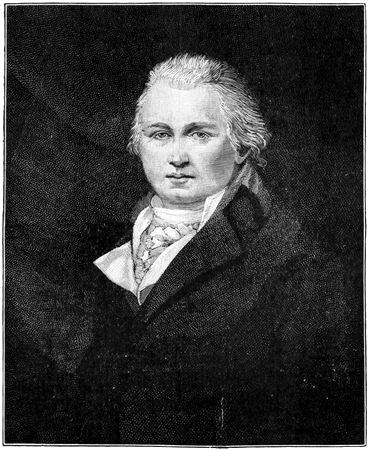
WILLIAM COBBETT.
[See larger version]
This signal and unexpected defeat seemed to rouse the Government to a fresh effort for victory over the triumphant bookseller. The Lord Chief Justice Ellenborough, who was not accustomed to let juries and the accused off so easily, rose from his sick bed, where he was fast drifting towards the close of his career. The defendant was called into court the next morning, the 19th of December. There sat Ellenborough, with a severe and determined air. Abbott sat by his side. Hone this time was charged with having published an impious and profane libel, called "The Litany, or General Supplication." The Attorney-General again asserted that, whatever might be the intention of the defendant, the publication had the effect of bringing into contempt the service of the Church. Hone opened his books to recommence the reading of parallel productions of a former day, or by persons high in esteem in the Church, but this was precisely what the invalid Lord Chief Justice had left his bed to prevent. The judge told him all that was beside the mark, but Hone would not allow that it was so, opened his books, and read on in spite of all attempts to stop him. Never had Ellenborough, not even in his strongest and best days, been so stoutly encountered; scarcely ever had such a scene been witnessed in the memory of man. The spectators showed an intense interest in the combat, for such it was, and it was evident that the general sympathy went with the accused, who put forth such extraordinary and unlooked-for power. The exhausted Chief Justice was compelled to give way, and Hone went on reading one parody after another, and dwelt especially on the parodies of the Litany which the Cavaliers wrote to ridicule the Puritan Roundheads. When he had done, the Lord Chief Justice addressed the jury in a strain of strong direction to find a verdict for the Crown. He said "he would deliver the jury his solemn opinion, as he was required by the Act of Parliament to do; and under the authority of that Act, and still more in obedience to his conscience and his God, he pronounced this to be a most impious and profane libel. Believing and hoping that they, the jury, were Christians, he had no doubt but they would be of the same opinion." This time the solemn and severe energy of the Lord Chief Justice seemed to have made an impression on part of the jury, for they took an hour and a half to determine their verdict, but they again returned one of Not Guilty.
Here, had the Government been wise, they would have stopped; but they were not contented without experiencing a third defeat. The next morning, the 20th of December, they returned to the charge with an indictment against Mr. Hone for publishing a parody on the Athanasian Creed, called "The Sinecurist's Creed." The old Chief Justice was again on the bench, apparently as resolved as ever, and this time the defendant, on entering the court, appeared pale and exhausted, as he well might, for he had put forth exertions and powers of mind which had astonished the whole country and excited the deepest interest. The Attorney-General humanely offered to postpone the trial, but the defendant preferred to go on. He only begged for a few minutes' delay to enable him to put down a few notes on the Attorney-General's address after that was delivered; but the Chief Justice would not allow him this trifling favour, but said, if the defendant would make a formal request for the purpose, he would put off the trial for a day. This would have injured the cause of the defendant, by making it appear that he was in some degree worsted, and, fatigued as he was, he replied, promptly, "No! I make no such request." William Hone, on this third trial, once more seemed to forget his past fatigues, and rose with a strength that completely cowed the old and fiery judge. He did not desist till he had converted his dictatorial manner into a suppliant one. After quoting many eminent Churchmen as dissentients from the Athanasian Creed, and amongst them Warburton and Tillotson, he added, "Even his lordship's father, the Bishop of Carlisle, he believed, took a similar view of this creed." This was coming too near; and the judge said, "Whatever that opinion was, he has gone, many years ago, where he has had to account for his belief and his opinions. For common delicacy, forbear." "O, my lord," replied the satisfied defendant, "I shall certainly forbear." The judge had profited by the lesson to-day: he gave a much more temperate charge to the jury, and they required only twenty minutes to return the third and final victory of Not Guilty. Never had this arbitrary Government suffered so withering a defeat. The sensation throughout the country was immense. The very next day Lord Ellenborough sent in his announcement of retiring from the bench, and in a very short time he retired from this world altogether (December 13, 1818), it being a settled conviction of the public mind that the mortification of such a putting-down, by a man whom he rose from his sick-bed to extinguish, tended materially to hasten that departure.
The only matters of interest debated in Parliament during this year, except that of the discontent in the country, were a long debate on Catholic emancipation, in the month of May, which was negatived by a majority of only twenty-four, showing that that question was progressing towards its goal; and a motion of Lord Castlereagh for the gradual abolition of sinecures. This intimated some slight impression of the necessity to do something to abate the public dissatisfaction, but it was an impression only on the surface. This Ministry was too much determined to maintain the scale of war expenditure to which they had been accustomed to make any real retrenchment. A committee appointed to consider the scheme recommended the abolition of sinecures to the amount of fifty-four thousand pounds per annum, but neutralised the benefit by recommending instead a pension-list of forty-two thousand pounds per annum. The country received the amendment with disgust and derision.
The year, gloomy in itself from the dislocation of trade and the discontent of the people, terminated still more gloomily from another cause—the death of the Princess Charlotte. This event, wholly unexpected, was a startling shock to the whole nation. This amiable and accomplished princess was not yet twenty-two. She had been married only in May, 1816, to Prince Leopold of Coburg, and died on the 6th of November, 1817, a few hours after being delivered of a stillborn child. What rendered the event the more painful was that her death was attributed to neglect by her accoucheur, Sir Richard Croft. Dr. Baillie, who saw her soon after her confinement, refused to join in the issue of a bulletin which the other medical men had prepared, stating that she was going on well, and a few hours proved the fatal correctness of his opinion. Sir Richard, overwhelmed by the public indignation and his own feelings, soon afterwards destroyed himself. No prince or princess had stood so well with the nation for many years. The people saw in her a future queen, with the vigour, unaccompanied by the vices and tyrannies, of Elizabeth. She had taken the part of her mother against the treatment of her father, and this was another cause which drew towards her the affections of the people. All these hopes were extinguished in a moment, and the whole nation was plunged into sorrow and consternation, the more so that, notwithstanding the twelve children of George III., there had only been this single grandchild, and several of his sons remained unmarried.
The year 1818 commenced gloomily. On the 27th of January Parliament was opened by a Speech, drawn up for the Prince Regent, but read by the Lord Chancellor. The first topic was, of course, the severe loss which the country and the prince had sustained in the death of the Princess Charlotte. It was only too well known that the prince and his daughter had not for some time been on very cordial terms, the princess having taken the part of her mother; and the vicious and voluptuous life of the Regent did not probably leave much depth of paternal affection in his nature, which had originally been generous and capable of better things. It was remarked by Mr. Ward, afterwards Lord Dudley and Ward, that the mention of the princess "was rather dry—sulky, rather than sad." But the death of his only issue, and that at the moment that she might have been expected to give a continued succession to the Throne, was a severe blow to him. There was an end of all succession in his line. He stood now without the hopeful support which his daughter's affectionate regard in the country had afforded him, and he was ill able to bear the loss of any causes of popularity. He received a serious shock; and it was only by copious bleeding that he was saved from dangerous consequences; yet, so little was the depth of his trouble, that within three months of his loss he attended a dinner given by the Prussian ambassador, and entertained the company with a song.
The rest of the Speech consisted of endeavours to represent the country as in a prosperous condition; to have escaped from insurrection by the vigilance of Ministers, and to have recovered the elasticity of commerce. No amendment was moved to the Address in either House, but not the less did the conduct of Ministers escape some animadversion. In the Peers, Lord Lansdowne ridiculed the alarms which had been raised regarding the movements in Derbyshire, which, he said, had not been at all participated in by the working population at large, and had been put down by eighteen dragoons. He contended that there was no evidence of any correspondence with these conspirators in other quarters; but this was notoriously incorrect, for there had been a correspondence in Lancashire and Yorkshire, a correspondence especially disgraceful to Ministers, for it was on the part of their own incendiary agents. He observed truly, however, that the insurrection, as it was called, had by no means justified the suspension of the Habeas Corpus Act, for it could have been most readily put down without it by the regular course of law. In the Commons, Sir Samuel Romilly thought that the Derbyshire insurrectionists had been very properly brought to trial; for Brandreth had committed a murder, and, therefore, those who acted with him were, in the eye of the law, equally guilty. But if they were properly brought to trial, there were others who ought still more properly to have been brought to trial too—the very men whom Government had sent out, and who had aroused these poor people into insurrection by false and treacherous statements. There was no justice in trying and punishing the victims, and screening their own agents; and this was what Government had done, and were still doing. It is in vain, therefore, that their defenders contend that they gave no authority to Oliver and the other spies to excite the people to outbreak: these spies having notoriously done it, they still protected and rewarded them, and thus made themselves responsible for their whole guilt. If they had not authorised the worst part of the conduct of the spies, they now acted as though they had, and thus morally assumed the onus of these detestable proceedings. One thing immediately resulted from the pæans of Ministers on the flourishing state of the country—the repeal of the Suspension Act. The Opposition at once declared that if the condition of the country was as Ministers described it, there could be no occasion for the continuance of this suppression of the Constitution; and accordingly a Bill for the repeal of the Suspension Act was at once brought in and passed by the Lords on the 28th, and by the Commons on the 29th of January.
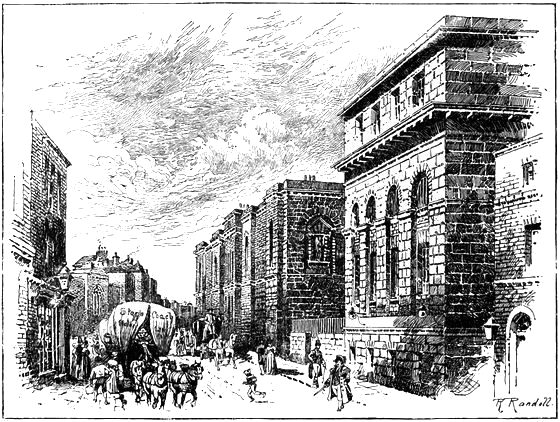
OLD BAILEY, LONDON, 1814.
[See larger version]
Now, much of this at the moment was true; the manufacturers were naturally anxious to resume their business, and a fall in the price of corn, after the plentiful harvest of 1817, to seventy-four shillings and sixpence, relieved a little the pressure on the working classes. Could cheap bread have been secured, the condition of the people might soon have become easy; but the fatal Corn Law came immediately into operation. By the end of 1817 corn had risen in price again to eighty-five shillings and fourpence; and then the ports were opened, but the supplies did not bring down the markets. The spring of 1818 proved wet, and then about the middle of May a drought set in, and continued till September, so that the apprehension of a deficient harvest kept up the price of all articles of life, notwithstanding that a million and a half quarters of wheat had been imported during the year. So long as bread was tolerably cheap, and work more abundant, political agitation in the manufacturing districts subsided; but it was soon proved that the apparent increase of activity in manufacturing and commercial exports was but a feverish desire on the part of manufacturers and merchants to force a trade for which the exhausted Continent was not yet prepared. Nothing but a free importation of corn could have carried the country comfortably through the crisis; and this was denied by the measures of Government, except at a rate of price that put the proper consumption of bread beyond the means of the working classes.
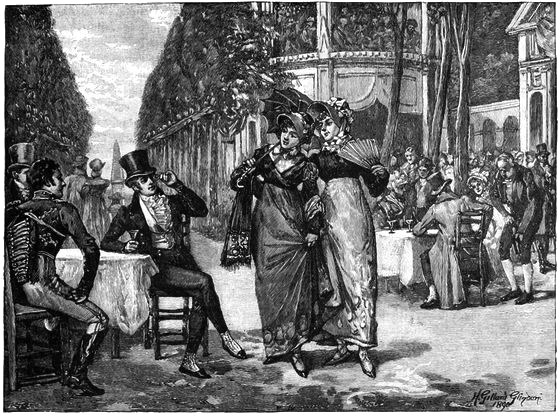
BEAUS AND BELLES OF THE REGENCY PERIOD.
[See larger version]
Meanwhile Ministers, anxious to exonerate themselves from the odium so fully their due for fomenting insurrection, commenced Parliamentary inquiries which only the more clearly demonstrated their guilt. On the 2nd of February the celebrated green bag was sent down by the Prince Regent to the Lords, and another green bag on the following day to the Commons. These green bags—or rather, this green bag, for they were classed as one by the public, their contents being one—made a great figure in the newspaper comments of the time. They were stuffed with documents regarding the late extraordinary powers assumed by Ministers, and the occurrences in the midland counties which had been held to justify them. No doubt the papers had been carefully selected, and they were now submitted to a secret committee of each House, which, being named by Ministers, was pretty sure to bring in reports accordingly. On the 23rd the Lords' committee brought up their report, and on the 27th the Commons' produced theirs. As might have been expected from their parentage, there was a striking likeness in the offspring of the committees; they were veritable twins. Both travelled over the same ground; the statements made by the secret committee of 1816 averring that schemes of conspiracy were in agitation, and the events of 1817, particularly in Derbyshire and Yorkshire, as fully confirming these averments. They were compelled, however, to confess that the insurrections, though clearly connected in different counties, in Lancashire, Yorkshire, Derbyshire, and Nottinghamshire, were not very formidable, and that the mass of the population in these counties did not at all sanction, much less second, such proceedings. Yet, notwithstanding this confession, the fact remained that under the arbitrary measures of Ministers a great number of persons had been thrown into prison, against whom no charge could be established; and that at Derby three had been executed, and twenty others transported or imprisoned for long terms, and these, every one of them, through the acts and incitements of the emissaries of Ministers themselves. On the motion for printing the report of the Commons, which, of course, justified Ministers, Mr. Tierney said it was scarcely worth while to oppose the printing of "a document so absurd, contemptible, and ludicrous."
But Ministers were too sensible of the unconstitutional character of their deeds to rest satisfied with the mere justification of an accepted report. A Bill of Indemnity was introduced to cover "all persons who had in 1817 taken any part in apprehending, imprisoning, or detaining in custody persons suspected of high treason, or treasonable practices, and in the suppression of tumultuous and unlawful assemblies." Thus Ministers were shielded under general terms, and to avoid all appearance of personal movement in this matter by those in the Cabinet the most immediately active, the Bill was introduced by the Duke of Montrose, the Master of the Horse.
There was an energetic debate in each House as the Bill passed through. It was opposed in the Peers by Lords Lansdowne, Holland, and Erskine, but was carried by ninety-three against twenty-seven. Ten peers entered a strong protest on the journals against the measure, denying the traitorous conspiracy or the extensive disaffection to the Government alleged, affirming that the execution of the ordinary laws would have been amply sufficient, and that Ministers were not entitled to indemnity for causeless arrests and long imprisonments which had taken place, for the Bill went to protect them in decidedly illegal acts. In the House of Commons the Bill was strongly opposed by Brougham, Tierney, Mr. Lambton—afterwards Lord Durham—and Sir Samuel Romilly. They condemned the conduct of Ministers in severe language, while the Bill was supported by Canning, by Mr. Lamb—afterwards Lord Melbourne, who generally went with the other side—by Sir William Garrow, and Sir Samuel Shepherd, Attorney-General.
Ministers carried their indemnity in the Commons by one hundred and sixty-two against sixty-nine; but this did not prevent a prolongation of the demands of the Reformers for a searching inquiry into their employment of the spies. Many petitions were presented to the House of Commons for this inquiry—one of them from Samuel Bamford, who had been a sufferer by imprisonment. On the 3rd of February Hone's case was brought forward by William Smith, of Norwich; on the 10th, Lord Archibald Hamilton made a motion for inquiry into similar prosecutions of persons in Scotland, and especially of Andrew M'Kinley, and this was supported by Sir Samuel Romilly and others, but rejected; yet the next day Mr. Fazakerley made a demand for a rigid inquiry into the employment of the spies, and for ascertaining whether they really had exceeded their instructions. Here was an opportunity for Ministers to clear themselves, were they really innocent of sending them out to excite as well as to discover conspirators. There was a violent debate, but the motion was rejected by one hundred and eleven against fifty-two. The discussion left no doubt of the employment of Oliver and others, and this fact being put beyond dispute, Ministers should, in self-vindication, have cleared themselves, if they were guiltless, as their friends pretended; but they did not do so. On the 17th Lord Folkestone moved for inquiry into the treatment in prison of Mr. Ogden and others, and a similar motion was made on the 19th, in the Lords, by the Earl of Carnarvon. In both cases Ministers, instead of courting inquiry, resented it, and closed the door of investigation by large majorities. Lords Sidmouth, Bathurst, and Liverpool were prominent in staving off these inquiries; and Lords Grosvenor, King, and Holland were earnest in urging the necessity of such inquiry for their own good fame. Lord Stanley, afterwards Earl of Derby, put this in the strongest light. He said that he thought Ministers "had been much calumniated, but they would be most so by themselves if they refused to inquire into those acts, when inquiry, according to their own statements, would fully acquit them of the charges laid against them." This was so self-evident that the fact that they would not admit this inquiry might, were there no other grounds for decision, be taken as positive proof of their guilt. But it is not likely that Oliver and his comrades, who were for months in daily communication with Ministers whilst on their detestable missions, would have dared so far to exceed their orders, or, had they done so, that they would have been protected at the expense of the reputations of Ministers themselves, and rewarded into the bargain. The instructions to these men were undoubtedly of too dark a character to be produced in open daylight.