Venetian and North Italian Art (Galleries 19-29)
Reading edition
The splendor of Venetian art reflects the city’s prosperity during its years as a major Mediterranean port. Typical of Venetian lavishness is The Feast of the Gods (gallery 22) by Giovanni Bellini, Renaissance artist and teacher of Giorgione and Titian. This huge painting draws from the fantasies of mythology, turning a Venetian picnic into a feast for gods.
Aware of the subtle reflections of light and shadow playing in the 7 misty air over the lagoons of Venice, sixteenth-century artists such as Titian, Veronese (gallery 28), and Tintoretto (gallery 29) strove to capture the illusion of surface texture and tangible atmosphere through their paints. Because oils blended easily together and because one could thicken these paints with pigments, artists soon established a more flexible technique. At the same time, they abandoned rigid wood panels for canvas supports, which allowed larger, lighter pictures. These innovations, combined with worldly subjects, soon had a significant impact on the rest of Europe.

GALLERY 21: Giorgione, The Adoration of the Shepherds, painted c. 1510
Dominated by a placid landscape bathed in the half-light of dawn, Giorgione’s composition focuses on the small group placed off-center in the foreground. Rendering the Holy Family in luminous colors, the artist has silhouetted them against the dark mouth of a cave, a traditional nativity setting borrowed from Byzantine art that here reflects the strong cultural ties between the city-state of Venice and the empire to the east. This composition, one of the very few existing paintings by the master, demonstrates Giorgione’s mastery of color and control of mood, elements which helped him to achieve fame during his short life of thirty-three years.
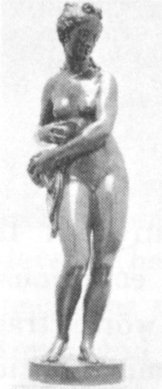
WEST SCULPTURE HALL: Jacopo Sansovino, Venus Anadyomene, cast c. 1527-1530
One of the rare, life-sized bronzes of the Renaissance now in the United States, the Venus Anadyomene is of unparalleled elegance. While the softness of the modeled forms and the vertical sweep of the curving silhouette invest the nude with a heightened grace, her twisting pose invites the viewer to move around the statue, following the fluid line of her encircling arms. Shown holding a seashell, a reflection of Venus’ birth from the sea, this statue is appropriately entitled anadyomene, “rising from the waters.” The artist, Jacopo 8 Sansovino, was trained in Florence and Rome. Moving to Venice in 1527, this major high Renaissance sculptor and architect designed or remodeled many important private and public buildings including several palaces and the Library of Saint Mark.
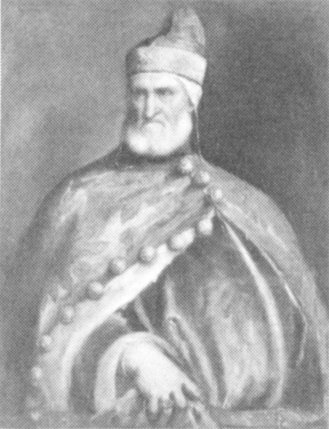
GALLERY 28. Titian, Doge Andrea Gritti, painted c. 1535/1540
Typically Venetian was Titian’s method of starting with a dark preparatory ground, then building up the forms with thin layers of oil paint. Choosing the pose that best focuses our attention, Titian has captured his sitter’s restless vitality in the turn of the doge’s head and the penetrating glance. By accentuating the size and grasp of the hand and the bulk of the body beneath the sumptuous ceremonial robes, the artist has drawn a massive and commanding presence befitting this renowned admiral and doge, or duke of Venice. As seen here, the figure seems to emerge quite powerfully from the shadow, and the predominant hues of red and yellow have a rich, smoldering quality.