Dutch Art (Galleries 44-49)
Reading edition
The United Netherlands was founded in 1609 as a Protestant nation following bitter wars of liberation from Catholic Spain. The combination of excellent seaports, a powerful navy, and strong mercantile interests made Holland a flourishing economic center. Dutch patrons, predominantly Calvinist and middle class, demanded not religious or mythological pictures, but landscapes, portraits, still lifes, and genres, or scenes of daily life. Their demands were met by an ever-increasing number of Dutch artists who, perhaps in response to a burgeoning and competitive market, specialized in a single type of subject. Thus Frans Hals was famed for his portraits, Kalf for his still lifes, and Ruisdael and Hobbema for their landscapes. The one exception was Rembrandt, whose penetrating insight into the human condition and whose superb technical facility enabled him to explore successfully a variety of subjects. Holland’s artistic boom was soon ended, however, for as quickly as it arose, the economic and artistic Golden Age declined during the last years of the seventeenth century.
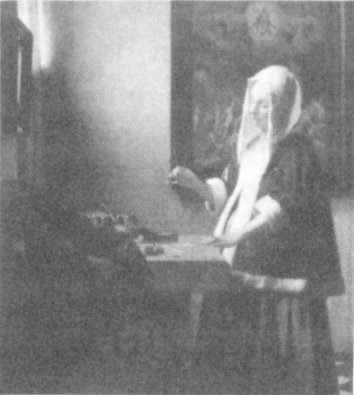
GALLERY 44: Jan Vermeer, A Woman Weighing Gold, painted c. 1657
One aspect of Vermeer’s genius was his ability to create a poetry of the obvious, to transmute a mundane scene into an evocative moment. In what appears at first to be a simple depiction of a woman holding a pair of scales, a framed painting of the Last Judgment included on the back wall of the scene suggests a more serious, allegorical meaning. Weighing the souls of mankind serves as a point of comparison to the woman weighing her worldly possessions. Vermeer’s incomparable sensitivity in rendering effects 14 of light can be seen in the careful modulation of the cool, muted daylight that fills the room. Especially striking are the touches of pure white paint that highlight the fur collar and the pearls on the table. The stable, geometric gridwork formed by the table, picture frame, and window reinforce the calm and serious mood.
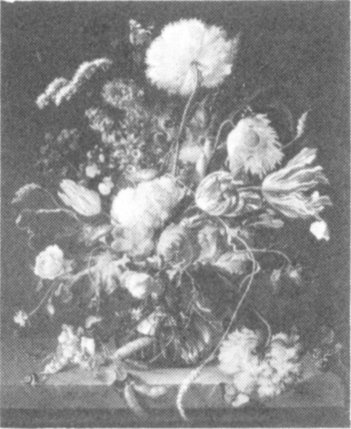
GALLERY 44: Jan Davidsz. de Heem, Vase of Flowers, painted c. 1645
This still life reveals more than a study of inanimate objects positioned in light and shadow; it also betrays the artist’s interest in the lively microcosmic worlds unnoticed in our daily life. Using more than twenty varieties of blossoms, including roses, tulips, morning-glories, and candytuft, de Heem weaves the blooms, overflowing in the insect-inhabited shadows, into the arrangement of sunlit flowers thriving in the central area of the painting. Since none of the flowers bloom concurrently, the artist portrayed them either from illustrations in botanical texts or from his own studies made during different times of the year. Such interest in the cycle of the seasons and the transience of life, as reflected in this symbolic bouquet, is frequently seen in Dutch flower painting.
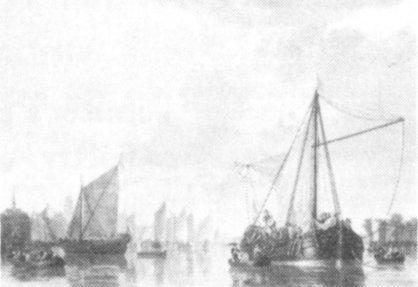
GALLERY 47: Aelbert Cuyp, The Maas at Dordrecht, painted c. 1660
Cuyp was a marine and landscape painter, noted for his delicate atmospheric effects. A major portion of this composition is taken up by the sky, which is painted in translucent washes of thinned oils. The scene, bathed in the gentle golden light of early morning, shows the Maas River and, at the left, the unfinished church tower of Cuyp’s home city of Dordrecht. The fleet of boats on the left, arranged on the diagonal, serves both to create deep space and to contrast with the single massive ship on the right. As cannons salute in the middle distance, a figure in a vivid red, black, and white uniform prepares to board ship.
15
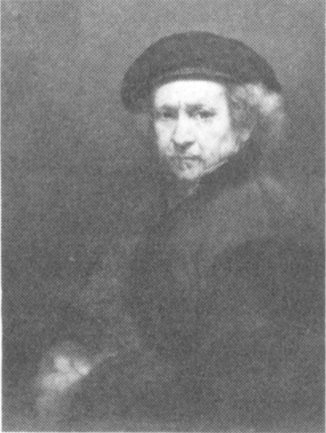
GALLERY 48: Rembrandt, Self-Portrait, dated 1659
The some sixty self-portraits painted by Rembrandt during his long career form a unique visual autobiography. In early life, he was Amsterdam’s leading portraitist and narrative painter and a wealthy man. Later, ravaged by bankruptcy and personal misfortunes, Rembrandt became increasingly introspective. In this self-portrait, painted when he was fifty-three, all but the essential forms are concealed in shadow. Light appears to emanate from the face itself, although the eyes are veiled in a mysterious half-shadow. Rembrandt’s technical genius enabled him to create subtle nuances even within a restricted range of color; the golden light glistening from his forehead merges with the blue-gray at the temples. All of Rembrandt’s painterly skill was used, ultimately, to confront us with a candid self-appraisal that neither flatters nor disparages. (The National Gallery has a wide range of Rembrandt paintings in galleries 45 and 48.)