Flemish and German Art (Galleries 35, 35A, 39-43)
Reading edition
At the beginning of the fifteenth century, northern European art was caught up by the same spirit of empirical inquiry and technical innovation that predominated in Italy during this period. Northern art, however, reflects neither the influence of classical art nor the development of a single-point perspective that are the hallmarks of the Italian Renaissance. Rather, Netherlandish artists such as Jan van Eyck achieved mastery in the new technique of oil painting. The use of oil on wood panel permitted an extraordinary increase in the depth and richness of color, which, in turn, was coupled with the tradition of minute, craftsmanly detail established in late medieval manuscript illumination.
Around 1500, Italian humanism and Renaissance science had a discernable effect upon northern European painting. Albrecht Dürer (gallery 35A) and Francois Clouet (gallery 41) both profited from their exposure to Italian art. The Renaissance influence carried over into the work of Rubens in the seventeenth century despite the religious and political upheaval of the Reformation which affected so 11 much European art of the mid-1500s. Catholic Flanders, the home of Rubens, remained relatively untouched by the changing times and maintained a continuity of political and economic ties to the Spanish monarchy. Rubens, who drew heavily from the work of earlier Italian masters, at the same time developed a baroque preference for large-scale canvases and bravura brushwork, transmitting this style to his associate van Dyck.
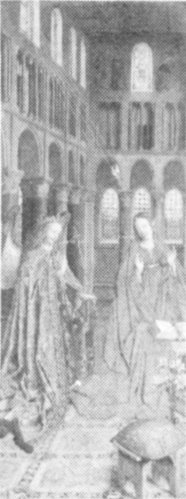
GALLERY 39: Jan van Eyck, The Annunciation, painted c. 1425/1430
The sacred setting of a medieval church provides the backdrop to van Eyck’s interpretation of the Annunciation. The archangel Gabriel, dressed in jewels and rich fabrics, greets Mary: “Hail Mary, full of grace.” The simply gowned young virgin lifts her hands in wonder and replies, “Behold the handmaiden of the Lord.” The two Latin phrases (Mary’s is written upside-down) reinforce the contrast and balance between these two important figures: Gabriel in his sumptuous attire and with wings in rainbow colors stands slightly in front in a partially turned position, whereas Mary in her subdued glory sits slightly behind the angel and faces forward. Following the established tradition of the story, van Eyck added a lily, symbol of purity, and a dove, symbol of the Holy Spirit. He also decorated the floor tiles with Old Testament scenes prefiguring the life and triumph of Christ—Samson destroys the Philistine temple and David slays Goliath. This subtle integration of religious history into the background of the painting is indicative of the late medieval belief that objects of the external world are imbued with religious symbolism.
12
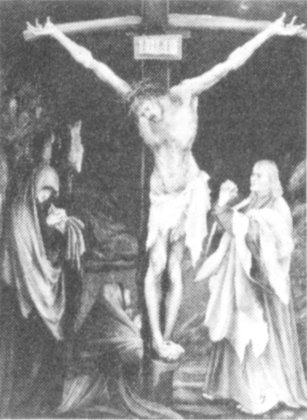
GALLERY 35A: Mathis Grünewald, The Small Crucifixion, painted c. 1510
One of the few surviving paintings by Grünewald, this crucifixion amply displays the emotional power of this German Renaissance artist. Set against a sky darkened by an eclipse of the sun, the scarred and haggard body of Christ makes the scene painfully and physically immediate. With the agonized gesture of the hands, the ragged loincloth, the dislocated shoulders, and twisted feet, little remains to soften the tension of the painting; rather, the artist emphasizes the human suffering necessary for Christ to redeem mankind. Painted on the eve of the Protestant Reformation, this panel reflects the growing insistence in northern Europe upon the reality and importance of private religious experiences.
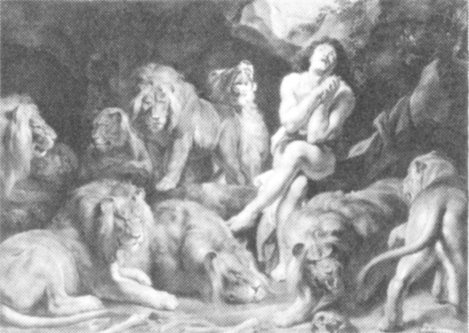
GALLERY 41A: Peter Paul Rubens, Daniel in the Lions’ Den, painted c. 1615
Scholar, collector, diplomat, and one of the finest artists of his century, Rubens was famed for the boundless enthusiasm and technical wizardry of his paintings. This monumental piece was executed early in Rubens’ career. Its impact depends not only upon its large scale but also upon the baroque combination of the theatrical—the dramatic lighting and Daniel’s expressive pose—with a convincing realism—the lifelike postures and superbly rendered lions’ fur.
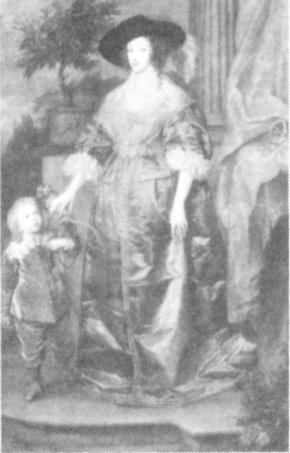
GALLERY 42: Sir Anthony van Dyck, Queen Henrietta Maria with Her Dwarf, painted probably in 1633
Painted in London, this depiction of Henrietta Maria, wife of Britain’s Charles I and sister of France’s Louis XIII, is a prime example of the baroque “Grand Manner” portrait. Analysis of character is sacrificed in favor of a stately and essentially flattering mode of presentation; the glittering crown, for example, recalls Henrietta Maria’s station as a queen and the sumptuous fabrics declare her wealth. The large size of the canvas and the lack of expression on the queen’s face are both devices that engender a mood of aloof formality and grandeur; animation and warmth are limited 13 to the minor figures of the dwarf Geoffrey Hudson, who was to become a trusted ambassador, and his pet monkey Pug. With seventeen paintings by van Dyck, the National Gallery has one of the finest and most representative collections of portraits by this master.