British Art (Galleries 57-59 and 61)
Reading edition
The history of sixteenth-century England was characterized by unstable, often short-lived alliances made with her several continental neighbors. No wonder then that the influx and influence of foreign artists during this and the following century reflects the diversity of political ties between England and Europe. In the 1500s, the German Hans Holbein the Younger (gallery 40) was court artist to Henry VIII soon after that monarch’s audacious break with the Church, and in the 1600s the Fleming, Anthony van Dyck (galleries 42 and 43), was in the employ of Charles I.
20
In the eighteenth century, however, when England became a leading maritime and industrial nation under George III and George IV, a large group of native British painters emerged, and in 1768 the Royal Academy was founded in London. The portraitists were led by Sir Joshua Reynolds, first president of the Royal Academy, and Thomas Gainsborough, noted for his virtuoso brushwork. Among their contemporaries and followers were Romney, Hoppner, Raeburn and Lawrence. In the early 1800s, England produced two landscapists who achieved international reputations. Constable was basically a realist in his study of scenes in natural light; Turner, however, was a romantic who interpreted the moods of nature.
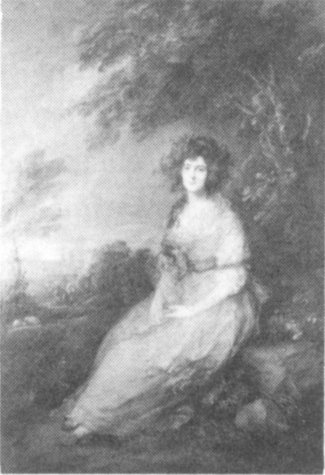
GALLERY 59: Thomas Gainsborough, Mrs. Richard Brinsley Sheridan, painted probably 1785/1786
With a feeling for theatricality, Gainsborough interplays the frail figure of a young woman and the powerful mood of nature to establish a perfect setting for this celebrated actress and wife of the playwright and politician Sheridan. Born Elizabeth Linley, she was Gainsborough’s lifelong friend. A motif common to the eighteenth century, the Age of Enlightenment, was the use of nature and an informal pose to achieve unaffected simplicity. In this portrait, however, early signs of romanticism are clearly seen in the dramatic quality of the blowing trees and windswept figure contrasted with the calm features of the finely modeled face. Gainsborough normally painted under candlelight to give a glow and flickering liveliness to his sitters and sometimes used six-foot-long brushes to avoid finicky detailing.
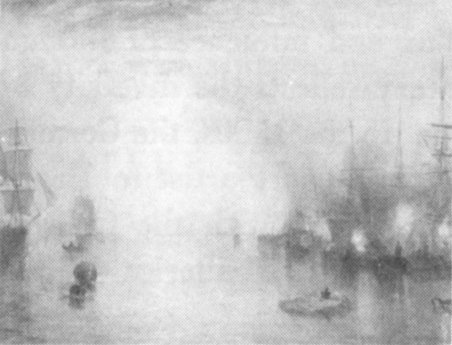
GALLERY 57: Joseph Mallord William Turner, Keelmen Heaving in Coals by Moonlight, painted probably in 1835
Turner’s exaggerated rendition of moonlight was criticized by conservatives when this night scene on the River Tyne was exhibited at the Royal Academy in 1835. Cutting through the center of the painting, the arched curve of brilliant light transforms the reality of a gritty industrial scene into 21 an appealingly romantic seascape and brings the world of man into accord with nature. Through the misty English air and against the thinly painted sky, the moon shimmers forth as a disk of thick white paint.