THE COLLECTIONS
Reading edition
3 Florentine and Central Italian Art
6 Venetian and North Italian Art
8 Italian Art of the 17th and 18th Centuries
10 Flemish and German Art
13 Dutch Art
15 Spanish Art
16 French Art of the 17th, 18th, and Early 19th Centuries
19 British Art
21 American Art
24 French Art of the 19th Century
28 20th-Century Art
30 Decorative Arts
30 Prints and Drawings
31 Index of American Design
About the Works of Art Listed in this Brochure
Owing to changes in installation, certain works of art listed in this brochure may not always be on view. For up-to-date information, please inquire at the information desks.
2
The paintings and sculpture given by the founder, Andrew W. Mellon, comprising works by the greatest masters from the thirteenth to the nineteenth century, have formed a nucleus of high quality around which the collection has grown. Indeed, in making his gift Mr. Mellon had expressed the hope that the newly established National Gallery would attract gifts from other collectors, so that these works of art might be enjoyed by all and would be a lasting contribution to the cultural life of the nation.
Mr. Mellon’s hope that others would carry on the work was realized, even before the Gallery opened, by the action of Samuel H. Kress, who gave to the nation his great collection of paintings and sculptures of the Italian schools ranging from the thirteenth to the eighteenth centuries. Enlarging and enriching the Kress Collection on subsequent occasions, Samuel H. Kress and his brother Rush H. Kress made the National Gallery outstanding for its representation of Italian art and also added a distinguished group of French eighteenth-century canvases and sculpture and fine examples of early German paintings, as well as works of first importance from other schools.
In 1942 Joseph E. Widener gave the famous collection of painting, sculpture, and decorative arts formed by him and his father P.A.B. Widener. Chester Dale, besides making numerous gifts during his lifetime, bequeathed his extensive collection of nineteenth- and twentieth-century French paintings to the Gallery. Ailsa Mellon Bruce also bequeathed her collection of French paintings to the Gallery and, in addition, generously provided funds for the purchase of many old master paintings, including the Leonardo da Vinci. Lessing J. Rosenwald has given over 20,000 prints and drawings.
In addition, more than 325 other donors have generously added to the collections of the National Gallery of Art.
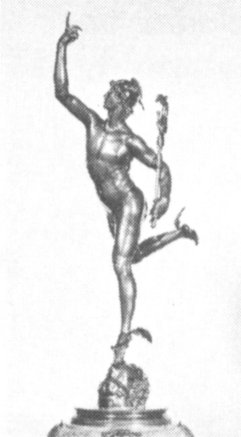
ROTUNDA: Attributed to Adriaen de Vries, Mercury, cast probably c. 1603-1613
The vigorous movement, muscular lines, and above all the grace and lightness of the bronze figure capture in this Mercury the fleeting presence of an ancient god. Protector of the forlorn and travel weary, patron of shepherds, merchants, wayfarers, and even thieves fleeing the law, Mercury was the bearer of news and tidings for the gods of mythology. He was known by his winged feet, a 3 traveler’s cap with wings, and his herald’s staff, a caduceus, perhaps given him by Apollo, who had the power of healing. The design of Mercury’s caduceus with its two serpents intertwined has been traditionally associated with medicine and is the adopted symbol of the medical profession. This masterful piece was probably made by Adriaen de Vries, a Dutch artist trained in Italy, and was modeled after a Mercury completed twenty years earlier by Giovanni Bologna.