American Art (Galleries 60, 60A, 60B, 62, and 64-68)
Reading edition
Established as a subculture of the mother country, the American colonies looked to England for leadership in the arts. Ambitious painters, finding no opportunity for formal training in the colonies, went to study in Europe. Benjamin West, a Pennsylvania Quaker, after three years in Italy, in 1763 established himself in London, where he achieved such renown that he became History Painter to King George III and was later appointed second president of the Royal Academy of Arts. Until after the Civil War, the best training was still abroad, but usually the American students returned to the United States, where a growing urban society with more leisure was providing a market for works of art.
During the first half of the nineteenth century, many untrained artists, working in the cities but more often traveling about the countryside, provided naïve or primitive pictures for the ever-increasing middle classes. Up to this time the artist had been mainly a portraitist; but with the invention of the camera in 1839 he had to shift his emphasis, and by mid-century America had a thriving school of landscape painters, whose works fed a national pride in the great wild terrain of the New World. After the Civil War, however, these landscapes also appealed to a populace seeking relief in the ideal world of a quiet countryside away from the humdrum of dirty cities that were springing up everywhere, the result of the Industrial Revolution.
Thomas Eakins and Winslow Homer were the great turn-of-the-century artists. They portrayed American life and scenery with straightforward candor. Their example has been carried on by some modern American artists who, fascinated with the urban growth of the 1900s, have emphasized the vitality of city life. These include painters such as Henri, Bellows, and Sloan. More recently abstract art has been in the forefront of American painting.
22
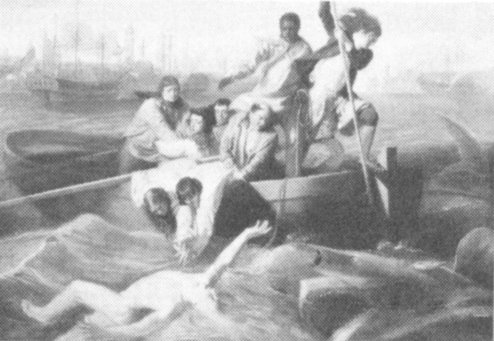
GALLERY 64: John Singleton Copley, Watson and the Shark, dated 1778
Unusual in European art, the sense of immediacy in this rescue scene was an American innovation, and it assured Copley’s reputation in Britain while furthering the importance of realism in narrative painting. The successful merchant and former English sailor Brook Watson commissioned the young American artist, who had settled in London, to depict an adventure that occurred in the sailor’s youth. Watson had been attacked by a shark while swimming in Havana, Cuba, in 1749. Using a fresh approach, Copley recaptured the horror of that event by lending vivid emotions to the rescuers—cowardice, fear, compassion—and by catching the helpless fright of the boy.
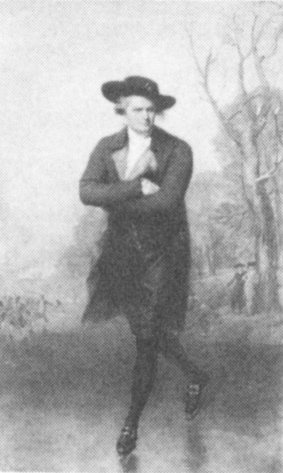
GALLERY 60B: Gilbert Stuart, The Skater, painted in 1782
Artist and subject, while breaking from the first posing session for this portrait, took to the fresh air and exercise of skating on the frozen Serpentine in London’s Hyde Park. The sport gave Stuart a novel idea, which he translated with a free-spirited freshness and vigor. Commissioned by Mr. William Grant, this, Stuart’s first full-length portrait, was a triumph at the Royal Academy exhibition in 1782. Unlike West, under whom he studied, and Copley, another American artist, Gilbert Stuart eventually returned to the United States, achieving further fame with his innumerable portraits of George Washington. Painted in 1795, the famous portrait in gallery 62 is believed to be his first life study of the president.
23
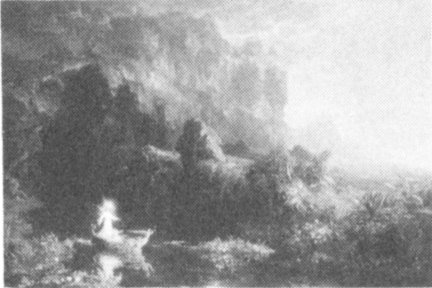
GALLERY 60: Thomas Cole, The Voyage of Life: Childhood, dated 1842
One of the earliest American landscapists, Thomas Cole produced imaginary, symbolic scenes as well as glorified panoramas of native wilderness. In the first of four fantasies, Childhood, a baby’s ship of life, steered by a guardian angel, floats at the source of a river toward a promising dawn. In the other three pictures completing The Voyage of Life series, Youth sets off on a meandering stream, striving toward a castle in the clouds, while Manhood weathers a storm on a tumultuous river and Old Age drifts into a quiet ocean where heavenly messengers wait to receive him.
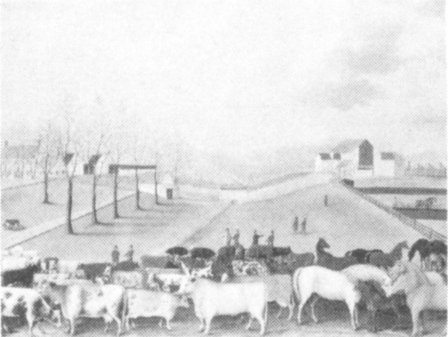
GALLERY 66: Edward Hicks, The Cornell Farm, dated 1848
After an 1848 Pennsylvania agricultural fair, James Cornell commissioned this record of his prize-winning livestock and acreage. In addition to carefully detailing each cow, horse, pig, sheep, and building, the artist Edward Hicks has also emphasized the decorative patterning of the group. This so-called naïve piece does not present a sophisticated rendering of anatomy or landscape, but it does present a study in contrast between the rhythmic row of animals and the geometric background. Lacking formal artistic schooling, Hicks was a sign and coach painter, who did pictures as a sideline or as favors for friends.
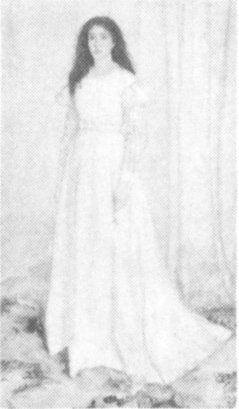
GALLERY 67: James McNeill Whistler, The White Girl (Symphony in White, No. 1), dated 1862
Painted in Paris, this canvas caused a scandal at an 1863 exhibition. The lack of personality in the face infuriated critics; they failed to realize that this was not intended as a portrait. Whistler, an American expatriate, was exercising his artistic theories by exploring a single tone—white. The starched cuffs, striped sleeves, cambric skirt, brocade curtain, and fur rug create a “Symphony in White,” as Whistler once titled this work. The fullness of the girl’s lips, the thick richness of her chestnut hair, and her wide blue eyes, 24 however, mark a subtle but uneasy contrast to the purity of the white color. This tension is carried further by the presence of the bearskin and the garish flowers wilting on the floor, symbolic, perhaps, of a bestiality of nature and an innocence lost. To emphasize the color relationships around this woman, his mistress Joanna Hiffernan, Whistler flattened the space and avoided strong lights and shadows.
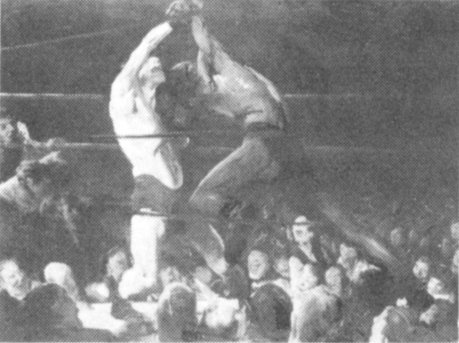
GALLERY 68: George Bellows, Both Members of This Club, painted in 1909
When public boxing was illegal in New York, fights were held in private clubs with fighters elected as members for only the night of the match. The black boxer may be Joe Gans, lightweight champion from 1901 to 1908; his opponent has not been identified. Once a professional athlete himself, George Bellows understood the violence of the sport. Brutality is conveyed by the angular lines of the fighters’ bodies, the boldly slashing brushwork, and the lurid glare of spotlights within the gloomy arena.