French Art of the 19th Century (Galleries 72, 77, and 83-93)
Reading edition
French art during the second half of the 1800s is noted for its innovation and its diversity. Yet, although the paintings produced during this period differ in their visual effects, the artists of these works were all largely concerned with the same problem: how to treat nature and how to define reality. Thus, in reaction to the neoclassicists, who stressed line and color, and the romantics, who favored lush hues, exotic or unusual subject matter, and emotionalism, the realists sought to paint only what was before them, free from embellishment. Other artists such as Monet and Renoir concentrated 25 upon recording the fleeting and subtle color impressions created by changes in sunlight. Because their technique was rapid and sketchy, these latter artists gave less attention to studiously modeled form, and their paintings, although “realistic” in their rendition of light and space, do not have the solid, tangible qualities so evident in Academic painting. (The Gallery’s collections are particularly comprehensive in the works of Manet, Renoir, and Degas. Included also is Mary Cassatt, the only American who exhibited with the impressionists.) Still other artists rejected impressionism’s concern with transitory moments in order to express either their intuitive reactions to the natural world or their personalized interpretation of the physical laws that order appearances. Reality was redefined by these artists, such as Gauguin, van Gogh, Toulouse-Lautrec, and Cézanne, who were known as post-impressionists. It was their work which prepared the way for twentieth-century expressionism and abstraction.
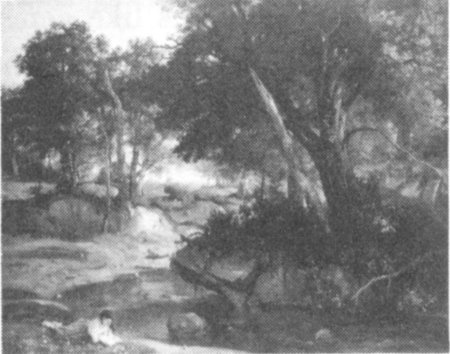
GALLERY 93: Jean-Baptiste-Camille Corot, Forest of Fontainebleau, painted c. 1830
Amid the controversies of nineteenth-century French art criticism, Corot was a transitional figure. Popular with conservative patrons, he was also a champion of the younger, radical painters. This scene in a forest near Paris is composed of traditional elements: the overlapping planes of light and dark foliage and a deep perspective established by the path of light and space running through the painting’s center. Corot’s treatment of light, studied directly from nature, is quite modern, however, as he exactly captures the harsh glare and heavy shadow caused by strong sun.
26
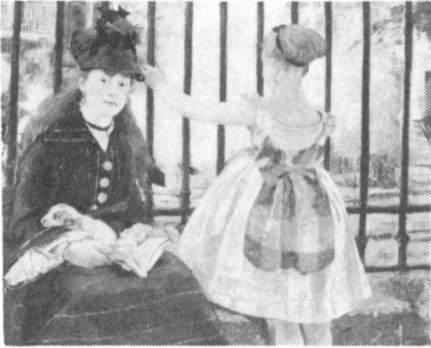
GALLERY 83: Edouard Manet, Gare Saint-Lazare, dated 1873
Overlooking Paris’ Saint-Lazare railroad yards, this sun-drenched scene is the first major picture Manet executed out-of-doors. Though influenced by his friends, the impressionists Monet and Renoir, Manet’s disciplined temperament rejected impressionism’s less structured effects. The rigid lines of the iron fence, for example, act as a foil for the figures’ curves. The little girl, whose interest lies on the rail yards behind, forms a subtle tension with the woman who gazes out at the viewer. The color scheme, with its reversal of colors, serves both to unify the pattern and to underscore the separation of the two figures: the full womanly figure is dressed in blue accented with white, whereas the childish figure is in white accented with blue.
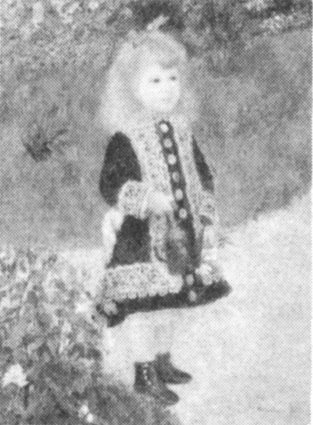
GALLERY 90: Auguste Renoir, A Girl with a Watering Can, dated 1876
Wanting to capture the dazzling colors found in strong sunlight, the impressionist painter Renoir intensified the natural hues of reality to a greater vibrancy on canvas. The green of the grass depicted here is more intense in hue than that which one might expect to find in nature, and the gravel path sparkles like gems. In calculating the juxtaposition of color, the artist placed pale blue-green shadows on the child’s face to heighten her rosy complexion. In addition, the blurred impressionist brushstrokes create the effect of shimmering sunlight dissolving form and detail. Once in response to criticism about his work, Renoir said, “There are enough things to bore us in life without our making more of them.”
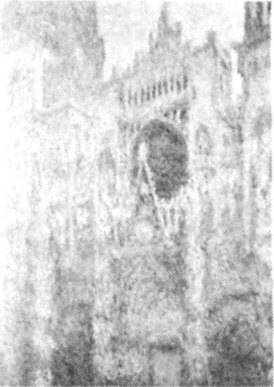
GALLERY 86: Claude Monet, Rouen Cathedral, West Facade, dated 1894
Monet, a founder of impressionism, became obsessed with the variations with natural light. From 1892 to 1895, he recorded in a series of paintings a medieval French cathedral as it appeared at different times of day or under different weather conditions. In over thirty canvases of Rouen Cathedral, Monet’s analyses of light on the cathedral’s surfaces resulted in iridescent colors and thick paint textures that are visually sensational 27 yet highly naturalistic. Here, in early morning, the church shimmers lavender and violet, the stone of the upper portions glowing in the rich red-orange of the rising sun. Another from the Rouen series, showing the church in the yellow-white heat of the afternoon, is also in this room.
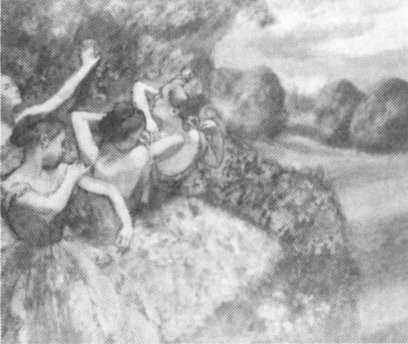
GALLERY 85: Edgar Degas, Four Dancers, painted c. 1899
One of Degas’ own favorite works, this, his last major oil painting, has a chalky texture reminiscent of the pastels he frequently used. Studying the strong patterns in Japanese prints as well as the snapshot effects of photography, this superb draftsman often designed his paintings with an angled point of view or created an off-center balance, cutting off figures by the frame edge. With the increasing abstraction of his late style, Degas here used a black outline which not only separates the gestures of the dancers but also accents their red apparel, intensifying the theatrical effect.
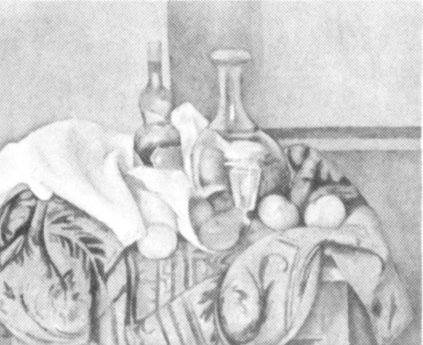
GALLERY 85: Paul Cézanne, Still Life, painted c. 1894
Most evident in this painting is the tension between what is, on the one hand, a rendition of nature and, on the other, Cézanne’s deliberate organization of the shapes into a rhythm of forms. The swirls and eddies of the blue drapery are reflected in the curves of the apples, peppermint bottle, white linen, and carafe. At the same time, horizontal or vertical lines dominate along the edge of the table, the molding of the back wall, and the neck of the bottle, creating a linear grid that offsets and balances the curving lines. The blue-green tonality, in addition to the geometric patterning, further demonstrates the artist’s intent to visually organize and unify. Indeed, for the sake of unity, Cézanne has even distorted the carafe by swelling it out on one side, pulling it deeper into the folds of the fabric.
28