Florentine and Central Italian Art (Galleries 1-10)
Reading edition
Because the Church defined much of the social and cultural structure of medieval life, Christian themes predominated as the subject matter for the arts of the period. In the National Gallery collections, works created in Florence, Siena, Rome, and Central Italy show the range of skills and styles prevalent in painting as it progressed from the highly religious art of the Middle Ages to the more secular art of the Renaissance.
The usual technique for medieval religious art was egg tempera on wood panels covered with a fine bone plaster, called gesso. Egg yolk mixed with powdered pigments was applied to the gesso surface resulting in pictures characterized by bright colors and clear outer contours. To recall the radiant light of the heavenly kingdom and to heighten the patterns typifying this art, the artist often used gold-leafed grounds as well.
By the late fifteenth century, tempera gave way to oil paints that dried more slowly, permitting the artist subtle modulations in his color and allowing him to create realistic atmospheric effects. As the Renaissance progressed, artists combined a renewed interest in nature, analytical science, and classical humanism with the recently developed techniques in media to bring about a corresponding realism in art.
4
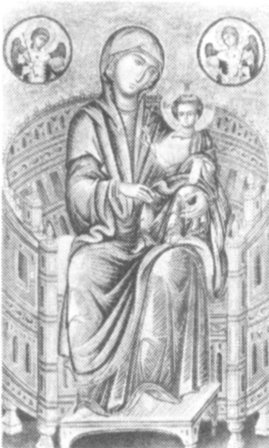
GALLERY 1: Byzantine School, Enthroned Madonna and Child, 13th century
A medieval walled city is transformed into a throne by this imaginative, unknown artist to symbolize the dominance of Christ and Mary, Queen of Heaven, over the celestial city. To symbolize Christ’s rule on earth as well, the artist included, in the rondels, images of angels bearing orbs and scepters. So typical of the art of the Byzantine Empire, this painting is an icon, or holy image, and reflects within its composition a fusion of ancient Roman and medieval Oriental styles. A feeling for classical solidity shows in the faces, which are modeled with cast shadows to suggest three-dimensional forms, whereas a Near Eastern love of decoration accounts for the flattened drapery patterns and their dazzling highlights. The Enthroned Madonna and Child and another large Byzantine icon of the same subject, also in this room, are among the earliest paintings in the collection.
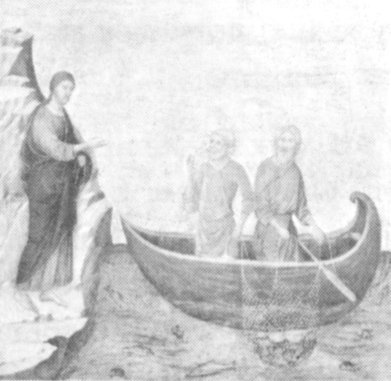
GALLERY 3: Duccio, The Calling of the Apostles Peter and Andrew, painted between 1308 and 1311
Called to be “fishers of men,” the brothers Peter and Andrew pause in their labors at the persuasive words of Christ. In him, their future as apostles, or teachers, and the future of mankind hang momentarily suspended—like the net in their hands. This panel is part of an altarpiece commissioned for the high altar of the Cathedral in Siena and called the Maestà (“majesty”) because its central theme was the Virgin splendidly enthroned with angels and saints. The purpose of this piece, like so many medieval paintings, was to teach, and Duccio arranged bright colors in simple shapes so that the story could easily be recognized.
5
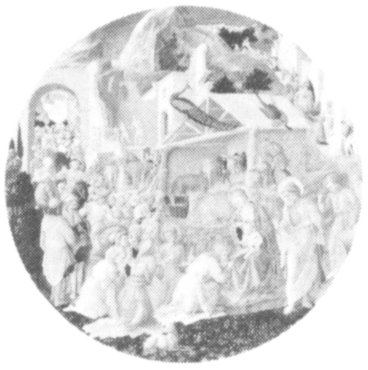
GALLERY 4: Fra Angelico and Fra Filippi Lippi, The Adoration of the Magi, painted c. 1445
Painted by two monks (Fra means “friar”), this important painting fuses the concerns and techniques of medieval and Renaissance artists. The tapestrylike lawn, the decorative bright colors, and the inverted perspective of the shed are elements common to medieval art. The realistic rendering of birds and animals, the weight and volume given the kneeling Magi in the foreground, and the classically inspired nude figures at the distant left reflect the new-found interest of the Renaissance in both classical antiquity and the external world. The colorful, festive mood of the painting, moreover, is emphasized by the bustling throngs of people arriving to worship the Christ Child.
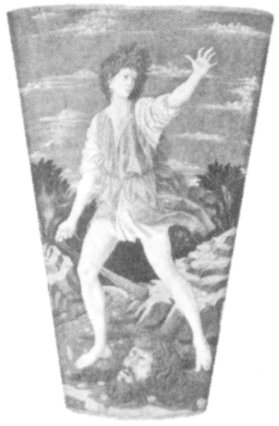
GALLERY 4: Andrea del Castagno, The Youthful David, painted c. 1450
Not simply a work of art, this painted leather shield reflects the uniquely nationalistic consciousness of the Florentine city-state. As a public image carried in parades and ceremonies, its function was to symbolize the Florentine struggle for freedom and, as a gruesome depiction of victory against oppression, to warn all potential enemies of Florence. On the shield, both main episodes of the Old Testament story appear concurrently: David takes aim with his sling, while the giant’s head lies already severed at his feet. The effective, although awkward, foreshortening of the upraised arm and the sharply delineated veins and muscles attest to Castagno’s Renaissance interest in the realistic rendition of perspective and anatomy.
6
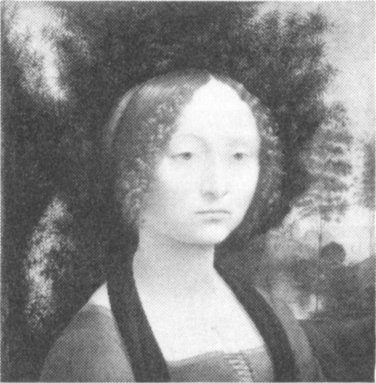
GALLERY 6: Leonardo da Vinci, Ginevra de’ Benci, painted c. 1480
With precise draftsmanship and an infinitely subtle manipulation of light and shadow, Leonardo captures the character of a young Florentine noblewoman of the fifteenth century. In her eyes he has drawn a look of intelligence; in her bearing and the set of her mouth, there is a sense of determination and conviction. Punning on the name of his sitter, the artist has framed her head with a juniper bush—ginepro in Italian—and decorated the back of the panel with a juniper sprig. Commissioned just after he completed an apprenticeship with Verrocchio, this early work is the only painting in the Western hemisphere accepted by scholars as indisputably by Leonardo, one of the true geniuses of the Renaissance.
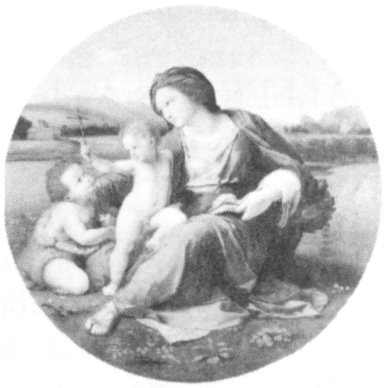
GALLERY 8: Raphael, The Alba Madonna, painted c. 1510
The solidity and serenity of the figures derive from the forms and poses seen in ancient Roman sculpture and from the art of Raphael’s contemporaries, Leonardo and Michelangelo. The equilibrium and stability of the grouping provides not only a freshness and majesty suitable for the religious moment but also a source of contrast to the subtle but painful implications of the reed cross held by the two children. Named for the Spanish Dukes of Alba who once owned it, the Alba Madonna is one of five paintings by Raphael in the National Gallery of Art.