Spanish Art (Galleries 30, 38, 39, 50, 51 and 76)
Reading edition
Imported by the royal courts or commissioned by the Church, foreign artists dominated the arts of Spain during the fifteenth and sixteenth centuries. Juan de Flandes, a Flemish painter (galleries 38 and 39), served the court of Ferdinand and Isabella, and El Greco (gallery 30), a Greek who studied in Venice and Rome, settled and worked in Toledo. By the 1600s, Spain had become an economic and cultural force in Europe, her power sustained in large part by the wealth of her vast American colonies. Seville was then the artistic capital of Spain; Zurbarán, Valdés Leal, Murillo, who founded an academy there in 1660, and Velázquez all worked in Seville. After moving to Madrid, Velázquez served Philip IV as court painter and director of the royal museum. The greatest Spanish artist of the late eighteenth and early nineteenth centuries was Francisco de Goya, who was court portraitist to a succession of corrupt monarchs and French conquerors. It should not be forgotten, too, that the twentieth-century artist Pablo Picasso (gallery 76) was first active in Barcelona before emigrating to France.
16
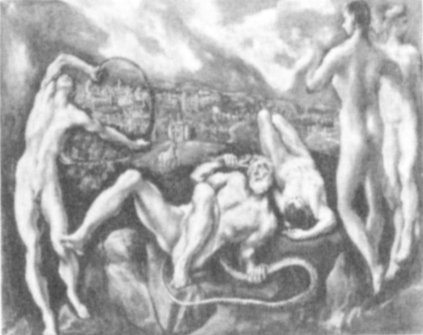
GALLERY 30: El Greco, Laocoön, painted c. 1610
Unnatural color, particularly in the weightless, elongated figures, combines with a mannered representation of landscape in this unearthly vision from Homeric legend. Shown is the priest Laocoön, who, with his sons, is attacked and destroyed by serpents for having offended the gods during the course of the Trojan War. Beyond the wooden horse lies the city of Troy, a distant and stormy image based on the artist’s adopted city of Toledo. Born in Greece, Domenikos Theotokopoulos was nicknamed El Greco, “the Greek,” when he moved to Spain in 1576.
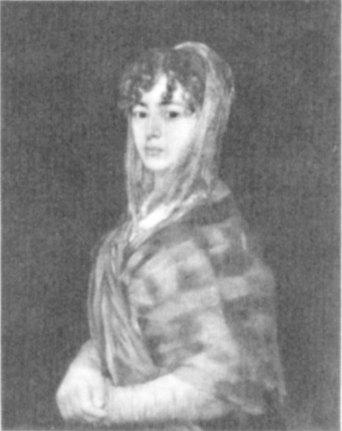
GALLERY 50: Francisco de Goya, Señora Sabasa García, painted c. 1806 or 1807
Acutely sensitive to the ignorance, hypocrisy, and cruelty in all levels of society, Goya often worked in a satirical mode to capture the realities of war and the tyranny and decadence of court life. Yet, in depicting the niece of a high-ranking government official, the artist has given us a marvelously direct and sympathetic portrait. The innate, peculiarly Spanish sense of pride and self-discipline is evident in Sabasa García’s aristocratic posture and bold, unflinching gaze. Equally direct is Goya’s manner of painting, which captures the rough texture of the shawl as well as the gossamer quality of the mantilla lace. The result is a portrait of great intensity heightened by feminine beauty.