French Art of the 17th, 18th, and Early 19th Centuries (Galleries 33, 44, 52-56, East Sculpture Hall, and Lobby C)
Reading edition
Troubled by the Catholic-Huguenot wars and civil wars of the previous century, seventeenth-century France followed a course of aggression against foreign monarchies and of consolidation within 17 the French state. Most heavily supported by the royal court, French artists were sent to Rome to study the arts of the Italian Renaissance and classical antiquity; some, like Claude Lorrain and Nicolas Poussin (gallery 52), chose to remain in Italy. In Paris, an Academy, which rapidly became the ruling body for French art, was established in 1648. To enhance the brilliance of his reign in the latter part of the century, Louis XIV sponsored a ceremonial art—more idealistic than realistic in style—and built near Paris the largest palace in Europe, Versailles. The fountains in the National Gallery’s East and West Garden Courts once stood in the gardens of Versailles and still bear traces of the lavish gold leaf that originally covered them.
Under Louis XV and Louis XVI in the eighteenth century, French society became more relaxed and informal. Most apparent in the decorative arts, the move to a lighter, more graceful style affected painting as well. The new style, rococo, was first developed by Watteau (galleries 53 and 54), who used a carefree delicacy, pastel colors, and gracefully curving lines. After the French Revolution of 1789, a school of neoclassical artists dominated painting, using themes of patriotic heroism and stressing severe beauty of line and firm modeling, over light and color.
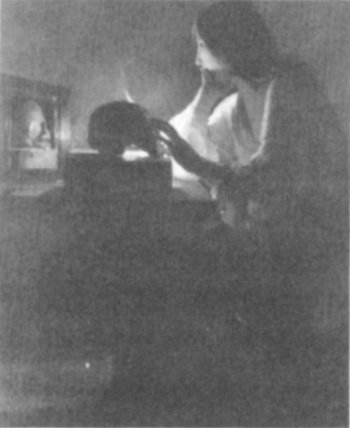
GALLERY 44: Georges de La Tour, The Repentant Magdalen, c. 1640
Within the melancholy darkness of this painting, the dim light reveals emblems of the vanity and brevity of life: a skull, book, and mirror. Eliminating unnecessary detail, La Tour makes us focus on the inward, spiritual aspect of his themes, through monumental shapes and a nearly abstract geometry of forms. Mary Magdalen’s fingers touching the skull, for instance, are emphasized in stark angularity against the light from the hidden flame. Like Vermeer, La Tour is a rediscovery of recent years. Although highly respected in his lifetime, La Tour slipped into obscurity, and only thirty-eight of his paintings survive today. A court painter to Louis XIII, La Tour was noted for his “nocturnes,” which generate a mood of isolation by their dense shadows that envelop the composition.
18
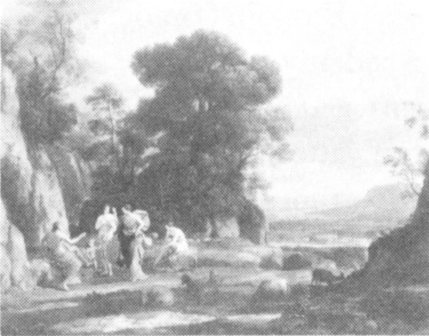
GALLERY 52: Claude Lorrain, The Judgment of Paris, painted 1645/1646
In a landscape of such serenity and beauty as this, the figures almost play a secondary role. The perfectly blue sky with light cloud formations enhances the golden tones of the foreground; the distant Trojan citadel on the right balances the figures at the near left, where three goddesses gather round the Prince of Troy, Paris. Chosen to judge the women on their beauty, Paris is bribed by Venus, here accompanied by her son Cupid, and accepts her aid in abducting Helen, Queen of Sparta. Claude’s vision of this episode, which eventually touched off the Trojan War, is a fine example of his ability both to ennoble and to idealize nature, and it was this mode of painting which was to dominate European landscape painting for the next two centuries.
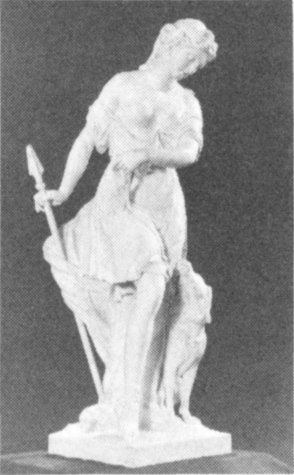
EAST SCULPTURE HALL: Jean-Louis Lemoyne, Diana, dated 1724
Girlish and slightly awkward, her skirts disheveled by the breeze, Diana is shown as though embarking on a woodland jaunt. The turning figure of the goddess, the poised, expectant look of her dog, and the lightness of her simple drapery lend a sense of buoyancy and delicacy to the ponderous weight of the marble. Lemoyne’s surviving masterpiece, this statue formed part of a group executed by several eighteenth-century French sculptors for the gardens of the Château de la Muette at Marly, a royal retreat and hunting lodge near Paris. This sculptural series helped to generate a new interest in graceful vitality, replacing the earlier ideals of serene monumentality in European statuary.
19
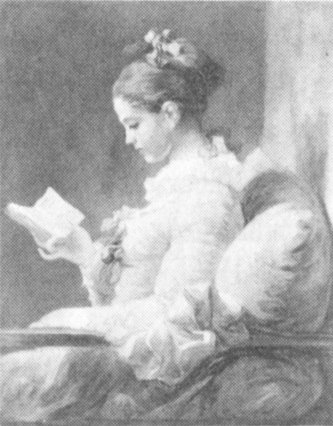
GALLERY 55: Jean-Honoré Fragonard, A Young Girl Reading, painted c. 1776
The delicate rococo style of the 1700s culminates in the work of Fragonard, court painter to Louis XVI. Indeed, an intimate portrayal such as this typifies rococo taste. Stabilized only by the straight wall and armrest, curving lines wind through the composition. Fragonard’s fascination with the irregular extends to the positioning of the girl’s hand and the boneless curl of her little finger, to the interlacings of her hair ribbons and the bows on her gown. The radiant golden quality of the light and the frothy texture of the paint add to the picture’s sensuous warmth.
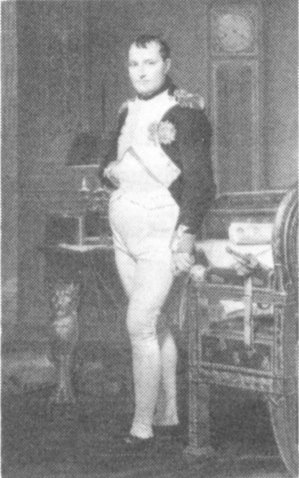
GALLERY 56: Jacques-Louis David, Napoleon in His Study, dated 1812
Sensitive to the political aspirations of his sitter, David has here chosen an activity, a time, and a setting that subtly but pointedly illuminate the tenacity and drive of the conqueror Napoleon. With the clock pointing to 4:13 and with candles guttering, Napoleon is presumably rising from a night of work; his dress uniform is wrinkled and his face unshaven. The study is littered with symbols of power, the sword alluding to Napoleon’s military conquests and the scroll on the desk representing the Napoleonic Code, still the basis of French law. The crisp silhouettes and dark colors typify the neoclassical style that followed the French Revolution of 1789.