THE UNGRATEFUL AGE
Reading edition
No sooner had Leon become encased in the uniform which distinguishes the city student from the provincial youngster in gray—viz., a black blouse with silver buttons—, than he came to know the monotonous and depressing life of the Russian schoolboy: rising by lamp=light during the long winter months; returning with his school=bag on his back; suffering the petty annoyances of an oppressive discipline and the black boredom of official education.
It was then that he discovered the theater. Not that he had ever been there. Like everybody else, his family had subscribed to a season ticket at the Italian Opera which was then at the height of favor and which eclipsed all efforts of an unappreciated national music to win its way; but our hero, being too small, was not allowed to go to the family box. With great difficulty, however, he had gained the privilege of staying up on Mondays—the days on which his family had the box—until their return. With delight he would then listen to his brother’s account of the “Puritans” or the “Favorita” and their tragical and pompous vicissitudes.
Tired of listening without acting, he constructed his own theater. He cut out his heroes from the sheets of colored paper soldiers, his princesses from the engravings in popular fairy tales illustrated at Epinal, his court ladies from the fashion magazines. Then he would place his actors on a paste board stage and “brush in” the scenery in water color with paint plundered from his color=box. The subjects were plentifully provided by the librettos of Verdi’s operas, augmented by supplementary murders. As for the audience—it was never lacking, Leon having always been the appointed and recognized entertainer of his little sisters.
This play of make=believe did not, however, entirely satisfy his precocious ardor. The strong desire for disguising and masking is, after all, quite general among children, who possess a genius for dramatizing the facts of life. Improvised plays were, therefore, put on. The most frequently recurring motif was the visit of the doctor. There was much
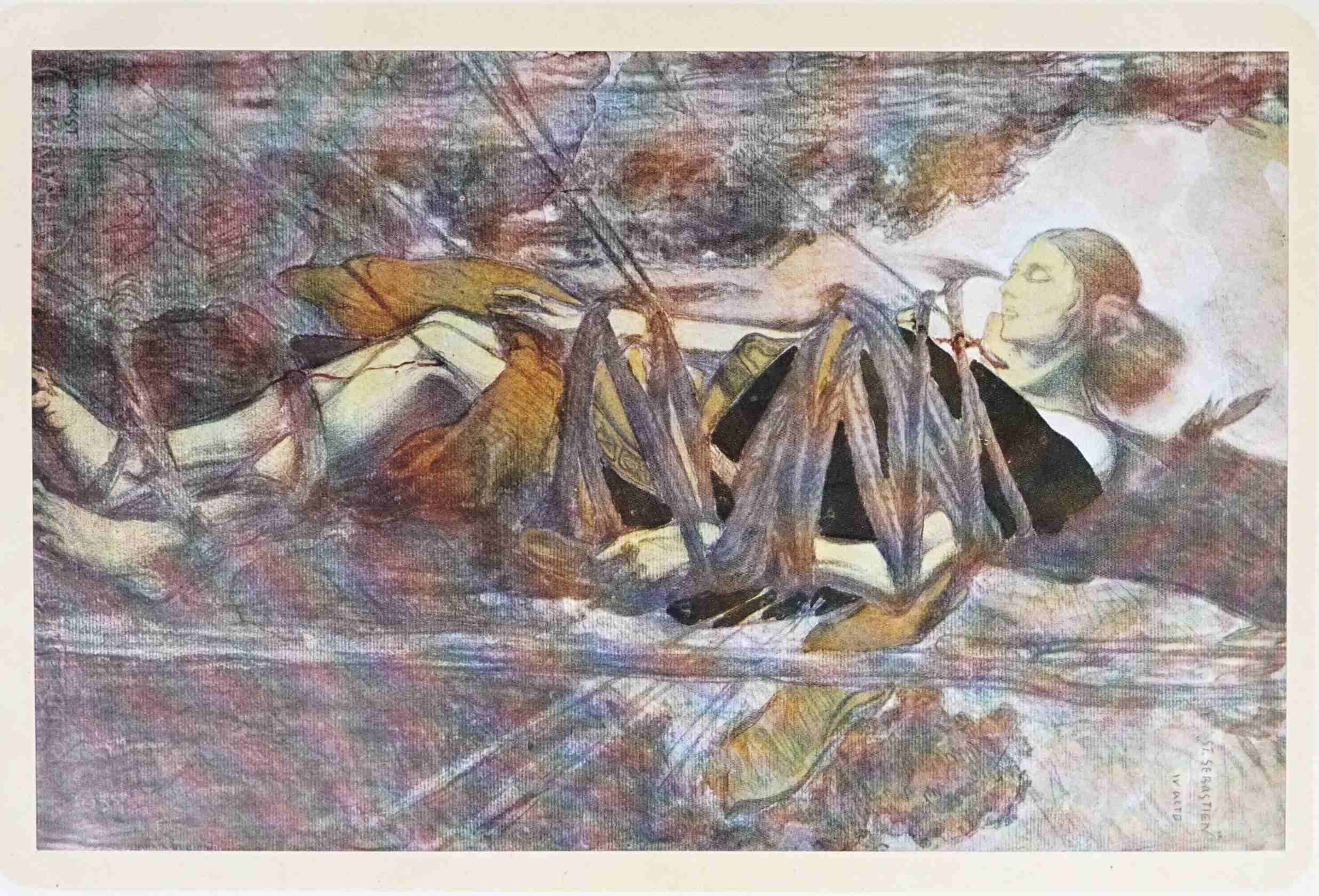
III
D’ANNUNZIO’S “MARTYRDOM OF ST. SEBASTIAN” (MME. RUBINSTEIN IN THE 5th ACT).
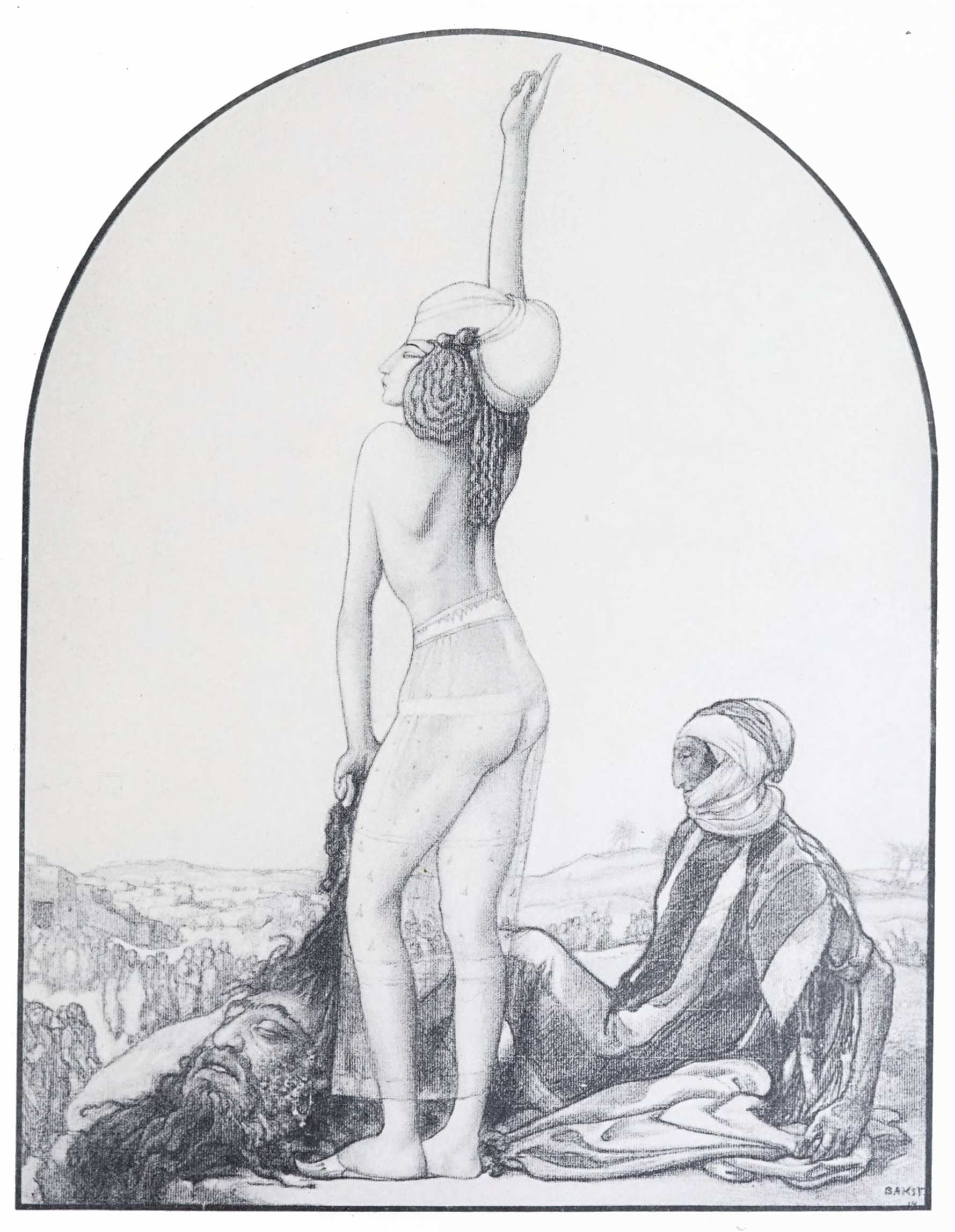
IV
JUDITH OF BETHULIA (PANEL)
illness at Leon’s home! Young Leon, besides being stage manager, would now play the role of the doctor with black robe, now that of the druggist, now even, with self=denial, the rather contemptible part of the patient.
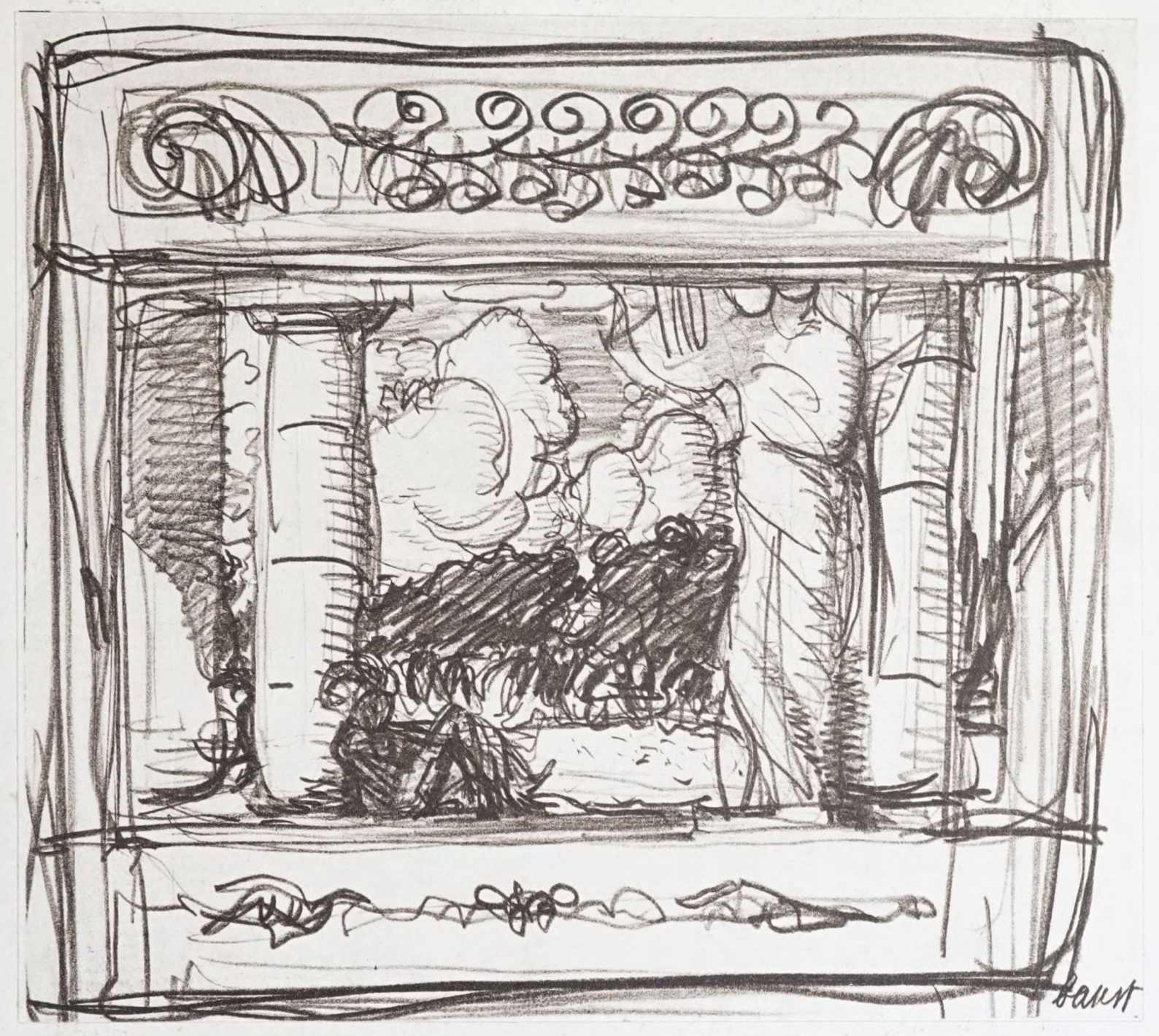
SKETCH OF COVER FOR THE REVIEW “APOLLON”
One day, as he had concocted a drug by diluting green coloring matter, he pursued realism to the point of swallowing the concoction. He fell ill. Only with the greatest effort in the world was it possible to save him by making him drink a quantity of milk.
Throughout all this, however, we do not yet see the painter come to the fore. Indeed, our schoolboy was decidedly not a success at drawing,
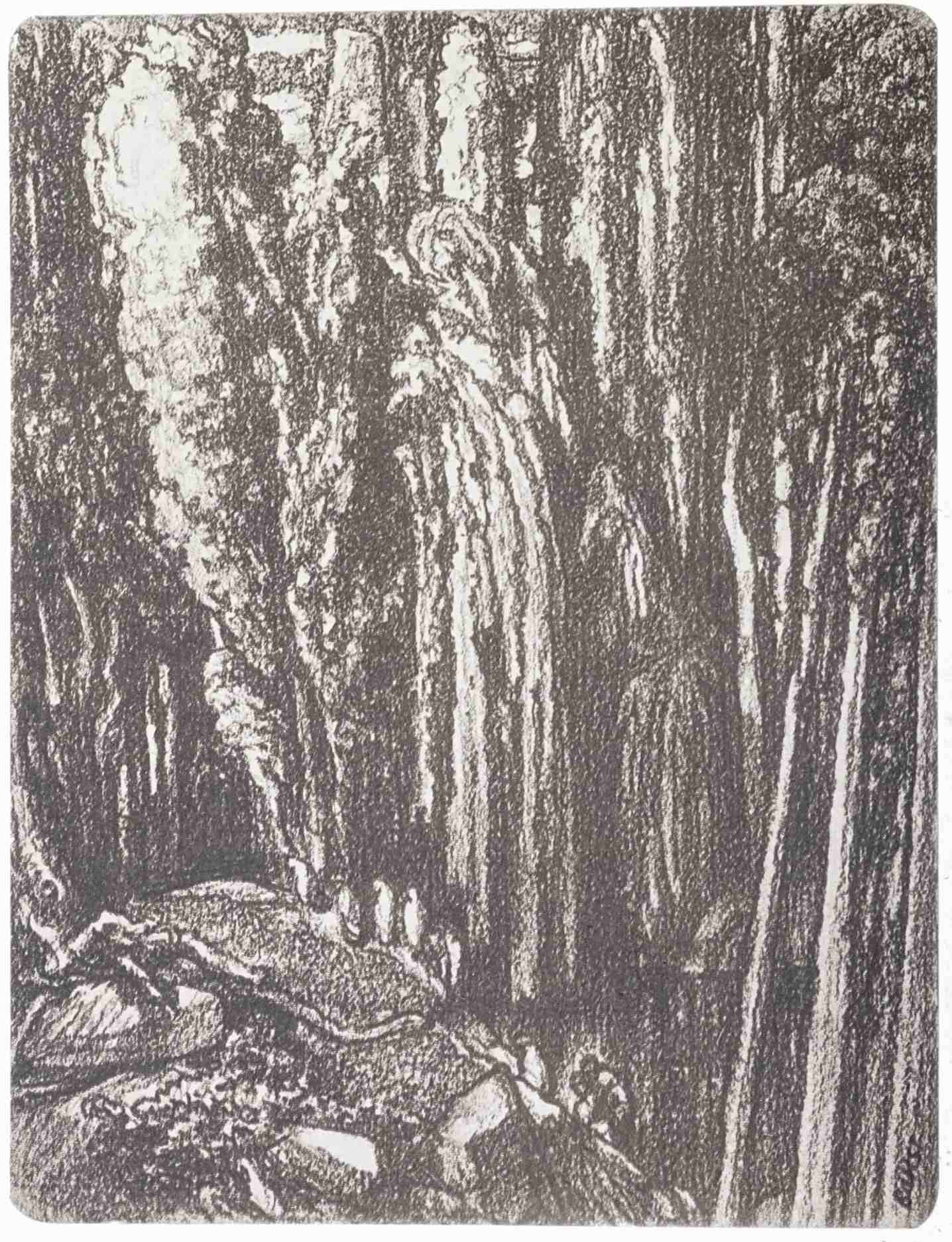
REMEMBRANCE (“ELYSIUM” CYCLE)
and with envy he watched how his chums sketched fine battle scenes upon the margins of their note books. His life’s calling announced itself for the first time when he was almost twelve years old. His school, known as “the sixth gymnasium”, was making preparations to celebrate the
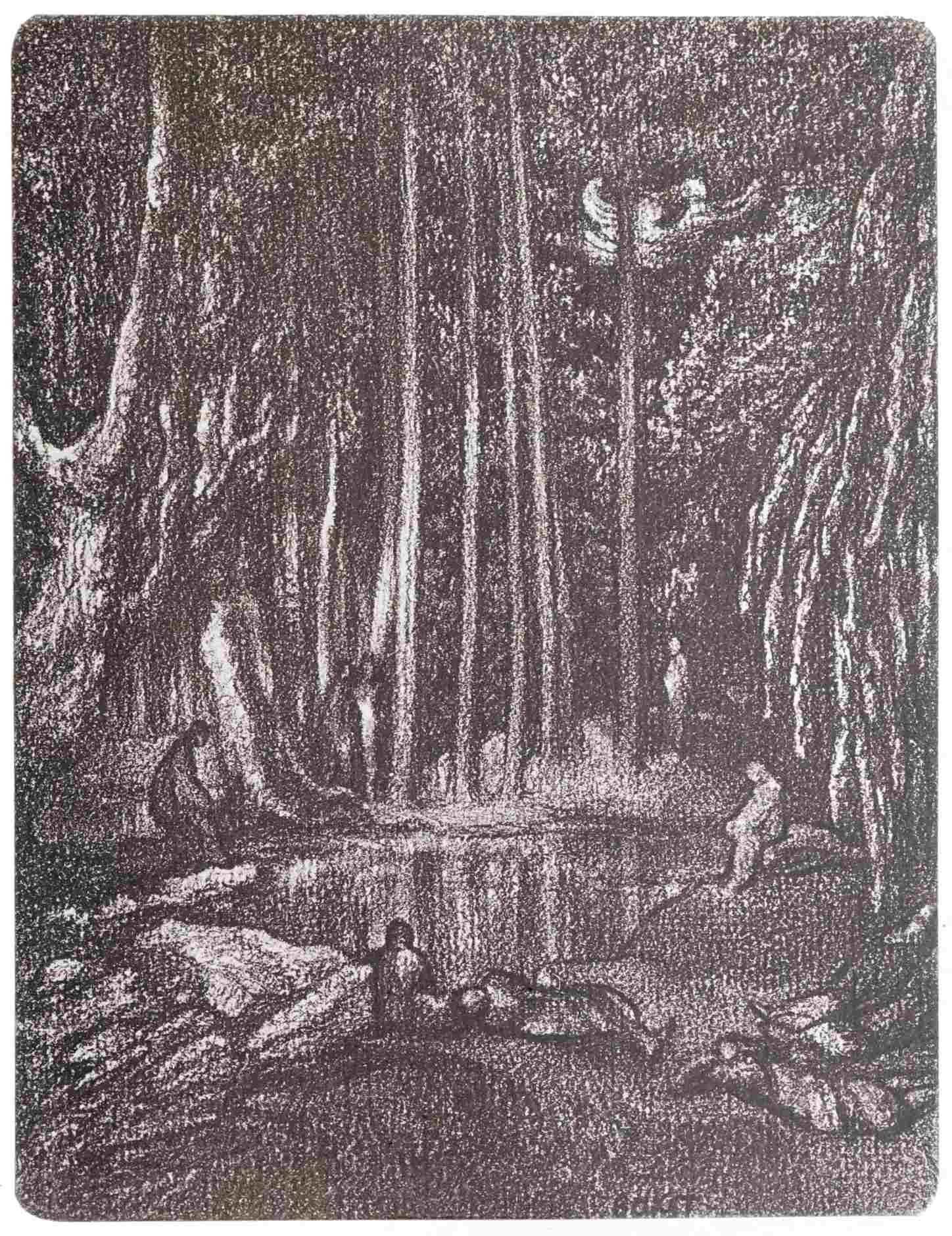
ETERNAL WANDERERS (“ELYSIUM” CYCLE)
centenary of Joukovsky, the celebrated Russian poet. A good portrait was wanted for the ceremony. Accordingly, a prize competition was organized. Bakst decided to enter it. He reverently took home the little engraving which was to serve as model, and four or five days later he brought back his drawing. The prize was awarded him, and his masterpiece put in a glass frame and hung in the gymnastic hall. From then on Bakst was unanimously proclaimed a painter, and he was able to pride himself on winning many a prize.
Leon’s father was not much pleased over this sort of success, especially since bad marks were raining thick in the other studies. He conceived the notion that his son’s predilection for drawing was due to sheer laziness. He therefore positively forbade him this pastime which, he argued, interfered with serious studies. Leon therefore continued drawing in secret, at night=time, by the light of a candle.
On the other hand his accomplishments brought him the friendship of his drawing and penmanship teacher, who became much attached to the youngster. Andrei Andreevitch was a diminutive little man with bowlegs; but this tail=coated freak in blue was fired with a divine enthusiasm. Striding about the class room he would talk incessantly to the pupils, now pondering the volutes of an acanthus leaf, now discussing the lives of great painters, their struggles, their triumphs. So volubly and so well did he speak that he stirred deeply the imaginative soul of little Bakst and awakened all the latent passion in him. Subsequently, the artist’s entire magnificent life was to be animated, as it were, by these rhythmic fits of intellectual fever, from which he was to emerge renewed, transformed, his mind’s eye turned toward unexplored horizons.
The profession of painting, therefore, suddenly appeared to Levoushka to be the highest of all destinies—one bearing the halo of heroism. Filled with this romantic dream, he was anxious to quit school at once. And he insisted with such impetuosity that his parents, routed in the argument, decided by way of setting him right to seek the advice of the sculptor Marc Antokolsky, a friend of the family and a recognized authority on all matters pertaining to art. The late Antokolsky was little known in Paris where he used to live, nor do people care much about him in Russia today, although his works, which are quite numerous, fill the museums of Moscow and especially of Petrograd. So deceptive is artistic glory!
For indeed, he had his day of glory. In Russia he was the sculptor of the century—of that nineteenth century which had lost the plastic
V
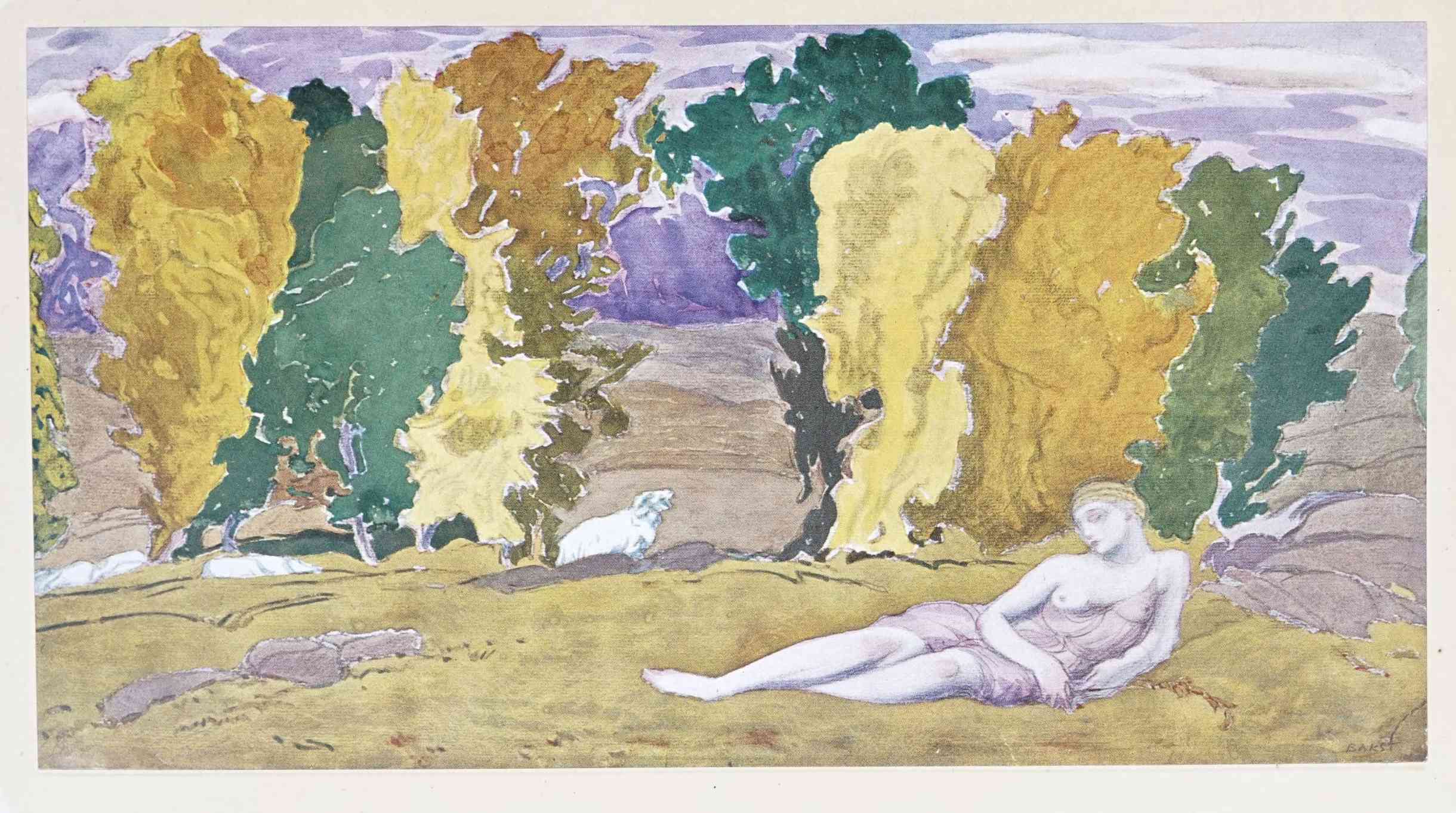
“FORSAKEN CHLOE”. PROJECT OF DECORATIVE PANEL. (GOUACHE)
VI
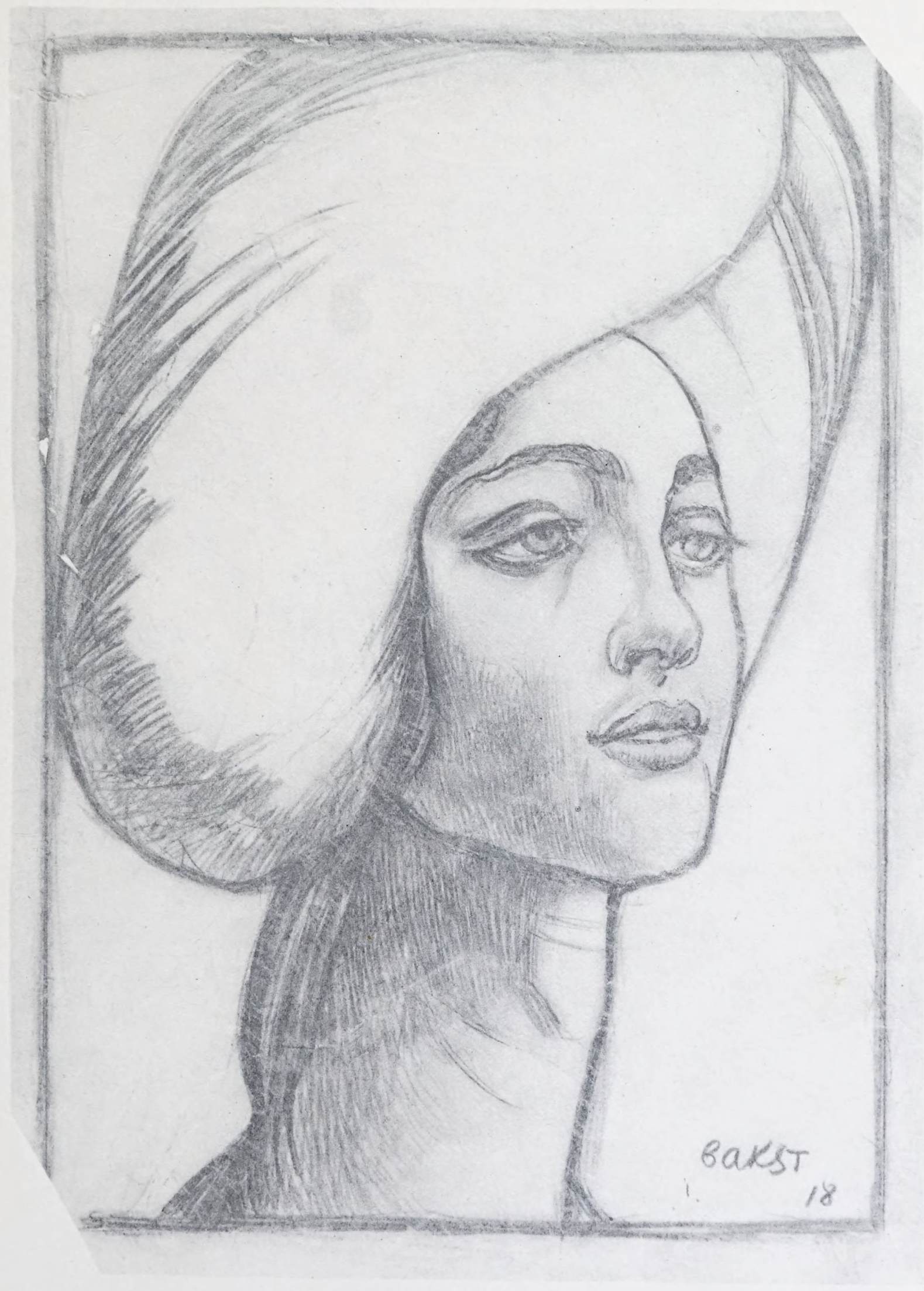
PORTRAIT OF MR. T. (RED CHALK)
arts almost completely. The conception of a strict naturalism placed at the service of humanitarian and social ideals, dominated by the idol People, a conception that also characterized the notable and prophetic “Association des expositions ambulantes”, was also his. Moreover, Stassov, the voluble and prolix critic who composed for the great Moussorgsky the monstrously confused text of “Khovanshchina”, turned Antokolsky’s mind toward Russian history.
And thus, through his bronze and marble sculptures, Antokolsky became the historical illustrator and portraitist of Russia. He wrought Ivan the Terrible, Nestor the Annalist, Peter the Great, and even Ermak the Cossack, conqueror of Siberia. With keen psychological sense he also composed the likenesses of heroes and martyrs of free thought: a dying Socrates, a Spinoza and a Christ insulted, the latter work being conceived in the spirit of Strauss and Renan. All these monumental figures which greatly stirred his contemporaries no longer show any signs of life.
There remains the personality of Antokolsky, which was in every respect a pure one. Not without reason did this poor and pertinacious young Jew, who hardly knew how to write Russian, become the idol and the oracle of two generations. We see but too clearly today that he travelled the wrong road. But he had faith. His artistic convictions were unalterable, unselfish, absolute,—those of a fanatic. More than that—a thing seldom to be found—, this fanatic was kindness itself.
Antokolsky, then, on being consulted made much of the misfortunes and bitter disappointments that one embarking upon an artistic career must expect. But he was not unwilling to look Leon’s drawings over. Pestered by the youngster, his father sent several sketches to Paris. Lo and behold! when the reply, so anxiously awaited by the boy, arrived, it was favorable, decisive, almost intoxicating. The master had found the drawings quite well done and advised the boy’s going to the Academy of Fine Arts, on condition, however, that he pursue his general education.
Thus Leon, the intractable and mediocre schoolboy of the day before, was to become a painter, a chosen and quasi-legendary being. He was then sixteen years of age.