A WRONG START
Reading edition
Leon was free now and left alone with his pride in his recent revolt; but there was also a great void in his soul. A country holiday out at Pavlovsk, the delightful suburban residence district where Constantine, the grand duke-poet, lived, afforded him salutary diversion. In the beautiful English park—the loveliest in all Russia—, where every clump of trees, every hill, every lawn forms part of a grandly-devised and complex general plan conceived by an architectural genius; in this park, in which he walked about carrying the burden of his liberty—a melancholy figure, he found what he lacked most: a friend. This new-found friend was a cartoonist by the name of Shpak, a pupil of Repine, and, though but a mediocre artist, yet one who gave himself to painting with a passionate and unselfish spirit. He guided Bakst in looking for motifs, spurred him on to direct observation of Nature, and awakened in him the proper respect for his profession. But this influence soon gave way to another.
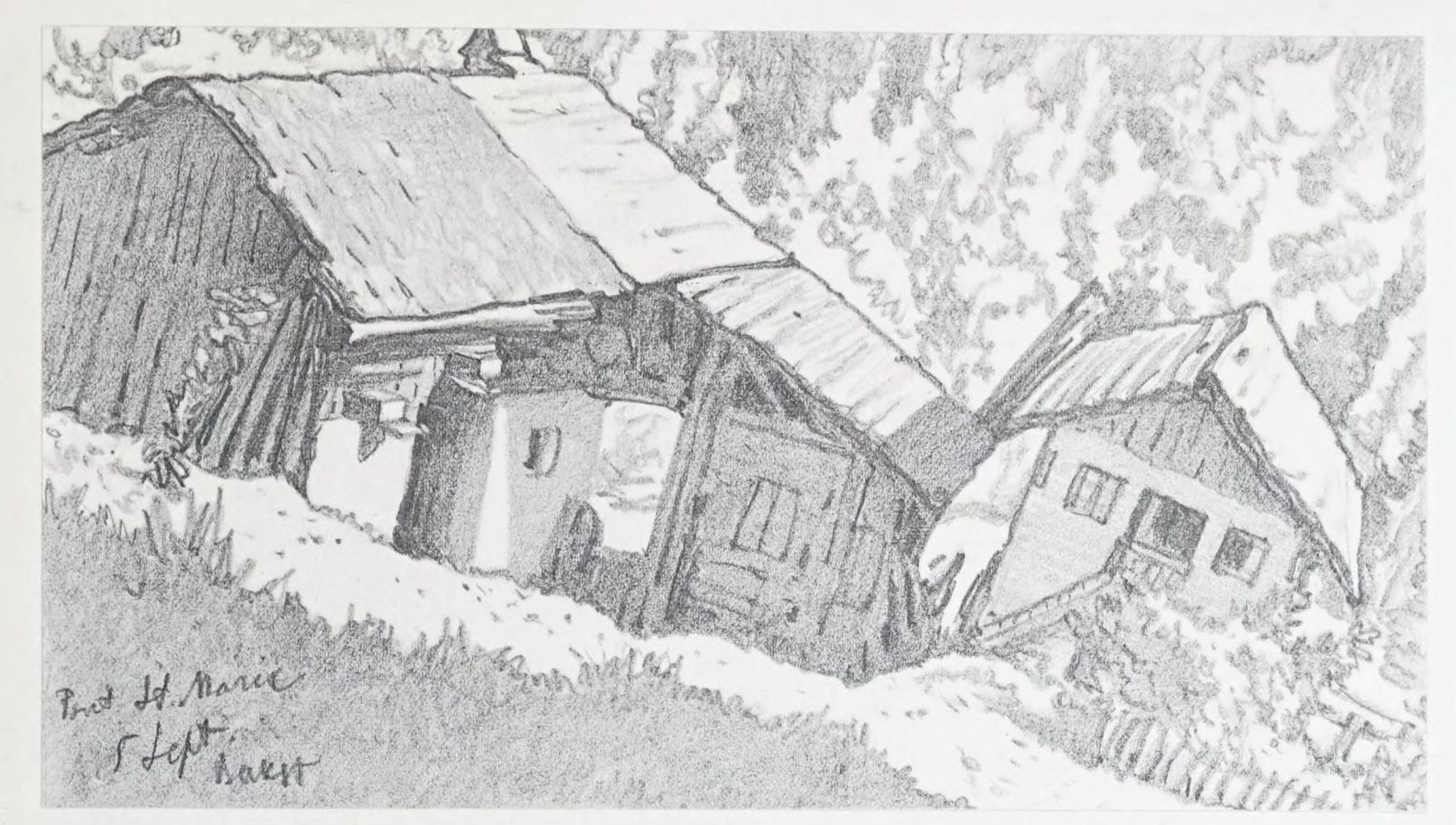
HUTS IN THE MOUNTAINS (SAVOY). DRAWING
Luck would have it that Bakst, during that same autumn, chanced to meet Albert Nikolaievitch Benois, the celebrated water-colorist who had no rival in Russia. He was a member of that “dynasty” of Benoises who have played so prominent a part in the artistic development of Russia. Albert Benois, a handsome, chivalrous and affable man, handled the brush with remarkable ease. He possessed a technique that was as natural for him as bel canto singing is to the Neapolitan beggar. But while his productions, at the same time that they possessed certain qualities of good taste and true knowledge of his art, nevertheless were rather too tame, their success in the eyes of the public was complete. This success of the “master”, who was fêted and flattered by his aristocratic and feminine entourage, and who was unanimously elected to the presidency of the society of water-color painters, dazzled young Bakst, blunted for a while in him the haughty pride of the seeker after new truths, and stimulated other ambitions in him. The fierce rebel who sneered at the Academy suddenly craved Success!
He achieved a success that was immediate, brilliant, and disastrous. Soon he began to neglect landscape painting in favor of the society portrait. Having tasted the apple, he next painted Eve. And, as he abandoned himself to these effeminate and futile pursuits with that same insatiable fervor with which he went into everything, he undertook, he simply allowed himself to drift. Besides, his good friend Shpak was no longer there to awaken his sleeping artistic conscience—he had died quite suddenly. Serov, too, was far away in Moscow and unable to warn him.
When I questioned him about this period of his life of which there are few traces left, Bakst spoke about them quite eloquently, yes, even persistently. He took evident pleasure in this confession; he seemed even to relish the mortification that it must have cost. Was it that in this race toward the abyss he tasted something of that spirit of adventure, of that happy faculty of spending without counting, of giving oneself body and soul to God or the Devil, which, indeed, was a part of his nature? Or was he dreaming of those pretty hands of women, slender but strong, which stroked his curly hair? As far as we are concerned, we must content ourselves with recounting briefly the outstanding facts in the early history of our friend and hero.
The most important of these is a long stay abroad. At Paris he made friends with Albert Edelfeldt, a Finnish painter and a remarkable man, to whose lot it fell to break the ground for the birth of a national art in his own country, in that he transmitted to it the enlightened knowledge of France. It should be noted in passing that all the Norse revivals which endowed the Scandinavian countries with an intense and original artistic life had their origin on the banks of the Seine. Edelfeldt was neither a creative genius nor an artist in the vanguard. He stuck to the cautious methods of a Bastien=Lepage. But he was a forceful and able painter. Some of his canvases are to be found in Paris, among them, if I remember correctly, his portrait of Pasteur.
The habit of working outdoors, the study of daylight and its effect upon massive subjects which Bakst pursued with his new friend who also in some respects became his teacher, contributed powerfully toward his success in performing the enormous task that was soon thrust upon his youthful energy. The Russian government asked the Prodigal Son
IX
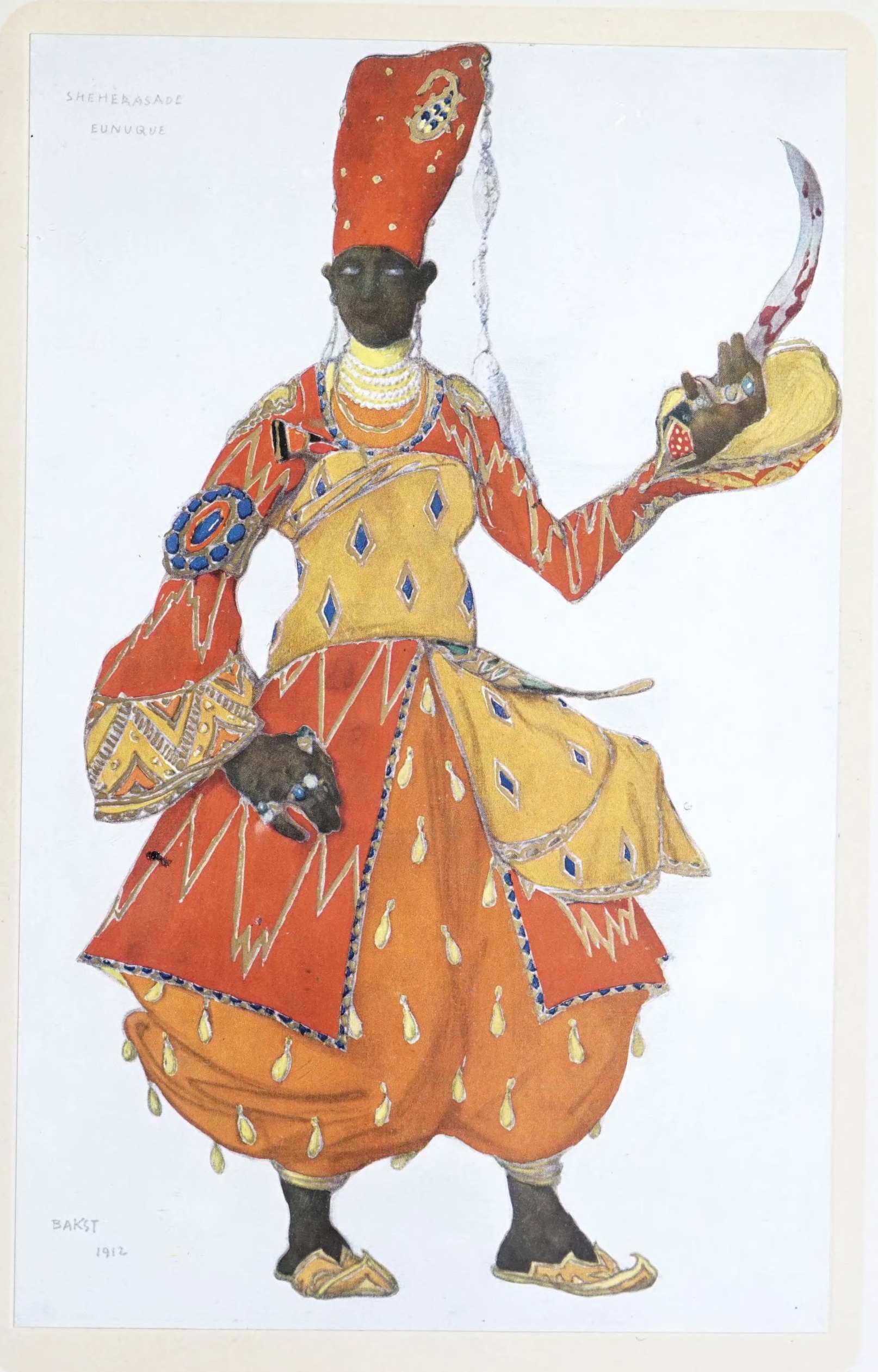
“SHEHERAZADE” BALLET. FIRST EUNUCH. (GOUACHE)
X
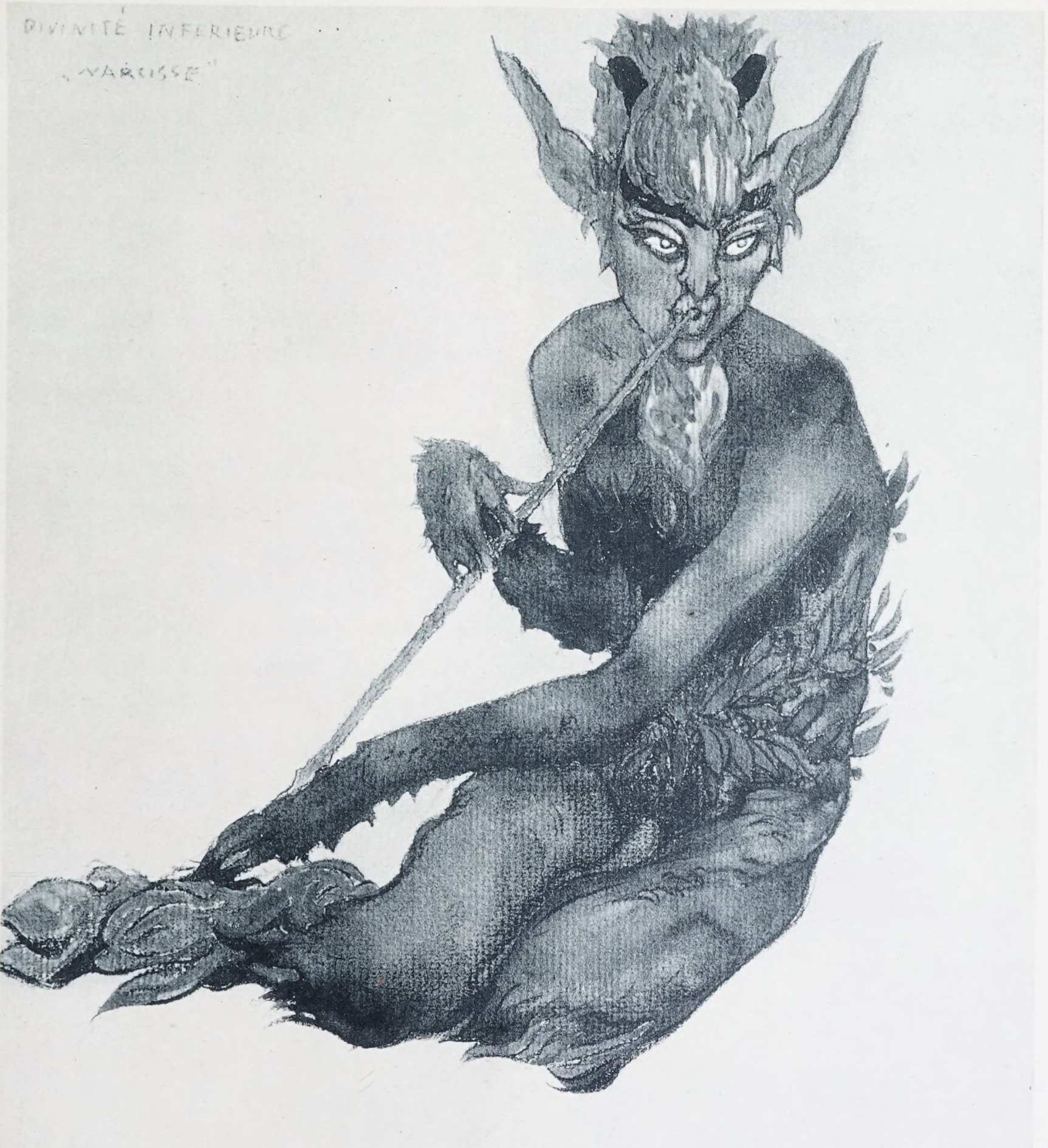
AN INFERIOR DEITY. “NARCISSUS” BALLET. (GOUACHE)
of the Imperial Academy to paint a canvas that was to have for its subject the arrival of Admiral Avellan in Paris.
Perhaps the reader remembers that this visit which, unless I am very much mistaken, took place in 1893, was one of the first formal ceremonies arranged in connection with the nascent Russo=French alliance. This canvas, the result of painstaking and honest labor, which displays a freshness of color and a virtuosity of touch that is by no means vulgar, is preserved today in the Navy Museum at Petrograd. Was the young rebel of yesterday to become the Roll or the Mentzel of the imperial fastes? Today we know that nothing of the sort happened.
One afternoon as Bakst, back from Paris, was lording it over a tea table surrounded by beautiful ladies, and was basking in the sunshine of his reputation, with flattering chatter all about him, he noticed a young man enter whose manners at first offended him. With a monocle in his eye, with haughty pride writ across his dark=complected face, round=shouldered, attired in the student’s green blouse with blue collar, he carried on the conversation with an ease that bordered upon disdain and insult. Yet in the very arrogance of the young upstart there was something that fascinated. Bakst took him aside and, when he pressed him for an expression of opinion as to what he thought of his painting, the young man replied candidly that, while he had the profoundest respect for the technical mastery of his questioner, the painting itself absolutely displeased him, and for good cause.
This young man’s name was Alexander Benois. As for Bakst, little did he imagine that he had arrived that afternoon at a turning point in his artistic career.