THE THEBAN GATE
Reading edition
Meanwhile Colonel Teliakovsky had succeeded Volkonsky. He owed his appointment as director to the fact that he had been in the Horseguards with Baron (later Count) Freedericksz, minister of the Court. A ludicrous figure he was—this horseman promoted
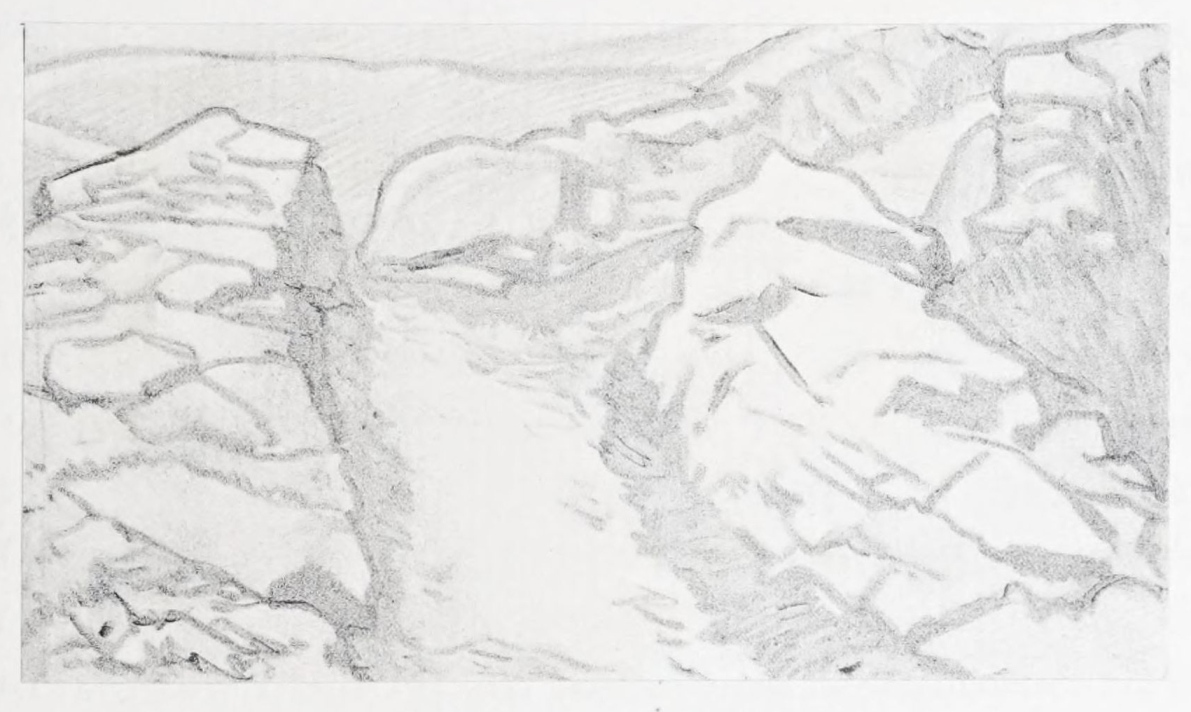
A ROAD IN THE FIELDS (SAVOY). DRAWING
to be stage manager—, without either ideas or prestige and consequently unable to contribute anything of value. But he gave others a free hand—and that is a great deal during a period of fermentation and revival.
Thus, soon after his appointment, he authorized an experiment of far-reaching importance. Alexander Theater was preparing to bring out Euripides’ tragedy, “Hippolytus,” the attempt being made to produce it as nearly like the ancient original as possible. The young stage director, Osarovsky, hoped to make a grand coup. The play was translated by Merejkovsky in exceedingly beautiful verse and with an extremely intense modern feeling. Among the Russian intellectuals of that time, Nietzschean ideas were held in great fascination. Now, in this early masterpiece the philosopher had transfigured the whole conception of the spirit of the ancients. Under the marble-like and placid guise of the Greece of Apollo’s time he had revealed the Dionysiac ecstacy, the pathetic distress and the mystic impulse of the masses. What had been considered as the key to their souls, viz., this sovereign and plastic art, was but a sham emancipation.
For a quarter of a century the government had tried to curb turbulent youth by means of the classical ferule. Greek was loathed as much as was the royal blue of the gendarme uniform. But the translation by Merejkovsky and the enthusiastic eloquence of Professor Zielinski, scholar and poet, who commented upon it as “the birth of tragedy”, caused great surprise and soon extreme fondness for it. It was necessary, however, in order to bring about this rehabilitation of antiquity, to make use of the best possible medium, namely, its consecration by the stage.
The scenery and costumes for “Hippolytus” were ordered from Bakst. After an interval of four years there followed “Oedipus at Colonnæ” and Sophocles’ “Antigone”.
It was an arduous task indeed, for the problem was that of adapting the essential dualism of the Greek tragedy—its lyric choruses and its active players, its dithyrambs and its dialogue, Dionysius and Apollo—to the arrangement of the modern theater, with its odd-shaped stage, like a box opened toward the side of the spectators. Bakst made the attempt. Once having entered upon the road to Thebes he solved the enigma of the Sphinx without stumbling and forced open the gate. By raising the background of the stage he made the foreground available for the proscenium, with the altar of the god of the tragedy in the middle. On this proscenium the choruses executed evolutions, the choristers chanted the strophes and anti-strophes rhythmically, while the ensemble of supernumeraries scanned certain final verses. At the end the leader of the chorus would ascend the steps which connected the proscenium with the platform in order
XXIII
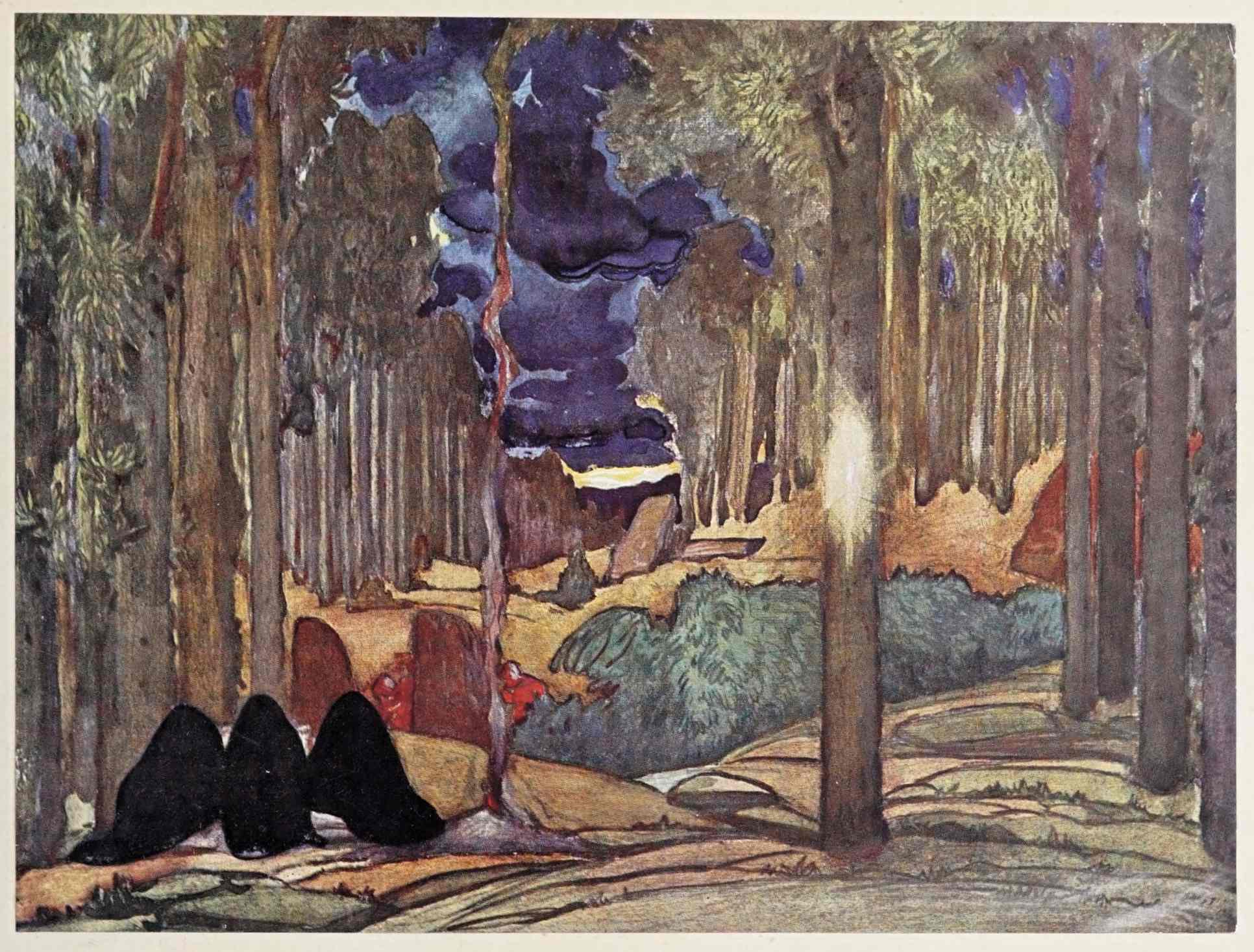
STAGE DECORATIONS FOR ACT 4th OF D’ANNUNZIO’S “ST. SEBASTIAN” (GOUACHE)
y
XXIV
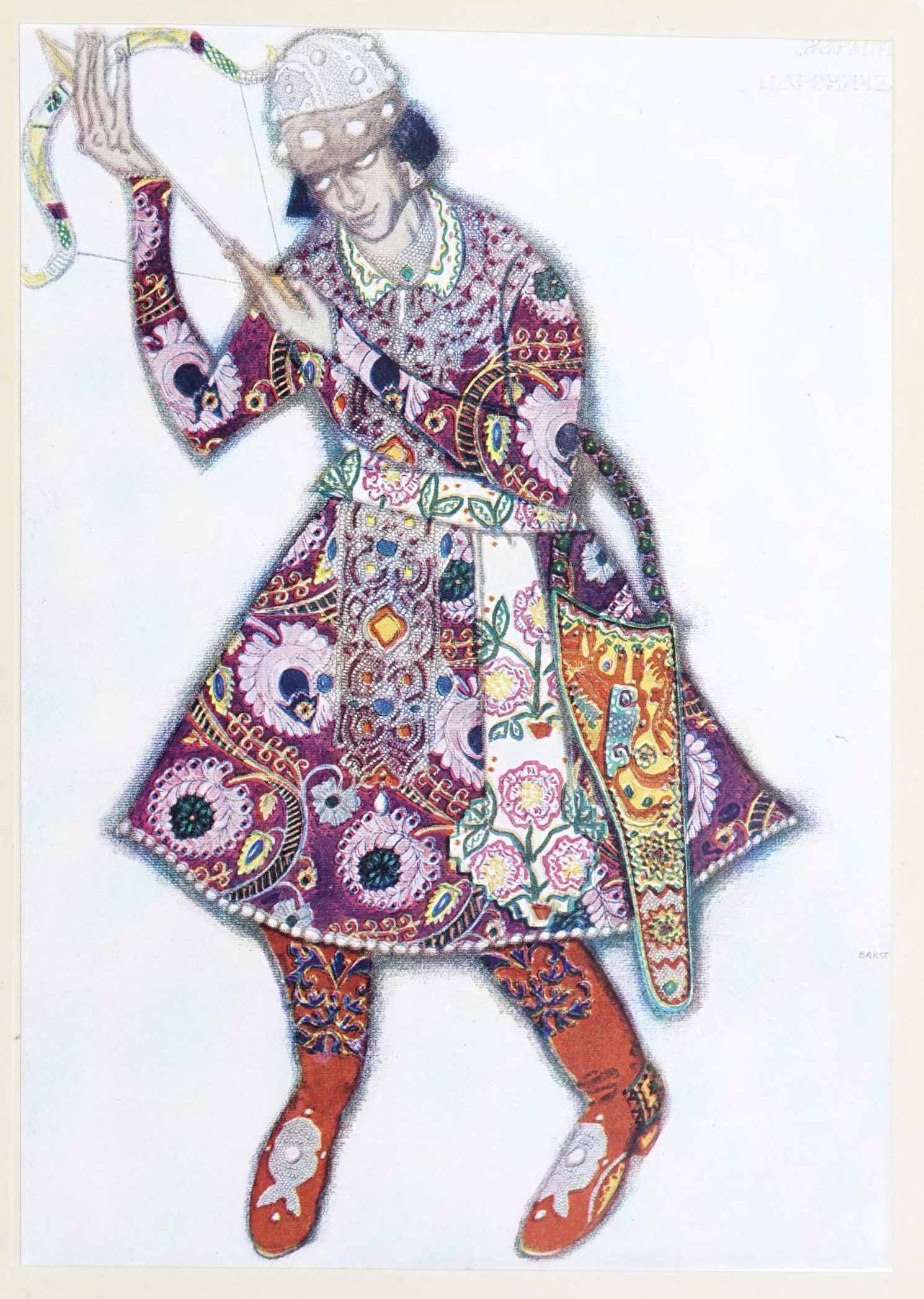
THE CZAREVITCH’S COSTUME (“THE BIRD OF FIRE”)
XXV
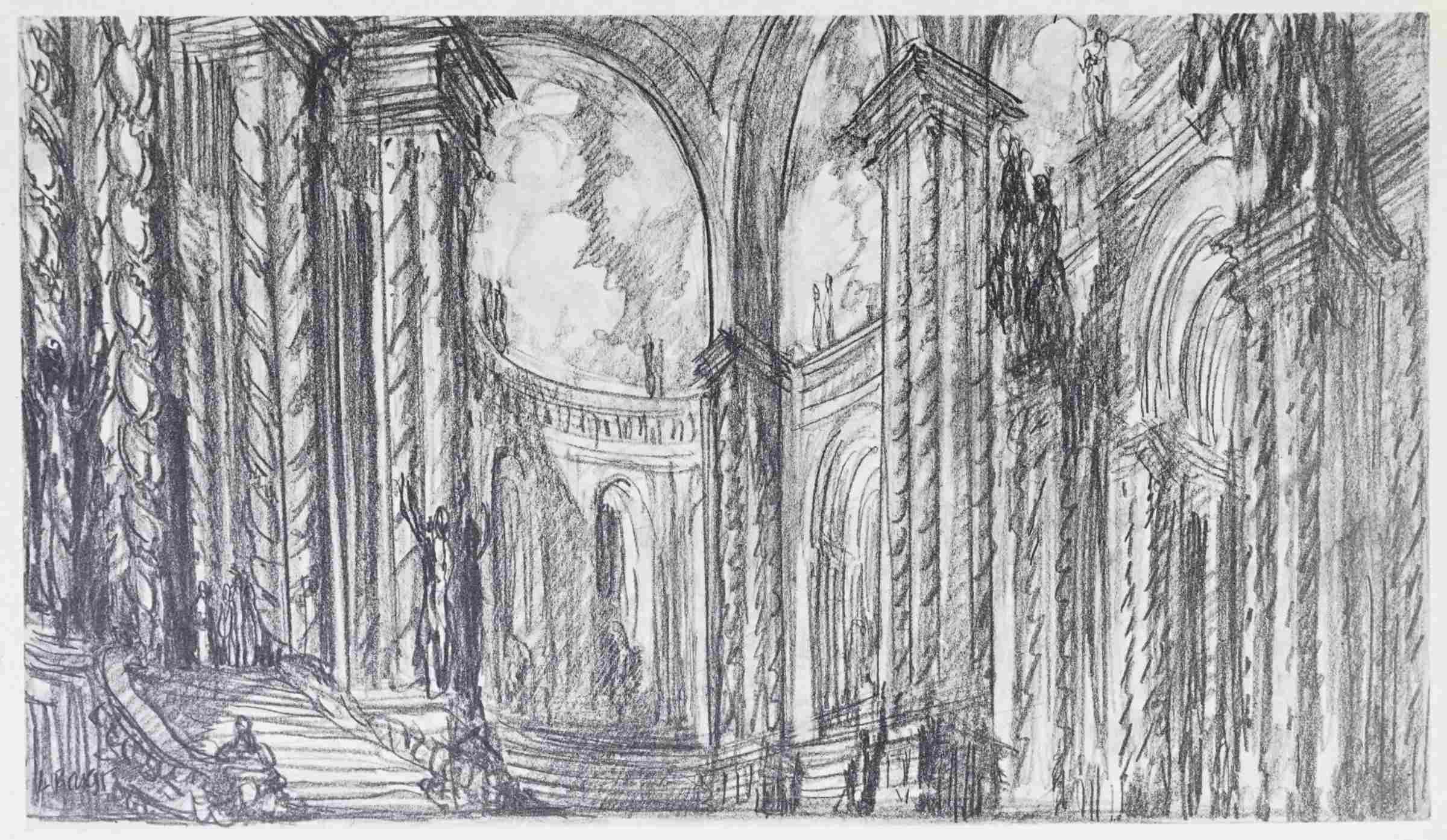
PROJECT OF STAGE DECORATIONS FOR “SLEEPING BEAUTY”
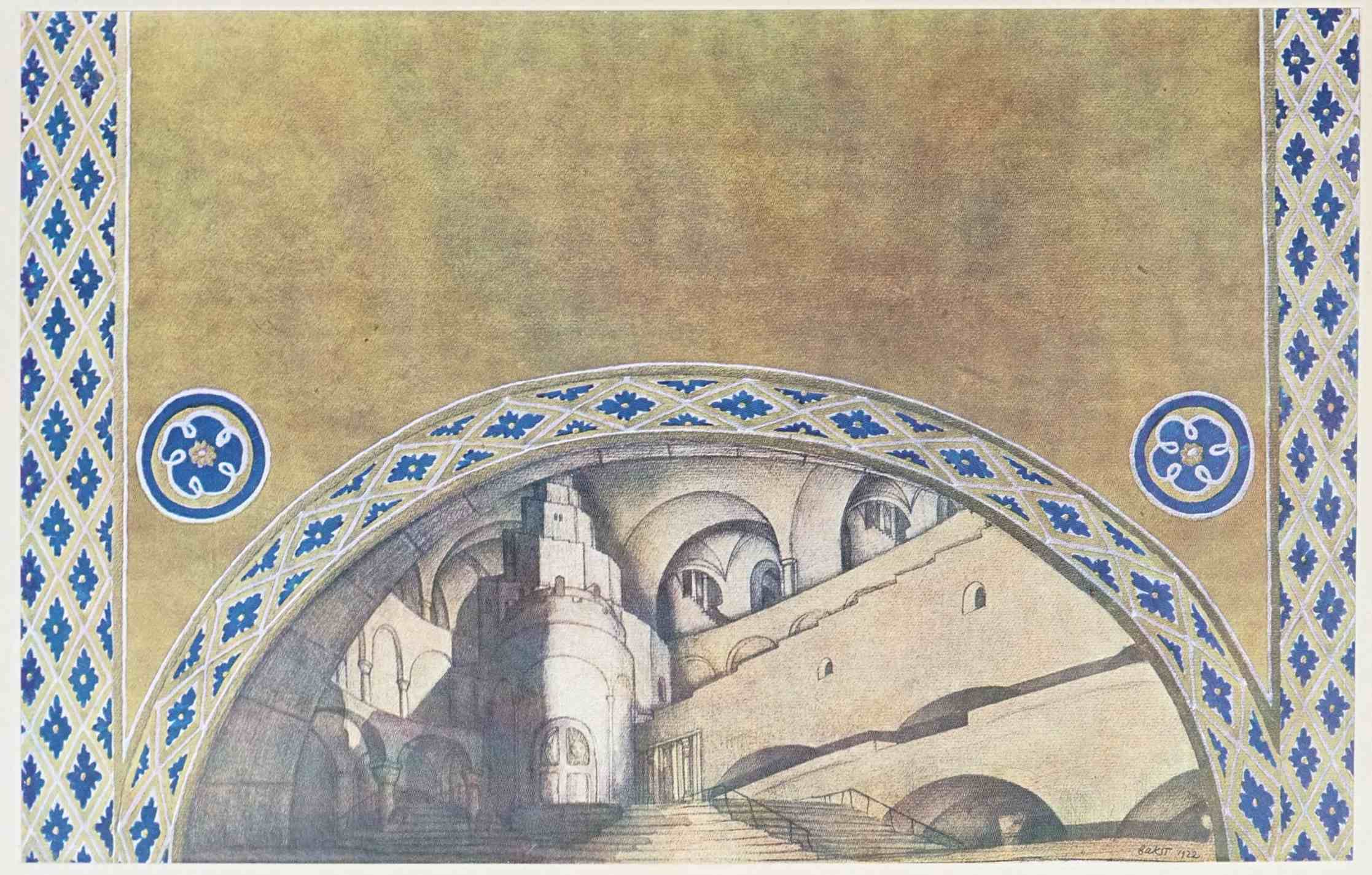
XXVI
STAGE DECORATIONS FOR THE VAULT SCENE (“ST. SEBASTIAN”)
to pronounce Fate’s supreme sentence upon the protagonist who had been prostrated by the gods.
Thus, for the first time, an attempt was made at a logical dissociation of the rhythmic and dramatic elements of the ancient theater. Years were
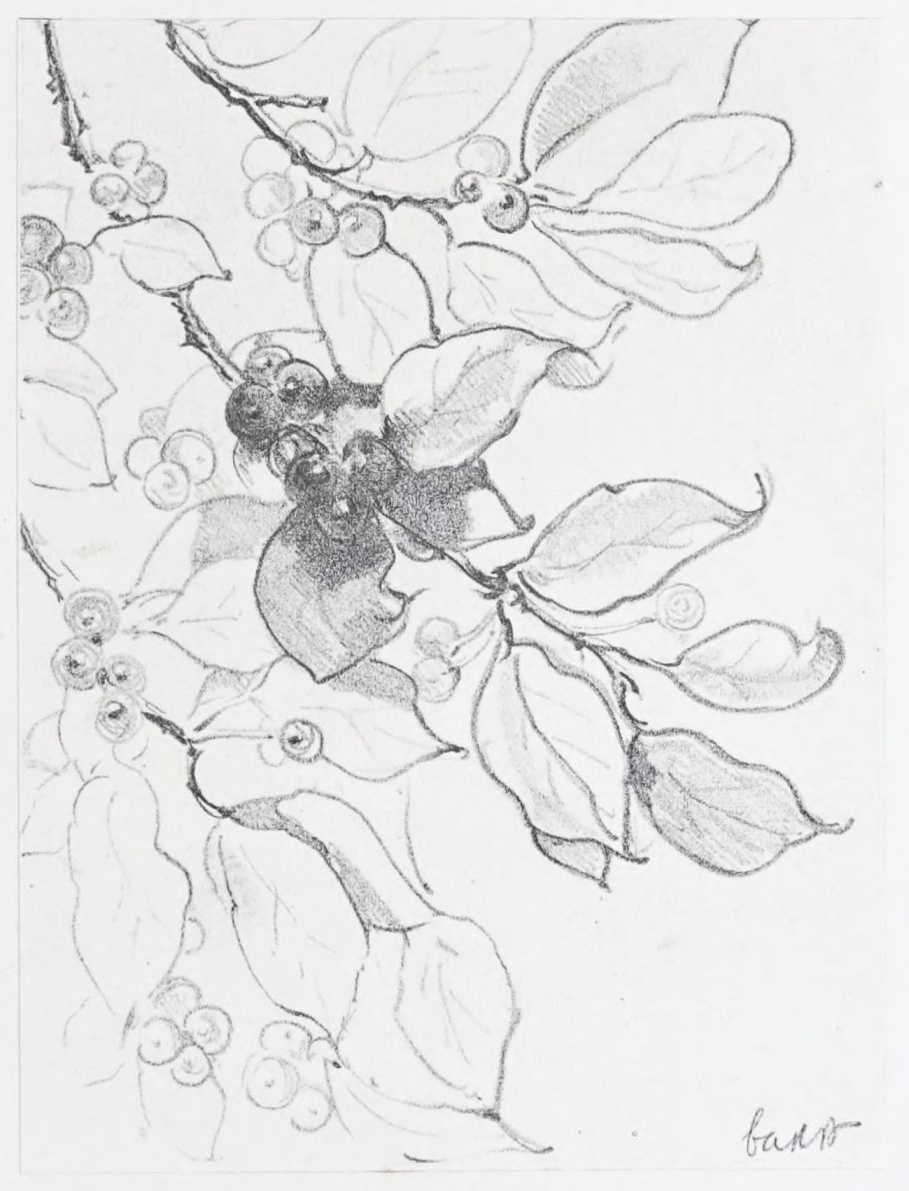
A BRANCH. SKETCH
to elapse before the German Max Reinhardt invented the monumental staircase and the proscenium of Lysistrata; and still a longer period until that same intrepid pioneer let loose upon the arena of a circus the hysterical multitude of a chorus of wild persons. Bakst was the first, not only in Russia, but in the world, to try to work out a stage and a conventional plastic language that was in accord with our modern conception of ancient art.
The Greeks who faced each other in the tragic dilemmas of “Hippolytus” and especially of “Oedipus” were no longer those classical personages
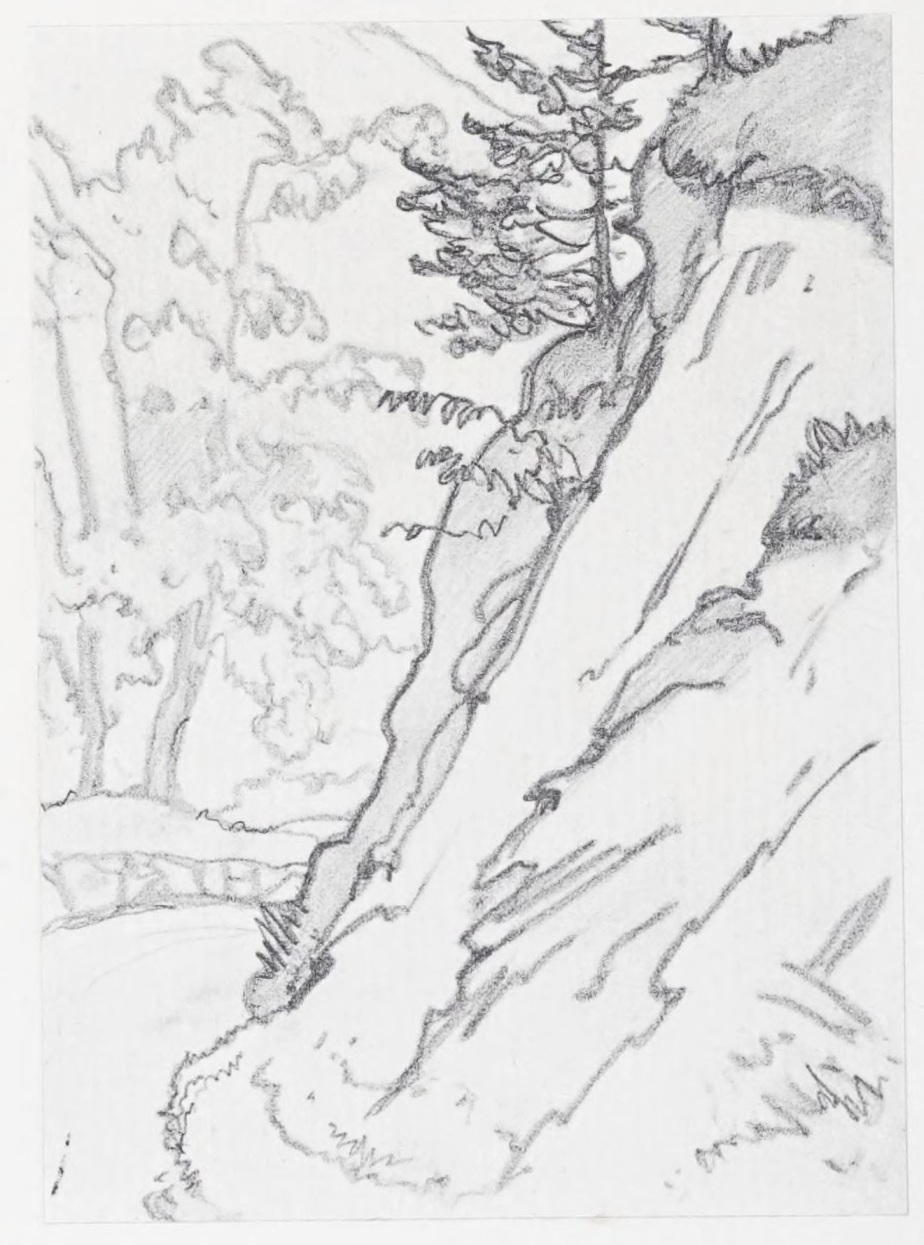
A ROAD IN UPPER SAVOY. DRAWING
with rounded gestures, draped in white, blue or red tunics that looked like a schoolboy’s drawing after a plaster=cast relief of Phideas. They displayed the angular shoulders of the warriors on one of Aegina’s bas=reliefs; the conical helmet with a visor protecting the brow and the nose, as well as the metal shin protectors, tended to simplify the lines of the actor. On the other hand the garments were brightcolored; the purple robe of Creon was resplendent with its ornamentation copied from Ionian pottery. The sixth century dispossessed the fifth, archaic art crowded out the classical canons, the intense colors of many hues
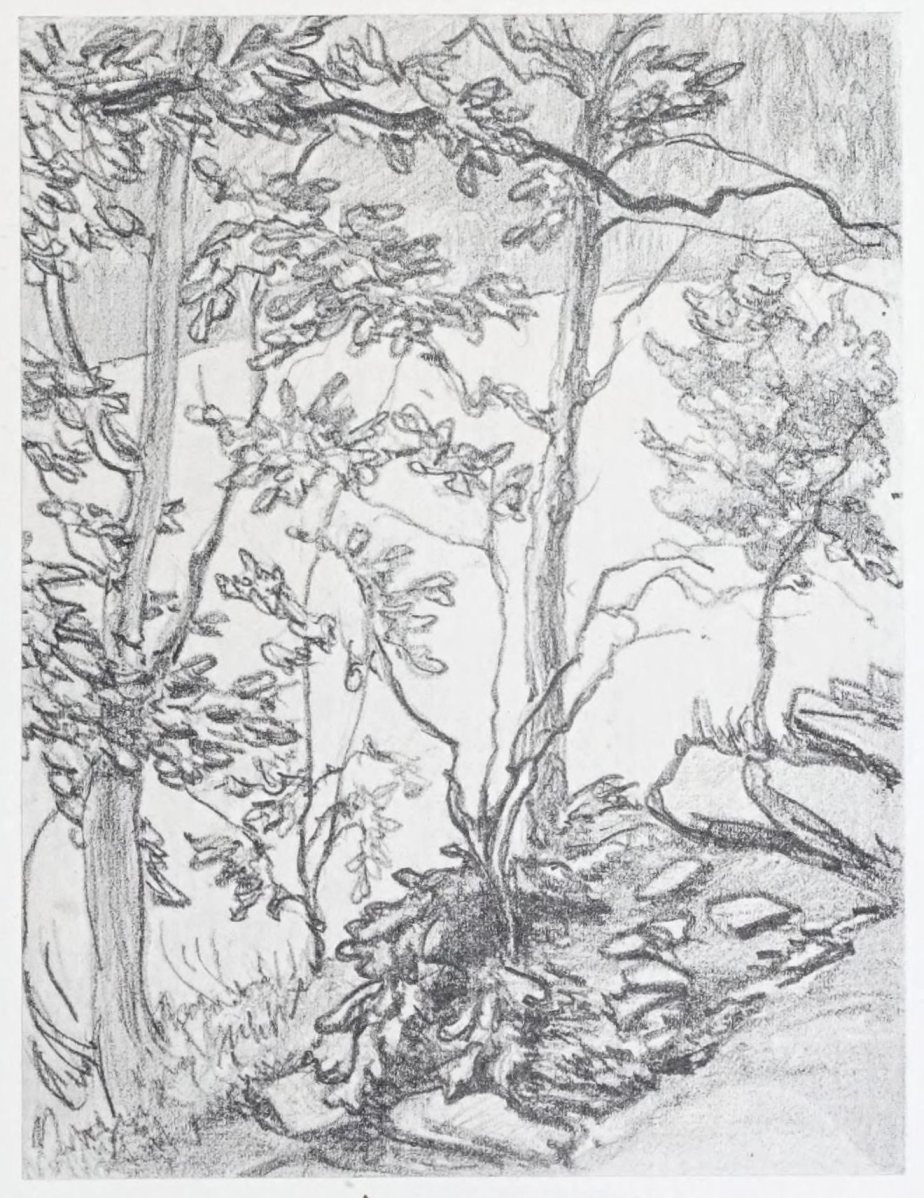
PROJECT OF LANDSCAPE (UPPER SAVOY). DRAWING
obtained preference over the marble whiteness of the statues. People breathed again; they felt themselves freed.
The great age of Pericles, which for three centuries had been exploited by every academy of Europe, which had been vulgarised, debased, enervated by the Alma=Tademas and the Siemiradskis, seemed gloomy, formal, deathly cold. Besides, an art that is perfect and definite, and that has reached its zenith affords no occasion for further research, for further development. It condemns its followers either to imitating it or else to diminishing it. Instinctively Bakst took issue with the academic rules. The fact that he possessed this divination of the right road to take is what placed him several years ahead of his contemporaries.
For he was quite alone in his passion for this Greek antiquity which at every new turn seemed different from every preconceived notion. His friends of the “Mir Iskousstva” were entirely taken up by their craze for rococo curios or for the majesty of imperial architecture; Diaghileff was looking for Russian portraits of the eighteenth century and was preparing the famous exposition of the Tauride Palace; Alexander Benois was living at Versailles, fascinated by the sight of regal splendor. The only one who followed his efforts with solicitude was Serov. So that, when Bakst felt the urgent need of testing his intuitions by direct observations, of knowing positively what he had merely guessed at, he succeeded in persuading the great portraitist to join him on his voyage of exploration into archaic Greece—a journey that was one of the outstanding events of his intellectual life.
Our great master has reserved to himself the task of some day telling in detail the thrilling events of this journey. With that devotion to friendship that is characteristic of him he has kept a minute account of the utterances and impressions of Serov’s manly and delicate mind. It will make a splendid volume some day.
Serov had guided Bakst’s first steps. This Greek expedition was Bakst’s return gift. With the help of these antique realities, which served him as striking arguments, he turned the tormented realist, the sensitive psychologist that Serov was, to a study of syntheticized painting expressing itself in broad and severe forms. And so Serov, pupil of Repine the “wanderer”, portraitist of important Moscow merchants and of great Russian intellectuals, brought back from this voyage a memorable “Abduction of Europa”. His days, however, were counted. And once again Bakst had to continue his solitary way unaided.
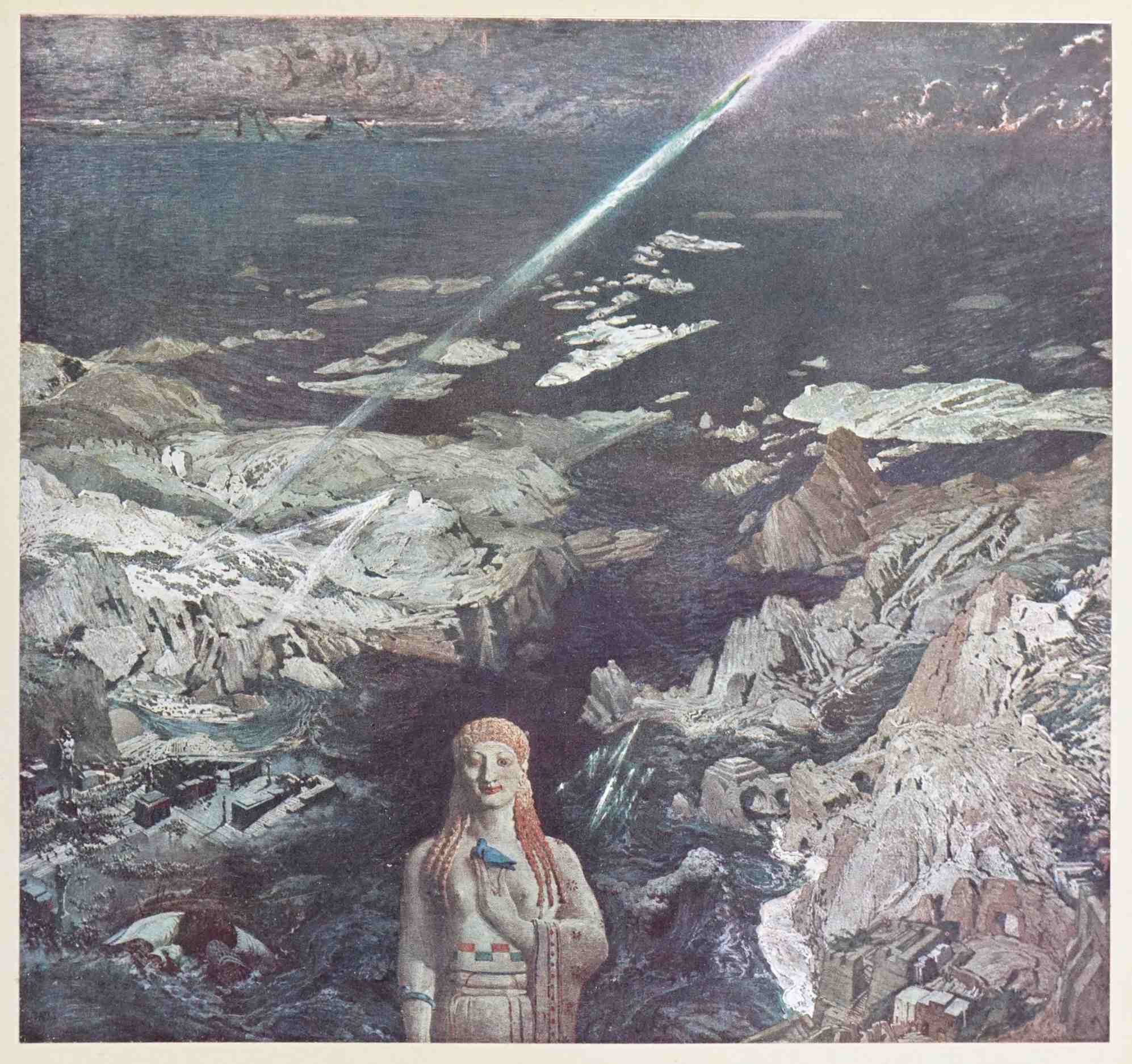
XXVII
“TERROR ANTIQUUS”.
FIRST GOLDEN MEDAL. 1911 UNIVERSAL EXHIBITION (BRUSSELS)
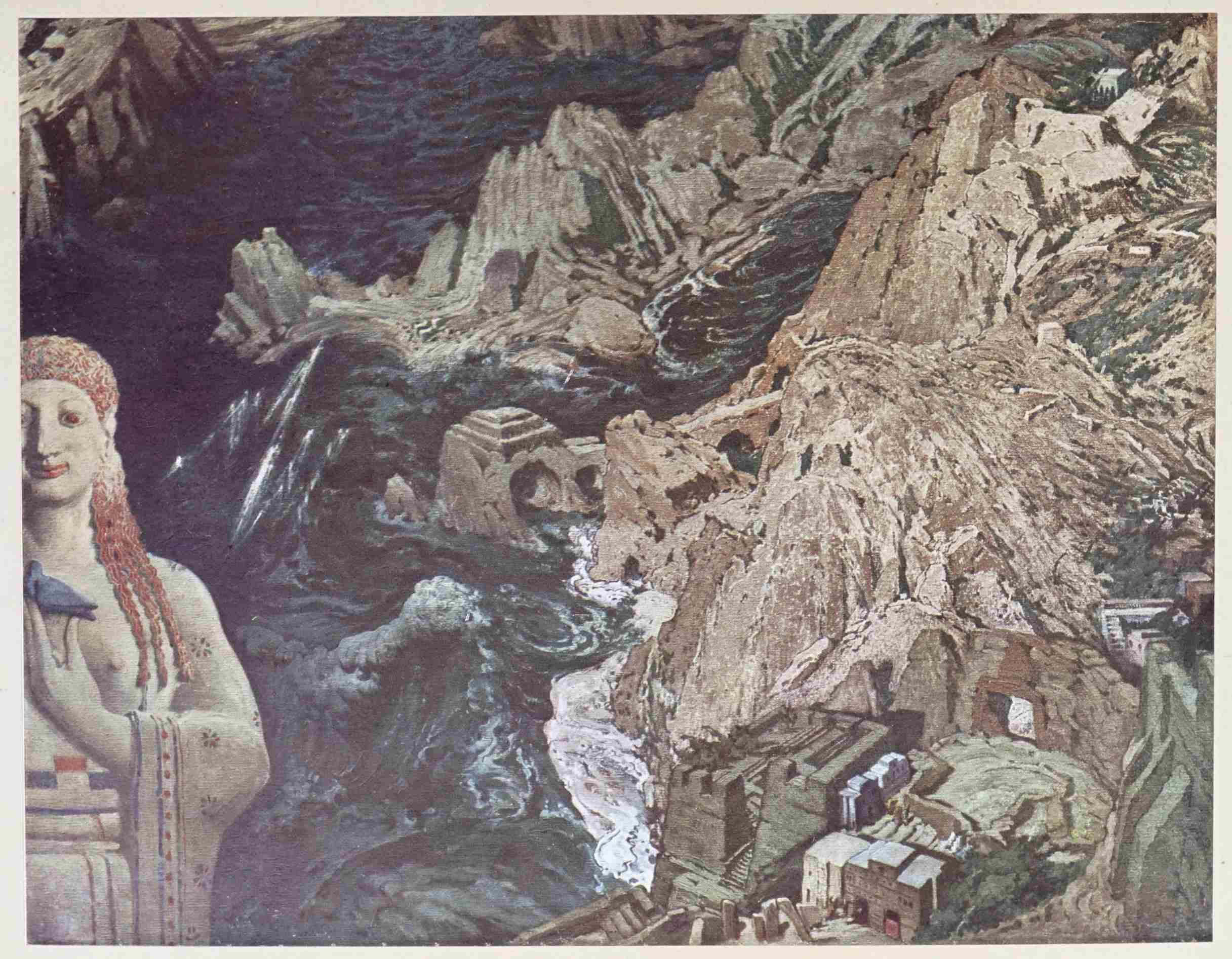
XXVIII
“TERROR ANTIQUUS” (DETAILED)
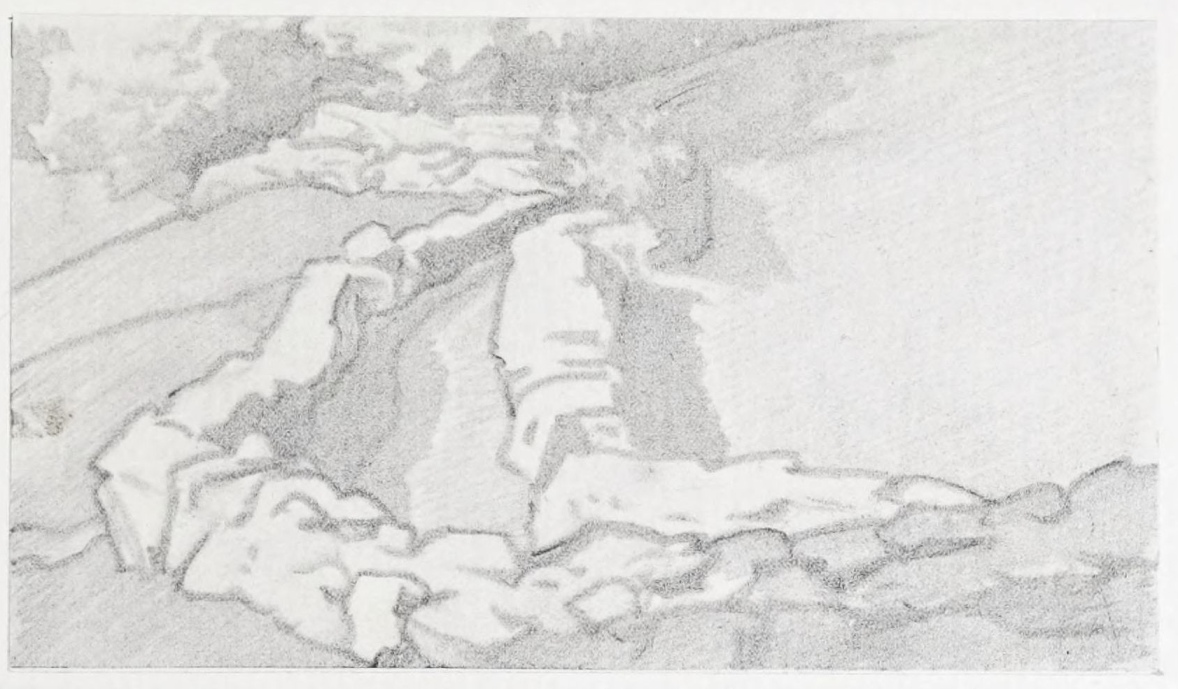
A ROAD IN THE FIELDS. DRAWING