“MIR ISKOUSSTVA”
Reading edition
The small vanguard took position hastily; impetuously it fell upon the enemy. Diaghileff, charging at the head of this handful of friends, sounded the rallying cry. He was successful. Moscow, too, had its raising of the shield. Serov supported the movement. Levitan, the landscape painter, contributed his tremendous popularity to the young cause. During this recruiting fever mistakes were not wanting; for instance, Vasnetzoff, the insipidly sweet imitator of icons, was singled out for praise. He had soon to be dropped. But instead Golovine, Polienov and others joined them who drew upon the real popular sources. It is further true that they almost succeeded in “reforming” Vroubel, the great romantic decorator who was haunted by the Demon.
Above everything this group was looking for allies from abroad. These were to be found at the very gates of Petrograd. A “young Finland” was rising about Edelfeldt as founder—the Axel Galiens, the Jaernefeldts, the Enkels; in short, all those who were destined to endow the “country of a thousand lakes” with a national art. The Finns accordingly took part in the first exposition in which “Mir Iskousstva” faced Russian public opinion. At the second there appeared French guests who after three generations found their way back to Russia.
This proved a decisive feat. An end was thus put to the isolation in which a waning Russian art found itself. For, at that time the whole European artistic movement was ignored in Russia. The prize winners of the Academy would go to Rome to perfect themselves and would there copy the Stanze of Raphael, or else, perhaps, they would go to study historical painting under Piloty, the De la Roche of Munich. The moving spirits of the school—a Kramskoi, or a Repine—would return from their western travels with nothing but contempt for the “futile” (as they called them) masterpieces of beautiful painting or else an infatuation for the virtuosity of the brush of a Fortuny or a Meissonnier.
Diaghileff and Benois flung the doors wide open. A motley crowd enters pell=mell; even the “decadents” of the Viennese Secession, with Renoir and Carrière. Mistakes are made; there is as yet no scale of values; the obscure Belgian, Léon Frederick, is put upon a pedestal while Cézanne is ignored until 1904. The reason for this is the fact that this group at first has no positive program. But its negative influence is inestimable. Repine, one of the most powerful exponents of this ideologic naturalism which I have mentioned in passing, launched a counter=attack in the name of the survivers of traditional academic style. Diaghileff, by his virulent reply, threw the champion of routine out of the saddle. It is a great period of ringing battles, of hard contests with the adversary who mangled even Ingres’ very name. These struggles were the more heroic since the public remained averse to them.
The editorial offices of their magazine were the hot=house in which new ideas were hatched and the staff headquarters where the big offensives were planned. Now, the editorial staff itself was divided into two sections. In the large salon we find Philosophov, handsome and slender as a thoroughbred courser, who meets the contributors to the literary section. There is Merejkovsky, who contributes his best works to the review and who introduces us to the art and the doctrines of Tolstoy and Dostoievsky; Leon Shestov, the apostle of “eradication” with his emaciated face of a Jewish Socrates; Rosanov who pried into the very depths of the sexual problem, a towering spirit who used to bare his inmost thoughts with candor. Of all these men, who were radiant in their young fame, Rosanov alone did not profess a supreme philosophical contempt for the fine arts. The painters, accordingly, would shrink back from the haughtiness and the affected attitude of the literary folk and would seek refuge in the office of the secretary=general, the headquarters of the artistic section.
There they would find Bakst, who was collecting the material that oftentimes was queer enough, and who in fact worked out the whole review. No task was too hard for him. He would group the various component parts and make up the pages. It would happen that Diaghileff, disconcerted over an engraving that came out badly and that had the earmarks of a confused work, would come to Bakst who would take up the work on the plate and give form to an amorphous jumble of touches. Another one of his steady tasks was that of decorating the book, of designing the cover, of drawing the ornamented letters, of supplying the tail=pieces. In this connection it should be recalled that the art of book decorating was revived at the end of the last century. The English, with Walter Crane at the head, started the procession. It was an Englishman, furthermore,—Aubrey Beardsley—who designed arabesques of extraordinary sharpness and delicacy upon the geometrical quadrangles of the pages. This new method was also being experimented upon in Petrograd. A number of artists of the second generation of “Mir Iskousstva”, such as Narbout and Mitrochin, are exclusively “vignettistes”. As for this first group, they had to do everything and accordingly they did everything. Benois, Somov, that other Russianized Frenchman Lanceray—all were experts at this art. Bakst, too, went through it. There are magazine covers of his extant
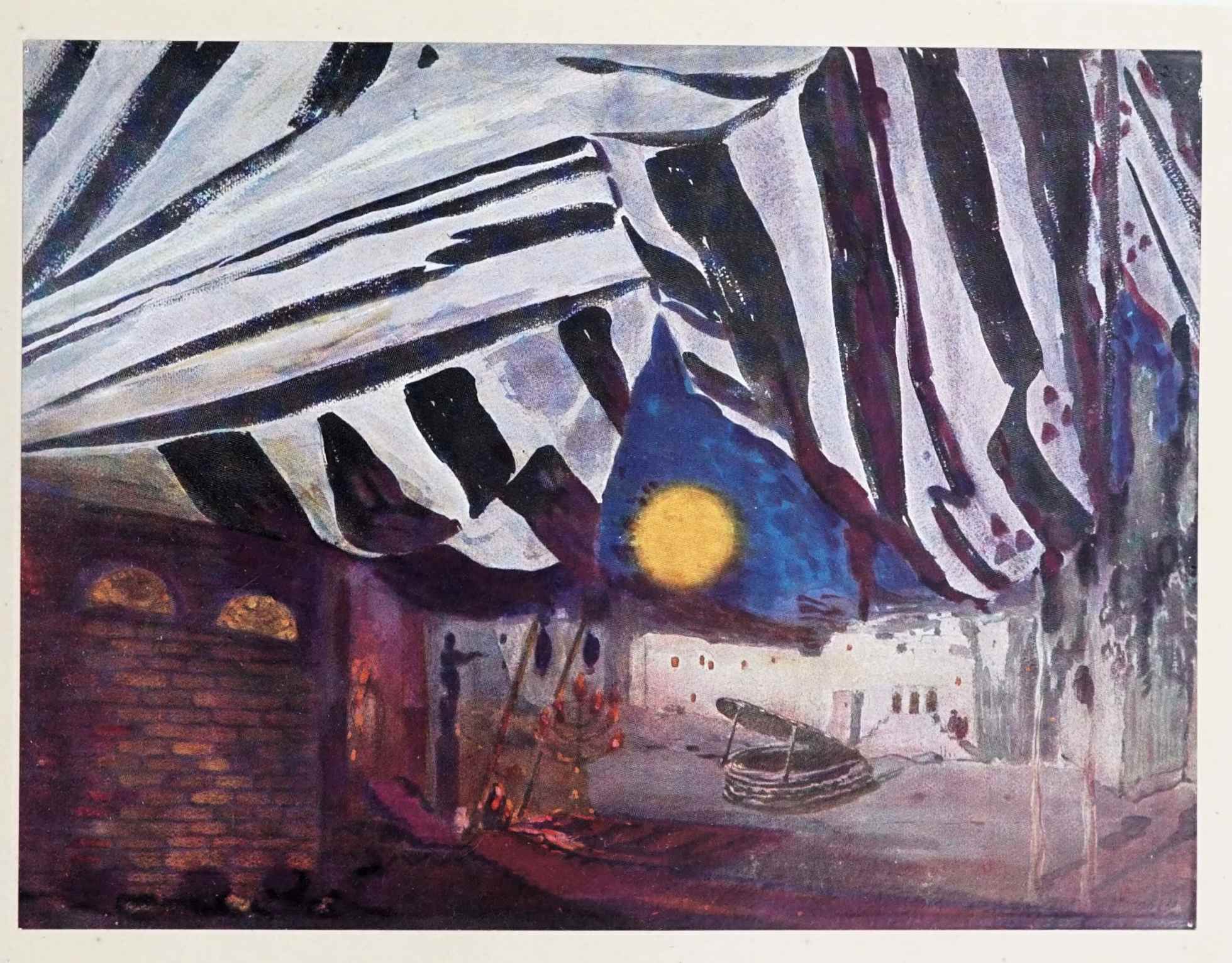
XIII
STAGE DECORATIONS FOR OSCAR WILDE’S “SALOMEA”. (GOUACHE)
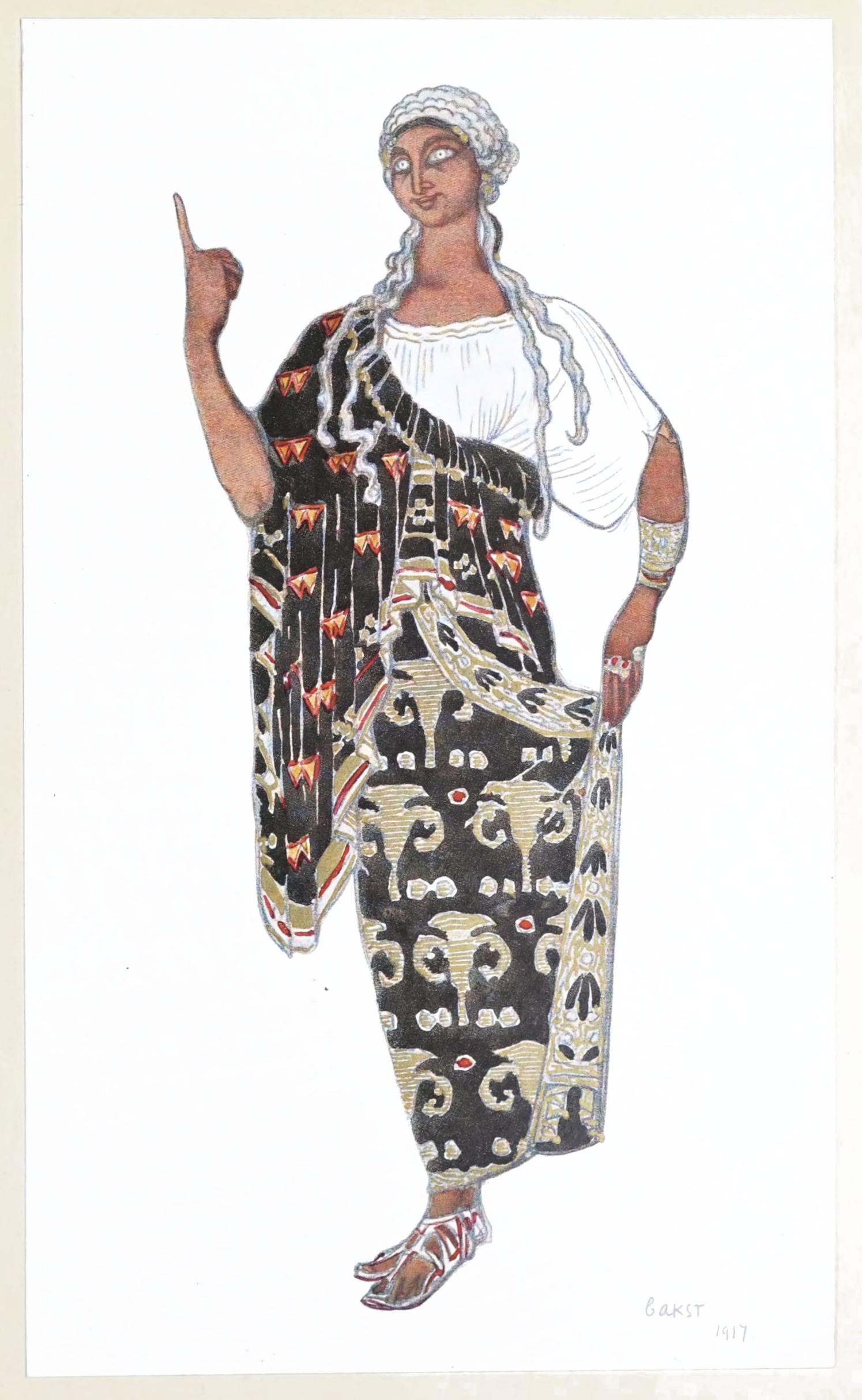
XIV
“PHAEDRA” TRAGEDY. PHÆDRA’S NURSE
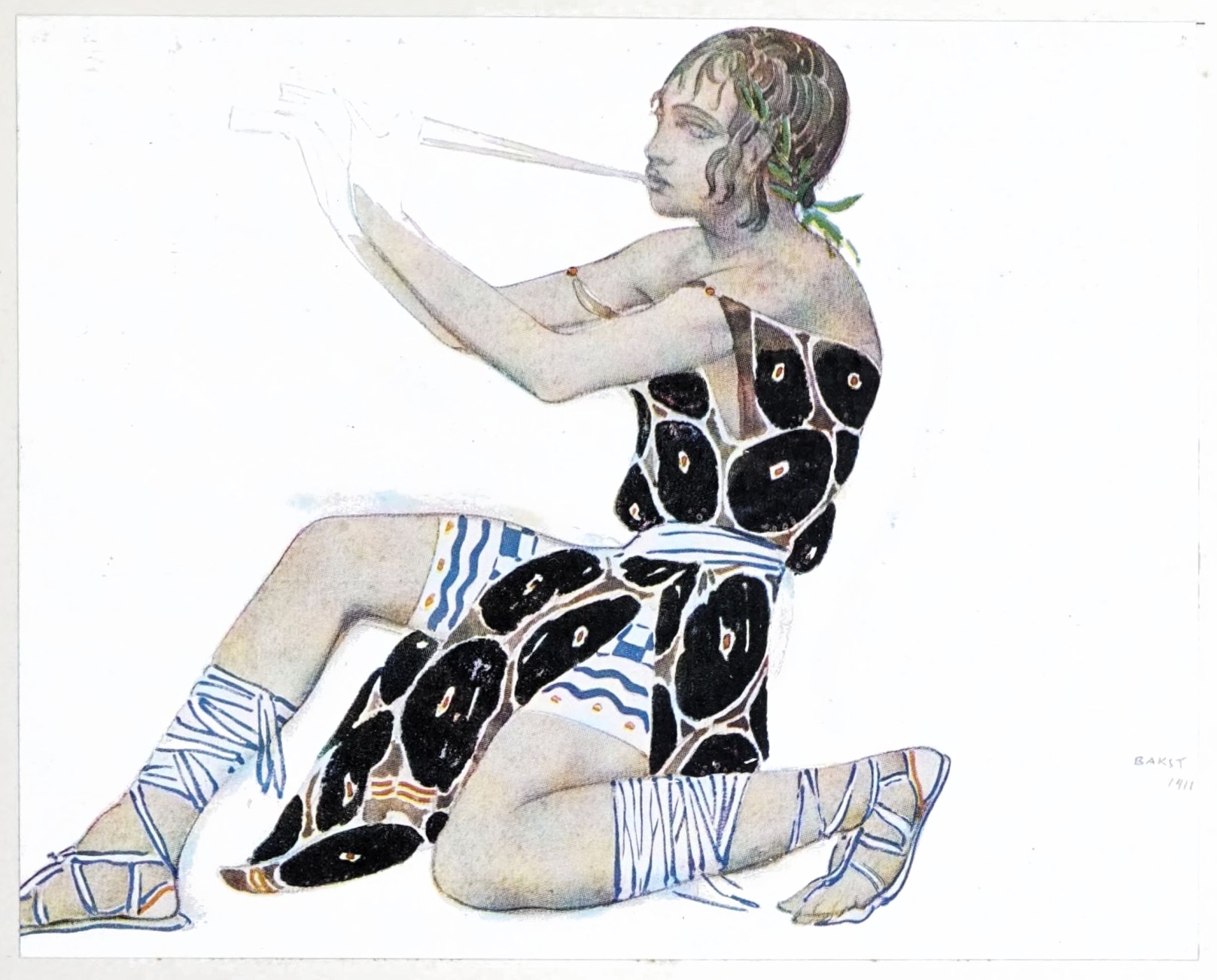
A YOUNG BEOTIAN. (“NARCISSUS” BALLET). WATER COLOUR
on which statuettes in Directoire style flank a medaillon, or on which there are artistic frames. At the same time he tried his hands at pure illustrating; there is, for instance, a water-color of his which illustrated “The Nose”, a grotesque story by Gogol. Today we look upon these designs as the first attempts at the masterful costume-pages of later days. “Bakst has hands of gold”, wrote Benois in his history of Russian painting, a work of which we shall speak again later. He admired his manual skill and the elasticity of his spirit and of his workmanship. But he was unconscious of his powerful personality.
Later on, dissatisfied with pen sketching that was then reproduced by the mechanical process of engraving, the group tried themselves at original lithography. Here, again, Bakst was successful: a head of Levitan brings out in sharp juxtaposition the intense black and white of the drawing.
Thus, then, we see Bakst working away at his table, which is covered with waste paper, with photographs and proofs. Around him, people talk idly, or loll about the couches, or draw caricatures, or debate. Then, through a cloud of smoke produced by ten cigarettes, Diaghileff comes rushing in, chasing a new rainbow. He tells of his latest discovery, or he scoffs at some idol that he adored the day before. His enthusiasm is as intermittent as it is uncompromising. He is the life of this party of outspoken, unreserved painters; he cares little for men of letters. Alexander Benois, on the other hand, forms the connecting link between the two clans; he arranges and coordinates everything by virtue of his broad and supple understanding. Soon new initiates—Grabar and Jaremitch, the artist=writers, and Kouzmin, the poet=musician, and others—join in the work of strengthening the somewhat difficult union of these two sections.
Within this community of painters, however, there was little agreement as to the road that should be followed. They agreed in their hatreds, but differed as to aims. Diaghileff, always hyper=sensitive to the sensations of the day and ready to take his ideas out of the clear sky, would misjudge the value of ephemeral tendencies and therefore
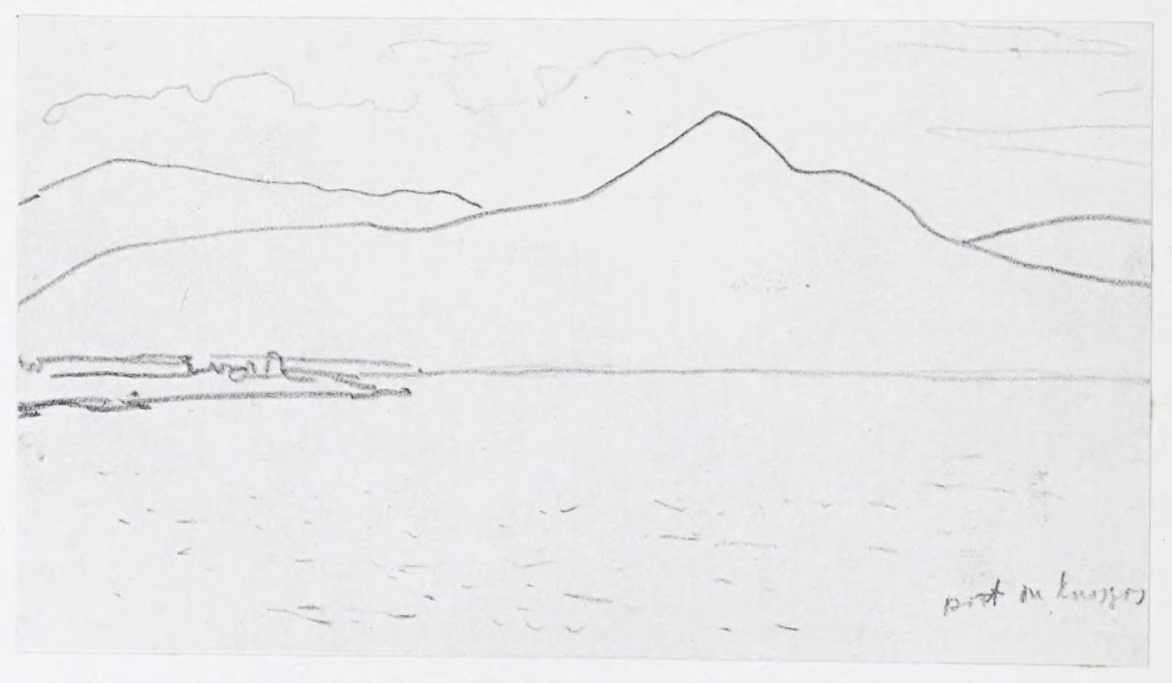
CNOSSOS HARBOUR (CRETE). SKETCH FOR ALBUM
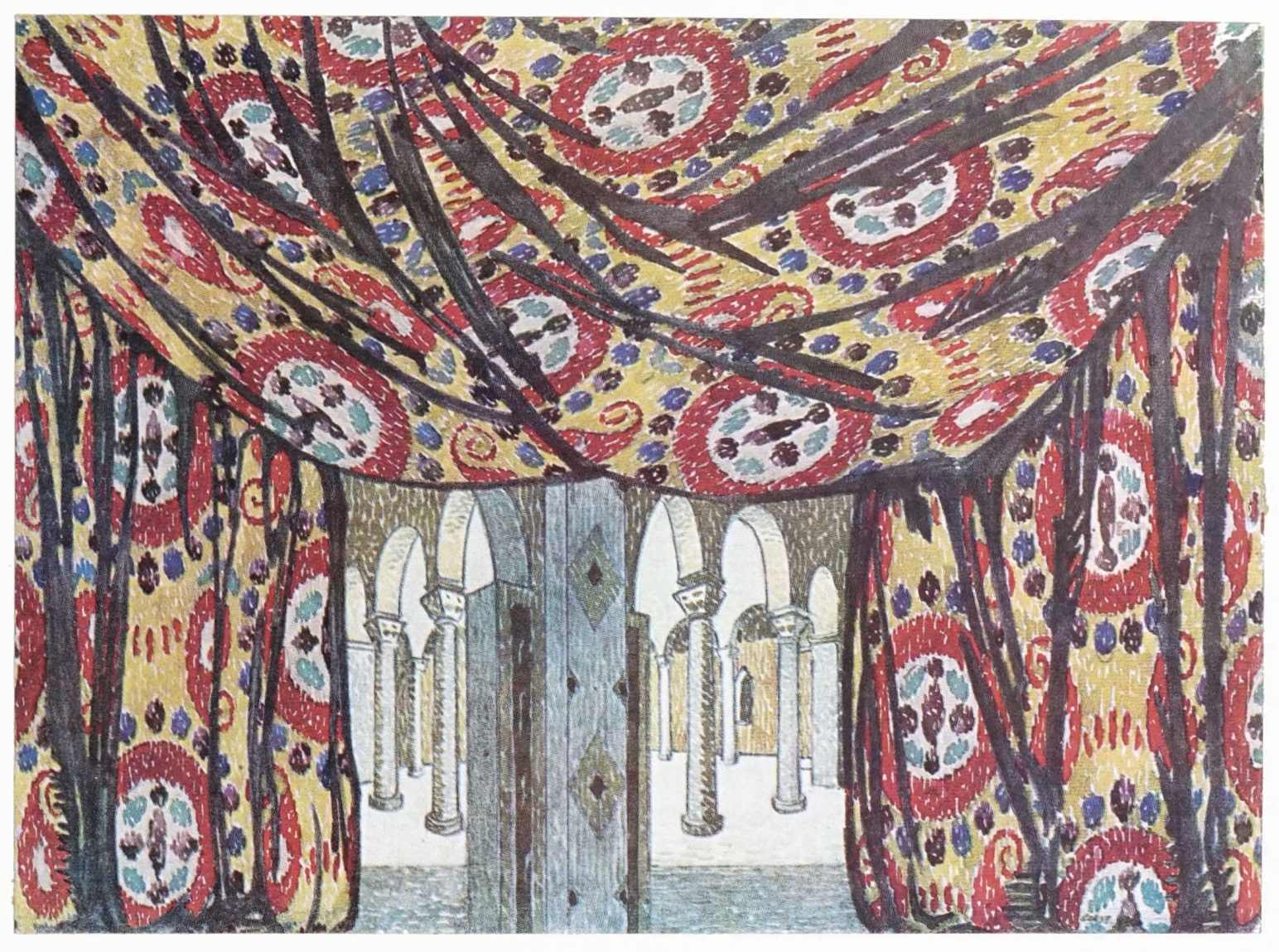
STAGE DECORATION FOR PROLOGUE IN ORIENTAL STYLE
at times get himself into an impasse. Thus he allowed himself to be carried away into enthusing over that atrocious “modern style”, the architectural vestiges of which today disgrace every large city in the world. Bakst together with his older friend Serov set himself against painting in the style of Gustav Klimt and against architecture à la Olbrich in the name of an honest, direct and robust art.
The weak spot about all this combativeness and intellectual ardor, which proved fatal and unavoidable amid these divergent points of view, was the lack of creative ability on the part of the group. This group had deposed and duly trampled under foot the art of the “wanderers” with its social tendencies and its worship of the moujik. It had done this to the greater glory of an art that is unselfish and creative. But almost immediately its members turned toward literature. Among all those former members of the Club (I except only Serov and the Moscovites), there was not a single painter in the real sense of the word. Benois, who never when working at a canvas could completely overcome his amateurish clumsiness, Lanceray, later Doboujinsky—they all were first and foremost illustrators, rather than painters, who were steeped in precious recollections, who gleaned from every style and who discovered forgotten beauties.
With this select group, then, the motif prevailed more and more over its execution; the brush became a means of interpreting a history perceived with a sort of sentimental homesickness mixed with irony. Is it surprising, then, that the retrospective attitude got the upper hand more and more, and that the offshoots of this movement were sacrificed to a propaganda for the past?
As a matter of fact, discovery followed upon discovery. Preceding generations, going into Russian extremes, became infatuated with the idea of progress. Accordingly they either ignored or misunderstood their national past. Then, under Nicholas I the czar-gendarme, the old architecture was disfigured by German builders. As for the unique and grandiose beauty of the structures in the style of the Empire and of Louis XVI,—buildings without parallel in the occidental world—these were confounded by the public with that implacable hatred that it bore toward the regime that had erected and that was maintaining them. An educated Russian could not possibly find anything beautiful about the Winter Palace, this fine masterpiece of Rastrelli; he would decline to admire the Admiralty Building because the defeat of Tsushima was prepared within its formidable walls. The writer of this sketch was himself brought up in this atmosphere of hateful contempt for the “official ugliness” and the “style of the barrack.”
Benois and his friends discovered this slandered beauty and became enamoured of it. Later on we shall see how Bakst discharged his debt of gratitude to old Petrograd, this wonderful city which rose miraculously from the surface of the waves.
But the surprises were not yet over. In his history of modern Russian painting, Benois with boldness and with charming eloquence recalled the founders of this style of painting, the portrait-painters of the eighteenth century, especially Levitzky and Borovikovsky. He cast
XV
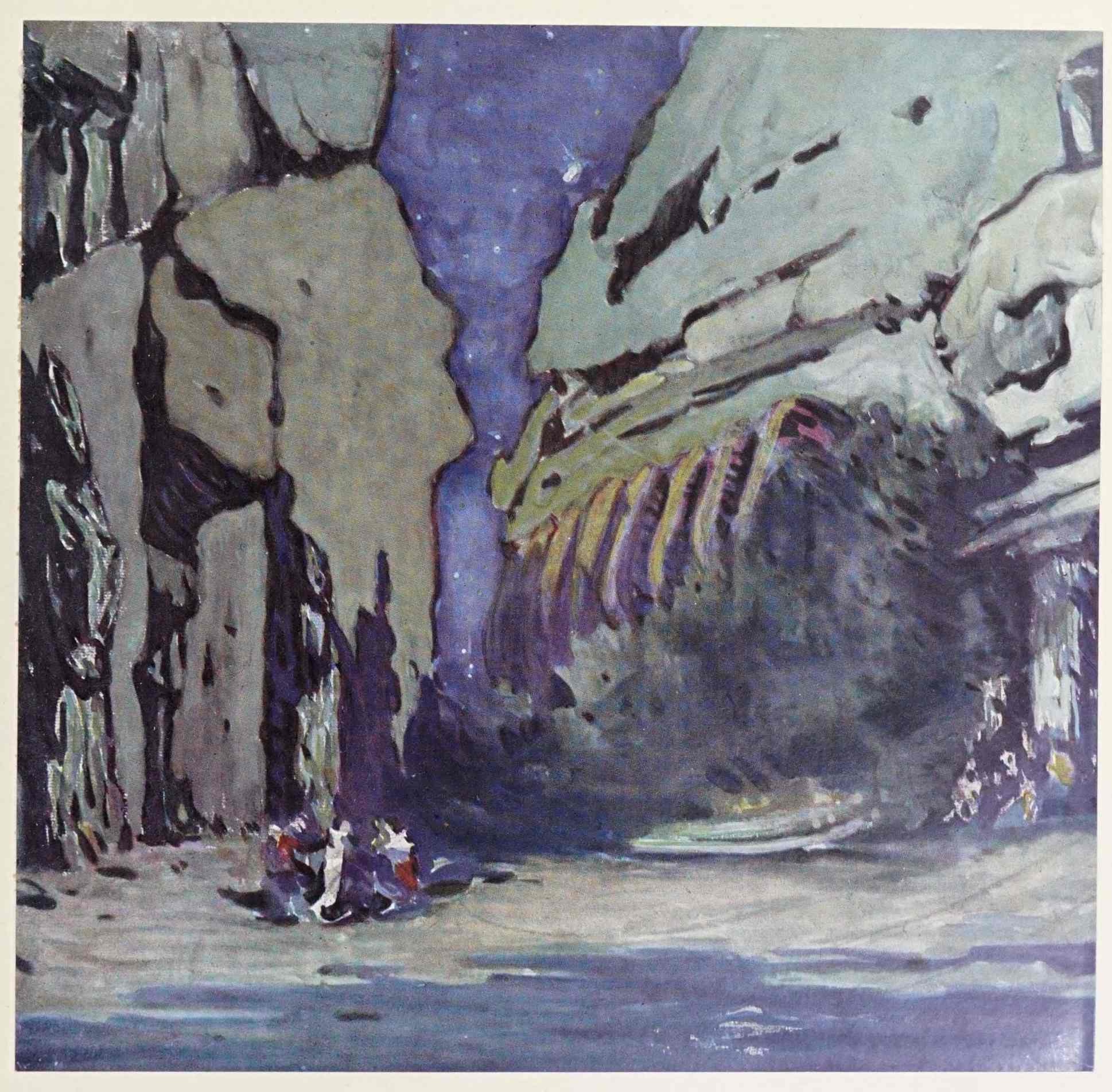
STAGE DECORATIONS FOR HINDU BALLET (GOUACHE)
XVI
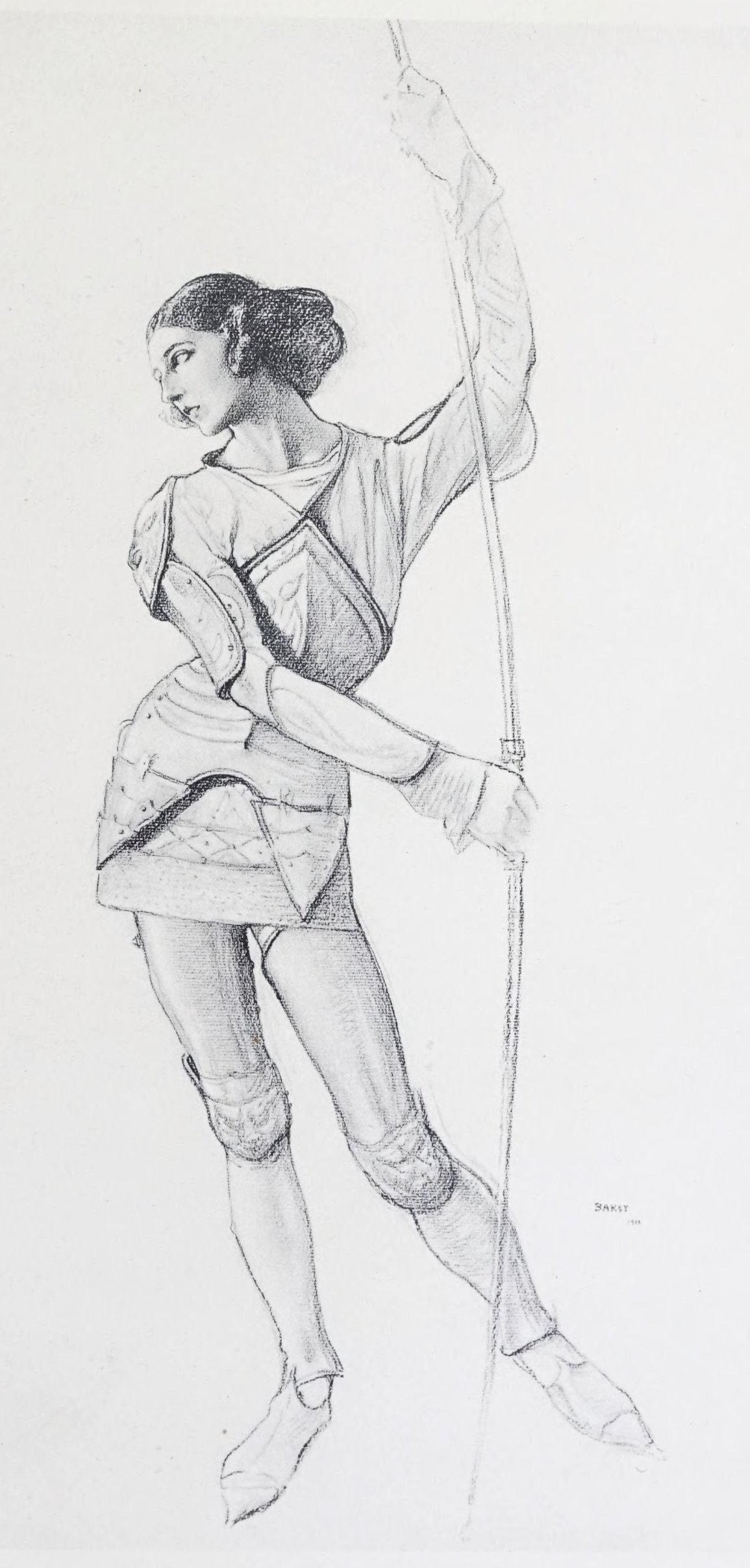
MME. IDA RUBINSTEIN AS ST. SEBASTIAN
XVII
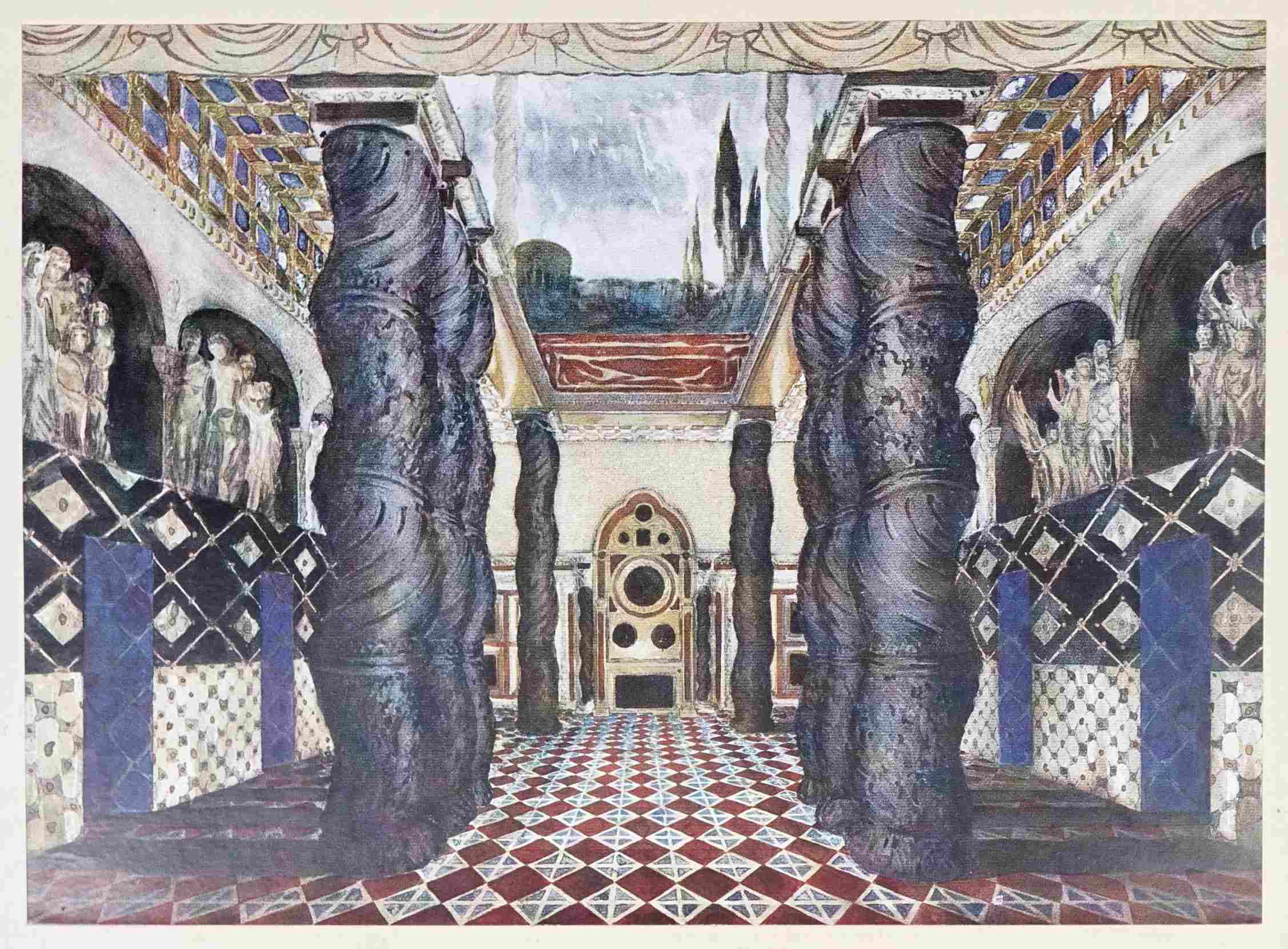
THE IMPERIAL PALACE (“THE MARTYRDOM OF ST. SEBASTIAN”)
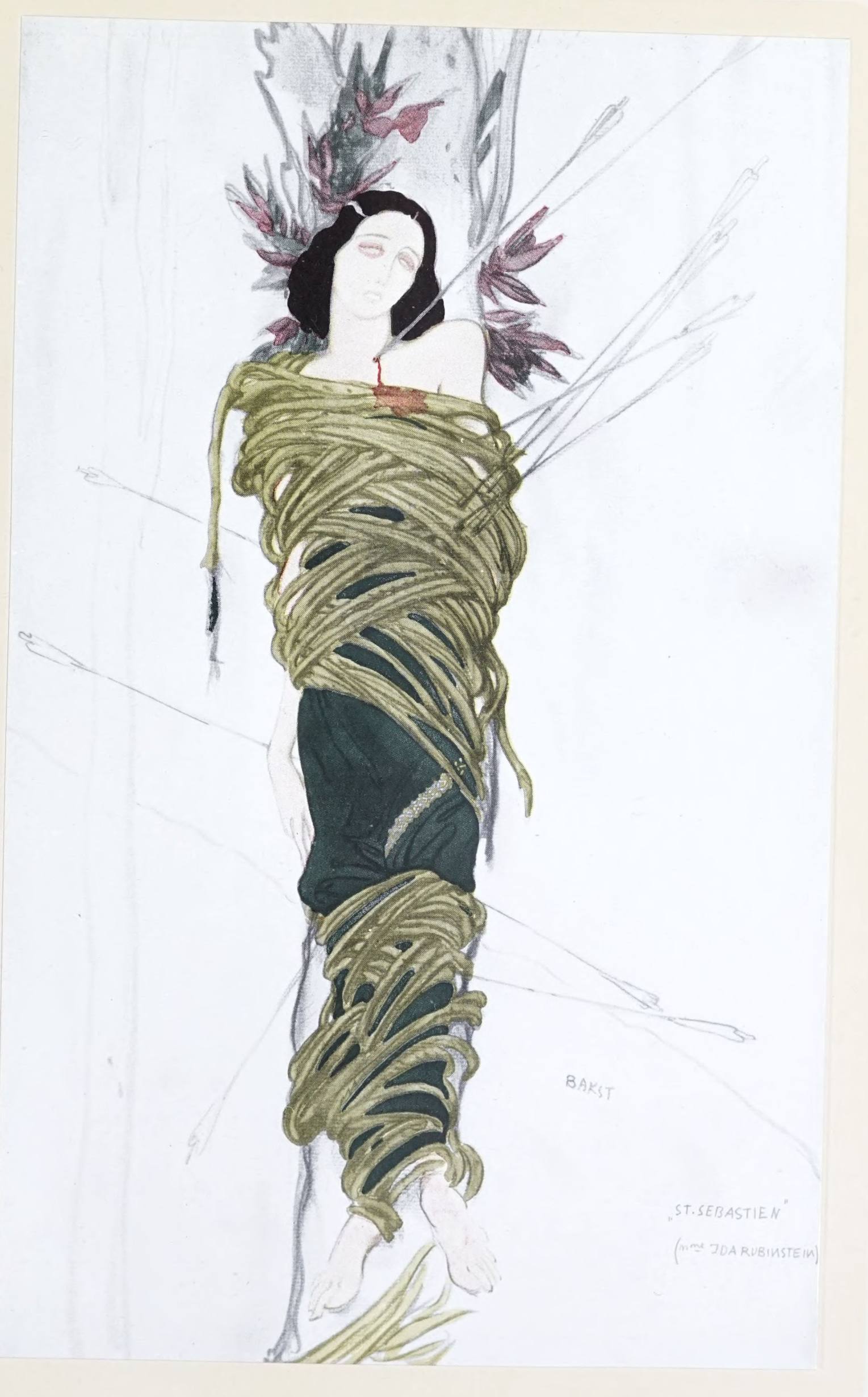
XVIII
MME. IDA RUBINSTEIN IN “THE MARTYRDOM OF ST. SEBASTIAN”
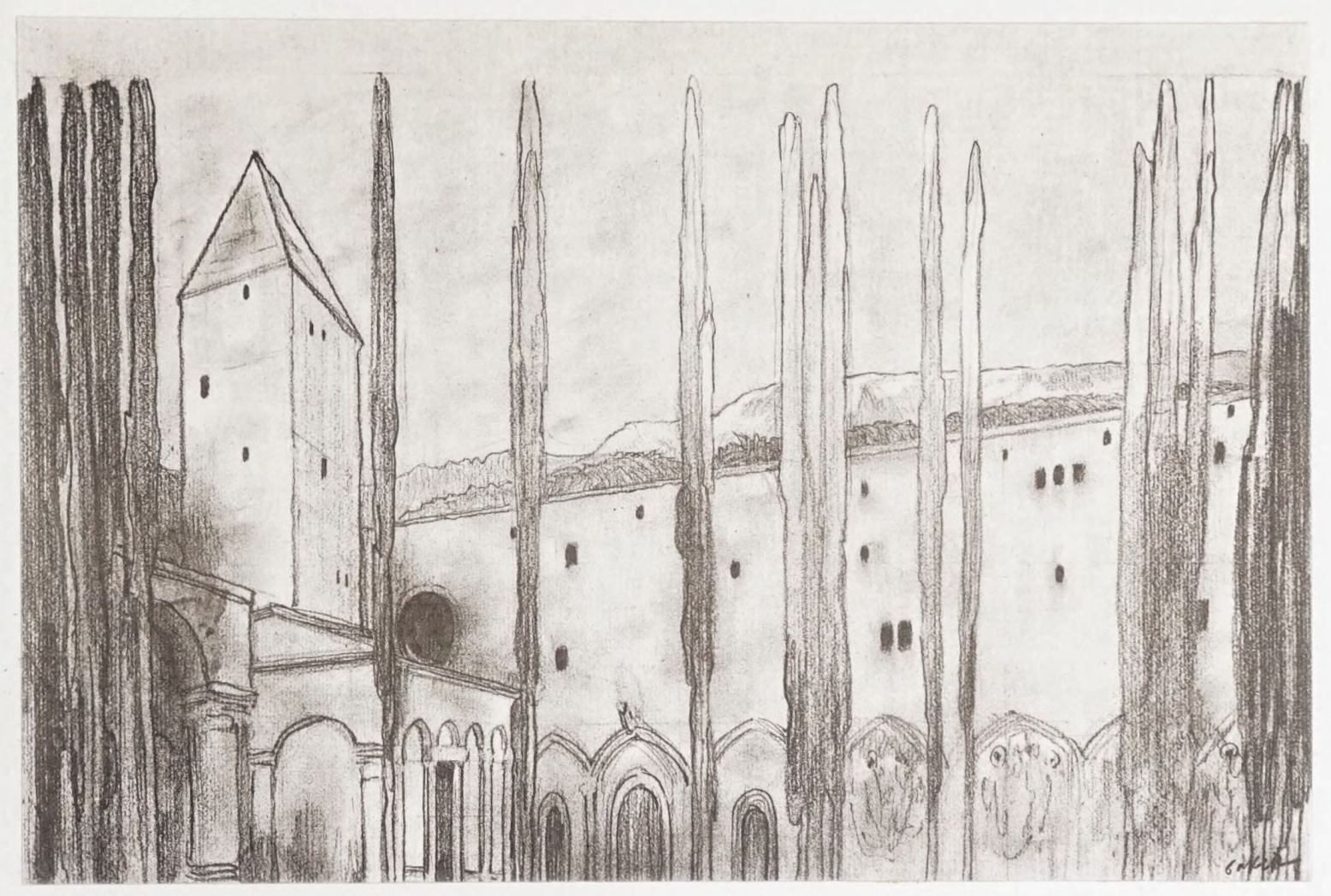
STAGE DECORATION FOR D’ANNUNZIO’S TRAGEDY “LA PISANELLA”
overboard all existing estimates and showed up the emptiness of the “wanderers” school. But his justified and impetuous enthusiasm proved—or nearly so—the undoing of “Mir Iskousstva”.
The magazine deteriorated before one’s eyes. Side by side with it Benois brought out a collection, or analytical inventory, called “The Art Treasures of Russia”. The creator became a collector. Ceaselessly he and his friends collected. Bric-a-brac occupied a prominent place. Icons of the school of Novgorod were dug up, likewise family portraits done by serfs in the old households of the nobility, mahogany furniture dating back to the Peace of Tilsit, and popular likenesses.
For a time Diaghileff allowed himself to drift. As usual he treated this craze for the past on a grand scale. He even resumed it in a definite effort of which I shall speak later. But for the present he and his friends felt themselves reduced to the role of custodians of a museum or of benevolent guides, a thing that was repugnant to his ambition and his temperament. He looked for a way out. The stage alone seemed to offer it.
Naturalism had just won its greatest triumphs, thanks to the Moscow Art Theater. But if comedy was taken possession of by the naturalists, the opera and the ballet could react. Already Mamontov, the famous mæcenas who discovered Shaliapin, had ordered stage decorations from the Moscow painters, Vroubel and Golovin. At Petrograd everything was given a trial. I cannot, without exceeding the limits set me, speak at greater length of what became of this movement; some day, perhaps, I shall be able to strike its balance. As a matter of fact, I have already had to enlarge considerably upon my subject in order to set the subject of my sketch down in his proper surroundings, in that unique atmosphere, created by historical and personal contingencies, which is ignored for the most part by the Russian people, and which entirely escapes the attention of the foreign reader. Besides, this union of a handful of men who were determined to restore the artistic greatness of their country was so brotherly, so fraternal that it would be wrong to differentiate between their respective roles and artificially to isolate their efforts.
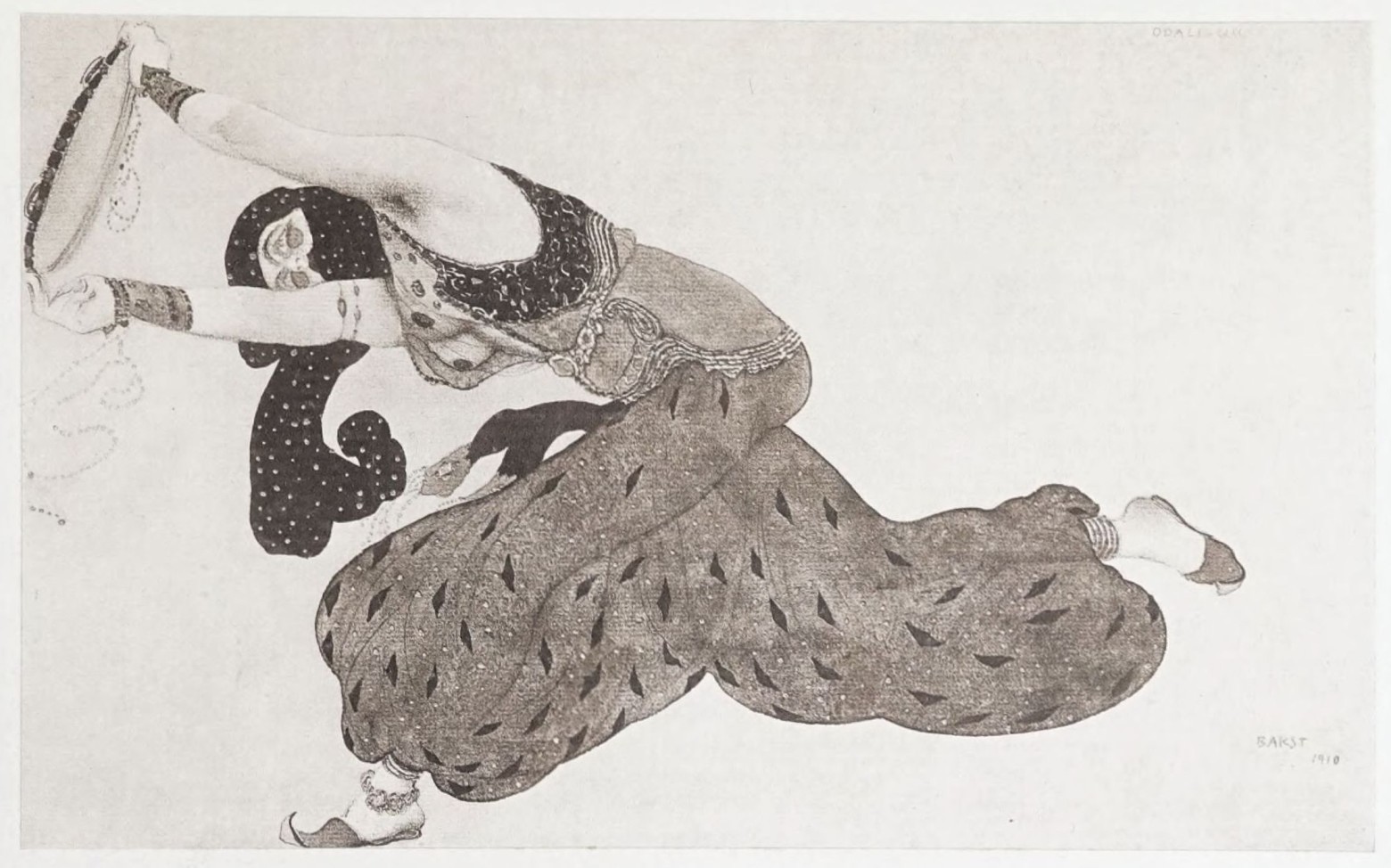
AN ALMEE. “SHEHERAZADE” BALLET