THE SPIRAL ROAD
Reading edition
Into this period of researches and visions in Greece falls many an episode that is entirely different but no less significant. Since 1903 Bakst had been using the ballet of the “Dolls’ Fairy” on the imperial stage. It furnished the prototype of those romantic productions, of those entertainments for children which are colorless reflections of Hoffmann’s Coppelius or of Andersen’s tales and in which one sees toys awakened to an artificial and mechanical life by a magic wand—entertainments, furthermore, which have become vapid by their being produced on innumerable German stages. Also, he rendered homage thereby to that “old Petrograd” that was dear to the members of “Mir Iskousstva”.
The prologue, which represents the busy coming and going in a doll shop in the capital city of 1830, is acted by a big crowd of people—shop=attendants, customers of every sort, small merchants and grand ladies, lackeys and grenadiers, mailmen and policemen produced on the stage as the naive action unfolds. All these masques and costumes are absolutely authentic, but they seem fragile and delicate like a dream. The fact is that the documents from which the dossier of the decorator was constructed were anything but commonplace. Bakst did not seek his information from the more direct sources supplied by the engravings of that time: he went to the show cases of porcelain ware.
Too little are the charming products of Russian porcelain makers—the Gardners and the Popovs—known. To be sure, they often merely misrepresent, in their style, the models from Saxony or Sèvres, but they do it with a naive flash of pure color that appeals to rustic artisans. But side by side with such imitations these obscure Russian artists modeled an entire little world of their own in tender clay—cossacks in uniform, drunken serfs, nude women, coiffed “en cabriolet” and burying their chilly hands in fur muffs. Whatever tastefully conventional there was in these figures, Bakst transposed into the language of the theater. Ever since that time this form of ballad (or “boutade”, as it was called
XXIX
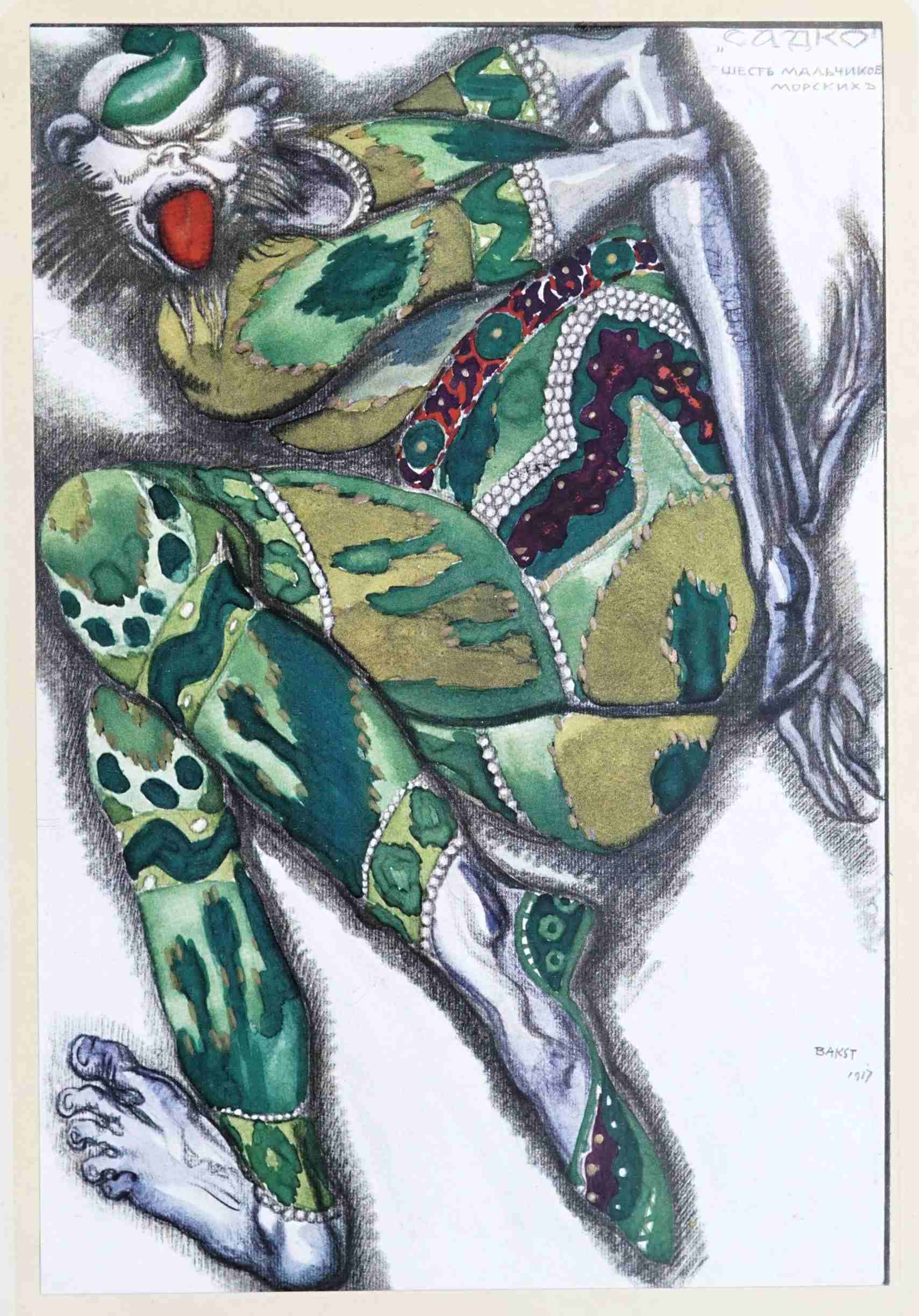
SUBMARINE MONSTERS (“SADKO” OPERA). (GOUACHE)
XXX
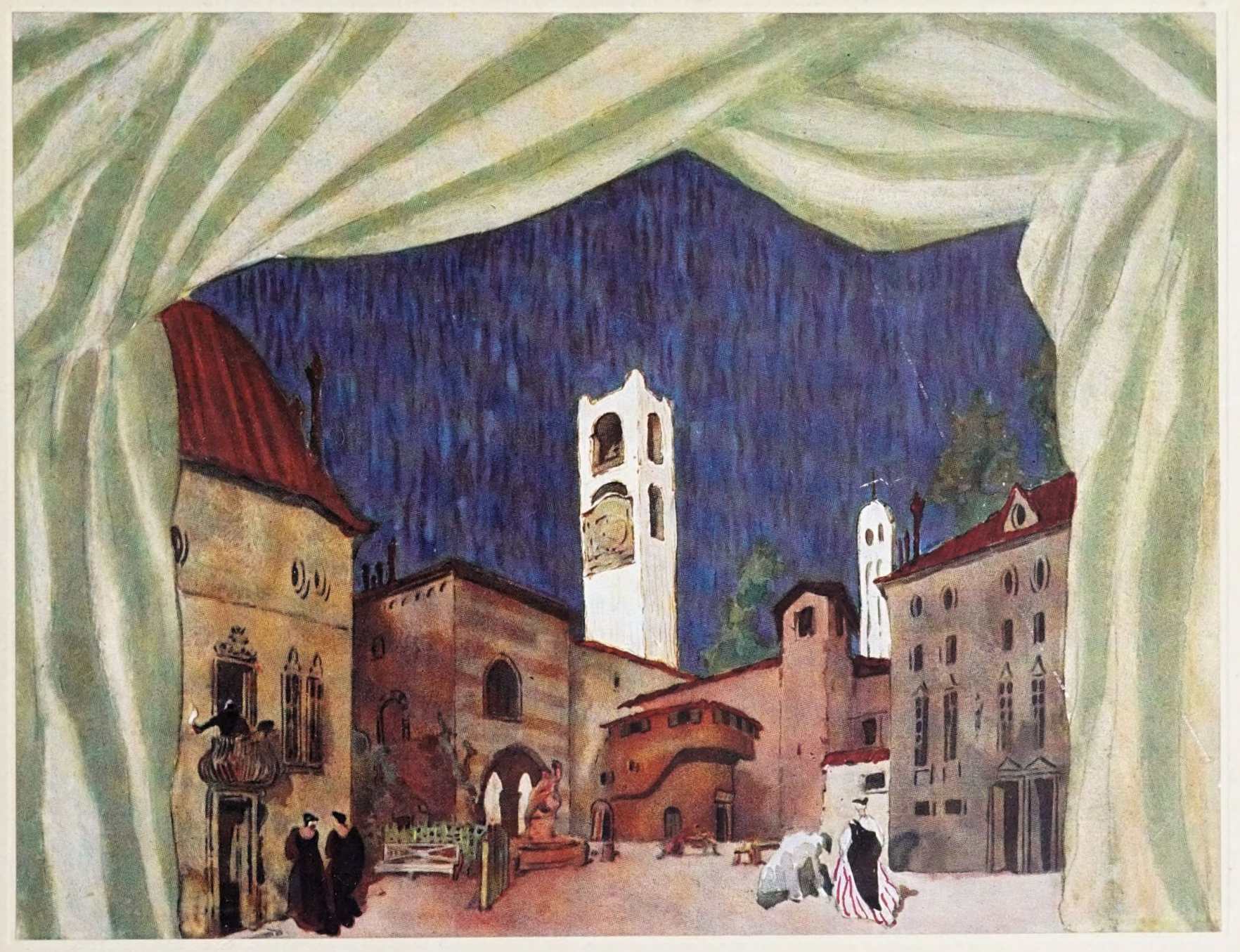
STAGE DECORATIONS FOR THE BALLET “WOMEN OF GOOD HUMOUR” (SECOND VERSION). GOUACHE
XXXI
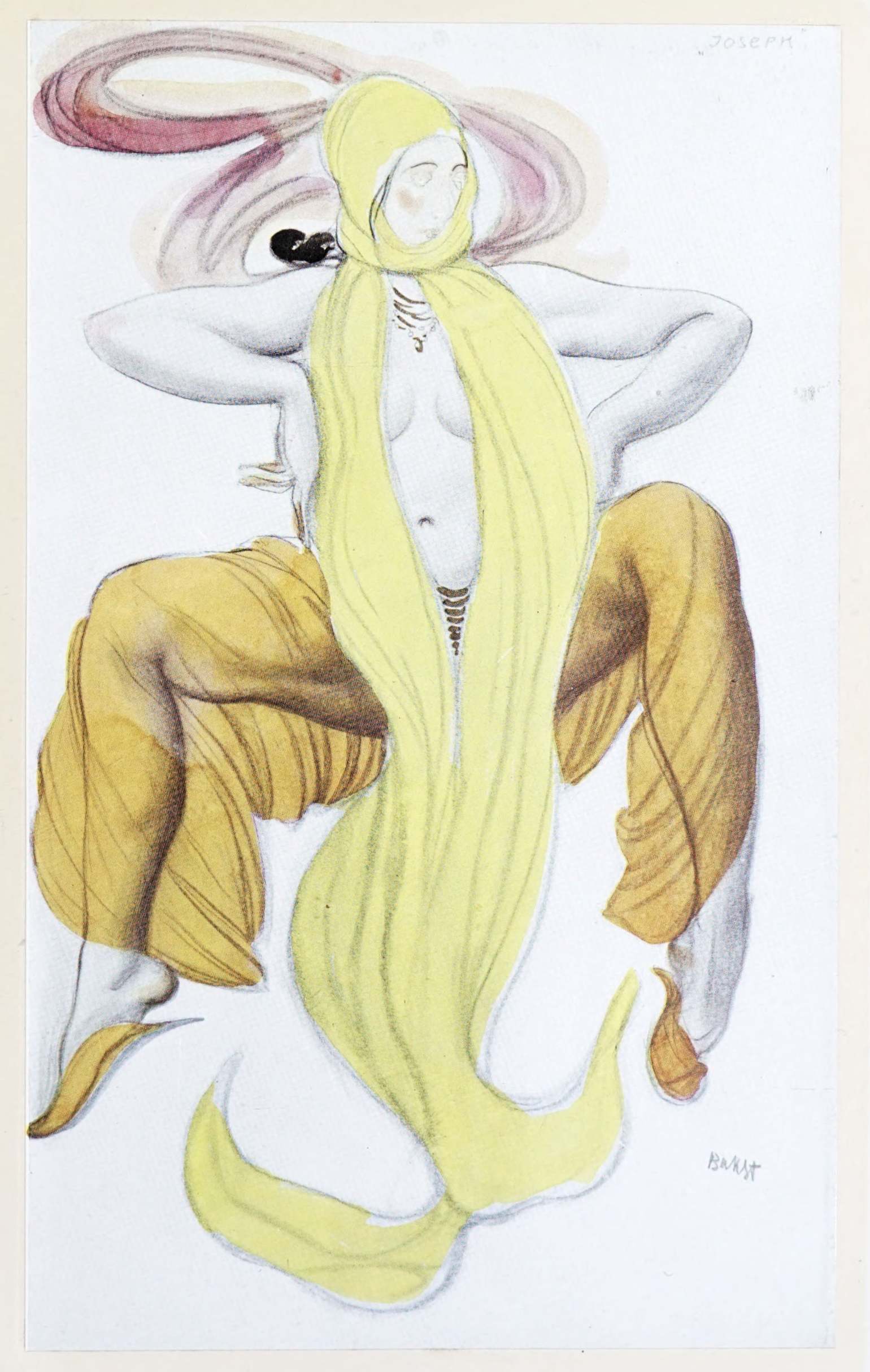
A BACCHANALIAN DANCE (JOSEPH) BY R. STRAUSS
XXXII
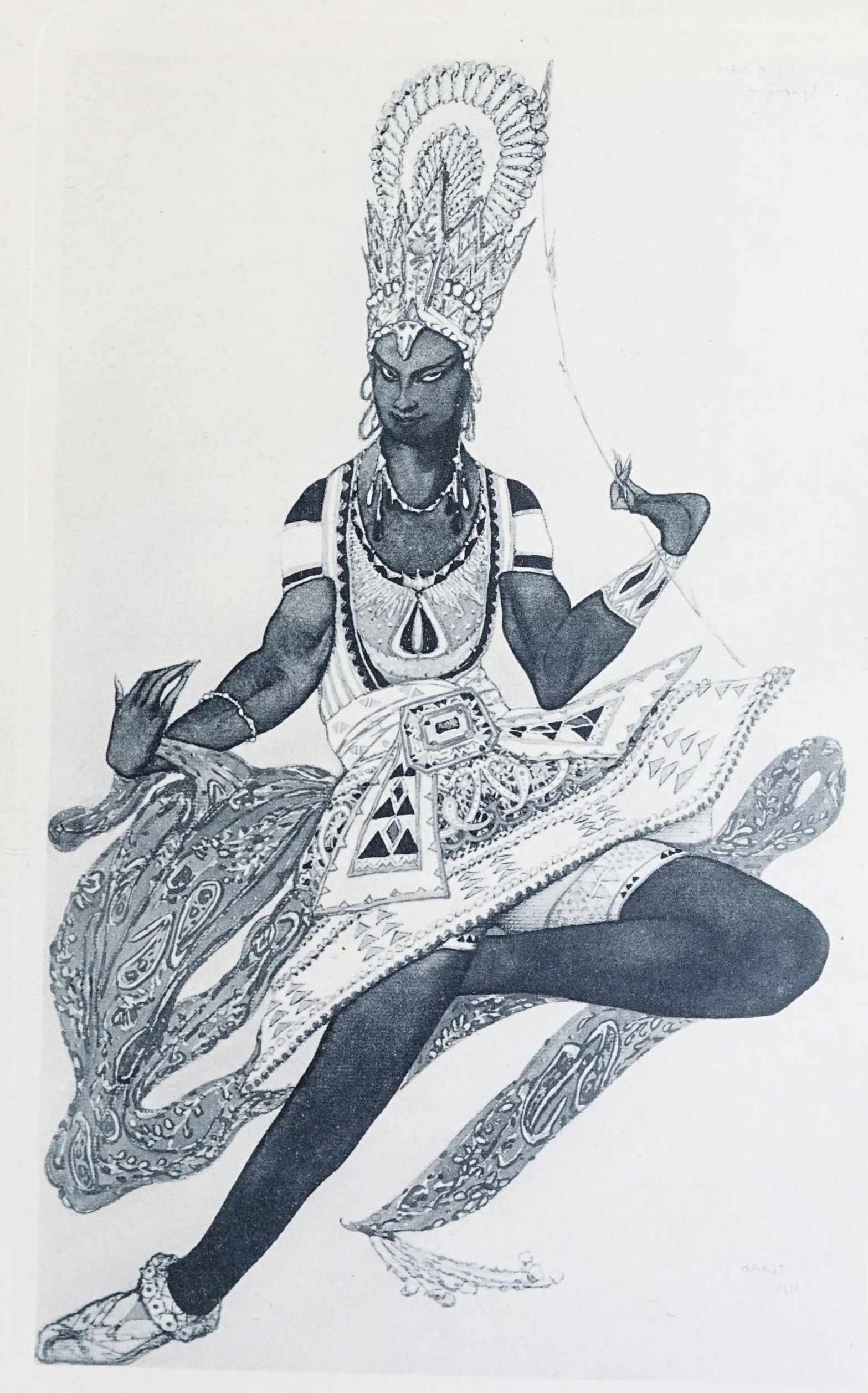
Mr. NIJINSKY AS “BLUE GOD”. (GOUACHE)
in the time of Cardinal Mazarin), the dancing for which had been designed by Serge Legat, a splendidly endowed young man who committed suicide in a fit of passion and despair over a love affair, has maintained its place on the program. Examples of it are the “Carnival”, “Phantom of the Rose” and “Secret of Suzanne”, that delightful little=work in which one already sees Napoleon evolving from Bonaparte.
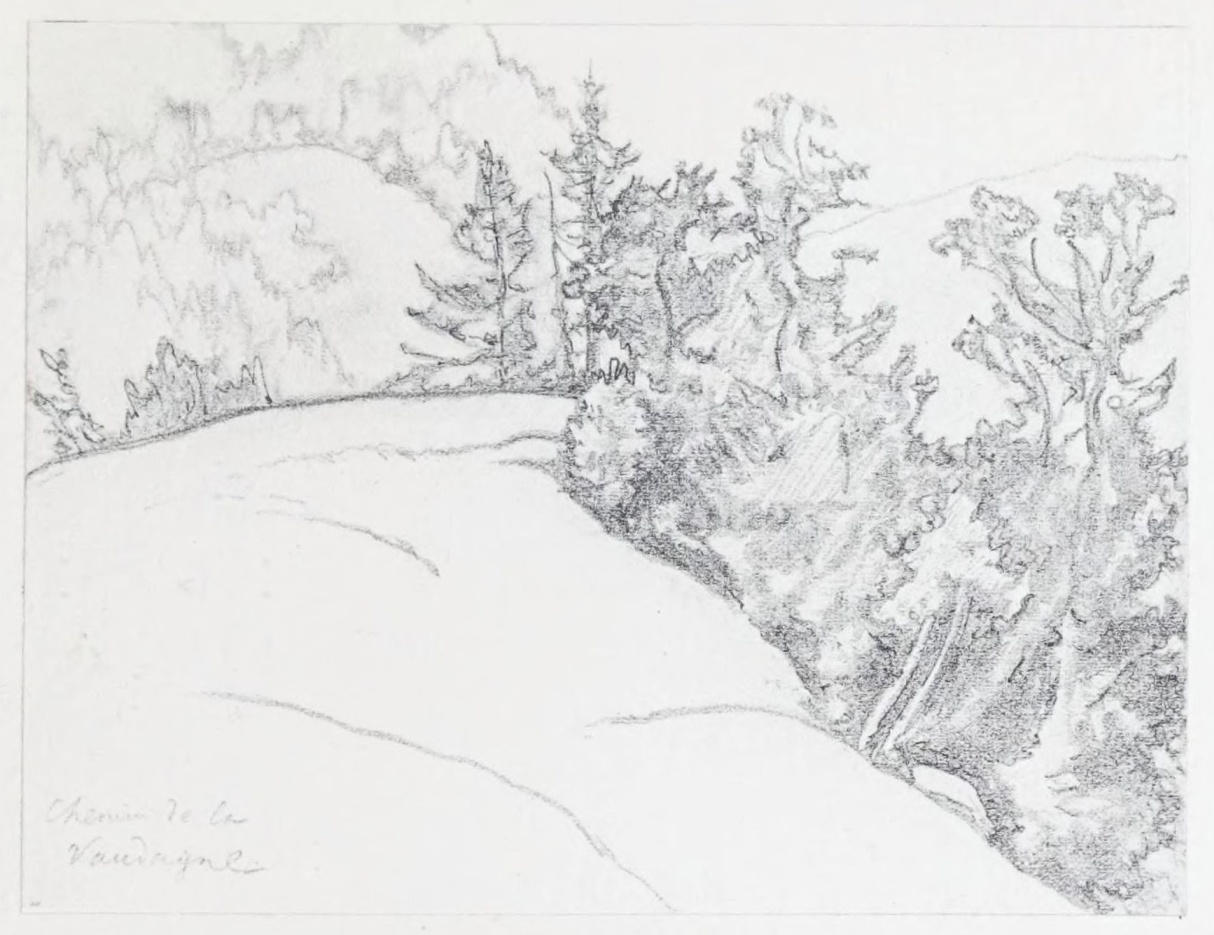
IN UPPER SAVOY. DRAWING
But Bakst had by no means given up his painter’s easel for his theatrical sketches. Numerous portraits of his bear out this fact, such as that of the philosopher and lay theologian Vassili Rosanov, of his friend Benois, of Levitan the remote emulator of Corot who discovered the intimate and poignant beauty of the humble Russian landscape, of Diaghileff and his old nurse. Painted with keen observation, with facility of touch and in vivid colors that spread over broad surfaces, these portraits coming from the school of Serov showed nothing of that painful affectation, of that anguish of definitive, absolute expression with which the Moscow master often endowed his canvases to the point of tiresomeness. In the case of Bakst there is nothing of the exact analyst who dissects and torments the soul of his model. With our artist everything seems to be improvisation, happy inspiration; it is a style for which the fine term “prime=sautier” (ready=wit), once coined by Montaigne, is exactly appropriate.
His growing familiarity, however, with Greek art, which is in a high degree plastic and linear, turned him in the direction of more concentrated and more simplified processes. The painting of vases in the merest outlines and on flat surfaces neatly silhouetted, imperceptibly drew him into the path followed by Ingres. He therefore gave up his paint brushes in favor of the lead pencil and the colored crayon. In his portraits thus designed it is the line which circumscribes the person, which sets it out in space, which expresses its character and suggests its size. Thus the Russian painter is already en route towards that strictly linear transposition of a body of three dimensions without the aid of the model, or of any standard of values, or of any material record; a style which some day Pablo Picasso employed as master and Modigliani as spiritual dreamer.
But even all this could not satisfy that fever for activity, that fecund restlessness which at all times determined the tremendous productivity of Bakst. It was necessary, people were agreed, to offer, in opposition to the Academy of Fine Arts, managed by pedantic dilettants who were embittered by the triumph of the new art, a form of instruction at once free and sane. The haughty air of the Academy’s official staff was not justified either because of any venerable tradition nor because of the most elementary savoir faire. The “wanderers”, having dislodged from the Academy the pedants whom Bakst knew, placed themselves in their seats. Their æsthetic carelessness was complete, their ignorance of Western art absolute and provoking. At the same time young artists who rebelled at this teaching were reduced to the necessity of acquiring the rudiments of painting by themselves.
Affairs were in such a condition that they absolutely needed to be remedied. Bakst therefore associated himself with Mstislas Doboujinsky,
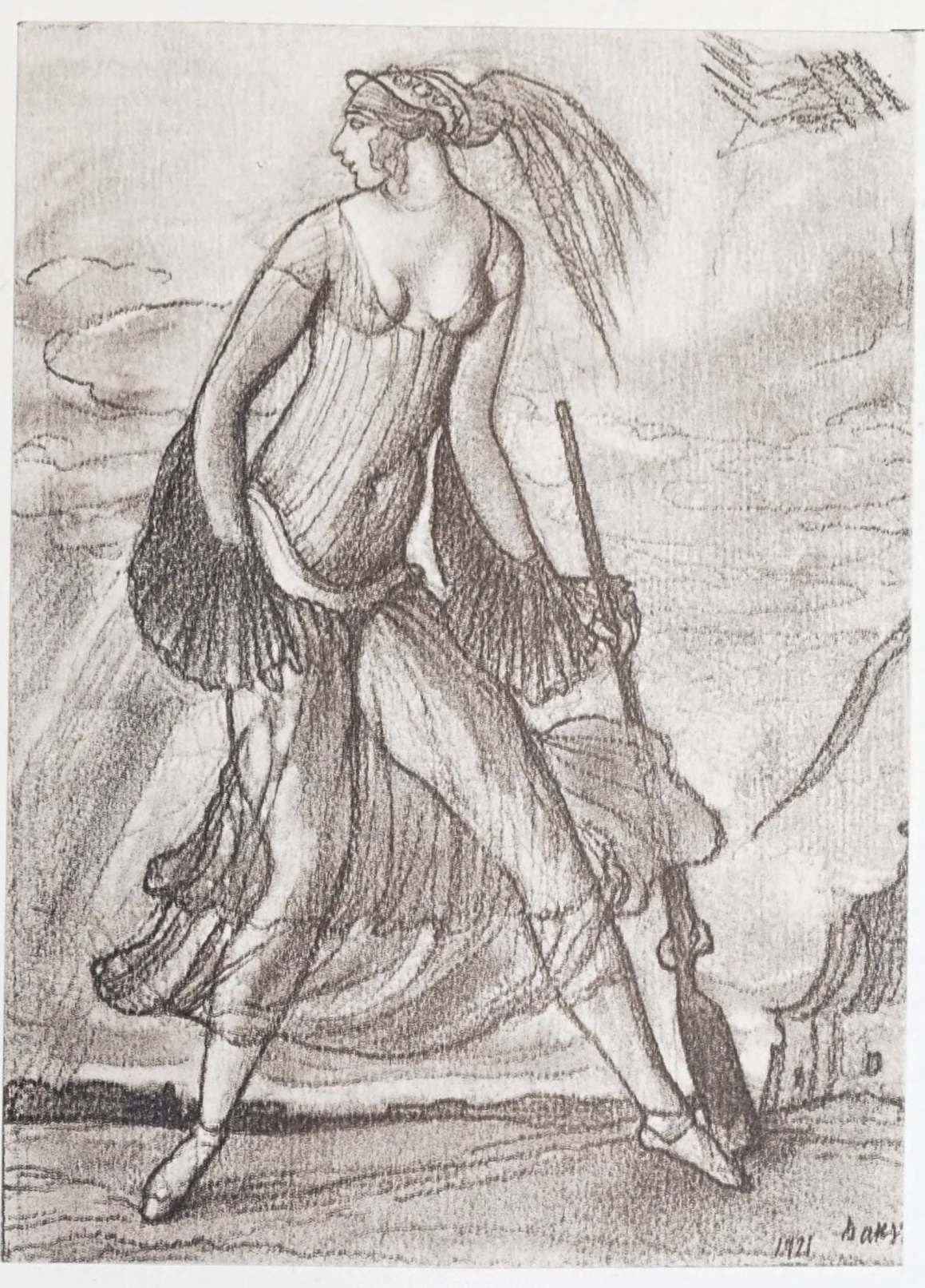
A HUNTRESS IN 1930
a remarkable offspring of “Mir Iskousstva”, who excelled in the designing of the ornament and of the vignette, and who later worked with considerable success in the theater, in order to start a free school. I recall having been able, in connection with an exposition organized by the review “Apollo”, to estimate the results achieved during the first year of the school’s work. One series of studies symbolized a nude man on a background of red material. There was none of that “academic” way of placing things in a vacuum or in a neutral atmosphere, nor of sketches colored amid gray shadows. The bright red of the background played upon the subject in green lights; the rhythm of the colored surfaces superimposed itself upon the anatomic harmony of the body. All these attempts were strictly anonymous as far as the public was concerned; it was not the personal pride of the students that was to be flattered; it was merely a question of establishing the validity of the method. That did not hinder the fact, however, that some of those young unknown painters today enjoy a reputation that borders upon renown.
We have now reached the year 1908. Bakst seems to have condensed his effort. He has summoned back the ancient legendary tale and has restored it to the theater. This myth he has also projected upon a famous canvas. In his portraits his incisive line closely encompasses material and internal realities. In his romantic dreams he has been able to live again through what Stéphane Mallarmé has called “la grâce des choses fanées”. Later he makes a division of his artistic property among his enthusiastic students. How much there is in this to fill a beautiful life! One might think that the circle of such men as Bakst is completed in one harmonious curve. But it is nothing of the sort.
Bakst is one of those men whose road is laid out in spiral form. What seems like a stop, is in fact nothing but a turn of the road. And at each turn the circle widens. At Petrograd his task is completed. There is nothing left there except to follow. But there remains Paris and the universe.
In reality, I am at the end of my task, which is that of acquainting the reader with a Bakst who has not yet been written up, of speaking of his formative period and of the intimate and hidden sources of his inspiration. Once my hero had entered upon public life, I ought already to have left the domain of his private existence. It is with regret that I take leave of the good little fellow who goes into ecstasy over his grandfather’s canary birds; of the uncompromising youth who defies his ignorant masters; of the young man who risks his future—and what a
XXXIII
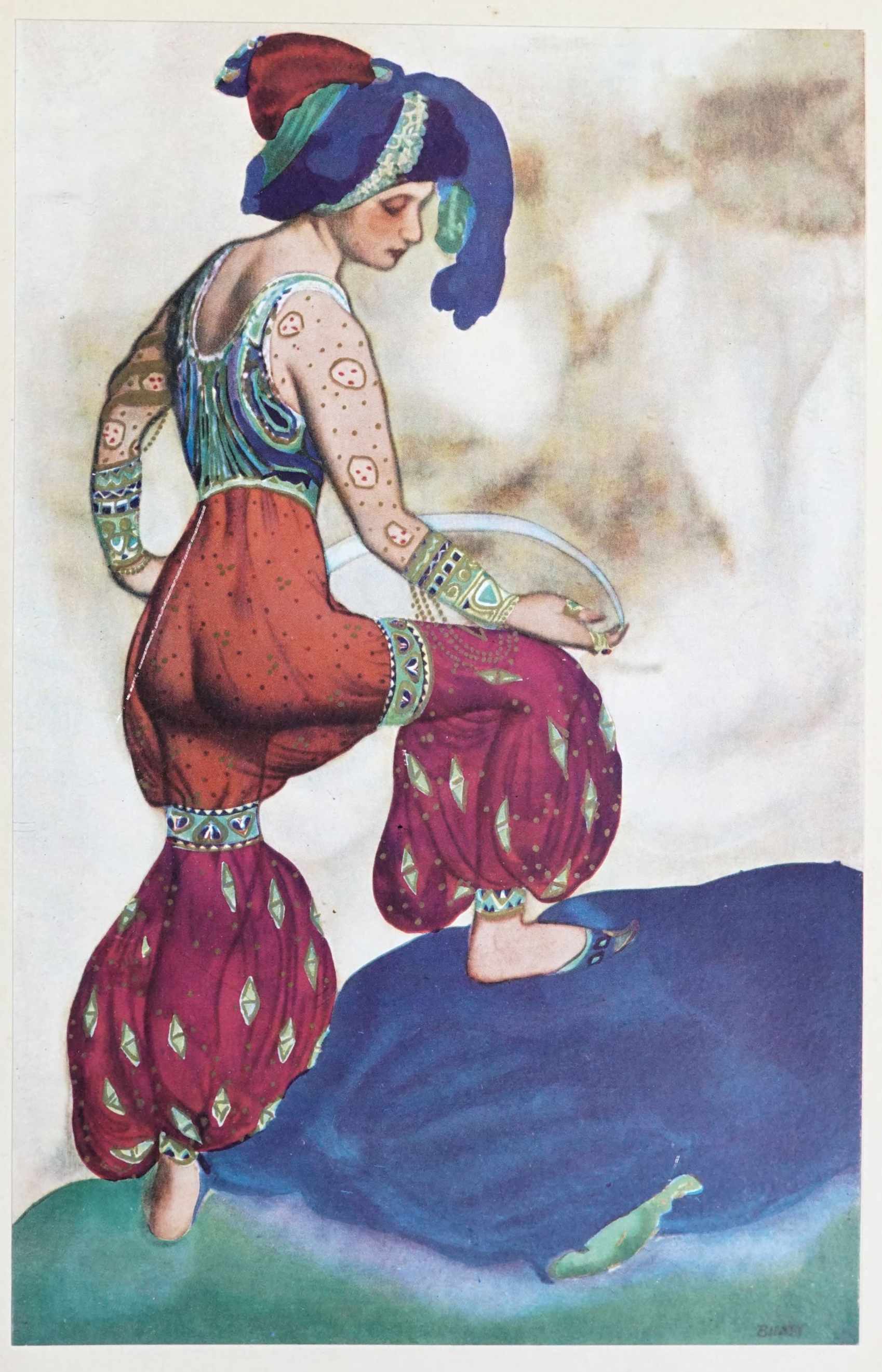
THE RED SULTANA
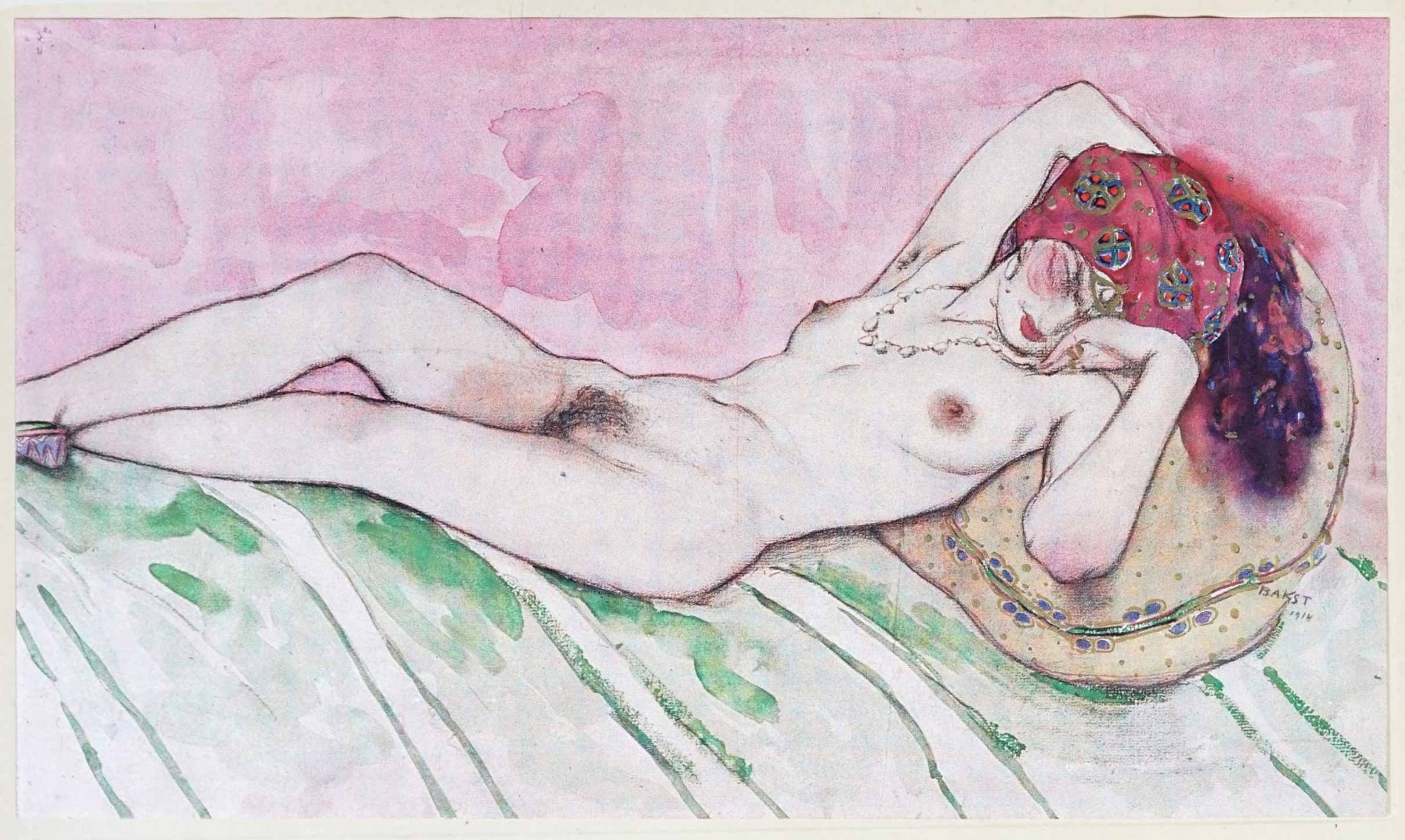
XXXIV
THE PINK SULTANA. (GOUACHE)
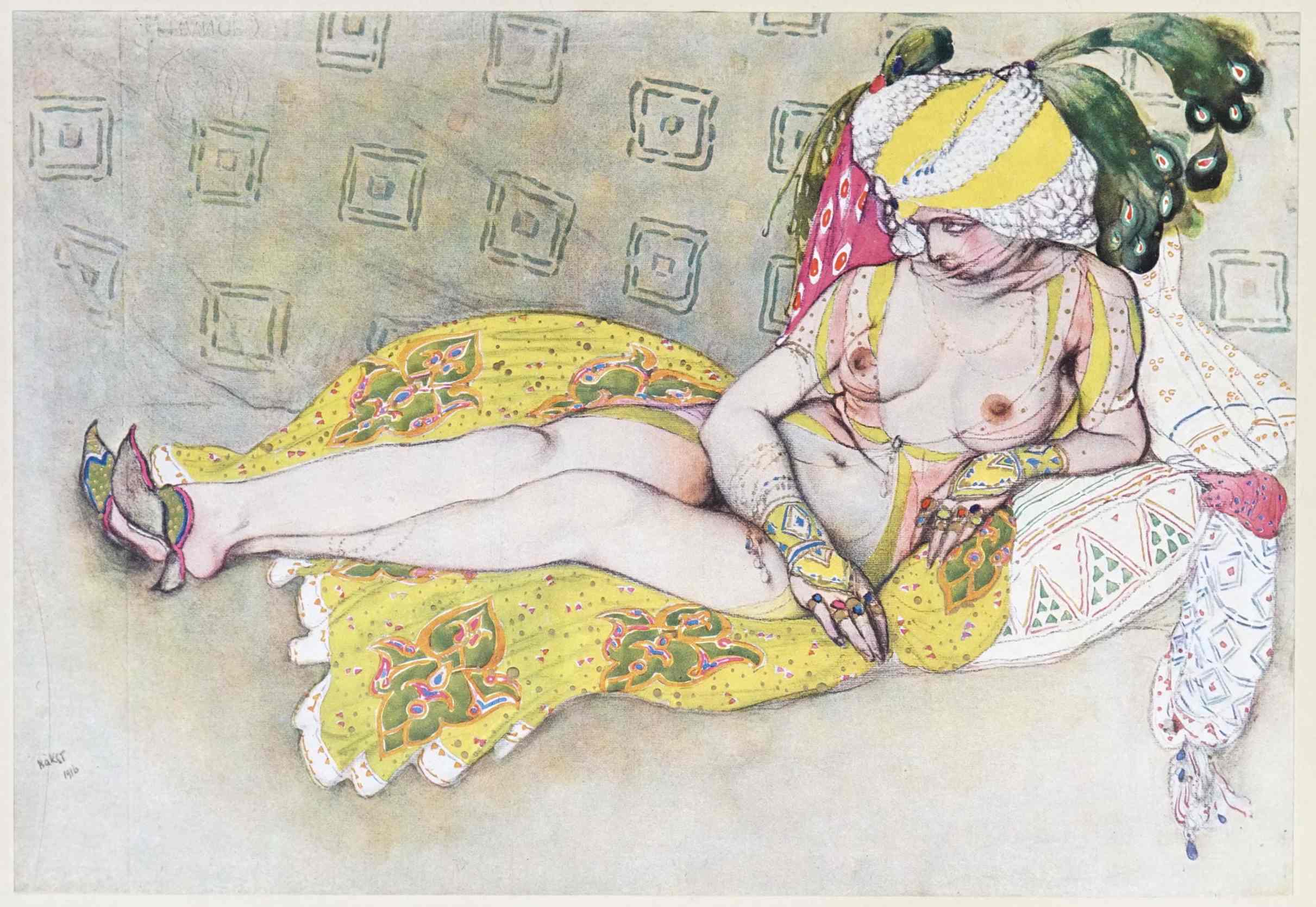
XXXV
THE YELLOW SULTANA. (GOUACHE)
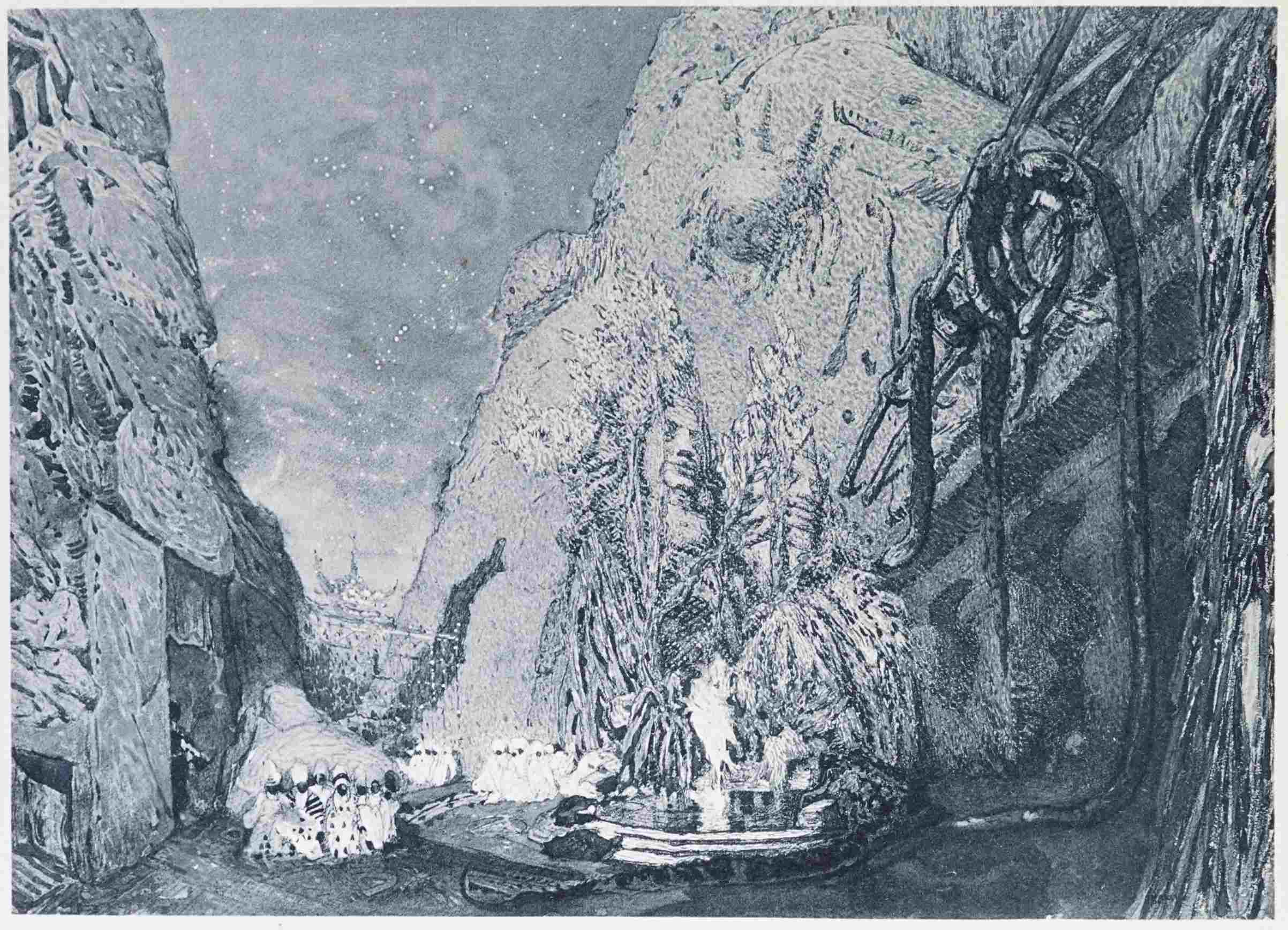
XXXVI
STAGE DECORATIONS FOR THE “BLUE GOD”
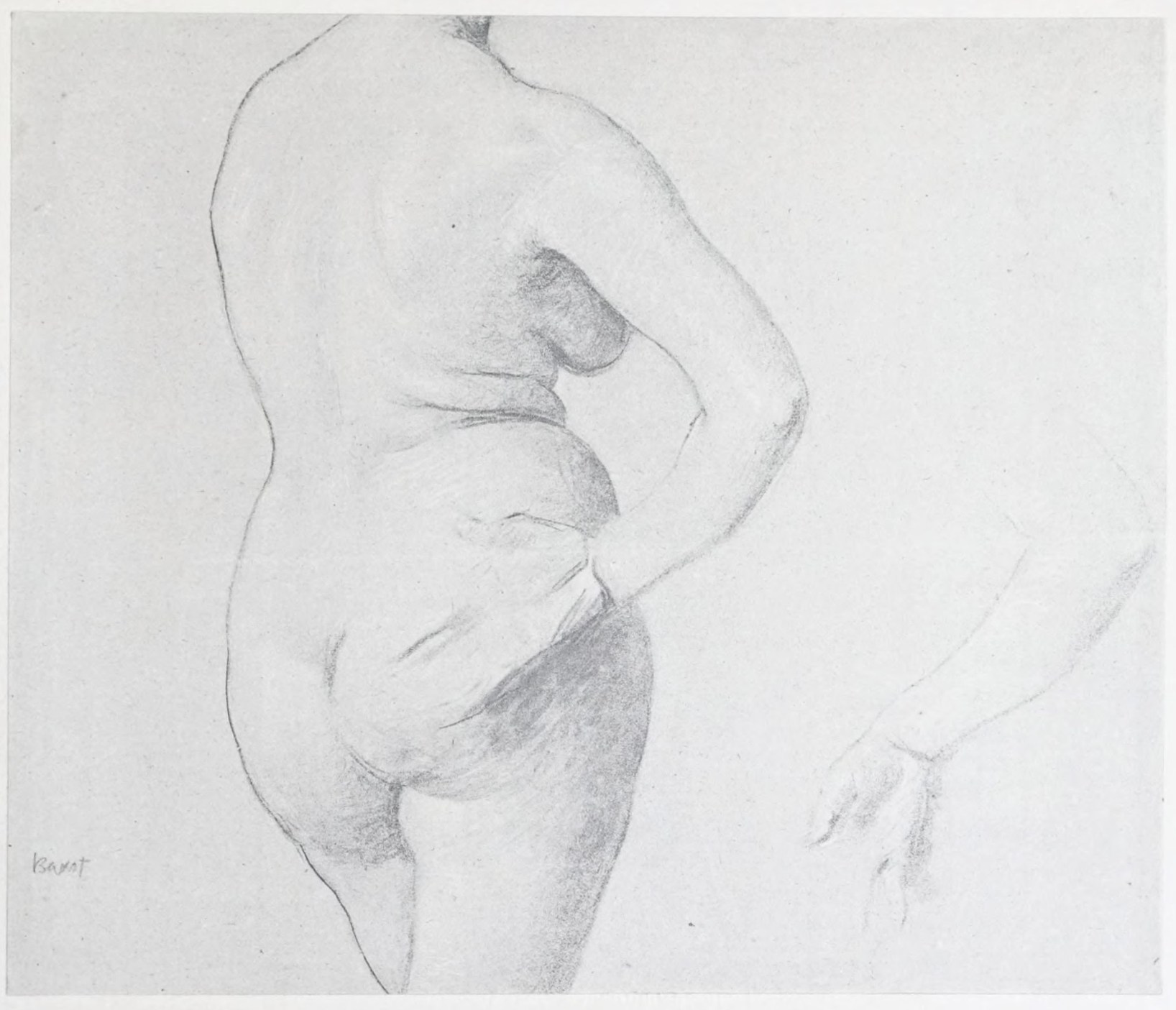
A DRAWING
future!—for the sake of the exquisite form of a smile and the profile of a tapering hand; and finally of the artist whom I see in my country becoming identified with all big projects, either undertaking them or excelling in them.
But this study would perforce be incomplete if I did not decide to accompany our friend on his exodus toward the West and to put together the main facts of his recent activity which sends its rays over the entire world—an activity of which, for the most part, I am a witness.
Therefore, en route to Paris!