THE THREE KNOCKS
Reading edition
Resolutely Diaghileff turned his co=workers towards the theater. The time was propitious. Vsevolojsky, the director of the Imperial theaters, had just resigned his position which he had filled so brilliantly. Himself a dilettante nobleman and a man of good taste he had personally designed most of the costumes that, under his direction, were built for the ballet and the operas. He had to a large extent reconstructed the Russian and foreign repertoire, devoting himself to Tchaikovsky and making a place for Wagner. A galaxy of stars surrounded him. Marius Petitpas, the greatest living choreographer, exercised his successful dictatorship over the ballet. A brilliant young woman, just out of school, was about to eclipse the celebrated Italian virtuosos. Highly respected painters—the Shishkovs and the Botcharovs—who were experts at the art of stage decoration, executed the ideas of their director. In short, he did everything. Was it his fault that his activity fell within the worst epoch of a century that was called the stupid century? Is he to be blamed that the sources of his inspiration and the quality of the documents consulted by him bore the marks of that terrible decadence of the artistic instinct of which the year 1900 marks the climax and presages its end? However that may be, he prepared a glorious end for an obsolete art. The old opera passed away in beauty.
Yet with all the extraordinary perfection of execution, a certain uneasiness was germinating. Vague manifestations of independence were threatening the rigorous traditional discipline. In the midst of this crisis the helm was given to a young man. Prince Serge Volkonsky, who had distinguished himself in the Court theater by his splendid bearing and his clever acting, belonged to one of the noblest Russian families. His grandfather had taken part in the famous “Decembrist insurrection” of 1825; his grandmother had followed her husband to his Siberian convict prison with a devotion that inspired Nekrasov to write a celebrated poem. Volkonsky let the dead bury their dead and from the very first made his appeal to the young men and women—to Diaghileff and his friends. They plunged into their work: a revival of Delibes’ “Sylvia” was decided upon.
The Mir Iskousstva painters agreed to make their first attack upon the stage together. Accordingly, they divided up the work by acts, Alexander Benois leading—Benois who even today, after his successful collaboration with Stravinsky, retains a real feeling of reverence for Delibes whom he places, without hesitation, in a class with Wagner. Bakst and Serov also collaborated.
But the opera was never put on. There is a veritable hoode about this “Sylvia”, which kept haunting the Russian artists and yet was never produced. The late Andrianov, an exceedingly good dancer, was about to show an abridgement or sketch of this piece, but the attempt came to naught; Fokine dreamed about it vainly for many years.
As to this first attempt at cooperative work, it failed for personal reasons. From the beginning Volkonsky felt his prestige as manager
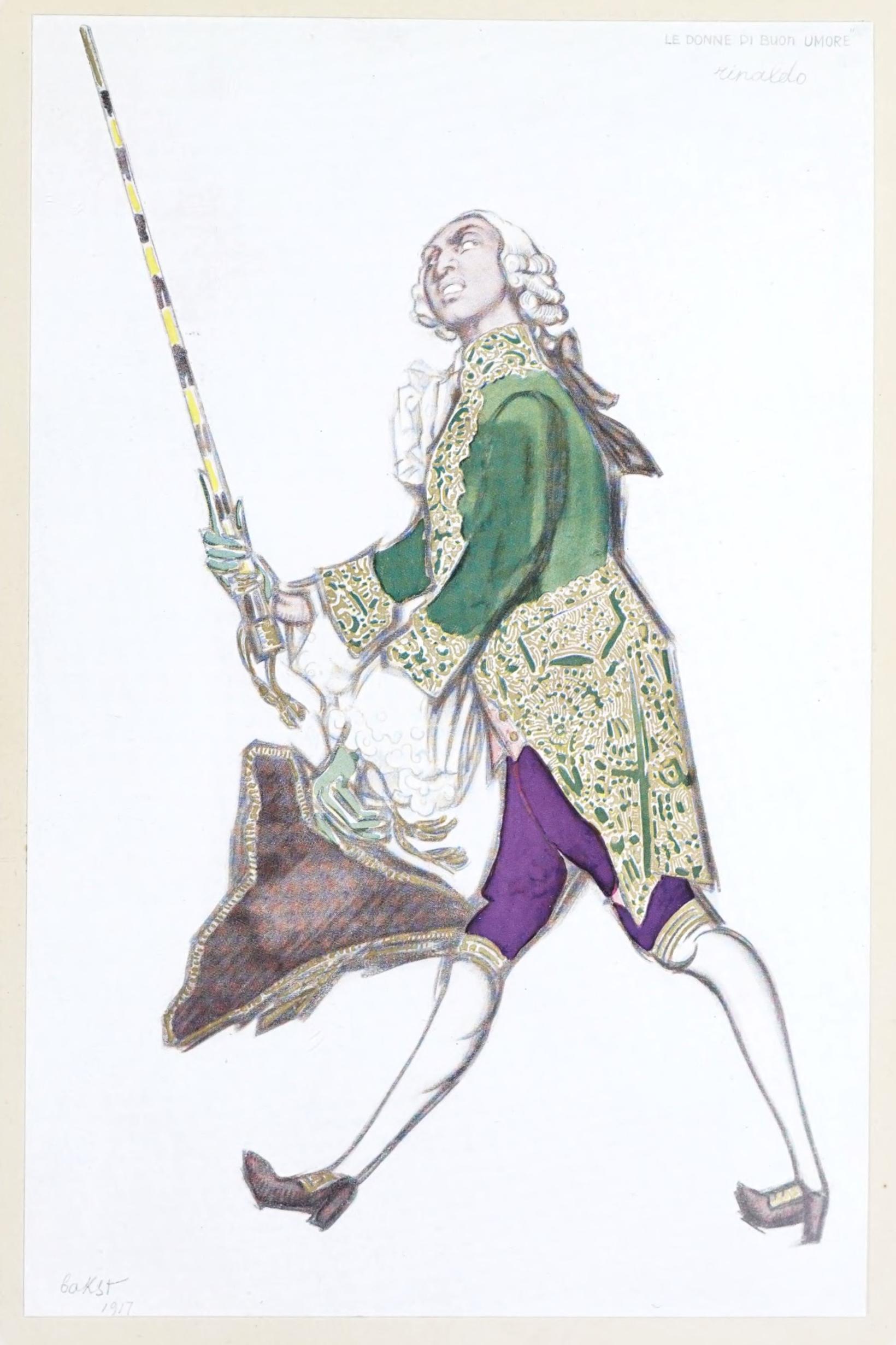
XIX
THE “WOMEN OF GOOD HUMOUR” BALLET. RINALDO. (GOUACHE)
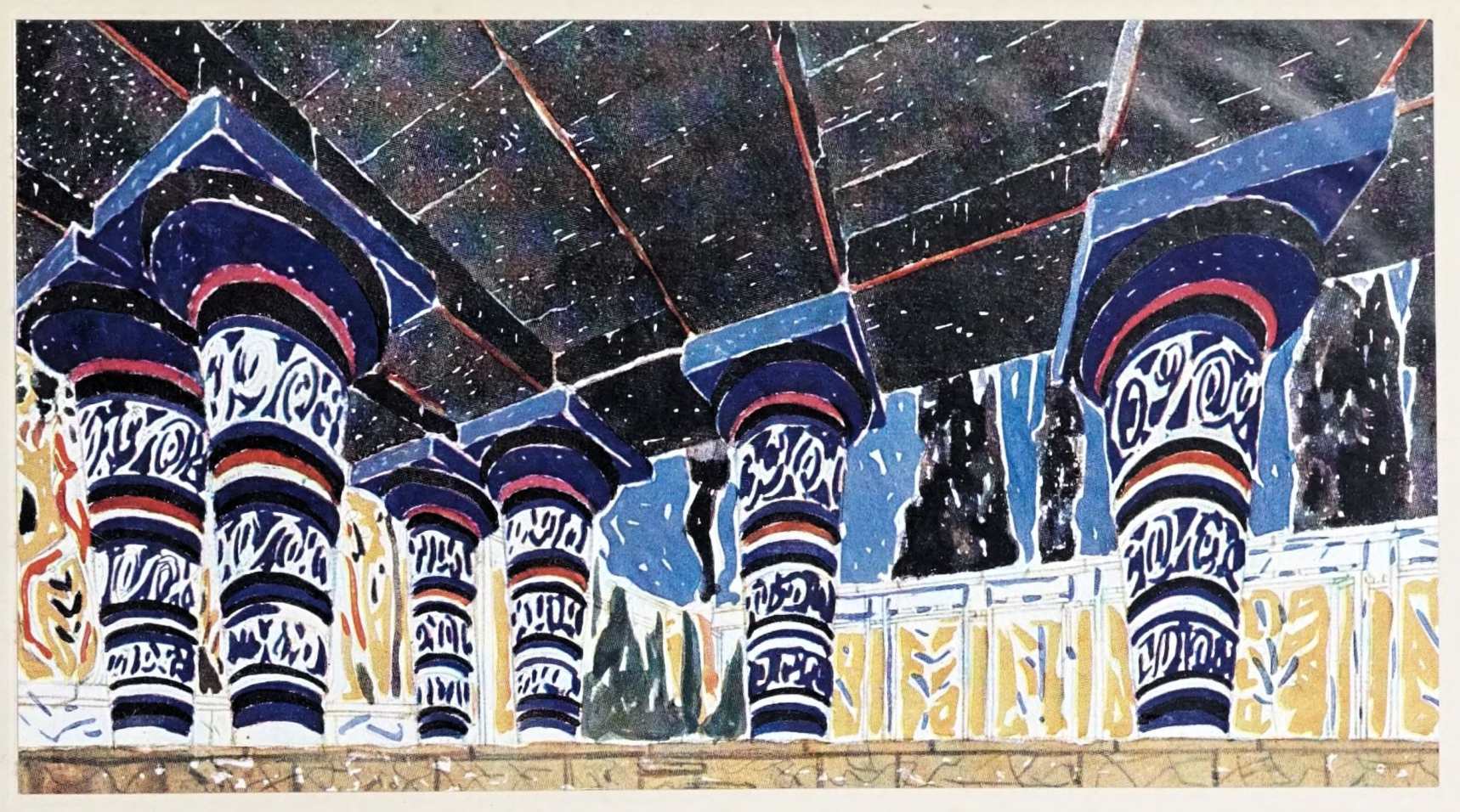
XX
STAGE DECORATIONS FOR “PHÆDRA”. (GOUACHE)
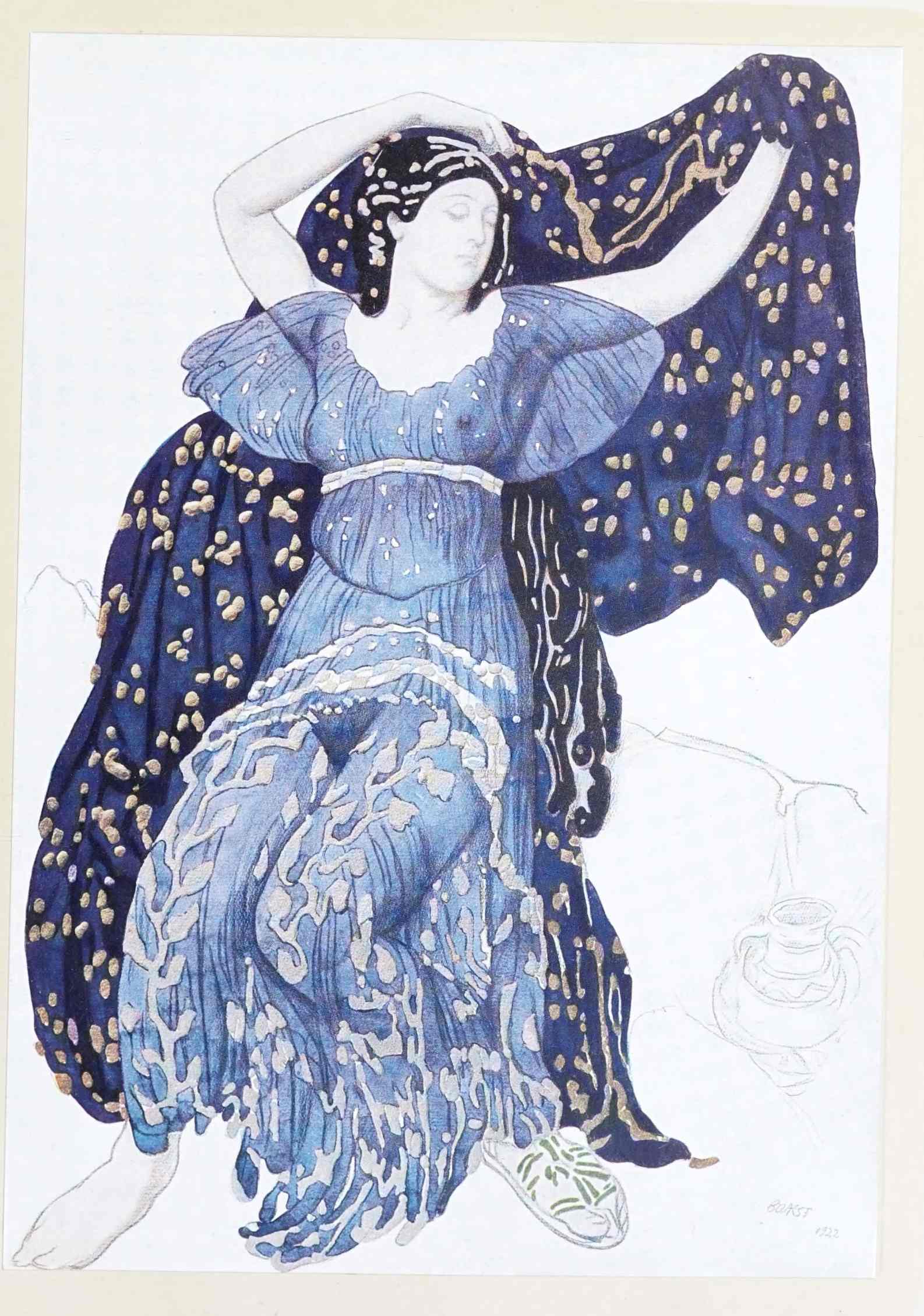
XXI
A COSTUME. “NARCISSUS” BALLET
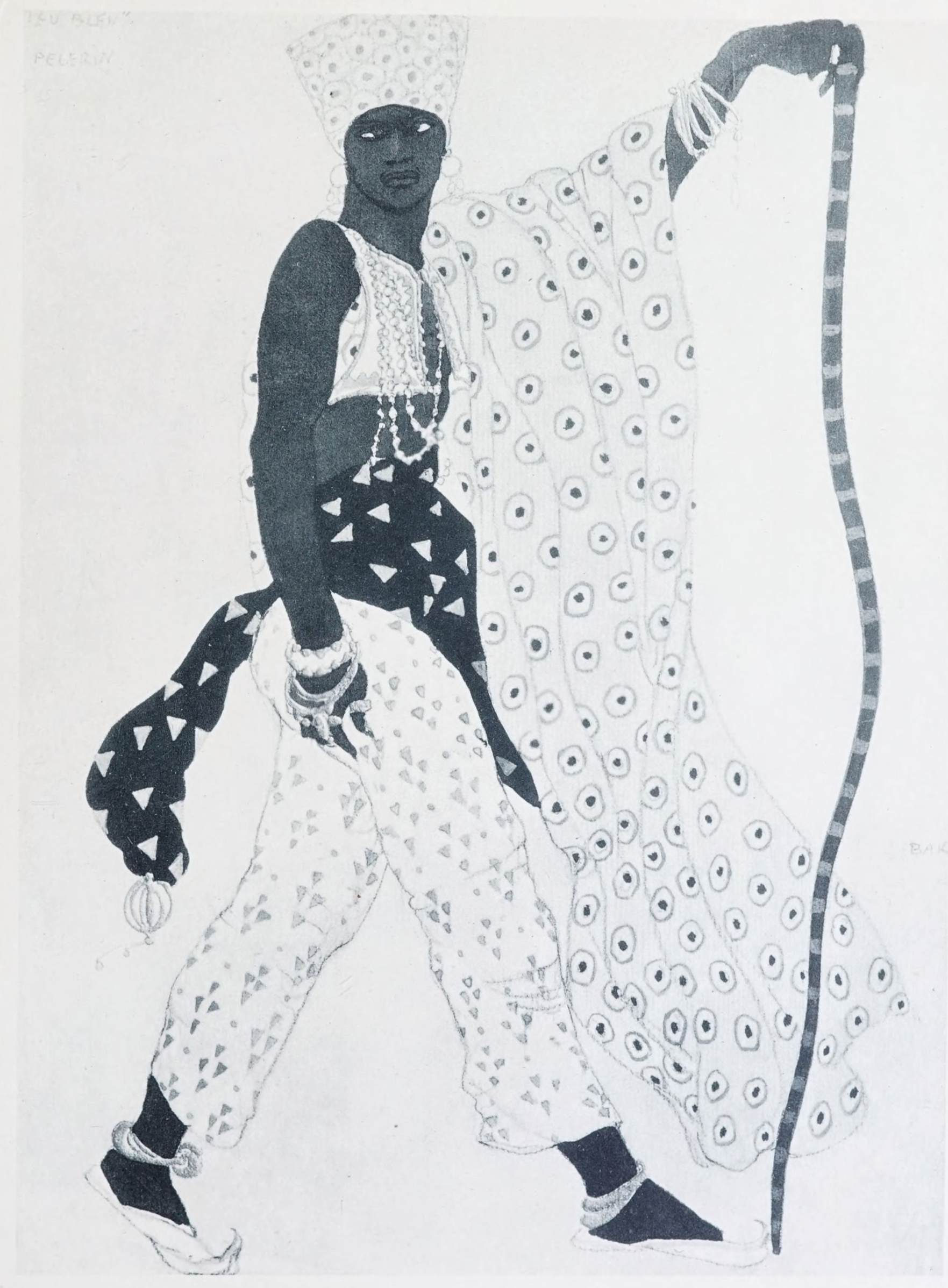
XXII
THE PILGRIM (“BLUE GOD” BALLET). (GOUACHE)
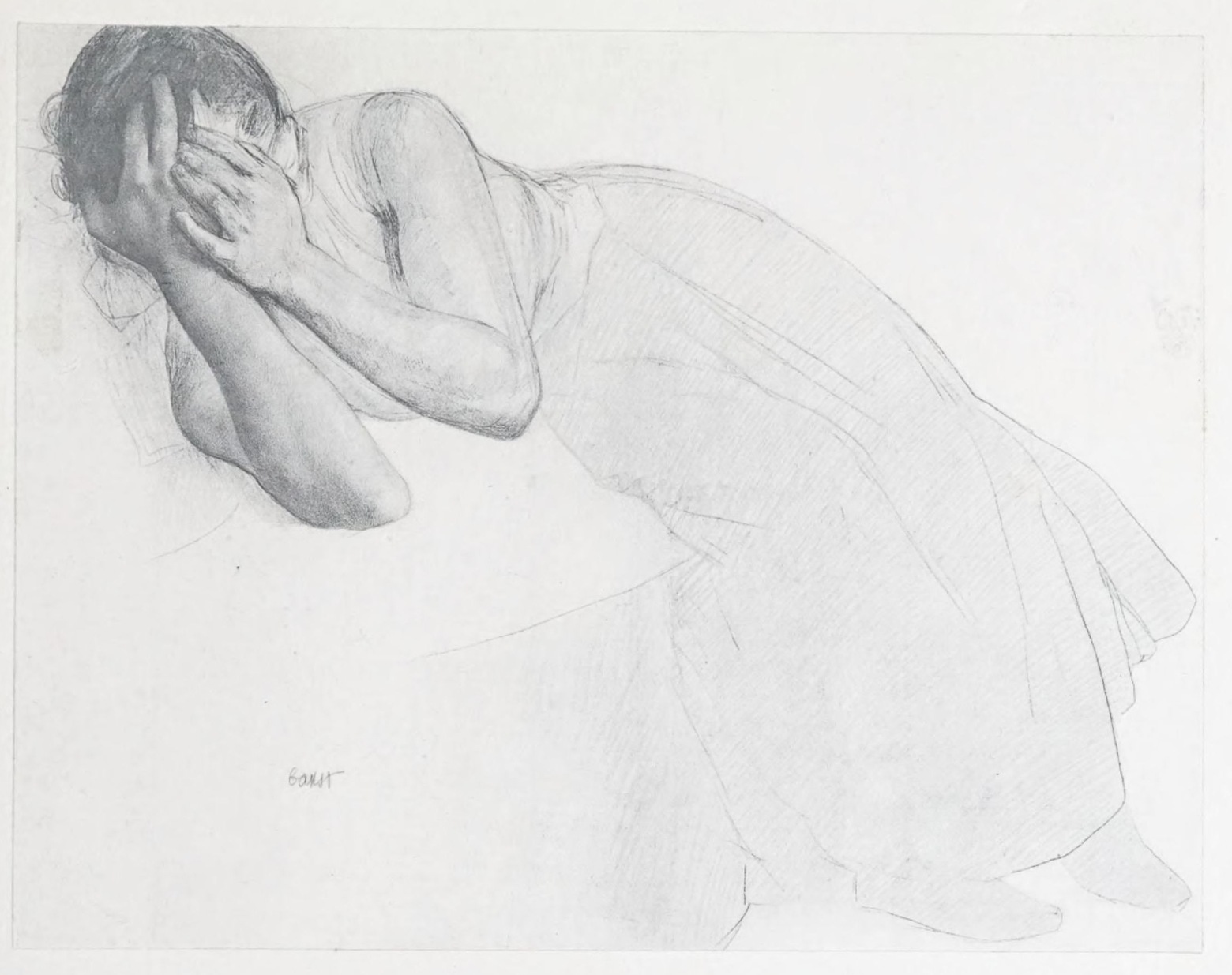
DRAWING OF A LIVING MODEL FOR A PICTURE
threatened by the consuming energy and the unscrupulous ambition of his “employé”, Diaghileff. To be sure, Diaghileff, conscious of his actual superiority, carried himself as though he were the boss. Fearing he would be supplanted by this maire du palais, the director requested Diaghileff to resign voluntarily. Diaghileff would do nothing of the sort. Exasperated, Volkonsky promptly discharged him, by applying the famous “paragraph three” of the rules and regulations to his case, by the terms of which the “government secretary Diaghileff” was forever barred from all public appearance. Who knows but that to this act of administrative jealousy we owe the grandiose effort of the “Russian Season”? Excluded from official life, Diaghileff, the great condottiere of art, could unfold his full power!
Diaghileff left, his friends followed, a great gap closed in about the director, and several months later, not being able to have the last say in a quarrel with a star who was both famous and powerful, Volkonsky had himself to resign and leave.
Bakst, however, had not participated in this boycott of the prince; he plunged into his work for its own sake. But it was not at the Marie Theater that he made his real debut. Grand-Duke Vladimir Alexandrovitch had brought back with him from one of his frequent trips to Paris the text for a pantomime, the author of which was Fèvre, the comedian. This play, The Heart of the Marchioness”, found favor with the directors. It was decided to play it at the Hermitage Theater, an auditorium reserved exclusively for the Imperial family and the members of the Court. It was connected with the Winter Palace by a passage. The French actors of the Michel Theater, under the direction of the maître de ballet, Enrico Cecchetti, executed the pantomime before an audience of grand dukes and chamberlains.
Vladimir entrusted the scenery to Bakst. The latter conceived a semicircular pavilion as stage setting. For costumes he went straight to authentic sources and utilized the elements for devising a good ensemble. He brought a new idea to the theater: that of style. That is, at least, what eye-witnesses claim; nothing has been preserved of this work of his.
As the pantomime was tremendously successful, the Emperor had this show put on at a gala benefit performance in the Marie Theater—and this is how Bakst for the first time appeared on the most famous of all Russian stages. This winter of 1900, then, when for the first time he went upon the stage that, according to Goethe, “means the universe”, decided his future. Who could today imagine what the fate of modern scenerie would be without the contribution of Bakst? And who could conceive of a Bakst remaining a stranger to the theater? It took him ten years to find his place. The three knocks struck home. For the first time the curtain rises over a work of Bakst. Ten years later Paris will crown “Sheherazade”.