THE CLUB
Reading edition
For a number of years a group of students from May College a private institution, had been in the habit of meeting at the home of their comrade, Alexander Benois. Among them was Constantine Somoff, a son of the venerable director of the Hermitage, and the future originator of “Echoes of Days Past”; Philosophov who later, when he was associated with Dimitri Merejkovsky, was destined to become one of the revivers of religious sentiment in Russia; and others besides who afterward constituted the nucleus of the society named “The Artistic World” and who still later supplied the staff of the Russian Ballet. Unique, indeed, was the atmosphere of this house.
I have already had occasion to speak of the Benois family. They were the descendants of one of those numerous immigrants who for more than a century, from the accession of Peter the Great till the Moscow Fire, were called upon to help in the transformation of Russia. All of these newcomers went through a similar experience: the tremendous opportunities for initiative, the vast geographical extent and the artistic impulses of the young empire called forth the highest development of their abilities. Many a mediocre artist—or at least one assumed to be mediocre—who had become half suffocated amid the rabble of the western world, became transfigured in these favorable surroundings. The originality of the Russian character, the breadth of view of the grands=seigneurs of Catherine II’s time, the primitive simplicity of the life of the people—all this stirred their imagination. And so these men, who transplanted into Russia the artistic methods of the West, the conceptions of style and the traditions of art that had matured in Europe, became Russians themselves in heart and spirit. More than that: it is to these “Russianized” fellow=countrymen of ours that, in a large measure, we owe the birth of a modern Russian art.
The Benoises were related to the Cavos family, a veritable progeny of artists. Alexander’s maternal grandfather had been a noted composer of music, his uncle a theatrical architect of distinction. The Cavos family were of Venetian origin and never lost contact with their former
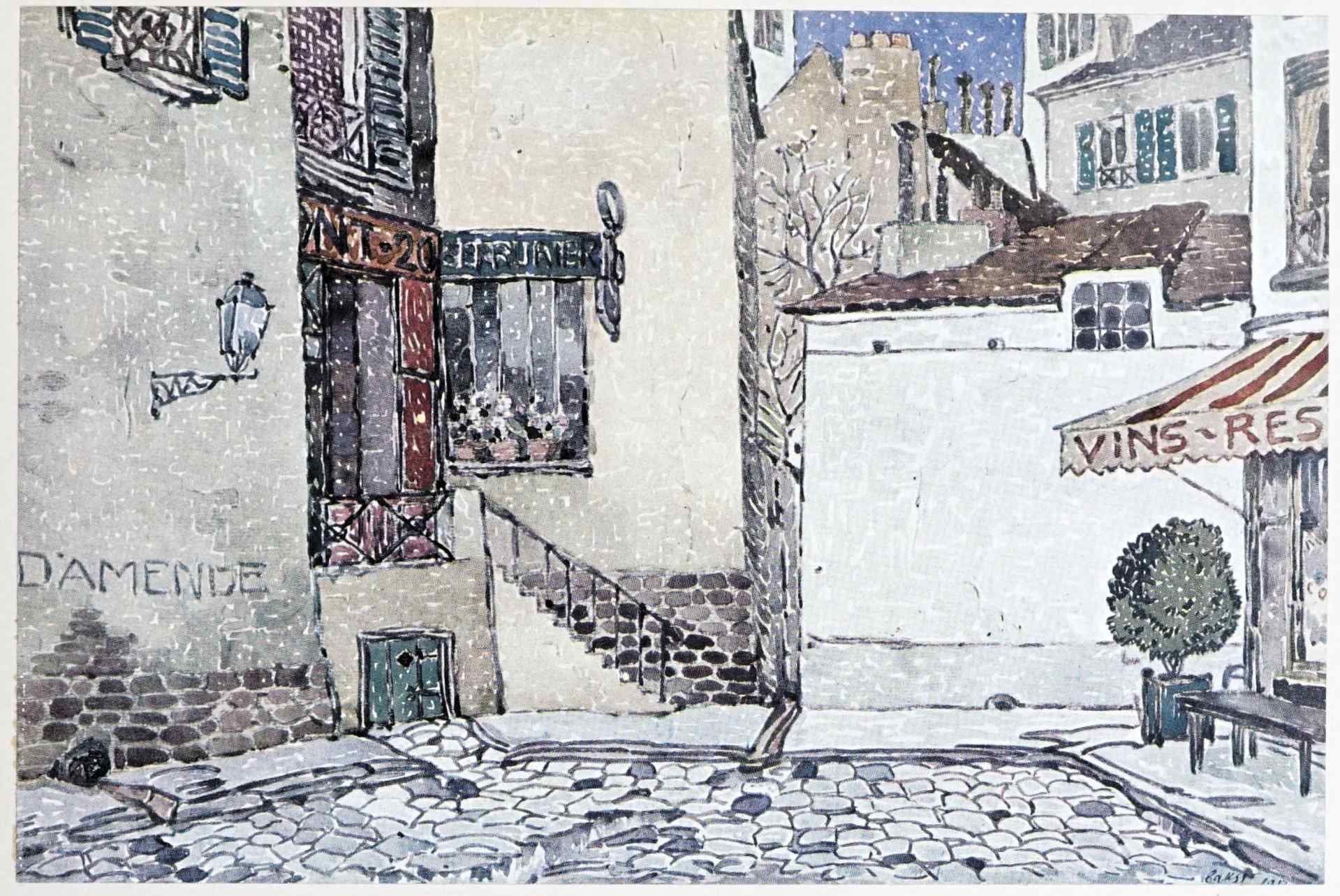
A STREET IN LA VILETTE (PARIS). STAGE DECORATION FOR “ALAIDIN”
fatherland; the Benoises had French blood in their veins. All this is of importance to those who are interested in looking for the origin of certain aspirations, of certain artistic inclinations and habits of mind, in atavism or in the call of blood. All of which did not prevent the Benois brothers, two of whom we already know and the third one of whom was an architect and later was made rector of the Academy of Fine Arts, from becoming the eminent Russian artists that in fact they are.
As for Alexander, from earliest childhood he possessed all the qualities needed for becoming, if not an intellectual leader, at least an intellectual centre. His general culture, broad indeed and so varied as to have become eclectic; a certain pedagogic inclination,—a tendency to instruct, to educate, to make ideas spring forth; added to this, a liveliness of temperament, an acuteness of perception which made him a malcontent, a wide=awake dreamer—all these rare qualities determined his life’s work. His attempts at painting, excepting only his theatrical creations, never seemed able to free themselves of a certain amateurishness. But this was a natural complement to the fact that he was primarily a theoretician or rather a man of artistic tastes who re=enforces his intuitions and his sensibilities with an exact sense of logic and with the true talent of a writer.
For many years Alexander Benois has been the most famous critic of Russia. He is passionate and imaginative. He proceeds either by invective or by panegyric. He is a thunderbolt. He gets worked up over some artist, some idea. Oftimes he is mistaken and his candidate for fame fails. That is due to the fact that Benois, who had really constructed his hero from his imagination, endowed him with his own ideas, and magnified his own conceptions in him, would suddenly, some nice day, leave the poor wretch to his own designs.
When Bakst was admitted to this group, or club, the school boys had become students and the original circle had widened. Philosophov had introduced into it a cousin of his, just in from the provinces,—a fat, chubby lad, exceedingly free in his manners, dictatorial and quite aggressive, inexhaustible in paradoxes which at times were absurd, but which he defended to the limit without in the least attempting to be polite about it. Benois was the soul of this group; the newcomer was to become its will, its moving power—he was to lead it to its supremest heights. The name of this fellow from the provinces was Serge Diaghileff.
Now what was it that transpired during these interminable confabs? The club had set itself up as a supreme court which was to judge the quick and the dead. Before doing anything constructive—they didn’t know themselves what—its members first wanted to wipe out everything existing. They would agree upon the victime, appoint someone as prosecutor, and then conduct a trial. The defendant might be a Shishkin or a Verestchagin—in any case he was one of those celebrities whose wrongly acquired reputation was debasing the real character of Russian genius in the eyes of the whole world! But this whole work of tearing down could not satisfy this enthusiastic group of young people. They felt the need of giving themselves over to something, of consuming themselves
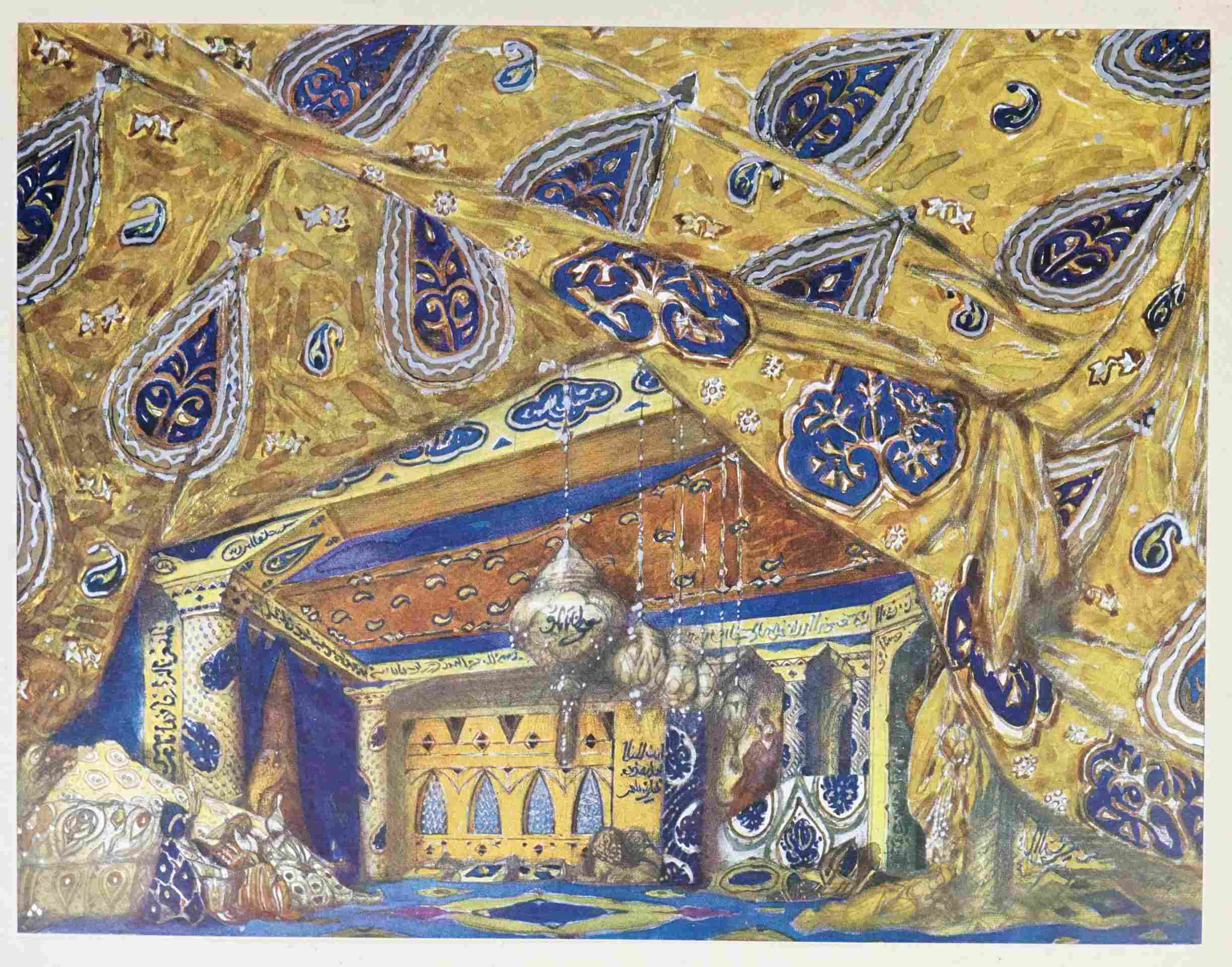
XI
STAGE DECORATIONS FOR BALLET “ORIENTALES”. (GOUACHE)
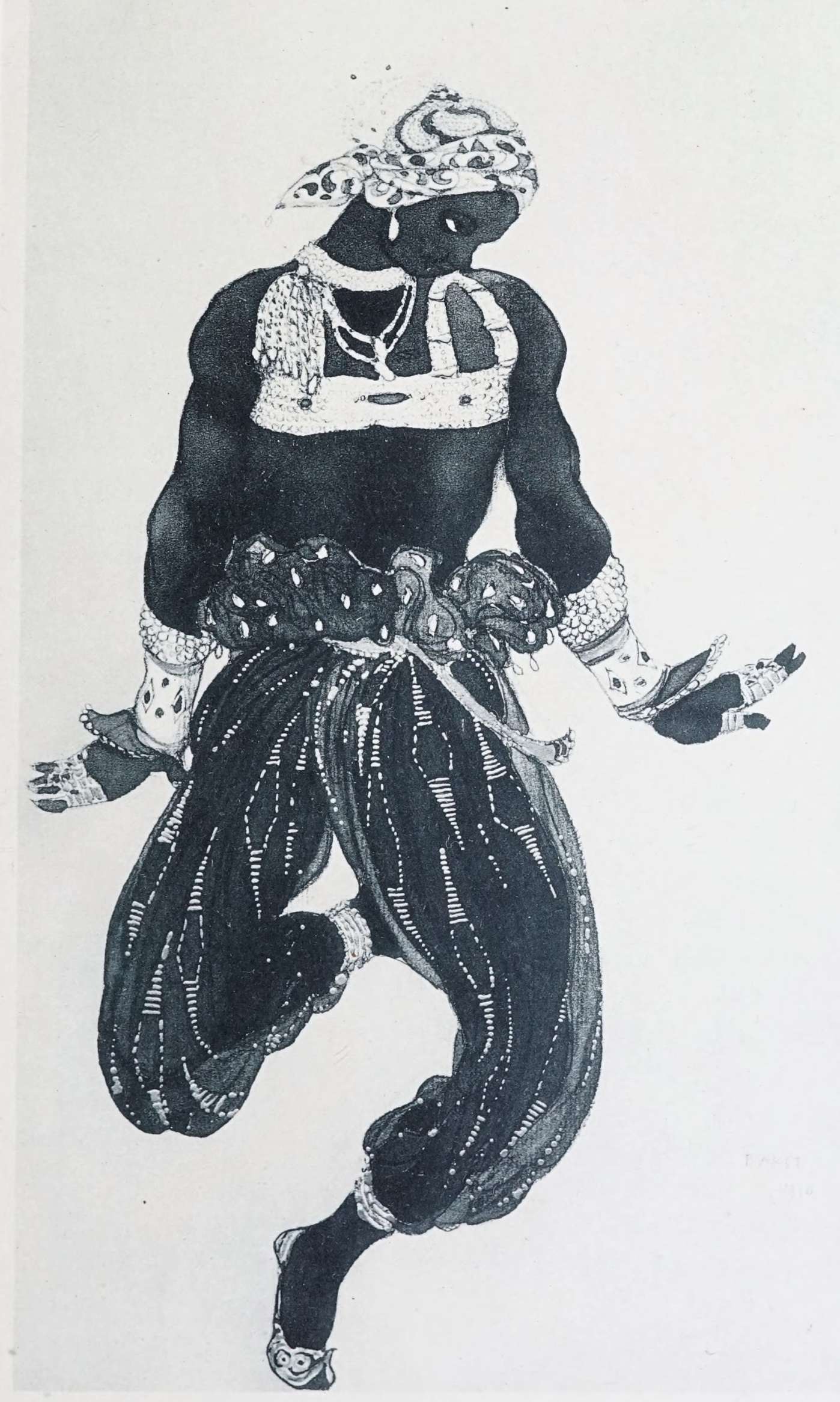
XII
A NEGRO’S COSTUME (SHEHERAZADE)
for something. At first their idol was Tchaikovsky, the composer of the “Sleeping Beauty”. Tchaikovsky had already become famous; there was therefore no “Battle of Hernani” to fight. It was merely a question with them of which work of this master should be given preference. They decided upon the “Queen of Spades” and placed it upon the pinnacle. What thrilled our friends about this work was the fact that it conjured up the 18th century in Russia. The action of the opera, the text for which was taken from a story by Pouchkine, takes place amid a setting that is an exact reproduction of “Old Petrograd”,—amidst a scenery that is familiar and famous. The promenade in the summer garden, the little bridge over the winter canal—this, when displayed on the stage, called to mind anew the beauty of the venerable capital—a beauty ever present, but unappreciated and neglected—and rehabilitated its declining fame.
If I have dwelt rather at length upon the feats and exploits of a group of unknown youths, it is due to the fact that these young men, who after theater would walk along the quais during the “white night” singing a duet from the “Queen of Spades”, or would lean pensively over the cold granite parapet to listen to the clock of the Cathedral of Peter and Paul pealing forth its crystal melody over the gloomy walls of the prison fortress,—it is due, I say, to the fact that these young men were destined to reshape Russian artistic sense from top to bottom. Later, on the eve of the new century, the “Mir Iskousstva” Society was founded; with the generous aid of Princess Tenicheff, a magazine was published; art expositions were arranged. A new epoch was beginning. Bakst helped to shape it—and we already know that he gave himself to every task whole heartedly.
At this point I do not propose to narrate the story of “Mir Iskousstva”. It was a revolution and was outrageously attacked as such. But its exponents held that it saved Russian art. Today some people contend that it was a menace to art. A quarter of a century lies between these two conflicting opinions. It is not for me to judge which is right. But Bakst’s participation in the work of this society forms a beautiful page in the life of my friend and therefore, too, of this story of mine. And my task would be incomplete were I to omit giving a brief description of this great movement of ideas which for a long time determined the future of Russian art.
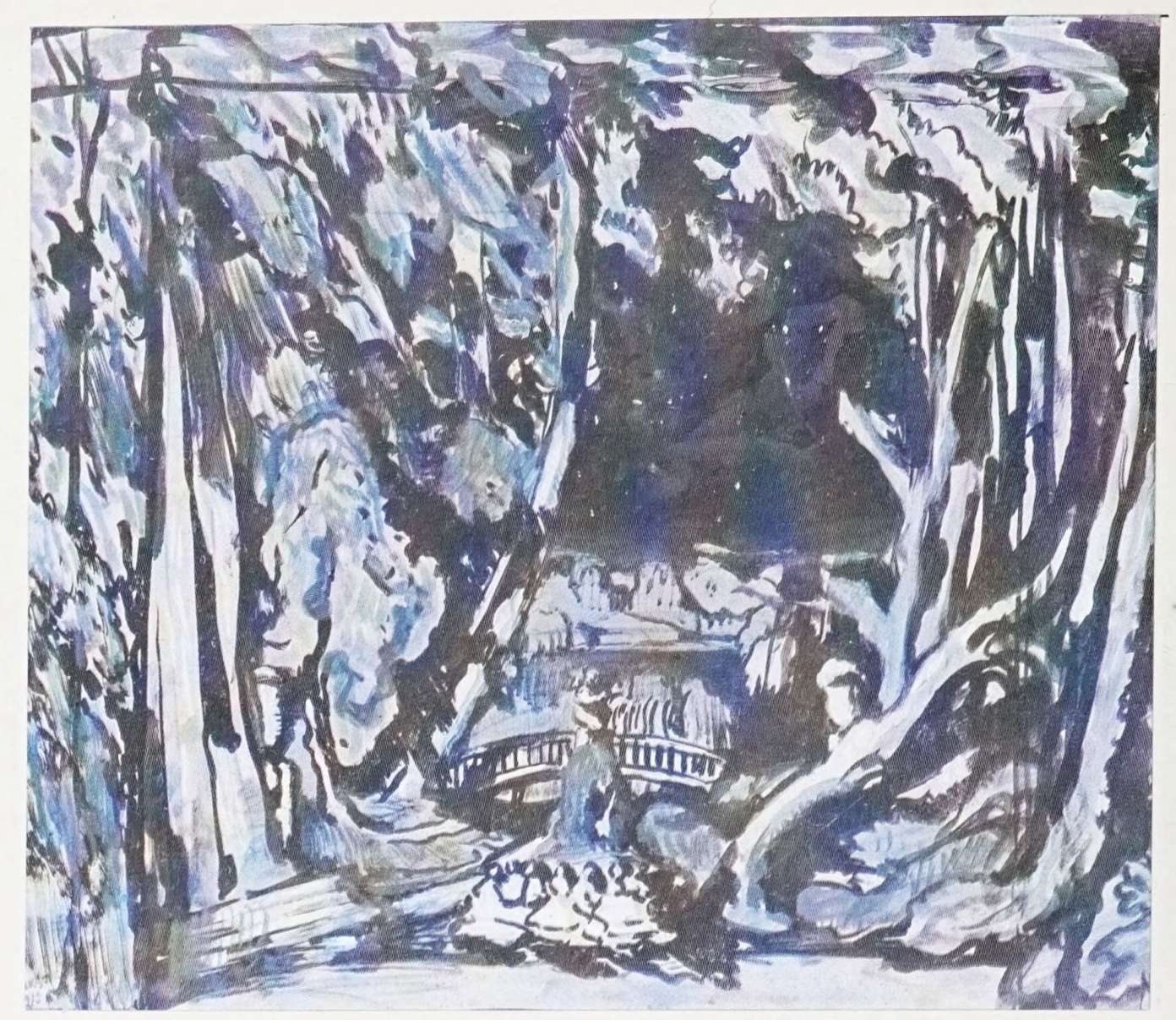
STAGE DECORATION FOR CHOPIN’S “NOCTURNES”