THE TWO SPHINXES
Reading edition
Leon, then, presented himself for examination but failed. Before being admitted to another test he had for a year to practice drawing from models; and only after he had solved the mysteries of this form of academic discipline, was he admitted. For another year he kept abreast of both his artistic studies and his general secondary education; soon, however, he neglected school and, after a few feeble attempts, gave it up altogether. Let us state the fact without bitterness: Bakst never received the Bachelor’s degree.
The first day that Bakst, attired in his new green uniform, wended his way along the granite embankment toward the Academy and, having passed under the eyes of the two Sphinxes from Thebes with a hundred gates which guard the sanctuary, decided to enter, his astonishment and his proud ecstasy knew no bounds. However, despite the grand pretense of a temple, the Imperial Academy of 1890 was a rather curious institution.
The academic instruction which flourished at the beginning of the century, maintained its power and authority until the close of Nicholas I’s reign. But from 1863 on it was badly shaken by the famous secession of the “Thirteen”, with Kramskoi at the head. These thirteen later became the first “wanderers”; they were destined to herald the arrival of a certain humanitarian realism closely related to the teachings of Proudhon and of Courbet. They professed the haughtiest contempt for disinterested pictorial beauty, for mere virtuosity, yes, even for sound craftmanship based upon traditional experience.
Among the “pompiers” classicism had degenerated into hackneyed copying; teaching became vulgar pedantry. Among the revolutionaries classicism was the complete and absolute negation of art, admitted only as a function of social apostleship. But the younger artists had public opinion behind them, which hailed the catastrophe as a liberation. Yet for thirty years the Academy, powerful solely because of its official authority, continued to stick to the past and to live outside the pale of a throbbing artistic life.
Not until 1893 did the “wanderers”, led by Makovsky and Repine, enter the citadel in order to establish a bold and frank dilettantism while still respecting the remnants of the old Academy. At that time Bakst had already broken with his first masters; we shall soon see why.
Let us first, however, briefly complete the history of the institution on the Nicholas Embankment. Toward 1910 a reaction set in against the anarchy of the “wanderers” and in favor of a classic revival, of a rehabilitation of craftmanship. This movement was of short duration, however, for the October Revolution abolished the Academy and established free studios upon its ruins, the management of which was placed in the hands of artists who supported the Communist regime. On the day of its death the Russian Imperial Academy was more than 150 years old.
Thus, at the Fine Arts School, Bakst found a training that clung to unchanged formulæ, but that was decadent, inert, and lifeless. He spent three months drawing from bas=reliefs and one year sketching models. Then, after having passed the class in costumes and copied draped mannequins, he was admitted to the studio class. His teacher, Tchistiakoff, did not encourage him to continue; he considered Bakst a promising sculptor, and whenever his pupil tried to talk painting to him, he would invariably turn the conversation to sculpture. Tchistiakoff’s colleague, Venig, was more far=sighted and, while disapproving of a certain vivacity and truculence of colors which netted young Bakst the ironical title of “Rubens newly ground”, he was not unfriendly to him. This meant a great deal, for it was impossible to think of any more intimate relations—any communion of ideas or of feelings—between the pope=like officials and their pupils who were as yet unknown quantities.
Far more important were his relations with his fellow students, especially with the class that was about to leave. At school and at his paternal home he had been placed in a position of isolation because of his artistic aspirations; here he found himself surrounded by young people devoted to that same art that was viewed with such suspicion by the Russian intellectuals of yesteryear. At the Academy Bakst met Nesteroff who, following Vasnetzoff and contemporaneous with Vroubel, was to attempt a revival of the ikon,—a revival which, besides proving abortive, was more in the nature of sentimental and artificial imitation. This craze for old national art went hand in hand among certain students with a strong animosity against the “métèques”; besides, anti-Semitism was officially encouraged and stimulated, since it served to side=track the hatred which was more and more undermining the autocratic power. Bakst, sensitive and meticulous, was grieved at this. He therefore clung all the more closely to Seroff, several years his senior, who was finishing his education and who aspired to winning the Grand Prize for Painting—the gold medal. This future portraitist was a son of the celebrated musician whose masterpiece, “Judith”, is known to Parisians only by partial selections. Already he had achieved, in the eyes of his fellow students, the intellectual and moral prestige that was due to the uprightness—albeit somewhat morose—of his character and the tenacity of his effort. Soon, indeed, he came to the forefront of his generation.
This man, already matured, reserved, and little given to effusive outbursts, took a fancy to the red haired young lad. The pair would sit together in the studio; they would spend the evenings chatting in the modest students’ apartment where Seroff lived and drinking plenty of tea. Those were the happy days! They lasted for eighteen months. Clouds were, however, gathering over the head of Bakst who had already given repeated offense to his superiors by his whims of independence. A free competition was announced in which “The Madonna Weeping Over Christ” was to be the subject and the Grand Medal of silver the prize. Bakst joined the competitors.
He sought inspiration from those artists of his time who had attempted a revival of religious subjects by displaying a realistic setting—thus breaking away from the iconographic traditions of the Renaissance—, by giving care to ethnographic detail, by minutely studying the expression observed. These artists included Repine and Polienoff in Russia, and Munkaczy abroad. But, carried away by a youthful enthusiasm, he wished to go beyond the fastidious and cautious realism of these painters and make a ten=strike.
He therefore chose a canvas of enormous dimensions—almost seven feet in length—and plunged into his work. For the characters of the legend he set down Jewish types that were obviously overdone, and imparted
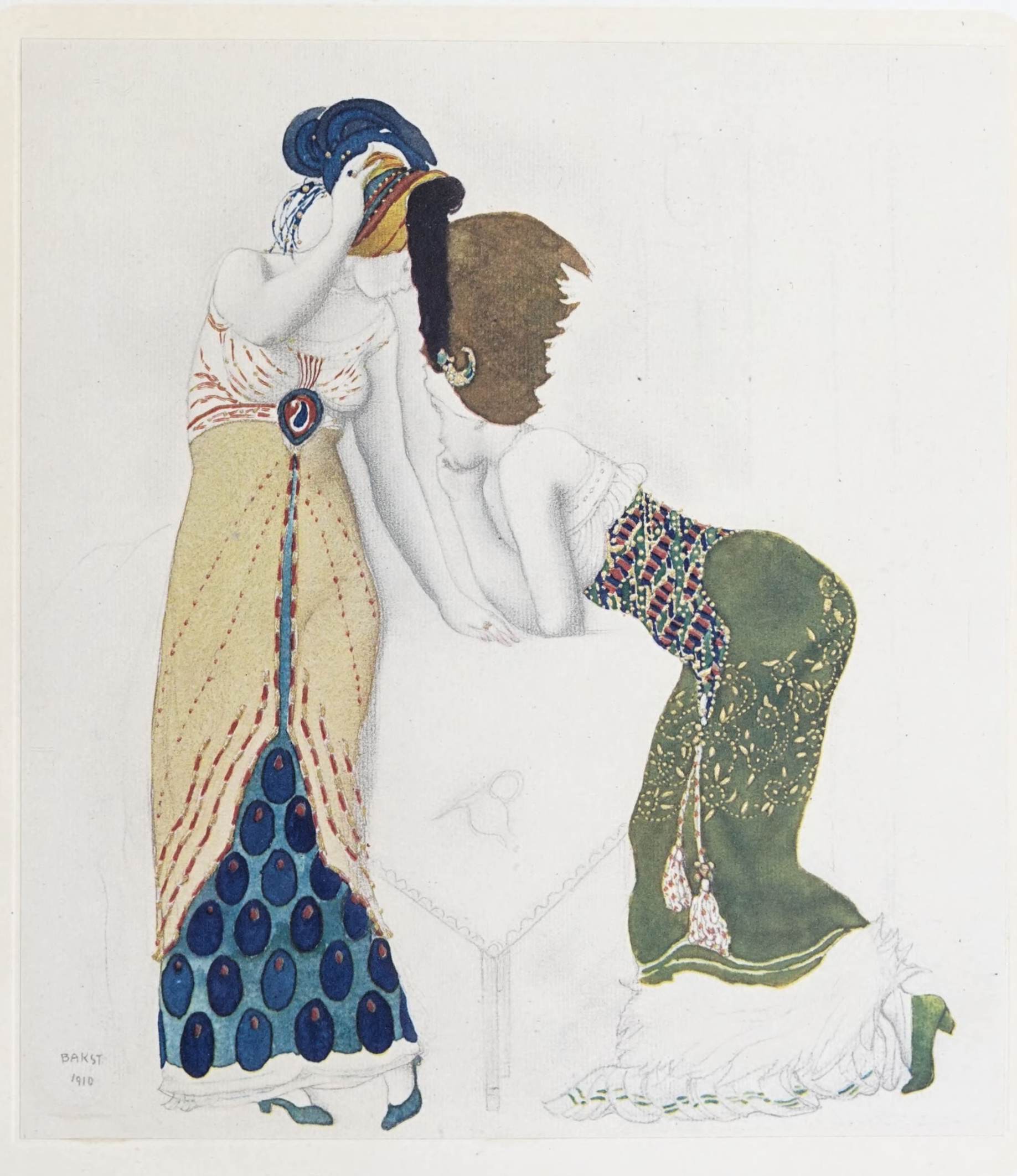
VII
“MODERN DRESS” (A “FANTAISIE”)
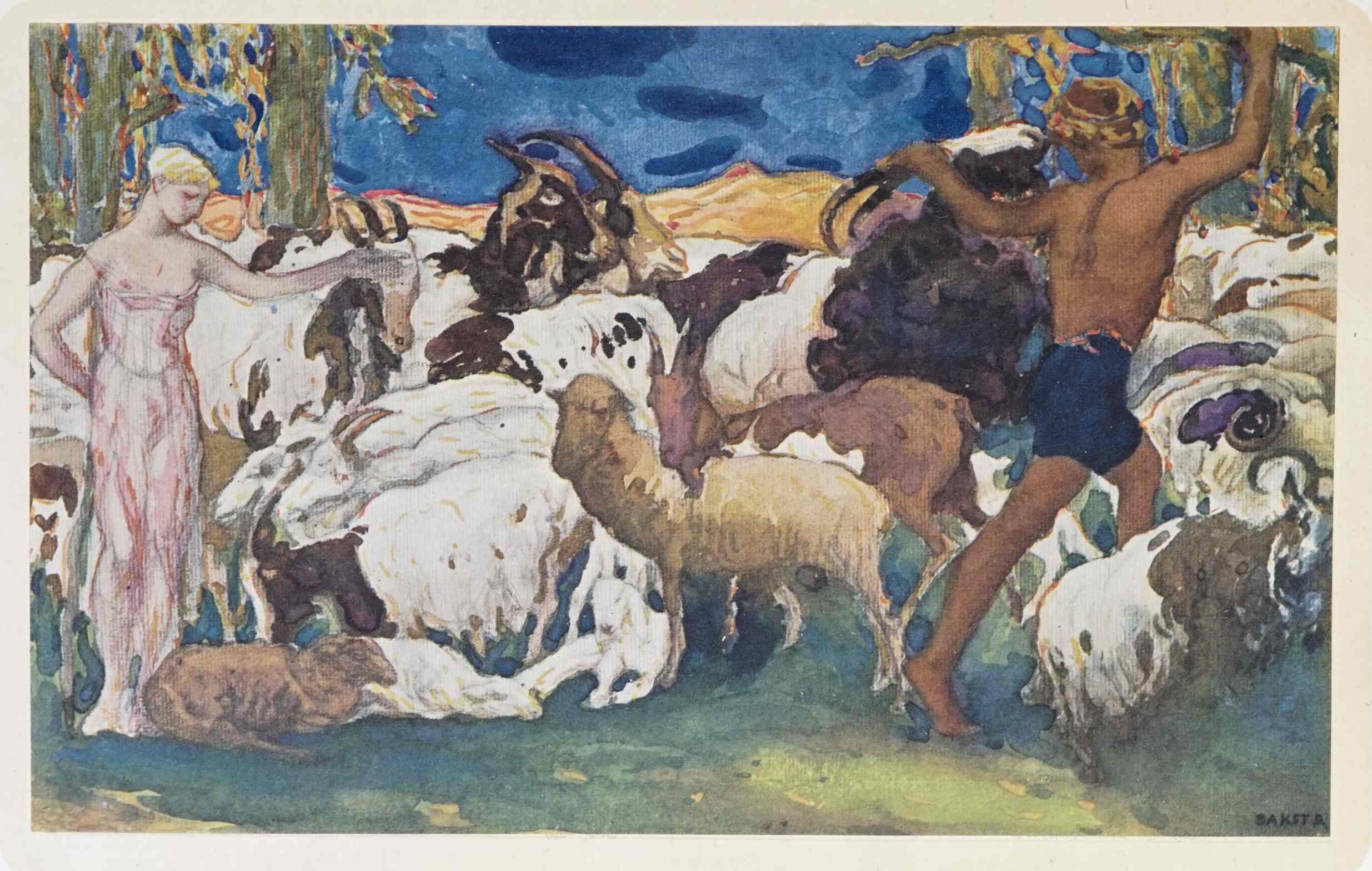
VIII
“DAPHNIS AND CHLOE PARTING IN THE EVENING”. SKETCH FOR DECORATIVE PANEL (GOUACHE).
a movement to them that imitated the gesticulation of Lithuanian clothing merchants or of elders in the synagogue. As to the Virgin, she was an old, dishevelled woman, with eyes red from weeping. Our candidate was, to be sure, vaguely conscious of the fact that he was digging his own grave; nevertheless he obstinately persisted in his daring attempt.
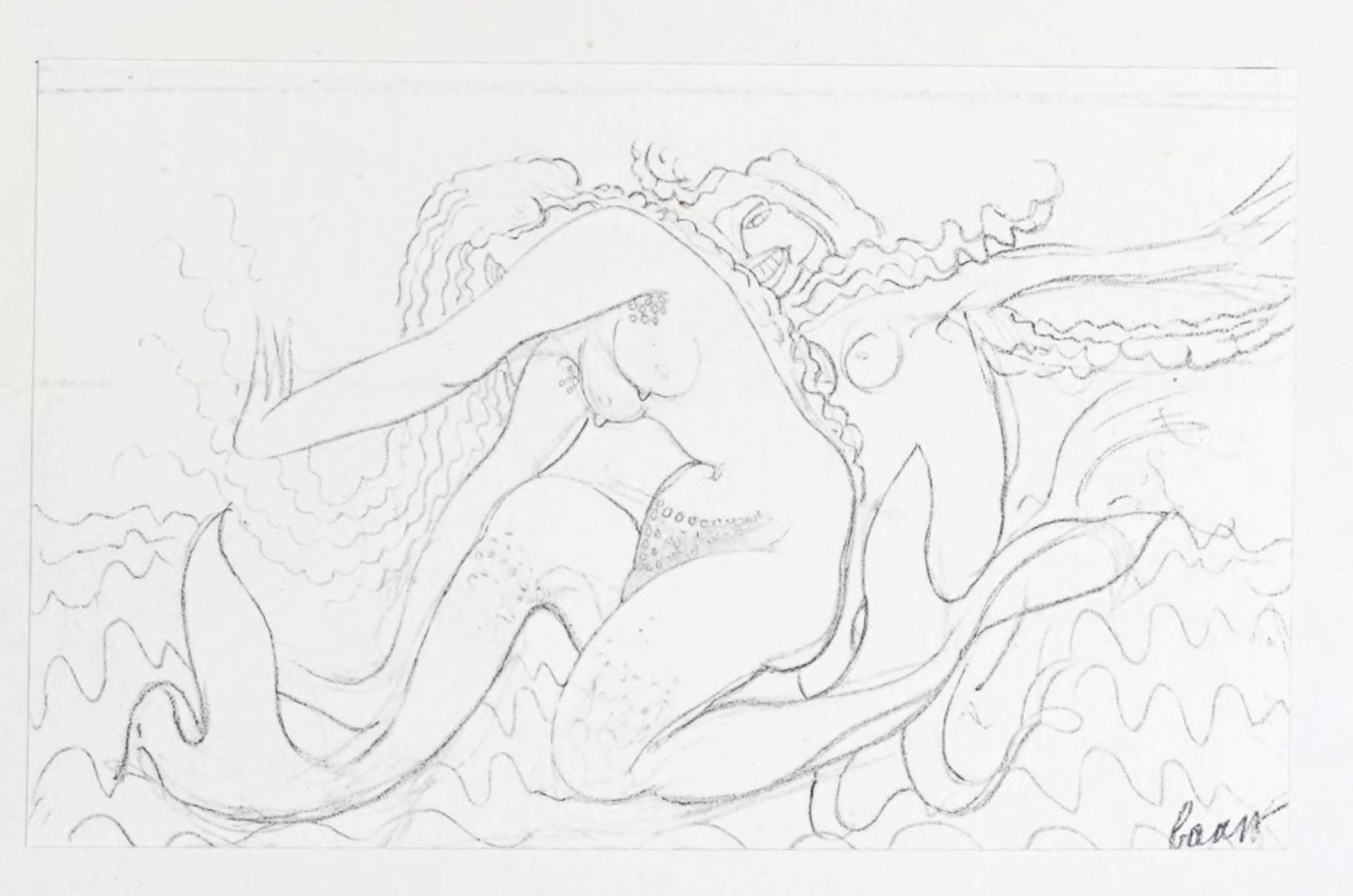
“SYRENS”. PROJECT OF PANNEAU.
What anguish he suffered while he awaited the decision of the jury on the winding staircase that constituted the Bridge of Sighs for the young daubers of Petrograd!
And justly so, for when his name was called and he appeared before the tribunal, he saw his canvas crossed out by two furious strokes of crayon, and he had to listen to an official rebuke by the president.
The next day he quit the Academy under the impassive glances of the two bearded sphinxes of pink marble, emerging from the gloomy twilight.
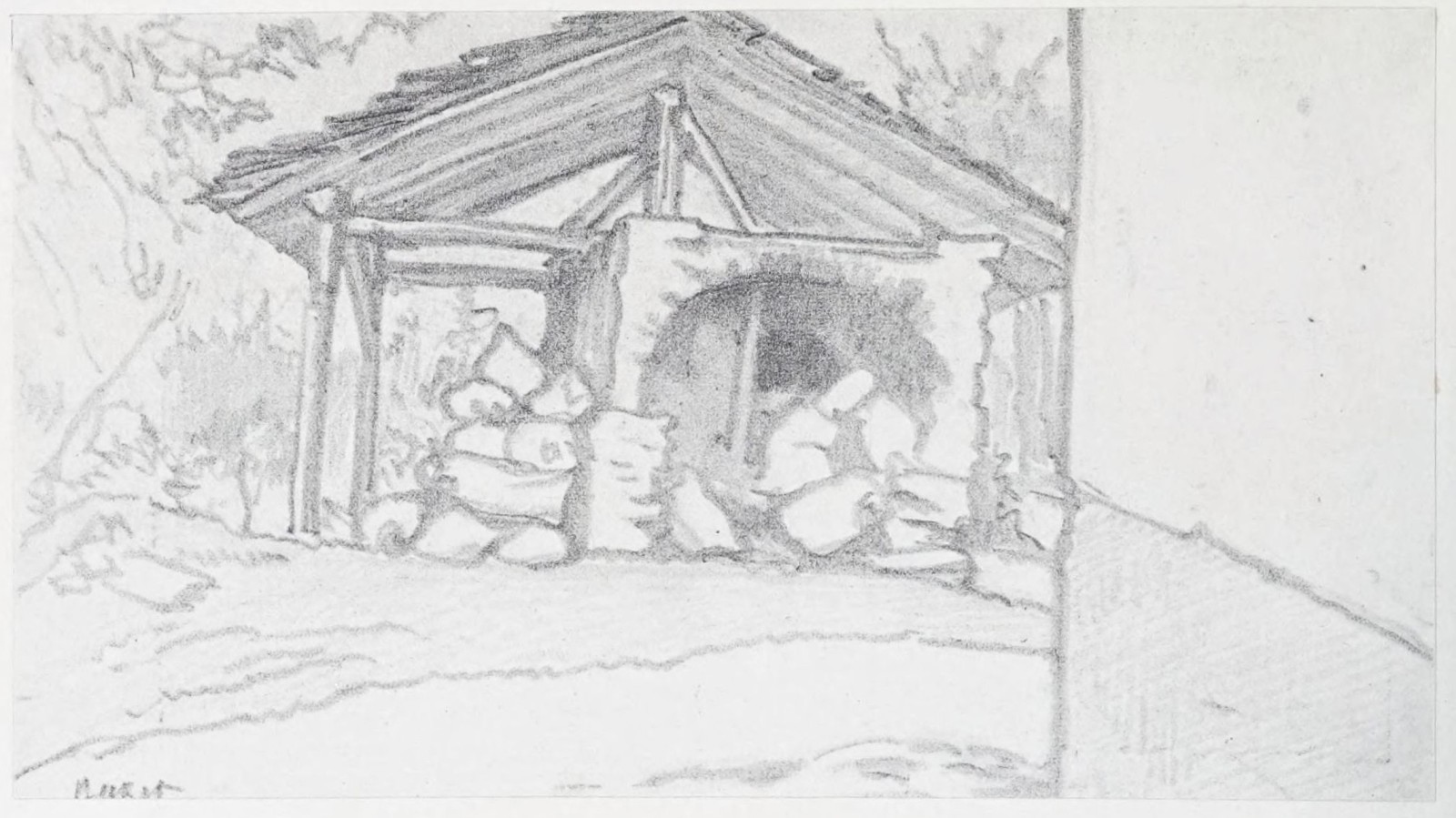
A HUT (SAVOY). DRAWING