Volume 5 — DISEASES OF THE NERVOUS SYSTEM. (continued 9)
Reading edition
106 Op. cit.
An affection termed general nervousness has been described by Mitchell. It does not seem to be strictly a neurasthenia, nor does it always occur in hysterical individuals. These cases are sometimes “more or less neurasthenic people, easily tired in brain or body; but others are merely tremulous, nervous folks, easily agitated, over-sensitive, emotional, and timid.” It is sometimes an inheritance; sometimes it results from the misuse of alcohol, tobacco, tea or coffee. Usually, it is developed slowly; occasionally, however, it arises in a moment. Thus, Mitchell mentions the case of a healthy girl who fell suddenly into a state of general nervousness owing to the fall of a house-wall. General nervousness is to be distinguished from hysteria, into which it sometimes merges, only by the absence of the mental perversions and the special motor, sensory, vaso-motor, and visceral disorders peculiar to the latter.
The differential diagnosis of hysteria and hypochondria, or what is better termed hypochondriacal melancholia, is often, apparently at least, somewhat difficult. Formerly, it was somewhat the fashion to regard hysteria in the male as hypochondria; but this view has nothing to support it. Hypochondria and hysteria, as neurasthenia and hysteria, are sometimes united in the same subject; one sometimes begets the other, but they have certain points of distinction. Hypochondria more frequently passes into real organic disease than does hysteria; it is more frequently associated with organic disease than is hysteria. Hypochondria is in the majority of cases a true insanity, while hysteria can only be regarded as such in the special instances which have been discussed. In hypochondria the individual's thoughts are centred upon some supposed disease until a true delusional condition is developed; this does not often occur in hysteria. Hypochondria is seen with as great a frequency in the male as in the female, while hysteria prevails much more largely in the female sex. In typical hypochondria more readily than in hysteria the patient may be led from one set of symptoms to another, the particulars of which he will detail in obedience to questions that are put to him, these symptoms not unusually partaking of the absurd and impossible. In hypochondria are absent those distinctive symptoms which in nearly all cases of hysteria appear in greater or less number, such as convulsions, paralysis, contracture, aphonia, hysterical joints, and the like. In hypochondria is present the groundless fear of disease without these outward manifestations of disease. The symptoms of hypochondria, as a rule, but not invariably, are less likely to change or abate than those of hysteria.
It is often of moment to be able to distinguish between two such well-marked affections as common acute mania and hysterical mania. In acute mania the disorder usually comes on gradually; in hysterical mania the outbreak of excitement is generally sudden, although prodromic manifestations are sometimes present. This point of difference is not one to be absolutely depended upon. In acute mania incoherence and delusions or delusional states are genuine phenomena; in hysterical mania delusional conditions, often of an hallucinatory character, may be present, but they are likely to be of a peculiar character. Frequently, for instance, such patients see, or say that they see, rats, toads, spiders, and strange beasts. These delusions have the appearance of being affected in many cases; very often they are fantastical, and sometimes at least they are spurious or simulated. In hysterical mania such phenomena as obstinate mutism, aphonia, pseudo-coma, ecstasy, catalepsy, and trance often occur, but they are usually absent in the history of cases of acute mania. In acute mania under the influence of excitement or delusion the patients may take their own lives: they may starve or kill themselves violently; in hysterical mania suicide will be threatened or apparently attempted, but the attempts are not genuine as a rule; they are rather acts of deception. In acute mania the patients often become much reduced and emaciated; in hysterical mania in general, considering the amount of mental and motor excitement through which the individuals pass, their nutrition remains good. In acute mania sleeplessness is common, persistent, and depressing; in hysterical mania usually a fair amount of sleep will be obtained in twenty-four hours. In many cases of hysterical mania the patients have their worst attacks early in the morning after a good night's rest. Acute mania under judicious treatment and management may gradually recover; sometimes, however, it ends fatally: this is especially likely to occur if the physician supposes the case to be simply hysterical and acts accordingly. Hysterical mania seldom has a serious termination unless through accident or complication.
In order to make the diagnosis of purposive hysterical attacks watchfulness on the part of the physician will often suffice. Such patients can frequently be detected slyly watching the physician or others. Threats or the actual use of harsh measures will sometimes serve for diagnostic ends, although the greatest care should be exercised in using such methods in order that injustice be not done.
In uræmia, as in true epilepsy, the convulsion is marked and the condition of unconsciousness is usually profound. An examination of the urine for albumen, and the presence of symptoms, such as dropsical effusion, which point to disorder of the kidneys, will also assist.
Hysterical paralysis in the form of monoplegia or hemiplegia must sometimes be distinguished from such organic conditions as cerebral hemorrhage, embolism or thrombosis, tumor, abscess, or meningitis (cerebral syphilis).
When the question is between hysteria and paralysis from coarse brain disease, as hemorrhage, embolism, etc., the history is of great importance. The hysterical case usually has had previous special hysterical manifestations. The palsy may be the last of several attacks, the patient having entirely recovered from other attacks. In an organic case, if previously attacked, the patient has usually made an incomplete recovery; the history is of a succession of attacks, each of which leaves the patient worse. In cerebral syphilis it happens sometimes that coming and going paralyses occur; but the improvement in these cases is generally directly traceable to specific treatment. Partial recoveries take place in embolism, thrombosis, hemorrhage, etc. when the lesion has been of a limited character, but the improvement is scarcely ever sufficient to enable the patient to be classed as recovered. The exciting cause of hysterical and organic cases of paralysis is different. While in hysterical paralysis sudden fright, anxiety, anger, or great emotion is frequently the exciting cause, such psychical cause is most commonly not to be traced as the factor immediately concerned in the production of the organic paralysis. In the organic paralysis an apoplectic or apoplectiform attack of a peculiar kind has usually occurred. In cerebral hemorrhage or embolism the patient suddenly loses consciousness, and certain peculiar pulse, temperature, and respiration phenomena occur. The patient usually remains in a state of complete unconsciousness for a greater or less period. In hysteria the conditions are different. A state of pseudo-coma may sometimes be present, but the temperature, pulse, and respiration will not be affected as in the organic case.
Hysterical monoplegia or hemiplegia, as a rule, is not as complete as that of organic origin, and is nearly always accompanied by some loss of sensation. The face usually escapes entirely. In organic palsy the face is generally less severely and less permanently affected than the limbs, but paresis is commonly present in some degree. Hysterical palsies are more likely to occur upon the left than upon the right side. Embolism is well known to occur most frequently in the left middle cerebral artery, thus giving the palsies upon the right. In hemorrhage and thrombosis the tendency is perhaps almost equal for the two sides. Some of these and other points of distinction between organic and hysterical palsies have been given incidentally under Symptomatology.
In organic hemiplegia aphasia is more likely to occur than in hysterical cases; and acute bed-sores and wasting of the limbs, with contractures, are conditions frequently present as distressing sequelæ. Such is not the rule in hysterical cases, for while there may be wasting of the limbs from disuse and hysterical contractures, bed-sores are seldom present, and the wasting and contractures do not appear so insidiously, nor progressively advance to painful permanent conditions, as in the organic cases. Mitchell mentions the fact that in palsies from nerve wounds feeling is apt to come back first, motion last; while in the hysterical the gain in the power of motion may go on to full recovery, while the sense of feeling remains as it was at the beginning of treatment. This point of course would help only in cases where both sensory and motor loss are present.
The examination of an hysterically palsied limb, if conducted with care, may often bring out the suppressed power of the patient. Practising the duplicated, active Swedish movements on such a limb will sometimes coax resistance from the patient. As already stated, electro-contractility is retained in hysterical cases.
The disorders from which it may be necessary to diagnosticate hysterical paraplegia are spinal congestion, subacute generalized myelitis of the anterior horns (chronic atrophic spinal paralysis of Duchenne), diffused myelitis, acute ascending paralysis, spinal hemorrhage, spinal tumor, posterior spinal sclerosis or locomotor ataxy, lateral sclerosis or spasmodic tabes, multiple cerebro-spinal sclerosis, and spinal caries.
In spinal congestion the patients come with a history that after exposure they have lost the use of their lower limbs, and sometimes of the upper. Heaviness and pain in the back are complained of, and also more or less pain from lying on the back. Numbness in the legs and other disturbances of sensation are also present. The paralysis may be almost altogether complete. Such patients exhibit evidences of the involvement of the whole cord, but not a complete destructive involvement. A colored woman, age unknown, had been in her ordinary health until Nov. 24, 1884. At this time, while washing, she noticed swelling of the feet, which soon became painful, and finally associated with loss of power. She had also a girdling sensation about the abdomen and pain in the back. She was admitted to the hospital one week later, at which time there was retention of the urine and feces. She had some soreness and tenderness of the epigastrium. She complained of dyspnœa, which was apparently independent of any pulmonary trouble. It was necessary to use the catheter for one week, by which time control of the bladder had been regained. The bowels were regulated by purgatives. She was given large doses of ergot and bromide and iodide of potassium, and slowly improved, and after a time was able to get out of bed and walk with the aid of a chair. An examination at the time showed that the girdling pain had disappeared. There was distinct loss of sensation. Testing the farado-contractility, it was found that in the right leg the flexors only responded to the slowly-interrupted current, while in the left both flexors and extensors responded to the interrupted current. In both limbs with the galvanic current the flexors responded to twenty cells, while the extensors responded to fifty cells. She gradually improved, and was able to leave after having been in the hospital three months.
The diagnosis of subacute myelitis of the anterior horns from hysterical paraplegia is often of vital importance. “A young woman,” says Bennett,107 “suddenly or gradually becomes paralyzed in the lower extremities. This may in a few days, weeks, or months become complete or may remain partial. There is no loss of sensation, no muscular rigidity, no cerebral disturbances, nor any general affection of the bladder or rectum. The patient's general health may be robust or it may be delicate. She may be of emotional and hysterical temperament, or, on the contrary, of a calm and well-balanced disposition. At first there is no muscular wasting, but as the disease becomes chronic the limbs may or may not diminish in size. The entire extremity may be affected or only certain groups of muscles. Finally, the disease may partially or entirely recover, or remain almost unchanged for years.” This is a fair general picture of either disease.
107 Lancet, vol. ii. p. 842, November, 1882.
Two facts are often overlooked in this connection: first, that poliomyelitis is just as liable to occur in the hysterical as in the other class; and, secondly, that the symptoms of hysterical paraplegia and poliomyelitis may go hand in hand.
The history is different in the two affections. Frequent attacks of paralysis in connection with hysterical symptoms are very suggestive, although not always positive. In poliomyelitis the disease may come on with diarrhœa and fever; often it comes on with vomiting and pain. The patellar reflex is retained, often exaggerated, and rarely lost, in hysteria, while it is usually lost in poliomyelitis. Electro-muscular contractility is often normal in hysterical paralysis, although it is sometimes slightly diminished quantitatively to both faradism and galvanism: the various muscles of one limb respond about equally to electricity: there are no reactions of degeneration in hysterical paralysis as in poliomyelitis. In poliomyelitis reactions of degeneration are one of the most striking features. The cutaneous plantar reflex is impaired in hysterical paraplegia; bed-sores are usually absent, as are also acute trophic eschars and the nail-markings present both in generalized subacute myelitis and diffused myelitis. True muscular atrophy is also wanting in hysterical paraplegia, although the limbs may be lean and wasted from the original thinness of the patient or from disuse. The temperature of the limbs is usually good. There is no blueness nor redness of the limbs, nor are the bowels or bladder uncomfortably affected.
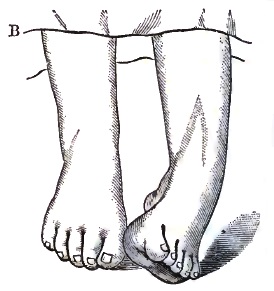
Buzzard108 gives two diagrams (Figs. 16 and 17), which I have reproduced. They are drawn from photographs. They show two pairs of feet, which have a certain superficial resemblance. In each the inner border is drawn up into the position of a not severe varus. They are the feet of two young women who were in the hospital at the same time. A (Fig. 16), really a case of acute myelitis, had been treated as a case of hysteria; and B (Fig. 17), really a case of hysteria, came in as a paralytic. In these cases the results of examination into the state of the electrical response and of the patellar-tendon reflex was sufficient to make a diagnosis clear. In the organic case the electrical reactions were abnormal and the patellar-tendon reflex was abolished. These conditions were not present in the hysterical case.
FIG. 16.
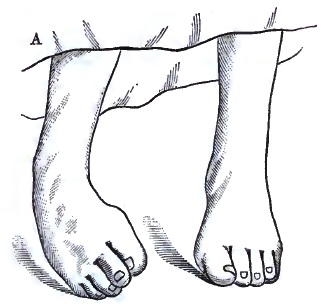
FIG. 17.
108 Clin. Lectures on Diseases of the Nervous System, London, 1882.
The diagnosis of hysterical paraplegia from diffused myelitis is governed practically by the same rules which serve in subacute myelitis of the anterior horns, with some additional points. In diffused myelitis, in addition to the motor, trophic, vaso-motor, electrical, and reflex disorders of myelitis of the anterior horns, affections of sensibility from involvement of the sensory regions of the cord will also be present. Anæsthesia and paræsthesia will be present.
Acute ascending paralysis, the so-called Landry's paralysis, particularly when it runs a variable course, might be mistaken sometimes for hysterical paralysis. In one instance I saw a fatal case of Landry's paralysis which had been supposed to be hysterical until a few hours before death. In Landry's paralysis, however, the swiftly ascending character of the disorder is usually so well marked as to lead easily to the diagnosis. In Landry's paralysis the loss of power begins first in the legs, but soon becomes more pronounced, and passes to the arms, and in the worst cases swallowing and respiration become affected.
Spinal hemorrhage and spinal tumors, giving rise to paralysis, may be mistaken for hysterical paralysis, partly because of the contractures. Reactions of degenerations are usually features of this form of organic paralysis. The contractures of hysterical paralysis can be promptly relieved by deep, strong pressure along supplying nerve-trunks; this cannot be accomplished in the organic cases. Severe localized pains in the limbs, sometimes radiating from the spinal column, are present in the organic cases. Pain may be complained of by the hysterical patient, but close examination will show that it is not of the same character, either as regards severity or duration.
Hysterical locomotor ataxy is usually readily distinguished from posterior spinal sclerosis, although the phenomena are apparently more marked and more peculiar than those exhibited as the result of organic changes. Hysterical ataxic patients often show an extraordinary inability to balance their movements, this want of co-ordinating power being observed even in the neck and trunk, as well as the limbs. In hysterical cases a certain amount of palsy, often of an irregular type, is more likely to be associated with the ataxia than in the structural cases. The knee-jerk, so commonly absent in true posterior spinal sclerosis that its absence has come to be regarded as almost a pathognomonic symptom of this affection, in hysterical motor ataxy is present and exaggerated. In hysterical locomotor ataxy other well-marked symptoms of general hysteria, such as hysterical convulsions, aphonia, etc., are present.
In the diagnosis of spastic spinal paralysis from hysterical paraplegia great difficulties will sometimes arise. A complete history of the case is of the utmost importance in coming to a conclusion. If the case be hysterical, usually some account of decided hysterical manifestation, such as aphonia, sudden loss and return of sight, hysterical seizures, etc., can be had. Althaus holds that a dynamometer which he has had constructed for measuring the force of the lower extremities will, at least in a certain number of cases, enable us to distinguish between the functional and spinal form of spastic paralysis. In the former, although the patient may be unable to walk, the dynamometer often exhibits a considerable degree of muscular power; while in the latter, more especially where the disease is somewhat advanced, the index of the instrument will only indicate 20° or 30° in place of 140° or 160°, and occasionally will make no excursion at all.
The diagnosis of multiple cerebro-spinal sclerosis from hysteria occasionally offers some difficulties. Jolly goes so far as to say that it can only with certainty be diagnosticated in some cases in its later stages and by the final issue—cases in which the paralytic phenomena frequently alter their position, in which paroxysmal exacerbations and as sudden ameliorations take place, and convulsive attacks and disturbances of consciousness of a like complicated nature as in hysteria are met with. Disorders of deglutition and articulation, also characteristic of multiple cerebro-spinal sclerosis, are now and again observed in the hysterical. Recently, through the kindness of J. Solis Cohen, I saw at the German Hospital in Philadelphia a patient about whom there was for a time some doubt as to whether the peculiar tremor from which he suffered was hysterical or sclerotic. At rest and unobserved, he was usually quiet, but as soon as attention was directed to him the tremor would begin, at first in the limbs, but soon also in the head and trunk. If while under observation he attempted any movement with his hands or feet, the tremor would become violent, and if the effort was persisted in it would become convulsive in character. The effort to take a glass of water threw him into such violent spasms as to cause the water to be splashed in all directions. The fact that this patient was a quiet, phlegmatic man of middle age, that his troubles had come on slowly and had progressively increased, that tremor of the head and trunk was present, that cramps or tonic spasms of the limbs came and went, indicated the existence of disseminated sclerosis. The knee-jerk was much exaggerated, taps upon the patellar tendon causing decided movement; when continued, the leg would be thrown into violent spasm.
Spondylitis, or caries of the vertebræ, is sometimes difficult to distinguish from hysterical paraplegia or hysterical paraplegia from it, or both may be present in the same case. Likewise, painful paraplegia from cancer or sarcoma of the vertebræ may offer some difficulties. A woman aged forty-four when two years old had a fall, which was followed by disease of the spine, and has resulted in the characteristic deformity of Pott's disease. She was apparently well, able to do ordinary work, until about five years before she came under observation, when her legs began to feel heavy and numb, and with this were some pain and slight loss of power. These symptoms increased, and in three months were followed by a total loss of power in the lower extremity. She was admitted to the hospital, and for about three years was unable to move the legs. She went round the wards in a wheeled chair. The diagnosis was made of spondylitis, curvature, and paralysis and sensory disorders depending on compression myelitis, and it was supposed she was beyond the reach of remedies. One day one of the resident physicians gave her a simple digestant or carminative, soon after which she got up and walked, and has been walking ever since. She attributes her cure entirely to this medicine.
What is the lesson to be learned from this case? It is, in the first place, not to consider a patient doomed until you have made a careful examination. There can be much incurvation of the spine without sufficient compression to cause complete paralysis. In this patient organic disease was associated with an hysterical or neuromimetic condition. This woman had disease of the vertebræ, the active symptoms of which had subsided. The vertebral column had assumed a certain shape, and the cord had adjusted itself to this new position, yet for a long time she was considered incurable from the fact that the conjunction of a real and a mimetic disorder was overlooked.
Another patient aged twenty-seven had whooping cough, which lasted six weeks, and was followed by severe pain in the back. For this she consulted various physicians, being treated for Pott's disease and spinal irritation. She, however, continued to grow worse, and every jar and twist gave severe pain. At this time she had lost much flesh, had pain in her back and elsewhere, and was subject to numerous and violent spasms. When first seen by the physician who consulted me she was complaining of pains in her legs, hips, and left shoulder, which she considered rheumatic, and with pain in the abdomen. Examination of the back with the patient on her side showed a slight prominence over the position of the first or second lumbar vertebra. The spot was painful on pressure, and had been so ever since the attack of whooping cough three years before. A tap on the sole of either foot made her complain of severe pain in the back. The same result followed pressure on the head. The patient was unable to stand or walk, but occasionally sat up for a short time, although suffering all the time. There was no muscular rigidity. The limbs and body were quite thin, but, so far as could be detected, she had no loss of motor or sensory power. At times, when the pains were worse, the arms would be flexed involuntarily, and she stated that once the spine was drawn back and a little sideways. The pain in the hips was augmented by pressure. During the application of a plaster bandage she had a sort of fit and fainted, and the application was suspended. She soon recovered consciousness, but refused to allow the completion of the dressing. I diagnosticated the affection as largely hysterical, and a few months later received word that the patient was on her feet and well.
Kemper109 relates the case of a lady who eventually died of sarcoma of the vertebræ, the specimens having been examined by J. H. C. Simes of Philadelphia and myself. She was supposed at first and for some time to be a case of hysteria with spinal irritation. In the case of a distinguished naval officer, who died of malignant vertebral disease after great suffering a short time since, this same mistake was made during the early stages of the disease: his case was pronounced to be one of neurasthenia, hysteria, etc. before its true nature was finally discovered. The absence of muscular rigidity in the back and extremities is the strongest point against vertebral disease in these cases.
109 Journal of Nervous and Mental Diseases, vol. xii., No. 1, January, 1885.
In hysterical hemianæsthesia, ovarian hyperæsthesia, hystero-epileptic seizures, ischuria, and other well-known hysterical symptoms have usually been observed. The anæsthesia in hysterical cases is most commonly on the left side of the body, but it may happen to be so located in an organic case, so that this point is only one of slight value.
Some older observers, as Briquet, who is quoted and criticised by Charcot, believed that hemianæsthesia from encephalic lesions differed from hysterical hemianæsthesia by the fact that in the former case the skin of the face did not participate in the insensibility, or that when it existed it never occupied the same side as the insensibility of the limbs. Recently-reported cases have disproved the accuracy of this supposed diagnostic mark. In his lectures, delivered ten years ago, Charcot observed that up to that period anæsthesia of general sensibility alone appeared to have been observed as a consecutive on an alteration of the cerebral hemispheres, so that obtunding of the special senses would remain as a distinctive characteristic of hysterical hemianæsthesia. He, however, expected that cases of cerebral organic origin would be reported of complete hemianæsthesia, with derangements of the special senses, such as is presented in hysteria. His anticipations have been fulfilled. In the nervous wards of the Philadelphia Hospital is now a typical case of organic hemianæsthesia in which the special senses are partially involved.
Paralysis and contractures, if present, are apt to be accompanied in cases of organic hemianæsthesia, after time has elapsed, by marked nutritive changes, by wasting of muscle, and even of skin and bone. This is not the case in hysteria.
The subsequent history of these two conditions is different. The hysterical patient will often recover and relapse, or under proper treatment may entirely recover; while all the treatment that can be given in a case of organic hemianæsthesia will produce no decided improvement, for there is a lesion in the brain which will remain for ever. Hemianopsia, so far as I know, has not been observed in hysterical hemianæsthesia.
In the monograph of Shaffer, with reference to both true and false knee-joint affections certain conclusions are drawn which I will give somewhat condensed:
Chronic synovitis produces very few if any subjective symptoms; hysterical imitation presents a long train of both subjective and objective symptoms and signs, the former in excess. Chronic ostitis may be diagnosticated if muscular spasm cannot be overcome by persistent effort; when the spasm does not vary night nor day; when it is not affected by the ordinary doses of opium or chloral; when reaction of the muscles to the faradic current is much reduced; when a local and uniform rise of temperature over the affected articulation is present; when purely involuntary neural symptoms, such as muscular spasm, pain, and a cry of distress, are present. Hysterical knee-joint is present, according to this author, when the muscular rigidity or contracture is variable, and can be overcome by mildly persistent efforts while the patient's mind is diverted, or which yields to natural sleep, or which wholly disappears under the usual doses of opium or chloral; when the faradic response is normal; when rise of temperature is absent or a reduced temperature is present over the joint; when variable and inconstant, emotional, and semi-voluntary manifestations are present.
To recognize the neuromimesis of hip disease Shaffer gives the following points: The limp is variable and suggests fatigue; it is much better after rest; it almost invariably follows the pain. Pain of a hyperæsthetic character is usually the first symptom, and it is found most generally in the immediate region of the joint. “In place of an apprehensive state in response to the tests applied will be found a series of symptoms which are erratic and inconstant. A condition of muscular rigidity often exists, but, unlike a true muscular spasm, it can in most cases be overcome in the manner before stated. A very perceptible degree of atrophy may exist—such, however, as would arise from inertia only. A normal electrical contractility exists in all the muscles of the thigh.”
In the neuromimesis of chronic spondylitis or hysterical spine the pain is generally superficial, and is almost always located over or near the spinous processes; it is sometimes transient, and frequently changes its location from time to time; a normal degree of mobility of the spinal column under properly directed manipulation is preserved; the nocturnal cry and apprehensive expression of Pott's disease are wanting.
With reference to the hysterical lateral curvature, Shaffer, quoting Paget, says “ether or chloroform will help. You can straighten the mimic contracture when the muscles cannot act; you cannot so straighten a real curvature.”
In the diagnosis of local hysterical affections one point emphasized by Skey is well worthy of consideration; and that is that local forms of hysteria are often not seen because they are not looked for. “If,” says he, “you will so focus your mental vision and endeavor to distinguish the minute texture of your cases, and look into and not at them, you will acknowledge the truth of the description, and you will adopt a sound principle of treatment that meets disease face to face with a direct instead of an oblique force.” According to Paget, the means for diagnosis in these cases to be sought—(1) in what may be regarded as the predisposition, the general condition of the nervous system, on which, as in a predisposing constitution, the nervous mimicry of disease is founded; (2) in the events by which, as by exciting causes, the mimicry may be evoked and localized; (3) in the local symptoms in each case.
Local symptoms as a means of diagnosis can sometimes be made use of in general hysteria. A case may present symptoms of either the gravest form of organic nervous disease or the gravest form of hysteria, and be for a time in doubt, when suddenly some special local manifestation appears which cannot be other than hysterical, and which clinches the diagnosis. In a case with profound anæsthesia, with paraplegia and marked contractures, with recurring spasms of frightful character, the sudden appearance of aphonia and apsithyria at once cleared all remaining doubt. Herbert Page mentions the case of a man who suffered from marked paraplegia and extreme emotional disturbance after a railway collision, who, nine months after the accident, had an attack of aphonia brought on suddenly by hearing of the death of a friend. He eventually recovered.
To detect hysterical or simulated blindness the methods described by Harlan are those adopted in my own practice. When the blindness is in both eyes, optical tests cannot be applied. Harlan suggests etherization.110 In a case of deception, conscious or unconscious, he says, “as the effect of the anæsthetic passed off the patient would probably recover the power of vision before his consciousness was sufficiently restored to enable him to resume the deception.” Hutchinson cured a case of deaf-dumbness by means of etherization. For simulated monocular blindness Graefe's prism-test may be used: “If a prism held before the eye in which sight is admitted causes double vision, or when its axis is held horizontally a corrective squint, vision with both eyes is rendered certain.” It should be borne in mind that the failure to produce double images is not positive proof of monocular blindness, for it is possible that the person may see with either eye separately, but not enjoy binocular vision, as in a case of squint, however slight. Instead of using a prism while the patient is reading with both eyes at an ordinary distance, say of fourteen or sixteen inches, on some pretext slip a glass of high focus in front of the eye said to be sound. If the reading is continued without change, of course the amaurosis is not real. Other tests have been recommended, but these can usually be made available.
110 Loc. cit.
The diagnosis of hysterical, simulated, or mimetic deafness is more difficult than that of blindness. When the deafness is bilateral, the difficulty is greater than when unilateral. The method by etherization just referred to might be tried. Politzer in his work on diseases of the ear111 makes the following suggestions: Whether the patient can be wakened out of sleep by a moderately loud call seems to be the surest experiment. But, as in total deafness motor reflexes may be elicited by the concussion of loud sounds, care must be taken not to go too near the person concerned and not to call too loudly. The practical objection to this procedure in civil practice would seem to be that we are not often about when our patients are asleep. In unilateral deafness L. Müller's method is to use two tubes, through which words are spoken in both ears at the same time. When unilateral deafness is really present the patient will only repeat what has been spoken in the healthy ear, while when there is simulation he becomes confused, and will repeat the words spoken into the seemingly deaf ear also. To avoid mistakes in using this method, a low voice must be employed.
111 A Textbook of the Diseases of the Ear and Adjacent Organs, by Adam Politzer, translated and edited by James Patterson Cassells, M.D., M. R. C. S. Eng., Philada., 1883.
Mistakes in diagnosis where hysteria is in question are frequently due to that association with it of serious organic disease of the nervous system of which I have already spoken at length under Complications. This is a fact which has not been overlooked by authors and teachers, but one on which sufficient stress has not yet been laid, and one which is not always kept in mind by the practitioner. Bramwell says: “Cases are every now and again met with in which serious organic disease (myelitis and poliomyelitis, anterior, acute, for example) is said to be hysterical. Mistakes of this description are often due to the fact that serious organic disease is frequently associated with the general symptoms and signs of hysteria; it is, in fact, essential to remember that all cases of paraplegia occurring in hysterical patients are not necessarily functional—i.e. hysterical; the presence of hysteria or a history of hysterical fits is only corroborative evidence, and the (positive) diagnosis of hysterical paraplegia should never be given unless the observer has, after the most careful examination, failed to detect the signs and symptoms of organic disease.”
PROGNOSIS.—Hysteria may terminate (1) in permanent recovery; (2) in temporary recovery, with a tendency to relapse or to the establishment of hysterical symptoms of a different character; (3) in some other affection, as insanity, phthisis, or possibly sclerosis; (4) in death, but the death in such cases is usually not the direct result of hysteria, but of some accident. Death from intercurrent disorders may take place in hysteria. It is altogether doubtful, however, whether the affection which has been described as acute fatal hysteria should be placed in the hysterical category. In the cases reported the symptom-picture would in almost every instance seem to indicate the probability of the hysteria having been simply a complication of other disorders, such as epilepsy, eclampsia, and acute mania.
As a rule, hysterical patients will not starve themselves. They may refuse to take food in the presence of others, or may say they will not eat at all; but they will in some cases at the same time get food on the sly or hire their nurses or attendants to procure it for them. In treating such cases a little watchfulness will soon enable the physician to determine what is best to be done. By discovering them in the act of taking food future deception can sometimes be prevented. Hysterical patients do sometimes, however, persistently refuse food. These cases may starve to death if let alone; and it is important that the physician should promptly resort to some form of forcible feeding before the nutrition of the patient has reached too low an ebb. I have seen at least two cases of hysteria or hysterical insanity in which patients were practically allowed to starve themselves to death, but an occurrence of this kind is very rare. Feeding by means of a stomach-tube, or, what is still better, by a nasal tube, as is now so frequently practised among the insane, should be employed. Nourishment should be administered systematically in any way possible until the patient is willing to take food in the ordinary way. In purposive cases some methods of forcible feeding may prove of decided advantage. Its unpleasantness will sometimes cause swallowing power to be regained.
Wunderlich112 has recorded the case of a servant-girl, aged nineteen, who, after a succession of epileptiform fits, fell into a collapse and died in two days. Other cases have been recorded by Meyer. Fagge also speaks of the more chronic forms of hysteria proving fatal by marasmus. He refers to two cases reported by Wilks, both of which were diagnosticated as hysterical, and both of which died. Sir William Gull describes a complaint which he terms anorexia nervosa vel hysterica. It is attended with extreme wasting; pulse, respiration, and temperature are low. The patients were usually between the ages of sixteen and twenty-three: some died; others recovered under full feeding and great care. In many of the reported fatal cases careful inquiry must be made as to this question of hysteria being simply a complication.
112 Quoted in The Principles and Practice of Medicine, by the late Charles Hilton Fagge, M.D., F. R. C. P., etc., vol. i. 1886, p. 736.
Are not hysterical attacks sometimes fatal? With reference to one of my cases this view was urged by the physician in attendance. Gowers113 on this point says: “As a rule to which exceptions are infinitely rare, hysterical attacks, however severe and alarming in aspect, are devoid of danger. The attacks of laryngeal spasm present the greatest apparent risk to life.” He refers to the paroxysms of dyspnœa presented by a hemiplegic girl as really alarming in appearance, even to those familiar with them. He refers also to a case of Raynaud's114 in which the laryngeal and pharyngeal spasm coexisted with trismus, and the patient died in a terrible paroxysm of dyspnœa. The patient presented various other hysterical manifestations, and a precisely similar attack had occurred previously and passed away, but she had in the interval become addicted to the hypodermic injection of morphia, and Raynaud suggested that it might have been the effect of this on the nerve-centres that caused the fatal termination. Such cases have been described in France as the hydrophobic form of hysteria.
113 Epilepsy and Other Chronic Convulsive Diseases, by W. R. Gowers, M.D., London. 1881.
114 L'Union médical, March 15, 1881.
Patients may die in hysterical as in epileptic attacks from causes not directly connected with the disease. One of these sources of danger mentioned by Gowers is the tendency to fall on the face sometimes met with in the post-epileptic state. He records an example of death from this cause. He also details a case of running hysteria or hystero-epilepsy, in which, after a series of fits lasting about four hours, the child died, possibly from some intercurrent accident.
TREATMENT.—Grasset,115 speaking of the treatment of hysteria, says that means of treating the paroxysm, of removing the anæsthesia, of combating single symptoms, are perhaps to be found in abundance, but the groundwork of the disease, the neurosis or morbid state, is not attacked. Here he indicates a new and fruitful path. In his own summing up, however, he can only say that the hysterical diathesis offers fundamental grounds for the exhibition of arsenic, silver, chloride of gold, and mineral waters!
115 Brain, January, 1884.
No doubt can exist that the prophylactic and hygienic treatment of hysteria is of paramount importance. To education—using the term education in a broad sense—before and above all, the most important place must be given. It is sometimes better to remove children from their home surroundings. Hysterical mothers develop hysterical children through association and imitation. I can scarcely, however, agree with Dujardin-Beaumetz that it is always a good plan to place a girl in a boarding-school far from the city. It depends on the school. A well-regulated institution may be a great blessing in this direction; one badly-managed may become a hotbed of hysteria.
Recently I made some investigations into the working of the public-school system of Philadelphia, particularly with reference to the question of overwork and sanitation.116 I had special opportunities during the investigations to study the influences of different methods of education, owing to the fact that the public-school system of Philadelphia is just now in a transition period. This system is in a state of hopeful confusion—hopeful, because I believe that out of its present condition will come eventually a great boon to Philadelphia. At one end of the system, in the primary and the secondary schools, a graded method of instruction has been introduced. The grammar and the high schools are working on an ungraded or differently graded method. I found still prevailing, particularly in certain of the grammar schools for girls, although not to the same extent as a few years since, methods of cramming and stuffing calculated above all to produce hysteria and allied disorders in those predisposed to them.
116 The results of these investigations were given in a lecture which was delivered in the Girls' Normal School of Philadelphia before the Teachers' Institute of Philadelphia, Dec. 11, 1885.
Education should be so arranged as to develop the brain by a natural process—not from within outward; not from the centre to the periphery; not from above downward; but as the nervous system itself develops in its evolution from a lower to a higher order of animals, from the simple to the more complex and more elaborate. Any system of education is wrong, and is calculated to weaken and worry an impressionable nervous system, which attempts to overturn or change this order of the progress of a true development of the brain. To develop the nervous system as it should be developed—slowly, naturally, and evenly—it must also be fed, rested, and properly exercised.
In those primary schools in which the graded method was best carried out this process of helping natural development was pursued, and the result was seen in contented faces, healthy bodies, and cheerful workers. In future the result will be found in less chorea, hysteria, and insanity.
To prevent the development of hysteria, parents and physicians should direct every effort. The family physician who discovers a child to be neurotic, and who from his knowledge of parents, ancestors, and collateral relatives knows that a predisposition to hysteria or some other neurosis is likely to be present, should exercise all the moral influence which he possesses to have a healthy, robust training provided. It is not within the scope of an article of this kind to describe in great detail in what such education should consist. Reynolds is correct when he says that “self-control should be developed, the bodily health should be most carefully regarded, and some motive or purpose should be supplied which may give force, persistence, unity, and success to the endeavors of the patient.” In children who have a tendency to the development of hysteria the inclinations should not always or altogether be regarded in choosing a method or pursuing a plan of education. It is not always to what such a child takes that its mind should be constantly directed; but, on the contrary, it is often well to educate it away from its inclination. “The worst thing that can be done is that which makes the patient know and feel that she is thought to be peculiar. Sometimes such treatment is gratifying to her, and she likes it—it is easy and it seems kind to give it—but it is radically wrong.”
In providing for the bodily health of hysterical children it should be seen that exercise should be taken regularly and in the open air, but over-fatigue should be avoided; that ample and pleasant recreation should be provided; that study should be systematic and disciplinary, but at the same time varied and interesting, and subservient to some useful purpose; that the various functions of secretion, excretion, menstruation should be regulated.
The importance of sufficient sleep to children who are predisposed to hysteria or any other form of nervous or mental disorder can scarcely be over-estimated. The following, according to J. Crichton Browne,117 is the average duration of sleep required at different ages: 4 years of age, 12 hours; 7 years of age, 11 hours; 9 years of age, 10½ hours; 14 years of age, 10 hours; 17 years of age, 9½ hours; 21 years of age, 9 hours; 28 years of age, 8 hours. To carefully provide that children shall obtain this amount of sleep will do much to strengthen the nervous system and subdue or eradicate hysterical tendencies. Gymnastics, horseback riding, walking, swimming, and similar exercises all have their advantages in preventing hysterical tendencies.
117 Education and the Nervous System, reprinted from The Book of Health by permission of Messrs. Cassell & Co., Limited.
Herz118 has some instructive and useful recommendations with reference to the treatment of hysteria in children. It is first and most important to rehabilitate the weakened organism, and especially the central nervous system, by various dietetic, hygienic, and medicinal measures. It is important next to tranquillize physical and mental excitement. This can sometimes be done by disregard of the affection, by neglect, or by removal or threatened removal of the child from its surroundings. Such treatment should of course be employed with great discretion. Anæmia and chlorosis, often present in the youthful victims of hysteria, should be thoroughly treated. Care should be taken to learn whether children of either sex practise masturbation, which, Jacobi and others insist, frequently plays an important part in the production of hysteria. Proper measures should be taken to prevent this practice. The genital organs should receive examination and treatment if this is deemed at all necessary. On the other hand, care should be taken not to direct the attention of children unnecessarily to those organs when they are entirely innocent of such habits. Painting the vagina twice daily with a 10 per cent. solution of hydrochlorate cocaine has been found useful in subduing the hyper-irritation of the sexual organs in girls accustomed to practise masturbation. Herz, with Henoch, prefers the hydrate of chloral to all other medicines, although he regards morphine as almost equally valuable, in the treatment of hysteria in children. Personally, I prefer the bromides to either morphia or chloral. Small doses of iron and arsenic continued systematically for a long period will be found useful. Politzer of Vienna regards the hydrobromate and bihydrobromate of iron as two valuable preparations in the hysteria of children, and exhibits them in doses of four to seven grains three to four times daily.
118 Wien. Med. Wochen., No. 46, Nov. 14, 1885.
Hysteria once developed, it is the moral treatment which often really cures. The basis of this method of cure is to rouse the will. It is essential to establish faith in the mind of the patient. She must be made to feel not only that she can be helped, but that she will be. Every legitimate means also should be taken to impress the patient with the idea that her case is fully understood. If malingering or partial malingering enters into the problem, the patient will then feel that she has been detected, and will conclude that she had better get out of her dilemma as gracefully as possible. Where simulation does not enter faith is an important nerve-stimulant and tonic; it unchains the will.
Many physicians have extraordinary ideas about hysteria, and because of these adopt remarkable and sometimes outrageous methods of treatment. They find a woman with hysterical symptoms, and forthwith conclude she is nothing but a fraud. They are much inclined to assert their opinions, not infrequently to the patient herself, and, if not directly to her, in her hearing to other patients or to friends, relatives, nurses, or physicians. They threaten, denounce, and punish—the latter especially in hospitals. In general practice their course is modified usually by the wholesome restraint which the financial and other extra-hospital relations of patient and physician enforce.
Although hysterical patients often do simulate and are guilty of fraud, it should never be forgotten that some hysterical manifestations may be for the time being beyond the control of patients. Even for some of the frauds which are practised the individuals are scarcely responsible, because of the weakness of their moral nature and their lack of will-power. Moral treatment in the form of reckless harshness becomes immoral treatment. The liability to mistake in diagnosis, and the frequent association of organic disease with hysterical symptoms, should make the physician careful and conservative. It is also of the highest importance often that the doctor should not show his hand. The fact that an occasional cure, which is usually temporary, is effected by denunciation, and even cruelty, is not a good argument against the stand taken here.
Harsh measures should only be adopted after due consideration and by a well-digested method. A good plan sometimes is, after carefully examining the patient, to place her on some simple, medicinal, and perhaps electrical treatment, taking care quietly to prophesy a speedy cure. If this does not work, in a few days other severe or more positive measures may be used, perhaps blistering or strong electrical currents. Later, but in rare cases only, after giving the patient a chance to arouse herself by letting her know what she may expect, painful electrical currents, the hot iron, the cold bath, or similar measures may be used. Such treatment, however, should never be used as a punishment.
The method of cure by neglect can sometimes be resorted to with advantage. The ever-practical Wilks mentions the case of a school-teacher with hemianalgesia, hemianæsthesia, and an array of other hysterical symptoms who had gone through all manner of treatment, and at the end of seven months was no better. The doctor simply left her alone. He ordered her no drugs, and regularly passed by her bed. In three weeks he found her sitting up. She talked a little and had some feeling in her right side. She was now encouraged, and made rapid progress to recovery. Neglect had aroused her dormant powers. It must be said that a treatment of this kind can be carried out with far more prospects of success in a general hospital than in a private institution or at the home of a patient. It is a method of treatment which may fail or succeed according to the tact and intelligence of the physician.
I cannot overlook here the consideration of the subject of the so-called faith cure and mind cure. One difference between the faith cure as claimed and practised by its advocates, and by those who uphold it from a scientific standpoint, is simply that the latter do not refer the results obtained to any supernatural or spiritual agency. I would not advise the establishment of prayer-meetings for the relief of hysteria, but would suggest that the power of faith be exercised to its fullest extent in a legitimate way.
A young lady is sick, and for two years is seen by all the leading doctors in London; a clergyman is asked in and prays over her, and she gets up and walks. The doctors all join in and say the case was one of hysteria—that there was nothing the matter with her. Then, says Wilks, “Why was the girl subjected to local treatment and doses of physic for years? Why did not the doctors do what the parson did?”
Tuke119 devotes a chapter to psychotherapeutics, which every physician who is called upon to treat hysteria should read. He attempts to reduce the therapeutic use of mental influence to a practical, working basis. I will formulate from Tuke and my own experience certain propositions as to the employment of psychological measures: (1) It is often important and always justifiable to inspire confidence and hope in hysterical patients by promising cures when it is possible to achieve cures. (2) A physician may sometimes properly avail himself of his influence over the emotions of the patient in the treatment of hysterical patients, but always with great caution and discretion. (3) Every effort should be made to excite hysterical patients to exert the will. (4) In some hysterical cases it is advisable to systematically direct the attention to a particular region of the body, arousing at the same time the expectation of a certain result. (5) Combined mental and physical procedures may sometimes be employed. (6) Hypnotism may be used in a very few cases.
119 Influence of the Mind upon the Body.
The importance of employing mental impression is thoroughly exemplified, if nothing else is accomplished, by a study of such a craze as the so-called mind cure. Not a few people of supposed sense and cultivation have pinned their faith to this latest Boston hobby. A glance at the published writings of the apostles of the mind cure will show at once to the critical mind that all in it of value is dependent upon the effects of mental impression upon certain peculiar natures, some of them being of a kind which afford us not a few of our cases of hysteria. W. F. Evans has published several works upon the subject. From one of these120 I have sought, but not altogether successfully, to obtain some ideas as to the basis of the mind-cure treatment. It is claimed that the object is to construct a theoretical and practical system of phrenopathy, or mental cure, on the basis of the idealistic philosophy of Berkeley, Fichte, Schelling, and Hegel. The fundamental doctrine of those who believe in the mental cure is, that to think and to exist are one and the same, and that every disease is a translation into a bodily expression of a fixed idea of mind. If by any therapeutic device the morbid idea can be removed, the cure of the malady is assured. When the patient is passive, and consequently impressible, he is made to fix his thoughts with expectant attention upon the effect to be produced. The physician thinks to the same effect, wills it, and believes and imagines that it is being done; the mental action to the patient, sympathizing with that of the physician, is precipitated upon the body, and becomes a silent, transforming, sanitive energy. It must be, says Evans, “a malady more than ordinarily obstinate that is neither relieved nor cured by it.”
120 The Divine Law of Cure.
Hysteria cannot be cured by drugs alone, and yet a practitioner of medicine would find it extremely difficult to manage some cases without using drugs. Drugs themselves, used properly, may have a moral or mental as well as a physical influence. Among those which have been most used from before the days of Sydenham to the present time, chiefly for their supposed or real antispasmodic virtues, are galbanum, asafœtida, valerian, castor and musk, opium, and hyoscyamus. The value of asafœtida, valerian, castor, and musk is chiefly of a temporary character. If these drugs are used at all, they should be used in full doses frequently repeated. Sumbul, a drug of the same class comparatively little used, is with me a favorite. It can be used in the form of tincture or fluid extract, from twenty minims to half a drachm of the latter or one to two drachms of the former. It certainly has in many cases a remarkably calmative effect.
Opium and its preparations, so strongly recommended by some, and especially the Germans, should not be used except in rare cases. Occasionally in a case with sleeplessness or great excitement it may be absolutely indispensable to resort to it in combination with some other hypnotic or sedative. The danger, however, in other cases of forming the opium habit should not be overlooked. According to Dujardin-Beaumetz, it is mainly useful in the asthenic forms of hysteria.
Of all drugs, the metallic tonics are to be preferred in the continuous treatment of hysteria. Iron, although not called for in a large percentage of cases, will sometimes prove of great service in the weak and anæmic hysterics. Chalybeates are first among the drugs mentioned by Sydenham. Steel was his favorite. The subcarbonate or reduced iron, or the tincture of the chloride, is to be preferred to the more fanciful and elegant preparations with which the drug-market is now flooded. Dialyzed iron and the mallate of iron, however, are known to be reliable preparations, and can be resorted to with advantage. They should be given in large doses. Zinc salts, particularly the oxide, phosphide, and valerianate; the nitrate or oxide of silver, the ammonio-sulphate of copper, ferri-ferrocyanide or Prussian blue,—all have a certain amount of real value in giving tone to the nervous system in hysterical cases.
To Niemeyer we owe the use of chloride of sodium and gold in the treatment of hysteria. He refers to the fact that Martini of Biberach regarded this article as an efficient remedy against the various diseases of the womb and ovaries. He believed that the improvement effected upon Martini's patient was probably due to the fact that this, like other metallic remedies, was an active nervine. He prescribed the chloride of gold and sodium in the form of a pill in the dose of one-eighth of a grain. Of these pills he at first ordered one to be taken an hour after dinner, and another an hour after supper. Later, he ordered two to be taken at these hours, and gradually the dose was increased up to eight pills daily. I frequently use this salt after the method of Niemeyer.
The treatment of hysteria which Mitchell has done so much to make popular, that by seclusion, rest, massage, and electricity, is of value in a large number of cases of grave hysteria; but the proper selection of cases for this treatment is all important. Playfair121 says correctly that if this method of treatment is indiscriminately employed, failure and disappointment are certain to result. The most satisfactory results are to be had in the thoroughly broken-down and bed-ridden cases. “The worse the case is,” he says, “the more easy and certain is the cure; and the only disappointments I have had have been in dubious, half-and-half cases.”
121 The Systematic Treatment of Nerve-Prostration and Hysteria, by W. S. Playfair, M.D., F. R. C. P., 1883.
Mitchell122 gives a succinct, practical description of the process of massage: “An hour,” he says, “is chosen midway between two meals, and, the patient lying in bed, the manipulator starts at the feet, and gently but firmly pinches up the skin, rolling it lightly between his fingers, and going carefully over the whole foot; then the toes are bent and moved about in every direction; and next, with the thumbs and fingers, the little muscles of the foot are kneaded and pinched more largely, and the interosseous groups worked at with the finger-tips between the bones. At last the whole tissues of the foot are seized with both hands and somewhat firmly rolled about. Next, the ankles are dealt with in the same fashion, all the crevices between the articulating bones being sought out and kneaded, while the joint is put in every possible position. The leg is next treated—first by surface pinching and then by deeper grasping of the areolar tissue, and last by industrious and deeper pinching of the large muscular masses, which for this purpose are put in a position of the utmost relaxation. The grasp of the muscles is momentary, and for the large muscles of the calf and thigh both hands act, the one contracting as the other loosens its grip. In treating the firm muscles in front of the leg the fingers are made to roll the muscles under the cushions of the finger-tips. At brief intervals the manipulator seizes the limb in both hands and lightly runs the grasp upward, so as to favor the flow of venous blood-currents, and then returns to the kneading of the muscles. The same process is carried on in every part of the body, and especial care is given to the muscles of the loins and spine, while usually the face is not touched. The belly is first treated by pinching the skin, then by deeply grasping and rolling the muscular walls in the hands, and at last the whole belly is kneaded with the heel of the hand in a succession of rapid, deep movements, passing around in the direction of the colon.”
122 “Fat and Blood,” etc.
Massage should often be combined with the Swedish movement cure. In the movement cure one object is to call out the suppressed will of the patient. This is very applicable to cases of hysteria. The cure of cases of this kind is often delayed by using massage alone, which is absolutely passive. These movements are sometimes spoken of as active and passive, or as single and duplicated. Active movements are those more or less under the control of the individual making or taking part in them, and they are performed under the advice or direction, and sometimes with the assistance, of another. They proceed from within; they are willed. Passive movements come from without; they are performed on the patient and independently of her will. She is subjected to pushings and pullings, to flexions and extensions, to swingings and rotations, which she can neither help nor hinder. The same movement may be active or passive according to circumstances. A person's biceps may be exercised through the will, against the will, or with reference to the will.
A single movement is one in which only a single individual is engaged; speaking medically, single movements are those executed by the patient under the direction of the physician or attendant; they are, of course, active. Duplicated active movements require more than one for their performance. In these the element of resistance plays an important part. The operator with carefully-considered exertion performs a movement which the patient is enjoined to resist, or the latter undertakes a certain motion or series of motions which the former, with measured force, resists. Still, tact and experience are here of great value, in order that both direct effort and resistance should be carefully regulated and properly modified to suit all the requirements of the case. By changing the position of the patient or the manner of operating on her from time to time any muscles or groups of muscles may be brought into play. It is wonderful with what ease even some of the smallest muscles can be exercised by an expert manipulator.
The duplicated active movements are those which should be most frequently performed or attempted in connection with massage in hysterical patients. The very substance of this treatment is to call out that which is wanting in hysteria—will-power. It is a coaxing, insinuating treatment, and one which will enable the operator to gain control of the patient in spite of herself. As the patient exerts her power the operator should yield and allow the part to be moved.
Much of the value of massage and Swedish movements, in hysteria as in other disorders, is self-evident. Acceleration of circulation, increase of temperature, direct and reflex stimulation of nervous and muscular action, the promotion of absorption by pressure,—these and other results are readily understood. “The mode in which these gymnastic proceedings exert an influence,” says Erb,123 “consists, no doubt, in occasioning frequently-repeated voluntary excitations of the nerves and muscles, so that the act of conduction to the muscles is gradually rendered more facile, and ultimately the nutrition of the nerves and muscles is augmented.”
123 Ziemssen's Cyclopædia.
The objects to be attained by the use of electricity are nearly the same as from massage and duplicated active movements: in the first place, to improve the circulation and the condition of the muscles; and in the second place, to make the patient use the muscles. The faradic battery should be employed in these cases, and the patient should be in a relaxed condition, preferably in bed. A method of electrical treatment introduced some years ago by Beard and Rockwell is known as general faradization. This is sometimes used in the office of the physician. In this method the patient is placed in a chair with his feet on a large plate covered with chamois-skin; the operator then takes hold of the patient's hand and the other electrode is passed over the muscles of the neck, back, trunk, and extremities.
When the patient is in bed, as in the regular rest treatment, this method has to be modified, and then the best treatment is by direct muscular faradization. Two sponge electrodes are employed. The sponges are moistened, so that the current may pass through the skin and reach the muscles. Both electrodes are taken in one hand, the handle of one, pointing backward, being between the first and second fingers, while the handle of the other is between the third and fourth fingers. In this way the distance between the points of application can be readily altered. The current is then applied to the muscles everywhere, beginning with those of the feet. Muscles should be relaxed before passing the current through them. The whole body can be gone over in this way in the course of half an hour.
The hydropathic treatment of hysteria is one that has much in it to be commended. Jolly approves the systematic external application of cold water; Chambers advocates the daily morning use of shower-baths, holding that the bracing up of the mind to the shock of a cold shower-bath is a capital exercise for the weak will-power of the hysterical individual, and some admirable results have been reported by Charcot in inveterate neurasthenics and hysterics. Hydrotherapeutic treatment, continued perseveringly for a long time, says Rosenthal, “diminishes the extreme impressionability of hysterical patients, strengthens them, and increases their power of resistance to irritating influences, stimulates the organic functions, combats the anæmia, calms the abnormal irritability of the peripheral nervous system, and by diminishing the morbid increase of reflex power relieves the violence of the spasmodic symptoms. Even chronic forms which are combined with severe paroxysms of convulsions are susceptible of recovery under this plan of treatment.”
The hydrotherapeutic treatment may be contrasted with the treatment by seclusion, rest, massage, and electricity. Undoubtedly, one class of hysterical patients is greatly benefited by the latter method systematically carried out; these have already been described. In other cases, however, this method of treatment is useless; in some of them it has a tendency to prolong or aggravate the hysterical disorder, while in the same cases a well-managed hydrotherapeutic treatment will answer admirably. This is applicable in hysterical patients who eat and drink well, who, as a rule, preserve a good appearance, but whose mind and muscles are equally flabby and out of tone, and need to be stirred up both physically and mentally.
Dujardin-Beaumetz recommends prolonged warm baths of from one to two hours' duration, and believes that the therapeutic virtues of these baths are augmented by infusions of valerian.
In order to obtain satisfactory results from hydrotherapy, as well as from massage, electricity, etc., it is best to remove patients from their family surroundings. Good sanitariums near our large American cities where hydrotherapy and other special methods of treatment can be carried out are sadly needed. Hydrotherapeutic treatment is much more efficacious when conducted at a well-regulated institution, for several reasons. Measures troublesome in themselves are here carried out as a matter of daily routine. Numerous patients permit of the employment of competent attendants. The change is often of great benefit. The close personal supervision which hysterical patients are likely to have in a hydrotherapeutic establishment is also to be taken into consideration. Better modes of living, proper forms of exercise, regulated diet, etc. also enter; but still, a fair share of the good which results can be attributed to the water treatment.
While, however, it is better to remove hysterical patients, for hydrotherapeutic as well as for other treatment, from their family surroundings, and to place them in some well-regulated establishment, it is not by any means impossible to carry out such treatment in private practice, particularly in a house supplied with a bath-room. Many of our hydrotherapeutic institutions are in the hands of charlatans or of individuals who are not practically well fitted for their work. Not infrequently, however, good results are obtained even under these circumstances. Much more can be done in this direction with modest buildings and appliances than is generally supposed. It is not necessary to have numerous apartments: three or four rooms in a well-appointed house, if the arrangements for carrying out the hydrotherapeutic treatment are of a proper kind, will suffice for a large amount of good work. In almost any house provided with bath-rooms with hot and cold water some useful hydrotherapy may be attempted. The spinal douche or pour can be used by placing the patient in a sitz- or ordinary hip-bath and pouring the water from a spout or hose held at a certain height, the distance being regulated according to the patient's condition. Again, the patient sitting in a tub, water can be poured upon her, beginning at first with a high temperature and gradually lowering it. The shower-bath may also be used. An extemporaneous shower-bath can be provided by an ordinary watering-pot. Whole, three-quarters, or half baths at different temperatures can be given. One method of carrying out the wet pack is very simple. A comforter is spread upon the bed; next to this is placed a woollen blanket, and over the blanket a wet linen sheet, upon which the patient rests, with the head on a low pillow. The wet sheet, blanket, and comforter are then wrapped closely about the patient, bottles of hot water being placed at the feet. The cold drip-sheet method is another easily used. It consists in placing about the patient, while sitting up or standing, a sheet wet with cold water, and then vigorously rubbing her through the sheet.
Baths to the head may be used in some cases; cool head-baths are most frequently applied. One method of using these baths is to have the patient lie in such a position that the head projects a little beyond the edge of the bed and over a basin or receptacle of some kind. Water of a suitable temperature is then poured gently or squeezed out of a sponge over the head. For some forms of insomnia or some of the disorders of sleep in hysteria this treatment is a valuable auxiliary to other measures.
For the hysterical spine cold compresses may be used along the spine. On the other hand, hot fomentations may be found of benefit in some cases. Where hydrotherapeutic measures are employed attention should be paid to the condition of the circulation, particularly in the extremities. If the feet or hands are cold, hot applications or frictions should be used.
For certain of the vaso-motor disorders of hysteria, such as cold or hot feet, flushings, etc., local hydrotherapeusis will be of service. In hysterical contractures local stimulation by the douche method or by the steam bath may be tried. For the excitable rectum cold enemata in small quantities, so as not to be expelled, will be found to be very efficacious. For spasmodic attacks, whether purposive or involuntary, the use of the wet pack or the plunge-bath will sometimes be found of good service. In neuralgias and other painful local disorders of hysteria, frictions, fomentations, Turkish or Russian baths, and the wet pack are often very beneficial.
When hysteria is complicated, as it very often is, with disorders of the liver and stomach, hydrotherapeutic measures will be of added efficacy. When it is associated with genito-urinary disorders, even though the latter are not regarded as the cause of the former, special beneficial effects, both local and general, can be obtained from hydrotherapeutic measures. Locally, sitz-baths, hip-baths, douche-baths, hot and cold injections, and foot-baths may act as revulsives, astringents, or local tonics, while at the same time they are measures which tend to strengthen the system as a whole.
Sea-bathing is often of the greatest value, although it is sometimes difficult to induce hysterical patients, who are willing enough to go to the seashore, to resort to surf-bathing. Few measures are better calculated to bring up the tone of the nervous system of an hysterical or neurasthenic patient than well-directed sea-bathing. Where sea-bathing cannot be employed sea-water may be used indoors. Sea-water establishments, where baths at various temperatures may be had, are now to be found at all the best seaside resorts. In a few cases the internal use of large quantities of either hot or cold water, or of the ferruginous mineral waters, may be associated with the external treatment.
The climatic treatment of hysteria has received little or no attention; undoubtedly, much could be said in this connection. In a great country like ours a climate suited to the requirements of almost every form of disease can be had. The climate of those regions, either of the seaboard or inland, particularly well suited to cases of lung trouble, will often be useless, and sometimes harmful, to neurotic patients. For a certain class of hysterical patients a sojourn at the seashore, if not too protracted, will prove of great value. On the whole, for most hysterical patients of the neurasthenic type the best plan is to go first to the seashore for a few weeks, and then resort to an inland hilly or mountainous country, but not at too great an elevation. I have known the climate of some of the high altitudes of Colorado to be of positive injury by depressing the nervous system. Resorts like Capon Springs in West Virginia, out of the reach of steam and worry, with prevailing south-west winds, are desirable places.
The treatment of hysteria by the method of metallotherapy is worthy of some consideration. It is a method by no means new. It was known and practised by the ancients with rings and amulets. Popularized at the beginning of the present century by certain travelling charlatans, it was later, for a time, wholly ignored. In recent years it has been received with considerable attention. One Burq for many years practised metallotherapy in Paris disregarded or scouted by the profession, but claiming many remarkable cures. Finally, Charcot was induced to give him an opportunity of demonstrating the truth or falsity of his claims at Salpêtrière.124 Cases of grave hysteria were submitted to the treatment, and in certain instances with striking results.
124 Lancet, Jan. 19, 1878.
After having determined by a series of experiments the particular metal to which the patient is sensitive, bits of metal may be applied to the surface of the body in various places; this constitutes external metallotherapy. Or the metal, in the form of powder (as reduced iron) or an oxide or some other salt, may be administered; this is internal metallotherapy. That certain definite effects may be produced by the application of metals to the surface of the body is unquestionable. Some of the results which have followed their employment are the removal of anæsthesia and analgesia, relief of hysterical paralysis, improvement in the circulation, removal of achromatopsia, relief of contracture.
Many investigations in Germany, England, France, and this country have demonstrated that the same or similar effects can be produced by the application of other non-metallic substances, such as discs of wood, minerals, mustard plasters, etc. Hammond, among others, has shown this. How the results are obtained is still a matter of dispute. On the one hand, it is claimed, principally by the French observers, that the cures are due to the metals themselves, either by virtue of some intrinsic power or through some electrical currents generated by their application. On the other hand, it is asserted, particularly by the English observers, that the phenomena are best explained on the doctrine of the influence of the mind on the body; in other words, by the principle of expectant attention. Some at least of the effects are to be explained on the latter hypothesis, but it is likely that the monotonous impressions made upon the peripheral sense-organs by different substances applied locally may act reflexly on the brain.
Seguin125 reports a case of convulsion and hemianæsthesia in an adult male cured by metallotherapy; the metal used was gold. Two ordinary twenty-dollar gold pieces were placed in the patient's hands, and afterward on his forearm, cheek, and tongue. Nothing else was suggested or done to him; sensibility returned, and the staggering and other symptoms disappeared. The patient left the hospital claiming to be perfectly well. The same author reports several other successful cases of metallotherapy, all of them reactions to gold. One was a girl sixteen years old with analgesia.
125 Arch. of Medicine, New York, 1882.
Not a few cases are now on record of the cure of hysterical contracture and other forms of local hysterical disorders by the application of a magnet. Charcot and Vigouroux cured one case of hysterical contracture of the left arm by repeated applications of the magnet to the right or healthy arm. Debove by prolonged application of magnets relieved hemianæsthesia and hemiplegias—not only the hysterical varieties, but also, it is said, when dependent upon such conditions as alcoholism, plumbism, and even cerebral lesions. Maggiorani of Rome studied the physiological action of the magnet and laid down the first rules for its therapeutic use. In the case of powerful magnets we have more room for believing that an actual, tangible force is at work in producing the results than in the case of simple metals.
The question has been sometimes asked whether hypnotism can be used with success in the treatment of hysteria. Richer reports a few cures of hysteria through this agency. Braid has put on record between sixty and seventy cases which he claims to have cured by the same means. This list undoubtedly includes some hysterical cases—of paralysis, anæsthesia, aphonia, blindness and deafness, spinal irritation, etc. Both on theoretical grounds and from experience, however, I believe that the practice of hypnotization may be productive of harm in some cases of hysteria, and should be resorted to only in rare cases of mental or motor excitement.
By some, special measures during the hysterical fit are regarded as unnecessary. Jolly, for instance, says that we must merely take care that the patients do not sustain injury in consequence of their convulsive movements, and that respiration is not impeded by their clothing. Rothrock126 reports several cases of hysterical paroxysms relieved by the application of either snow or ice to the neck. The applications were made by stroking up and down either side of the neck along the line of the sterno-cleido-mastoid muscles. He believed that the most probable explanation of the results obtained was the shock received from the cold substance, but that supplemental to this there may have been supplied through the pneumogastric nerve a besoin de respirer. This measure and the use of the cold spinal douche are both to be recommended.
126 Philada. Med. Times, 1872-73, iii. 67.
Emetics are sometimes valuable. Miles127 reports several cases of severe hysterical seizure in which tobacco was promptly efficient in controlling the affection. He used the vinum tabaci in doses of one drachm every half hour or hour until the system was relaxed and nausea induced, the effects usually being produced after taking three or four doses. Fifteen grains of sulphate of zinc may be used in adult cases. James Allen for a case of hysterical coma successfully used a hypodermic injection of one-tenth of a grain of apomorphia. Recently, at the Philadelphia Hospital this remedy has been successfully employed in two cases, one of hysterical coma and the other of hysterical mania. Inhalations of nitrite of amyl are often of surprising efficiency. This and other measures referred to under HYSTERO-EPILEPSY are also applicable in the treatment of any form of hysterical spasm.
127 Clinical Med. Reporter, 1871, iv. 25-27.
For hysterical convulsions occurring during pregnancy an enema of asafœtida, camphor, the yolk of an egg, and water, such as has been recommended by Braun of Vienna, will often be found promptly efficacious.
Fagge128 mentions a procedure which he had often seen adopted by Stocker—namely, pressure upon the arteries and other structures on each side of the neck.
128 British Medical Journal, March 27, 1880.
For hysterical paralysis faradism and galvanism hold the chief place. Metallic-brush electricity should be used in the treatment of anæsthesia.
Whenever, in local hysteria, particularly of the paralytic, ataxic, or spasmodic form, it is possible to coax or compel an organ or part to perform its usual function long unperformed or improperly performed, treatment should be largely directed to this end. Thus, as Mitchell has shown, in some cases of aphonia, especially in those in which loss of voice is due to the disassociation of the various organs needed in phonation, by teaching the patient to speak with a very full chest an involuntary success in driving air through the larynx may sometimes be secured. Once compel a patient by firm but gentle means to swallow, and œsophageal paralysis begins to vanish.
Mitchell makes some interesting remarks upon the treatment of the peculiar disorders of sleep, which he describes and to which I have referred. When the symptoms are directly traceable to tobacco, he believes that strychnia and alcohol are the most available remedies, but gives a warning against the too liberal use of the latter. A treatment which was suggested to him by a clever woman who suffered from these peculiar attacks consists in keeping in mind the need of breaking the attack by motion and by an effort of the will. As soon as the attack threatens the patient should resolutely turn over, sit up, or jump out of bed, and move about, or in some such way overcome the impending disorder. Drugs are of little direct use. Small doses of chloral or morphia used until the habit is broken may answer, but general improvement in health, proper exercise, good food, and natural sleep are much more efficient.
Fagge says that he has seen more benefit in hysterical contracture from straightening the affected joints under chloroform, and placing the limb upon a splint, than from any other plan of treatment. Hammond129 (at a meeting of the New York Neurological Society, Nov. 6, 1876) reports a case of supposed hysterical contracture in the form of wry neck, in which he divided one sterno-cleido-mastoid muscle; immediately the corresponding muscle of the other side became affected; he cut this; then contraction of other muscles took place, which he kept on cutting. The case was given up, and got well spontaneously about two years later. Huchard130 entirely relieved an hysterical contracture of the forearm by the application of an elastic bandage.
129 Philadelphia Medical Times, vol. vii., Nov. 25, 1876.
130 Revue de Thérapeutique, quoted in Med. Times, vol. xiii., June 16, 1883.
A lady with violent hysterical cough was chloroformed by Risel of Messeberg131 for fourteen days at every access of the cough, and another for eight days. In both the symptoms were conquered. Nitrite of amyl is useful in similar cases.
131 Allg. Med. Centralzeitung, Oct. 9, 1878.
Graily Hewitt132 reports a case of hysterical vomiting of ten months' duration, caused by displacement of the uterus, and cured by reposition of that organ. The same authority, in a paper read to the London Congress, advanced the opinion that the exciting cause of attacks of hysteria and hystero-epilepsy was a distortion of the uterus produced by a flexion of the organ upon itself, either forward or backward. He believed the attacks were the result of reflex irritation. He recited eighteen cases, all of which were relieved. Flechsig133 favors the gynæcological treatment of hysteria, including castration or oöphorectomy. He reports three cases with good results. His article favors the idea that any morbid condition of the genital organs present ought to be remedied before treating the hysterical symptoms. Zeuner,134 on the other hand, refers to a number of cases in which gynæcological treatment gave either entirely negative results or was productive of positive injury to hysterical patients. He quotes Perreti,135 physician to an asylum for the insane, who gives the details of a number of cases in which gynæcological examinations or treatment were directly productive of injury. He mentions a case of a female patient who had delusions and hallucinations of a sexual type in which the physician was the central figure. He reports cases in which proper constitutional treatment, without gynæcological interferences, led to a full recovery. Playfair, also quoted by Zeuner, states that he has often known the condition of hysterical patients to be aggravated by injudicious gynæcological interference. Oöphorectomy will be more fully discussed under HYSTERO-EPILEPSY.
132 Med. Press and Circ., June 2, 1880.
133 Neurol., 7 Abt., 1885, Nos. 19, 20.
134 Journ. American Med. Ass., Chicago, 1883, i. 523-525.
135 Berliner klinische Wochenschrift, No. 10.
HYSTERO-EPILEPSY.
BY CHARLES K. MILLS, M.D.
DEFINITION.—Hystero-epilepsy is a form of grave hysteria characterized by involuntary seizures in which the phenomena of hysteria and epilepsy are commingled, and by the presence in unusual number and severity, between the paroxysms, of symptoms of profound and extensive nervous disturbance, such as paralysis, contracture, hemianæsthesia, hyperæsthesia, and peculiar psychical disorders.
SYNONYMS.—Hystero-epilepsy has long been known under various names, as Epileptiform hysteria, by Loyer-Villermay and Tissot; as Hysteria with mixed attacks, by Briquet; as Hysteria major or Grave hysteria, by Charcot. The term hystero-epilepsy has been used with various significations, and often without due consideration, and for these reasons some authorities advise that it should not be used at all. Gowers,1 for instance, refers to epileptic hysteria, hysterical epilepsy, and hystero-epilepsy as hybrid terms which tend rather to hinder than to advance the study of the nature of these convulsive attacks and their relations to other forms of hysteria. He holds that it is a clear advantage to discard them as far as possible, and suggests the use of the term hysteroid, as proposed by W. W. Roberts, or that of co-ordinate convulsions, as describing accurately the character of the attack. These suggested terms do not strike me as improvements upon those which he wishes the profession to avoid. The word hysteroid, while good enough in its way, is certainly objectionable on the ground of indefiniteness. Co-ordinate is proposed, because the convulsive movements are of a quasi-purposive appearance; that is, they are so grouped as to resemble phenomena which may be controlled by the will. This meaning of co-ordinate, however, as applied to the disorder in question, would not be easily grasped by the average physician. When it is impossible to name a disease from the standpoint of its pathological anatomy, the next best plan is to use a clinical term which in a plain common-sense manner gives a fair idea of the main phenomena of the affection. Hystero-epilepsy, if it means anything, means simply a disorder in which the phenomena of both hysteria and epilepsy are to some degree exhibited. Certainly, this is what is seen in the cases known as hystero-epileptic. In forming the compound the hysterical element is, very properly, expressed first, the disease being a hysteria with epileptic or epileptoid manifestations, rather than an epilepsy with hysterical or hysteroid manifestations. A study of the definition of hystero-epilepsy which has been given will show that it is intended to restrict the application of the term in the present article to cases with involuntary or non-purposive attacks, the voluntary or purposive having been considered in the last article.
1 Epilepsy and other Chronic Convulsive Diseases: their Causes, Symptoms, and Treatment, by W. R. Gowers, M.D., F. R. C. P., etc., London, 1881.
HISTORY.—The greatest impulse to the study of hystero-epilepsy in recent years has been given by the brilliant labors of Charcot and his pupils and assistants in his famous service at La Salpêtrière. In his lectures on diseases of the nervous system2 (edited by Bourneville), and in various publications in Le Progrès médical and other journals, Charcot has reinvestigated hysteria major with great thoroughness, and has thrown new light upon many points before in obscurity. He deserves immense credit also for the work which he has stimulated others to do. Bourneville, well known as the editor of some of Charcot's most valuable works, has published, alone or with others, several valuable monographs upon hysteria and epilepsy.3 The most valuable work on hystero-epilepsy, however, because the most elaborate and comprehensive, is the treatise of Richer.4 Richer was for a time interne in the Salpêtrière Hospital, and with Regnard pursued his investigations under the superintendence and direction of Charcot. His book is a volume of more than seven hundred pages, containing a vast amount of information and profusely illustrated, in large part by original sketches by the author. Charcot himself has written for it a commendatory preface.
2 Leçons sur les Maladies du Système nerveux. A portion of these lectures have been translated by G. Sigerson, M.D., and published by the New Sydenham Society of London, and reprinted in 1878 and 1879 in Medical News.
3 Bourneville, Recherches clinique et therapeutique sur l'Épilepsie et l'Hystérie, 1876; Bourneville et Voulet, De la Contracture hystérique-permanente, 1872; Bourneville et Regnard, Iconographie photographique de la Salpêtrière. I have made special use of the second volume of the last of these works.
4 Études cliniques sur l'Hystero-épilepsie, ou Grande Hystérie, par le Dr. Paul Richer, Paris, 1881.
No article on hystero-epilepsy can be written without frequent use of this work of Richer, and also of the numerous contributions of Charcot. To them we are indebted for new ways of looking at this disease, as well as for an almost inexhaustible array of facts and illustrations of the diverse phases of this disorder.
While the curious, grotesque, or outrageous manifestations now known as hystero-epileptic have been discussed with more or less minuteness by authors from the time of Sydenham to the present, usually, and more especially in all countries but France, these manifestations have been studied as isolated phenomena. Charcot and Richer, however, present a comprehensive view of hysteria as a disease of a certain typical form, but often manifesting itself in an imperfect or irregular manner. This regular type is characterized particularly by a frequently- or infrequently-recurring grave attack, which is divided into distinct periods, and these periods into phases.
This regular type of grave hysteria once understood, a place of advantage is gained from which to study the disease in its imperfect, irregular, and abortive forms. Whatever its pathology may be, such striking symptoms as loss of consciousness with spasm, hallucinations, and illusions show at least temporary disturbance of the integrity of the cerebrum.
Hystero-epilepsy of imperfectly developed or irregular type is a not uncommon affection in this country, but the disease in its regular type is comparatively rare.
VARIETIES.—Hysteria and epilepsy, so far as seizures are concerned, may show themselves in two ways in the same patient; but I believe that it is best that the term hystero-epilepsy should be restricted in its application, as Charcot, Bourneville, and Richer have advised, to the disorder in which hysterical and epileptic symptoms are commingled in the same attack—what is spoken of by the French as hystero-epilepsy with combined crises. The other method of combination is in the affection known as hystero-epilepsy with separate crises, in which the same patient is the victim of two distinct diseases, hysteria and epilepsy, the symptoms of which appear independently of each other.
The fact that hysteria is at times associated with true epilepsy is often overlooked. A patient who is known to have had pure hysterical seizures of the grave type has also a genuine paroxysm of epilepsy, and thus the medical attendant is deceived. I will dismiss the consideration of hystero-epilepsy with separate crises with a few paragraphs at this place, devoting the rest of the article to the disorder with combined crises.
The coexistence of hysteria and epilepsy, with distinct manifestations of the two neuroses, has been most thoroughly considered by D'Olier.5 Beau in 1836, and Esquirol in 1838, first showed this coexistence. Landouzy in 1846 first made use of the name hystero-epilepsy with separate crises.
5 Memoir which obtained the Esquirol prize in 1881, by M. D'Olier, interne of the hospitals of Paris, on “Hystero-Epilepsy with Distinct Crises, considered in the Two Sexes, and particularly in Man,” translated and abstracted by E. M. Nelson, M.D., in the Alienist and Neurologist, April, 1882.
In France the distinct existence of hysteria and epilepsy in the same individual is not, according to D'Olier, a very exceptional fact. Beau has reported it 20 times in 276 cases. The different modes of coexistence have been summed up by Charcot as follows: “1, Hysteria supervening in a subject already epileptic; 2, epilepsy supervening in a subject previously hysterical; 3, convulsive hysteria coexisting with epileptic vertigo; 4, epilepsy developing upon non-convulsive hysteria (contracture, anæsthesia).”
The following case, now in the Philadelphia Hospital, illustrates the first of these modes of combination: S——, aged thirty-nine, female, a Swede, came to this country in 1869. She said that her mother had fits of some kind. The patient had her first fit when she was four years old. Her menses did not come on until she was nineteen. With the appearance of her periods she had fainting-spells off and on for two years, and in these spells she would fall to the ground. After two years she improved somewhat, but still would have an occasional seizure like petit mal. Four years ago she had a severe fit, in which she bit her tongue. This was a paroxysm of true epilepsy. It was witnessed by the chief nurse in the hospital, a competent observer. Since then she has had attacks of some kind every month or oftener. She rarely had a true epileptic seizure. Often, however, she had hysterical and hystero-epileptic attacks. These paroxysms have been witnessed by myself and by the resident physician and nurse. Rarely they were epileptic, frequently they were hysterical. Mental excitement will often induce an hysterical spasm.
PATHOLOGY.—Holding that hystero-epilepsy is a form of grave hysteria, the remarks which have been made in the last article on the probable nature of severe convulsive attacks will be applicable here. In hystero-epilepsy with the typical grave attack we have the highest expression of that disturbance of cerebro-spinal equilibrium which constitutes the pathology of hysteria.
ETIOLOGY.—It will also be unnecessary to go at length into the discussion of the predisposing and exciting causes of hystero-epilepsy. In general, its predisposing causes are those of hysteria of any form. Certain causes or conditions, however, predispose to certain types or forms of hysteria. The Latin races are more inclined to the hystero-epileptic form of hysteria than are the natives of more temperate or colder climates. Bearing upon this point, I have already quoted the letter of Guiteras with reference to hysteria and hystero-epilepsy in Cuba and semi-tropical America. Forms of religion which cultivate to an extreme degree the emotional or the sentimental side of human nature tend to produce hystero-epilepsy.
With reference to sex it may be said that hystero-epilepsy prevails to a greater extent among females than males, even proportionately to a larger degree than some of the other marked phases of hysteria. It does, however, occur in men and boys, although rarely. Richer records, from the practice of Charcot, a case in a lad of twelve years. Several cases have fallen under my own care.