Volume 5 — DISEASES OF THE NERVOUS SYSTEM. (continued 3)
Reading edition
The topography of such lesions is illustrated by Fig. 7.
FIG. 7.
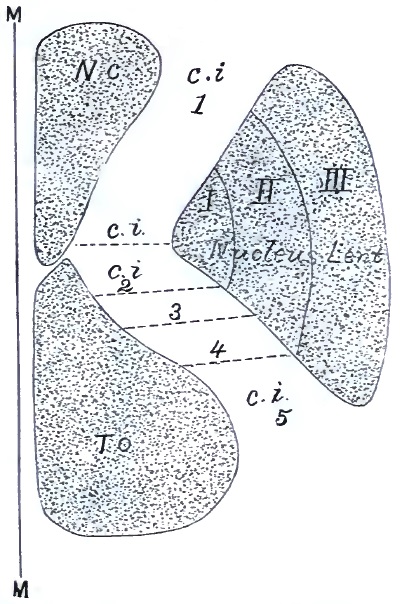
Horizontal Section through the Centre of the Right Cerebral Hemisphere: M, median line; Nc, nucleus caudatus; Nucleus lent., nucleus lentiformis with its three segments; To, thalamus opticus; c. i., internal capsule with its frontal division, its bend or knee, and its caudal division. 1, mass of fibres destined for pons and others forming a part of the corona radiata, non-pyramidal fibres; 2, knee of the internal capsule, containing fasciculus from cortical centre for the face to the nucleus of facial nerve (non-pyramidal fibres); 3, fasciculus for the tongue and throat to nucleus of hypoglossus, etc. (non-pyramidal fibres); 4, fasciculi from the pre- and postcentral gyri and the paracentral lobule to the pyramid of the oblongata (the true pyramidal fasciculus, continued in the cord as fasciculi, 10 and 11 of Figs. 5 and 6); 5, the caudal third of the internal capsule, containing fasciculi destined to the sensory cortical centres.
(c) Lesions of cortical areas connected with fasciculi of the sensory part of the internal capsule (c. i. 5).
(α) Lesion of the cortical area or centre for smell cannot at present be diagnosticated. From the results of experiments upon higher mammals we would expect such a centre to be in the cortex of the mesal gyri of the temporal lobe.
(β) Lesions of the cortical centre for taste are equally unknown; it is probably situated in the meso-basal aspect of the temporal lobe.
(γ) Lesions of the acoustic centre are somewhat better known, at least as far as the function of hearing language-sounds (psychic hearing) is concerned. A number of recently-published cases9 have quite positively shown that the existence of word-deafness indicates a destructive lesion of the dorsal gyri (more particularly the first and second) of the temporal lobe (the left always?). The lesion may also be in the inferior parietal lobule and gyrus supramarginalis, penetrating deeply enough to injure the acoustic fasciculus on its way from the internal capsule to the centre.
9 R. W. Amidon, “On the Pathological Anatomy of Sensory Aphasia,” New York Medical Journal, xl. 113, 181.
(δ) The centre for visual impressions is now the best known of any of the sensory cortical areas. The experimental studies and pathological results of the last few years have indicated that the occipital lobe was probably the seat of higher, organized vision (for form and color). More recent autopsies and re-examination10 of the subject point to the cuneus and adjacent gray matter as the visual centre. The anatomical arrangement is, however, peculiar and complex, in that each cortical visual area receives impressions from one lateral half of both retinæ, through the fasciculus opticus.
10 E. C. Seguin, “A Contribution to the Pathology of Hemianopsia of Central Origin (Cortex-hemianopsia),” Journal of Nervous and Mental Diseases, 1886, No. 1.
Destructive lesion of one visual centre is therefore indicated during life by the symptom lateral hemianopsia alone (the dark half-fields on the side opposite the lesion).
The accompanying diagram illustrates the course of the visual paths from the eyes to the cortical centres, and the mechanism of production of various forms of hemianopsia:
FIG. 8.
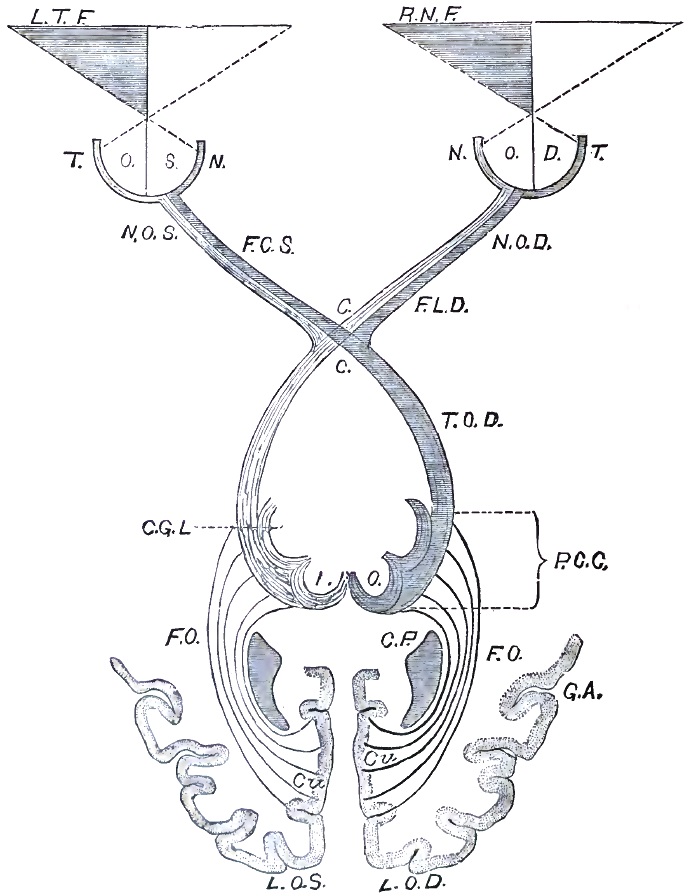
Diagram of Visual Paths, designed to illustrate specially Left Lateral Hemianopsia from any lesion. L. T. F., left temporal half-field; R. N. F., right nasal half-field; O. S., oculus sin.; O. D., oculus dexter; N. T., nasal and temporal halves of retinæ; N. O. S., nervus opticus sin.; N. O. D., nervus opticus dext.; F. C. S., fasciculus cruciatus sin.; F. L. D., fasciculus lateralis dext.; C., chiasma, or decussation of fasciculi cruciati; T. O. D., tractus opticus dext.; C. G. L., corpus geniculatum laterale; L. O., lobi optici (corpus quad.); P. O. C., primary optic centres, including lobus opticus, corp. genic. lat., and pulvinar of one side; F. O., fasciculus opticus (Gratiolet) in the internal capsule; C. P., cornu posterior; G. A., region of gyrus angularis; L. O. S., lobus occip. sin.; L. O. D., lobus occip. dext.; Cu., cuneus and subjacent gyri, constituting the cortical visual centre in man. The heavy or shaded lines represent parts connected with the right halves of both retinæ. The reader may place the lesion as he pleases.
The following diagnostic propositions are applicable to cases presenting the symptom lateral hemianopsia:
“1. Lateral hemianopsia always indicates an intracranial lesion on the opposite side from the dark half-fields.
“2. Lateral hemianopsia, with pupillary immobility, optic neuritis, or atrophy, especially if joined with symptoms of basal disease, is due to lesion of the tractus opticus or of the primary optic centres on one side.
“3. Lateral hemianopsia, or sector-like defects of the same geometric order, with hemianæsthesia and choreiform or ataxic movements of one-half of the body without marked hemiplegia, is probably due to lesion of the caudo-lateral part of the thalamus or of the caudal division of the internal capsule (vide Fig. 7).
“4. Lateral hemianopsia, with complete hemiplegia (spastic after a few weeks) and hemianæsthesia, is probably caused by an extensive lesion of the internal capsule in its central and caudal part.
“5. Lateral hemianopsia, with typical hemiplegia (spastic after a few weeks), with aphasia if the right side be paralyzed, and with little or no anæsthesia, is quite certainly due to an extensive superficial lesion in the area supplied by the middle cerebral artery; we should expect to find softening of the speech-centre, of the motor zone and of the gyri lying at the extremity of the fissure of Sylvius—viz. the gyrus supramarginalis, inferior parietal lobule, and gyrus angularis. Embolism or thrombosis of the middle cerebral artery would be the most likely pathological cause of the softening.
“6. Lateral hemianopsia, with moderate loss of power in one-half of the body if associated with impairment of muscular sense, but without ordinary anæsthesia, would probably be due to a lesion of the inferior parietal lobule and gyrus angularis, with their subjacent white substance, penetrating deeply enough to sever or compress the optic fasciculus in its way caudad to the visual centre.
“7. Lateral hemianopsia, without motor or common sensory symptoms; this symptom alone, is due, we believe from the convincing evidence afforded by Cases 28, 29, 41, and 45, to lesions of the cuneus only, or of it and of the gray matter immediately surrounding it on the mesal surface of the occipital lobe in the hemisphere opposite the dark half-fields. Most surgical cases of lateral hemianopsia come at once or after convalescence within this rule, or No. 6.”11
11 Seguin, op. cit.
The cortical visual area, as above defined, is supplied by one large vessel—viz. the occipital artery, a branch of the posterior cerebral. Embolism or thrombosis of the former vessel is to be thought of as the probable cause of a suddenly-developed lateral hemianopsia without paralysis or anæsthesia.
(ε) The cortical centre for sensory impressions of muscular sense, so called, is probably located in the inferior parietal lobule. The diagnosis of a lesion so placed, in a case presenting along with other sensory or with motor symptoms marked impairments of muscular sense in the arm and leg of one side, is justified by a few recent cases.12 Spitzka believes that he has clinically and pathologically demonstrated a basal path (fasciculus) for this mode of sensibility in the pons and oblongata, dorsad of the pyramidal tracts.13
12 Westphal, Charité Annalen, vii. p. 446, 1882; Stenger, Archiv f. Psychiatrie u. Nervenkrankheiten, xiii. p. 240, Case viii.; Wernicke u. Hahn, Virchow's Archiv, lxxxvii. p. 325; Ball and Seguin, Archives of Medicine, New York, v. p. 136.
13 Spitzka, “A Contribution to the Morbid Anatomy and Symptomatology of Pons Lesions,” American Journal of Neurology and Psychiatry, ii. p. 617 (1883).
(ζ) Lesions of the cortical area for common cutaneous sensibility cannot be positively recognized at the present time. By exclusion of the better-known centres, and from experimental data, we may approximately locate it in the gray matter lying ventrad of (below) the inferior parietal lobule, extending to the base, and possibly the mesal aspect, of the temporal lobe, and possibly also on the lateral aspect of the occipital lobe.
2. LESIONS OF THE KINESODIC SYSTEM OF THE ENCEPHALON.—The kinesodic system is far better understood, anatomically and physiologically, than the æsthesodic. Its limits, beginning from the junction of the cord and oblongata, are as follows: The pyramids, containing the fibres of the direct and crossed pyramidal fasciculi of the cord (Fig. 5, Nos. 10 and 11), form the meso-basal aspect of the oblongata, appearing on either side of the median line as two large distinct bundles of white substance which enter the pons under its projecting transverse fibres. Within the pons each pyramid is divided into quite a number of fasciculi more or less separated by fibres of other systems. Again collected, these bundles constitute a considerable part of the crus cerebri—its basal middle two-fifths. (The outer or latero-dorsal one-fifth part of the crus belongs to the æsthesodic system, the middle (intermediate) two-fifths are the pyramidal fibres, and the remaining two-fifths, meso-basal part, contain some fibres from the direct cerebral motor tract destined for the hypoglossal and facial nuclei, and also large bundles probably derived from the nucleus caudatus and frontal lobes). As the crus enters the cerebrum and becomes what we know as the internal capsule, the pyramidal fibres occupy the bend or elbow of the capsule and part of its caudal segment (vide Fig. 7).
From this level the fibres of the internal capsule again diverge, as fasciculi whose physiological independence has been well determined, going dorsad and frontad to certain gyri of the cerebral cortex where their fibres join ganglion-cells. Three large fasciculi and corresponding cortical areas are recognized as constituting the pyramidal tract, strictly speaking: (1) A fasciculus which extends frontad to the base of the second frontal gyrus where it coalesces with the precentral, the centre and fasciculus for movements of the facial muscles of the opposite side; (2) a fasciculus which extends to the precentral and postcentral gyri, more especially in their middle part, constituting the centre and fasciculus for movements of the arm and hand; (3) another fasciculus which goes dorso-mesad, almost vertically in the brain, to join the ends of the pre- and postcentral gyri at the top of the hemisphere, and their continuation upon its mesal aspect known as the paracentral lobule, centre and fasciculus for movements of the opposite foot and leg. Besides these three great cortical areas and their connected fasciculi of nerve-fibres, which go to make up the pyramidal tract, we recognize (4) a cortical centre for speech movement of the tongue and lips in the base of the left third frontal gyrus over the fissure of Sylvius (Broca's speech-centre), with a connected white fasciculus which passes into the elbow of the internal capsule, and can be traced (by means of secondary degeneration) into the inner part of the base of the crus and into the pons, but not to the pyramid. Another probable centre (5), for coarse lingual movements and for the various movements of deglutition, is in the folds of the insula, its fasciculus not joining the pyramid.
FIG. 9.
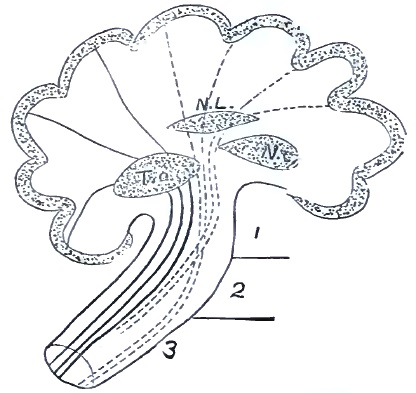
Longitudinal (sagittal) Section through the Brain, to show the distribution of the fasciculi of the internal capsule. Fasciculi of motor tract in dotted lines, to fronto-parietal convolutions. Fasciculi of sensory tract in full lines, to temporo-parieto-occipital convolutions: N. C., nucleus caudatus; N. L., nucleus lentiformis; T. O., thalamus opticus. 1, level of crus cerebri; 2, level of pons; 3, level of oblongata. (This diagram is to be used in conjunction with Fig. 7.)
The location of two other motor centres—one for the movement of the eyeballs in or near the gyrus angularis, and one for vocal laryngeal movements in the base of the right third frontal gyrus (homologous to the speech-centre in the left hemisphere), is problematical, or at least not well enough established to be recognized in a practical treatise.
Recent experimental researches have shown that to electrical excitation at least the fasciculi for the tongue, face, arm, and leg yield the same distinct reaction (isolated muscular contractions) as do their respective centres or cortical areas; perhaps they are more excitable.
When these cortical areas are destroyed by disease, or when their connected fasciculi are severed, secondary degeneration takes place and extends to the end of the respective bundles, even to the lower extremity of the spinal cord.
Before leaving the subject of the composition of the kinesodic system it is desirable to add a few words concerning the decussation of the pyramids or distribution of the pyramidal tract in the spinal cord. As is well known, this is double, a small part of the pyramidal bundle remaining on the same side of the median line, the so-called direct pyramidal fasciculus or column of Türck (Fig. 5, No. 11) forming the mesal edge of the anterior column of the cord. The larger part of the pyramid crosses the median line at the decussation, and enters the opposite lateral half of the cord, in which it is found as the crossed pyramidal fasciculus (Fig. 5, No. 10) in the posterior part of the lateral column, rapidly diminishing in size in the dorso-lumbar part of the cord. The important point to bear in mind for the study of monoplegias and of hemiplegia is that the amount of decussation is far from uniform. This variability was first demonstrated by Flechsig.14 He found in a series of sixty fœtuses such variations in the relation of the crossed and direct fasciculi as 100:0 (complete decussation), 92:8, 84:16, 70:30, 52:48 (nearly semi-decussation, producing equal fasciculi), 35:65, 10:90 (almost non-decussation).
14 Die Leitungsbahnen im Gehirn und Rückenmark des Menschen, Leipzig, 1876.
It should also be added that quite certainly the cerebellum, nucleus caudatus, nucleus lentiformis, and nucleus pontis form parts of the complete kinesodic system, but we are as yet ignorant of their exact connections and functions.
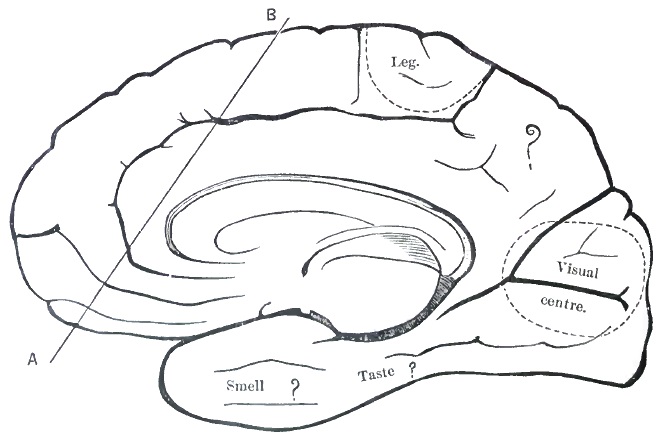
With respect to the anterior part of the frontal lobe, forward of the oblique line A B across Figs. 10 and 11, the study of human cases of destructive injury and disease would indicate that it is not associated either with the kinesodic or with the æsthesodic systems.
The SYMPTOMS of lesions of the kinesodic system, particularly of the pyramidal tract, are exclusively motor, consisting of spasm and paralysis. Contracture of the paralyzed parts follows the paralysis after a few weeks if the lesion be a destructive one.
Clinically, the following DIAGNOSES of localization of lesions in this system are now possible:
(a) Lesion of the speech-centre (4) and of its associated white fasciculus is indicated by intermittent or constant aphasia of the motor form, with or without paralysis of the face and limbs (on right side usually).
(b) Lesion of the facial centre (1) and of its associated fasciculus is characterized by the occurrence of spasm or paralysis, or of both in rapid succession, in the facial muscles; their electrical reactions remaining normal.
(c) Lesion of the brachial centre (2) and of its associated fasciculus is made known by spasm or paralysis, or by both in succession, in the hand and arm. In many cases (tumor especially) the first symptom is clonic convulsive movements of two or more fingers, extending to other parts of the arm. Such brachial monospasm or monoplegia is usually accompanied or followed by incomplete hemiplegia.
(d) Lesion of the crural centre (3) in the paracentral lobule and of its associated fasciculus of white substance is indicated by priority and predominance of convulsive and paralytic phenomena in the foot and leg: a crural monospasm or monoplegia exists with or without incomplete hemiplegia.
The positive diagnosis of these separate localizations is most feasible in cases of tumors or of cranial injury where the initial lesion is limited in extent and where the morbid process is for a time localized. As a rule, localized spasm (Jacksonian epilepsy) without loss of consciousness is the first symptom, followed after a time by localized paralysis (always in the same muscular groups); and later still the symptom-group becomes obscured by the supervention of other symptoms indicating extension of disease to other parts of the kinesodic system, or even to the æsthesodic system.
(e) Lesion of the insula and adjacent white substance laterad of the nucleus lenticularis (5) may be suspected from the rapid or sudden development of symptoms imitating those of acute bulbar paralysis, but without bilateral paresis of the body and anæsthesia. Aphasia is very apt to coexist with the bulbar symptoms if the lesions involve the left insula, whose frontal folds are continuous with the speech-centre.
Common hemiplegia with contracture, but without anæsthesia, represents a gross lesion of the kinesodic system, involving several cortical centres or the motor part of the internal capsule:
(1) A widely-spread lesion of the cortex of the brain, softening of the motor zone (centres 1, 2, 3, 4) from embolism or thrombosis of the middle cerebral artery.
(2) Hemorrhage from vessels of the nucleus caudatus and nucleus lentiformis compressing or destroying the motor segment of the internal capsule at various levels. More rarely there is a form of softening or gliomatous growth involving the same parts. Any of these lesions may be so localized as to destroy only one fasciculus of the capsule, giving rise to monoplegia.
The limits of the so-called sensory and motor centres or cortical areas, and the possible localization of lesions in them, will be better understood by the help of the accompanying diagrams (Figs. 10 and 11, p. 90) of the lateral and mesal aspects of the hemisphere.
B. FOCAL LESIONS OF THE ENCEPHALON.—1. FOCAL LESIONS OF THE CEREBRUM, OF ITS CORTEX AND SUBJACENT WHITE SUBSTANCE, AND BASAL GANGLIA.—(a) Focal lesions of the frontal lobe produce no specific symptoms, and cannot be directly diagnosticated unless they extend as far caudad as the base of the second and third frontal gyri. The forward mass of the frontal lobe, including the orbital lobule (vide Fig. 10), appears to be inexcitable and insensitive. Even psychic symptoms do not necessarily appear after the loss of considerable amount of cerebral substance from this region. The diagnosis of tumors, abscesses, etc. in this part of the brain must be made by taking into consideration the seat of pain, the presence of cicatrices or other etiological indications, the general signs of the cerebral irritation and compression, but, after all, usually by exclusion. In some cases unilateral anosmia is produced.
(b) Focal lesions of the caudal part of the frontal lobes, of the insula, the pre- and postcentral gyri, and other parts of the motor zone are usually easy of diagnosis. The symptoms of such lesions have already been detailed when speaking of lesions of the kinesodic system.
(c) Focal lesions of the parietal, temporal, and occipital lobes of the brain have the characteristic semeiology of lesions of the æsthesodic system, considered supra.
(d) Lesions of the so-called basal ganglia, the nucleus caudatus, nucleus lentiformis, and thalamus, usually give rise to motor and sensory symptoms indirectly by pressure upon or destruction of the segments of the internal capsule which lie between these bodies (vide Figs. 7 and 9). Lesions of the nuclei caudatus and lentiformis are thus more prone to produce purely motor symptoms, while sensori-motor and ataxic symptoms result from lesion of the thalamus.
The symptoms indicating lesions strictly limited (in extent and in effect) to these ganglionic bodies are at present practically unknown.
(e) Lesions (tumors, etc.) of the lobi optici (tubercula quadrigemina) are productive of early neuro-retinitis and blindness, of convulsions, and of diffused bilateral incomplete paralysis of the body, without symptoms of disease at the base of the brain (vide infra). The diagnosis intra vitam remains of great uncertainty, inasmuch as other lesions in the median line, involving parts adjacent to the lobi optici, may give rise to the same symptom-group.
FIG. 10.
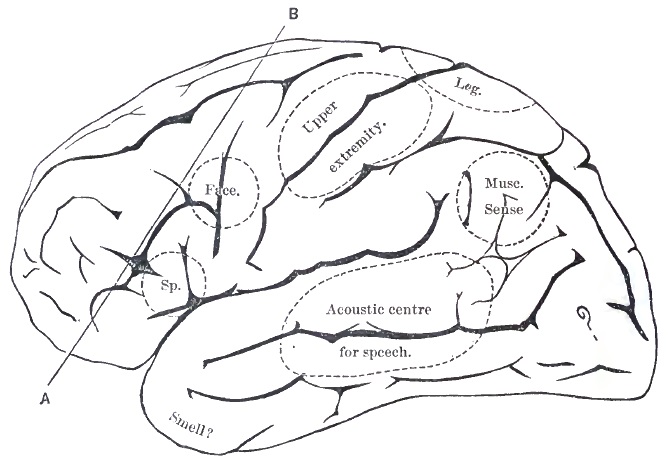
FIG. 11.
2. FOCAL LESIONS OF THE CEREBELLUM.—(a) Lesions strictly limited to one lateral lobe or hemisphere of this organ do not give rise to any characteristic symptoms—in some cases, indeed, to no symptoms at all. When the lesion tends basad, irritating and compressing the subjacent pons and oblongata on one side, incomplete paralysis appears in the limbs opposite the lesion, the face usually remaining normal. Occipital headache, attacks of vomiting, opisthotonos, or intense subjective stiffness of the back of the neck, with neuro-retinitis, would strengthen the diagnosis. If the lesion extend laterad, so as to involve the processus ad pontem (lateral peduncle), a tendency to rotate while lying or to deviate in walking toward the side of the lesion may be added.
(b) Lesions of the middle lobe, or vermis superior in particular, may be positively recognized during life. Besides the above-mentioned general symptoms of cerebellar and bulbar irritation and compression—viz. occipital headache, cervical stiffness, attacks of vomiting, neuro-retinitis, and atrophy of the optic nerve—there is a very characteristic, almost pathognomonic, symptom. This is cerebellar titubation, miscalled cerebellar ataxia. The patient, whose equilibrium may be perfect while lying or sitting, upon rising and attempting to walk does so somewhat like an intoxicated person: the head and body are bent forward; the arms and hands held out and moved as balancing weights; the feet are widely separated, the toes clutching the floor or carpet; the body oscillating somewhat over its base of support. There are not the wide excursions of the entire body, the zigzagging, of alcoholic intoxication, nor is there any of the stamping or jerky step of locomotor ataxia. If the patient be tested lying or sitting, it is found that neither in the hands nor in the legs is there a trace of ataxia: muscular strength and sensibility are long preserved, and the patellar reflex is exaggerated.
3. FOCAL LESIONS OF THE BASE OF THE BRAIN, either within the nervous substance or springing from the dura, and acting by irritation and pressure upon various parts of the basal aspect of the encephalic mass.
(a) Diffused bilateral lesions of this class situated frontad of the crura give rise to more or less distinct symptoms, and a diagnosis is sometimes possible. (1) Lesions in the vicinity of the sella turcica and optic chiasm produce symptoms in the optic apparatus very early, and these remain prominent throughout the illness. These symptoms are, irregular (at least not lateral) hemianopsia, neuro-retinitis followed by atrophy of the optic nerve, temporary or permanent paralysis of one or several ocular nerves. If these exist without symptoms of lesion of other parts of the brain (reasoning by the process of exclusion), we may strongly suspect the seat of the lesion to be in the region named. Other symptoms are paroxysmal headache and occasional vomiting, epileptiform convulsions (never Jacksonian in distribution), partial hemiplegia, or general muscular weakness. By such data we were recently led to the correct localization of a tumor. (2) If the lesion be farther frontad—i.e. strictly in the orbital areas of the basis cerebri—anosmia, uni- or bilateral, usually with hallucinations of smell, will be an early symptom, along with neuro-retinitis and obscure motor and sensory symptoms (headache and convulsions more especially).
(b) Lesions situated caudad of the infundibulum. (1) Bilateral lesions give rise to symptoms which are the symmetrical duplication on either side of the face and body of those to be next described as characteristic of—
(2) Unilateral focal lesions of the base of the encephalon from the crura caudad to the pyramidal decussation.
In a general way, the symptoms of these lesions are designated as varieties of crossed paralysis.
Clinically, a crossed paralysis is one in which one or several cranial nerves show symptoms of irritation or destruction on one side of the median line, while body symptoms are present on the opposite side.
Physiologically and anatomically, a crossed paralysis is one in which the lesion is so placed as to affect a cranial nerve (or more than one) at a point caudad (below) of the decussation of the fibres which connect its nucleus with the cerebral cortex, or at its nucleus of origin, or so as to injure the nerve-trunk itself; while at the same time the lesion affects the main fasciculus of the pyramidal tract frontad (above) of its decussation, in the crus, pons, or oblongata.
In many cases of crossed paralysis, besides common motor and sensory symptoms, there is apt to be neuro-retinitis with its consequences.
The chief forms or types of crossed paralysis are:
(α) Lesions involving the meso-ventral aspect of one crus cerebri. The direct symptoms of such a lesion are in the range of distribution of the motor oculi (N. iii.), such as ptosis, mydriasis, external strabismus, and heteronymous diplopia; the crossed symptoms are more or less complete paralysis of the lower part of the face and of the extremities on the opposite side (hemiplegia). This relatively frequent form of crossed paralysis we designate as the eye-and-body type.
(β) The lesion occupies the latero-ventral part of the crus. This rare localization would give rise to direct paralysis of the fourth nerve, indicated by homonymous diplopia in the lower inner field of vision; to lateral hemianopsia with dark half-fields opposite the lesion, from injury to the tractus opticus (vide Fig. 8); and to a mixed motor and sensory disturbance in the opposite side of the face and body, without anæsthesia of the olfactory and auditory apparatus. A very large lesion involving almost the entire crus would probably also cause direct paralysis of N. iii.
(γ) Lesion of the basal part of the pons frontad of an imaginary transverse line passing through the apparent origin of the trigemini (NN. v.). Symptoms: A common hemiplegia of the lower face and extremities on the opposite side with neuro-retinitis and other general signs of basal disease. The abducens nerve (N. vi.) would in some cases be involved in its course frontad over the pons, giving rise to internal strabismus and homonymous diplopia on the same side as the lesion.
(δ) A focal lesion in the caudo-ventral part of the pons—i.e. caudad of an imaginary transverse line passing through the trigeminus roots—gives rise to highly characteristic symptoms. These are: Direct paralysis of the face, not (?) affecting all the muscles, but without De R., and common hemiplegia of the limbs on the opposite side.
If the lesion be strictly basal—i.e. one springing from the membranes or bone, the trunks of the sixth and seventh (facial) nerves are directly injured, and the resulting facial paralysis is of the peripheral form, affecting all the muscles and yielding De R. The body symptoms on the side opposite the lesion are less marked.
In the first category of cases, those in which the lesion is in the substance of the pons, the motor fasciculus from the cortex cerebri to the nucleus of N. vii. is injured caudad of (below) its theoretical decussation-point on the middle part of the pons, while the pyramidal tract is involved frontad of (above) its decussation.
This symptom-group is known as face-and-body type, or as crossed hemiplegia, strictly speaking.
(ε) A lesion so placed laterally in or on the pons as to affect the origin of one trigeminus (N. v.) will cause, besides motor symptoms in the face and body (types γ or δ), special direct symptoms—viz. anæsthesia in the distribution of the fifth nerve and paralysis of the masticatory muscles opposite to the body symptoms. This is the trigeminus and body type.
Lesions may be so placed ventrad or laterad upon or in the oblongata as to give rise to other types of crossed paralysis: these are easily assumed in a theoretical manner, but in practice such cases are extremely rare, present a complicated semeiology, and are usually not correctly diagnosticated during the patient's life.
V. Cranio-cerebral Topography.
The study of cerebral localizations from a diagnostic and practical point of view would be incomplete without a brief reference to the relations existing between the various gyri of the cerebrum and the external surface of the head, in order to render more accurate the estimation of the actual location of cerebral injuries and diseases.
The surgical anatomy of the head with reference to its contents has been developed with remarkable completeness during the past fifteen years, chiefly by the researches of Broca, Bischoff, Heftler, Turner, and Féré. Acting upon these data, a number of surgeons have successfully trephined the skull for the result of injuries, for abscess, and even for tumors.
The location of many convolutions and fissures of the cerebrum can be accurately mapped out upon the surface of the skull, or even upon the head of the living subject, from the projections of certain lines and measurements from points thus obtained, as well as from some natural landmarks. For the projection of these lines the head is placed in a particular position, as can easily be done when we operate upon a bare skull, but which can also be approximated when we deal with a living subject either sitting or lying in bed. The skull or the shaven head should be so placed and held that a line passing from the alveolar process of the superior maxilla and through the lowest part (condyles) of the occipital bone shall be truly horizontal. The greatest care should be used to determine this line—the alveolo-condyloid plane of Broca—for upon it all other projections and measurements are based. This position of the head and the alveolo-condyloid plane (line 1-1) are represented in Fig. 12.
FIG. 12.
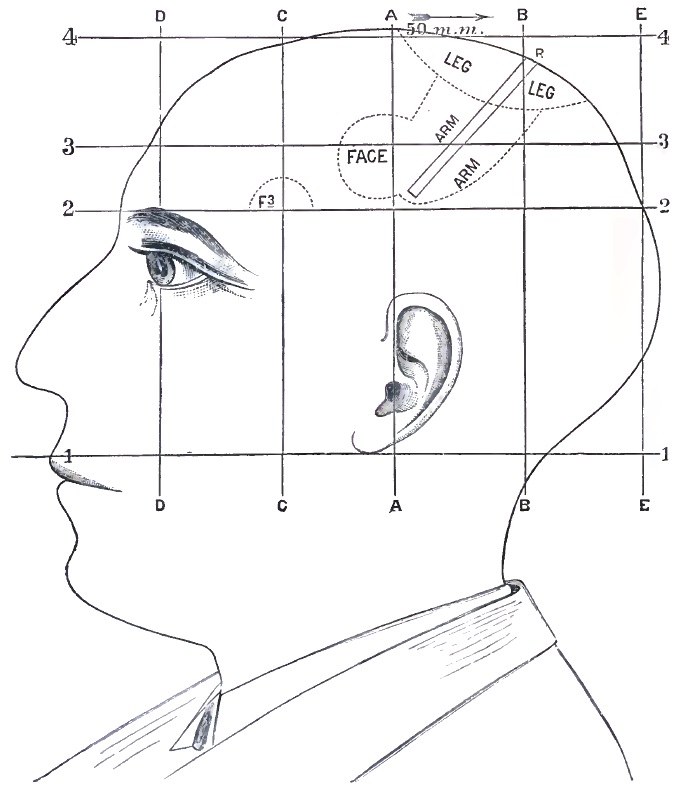
Topographical Lines applied to the External Contour of the Head.
From this line (1-1) a vertical line, or one exactly perpendicular to the first, is drawn through the external auditory meatus. At the top of head this line—the auriculo-bregmatic line (A A)—indicates the bregma or true vertex, which important landmark is to be marked with carmine or aniline upon the scalp. Upon the top of the head an imaginary horizontal line (4-4), parallel with the alveolo-condyloid plane, is projected, and upon it we measure backward a distance of 50 mm. (2 inches), and then draw a second vertical line (B B). At the point where this line reaches the convexity of the head is the Rolandic point (R), under which, in average heads, lie the upper or posterior extremity of the fissure of Rolando, the upper ends of the pre- and postcentral gyri, and within the longitudinal fissure the paracentral lobe, which together constitute the cortical centre for the leg of the opposite side. The Rolandic point, thus determined, should be distinctly marked upon the shaven scalp.
A third horizontal line is next to be drawn from the external angular process of the frontal bone backward, parallel with Broca's plane. This line (2-2), which may be termed the fronto-lambdoid because its posterior extremity usually passes at or near the upper angle of the lambdoidal suture, serves for the determination of several important parts. In the first place, the line (2-2) passes at about 5 mm. above the upper border of the squamous suture, or through it, and under this line, mostly parallel to it, are the anterior two-thirds of the fissure of Sylvius. Secondly, at about 5 mm. above and behind the intersection of lines (A A) and (2-2) is the inferior extremity of the fissure of Rolando, bounded by the pre- and postcentral gyri. In the third place, upon this line (2-2), at a distance of 18 or 25 mm. behind the external angular process, is the folded part of the base of the third frontal gyrus or Broca's speech-centre (F 3).
FIG. 13.
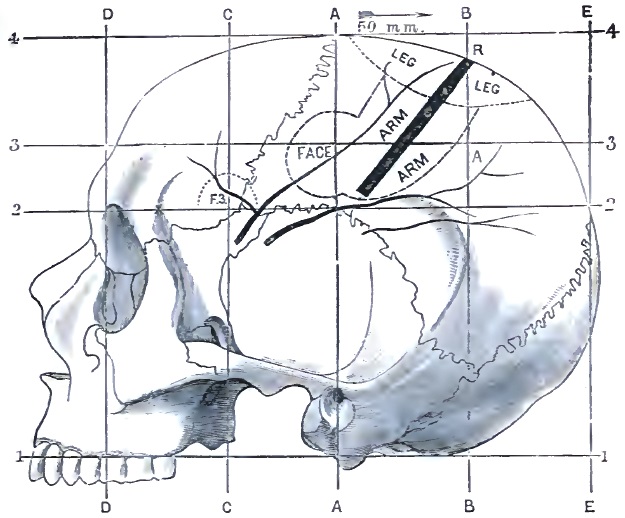
Topographical Lines applied to Henle's Figure of the Skull. Location of the Rolandic point. Rolandic line, motor-centres, and the branches of the middle meningeal artery.
Having exactly determined and marked the situation of the Rolandic point and of the inferior termination of the fissure of Rolando above the ear, these two points are to be connected by a line, which is represented on the diagram by a black bar. This, the Rolandic line, is the guide for nearly all operations for the relief of spasm or paralysis of traumatic origin, or of such as may be caused by tumors, abscesses, etc. It is surrounded by the so-called motor centres for the face, arm, and leg (?) as demonstrated by experiments upon animals and by now numerous autopsies in human cases of injury and disease.
Other relations of interest are the apex of the temporal lobe, a little beneath the line (2-2) and at about 10 to 15 mm. posterior to the external angular process of the frontal bone; the situation of the occipito-parietal fissure, almost immediately under the posterior end of the line (2-2) at its junction with the lines (E E), which indicate the posterior extremity of the cerebrum; the anterior end of the brain being marked off by the line (D D).
Furthermore, for certain purposes the limits of the basal or central ganglia may be estimated as follows: Their superior limit is indicated by a horizontal line (3-3) drawn at 45 mm. below the vertex, their anterior limit corresponding to the head of the nucleus caudatus by the vertical line (C C), and their posterior limit, the hinder end of the thalamus, by the vertical line (B B).
Upon the median line at the top of the head an allowance of full 15 mm. should be made for the width of the superior longitudinal sinus separating the hemisphere.
FIG. 14.
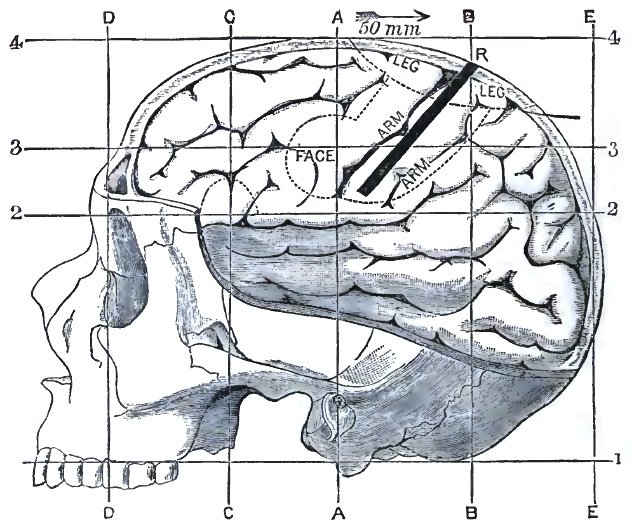
The same Topographical Lines applied to the Left Cerebral Hemisphere in Henle's Skull. The motor centres are approximately indicated by dotted lines. (The leg centre should be reduced in size as it lies near to and in the longitudinal fissure.) The Rolandic line is placed a little behind the fissure for the sake of clearness.
The location of the middle meningeal artery, which so often furnishes the blood that compresses the brain after various injuries to the head, is surgically of great importance. The course of its two principal branches is approximately indicated upon Fig. 13 by the branching lines drawn on the anterior inferior angle of the parietal and the upper part of the squamous portion of the temporal bone. In the living subject the main trunk of the artery would be found under the horizontal line (2-2) a little posterior to the speech-centre, about 30 mm. behind the external angular process, and in front of the beginning of the fissure of Sylvius.
Upon the shaven head of a patient seated in a chair or lying in bed the principal landmarks and relations above defined can be mapped out with sufficient approximation to accuracy by the use of a ruler to mark the alveolo-condyloid plane, and a cardboard cut so as to stand astride the head in the auriculo-bregmatic vertical. A light wooden apparatus can easily be made to indicate these two lines, while the remaining measurements can be made with a steel tape-measure, and the points marked with carmine ink or an aniline pencil.
The value of cranio-cerebral topography is obvious for ordinary surgical purposes, but it may in the future prove of great utility in the treatment of cerebral diseases (tumors, abscesses, etc.) by surgical means. A bold and nearly successful attempt at removing a tumor of the brain has already been made,15 and doubtless there are surgeons who will not hesitate to follow the path thus opened up when physicians give them a diagnosis of localized tumor or abscess in parts of the cortex cerebri to serve as a basis.
15 Bennett and Godlee, The Lancet, 1884, ii. 1090; 1885, i. p. 891.
The indications for trephining or raising bone after cranial injuries, for the relief of symptoms of cerebral irritation, compression, or disorganization, may be provisionally stated as follows:
(a) When aphasia supervenes immediately or within a few days or weeks after an injury of the anterior portion of the head on the left side. It is extremely probable that in the first case a clot or bony spiculum will be found compressing the speech-centre; in the second case, that an abscess has formed in or near it (Broca's case).
(b) When simple hemiplegia or hemiplegia with hemispasm follows an injury, however slight, in the temporo-parietal region. If the paralysis or spasm be limited to one side of the face or to one extremity, the indication to operate is even stronger. Even if in such cases the injury be not immediately over the motor area, the surgeon is justified in exploring that region.
(c) In conditions of stupor and coma after cranial injuries, sometimes without external wound, in which meningeal hemorrhage is the cause of impending death, the discovery of slight hemiplegia should justify trephining planned according to the topographic rules above laid down (Weir's case, 1882). In some cases latent hemiplegia may be discovered by the presence of an erythematous flush on one buttock and of a slightly increased peripheral temperature (taken between fingers or toes).
(d) In the very rare cases in which paralytic phenomena are found on the same side as the evident cranial injury, it would be proper to trephine on the opposite side of the skull in search of fracture or hemorrhage, the result of contre-coup.
(e) In chronic epilepsy after traumatism of the head the indication for trephining is present, but it is seldom a specific indication connected with the subject of localization. Lesions of any part of the skull and dura may be a cause of epileptic attacks, irrespective of motor centres.
(f) In cases of tumor in the motor centres, if there be not symptoms of tumors in other parts of the brain (multiple tumors) or of penetration of the tumor to the central parts of the brain, we believe trephining not only justified, but demanded in the present state of science.
Some of the contraindications to trephining may be thus stated:
(a) Whenever in apparently favorable cases there are signs of injury to the base of the brain, such as paralysis of cranial nerves, neuro-retinitis, and Cheyne-Stokes respiration (although the last symptom may occur from simple compression).
(b) When hemispasm or hemiplegia is accompanied by hemianæsthesia, thus making it probable that the lesion is deeper and farther back.
It should be added, in conclusion, that these indications and contraindications are formulated from the standpoint of the neurologist.
MENTAL DISEASES.
BY CHARLES F. FOLSOM, M.D.
DEFINITIONS OF INSANITY.—The term insanity conveys quite different meanings to the community, to lawyers, and to physicians. From the three points of view its definition has been constantly widening for the past century. A great part of the alleged recent increase in insanity is due to the fact that its definition is applied to more people. Our insane asylums are more quiet and orderly, not only because of the more humane treatment of the inmates, but largely also because quieter and less insane people are now sent there than formerly. Doubtless the mistake is sometimes made of going so far, in zeal for science and philanthropy, as to make the definition of insanity too broad; and in a refined civilization the nice adjustment of complicated social relations, or even a fastidious taste, requires people to be sent to insane asylums who in simpler states of society would be cared for at home.1
1 The physician in general practice is referred to Clouston's Clinical Lectures on Mental Diseases, and to Part 1 of Spitzka's Manual of Insanity. For those who wish to study insanity thoroughly the literature is rich and its bibliography is readily available. Of many parts of the subject only an outline, of course, can be given within the limits of the present paper.
The popular idea of insanity is of wild, incoherent, or crazy conduct. If maniacal, the timid or frightened young girl who would not hurt a fly, and the tottering, harmless old man if confused and partly demented, are hurried off to the asylum with the use and show of force suitable for a desperate criminal, while the victim of overwhelming delusions, because he seems clear, logical, and collected, is vigorously defended against the physician's imputation of insanity until he commits an offence against the laws, when he is fortunate if he is not treated as a criminal. It is often impossible for judges, juries, counsel, and even medical experts, to wholly divest themselves of the popular notions of insanity in cases appealing strongly to the passion or prejudice of the day. Cases involving the question of responsibility for crime are decided against science and the evidence because of certain preconceived notions upon insanity which no amount of skilled opinion can controvert. Jurors, and less often judges, make up their minds what a sane man would do under given conditions, and of what an insane man is capable, judging from the facts within their own experience; and in forming their decisions it is the act itself, and not the man, diseased or otherwise, in connection with the act, that chiefly governs them. Often they are right, not seldom wrong. Strange, apparently purposeless, illogical, inconsistent action is frequently attributed to the author of it being insane on that subject, whereas he may be simply acting from strong impulse or emotion, and may be by no means insane. On the other hand, because a man knows right from wrong in the abstract, and can ordinarily behave well, the very characteristic workings of his insane mind are often seized upon as unquestionable proof of sanity, even when they admit of no other explanation to the skilled physician than that of insanity. There is no doubt of the fact that the whipping commonly used in the treatment of the insane by the monks several centuries ago put an end to much insane conduct; and in insane asylums now, in spite of the best efforts of the medical staff to the contrary, a brutal, bullying patient is sometimes struck by another patient or an attendant in return for some unusually exasperating and cruel conduct, with the result of making him behave well in the future. It is with reference to this class of cases that the crowd oftenest errs in its definition of insanity. Society claims a voice in the enforcement of the laws for its own protection, assuming to know who could control themselves from crime and who not, and naturally wishes the standard of responsibility to be kept high. Of course its sympathies and prejudices largely govern its voice in the matter.
With precisely the same degree of insanity and the same power to control their actions two murderers may be sentenced, one to death for an act where the motive and method were those of the criminal, and the other to an insane asylum for killing a person under circumstances which are not explainable by sane reasons. The Pocasset Adventist who sacrificed his loved child, as he thought, by the Lord's command, would probably have been hanged if he had committed a crime similar to John Brown's, Wilkes Booth's, Orsini's, or Guiteau's. Sometimes the accused gets the benefit of the doubt, and sometimes society, according to the view of the merits of the case taken by the judge in his charge or by the jury in their verdict.
To the lawyer insanity means only a condition of mind with reference to certain conduct. An insane man is simply non compos mentis. Insanity is irresponsibility. The whole question to the lawyer is with regard to a certain act or series of acts. The lawyer's definition is narrower than that of the physician. In wills and contracts the course is usually clearer than when there is a question of serious crime, and even an insane person in an asylum may be a party to a valid contract or make a will that will hold in law. It is not necessary that a will or contract be such as would be made by a just man or a reasonable man, but simply that it fairly represent the wishes and character of the man making it, uninfluenced by any insane delusion or prejudice caused by mental impairment; that the will or contract in itself bear evidence of a correct appreciation of the circumstances and conditions of the case; and that the mind be able to act independently enough, with a reasonable knowledge of the duties of the individual and the just rights of others. An unsound mind, as defined by the physician, would cover a large portion of the convicts in our workhouses and prisons to-day if they could be critically examined, but the lawyers and courts would not find many of them insane. A man is not insane in law unless his act is traceable to, or its nature has been determined by, mental disease affecting his free agency; in other words, unless insanity caused his act either wholly or in great part.
In the partly irresponsible condition of mind often produced by grave hysteria, so-called nervous prostration, and the general mental and moral demoralization often seen in seduced and abandoned women, or after exhausting illness, or following apparent recovery from cerebral hemorrhages or embolism, blows upon the head, sunstroke, chronic alcoholism, syphilis, etc., there may be loss of self-control and a distinct moral perversion or decided change of character without very evident mental impairment; and the courts recognize a diminished capacity, as the result of disease, to appreciate and follow what is right and just and to avoid what is wrong or unjust, and yet not complete irresponsibility. In this connection the fact should be borne in mind that a very little mental disease can make bad people criminals, and may not take others beyond the bounds of propriety. A criminal may become insane and be still pretty much the same kind of a criminal as before. Morality, too, is relative, and many criminals, like children, know almost nothing of abstract truth, justice, or virtue, because they have never been taught them; and there are many cases where the perverse or criminal actions of people may be about equally explainable on the theory of insanity or wickedness. The criminal, a creature of his surroundings and associations, may often not be discriminated from the man with mental disease. Indeed, it is not difficult to take the philanthropic position that all criminals are insane because they are not in sympathy with the moral conceptions of their time, or, to use the fashionable expression of the day, because they are not in harmony with their environment. Such a view of crime, however, leads to only one of two conclusions—either that insanity is no sufficient defence for wilful violation of the laws, or that all criminals should be treated as persons of unsound mind.
The free agency of the individual is affected or modified in many different ways by the different diseases of the mind, and the question of responsibility will often be found to be one of the most perplexing problems with which the physician has to deal. If well-marked forms of insanity alone were to be investigated, the matter would be comparatively a simple one; but such is far from always being the case. The insane man often commits certain crimes precisely as an ordinary sane criminal would do the same thing. Often the evidence is contradictory, the testimony as to previous life and character conflicting, and the disease of so obscure a stage or type that it is almost impossible to form a clear opinion. The determination of a man's degree of free agency is no simple affair which can be decided in all cases by a few or a few dozen interviews. Not seldom the mystery remains unsolved after the autopsy. Man's free will is not the property of any substance which can be demonstrated by chemistry, physiology, or microscopical research, but it is the result of the combined action of a whole group of functional activities the very relations of which to each other are as unknown as their method of action. No stethoscope or ophthalmoscope can reveal its morbid action, which can only be inferred indirectly from the operations of the mind.
The cases in which the physician is called upon to define insanity as the term is used by the lawyers are (1) to secure limitation or control of an individual's actions, usually by a guardianship; (2) to control him absolutely in an asylum; (3) to estimate his culpability or criminality, or his capacity to make a will or contract or to transact business. It is quite important, therefore, that the medical man should understand that there may be, as regards some particular person, a wide difference between medical insanity or mental disease and legal insanity or irresponsibility. He does most wisely when he confines his testimony to an explanation of the changes caused by disease in the particular case, and to the effect of such changes upon the mind, leaving to the judge's charge and the jury's verdict the questions of guilt and responsibility.
Insanity may be of congenital origin or slowly developed from early childhood, but usually it indicates a change caused by disease, so that the person alleged to be insane must, as a rule, be compared with himself at some previous time, and not with some ideal standard of mental health which does not exist. Indeed, if we could measure nicely no two of us could be fairly held to precisely the same degree of accountability. The knowledge of right and wrong is not a fair criterion, as many insane men possess that knowledge well enough in the abstract. The ability to distinguish right from wrong in the particular act is possessed by some insane persons whose will and power of self-control have become so limited by disease that they cannot avoid what they know to be crime. Delusion overpowering the mind is sufficient evidence of irresponsibility, but all delusions are by no means so powerful that they cannot be resisted, and many must be classed as simply false beliefs or mistaken views which could be, and should be, controlled. In case, therefore, of alleged delusions not manifestly insane further evidence of insanity is required, and the way in which a man believes or does anything may be more of an indication as to the soundness or unsoundness of his mind than what he believes or does. A crime committed under the influence of maniacal delirium, acute delirious mania, epileptic furor, uncontrollable impulse, alcoholic insanity, or hysterical mental disease will usually explain itself, while a demented insane person is so characteristic an object that his crime cannot well be mistaken for that of a responsible agent.
The different conditions of mind grouped under the general terms moral insanity, affective insanity, and impulsive insanity are still the bugbear of jurists, and there is a wide difference of opinion as to the degree of accountability for actions performed under the influence of moral perversion with only slight intellectual impairment; but the degree to which the individual deviates from the path of the law may depend more upon his training and surroundings than upon his disease—points which must always be considered in establishing a definition of insanity in obscure cases. Of two persons whose circumstances in life, in connection with a certain amount of disease, have produced as nearly as possible identical morbid mental states, it now and then happens that the necessary surroundings of the one steady and support him, while the associations and conditions of life throw the other still more off his balance. The one is able to sustain the ordinary relations with the world, the other not.
The intelligent study of mental disease by medical men has resulted in its being detected at so early a stage and in such a mild form that its proper treatment might almost be called, when successful, the prevention of insanity. Cerebro-mental disease, though it be only in its incipient form, implies to the physician the necessity for medical treatment; but it is another question whether the disease is sufficient in amount to impair the power of self-control and will so as to determine irresponsibility. It is not the doctor's province to punish for crime, but to treat for disease, and he often forgets that fact. The various medical definitions of insanity in textbooks and on the witness-stand do not clearly enough state how far the medical and how far the forensic meaning of the word is implied. What seem to be wide differences of opinion regarding responsibility for crime, as given in the courts, are often due to different ways of stating the question, and nothing more.
Boileau said that all men are insane, the only difference between them being the varying degrees of skill with which they are able to conceal the crack; and Montesquieu, that insane asylums are built in order that the outside world may believe itself sane. In 1832, Haslam, one of the first experts in mental disease in England at that time, testified in court that he had never seen a sane man in his whole life, adding, “I presume the Deity is of sound mind, and He alone.”
It is impossible to give a satisfactory definition of insanity, to draw any hard and fast line on one side of which we should put all the sane, and on the other all the insane. It is not possible to divide insanity from sanity by a single criterion, such as the existence of delusions, inasmuch as many sane people have very curious delusions; for instance, Sir William Blackstone's belief in witchcraft, as stated in his Commentaries on the Laws of England; Martin Luther's assertion that he saw the devil and threw an inkstand at him at a time when a belief in a personal devil was required by the canons of the Church of England; Napoleon's faith in his star; the common belief of the French generals that Joan of Arc's hallucinations were divine messages. Insane delusions have been defined as false beliefs, impossible from the nature of things or the circumstances of the case, according to general belief. One can only judge of each case and each person by the conditions attending them. A belief consistent with one person's whole life and character might indicate such a change in another as to be a mark of insanity.
Hallucinations—"psycho-sensorial disturbances characterized by sensations perceived when the exercise of the sense has not been determined by any external excitation”—are characteristic of many conditions of disturbed health besides insanity; and the same is true of illusions—erroneous interpretations of sensations actually perceived. In both cases the existence of insanity is determined by the fact whether or not the erroneous impressions are corrected by the judgment. An important point is to consider most carefully every unnatural, strange, or unexplained action, whether deliberate or from impulse, particularly in the large class of eccentric, ill-balanced, or weak-minded persons on the border-line between sanity and insanity. There are people who at one time seem to belong to the sane and at another to the insane class. Baillarger states that the essential element of insanity is loss of free will. Ball of Paris describes an insane man as one who, in consequence of a profound disturbance of the intellectual faculties, has lost more or less completely his free will (liberté morale), and has ceased thereby to be responsible to society for his actions.
Bucknill describes insanity, in his Sugden prize essay, as “a condition of the mind in which a false action of conception or judgment, a defective power of the will, or an uncontrollable violence of the emotions and instincts has been separately or conjointly produced by disease.” Maudsley's definition is, “Insanity is, in fact, disorder of brain producing disorder of mind; or, to define its nature in greater detail, it is a disorder of the supreme nerve-centres of the brain—the special organs of mind—producing derangement of thought, feeling, and action, together or separately, of such degree or kind as to incapacitate the individual for the relations of life.... Mind may be defined physiologically as a general term denoting the sum-total of those functions of the brain which are known as thought, feeling, and will. By disorder of the mind is meant disorder of those functions.”
Bucknill considers insanity a disease of the brain affecting the integrity of the mind. Maudsley calls it a disorder of the mind of such a degree as to incapacitate one for the ordinary relations of life, implying that there may be certain deviations from the condition of sound mind which do not constitute insanity. Tuke's definition is that “insanity consists in morbid conditions of the brain, the result of defective formation or altered nutrition of its substance, induced by local or general morbid processes, and characterized especially by non-development, obliteration, impairment, or perversion of one or more of its psychical functions.” Instead of itself being a disease, insanity, properly speaking, is a symptom of diseases which under varying manifestations probably affect different functions of the brain—at least they affect the brain in different ways.
As Krafft-Ebing says, “It is a logical, self-evident proposition that the organ whose function under normal conditions is to bring about all mental processes must be the seat of changes when these functions are disturbed;” and Schüle adds, “The study of disturbances of the mind involves the changes of the normal mental functions produced by disease.... Mental diseases are brain diseases, but they are more than that.” The normal action of the mind is a strange combination of reason and impulse, varying greatly in different persons, and in the same person at different times and under varying influences. The relations of the one to the other, and their influence on action, often change, under varying conditions and circumstances, in sane persons, but still more in the insane.
Lord Bramwell once said that insanity is strong but not conclusive evidence of innocence; and Lord Blackburn has stated that the jury must decide in each individual case whether the disease of the mind or the criminal will was the cause of the crime. The position of Sir James Stephen in his History of the Criminal Law in England best states the most recent views of irresponsibility—namely, that “no act is a crime if the person who does it is, at the time when it is done, prevented either by defective mental power or by any disease affecting his mind from controlling his own conduct, unless the loss of the power of control has been produced by his own default.” He says that a man laboring under such a defect of reason that he does not know that he is doing what is wrong may be defined as one deprived, by disease affecting the mind, of the power of passing a rational judgment on the moral character of the act which he meant to do. There are persons too insane to make a valid will by virtue of a single delusion, whose right to vote, under the law prohibiting the insane from voting, would not be questioned. Another might not be held responsible for crime, and still make a contract involving the rights of others besides himself that would hold in law.
Bucknill's recent medico-legal definition of insanity is, incapacitating weakness or derangement of mind produced by disease; meaning, in criminal cases, inability of abstaining from the criminal act, which would be expressed by Lord Bramwell's test, Could he help it? Bucknill suggests as an amendment to the law of England that no act is a crime if the person who does it is at the time incapable of not doing it by reason of idiocy or of disease affecting the mind.
Any definition of insanity would be incomplete without the statement of Hughlings Jackson's view, that disease only produces negative mental symptoms answering to dissolution, and that all elaborate positive mental symptoms (illusions, hallucinations, delusions, and extravagant conduct) are the outcome of activity of nervous elements untouched by any pathological process; that they arise during activity on the lower level of evolution remaining; that the insane man's illusions, etc. are not caused by disease, but that they are the outcome of activity of what is left of him (of what disease has spared), of all there then is of him. His illusions, etc. are his mind.
THE CLASSIFICATION OF MENTAL DISEASES.—There is no universally accepted classification of mental diseases, and the same terms even are used by different writers to convey entirely different meanings. The classification according to the causes of insanity was suggested by Morel of Paris, and fully elaborated by Skae of Edinburgh, as follows: (1) Moral idiocy; (2) intellectual idiocy; (3) moral imbecility; (4) intellectual imbecility; (5) epileptic insanity; (6) insanity of masturbation; (7) insanity of pubescence; (8) hysterical mania; (9) amenorrhœal mania; (10) post-connubial mania; (11) puerperal mania; (12) mania of pregnancy; (13) mania of lactation; (14) climacteric mania; (15) ovario- and uteromania; (16) senile mania; (17) phthisical mania; (18) metastatic mania; (19) traumatic mania; (20) syphilitic mania; (21) delirium tremens; (22) dipsomania; (23) mania of alcoholism; (24) post-febrile mania; (25) mania of oxaluria and phosphaturia; (26) general paralysis; (27) epidemic mania; (28) idiopathic sthenic mania; (29) idiopathic asthenic mania.
In a large proportion of cases the causes of insanity are so many and so complex that it is not within human power to say which of a number has been the most important, or the assigned and classified cause may be only an accidental complication or the most striking, but by no means most potent, cause.
The classification, according to the functions interfered with, is that adopted by Maudsley and by Bucknill. According to Bucknill, we have
(1) Insanity of the intellect or ideas: Idiocy, imbecility, dementia, delusional insanity, monomania, mania.
(2) Insanity of the feelings and the moral sentiments: Moral imbecility, moral insanity, melancholia, religious insanity, hypochondriacal insanity, nostalgic hypochondriacal insanity, exaltation regarding religion, pride, vanity, ambition.
(3) Insanity of the propensities, instincts, or desires: Mania, homicidal mania, suicidal mania, erotomania, dipsomania.
Maudsley's classification, according to the faculties thought to be affected, is also inconsistent: I. Affective insanity: (1) Simple mania; (2) simple melancholia; (3) moral insanity. II. Ideational insanity: (1) General (acute and chronic mania and melancholia); (2) partial (monomania and melancholia); (3) dementia (primary and secondary); (4) general paralysis; (5) idiocy and imbecility.
The classification according to symptoms is most generally adopted, being used, more or less modified, in Germany, generally in France, and more commonly than any other in this country and in England. It has been suggested by different writers in a dozen different forms, differing only in details. Griesinger's is as follows:
(1) States of mental depression: Hypochondriasis; simple melancholia; melancholia with stupor; melancholia with destructive tendencies; melancholia with persistent excitement of the will or impulse (moral insanity).
(2) States of mental exaltation: Mania; monomania.
(3) States of mental weakness: Chronic mania; dementia; idiocy; cretinism.
As important complications of insanity he places general paralysis of the insane and epilepsy, and various disorders of sensation and movement, such as convulsive gait, general cramps, choreic movements, hyperæsthesia of the skin, etc.
A classification according to the morbid condition of the brain has thus far proved unsuccessful. Up to the present time this remains largely a field of speculation, and even with the immense progress of the past dozen years it is a subject upon which there is now little definite to be said. Voisin's system is purely visionary—namely: I. Idiopathic insanity, due to vascular spasm. II. Insanity dependent on brain lesions: Congestive insanity; insanity from anæmia; atheromatous insanity; insanity from brain tumors. III. Insanity from alterations of the blood: Diathetic insanities; syphilitic insanity.
In basing his nomenclature on the clinical history of the various forms of insanity, Clouston makes his classification as follows:
(1) States of mental depression (melancholia, psychalgia): (a) Simple melancholia; (b) hypochondriacal melancholia; (c) delusional melancholia; (d) excited melancholia; (e) suicidal and homicidal melancholia.
(2) States of mental exaltation (mania, psychlampsia): (a) Simple mania (folie raisonnante); (b) acute mania; (c) delusional mania; (d) chronic mania.
(3) States of regularly alternating depression and exaltation (folie circulaire, psychorhythm, folie à double forme, circular insanity, periodic mania, recurrent mania).
(4) States of fixed and limited delusion (monomania, monopsychosis): (a) Monomania of pride and grandeur; (b) monomania of unseen agency; (c) monomania of suspicion.
(5) States of mental enfeeblement (dementia, amentia, psychoparesis, congenital imbecility, idiocy): (a) Secondary (ordinary) dementia (following acute or subacute disease, ending in chronicity); (b) primary enfeeblement (imbecility, idiocy, cretinism), the result of deficient brain development or of brain disease in very early life; (c) senile dementia; (d) organic dementia (the result of organic brain disease).
(6) States of mental stupor (stupor, psychocoma): (a) Melancholic stupor (melancholia attonita); (b) anergic stupor (primary dementia, dementia attonita); (c) secondary stupor (transitory, after acute mania).
(7) States of defective inhibition (psychokinesia, hyperkinesia, impulsive insanity, volitional insanity, uncontrollable impulse, insanity without delusion): (a) Homicidal impulse; (b) suicidal impulse; (c) epileptiform impulse; (d) animal impulse; (e) dipsomania; (f) pyromania; (g) kleptomania; (h) moral insanity.
(8) The insane diathesis (psychoneurosis, neurosis insana, neurosis spasmodica).
Some of the German mental pathologists have endeavored to combine in their classification the clinical history with the little that is known of its morbid anatomy. Meynert has gone so far in this direction as to have constructed an ideal mental pathology belonging to the sphere of brilliant speculation rather than exact science. Schüle has well summarized our knowledge on these points, as follows:
I. States of mental defect or degeneration. (1) States of mental defect: (a) Microcephalism; (b) idiocy. (2) States of mental degeneracy, chiefly as the result or further development of (a) Hereditary insanity, impulsive insanity, moral insanity; (b) insanity from the severe neuroses, epileptic insanity, hysterical insanity, hypochondriacal insanity; (c) periodic and circular insanity.
II. Insanity in persons of full mental and physical development:
(A) The cerebral neuroses causing mental disease, affecting primarily the mind alone (psychoneuroses): (1) The acute or subacute typical cerebral neuroses in healthy neurotic persons and with a vaso-motor origin: (a) Primary form, melancholia, melancholia agitata, simple mania; (b) secondary form, chronic mania and monomania, dementia. (2) The chronic cerebral neuroses giving rise to mental disease founded on degeneration and of neurotic origin primarily (delusional insanity): (a) Primary monomania of persecution, with a condition of pure mental depression or with exaggerated and exalted ideas; (b) delusional insanity, strictly speaking, psycho-convulsive form (maladie du doute), psycho-cataleptic form (delusional insanity attended with anomalies of sensation).
(B) The organic mental diseases affecting the psychic functions (cerebro-psychoses), differing from (A) chiefly in being deeper-seated: (1) With motor symptoms of excitement (acute mania): (a) Mania furiosa (including mania transitoria); (b) mania gravis; (c) acute delirious mania. (2) With motor neuroses and symptoms resembling catalepsy, tetanus, and anergic stupor, or the various forms of Spannungsneurosen: (a) Melancholia attonita; (b) delusional stupor; (c) primary dementia (stupor), acute and chronic. (3) With progressive paralysis, the typical form of paralytic dementia.
(C) The distinct lesions of the brain, giving rise secondarily to psychical disturbances. The modified paralyses or cerebral diseases in which dementia and paralysis are both observed clinically: (a) Meningo-periencephalitis, chronic and subacute; (b) pachymeningitis and hæmatoma; (c) diffuse encephalitis with sclerosis, without mental excitement and with mental excitement; (d) diffuse encephalitis with local softening, apoplexy, capillary aneurisms in groups or singly, multiple sclerosis; (e) diffuse encephalitis arising from foreign growths in the brain; (f) chronic periencephalitis, with previous tabes dorsalis; tabic paralysis: (g) primary atrophy of the brain, with accompanying spinal tabes, tabic dementia; (h) syphilitic encephalitis, with disturbances of the mind.
Krafft-Ebing's classification is as follows:
A. Mental Diseases of the Normal Brain.—I. Psychoneuroses: 1. Primary, curable diseases: a, Melancholia—_α, Simple melancholia; β, melancholia with stupor; b, Mania—α, Maniacal exaltation; β, acute mania; c, Stupidity (primary dementia) or curable dementia; d, confusional insanity (Wahnsinn). 2. Secondary, incurable diseases: a, Chronic delusional insanity; b, terminal dementia—α, with agitation; β, with apathy.
II. Conditions of Mental Degeneration.—a, Constitutional affective insanity (folie raisonnante); b, moral insanity; c, primary monomania—α, With delusions of persecution; β, with delusions of ambition; d, with imperative conceptions; e, insanity from constitutional neuroses—α, epileptic; β, hysterical; γ, hypochondriacal; f, periodic insanity (folie circulaire).
III. Diseases of the Brain with Mental Disturbances Predominating.—a, Paralytic dementia; b, cerebral syphilis; c, chronic alcoholism; d, senile dementia; e, acute delirium.
B. Conditions of Arrested Mental Development.—Idiocy and cretinism.
Krafft-Ebing agrees with Schüle in dividing mental diseases into two classes—those of a degenerative nature arising from the development of an hereditary or congenital neurotic tendency, or from injury, sexual or alcoholic excess, etc., and those which occur from what may be called accidental causes in otherwise healthy persons, in whom mental disease would not be anticipated, and from which the late Isaac Ray said that, with sufficient exciting cause, no one has any privilege of exemption. The essential distinction between them was pointed out by Moreau and Morel, and is best stated by Krafft-Ebing:
Degenerative insanity is a constitutional disease arising from slight exciting causes, even physiological conditions (puberty, menstruation, the puerperal state, climacterium), but for the most part from pathological conditions, chiefly hereditary predisposition, injury to the head, acute disease, etc., occurring during development of the sensitive brain, forming often the last in a series of neuropathic disorders, such as spinal irritation, hysteria, hypochondria, epilepsy. The tendency to recovery is slight, and generally there is only temporary return to the primary condition. Relapses and progressive development of graver forms of disease are common. There is progressive hereditary mental degeneration or a strong tendency to appear in descendants in progressively severer form. All forms of the psychoneuroses occur, but of severe type and irregular course, with sudden and rapid changes in the character of the disease, which does not follow any particular course and cannot be definitely classified, rarely ending in dementia, and often lasting in some form through life. The tendency to periodicity is strong. Delusions are chiefly physio-pathological as direct creations of the diseased brain, entirely without apparent cause, to the astonishment of the person and independent of his frame of mind at the time. They appear and disappear, to be replaced by morbid impulses or mental weakness. Delusions are strange, mysterious, monstrous, without possible explanation from the nature of the disease. There is, for the most part, an inseparable transition from pathological predisposition to actual disease, with a strange mixture of lucidity and diseased mental perversion. Acts are often from impulse. There are sudden outbursts or short attacks; as, for instance, in periodic, hysterical, and epileptic insanity.
In psychoneuroses developed in persons of previously normal brain-function heredity is only a latent predisposing cause. The tendency is to recovery; relapses are infrequent. They are not so readily transmitted to later generations. The disease follows the course of some well-defined type. There is not a tendency to periodicity. Delusions arise chiefly from psychological sources as the result of diseased mental conditions. They are usually not early symptoms, and in general they correspond with the prevailing state of the mind. Delusions correspond with the mental state. The change from health to disease is well defined.
These are the main features of the two classes of mental disease, but the line between them is not a hard and fast one, and it is not seldom impossible to place a particular diseased person definitely in the one or the other.
The objection to all of the classifications of insanity now in use, that they have not an accurate scientific basis, and that a diagnosis must often be delayed or changed as symptoms develop, applies, although in a less degree, to other diseases than of the mind.
HISTORY.—The history of insanity is probably as old as the human race, although its rarity among savage nations at the present day, and its greatest prevalence where there are the widest extremes of wealth and poverty, indicate that it is essentially a disease of the high civilizations. It is found even in the lower animals. It is described in the early writers on medicine from Hippocrates and Plato down. The ancient Egyptians had temples dedicated to Saturn, where they cared for the insane with music and dancing. The Greeks and Romans treated the sick, and probably some of the insane, in rooms adjoining their temples. The monks of Jerusalem built an asylum for the insane of their number in the sixth century. There were several asylums in existence among the Moors in the seventh century, and it is thought that at the time of their invasion of Spain they introduced them into Western Europe. The monks, who were the chief depositaries of medical knowledge in the Middle Ages, treated the insane, as they did to a less extent each other, by flagellations, until St. Vincent de Paul and the Knights of Malta proclaimed insanity a disease and treated it as such. It would be idle to estimate how many were put to the rack, burned, and otherwise maltreated as possessed of the devil or as witches—how many were called prophets or saints.
As late as the last quarter of the last century the insane, when not starving or neglected, were for the most part confined in jails and poorhouses or kept in chains. In Scotland a farmer reputed to be as large as Hercules was said to cure them by severity. In England the practice of exhibiting the inmates of Bethlehem Hospital (Bedlam) to the populace for a small fee was given up only in 1770. In Paris a few of the insane were treated in general hospitals, and the asylums were considered as receptacles for chronic cases, where the attendants, often convicts serving out their time, were allowed to whip them. Van Helmont recommended the sudden immersing of the insane into cold water and keeping them there for several moments—a remedy brought even to this country. Rush says, as late as 1812, that by the proper application of mild and terrifying modes of punishment (the strait waistcoat, the tranquillizer chair, privation of customary pleasant food, pouring water under the coat-sleeve so that it may descend into the armpits and down the trunk of the body, the shower-bath continued for fifteen or twenty minutes, and a resort to the fear of death) chains will seldom, and the whip never, be required to govern mad people. The intelligent ideas of the Egyptians, Greeks, and Romans regarding insanity were degraded first by the Jewish, and then by the Goth and Vandal, influences in Europe, until, after sixteen centuries of perverse teaching, the stimulus given to all medical work by John Hunter and Bichat, and to humanity by John Howard, prepared the way in France for the philosopher-physician Pinel and his pupil the clinical observer Esquirol. In Italy, Chiarruggi; in Germany, Langemann; in England, Tuke; in America, Rush,—began the reform. Up to that time the metaphysicians had nearly usurped the study of insanity. Hospitals for the treatment of curable mental disease were built in Germany besides the asylums for the chronic insane, but still sudden plunges in water, rapid whirling around, and all sorts of shocks and surprises formed a part of the treatment, while Heinroth, Pinel's leading pupil in Germany, thought that all insanity began in vice, that its source was a conscious neglect of God's will, that its best treatment consisted in a pious life, and the only means of prevention to be in the Christian religion. From that time to this, especially since the metaphysical theory of insanity was abandoned, and more particularly during the last quarter of this century, during which the theory of physical disease as the basis of insanity has prevailed, there has been a great and rapid advance in our knowledge of the pathology and treatment of the diseases of the mind, so as to place them beyond the pale of mystery, but on the same footing with other diseases, to be treated on the general principles of common sense and medical science.
PREVALENCE.—It would be idle to attempt to say what proportion of the population was insane at any time or in any country of the world until the most recent years. In Massachusetts in 1820 there were under custody in the one insane asylum in the State 50 patients, or 9.55 in each 100,000 of the population. This number had increased to 11.34 to every 100,000 people in 1830, 61.99 in 1840, 84.97 in 1850, 97.90 in 1855, 122.17 in 1860, 121.24 in 1865, 134.83 in 1870, 138.50 in 1875, and 177.67 in 1880, in six State, one county, one city, one corporate, and six private asylums. The number of the insane in asylums had increased sixty times, and the rate proportionately to the population had augmented more than eighteen times.
In the United States, even after due allowance for the fact that the enumeration of the insane was quite complete for the first time in 1880, the following table shows a recent large increase in their numbers. Of the 91,997 insane reported in 1880, there were 40,942 in lunatic hospitals, 9302 in almshouses without special departments for the insane, and 417 in jails. There are no statistics of the insanity prevalent among the 265,565 Indians living in tribal relations by the enumeration of 1883.
CENSUS OF THE UNITED STATES. Population.
Year. Total. Native. Foreign. White. Colored.
1860 31,443,321 27,304,624 4,138,697 26,922,537 4,441,830
1870 38,558,371 32,991,142 5,567,229 33,589,377 4,880,0092
1880 50,155,783 43,475,840 6,679,943 43,402,970 6,580,7933
Insane.
1860 24,042 17,399 5,784 23,276 766
1870 37,432 26,205 11,227 35,610 1,774
1880 91,997 65,651 26,346 85,840 5,998
Idiotic.
1860 18,930 17,685 1,125 16,952 1,978
1870 24,527 22,882 1,645 21,324 3,188
1880 76,895 72,888 4,007 67,316 9,4904
2 Unknown, 55.
3 Unknown, 148.
4 Unknown, 1.
INSANE AND IDIOTIC POPULATION IN THE UNITED STATES BY THE CENSUS OF 1880.5
Total. Native. Foreign. White. Negro and Mixed. Native White. Foreign White.
Insane. 91,997 65,651 26,346 85,840 5,998 59,600 26,240
Idiotic. 76,895 72,888 4,007 67,316 9,490 63,314 4,002
Of unsound mind. 168,892 138,539 30,353 153,156 15,488 122,914 30,242
Population to 1 insane. 545 662 253 505 1,097 618 250
Population to 1 idiotic. 652 596 1,666 644 693 581 1,642
Population to 1 of unsound mind. 297 314 220 283 425 299 217
5 Total population, 50,155,783; native, 43,475,840; foreign, 6,679,943; white, 43,402,970 (unknown, 148); negro and mixed, 6,580,793; native white, 36,828,640; foreign white, 6,574,330; civilized Indians, 66,407; Chinese, 105,465. Among the Indians there were 53 insane, 84 idiotic, 137, or 1 in 485, distributed over 30 States and Territories; among the Chinese, 105 insane, 5 idiotic, 110, or 1 in 959.
In England and Wales in 1860, with a population of 19,902,713, there were known to the lunacy commissioners 38,058 persons of unsound mind, including the insane, idiots, and imbeciles, or 523 persons to 1 of unsound mind. In 1870 this number had increased to 1 in 411. It seems by the census of 1871, however, that there were 39,567 insane and 29,452 idiots and imbeciles, in all 69,019 of unsound mind, or 1 in 330 of the population. In 1880, with a population of 25,708,666, there were known to the lunacy commissioners 71,191 persons of unsound mind, or 1 to 362 of the population. The census returns of 1881 are not available. The most recent statistics in Ireland indicate 1 person of unsound mind to each 260 of the population by the census, and in Scotland 1 in 362, according to the returns (not complete) to the lunacy commission.
In the following list, after the original States, of which Vermont, Maine, and West Virginia were parts later separated, the others are given in the order of their having been admitted as States to the Union, and finally the eight Territories. The States maintaining slavery up to the time of the civil war are printed in italics. The large proportion of insane persons in the District of Columbia is due to the fact that the government hospital contains so many officers and privates who really belong to the several States; and in California the insane hospitals have been used to a considerable extent by the adjoining States and Territories.
By the United States census of 1880 there was 1 person of unsound mind (insane and idiotic) in the United States to each 297 of the population; in the District of Columbia, 1 in 169; Connecticut, 1 in 245; Delaware, 313; Georgia, 373; Maryland, 294; Massachusetts, 249; New Hampshire, 197; New Jersey, 326; New York, 251; North Carolina, 270; Pennsylvania, 289; Rhode Island, 301; South Carolina, 368; Virginia, 290; Vermont, 182; Kentucky, 261; Tennessee, 259; Ohio, 232; Louisiana, 457, Indiana, 239; Mississippi, 415; Illinois, 330; Alabama, 337; Maine, 226; Missouri, 324; Arkansas, 371; Michigan, 328; Florida, 433; Texas, 414; Iowa, 334; Wisconsin, 305; California, 286; Minnesota, 416; Oregon, 312; Kansas, 478; West Virginia, 263; Nevada, 1270; Nebraska, 561; Colorado, 1104; Arizona, 1263; Dakota, 839; Idaho, 836; Montana, 529; New Mexico, 434; Utah, 481; Washington, 412; Wyoming, 3464.
The proportion of the enumerated insane in asylums was—District of Columbia, 90.6 per cent.; Connecticut, 39; Georgia, 36.8; Maryland, 49.1; Massachusetts, 60.1; New Hampshire, 27.1; New Jersey, 67.8; New York, 57.2; North Carolina, 13.2; Pennsylvania, 36.1; Rhode Island, 57.3; South Carolina, 38.2; Virginia, 45.5; Vermont, 44.7; Kentucky, 50.7; Tennessee, 16; Ohio, 48; Louisiana, 44.9; Indiana, 26; Mississippi, 33.7; Illinois, 42.7; Alabama, 24.5; Maine, 26.1; Missouri, 40.7; Michigan, 41.5; Florida, 30; Texas, 22.3; Iowa, 37.8; Wisconsin, 48.6; California, 80.3; Minnesota, 61.8; Oregon, 65.5; Kansas, 31.9; West Virginia, 40.1; Nebraska, 38; Colorado, 34.3. In Arkansas and in Nevada there was no insane asylum in 1880, and in Delaware the insane were sent to a Pennsylvania asylum or to the almshouse. In the Territories the provisions for the insane are very incomplete.
The statistics just given indicate an enormous increase in the numbers of the insane who become a public charge, and the figures gathered from all countries prove conclusively that more insane people are known to be in existence proportionately to the population from decade to decade. The question naturally arises, Is insanity increasing as fast as appears at first sight to be the case, or is the increase apparent rather than real?
In the first place, the definition of insanity has so widened of later years as to include vastly greater numbers of the population than hitherto. The nice adjustment of social relations in a high order of civilization and greater medical skill make insanity easier of detection. Large numbers of persons now confined would have been considered far from being fit subjects for insane asylums a half century ago. Again, it is hardly a generation ago that we began taking proper care of the insane. Some States have hardly commenced yet, and even in the oldest parts of our country many of unsound mind are kept neglected and squalid in town almshouses or county jails. Wherever humanity has demanded improved accommodations for the insane they have accumulated enormously, from the simple fact that they are protected like children, and kept from dying of neglect, suicide, and exhaustion. In other words, science and humanity have prolonged their lives of illness, in some cases to as much as tenfold their natural length if they had been left to themselves, even where nothing can be done but to prolong their misery. The more intelligent views now held of insanity as a physical disease rather than a family disgrace have led people to be less backward in reporting their insane relatives as such, while the increasing number of insane asylums and the growing confidence in them have brought many of the insane to notice who formerly would have been concealed in attics and cellars and never mentioned.
Whether or not more persons become insane each year in proportion to the population we have no methods of determining statistically. The mortality returns in Massachusetts for the last five census years show that the deaths from insanity, paralysis, apoplexy, softening of the brain, and unspecified diseases of the brain, including cephalitis, were 12.06 per 10,000 inhabitants in 1860, 14.39 in 1865, 14.95 in 1870, 16.42 in 1875, and 17 in 1880; which would probably indicate an increase, even after allowing for a considerable source of error due to inaccurate diagnoses, imperfect registration, and the influx of a large foreign population. It is claimed that the table on page 111 indicates a direct importation of insane persons from Europe. It is certainly a curious fact that the proportion of idiots and of the insane differs so little in the native population, and that among foreigners the idiots, who could not easily be sent here without being detected and sent back, are less than one-sixth of the number of their insane. But it is also true that the amount of insanity among strangers in a foreign land would naturally be greater than among those who are at home.
The prevalence of insanity as compared with other diseases at the present time may be fairly estimated from the statistics of Massachusetts for twenty years, where there were 604,677 deaths reported, including 2145 from suicide, 1995 from insanity, 1838 from delirium tremens and intemperance. The reported deaths from pulmonary consumption are fifty times as many as from insanity; from diarrhœal diseases, thirty times; from pneumonia, twenty times; from diphtheria, including croup, fifteen times; from scarlet fever, heart disease, and typhoid fever, each eleven times; from accidents, ten times; from cancer, five times; from childbirth and measles, each more than twice as many. The average death-rates reported from insanity per 100,000 inhabitants were 6.24 from 1861-70, and 7.12 from 1871-80, whereas the increase in the number of admissions to Massachusetts insane asylums in the twenty years was from 846 to 1610. The total number of insane people living in the State is less than the number of consumptives dying each year, and far less than the number of syphilitics.
CAUSATION.—It is clear that only a small proportion of the human race is liable to become insane, and one can only wonder that so few brains are overthrown by the multiplicity of causes in modern life which tend to disturb those “invisible thoroughfares of the mind which are the first lurking-places of anguish, mania, and crime.” When we come to investigate the causes of mental disease, we find that they are of two kinds—remote or predisposing and immediate or exciting. They are also moral or mental and physical.
Among the predisposing causes heredity includes nearly or quite 75 per cent. of all cases, and is easily first; in considering which not only the immediate parents are to be taken into account, but also the collateral branches, grandparents, uncles, aunts, sisters, brothers, and cousins, for hereditary insanity often skips one generation, and even appears, sometimes, first in the child, then later in the parent. An insane parent may have several children, of whom some may be exposed to the exciting causes of insanity and become insane, transmitting their disease, intensified or not, to their children, while others may avoid the exciting causes of mental disease, escape insanity, but yet transmit to their children a temperament predisposing them to disorder of the mind, which becomes the starting-point for actual mental disease as soon as the exciting causes are sufficient to develop the taint. If the exciting causes do not appear, however, in that generation, and wise marriages are made, the stock returns to the normal healthy standard and the disease disappears from the family. The same form of disease, too, is frequently not transmitted from parent to child or grandchild, but the neuroses, the psychoneuroses, and the cerebro-psychoses, the degenerative forms and the developed forms, are interchangeable. In the ancestry of insanity we find not only actual cerebro-mental disease, but epilepsy, brain disease due to syphilis, habitual drunkenness, any of the severe neuroses, apoplexy, pulmonary consumption, a closely-allied disease, and suicide. Very often the patient's friends think that there is no hereditary predisposition to mental disease, when the physician trained to study such cases would discover so strong a taint that he would not expect all of several children to escape insanity or some of its allied diseases even in a case where there had not been actual insanity in the family for several generations. For instance, where one parent is habitually using alcoholic liquors to such a degree as never to be drunk, and yet rarely quite himself, with the other a sufferer from one of the severe neuroses or cerebral diseases, a single child from such a marriage might stand a fair chance of inheriting and retaining mental health, but if several children should be born the chances that all would escape mental disorder are few. Again, if one parent were the victim of that intense intellectual strain and moral perversion so often seen in the eager pursuit of position and wealth, and the other, straining to keep up in the race, died early of pulmonary consumption, if there had been in the family cases of convulsions, chorea, apoplexy, or suicide, and if some member were hysterical or, without sufficient external cause, unreasonable, anxious, irritable, full of baseless fears, there might have been no insanity in the family, and yet a tendency to insanity might be transmitted to a considerable proportion of the offspring. On the other hand, the existence of a number of cases of insanity in a family may be due to external or accidental causes, and not indicate any general taint.
It is true that there are families in which insanity occurs where the allied neuroses do not often appear, and that various diseases of the nervous system may be frequent in a stock in which insanity is rare or absent. A person who has recovered from an acute attack of cerebro-mental disorder, if previously healthy and without hereditary predisposition to such diseases, may marry and not transmit to offspring either insanity or any of its allied diseases, while it is not uncommon for an individual seemingly the least liable to mental disease of a whole family to become insane, leaving several brothers and sisters with ill-balanced minds to get through life without breaking down, the morbid energy in the latter case expending itself in irregularities of conduct and of mental operations as fast as it is created, instead of being stored up for occasional outbreaks. The degree to which insanity may be expected to follow any given antecedents can only be estimated very approximately, as the laws of heredity are very little known, and as there is a tendency in nature, so strong that it is constantly asserting itself, to return to the healthy type if it has a chance. But, in general, it may be said that the more individuals of both branches in whom insanity and its allied diseases are found, just so far may a larger proportion of the children be expected to suffer. The character of the particular disease or tendency to disease which is likely to develop from any given antecedents is still a very obscure matter. But the case is often clear enough to justify the remark that if childhood has any rights it has the right to be born healthy.
It must be admitted that geniuses and men of extraordinary talent appear in families tainted with insanity, and, indeed, that comparatively few families have had distinguished men among them for several generations without also showing a considerable number of insane members. Schopenhauer, “mad Jack Byron's son,” and Johnson—who said that his inheritance made him mad all his life—are conspicuous examples of this well-known fact; and it is also observed that children and grandchildren of men distinguished for their great intellectual powers are subjects of degenerative mental disorders, or at least are of less than ordinary mental capacity and moral force. The sound and the unsound, too, may exist together in the same mind, each acting in certain ways independently of the other, and cerebro-mental disease not seldom, occurs in persons of the highest intellectual attainments. Dean Swift, with his delusion that parts of his body were made of glass; Bishop Butler, tormented all his life by his morbid fancies; Chatterton, committing suicide in an attic; Rousseau, Tasso, Pascal, Comte, Beethoven, Charles Lamb, John Bunyan, the author of Rab and His Friends, Schumann, Shelley, Cowper, Swedenborg, and the epileptics Julius Cæsar, Mohammed, and Napoleon,—are only a few of the many illustrations of this law. In the descending scale from insanity we find also crime, drunkenness, and all sorts of moral perversions, which may be its antecedents also. Even a man's self-indulgences may be intensified as mental or moral degeneration in his children. The degenerative processes may go on where there is intellectual stagnation in small communities, with the vices of civilization, as well as in the crowd, producing a large class of persons for whom doctors have only compassion, considering them as invalids although treated as responsible by law and society.
It is difficult to estimate the influence of intermarriage as predisposing to insanity. The history of the early Ptolemies, of numerous savage or uncivilized races, and of many selected cases in the enlightened world may be quoted to show that it is often attended with no evil results; and there are other causes of degeneration in the royal families and aristocracies of Europe and in the cases of individuals where intermarriage of relations has resulted in deterioration of stock. It is, at all events, certain that marriages may be made so as to intensify morbid tendencies or so as to eliminate them—to produce a race of clear heads with sober judgment, or a race part of whom shall be great sufferers from neuralgia or mental pain; another part ill-balanced or explorers in fields of thought and action never tried by calmer intellects, perhaps with now and then at long intervals a genius; a third part morbid and brilliant or stupid and imbecile; and still a fourth part near enough to the normal standard of mental health.
Undoubtedly, a great portion of the mental and nervous disorder commonly attributed to heredity is largely caused or aggravated by imitation and by vicious training of children. Schopenhauer says that the normal man is two-thirds will and one-third intellect—in other words, two-thirds made by education and one-third by inheritance. The intellect is often trained so as to enfeeble the will as well as to hinder the development of the physical man. Self-culture may so degenerate into self-indulgence as to destroy individuality and force; and mental health, as a rule, depends upon bodily health and the exercise of self-control.
In the uncivilized and half-civilized races of the world insanity is rare; in the early civilizations the insane perished from neglect, were hanged and burned, starved and died in famine and pestilence, and fell among the foremost in war. Some of the tribes of North American Indians shoot the insane, considering them possessed of evil spirits, while their white neighbors keep them in chains and squalor. Civilization brings better food, clothing, and shelter, and less danger from war, famine, and pestilence than savage or mediæval times. In the struggle for existence, however, physical strength no longer wholly wins the day, but also those faculties that involve great mental and bodily strain in mines, factories, crowded tenements, counting-rooms, offices; in the eager, excited over-study for prizes or rank in overheated, badly-ventilated schools, and, indeed, in every walk of life. People with marked neuroses, who would have gone to the wall a couple of centuries ago from want of physical strength, now support themselves by indoor light work, marry, and reproduce their kind. Minute division of labor involves monotonous toil and increases the impairment of the body's resistance to mental and nervous strain, and abuse of the nerve-stimulants tea, coffee, tobacco, or, worst of all, alcohol and narcotics, add to the evil. Degeneration due to the reproduction of poor stock is intensified by intermarriage. Luxury, idleness, excesses, syphilis, debility, drunkenness, poverty, disease, and overwork produce vitiated constitutions in which varying types of insanity appear in various nations and climates, but, so far as is known at present, not in very different degree under similar conditions. One of the great problems of the day is whether the many conditions incompatible with health in our crowded populations can be overcome so as to prevent the degeneration going on thereby.