Volume 5 — DISEASES OF THE NERVOUS SYSTEM. (continued 10)
Reading edition
Ten years since I saw a case of hystero-epilepsy, which in some respects closely simulated tetanus, in a youth nineteen years old. He was well until seventeen years of age, when he slightly wrenched his back. Shortly afterward he felt some pain between the shoulders. From that time, at irregular intervals, generally of a few days only, he was subject to attacks of dull pain, which seemed to run up the spine to the head. About two months after this injury he first had a spasmodic attack. A spasm would come on while he was quietly sitting or working. The body assumed the backward-arched position. As his father described the case, there was always space enough under his back for a baby to crawl through. Generally, he would have more than one seizure on a given occasion. He would sometimes have as many as six or seven in one hour. On coming to, he would stare and mutter and work his mouth and lips, at the same time pointing around with his hands and fingers in a wild way. Sometimes he would sleep for several hours afterward if not disturbed, but his sleep was not of a stertorous character. He said that he could feel the attacks coming on; his body felt as if it was stretching, his head going back. He thought he was not conscious during the whole of the attacks, but between the spasms he could take medicine when directed. When first examined he had decided tenderness on pressure over the second, third, and fourth dorsal vertebræ. Pressure in this region would sometimes bring on a convulsive paroxysm. When first seen he had been for three months having seizures every two or three weeks. He was under observation for several months, during which time he was treated with faradization to the spine, the hot spinal douche, tonics, and bromides, and made a complete recovery.
W. Page McIntosh6 has reported several cases of hystero-epilepsy in the male, one of which is doubly interesting because it was in a negro. This patient was twenty-one years old, stout, and previously in good health. He complained of intense pain in the stomach, and soon passed into a violent convulsion. To show the importance of diagnosis in these cases, it is interesting to note that the doctor first thought of strychnia-poisoning, then of acute indigestion, next of tetanus. Soon, however, he decided that he had a case of hysteria. The patient had other convulsions on the day following the first attack. The seizures were evidently hystero-epileptic or hysterical. He was not unconscious, and believed that on a recent previous evening he had been conjured by an old negress. The spell was to work in three days, which it did. The doctor counter-spelled him with a hypodermatic syringe, after which he promptly recovered. McIntosh reports another case in a man forty years old and the father of six children, who was laboring under strong mental excitement because of the sufferings of a dangerously ill child. His whole form was convulsed, and his body underwent a variety of peculiar contortions. He had had similar attacks before, and had subsequent recurrences.
6 Med. News, vol. xlviii., No. 1, Jan. 2, 1886, pp. 5-8.
The following case was observed in the Philadelphia Hospital: W. F. ——, aged twenty-eight years, married, has one child. His seizures began seven years ago, when he had an attack while playing a game of pool. At this time he had, according to his account, a sudden feeling of giddiness or vertigo in which he fell over and had a spasm, during which he thinks he was unconscious. After the seizure he suffered from headache, but had no disposition to sleep.
From that time until the present he has been subject to these spells, though the paroxysms are very irregular in frequency. Sometimes he will have several attacks in a day; again, he will be free from them for days, and perhaps for two or three weeks, but never for more than a month at a time. They have come on him while walking in the street, and on several occasions he has been taken to different hospitals. He was admitted to the Philadelphia Hospital four times. On his first admission he only remained over night; on his second and third he remained for two or three weeks. On the last admission he remained four weeks, and had spasms every day and night after admission. He had, by actual count, from five to six hundred after he went in; and in one evening, from seven P.M. to midnight, he had no less than thirty-eight. These seizures, which were witnessed by myself and two resident physicians, differed but little from each other, although at times some were more violent than others. They began with a forced inspiration; then the patient straightened himself out and breathed in a stertorous or pseudo-stertorous manner. The pulse in that stage became slow, and at times was as low as 48 per minute. The temperature was normal or subnormal. The arched position was sometimes taken, but the opisthotonos was not marked. The paroxysm ceased by an apparent forced expiration, and the breathing then became normal; the patient remained in a somewhat dazed condition, which was only momentary. During the attack the patient said that he was unconscious of his surroundings. In the interval between the attacks he suffered from headache and from pain over the region of the stomach. He also had tenderness on pressure over the lumbar vertebræ. He never bit his tongue.
Age has some influence in the development of hystero-epilepsy. It is of most common occurrence at the period of pubescence; it is rare in old age, but occurs with comparative frequency in middle life; or, rather, it should be said that middle-aged hystero-epileptics are not uncommonly met with, individuals who have for many years been subject to the attacks. In young children, girls or boys, it is certainly rare.
With reference to the exciting causes of hystero-epilepsy, it will only be necessary to say that of those which have already been enumerated in the general discussion of the etiology of hysteria, a few, such as domestic troubles, abnormal sexual excitement, and painful menstruation, are likely to induce the paroxysm, but fright, excitement, anxiety, sudden joy, and other psychical disturbances are the most frequent of the exciting causes of the seizures. A threat or a blow has been known to precipitate an attack. The use or abuse of alcohol is sometimes an exciting cause. Reflex irritation, such as that from intestinal worms, and digestive disorders sometimes produces hystero-epileptic attacks in children.
SYMPTOMATOLOGY.—In considering the symptoms of hystero-epilepsy the subject must be approached from several points of view. In the first place, the disorder can be divided (1) into the regular or typical grave attack; and (2) into the irregular attacks. These irregular seizures can be greatly subdivided, but their discussion will be confined to those types which have been most observed in this country, although I do not think that any variety of hystero-epilepsy is distinctively American; and this is what might be supposed from the largeness of our country and the different nationalities of which it is composed.
I have seen but few cases of hystero-epilepsy of the regular type. One of these was first described at some length in the American Journal of Medical Sciences for October, 1881. I will here give the case, with illustrations, somewhat condensed from the accounts as first published.7
7 For the opportunity of studying and treating this case I was under obligations to Charles S. Turnbull and J. Solis Cohen, the patient having been for several months under their care at the German Hospital of Philadelphia. Carefully prepared notes of the case were furnished to me by H. S. Bissey and H. W. Norton, resident physicians at the hospital. I was also under great obligations to my friend J. M. Taylor for a series of sketches of the positions assumed by the patient at different stages of the attack.
R——, æt. 21, single, was first admitted to the German Hospital Nov. 13, 1879. Between her ninth and twelfth years she had had several attacks of chorea. During childhood she was often troubled with nightmare and unpleasant dreams; she often felt while asleep as if she were held down by hands. She was frequently beaten about the head and body. Her menses did not appear until she was nearly eighteen. Before and at her first menstrual epoch she suffered severe pain and cramp. During the first year of her menstruation, while at Atlantic City, the flow appeared in the morning, and she went in bathing the same afternoon. She stayed in the water two hours, was thoroughly chilled, and the discharge stopped. Ever since that time she had only menstruated one day at each period, and the flow had been scanty and attended with pain. When about eighteen she kept company with a man for five months, and after having put much confidence in him learned that he had a wife and two children. This episode caused her much worriment. She positively denied seduction. She became much depressed. September 2, 1879, she was seized in a street-car with a fainting fit. On coming to, she found her left arm was affected with an unremitting tremor. Seven weeks later she was admitted to the German Hospital. She had severe spasmodic attacks, and the diagnosis of hysteria was made. She remained in the hospital about four weeks. On leaving she again went into service. She was readmitted June 9, 1880, in an unconscious or semi-conscious condition. She had been on a picnic, and while swinging was taken with an attack of spasm and unconsciousness. During two hours after admission she had a series of convulsions. After this she had similar attacks two or three times a week, or even oftener.
I first saw her about the middle of January, 1881. She had an hysterical face, but was possessed of considerable intelligence, and when questioned talked freely about herself. The most prominent physical symptom that could be discovered was a large tremor, affecting the left arm, forearm, and hand. This was constant, and had been present since her admission to the hospital. The left half of her body was incompletely anæsthetic, the anæsthesia being especially marked in the left forearm. Ovarian hyperæsthesia could not at this time be made out. She was, however, hyperæsthetic over the occipital portion of the scalp and the cervico-dorsal region of the spine. Pressure or manipulation of these regions would in a few moments bring on an attack of spasm. The attacks, however, usually occurred without any apparent exciting cause.
For a period of from six to twelve hours before an attack she usually felt dull, melancholy, and strange in the head. Frequently she had noises like escaping steam in her ears, but more in the right ear than in the left. She complained of cardiac palpitations. She usually had pain in the small of her back. Her limbs felt weak and tired. Just as the attack was coming on her eyes became heavy and misty, her head felt as if it was sinking backward, and if not supported she would fall in the same direction.
On several occasions I had the opportunity of watching every phase of the attack or series of attacks, the spasms continuing sometimes from one to four or five hours. The order of events was not always the same, and yet a general similarity could usually be seen in the successive stages of the phenomena. I will try to give an outline of the different stages and phases as observed on an occasion when the seizures were severe.
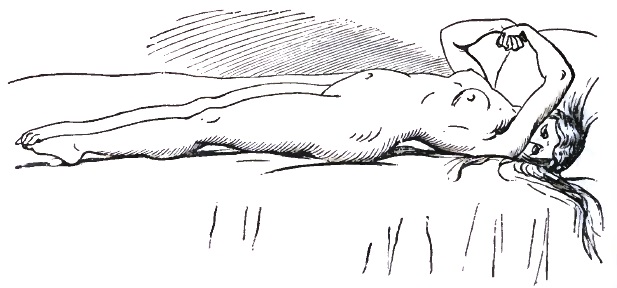
FIG. 18.
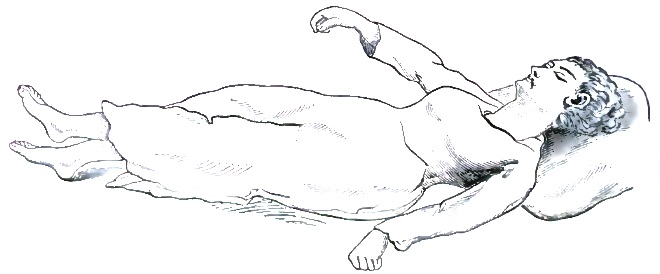
After lying down, the first noticeable manifestation was a twitching of the eyelids and of the muscles of the forehead and mouth. Her head was next moved from side to side, and she looked around vaguely. Respiration became irregular. In a few moments a convulsive tremor passed down her body and limbs. Her arms were now carried outward slightly from the body, the hands being partly clenched. The lower extremities were straightened, the left foot and leg being carried over the right (Fig. 18). Her limbs were rigid. Her mouth was closed, the teeth being ground together. Consciousness was lost, and respiration seemed to stop.
FIG. 19.
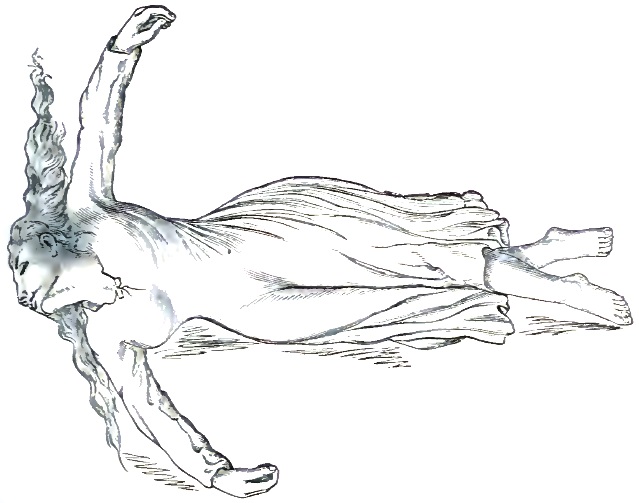
A series of strong convulsive movements next ensued. Her entire body was tossed up and down and twisted violently from side to side. Sometimes she assumed a position of opisthotonos. Her whole body was then again lifted and hurled about by the violence of the movements. A few seconds later she became quiet but rigid, in the position shown in Fig. 19, corresponding to the position of crucifixion of the French writers.
FIG. 20.
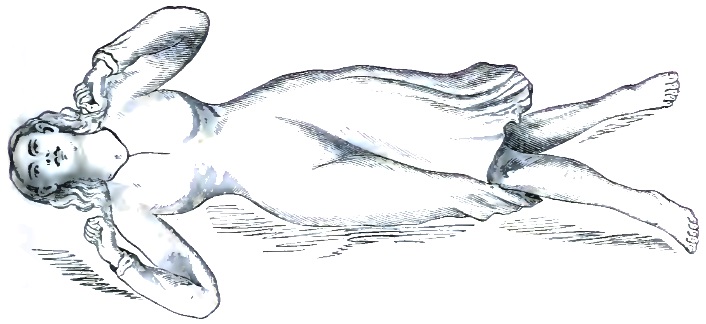
Soon she assumed the position represented by Fig. 20, and the convulsions were renewed with violence, the patient's limbs and body being frequently tossed about and the latter sometimes curved upward. After these movements had continued a brief period the patient became calm and partially relaxed; but the respite was not long. A series of still more remarkable movements began, chiefly hurling and lifting of the body. Eventually, and apparently as a climax to a succession of efforts directed to this end, she sprang into the position of extreme opisthotonos represented in Fig. 21. This sketch, by Taylor, is a very faithful view of her exact position. She remained thus arched upward for a minute, or even more. A series of springing and vibratory movements followed, the body frequently arching.
FIG. 21.
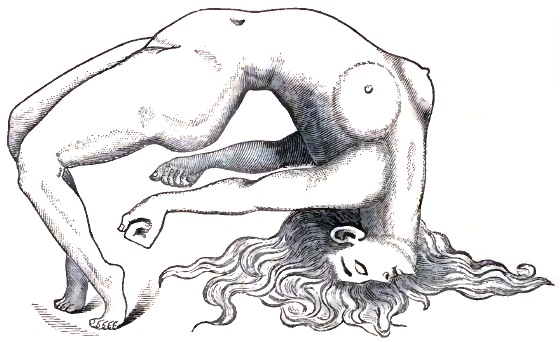
As the spasms left she sat up on her bed, and at first looked around with a bewildered expression. She turned her head a little to one side and seemed to gaze fixedly at some object. Her expression was slightly smiling. When spoken to she looked straight at the one addressing her, but without appearing to know what was said, and the next moment the former position and attitude were resumed. After a few minutes she lay down muttering incoherently, and in about a quarter of an hour fell asleep.
I have simply described one attack. Sometimes she would have several in succession, or the spasmodic manifestations would be repeated several times in a regular or an irregular manner. Strong pressure in the ovarian regions usually would not cut short the spasms. They could be stopped, however, by etherization or by active faradization of the limbs or trunk. She did not always conduct herself in the same manner in the period which succeeded the spasms. Sometimes, after getting into the sitting posture, instead of smiling, she would look enraged and speak a few words. The following expressions were noted on one occasion: “You know it! Yes, you do! Yes! yes!” Often she was heard to mutter for hours after the attack. Her lips would sometimes be seen to be moving without any words being heard. Sooner or later she would fall into sound sleep which would last several hours.
During the spasms she seemed to be entirely unconscious of her surroundings. To a looker-on her movements seemed sometimes to have the appearance of design, but I soon convinced myself that such was not the case. She was insensitive to painful or other impressions. Her expression was blank and unchanging. She said that the only thing that she remembered about the attacks was that she heard a strange, confused sound; this was most probably just as she was returning to consciousness.
Numerous remedies were tried without any apparent effect. These included sodium and potassium bromides, iron, zinc salts, physostigma, cimicifuga, camphor, ether, etc. A uterine examination was made, but nothing especially calling for local treatment was found. She was placed upon equal parts of tincture of valerian and tincture of iron in half-teaspoonful doses three times daily. Capsules of apiol were also ordered to be taken three times daily just before and during her menstrual period. Her menses became more profuse and continued longer. The attacks began to diminish in frequency, and became less severe. In March, not having had a seizure for several weeks, she left the hospital and again went into service. Six months elapsed and she had no attack. She reports occasionally at my office. She says that she feels entirely well. The tremor of the left upper extremity entirely disappeared. She continued to take valerian and iron for four months, but stopped the apiol after the second or third menstrual period.
With this case before us the phenomena of the disease can be more readily grasped. I will necessarily make free use of the labors of Richer in my description of symptoms.
Hystero-epileptic attacks usually, although not always, have distinct prodromes. These have been more thoroughly studied and reported by Richer than by any other author. They are classed by him under the four heads of psychical affections, including hallucinations, affections of the organic functions, motor affections, and affections of sensibility. The patient's condition is changing; she is listless, irritable, melancholy, despairing, slovenly. Sometimes she is noisy, sometimes mute. At times she is full of wild excitement. Hallucinations of sight sometimes come on at this period—most commonly visions of cats, rats, spiders, etc. These visions of animals, as first pointed out by Charcot, in passing before the patients run from the left to the right or from the right to the left, according as the hemianæsthesia is situated on the left or on the right. Hallucinations of hearing, as of music, threats, demands, whistling, trumpeting, etc., also occur, chiefly on the hemianæsthetic side. These hallucinations are worse at night. Sometimes at night the patients are the victims of imaginary amours. Want of appetite, perverted taste, nausea and vomiting, flatulence, tympanites, ptyalism, unusual flow of urine, feelings of oppression, hiccough, laughing, barking, loss of voice, palpitation of the heart, and flushings are among some of the many disorders of the organic functions which are sometimes present during the prodromal period. Loss of muscular power or a species of ataxia, peculiar limited spasmodic movements, contracture, first of one limb and then of another, may be observed. Charcot, Bourneville, Regnard, and Richer, all give admirable illustrations of different forms of contracture. In one case the right arm and wrist are flexed, and the hand held at the level of the shoulder with fingers extended. Anæsthesia—total, unilateral, or local, tactile, of pain, temperature, etc.—may also occur. Sometimes achromatopsia or color-blindness shows itself; sometimes deafness in one ear is present. Tenderness over the ovarian region is often an immediate precursor. To Charcot we owe the most careful study of these symptoms.
Among the most interesting prodromic affections of sensibility are the hysterogenic or hystero-epileptogenic zones. These have been well studied and described by Richer, from whose work Figs. 22 and 23 have been taken. Brown-Séquard has shown that animals rendered epileptic by lesions of the spinal cord, medulla oblongata, or nerves are sometimes attacked with convulsions spontaneously, but it is also possible to provoke these attacks by exciting a certain region of the skin which he designates as the epileptogenic zone. This zone, situated on the same side of the body as the nervous lesion, has its seat about the angle of the lower jaw, and extends toward the eye and the lateral region of the neck. The skin of this region is a little less sensitive than that of the opposite side, but touching it most lightly provokes epileptic convulsions. The simple act of breathing or blowing on it brings about the same result.
Something analogous to this epileptogenic zone has been noticed among hystero-epileptics, and has been pointed out by several writers. Richer gives the particulars of a number of cases. In one patient the hyperæsthetic zone was between the two shoulder-blades. Simply touching this region was sufficient to provoke an attack, and this was more easily done if near the time of a spontaneous seizure. After the grave attacks the excitability would seem to be exhausted, and pressure in the zone indicated would not cause any convulsive phenomena. A second case presented a similar condition. If touched over the dorsal spine between the shoulders, she felt a violent pain in the belly, then a sense of suffocation, which brought on at once loss of consciousness. In a third patient the hysterogenic zone was different. It was double. It was necessary to touch two symmetrical points situated to the outside and a little below the breasts in order to bring on the hystero-epileptic convulsions. Touching one of these points did not produce any result. Other cases are given in detail, but a glance at the two figures (22 and 23) will show some of the principal hysterogenic zones both for the anterior and posterior surfaces of the body. A zone of ovarian hyperæsthesia was common to all the patients. It did not differ essentially from the other hysterogenic zones. If the ovarian hyperæsthesia existed along with other hysterogenic points, the excitation of the ovarian region was always the most efficacious. The hysterogenic zones always occupy the same place in the same case. They are found on the trunk exclusively; they are more frequently in front than behind; in front they occupy lateral positions, and are often double and symmetrical; behind they are more often single and median; they exist more frequently to the left than to the right, and the unilateral zones have always been met with on the left side.
FIG. 22.
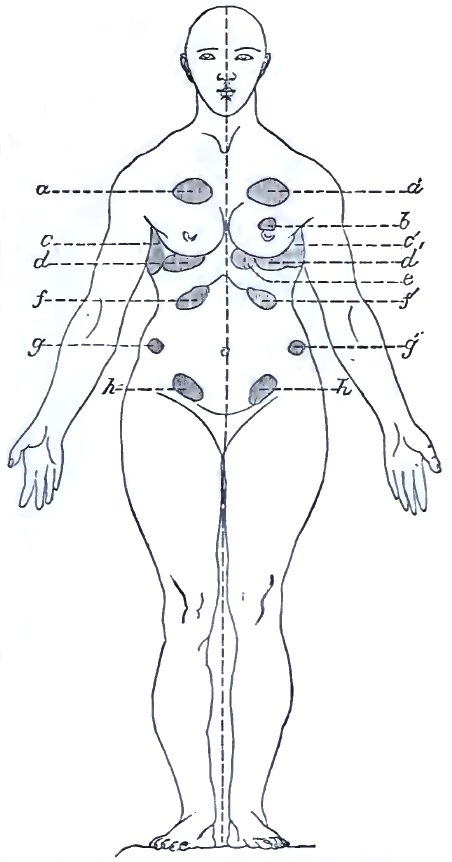
Principal Hysterogenic Zones, anterior surface of the body: a, a′, supramammary zones; b, mammary zones; c, c′, infra-axillary zones; d, d′, e, inframammary zones; f, f′, costal zones; g, g′, iliac zones; h, h′, ovarian zones (after Richer).
FIG. 23.
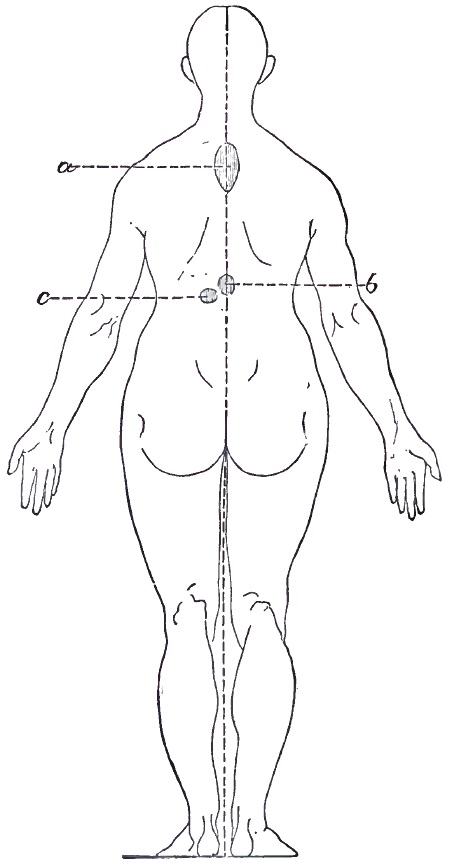
Principal Hysterogenic Zones, posterior surface of the body: a, superior dorsal zone; b, inferior dorsal zone; c, posterior lateral zone (after Richer).
The hysterogenic zones bear no constant relation to the hemianæsthesia. It is true that the ovarian pain is most often seated on the hemianæsthetic side, but sometimes it is present on the opposite side. They are not at all times equally excitable. They are more so when the convulsive attack is imminent.
Ovarian pressure gives rise to the spasmodic attacks: the same pressure arrests them. What is true of ovarian compression is equally true of all the hysterogenic zones. A light touch brings on the convulsions, which have scarcely commenced when they can be stopped by a new excitation of the same point.
As already stated, the attack of hystero-epilepsy, having fully begun, is divided by Richer into distinct periods. Although these are seldom seen in perfection, it is necessary to have some clear idea of their phenomena in order to view the affection comprehensively. They were seen well developed in the case given. These periods are—(1) The epileptoid period; (2) the period of contortions and of great movements; (3) the period of emotional attitudes; (4) the period of delirium.
In the first or epileptoid period of the hystero-epileptoid attack, which receives its name from its resemblance to true epilepsy, various phases always reproduce themselves in the same order. Loss of consciousness and arrest of respiration, muscular tetanization in various positions, followed by clonic spasms, and, finally, muscular resolution, are the successive phenomena of this period, which usually lasts several minutes. Loss of consciousness is complete during this period. Muscular tetanization shows itself in movements large and small, sometimes of the whole body. The trunk may become as stiff as a bar of iron; the face is sometimes cyanosed, puffed; froth even appears, which it is well to remember, as this is considered by some as absolutely diagnostic of epilepsy. Many positions may be assumed. The important significant features of the tonic phase of period are muscular tetanization with loss of consciousness and respiratory spasm. In the clonic phase movements at first rapid and short, later larger and more general, ensue, and are accompanied by whistling inspiration, jerking expiration, hiccoughs, noisy deglutition. The phase of muscular resolution comes on, in which the patient completely relaxes; sometimes a true stertor occurs. The epileptoid period usually lasts altogether several minutes, the first two phases usually occupying about one minute.
In the period of contortions and great movements wonderful attitudes and contortions are observed in one phase, and in another great movements. One of the attitudes particularly fashionable with hystero-epileptics is the arched position, in which the body is curved backward in the form of an arch so as to rest only on the head and feet. Sometimes the patient may rest on the belly or side, the remainder of the body preserving its curved position; the body may indeed assume almost any strange and seemingly impossible attitude. The so-called great movements are executed by the entire body or by a part of the body only; they are of great variety; sometimes they are movements of salutation; sometimes the semiflexed legs are projected upward, etc. Often the phase of great movements is marked at its beginning by a piercing cry; loss of consciousness is not the rule.
The period of emotional attitudes or statuesque positions is the most dramatic stage of a highly dramatic disease. Hallucinations ravish and transport the patient: sometimes they are gay, sometimes they are sad. The dramatic positions assumed are in consonance with the patient's hallucinations. The patient reproaches, opposes, supplicates, is angry, is furious; she assumes positions of supplication on her knees, becomes menacing, and even strikes. In the great works of Bourneville, of Regnard, and of Richer many cases are related at great length and with vivid details. Camera and pencil are frequently called in to assist the pen in presenting scenes which read as if drawn from an exciting drama or novel. Among the expressions and attitudes which they have succeeded in photographing are those illustrating emotions of menace, appeal, amorous supplication, erotism, ecstasy, mockery, beatitude.
After the period of the emotional attitude consciousness returns, but only in part, and for a time the patient remains a prey to a delirium whose character varies. This delirium may be concerned with subjects the most varied; it may be gay, sad, furious, religious, or obscene. It is mingled with hallucinations; voices are heard; sometimes are seen personages who are known; sometimes the scenes are purely imaginary. During this fourth period the patients will sometimes make the most astounding statements and accusations. They will wrongfully charge theft, abuse, etc. upon others; they believe in the reality of their hallucinations, and, what is more important, they will sometimes persist in this belief after the attack is over. The third and fourth periods are sometimes confounded. When the four periods described succeed each other in order, they constitute a regular and complete attack of hystero-epilepsy.
By comparing the notes upon the case detailed with the description given of the typical hystero-epileptic attack, it will be seen that the different periods, and even the phases, can be made out with but little difficulty. After a few moments of convulsive movements and irregular breathing the patient was attacked with muscular tetanization, arrested respiration, and loss of consciousness. Tonic convulsions followed, and then immobilization in certain positions. Next came the clonic spasms and resolution. In the period of contortions the arched position is one more extreme than any represented by the illustrations of the French authors, although it is closely approximated by some of their illustrations. After this position of opisthotonos had been taken a succession of springing and lifting movements occurred, probably corresponding to the phase of great movements. The period of emotional attitudes was very clearly represented by the position assumed, the expression of countenance, and sometimes by the words uttered. Even the period of delirium was imperfectly represented by the mutterings of the patient, which were sometimes long continued after the attack.
FIG. 24.
A beautiful illustration of one of the positions assumed by a hystero-epileptic is shown in Fig. 24 from Allan McLane Hamilton's treatise on Nervous Diseases. The patient, æt. eighteen, represented in the figure had suffered from hystero-epileptic attacks since the beginning of the menstrual period. Usually, she had severe but distinct epileptic seizures, and afterward an hystero-epileptic paroxysm. The muscles of her back were rigidly contracted in opisthotonos. Her arms were drawn over her chest, and her forearms slightly flexed and crossing each other. Her thumbs were bent in and covered by her other fingers, which were rigidly flexed. Her toes were also flexed, and her right foot presented the appearance called by Charcot le pied bot hystérique, or hysterical club-foot.
As has already been stated, hystero-epilepsy of irregular, imperfect, or abortive type is most commonly observed in this country, or at least in the Middle States, of which my own knowledge and experience are greatest. As has been demonstrated by Richer and Charcot, the irregular type may be of any form, from a paroxysm with a scarcely detectible convulsive seizure and scarcely recognizable loss of consciousness up to frightful attacks which from their terrible nature have been termed demoniacal, and in which occur the wildest phenomena of movement, frightful contortions and contractions, with grimaces and cries of fury and rage. Sometimes the movements show a violence beyond description. These frightful seizures are of extreme rarity in America. Sometimes attacks of ecstasy or attacks of delirium are the predominating or almost the only feature. The epileptoid attack, so far as my experience has gone, is the most prevalent variety of hystero-epilepsy. Epileptoid attacks are simply the result of the predominance and modification of the first or epileptoid period of the typical grave attack. Richer has described several varieties.
I have seen a number of cases of the epileptoid variety or other irregular forms. These cases have presented a few or many of the symptoms of grave hysteria, such as anæsthesia, analgesia, hyperæsthesia, blindness, aphonia, paralysis, contracture, etc., and have also had attacks of tonic and clonic spasm, with complete or partial loss of consciousness. The phenomena of the periods of contortions and great movements, of emotional attitudes, and of delirium have been, however, altogether or almost entirely absent. These epileptoid attacks have varied somewhat in different cases.
The following are the notes of three cases observed by me:8
8 Published in Journal of Nervous and Mental Disease, vol. ix., No. 4, October, 1882.
M——, æt. twenty-seven, a widow, admitted to the Philadelphia Hospital February 4, 1882, was married thirteen years before, when only fourteen years of age, and remained in comparatively good health for four years after her marriage, during which time she had three children, all of whom died in early infancy. Four years after her marriage, while carriage-riding, she for the first time had a spasm. According to her story, the seizure was very severe; she lost consciousness, and passed from one spell into another for an hour or more. She had a second attack within two weeks, and since has had others at intervals of from one week to three or four months. Four years ago she passed into a condition of unconsciousness or lethargy in which she remained for three days. On coming out of this state she found that the left half of her body was paralyzed and that she was speechless. In two weeks she recovered her speech and the paralysis disappeared. On June 15, 1881, she gave birth to a male child. On the night of the 16th she became delirious, and on the 17th she again lost her speech and had a paralytic seizure, the paralysis now affecting both legs. She recovered her speech in a few days, but the paralysis remained. Her babe lived, and with her was admitted to the hospital. He had had seven attacks of spasm at intervals of about a month. The patient's mother was for a time insane, and had been an inmate of an insane asylum for some months since her first epileptiform attack.
She was carefully examined on the day of her admission. She was bright, shrewd, and observant. She gave an account of her case in detail, and said she was a puzzle to the doctors. Both legs were entirely helpless; the feet were contractured in abduction and extension, assuming the position of talipes equino-varus; the legs and thighs were strongly extended, the latter being drawn together firmly. The left upper extremity was distinctly weaker than the right, but all movements were retained. She had no grasping power in the left hand. She was completely anæsthetic and analgesic below the knees, and incompletely so over the entire left half of the body. Pain was elicited on pressure over the left ovary and over the lower dorsal and lumbo-sacral region of the spine. Both knee-jerks were exaggerated.
I lectured on this patient at my clinic at the hospital, stating that I believed the case to be one of hystero-epilepsy, and only needed to see an attack of spasm to confirm the diagnosis. Up to this time she had not had a seizure since admission. She had, however, been complaining for several days of peculiar sensations in the head and of severe headache. She had also been more irritable than usual, and said that she felt as if something was going to happen to her. The same afternoon, Dr. Rohrer, the resident physician in charge of the patient, was sent for, and found her in a semi-conscious state. She did not seem to know what was going on around her, but was not in a stupor. Her pulse was 114 to 120; respirations were 20 to 22, regular. The corneæ responded on being touched. Some twitching movements of the eyeballs and eyelids were noticed; the thumb and forefinger of the left hand also moved, as if rubbing something between them.
In a few moments an epileptoid paroxysm ensued. She became unconscious and rigid. The lower extremities were strongly extended in the equino-varus position already described. The arms were extended at her sides, the wrist being partly flexed and rotated outward, the hands clenched. Her face, at first pale, became deeply congested. Her trunk became rigid in a position of partial opisthotonos. Brief clonic spasms followed, then resolution, the whole seizure not lasting more than from two to three minutes. She lay for a minute or two unmindful of anything or anybody, and then sat up and looked around wildly. She dropped back again and began to mumble, as if she wished to speak, but could not. Paper and pencil were given to her, and she wrote that she was conscious, but could not speak. Her temperature, taken at this time, was 99.8° F.
Attacks similar to the one just described occurred at irregular intervals for two days. On their cessation she was speechless, and the permanent symptoms already detailed—the anæsthesia, paralysis, etc.—were deepened. During the attacks but little treatment was employed; hypodermic injections of morphia and potassium bromide by the mouth were, however, administered. After the attack the valerianate of iron by the mouth, faradization of the tongue, and galvanization of the legs below the knees with weak currents, were ordered. Her speech returned in a week. For about a month she showed no other signs of improvement; then she began to mend slowly, gradually using her limbs more and more. On May 11, 1882, she was discharged, and walked out of the hospital with her child in her arms, apparently perfectly well. During the last month of her stay no treatment was used but mild galvanization every other day.
Mrs. A——, æt. forty-five, was seen by me in consultation. For some months at her menstrual period she had been out of sorts. At times she had had hallucinations of sight. For several weeks she had been troubled more or less with a feeling of numbness and heaviness in the left arm and leg, particularly in the latter, and also with diffused pain in the head and a sensation of aching and dragging in the back of the neck. For three weeks, off and on, she had had diarrhœa, which had weakened her considerably. She awoke one morning feeling badly and yawning every few minutes. She passed into a condition of unconsciousness with attacks of spasm. I did not see her on this the first day of her severe illness, but obtained from the physician in attendance some particulars as to the character of her seizures. Evidently the condition was similar to that presented by the last case, that described by Richer as the epileptoid status, in which tonic and clonic spasm and resolution are repeated again and again. Attack after attack occurred for nine or ten hours, sometimes one immediately following another, sometimes an interval of several minutes or of half an hour or more intervening. Respiration was partially arrested. Tonic spasm predominated; the limbs became rigid in various positions; sometimes the neck and trunk were strongly bent backward, producing partial opisthotonos. While the body and limbs remained tetanized they were thrown into various positions (clonic phase of an epileptoid attack). Although she answered questions addressed to her by her physician between the spells, she did not recognize him until evening, after the spasms had ceased, and then was not aware that he had been in attendance during the day, although he had been with her almost constantly. Leeching and dry cupping to the back of the neck were employed, and potassium bromide and tincture of valerianate of ammonia were given.
Early on the morning of the next day she had another attack of unconsciousness and spasm, in which I had the opportunity of seeing her. The spasm amounted only to a slight general muscular tetanization. The whole attack lasted probably from half a minute to a minute. The following day, at about the same hour, another paroxysm occurred, having a distinct but brief tonic, followed by a clonic, phase, in which both the head and body were moved. The next day, also at nearly the same hour, she had an attack of unconsciousness or perverted consciousness without spasm. She had a similar seizure at 4 P.M. For two days succeeding she had no attacks; then came a spell of unconsciousness. After this she had one or two slight attacks, at intervals of a few days, for about two weeks.
Between the attacks the condition of the patient was carefully investigated. On lifting her head suddenly she had strange sensations of sinking, and sometimes would partially lose consciousness. She complained greatly of pain in the head and along the spine. Her mental condition, so far as ability to talk, reason, etc. was concerned, was good, but any exertion in this direction easily fatigued her and rendered her restless. She had at times hallucinations of animals, which she thought she saw passing before her from left to right. The left upper and lower extremities showed marked loss of power. The paralysis of the left leg was quite positive, and a slight tendency to contracture at the knee was exhibited. She was for two weeks entirely unable to stand. The knee-jerks were well marked. Left unilateral sweating was several times observed.
A zone of tenderness was discovered in the occipital region and nape of the neck, and she had also left ovarian hyperæsthesia. Left hemianæsthesia was present, head, trunk, and limbs being affected. She complained of dimness of vision in the left eye, and examination by the attending physician and myself showed both amblyopia and achromatopsia, she was unable to read print of any size or to distinguish any colors with the left eye, although she could tell that objects were being moved before the eye. A distinguished ophthalmologist was called in consultation. An ophthalmoscopic examination showed a normal fundus. Each eye was tested for near vision. It was found that she could read quite well with the right eye, and not at all with the left. While reading at about sixteen inches a convex glass of three inches focus was placed in front of the right eye, but she still continued to read fluently. A few minutes later, however, on retesting, she could not read or distinguish colors with the left eye. Sometimes toward evening her feet would become slightly œdematous. Examination of the urine showed neither albumen nor sugar. The heart-sounds were normal.
Owing to the apparent periodicity of the attacks quinine in large doses was administered, and seemed to act beneficially. In addition, valerianate of zinc and iron, strychnia, and other nerve-tonics were used in her subsequent treatment. Applications of faradic electricity, both with the metallic brush and the moist sponges, were made every other day. She was persistently and strongly encouraged as to the certainty of her recovery. Her paralysis, anæsthesia, etc. gradually disappeared, and in little more than two months she was able to leave home and go to the country. She has since remained well, but is more easily fatigued than formerly, and does not feel as strong in the left side of her body as she did when in perfect health. At her menstrual period she becomes very nervous.
M——, æt. twenty-three, a well-educated young lady,9 in the autumn of 1880 had nursed her mother faithfully through a serious illness. She became anæmic and nervous. Choreic twitchings and occasional slight spasms were the first symptoms that alarmed her family. The spasms came on apparently from any over-exertion. Gradually they became a little more severe in character. Under rest-treatment, with gentle massage, tonics, and steady feeding, in six weeks she greatly improved. A few weeks later, however, she again relapsed, and became worse than she had ever been. The spasms returned with greater force and frequency. She became unable to walk, or could only walk a few steps with the greatest difficulty, although she could stand still quite well. On attempting to step either forward or backward her head, shoulders, hips, and trunk would jerk spasmodically and she would appear to give way at the knees. No true paralysis or ataxia seemed to be present, but locomotion was impossible, apparently because of irregular clonic spasms affecting various parts of her body. Eventually she became extremely hypersæsthetic in various regions (hysterogenic zones), along the spine, beneath the breasts, in the ovarian area, etc. The slightest pressure or any applications of heat or cold, electricity, etc. would generally bring on an attack of spasm.
9 This patient was for a long time under the professional care of George McClellan of Philadelphia, who has kindly furnished me with some notes. I shall simply give an outline sketch of the case, describing particularly her epileptoid attack. For several weeks, during the absence of McClellan from the city, she was attended by M. O'Hara, and with him I saw her frequently in consultation.
While trying to apply galvanism on one occasion she suddenly complained of nausea, and her expression changed, becoming somewhat fixed. Her face became flushed, her limbs and body rigid. The head and body were thrown backward to a moderate extent. Next, the shoulders were drawn upward, the head appearing to be sunk between them; the arms were found to be rigidly extended at her sides, the wrists partly flexed, and the fingers clenched; the legs also were spasmodically extended, the thighs drawn together, and the feet in the equino-varus or hysterical club-foot position. Phenomena like those described above as visceral spasm now were observed. The chest, and even the abdomen, were lifted up and down rapidly, and the respiration became quick, irregular, and apparently very difficult. Consciousness seemed to be impaired, but not absolutely lost. The symptoms just described took about one minute for their exhibition. Muscular relaxation now occurred, and an interval of calm, lasting about two minutes, followed, during which the patient spoke, answering one or two questions addressed to her. After the brief period of repose, however, another phase of the attack came on. In this the heaving movements of the body and what appeared to be intense respiratory spasms were the chief features. This portion of the attack endured scarcely a minute; the patient came to quickly, and was able to converse. In general, her attacks were of a similar character.
The drugs used included bromides, iodides, strychnia, chloride of sodium and gold, zinc salts, iron, etc. etc.; her condition vacillating, sometimes better, sometimes worse. She was finally placed in bed by McClellan, and an extension apparatus was employed, under which treatment, in a little more than one year from the time she was first attacked with spasm, she recovered.
The permanent or intervallary symptoms of hystero-epilepsy are in the main the phenomena which have been described when speaking of the prodromes of this affection. They are, indeed, the whole train of symptoms—the mental or psychical disorders, the motor, sensory, reflex, vaso-motor, and isolated phenomena—which have been described under special heads when considering the general symptomatology of hysteria. The full-fledged case of hystero-epilepsy is hysteria with a full array of special permanent hysterical manifestations, and the great paroxysm superadded. Certain phenomena are, however, more prominent and of much more frequent occurrence. Among these are paralysis or paresis, either of the unilateral or paraplegic variety; hemianæsthesia, including anæsthesia of all the senses; and contractures, particularly in the lower extremities.
DURATION AND COURSE.—The duration and course of hystero-epilepsy are very uncertain; most cases last many years. In a few instances the hystero-epileptic attacks are all from which the patient suffers; even in the cases of long duration the general health does not appear to become greatly impaired.
DIAGNOSIS.—To arrive at a correct diagnosis between hystero-epilepsy and epilepsy is sometimes very difficult. The fact that the patient is a male does not decide for epilepsy. In making this diagnosis close attention should be given to—1, The history and the causes of the disease; 2, the physical and mental condition of the patient; 3, above all, the phenomena of the spasmodic attacks.
In hystero-epilepsy a careful study of the history of the case will often elicit a moral cause. The patients rarely injure themselves seriously by falling, whereas in true epilepsy they often suffer from severe injuries. The mental and physical health of a person suffering from hystero-epilepsy differs widely from that of the true epileptic. In hystero-epilepsy the number of attacks has little or no apparent influence on the patient's mental or physical condition. Little or no deterioration of the mind occurs. The memory is not much impaired. Hystero-epileptics are usually well nourished and frequently of good physique. This is not the case in true epilepsy; the number of attacks has a decided effect on the patient's mental condition. The demented appearance of the old epileptic is well known, whereas in the hystero-epileptic nothing in physiognomy or carriage indicates that the patient has been suffering from any disease. It cannot be said that all epileptics have no mental power, but some deterioration of the mind usually occurs, and becomes well marked as the case progresses.
The paroxysms in epilepsy are very well marked, especially if it is epilepsy of the grave form. They are often ushered in with a scream. The patient suddenly falls, and at times is severely injured. The convulsion is generally violent, rapidly alternating from clonic to tonic spasm, without special phases or periods. Complete and profound loss of consciousness, with great distortion of face and eyes, is present. The tongue is frequently bitten. After the attack the patient passes into a deep stupor. In hystero-epilepsy usually the seizure does not begin with a scream or sudden fall, the convulsion has periods and phases, and the tongue is not bitten.
It is said that in hystero-epilepsy there is no loss of consciousness, but this is not strictly true. This point is the most difficult one for physicians to clear up in arriving at a diagnosis, as in many textbooks complete loss of consciousness is laid down as the strongest evidence of epilepsy. Loss of consciousness does occur in hystero-epilepsy, particularly in certain varieties. Richer says that the loss of consciousness is complete during the entire epileptoid period in a case of the regular type. To decide as to consciousness or unconsciousness is not as easy as might be supposed. Varying degrees of consciousness may be present. At times in hystero-epileptic attacks the patient may respond to some external influences and not to others. Consciousness is perverted or obtunded often, and it is hard to decide whether the patient is positively and entirely unconscious of her surroundings. In epilepsy the loss of consciousness is profound and easily determined. In regard to the distortion of the face and eyes, this sign is usually absent in hystero-epilepsy, as in the German Hospital case, in which the patient had a series of violent seizures lasting two hours, with marked opisthotonos, yet the facial expression remained calm and serene throughout.
In hystero-epilepsy the attacks are rarely single; usually they are repeated, constituting the hystero-epileptic status. They are more frequently repeated than in epilepsy, although it is of course well known that there is an epileptic status terrible in character. In a series of hystero-epileptic attacks usually the seizures come on in rapid succession, the interval being brief. These series are apt to last for hours or days. The attacks that compose a series in hystero-epilepsy vary in duration and in violence. At first they are of violent character; toward the end the seizures may gain in extent, but they are likely to lose in intensity.
Charcot and Bourneville make a strong diagnostic point between hystero-epilepsy and true epilepsy of the fact that in epilepsy there is a peculiar rise of temperature during the convulsion, even to 104° F., whereas in hystero-epilepsy the temperature is nearly or quite normal.
Arrest of attacks by ovarian compression in females, and by nerve compression, nitrite of amyl, and the application of electric currents, can be brought about in hystero-epilepsy, and not in epilepsy. A study of the effect of bromides may assist in arriving at a diagnosis. The action of bromides, drugs which are often used in both affections, favors the opinion that the two diseases are distinct. Bromides, according to Charcot and Richer, so effective in epilepsy, are without effect in hystero-epilepsy. Dujardin-Beaumetz, however, on the other hand, declares that “who says hysteria says bromides,” and also that at the present time there is not an hysterical patient but has taken bromides, the bromide of potassium being most frequently used. The truth is, that bromides may be useful for temporary purposes, for certain phases and symptoms of the disease, but produce no radical permanent improvement in the disease hystero-epilepsy.
D. Webster Prentiss,10 in reporting a case, gives some good points of distinction between real and hysterical tetanus, which is practically hystero-epilepsy. In his case, which was hysterical, the attack was ushered in by noise in the ears, deafness, and blindness, whereas in true tetanus and strychnia-poisoning the senses are preternaturally acute. There was unconsciousness during the paroxysm, which does not occur except just before death in the other affections. The eyes were closed during the spasms; they stare wildly open in the other diseases. The patient had long, uninterrupted sleep at night; in true tetanus no such relief comes until convalescence.
10 American Journal of the Medical Sciences, 1879.
FIG. 25.
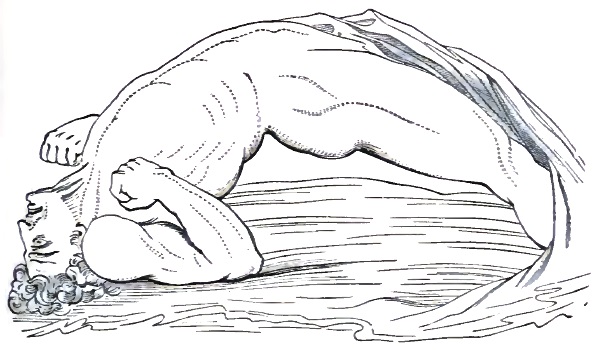
The figure is a representation of the opisthotonos of tetanus.11 It is the sketch of a soldier, struck with opisthotonos after having been wounded in the head; and in connection with it I will briefly call attention to the points of differential diagnosis as given by Richer, and which have been confirmed by my own observations. In the opisthotonos of tetanus the contraction of the face and the peculiar grin are distinguishing points, and are well represented in Bell's sketch. In the hysterical arched position, while the jaws may be strongly forced together, the features are most often without expression. The contracture of the face and the distortion of the features will be met with more often in the other varieties of contortion. The curvature of the trunk differs but little in the two cases, but the abdominal depression observed in the sketch of Bell is far removed from the tympanitic appearance present in the majority of hystero-epileptics. In the tetanic cases the patient rests only on the heels, while in the hysterical cases the knees are slightly flexed, and the patients are usually supported on the bed by the soles of the feet.
11 From Sir Charles Bell's Anatomy and Physiology of Expression as connected with the Fine Arts.
Hystero-epileptics are often suspected of simulation. Richer refers to many facts which seem to throw out conclusively the idea of simulation. Among these are the results obtained by æsthesiogenic agents, the experiments in hypnotism, where many of the results produced could not be simulated. Some English authors—and among them notably the physiologist Carpenter—have endeavored to find the explanation of the results obtained by the æsthesiogenic agents in a special action of the moral on the physical nature which they designate expectant attention. While the reality of the action of expectant attention in certain cases will not be denied, it cannot be invoked to explain satisfactorily all the phenomena. The patients are not aware of the results sought; which, indeed, in some cases, are contrary to the expectations of the observer himself.
PROGNOSIS.—A few cases of hystero-epilepsy get well, either with or without treatment, in a short time. Some cases, which in addition to the grave attack have had in the intervals the other striking symptoms of major hysteria, such as hemianæsthesia and contractures, get well only after many months or years; some never recover, although, as a rule, they do not die from anything directly connected with the disease, but from some accident or more commonly from some intercurrent disorder. Cases supposed to be cured often relapse. The patient may be apparently well for months, or even years, when under some exciting cause the old disorder is again aroused. On the whole, the prognosis is more serious the longer the case has endured. Family history and environment have much to do with determining the prognosis.
TREATMENT.—In considering the treatment of hystero-epilepsy I will, in the main, confine my attention to a discussion of the methods of managing and treating the convulsive seizures. With reference to the numerous special phenomena of this disease, the directions given and the suggestions made in the general article on Hysteria will be equally applicable in this connection.
Ruault12 has recently recommended compression of a superficial nerve-trunk in order to terminate an attack of hysteria or hystero-epilepsy. The face being always accessible, he prefers making pressure on the infraorbital nerves as they emerge from their foramina, but he has also compressed the ulnar nerve behind the inner condyle of the humerus. In a brief note to the Philadelphia Neurological Society, made Feb. 23, 1884, I called attention to the value of strong nerve-pressure for the relief of hysterical contracture, and can confirm from several successes Ruault's recommendation for the employment of the same measure to avert convulsive attacks.
12 La France médicale, vol. lxxxvi., p. 885.
Thiery13 of the Saint Pierre Hospital, Brussels, arrests paroxysms by what he calls torsion of the abdominal walls. He grasps in his hands the walls of the abdomen and imparts to them a certain kind of torsion, which he gradually increases. This treatment is practically the same as the deep ovarian pressure of Charcot. This compression of the ovary on the side of the seat of the lesion ordinarily will arrest immediately the convulsions. The patient is extended horizontally, and the physician plunges the closed fist into the iliac fossa, often using great force to overcome the muscular resistance. Poiner has invented an apparatus called a compressor of the ovaries, which can sometimes be used with advantage.
13 Medical and Surgical Reporter, Oct. 7, 1876.
Nitrate of amyl is undoubtedly of value in averting grave hysterical attacks—convulsions, trance, ecstasy, pseudo-coma, mania, etc. It is frequently used with marked success. Its action was studied on a vast scale at La Salpêtrière. The convulsions usually stop almost immediately after one, two, or three inhalations. It is to be preferred to inhalations of chloroform or ether.
Nitro-glycerin can be used in the treatment of the hystero-epileptoid convulsions. Notes of a very interesting case of hystero-epilepsy in which this remedy was successfully employed have been furnished me by David D. Stewart of Philadelphia. The case was one of hystero-epilepsy with combined crises. Amyl nitrate on several occasions broke the convulsive attack, but the patient did not completely regain consciousness. Stewart was called in during an attack, and found that the patient had been unconscious for an hour and a quarter. He gave her hypodermically three minims of a 1 per cent. solution of nitro-glycerin, and another injection after an interval of about eight minutes. She became conscious within one minute after the second injection. After this she had two seizures, both of which occurred on the same day, and yielded with remarkable promptness to a few minims of nitro-glycerin given by the mouth. She was put on three minims three times a day of this drug, the dose being gradually increased. Sufficient time has not elapsed to report as to the effect of the drug given during the intervals.
Strong faradic currents, applied with metallic electrodes to the soles of the feet or to the spine, are occasionally efficacious. The galvanic current to the head has been extensively employed in the service of Charcot to arrest hysterical and hystero-epileptic attacks of the grave variety. One electrode is applied to the forehead, the other to any convenient place upon the body, as the leg, the ovarian region, or the spine. The current is applied continuously for several minutes, or voltaic alternations are made. This method has been used with success in a few instances, but should never be resorted to by a physician uncertain of his diagnosis or one practically unfamiliar with the powers and properties of the electrical current.
The question of oöphorectomy for the relief of hystero-epilepsy is one of increasing importance in these days of major surgery. At the meeting of the American Neurological Association (June, 1884) G. L. Walton read a paper14 in which he concludes that hysteria is sometimes set up by ovarian irritation, and can be relieved by removing the offending organ. He cited a single case. Carsten15 concludes that it is criminal neglect not to perform Battey's operation in cases which fail to be benefited by other treatment. In the discussion which followed the reading of this paper the subject was well traversed by Spitzka of New York, Putnam of Boston, Putnam-Jacobi of New York, and others. Spitzka referred to one case of Israel's of Breslau, in which a patient was cured of hystero-epilepsy by a sham operation—a superficial incision in the parietes of the abdomen. Under the title of castration in hysteria the Lancet16 tells of an hysterical patient who had suffered for years from obstinate vomiting and severe ovarian pain. She became extremely weak, and finally consented to spaying as the only hope. The operation—performed under chloroform with antiseptic precautions—was a mockery, the skin only being incised; she was, however, perfectly cured of her hysterical symptoms.
14 “A Contribution to the Study of Hysteria as Bearing on the Question of Oöphorectomy.”
15 Quoted by Walton from American Journal of Obstetrics, March, 1883.
16 Vol. ii. p. 588.
In two clinical lectures published in the Philadelphia Medical Times17 I have given the histories of two cases of hystero-epilepsy in which oöphorectomy was resorted to for hystero-epilepsy. In the first of these cases, in which clitoridectomy was also performed, nymphomania, which was a distressing symptom, was benefited, but even this was not completely cured. The following is the patient's own statement: “Since the removal of the ovaries I have been able to control the desire when awake, but at times in my sleep I can feel something like an orgasm taking place. My experience leads me to say that my cure (?) is not due to the absence of the ovaries; there is no diminution of the sexual feeling. There would be as much excitement of the parts if the clitoris were still there. If my will gave way, I would be as bad as ever.” Her general mental and nervous condition is much the same as before the operations. She is still dominated by morbid ideas, still unable to take up any vocation which demands persistence, and still the frequent subject of hystero-epileptic seizures.
17 April 18 and May 30, 1885.
The second of these cases was a young girl about seventeen years old who had never menstruated. She had had epileptic or hystero-epileptic seizures for several years. An operation was performed in which the ovaries and Fallopian tubes were removed. Twelve days after the operation, from which she made a good recovery, she had four convulsive seizures. She had several attacks subsequently, and then for a considerable period was exempt. She had, however, acute inflammatory rheumatism, with endocarditis and valvular trouble. About seven months after the operation she had several severe convulsions with loss of consciousness, and died about a year after the operation, having had many severe seizures during the last few weeks of her life.
There is no warrant either in experience or in a study of the subject for spaying hysterical girls who have never menstruated. In a case diagnosticated as hysterical rhythmical chorea removal of the ovaries was advised by a distinguished specialist. The girl's trouble came on at about the age of thirteen years. She had never menstruated properly, although on one occasion, after several weeks of electric treatment, she had a slight show for a few days. It was proposed to remove the ovaries in this case on some general principle of given hysterical trouble; the ovaries must go. In this case, as in the last, it would have been far better to have put in a good pair of ovaries, or to have developed these rudimentary organs into health and activity.
With reference to oöphorectomy for hystero-epilepsy or any form of grave hysteria it may be concluded—1, It is only rarely justifiable; 2, it is not justifiable in the case of girls who have not menstruated; 3, when disease of the ovaries can be clearly made out by local objective signs, it is sometimes justifiable; 4, it is justifiable in some cases with violent nymphomania; 5, the operation is frequently performed without due consideration, and the statistics of the operation are peculiarly unreliable.
When we come to consider the treatment of the disease hystero-epilepsy, the practical importance of the distinction between this affection and true epilepsy becomes apparent. Cures of hystero-epilepsy are not rare. The original cases here reported have all apparently recovered. Grave hysteria is sometimes cured spontaneously, either by gradual disappearance with the progress of age, or suddenly because of some violent impression or under the influence of unknown causes. One of the worst cases in the service of Charcot has shown a gradual diminution of the hystero-epileptic manifestations with the advance of age. In another case under the influence of strong moral impressions the disease disappeared at a stroke. The affection, however, should not be abandoned to nature, as treatment is often of value.
The hydrotherapeutic method of treatment has been found of the greatest service. Hydrotherapy must be methodically employed by experienced hands. A number of cases cited by Richer were cured at hydrotherapeutic institutions. Limited success has followed the use of metallo-therapy. Besides metallic plates, the same results may be obtained with other physical agents, to which have been given the name of æsthesiogenic agents. Among these are feeble electric currents, vibrations of a tuning-fork, static electricity, etc.
Static electricity has a position of undoubted importance in the treatment of hystero-epilepsy in some of its phases. Those who have walked in the wards and visited the laboratories of Salpêtrière will recall the enormous insulated stools to which are brought troops of hystero-epileptic patients, who, to save time, are given a vigorous simultaneous charge of electricity. Even this wholesale plan of treatment is sometimes markedly efficacious. Vigoroux recommends static electricity as an æsthesiogenic agent, and regards it as the most valuable of all agents of this character.
Those drugs should be resorted to which have a tonic influence on the nervous system. Potassium bromide, as has already been indicated, is not efficacious. More is to be hoped from tonics and antispasmodics, such as valerian, iron, salts of silver, zinc, copper, sodium, and gold chlorides, etc. Good hygienic influences, moral, mental, and physical, are of the utmost importance.
CATALEPSY.
BY CHARLES K. MILLS, M.D.
DEFINITION.—Catalepsy is a functional nervous disease characterized by conditions of perverted consciousness, diminished sensibility, and especially by muscular rigidity or immobility, which is independent of the will, and in consequence of which the whole body, the limbs, or the parts affected remain in any position or attitude in which they may be placed.
Catalepsy sometimes, but not frequently, occurs as an independent disease; that is, the cataleptic seizure is the only abnormal phenomena exhibited by the patient. It is sometimes present, although also rarely, in organic disease of the nervous system. It has been noted, for instance, as occurring in the course of cases of cerebral hemorrhage, softening of the brain, abscess, tumor, and tubercular meningitis. One case is referred to by C. Handfield Jones in which it seemed to be due to intracranial epithelioma. As commonly seen, it is a complication, or perhaps, more properly speaking, a form of hysteria—hystero-catalepsy.
SYNONYMS.—Some of the many synonyms which have been used for catalepsy are Catochus, Morbus attonitus, Stupor vigilans, Synochus, Eclipsis, and Hysteria cataleptica. Trance and ecstasy are discussed sometimes as synonymous with catalepsy, but they will be considered as separate affections, as they have certain distinctive features. Catalepsy, trance, ecstasy, hystero-epilepsy, and other severe nervous disturbances may, however, all appear in the same patient at different times or at different stages of the same seizure.
With reference to the term catochus (κατοχη, from κατεχω, I take possession of), which has been used as synonymous with catalepsy, Laycock1 points out what he considers to be the proper use of this word, differentiating two cataleptic conditions, which he designates as the tetanic and the paralytic states. Catochus is the tetanic form, in which the trunk and limbs are rigidly extended and consciousness is abolished. Catalepsy proper is Laycock's paralytic form, although the term paralytic, as here applied, is by no means happy. It is the form characterized by the peculiar and striking symptom known as waxen flexibility (flexibilitas cerea)—a condition in which the limbs or parts are passive and are capable of being moulded like wax or lead pipe. Rosenthal would not consider any case as one of genuine catalepsy if this waxen flexibility was absent. I do not think that this rigorous criterion should always be imposed, although it might perhaps be better to apply the term cataleptoid to all cases which do not present true wax-like flexibility. The distinction sometimes made between catalepsia vera, or true catalepsy, and catalepsia spuria, or false catalepsy, is practically that indicated between Laycock's two forms. According to Charcot and Richer,2 the flexibilitas cerea is not present in the cataleptic state of hypnotism.
1 A Treatise on the Nervous Diseases of Women, by Thomas Laycock, M.D., London, 1840.
2 Journal of Mental and Nervous Diseases, Jan., 1883.
HISTORY.—The word catalepsy was used by Greek writers in its etymological signification of a seizure or surprise. Hippocrates described catalepsy; Galen, Aëtius, Rondeletius, and Fernelius have all related cases; Aëtius has left an accurate description of both catochus and catalepsy. In 1683, Laurence Bellini published a quarto volume on various subjects, one of which was catalepsy. From time to time interesting cases of catalepsy have been reported by medical writers. One of the best is that recorded by John Jebb in 1782, and quoted by Chambers in Reynolds's System of Medicine. The researches in hypnotism during the present century, and particularly those of Heidenhain and of Charcot and Richer, have thrown new light on many cataleptic phenomena.
ETIOLOGY.—In catalepsy, as in hysteria, insanity, and many neuroses, inheritance frequently plays a predisposing part. Eulenburg places it in the large group of diseased conditions designated by Griesinger constitutional neuropathies. The cataleptic of one generation may be the descendant of the insane, the epileptic, the syphilitic, or the alcoholized of a former. Catalepsy is particularly likely to occur in families which have a history of insanity or drunkenness. Of the cases detailed or alluded to in this paper, more than a majority had a clear neurotic history. Catalepsy, like hysteria, occurs with some frequency among the tuberculous.
Age plays some part in the development of catalepsy. It is of most frequent occurrence between the ages of fifteen and thirty, but has been observed at all ages. It is of unusual occurrence in very early childhood, but A. Jacoby,3 Clinical Professor of the Diseases of Children in the College of Physicians and Surgeons in New York, reports a case of well-marked catalepsy in a child three years old. This patient, a girl, was admitted to the Mt. Sinai Hospital, New York, in September, 1879. She had whooping cough and some symptoms of typhoid fever. After she had been in the hospital three weeks choreic twitchings of the eyes and eyelids, with divergent strabismus, were observed. Examining her, it was found that she was cataleptic; her arms and legs would remain in any position in which they were placed; she would drop the uplifted arms slowly when commanded; sensibility to contact, pain, and temperature were entirely lost, and the skin and patellar reflexes were diminished. Her appetite was ravenous, and urine was passed in large quantities. Other phenomena and details of cataleptic symptoms, which continued for about a month, are recorded by Jacoby. The child recovered, but remained weak and anæmic for a long time.
3 American Journal of Medical Science, N. S. lxxxix., 1885, p. 450.
Monti4 records eleven cases of catalepsy met with in children, male and female in about equal numbers, of from five to fifteen years, the average age being nine years. Eulenburg speaks of catalepsy at five years of age, and quotes Schwartz, who noticed in a boy seven years old, in consequence of rough treatment, first a choreic condition, which later passed into catalepsy. Lloyd's case, to be detailed later, also studied by myself at the University Hospital, was in a boy eight years old. B. L. Hovey5 of Rochester, New York, reports an interesting case of catalepsy in a boy eight years old.
4 Gerhardt's Handb. d. Kinderk., vol. v., L. P., 186 et seq., quoted by Jacobi.
5 The Hospital Gazette, 1879, vi. p. 19.
C. E. de Schweinitz of Philadelphia, Ophthalmic Surgeon to the Children's Hospital and Prosector of Anatomy at the University of Pennsylvania, has kindly put into my hands the unpublished notes of a highly interesting case of catalepsy or automatism at command, or of both, in a child two and a half years old. I will give this case in full, chiefly in the language of De Schweinitz, because it is, so far as I know, the youngest case on record. Some of the tests which were applied in this case are among the most useful which can be resorted to in determining how far the phenomena presented are genuine or induced, simulated, or imitated:
The patient was a girl aged two and a half years, who had recently recovered from an attack of diphtheritic conjunctivitis. During the period of her convalescence the attending nurse called attention to the unusual position assumed by the child while sleeping—viz. a lateral decubitus, the head raised a short distance from the pillow, and the forearm slightly elevated and stretched out from the body, the muscles at the same time exhibiting marked tremulousness. A series of trials readily demonstrated that the child when awake could be placed in any position compatible with her muscular power, and that she could thus remain until released. She was placed, for instance, in the sitting posture, the arm brought at right angles to the body, the forearm at right angles to the arm, and the hand at right angles to the forearm, both legs raised from the bed, and the head bent backward. This position, a most uncomfortable and difficult one to preserve, would be maintained until the little subject dropped from sheer exhaustion. Flexion and extension of each separate finger were easily produced, and the fingers remained until replaced in the positions in which they had been fixed. At the beginning the child's mind was sluggish, although she asked for food and made known her various wants. How far she appreciated surrounding objects could not be accurately ascertained, inasmuch as the previous disease of her eyes had left her with a central corneal macula on each side, rendering her almost sightless in one eye and with but indifferent object-perception in the other. Voluntary motion was preserved, and she sat up, turned, and moved whenever she pleased, but most often when at rest at this stage maintained somewhat of the position before described which during sleep first attracted attention to this condition.
In conjunction with Morris Lewis an examination of the cutaneous sensibility and reflexes was made, which showed diminished sensibility in the legs and thighs, but not higher up, where the pricks of the instrument were quickly appreciated. Her knee-jerk was apparently absent on the right side and present on the left; but this test, always most unsatisfactory in children, yielded no certain evidence and constantly gave contradictory results. Scratching the skin of the soles of the feet, legs, thighs, and abdomen with a pointed instrument was followed by marked reflex movements. Electro-muscular contractility was everywhere preserved. The child at this time was feeble and anæmic, but her appetite was good—not depraved nor voracious; the tongue was clean, the bowels regular. The urine was of a light amber color, specific gravity 1020, free from albumen and sugar.
As the nutrition of the child improved, it was found that the curious positions could be produced by word of command as well as by manipulation. In short, within six weeks after the first manifestations of this disorder, as a usual thing the little patient ate, slept, and played as a normal child should do, but could at any time be thrown into this cataleptoid state. Her one dominant idea apparently was to maintain the position in which she had been placed. She was often turned into some constrained posture, and all attendants absented themselves from the room and left her to her own devices; but no attempt on her part was made to in any way change her attitude. If at dinner-time a bowl of broth was placed before the patient, she would begin to eat with great relish, but if the spoon was taken away and her hands raised over her head, they would so remain, the child making no effort to return to her meal, although the bowl stood before her and all watchers again retired from the room. This experiment was suggested by H. C. Wood, who examined the child with me. To show how completely her consciousness was occupied with one idea of maintaining any position in which she had been placed, the following additional experiments may be quoted: If she was put into a sitting position, as in the act of supplication, with her hands folded and arms extended, and then given a sudden push sufficient to overthrow her equilibrium, the arms would be quickly and intuitively thrown out to protect her from the impending fall, but, the fall accomplished, they would as quickly be returned to their former position. If a heated silver spoon was gradually brought in contact with her extended hand, an expression of pain would pass the child's face, perhaps a cry escape her, and the injured member be rapidly withdrawn, but again almost immediately returned to its original place. It seemed as if the idea of fixity in a certain position which occupied the child's mind was suddenly disturbed by another outside impression, but, being dominant, it quickly drove away the intruder and the former state was restored. At this time the phenomena noted were somewhat in accord with those induced by the mesmeric process, inasmuch as the consciousness seemed largely given up to the one impression operating at that time—i.e. the maintenance of certain fixed positions. Unlike this condition, however, the readiness to receive new impressions, and the complete abeyance of those senses not operating was wanting, for, as seen above, the new impression only for a moment disturbed the child's one idea, to which she quickly returned; nor was there any true absence of sensibility, as was evidenced by the result from touching her with a heated spoon.
As time wore on, a new phase of this condition became evident. The induced manifestations seemed to act the part of some amusement to the child, and the complete absence of volition which had been an early characteristic phenomenon was not now so marked a feature. Thus, if, after the experimenter had for a time moulded and twisted the child into various shapes, he would suddenly leave the room, the little subject would cry lustily, as a child does when suddenly deprived of its playthings, although, curiously enough, no matter how hard she cried, she would not release herself from the last position in which she had been left. Often during any series of observations that were being made it was noted that a faintly-amused look played about her lips, which speedily gave way to a fit of crying when the performance stopped. The hand which, when formerly placed in any position, remained a perfectly motionless and passive object, was now seen slightly to change its place, move the fingers, or the like—an observation first made by A. K. Meigs while examining the patient. The house-physician, Nathan P. Grimm, took great care and interest in observing the case.
De Schweinitz, in reporting the case, briefly discusses the probable cause of the phenomena exhibited. He discards the views that either fear of the experimenter, such as is shown by a trained animal, or the partial blindness of the child, was responsible for the manifestations. He believes that a direct relation existed between the phenomena and the state of the child's nutrition. The more run down her system was, the more nearly did the nervous phenomena resemble those of true catalepsy. Evidently, her symptoms were partly cataleptic and partly phenomena of automatism at command, similar to those which have been observed in hypnotic experiments, and which will be alluded to later.
Catalepsy is of more frequency in the female than in the male sex, but the statistics are not sufficient to give any exact ratio.
The periods of puberty and early menstruation and of pregnancy furnish the most favorable opportunities for the development of cataleptoid seizures in predisposed individuals. In 3 of 10 cases observed by Landouzy catalepsy appeared to be developed in consequence of the sudden suppression of menstruation; in a fourth it occurred in a young girl after a dysmenorrhœa with chronic phlegmasia of the genitals. Masturbation is sometimes mentioned as a cause, particularly in boys.
Reflex irritation undoubtedly often acts as an exciting cause of catalepsy. Preputial irritation, relieved in part by circumcision, was present in the case of Lloyd, and has been noted by others. Handfield Jones mentions a case, recorded by Austen in his work on General Paralysis, in which the cataleptic seizure was, to all appearances, due to fecal accumulations. The attack disappeared promptly after an enema had thoroughly operated.
Briquet believed that catalepsy, when it did not follow upon organic disease, was ordinarily the result of moral causes, such as vivid and strong emotions—fear, chagrin, indigestion, anger, or profound and prolonged meditation. He refers to the able and curious thesis of Favrot,6 who states that in twenty cases in which the causes of the malady were indicated it had been always the result of a moral affection. A magistrate insulted at his tribunal, seized with indignation, is suddenly taken with catalepsy, etc. According to Puel, its causes are always depressing moral affections, as chagrin, hatred, jealousy, and terror at bad treatment. Unrequited love is set down as a cause, but what has not unrequited love produced? Jones mentions a case which occurred in a man sixty years old on the sudden death of his wife.
6 “De la Catalepsie”—Mémoire couronné par l'Académie de Médecine, Mémoires de l'Académie de Médecine, Paris, 1856, t. xx. p. 409, A. 526.
Cullen believed that catalepsy was always a simulated disease; he preferred, therefore, to place it as a species of apoplexy. Temporary catalepsy may, according to Rosenthal, be produced in hysterical patients by covering their eyes with their hands or a cloth. Malaria has been charged with the production of catalepsy, and apparently properly. Traumatism is another of its well-authenticated causes. Blows upon the head have been particularly recorded as having an etiological relation to this disorder.
Partial catalepsy has been observed after typhoid fever with severe cerebral symptoms, and also associated with meningitis and intermittent fever. Mancini7 relates a case of cerebral rheumatism complicated or causing catalepsy. A blacksmith, aged thirty-three, had nearly recovered from a rheumatic attack when he became melancholic, complaining also of severe headache. When admitted to the hospital he was found to be imperfectly nourished. He lay on his back, his face without expression, speechless, motionless, pupils insensible to the light, smell impaired, sensation of heat and pain and reflexes absent, galvanic and faradic contractility increased, the rectum and bladder paralyzed. He presented the phenomena of waxen flexibility, the trunk and limbs remaining in whatever position was given them. Considering the previous attack of articular rheumatism and the sudden appearance of nervous disorder during the convalescence of this disease, Mancini believed that the case was probably one of cerebral rheumatism. The man recovered under diaphoretics and counter-irritation.
7 Lo Sperimentale, March, 1878.
Among the important causes of catalepsy bad nutrition may undoubtedly be placed. In the case of De Schweinitz the cataleptoid phenomena rapidly improved, and eventually disappeared as the child's general health was restored by tonics and good diet. Hovey's case was insufficiently clad and badly fed. One of Laségue's cases, quoted by Handfield Jones, died of gradual marasmus, another of pulmonary phthisis. Attacks of catalepsy have sometimes resulted from a combination of excitement, fatigue, and want of food. They occur also in diseases or conditions like phthisis, anæmia, and chlorosis, affections which practically gives us the same cause—namely, bad nutrition. In these cases the nervous system, like other parts of the body, takes part in the general exhaustion.
Rosenthal refers to the production of symptoms of temporary catalepsy by the administration of narcotics and the inhalation of ether and chloroform. In a somewhat ancient American medical periodical8 Charles D. Meigs of Philadelphia gives an interesting account of a case of catalepsy produced by opium in a man twenty-seven years of age. The man had taken laudanum. His arms when in a stuporous condition remained in any posture in which they happened to be left; his head was lifted off the pillow, and so remained. “If he were made of wax,” says Meigs, “he could not more steadily preserve any given attitude.” The patient recovered under purging, emetics, and bleeding. Darwin, quoted by Meigs, mentions a case of catalepsy which occurred after the patient had taken mercury. He recovered in a few weeks.
8 The North American Medical and Surgical Journal, vol. i. p. 74, 1826.
That imitation is an exciting cause of catalepsy has been shown by the often-told story of epidemic hysteria, but more especially by accounts given of certain peculiar endemics of catalepsy. Handfield Jones9 gives an account of an endemic which prevailed at Billinghausen near Wurzburg: “The population consists of peasants who are well off, but who intermarry very much, and are small and deformed. The affected individuals constitute half of the number, males as well as females. They are called there the stiff ones (starren). A chill is commonly said to be the exciting cause of the attacks. The patients are suddenly seized by a peculiar sensation in their limbs, upon which all their muscles become tense, their countenances deadly pale; they retain the posture which they first assume; their fingers are bent and quiver slightly, and the eyeballs in the same way, the visual axis converging; their intellects and senses are normal, but their speech consists only of broken sounds. The attack ceases in from one to five minutes, and the body becomes warm.”
9 Op. cit., quoted from Schmidt's Jahrbuch.
SYMPTOMATOLOGY.—The cataleptic seizure, when it is not the result of some hypnotizing procedure, usually takes place in the following manner: The patient usually, after some patent exciting cause, suddenly ceases whatever she may chance to be doing, becoming rigid and immobile in the last position which she had been in before the attack ensued. “She remains,” says Rosenthal, “as if petrified by the head of Medusa.” The features are composed, the eyes usually directed forward. She is pale; breathing, pulsation, and temperature are usually somewhat reduced. At first the limbs may be found to offer some resistance; soon, however, and sometimes from the beginning, they can be moulded like wax into any possible position, where they will remain until again changed by external agency.
Attacks of catalepsy, as a rule, come on suddenly, without special warning; sometimes, however, special phenomena, which may be compared to epileptic aura, may precede the attack. Thus, Rosenthal speaks of two cases that were ushered in, and also bowed out, by hiccough. The attacks may terminate as suddenly as they begin, but sometimes the patients come out of the state gradually. They are quite likely to appear dazed and stupid when emerging.
Perverted consciousness is another marked symptom of catalepsy. According to some authors, the loss of consciousness is absolute, and upon this symptom they base their diagnosis from two or three other somewhat similar conditions. As I have already indicated in discussing the general subject of Hysteria, this question of consciousness or unconsciousness is not one to be decided in haste. In catalepsy, as in hystero-epilepsy, the conditions as to consciousness may differ. What might be termed volitional consciousness is in true catalepsy certainly in abeyance. Flint10 divides catalepsy, according to the condition as to consciousness, into three kinds—namely, complete, incomplete, and complicated. He, however, regards trance and day-mare as instances of incomplete catalepsy, in which the intellectual faculties are not entirely suspended and the senses are not materially affected, the patient being unable to move or speak, but conscious of all that is going on around him. He believes that such cases resemble more closely the cataleptic condition than they do that of ecstasy. In genuine catalepsy with waxen flexibility, analgesia, etc. there may be greater or less depths of unconsciousness, but some degree of unconsciousness or of obtunded consciousness is necessary to the existence of true catalepsy.
10 Buffalo Medical Journal, xiii., 1857-58, p. 141.
Catalepsy presents well-marked disturbances of sensation, although these, like the conditions as to consciousness, differ somewhat in different cases. Anæsthesia in its different forms, and especially analgesia, are always present in some degree. Experiments without number have been tried on cataleptic patients, showing their insensibility to painful impressions: they have been pinched, pricked, pounded, burned with heated irons, and rubbed down with blocks of ice. Skoda reports a case in which general sensibility was abolished, but a lighted paper rotated rapidly before the eyes gave rise to tremors of the limbs, and strong odors induced slight movement, redness of the cheeks, lachrymation, acceleration of the pulse, and elevation of the temperature.
Hyperæsthesia, although rare, has been noted in a few isolated cases of catalepsy. Puel records a case in which, during the cataleptic paroxysm, the slightest touch or noise caused the patient to grind the teeth and cry out. In some cases sensibility to certain special impressions, as to a strong current of electricity, has been retained, while all others were abolished. In a case of hystero-catalepsy at the Philadelphia Hospital, when all other measures had failed an attack was aborted and evidence of pain produced by the application of a strong faradic current with metallic electrodes.
A marked change in the state of reflex irritability is another of the striking symptoms of true catalepsy. Varying conditions as to reflex irritability have been observed by different authors. So far as I am aware, few special observations have been made upon the tendon reflexes in catalepsy. In the case of De Schweinitz the knee-jerk was apparently absent on one side and present on the other, although the cataleptic symptoms were not unilateral.
The symptom known as flexibilitas cerea, or wax-like flexibility, to which I have referred under Synonyms, is, as has been stated, by some considered pathognomonic of this affection. While I do not hold to this view, I regard the symptom as the most important phenomenon of the disease. It is a symptom which from its very nature can be, up to a certain point, readily shammed, and when considering Diagnosis some methods of determining its genuineness will be given.
Careful observation as to the pulse, respiration, and temperature are lacking in the reported cases of catalepsy. According to Eulenburg,11 “the respiration is generally of normal frequency, sometimes rather slow, more frequently of diminished or irregular intensity, so that lighter and deeper inspirations alternate. The pulse may also be slower, with slight excursion and diminished tension of the arteries. The temperature generally remains normal, but in certain cases is decidedly lowered.” The lowering of temperature, and particularly the presence of extreme coldness of the surface, with exceedingly weak pulse and respiration, have doubtless always been present in the cases—a few, at least, authentic—in which catalepsy has been supposed to be death.
11 Op. cit.
Hypnotic Catalepsy.
The investigations into the subject of hypnotism made in recent years have given to the profession a series of interesting phenomena which should be considered, at least briefly, under the symptomatology of catalepsy. In a general review of the subject of hypnotism12 by me many of the facts observed and theories advanced by Braid, Heidenhain, Charcot, Richer, and others were examined. I will here recall those observations of Heidenhain13 and of Charcot and Richer14 which relate to the production of a cataleptic or cataleptoid state, and to the phenomena which take place in this state.
12 Am. Journ. Med. Science, Jan., 1882.
13 Animal Magnetism: Physiological Observations, by Rudolph Heidenhain, Prof. Physiology in the University of Breslau, London, 1880.
14 Etudes cliniques sur l'Hystero-epilepsie, ou Grande Hystérie.
The method of Heidenhain was similar to that employed by Braid. The latter, however, did not make use of passes. In the first place, the individual was made to gaze fixedly at a shining faceted glass button for some six or eight minutes, the visual axes being made to converge as much as possible. Heidenhain, like Braid, found the most advantageous direction of the visual axes to be that of upward convergence. According to Carpenter, in the fixation this upward convergence is very important; it suffices of itself in blind people or in the night to produce hypnosis. After the fixation of gaze had been continued for some six or eight minutes, the operator stroked over the face, without immediately touching the surface, from the forehead to the chest, after each pass bringing the hands, which were warm, around in an arc to the forehead again. He either allowed the eyelids to be closed or gently closed them. After ten or twelve passes he asked the person to open his eyes. When this occurred without hesitation or with only slight difficulty, he again made the person stare at the glass for some six minutes, and then repeated the passes, which often brought about the hypnotic state when the simple fixation did not succeed.
The symptoms of the hypnotic state were in the main those which have just been described as the symptoms of catalepsy—namely, diminution of consciousness, insensibility, increased reflex irritability, and fixity of the body or limbs in any position given.
In the slighter forms of hypnotism the subjects were able to remember what had occurred during their apparent sleep. In more fully-developed forms they had no remembrance of what had taken place, but by giving hints and leading questions of their various actions they were able to call them to mind. In the most complete forms of hypnotism no remembrance whatever was retained. It can nevertheless be proved that even during the most completely developed hypnosis sensory perceptions take place, but they are no longer converted into conscious ideas, and consequently are not retained by the memory; and this is undoubtedly because the hypnotized individuals have lost the power of directing their attention to their sensations.
A symptom of the hypnotic state in its most complete development was highly marked insensibility to pain. A pin could be run right into the hand, and only an indistinct feeling of contact was brought about. Immediately on awaking the full sense of pain was again present. The fact that the tactile sense and the sense of pain are distinct was corroborated.
Increased reflex irritability and tonic spasm of the voluntary muscles accompanied the hypnotic condition. Stroking the flexible right arm of a subject, it at once became stiff, since all the muscles were thrown into a state of reflex spasm. Reflex muscular contraction spread over the body when certain definite cutaneous surfaces were irritated. With slight increase of reflex irritability those muscles alone contracted which lay immediately under the area of the skin which had been stroked. Stroking the ball of the thumb caused adduction of the thumb. Stimulating the skin over the sterno-mastoid caused the head to assume the stiff-neck position. When the irritability was somewhat more increased, by a continuous irritation of a definite spot of skin neighboring and even distant groups of muscles could be set into activity. Heidenhain stroked continuously the ball of the left thumb of his brother, when the following muscle-groups were successively affected with spasm: left thumb, left hand, left forearm, left upper arm and shoulder, right shoulder and arm, right forearm, right hand, left leg, left thigh, right thigh, right leg, muscles of mastication, muscles of the neck.
From a study of such phenomena Heidenhain was inclined to consider that the hypnotic state was nothing more than artificially produced catalepsy.
The possibility of fixing any part of the body in any given position constituted an essential factor in the exhibition of Hansen. He made one of his subjects, for instance, sit before him in a chair, and adapted the hands to the seat so that his fingers grasped the edges. After hypnotizing him he stroked along his arms, and his fingers took convulsive hold of the edges of the seat. Placing himself in front of the subject, he bent forward; the subject did the same. He then walked noisily backward, and thereupon the subject followed him through the hall, carrying his chair with him like a snail its shell.
One of the observations of Richer was on the influence of light on catalepsy and hysterical lethargy. The patient was placed before a bright focus of light, as a Drummond or electric light, on which she was requested to fix her sight. In a short time, usually a few seconds or several minutes, sometimes instantaneously, she passed into the cataleptic state. She was as one fascinated—immobile, the wide-open eye fixed on the light, the conjunctiva injected and humid. Anæsthesia was complete. If the patient was hemianæsthetic, she became totally anæsthetic. She did not present contractures. Her limbs preserved the suppleness of the normal state or nearly this—sometimes being the seat of a certain stiffness; but they acquired the singular property of preserving the attitude which one gave them. One interesting peculiarity was the influence of gesture on physiognomy. The features reflected the expression of the gesture. A tragic attitude imprinted a severe air on the physiognomy; the brows contracted. If one brought the two hands to the mouth, as in the act of sending a kiss, a smile immediately appeared on the lips. It was an example of what Braid calls the phenomena of suggestion—of Heidenhain's imitation. The state of catalepsy endured as long as the agent which produced it—that is, as long as the light continued to impress the retina.