Volume 5 — DISEASES OF THE NERVOUS SYSTEM. (continued 6)
Reading edition
The course is usually subacute, the duration a couple of years or more, and the termination in about half the cases is in recovery. Permanent change of character and further progress to incurable insanity are perhaps about equally common.
TREATMENT consists in a sedative and fattening diet, simple, healthful conditions of life. Removal to an asylum or some form of restraint is needed where the conduct is such as to demand seclusion and control.
SENILE INSANITY arises in suspicions and a generally deluded state of mind regarding those persons whom there is every reason to trust—namely, relations and near friends—and as extraordinary credulousness of designing persons whose interest and character would naturally suggest being on the guard against them. There is impaired judgment, as shown by the mismanagement of property and diminished capacity for business, usually some perversion of the sexual instinct. The suspicions and credulousness in time amount to insane delusions, and if life lasts the end is in marked dementia. But there may be no mental impairment evident to casual observers or to ordinary acquaintances for many years. The improper relations assumed with the opposite sex, the neglect or abuse of those nearest by ties of blood, the squandering of property on strangers, and the omission to provide properly for the members of the family, are wrongly attributed to a character become bad rather than to destructive brain disease, where they belong. Not seldom senile insanity is a moral insanity, and shows itself by an entire change of character not explainable by other circumstances than disease, and is then marked by indecent exposures, loss of the fine sense of the decencies and proprieties of life, destruction of the discriminating power between right and wrong acts.
The course of senile insanity is slow, unless there be also some fatal disease with it, and evident mental impairment may be so late that the disease may be overlooked for years.
The TREATMENT is abundant nutrition, including wine, removal from irritating conditions of life, protection of the individual against himself, and guarding the community against harm or indecencies. Small doses of morphia daily are often of great benefit, and there is no real danger of acquiring the opium habit if reasonable discretion is exercised in its use.
SENILE DEMENTIA is simply an excess of the natural mental weakness of old age out of proportion to the bodily state, an exaggerated childishness of senility to the extent of producing irresponsibility. It is in reality a subacute primary dementia modified by the peculiarities of old age. Memory fails first, and a condition of general weakness of mind follows rapidly afterward. Secretiveness, suspicions, delusions, and hallucinations of the special senses are almost always present.
It is not uncommon for the early symptoms to consist in an inhibition of the higher faculties of the mind, so that the lower impulses become prominent. The sense of right and wrong and the moral perceptions may become entirely weakened. Acts of indecency, dishonesty, injustice, depravity may follow impaired judgment, and yet so far precede strikingly perverted memory and general intelligence as to make the insanity, which is obvious to an experienced observer, entirely fail to impress itself upon the minds of the community.
The TREATMENT consists in caring for the comfort of the patient, which can usually be done at home or at least in a private family, unless there are persistent impulses requiring the control of an asylum. The preparations of opium are useful to control extreme restlessness, and may be given freely, avoiding narcotism. A bland diet of fattening food is best suited to the wants of the aged. A simplified life often serves every purpose, especially in the quiet of the country, although it is best not to remove them from familiar scenes unless as a matter of necessity.
Complicating Insanities.
Complicating insanities simply add to the usual symptoms of the special forms of mental disease many of the characteristics of the particular disease, rheumatism, gout, phthisis, organic diseases of the heart, etc. Choreic movements depend upon the same pathological changes as are found in the sane, and certain diseases are attended with such profound changes in the nutrition of the brain as to give rise to mental impairment, which amounts to almost extinction of the mind, such as myxœdema and chronic nephritis. Acute mania occurs in the last stage of Bright's disease, which may be difficult to differentiate from uræmia. Mania, melancholia, and delusional insanity occur in the course of acute febrile diseases or appear during the period of convalescence; in the latter case the prognosis is much more unfavorable than in the former. The close alliance between insanity and pulmonary consumption is a matter of frequent observation. The two diseases are interchangeable, and they often coexist. The relation between rheumatism and insanity is less close.
Insanity from Specific Poisons.
Maniacal symptoms have been reported from the use of various drugs, including iodoform, mercury, etc. Hasheesh dementia is not uncommon in the East. Acute delirium arises from hydrate of chloral and the preparations of opium analogous to acute alcoholic mania from excessive drinking, and chronic impairment from their prolonged use. Bromide of potassium rarely produces symptoms similar to those of mania; taken for a long time in even moderate doses, it tends to mental sluggishness, and in long-continued large quantities given uninterruptedly there is a danger of well-marked dementia.
All of these conditions may be prolonged beyond the usual action of the particular drug or give rise to symptoms in excess of those usually observed. The characteristic indications of the particular drug, sometimes marked by the combined use of several, will be found if they are carefully looked for.
The TREATMENT consists in breaking off the bad habit gradually or abruptly as each case may require, and in otherwise treating the persisting symptoms in accordance with the general principles already stated in considering the various mental diseases.
ALCOHOLIC INSANITY includes mental disorder from the use of alcohol in both the acute and chronic forms.
Acute alcoholic mania may come from a single excess in drinking, which in some individuals is always attended with maniacal symptoms. It may constitute the alcoholic trance described under the head of Transitory Insanity. From long drinking and exhaustion or by withdrawal of the accustomed stimulant we may have the familiar mania-a-potu or delirium tremens.
Under the prolonged use of alcohol primary delusional insanity, melancholia, mania, and dementia occur.
From long-continued drinking of alcohol, even to slight excess, for many years, it is rare not to find some mental impairment, if only an “uncontrollable violence of the instincts and emotions,” a sort of moral insanity.
The PROGNOSIS is more favorable than in most forms of insanity uncomplicated by the abuse of alcohol, especially in the case of primary delusional insanity, if the bad habits can be effectually corrected and if the alcoholic excesses have not been continued long enough to produce organic changes in the cerebral blood-vessels. In the latter case the dementia sometimes simulates that of general paralysis so closely as to be called pseudo-paralytic dementia from alcohol.
TREATMENT is rarely successful outside of some asylum.
SYPHILITIC INSANITY does not properly include those cases of mania, melancholia, and delusions of persecution of the ordinary type of which the exciting cause is found in the train of thought aroused and kept up by the consciousness of having contracted syphilis, but only such as depend upon the presence of the syphilitic poison in the system. There are no diagnostic marks to distinguish it from insanity not caused by syphilis, except in a certain proportion of cases of organic syphilitic disease of the brain.
The PROGNOSIS is rendered much less favorable from the fact of the syphilitic cachexia.
In addition to the usual means of TREATMENT for the several forms of insanity, the appropriate measures for syphilis should also be tried, except where there is evidence of diffuse organic disease.
Organic Mental Diseases.
GENERAL PARALYSIS OF THE INSANE is a disease marked by definite pathological changes in the central nervous system, chiefly in the cortex of the brain, but which may extend to any part of the cerebro-spinal tract or to the sympathetic ganglia and cranial and spinal nerves. Its constant symptoms are—(1) vaso-motor disturbance ending in vaso-motor paresis; (2) mental impairment, which makes progress, for the most part unevenly, to complete terminal dementia or extinction of mind; (3) impaired muscular control, which advances more or less uniformly to almost entire paresis or nearly total paralysis. Expansive delusions, the delirium of grandeur, megalomania (which may change suddenly to micromania), or simply a feeling of elation, happiness, self-satisfaction, or undue complacency, are found, but often not until or near the end. The other symptoms vary in individual cases within a wide range, so as to simulate almost every form of insanity; and it is quite possible that they include what a more exact pathology will hereafter recognize as several distinct diseases.
SYNONYMS.—General paralysis is also known as general paresis, progressive paralysis of the insane, paretic dementia, paralytic dementia, cirrhosis of the brain, paralysie-générale, folie paralytique, démence paralytique, periencephalite chronique diffuse, meningo-myélo-encephalite chronique interstitielle diffuse, encephalite généralisée, periencephalite chronique diffuse, encephalite interstitielle diffuse, encephalite avec proliferation sclereuse interstitielle, Allgemeine Paralyse, progressive Paralyse der Irren, chronische progressive parenchymatöse Encephalitis der Rindensubstanz, pericerebritis, periencephalo-meningitis diffusa chronica, periencephalo-myelitis chronica diffusa, encephalitis interstitialis corticalis, paralytische Blödsinn, primäre Encephalitis interstitialis mit Ausgang in Sclerose. Griesinger placed general paralysis among the complications of insanity. It is popularly known as softening of the brain (Gehirnerweichung).
HISTORY.—The combination of the two series of symptoms, paralysis and dementia, was recognized by Haslam, and at the beginning of this century by French writers, who also knew their fatal import. Esquirol describes a typical case of general paralysis of the insane under the head of monomania in his Maladies mentales. His pupils, especially Bayle and Calmeil, have studied and described general paralysis. At the time of his first visit to England, forty years ago, the late Luther Bell had never recognized a case, and there can be no doubt of the fact that it has rapidly increased, particularly in the last dozen or twenty years, with the rapid increase in the aggregation of the population.
ETIOLOGY.—So far as heredity is concerned, general paralysis has not such close relations with mental diseases as insanity in general. It is estimated to be hereditary, in the sense of being closely related to other forms of insanity, about one-half as often, and it is nearly allied to apoplexy and epilepsy. My own experience leads me to the conclusion that in those cases of general paralysis without a previous history of syphilis (and the same statement is true in less degree of persons who have had syphilis) the vast majority occur in families in which there have been cases of insanity, epilepsy, or apoplexy. It is rare among people living simple agricultural lives, but is intimately connected with the faults and vices of civilization—specialized overwork, involving strain in the office, study, factory, mine, etc., especially if to bodily exhaustion and brain wear and worry there be added hard living and hard drinking, sexual excesses, and syphilis. The Scotch Highlander rarely has the disease until he comes to Edinburgh or Glasgow. In Ireland general paralysis is so rare that of 9271 cases of insanity in 1882, only 6 were general paralytics, as compared with 1151 out of 13,581 in England the same year; during which, in Scotland, of 238 deaths from insanity, 10 were from general paralysis; but the Irishman has no special exemption from general paralysis in American cities or in large English towns and mines and factories, where he works hard, drinks hard, and lives hard generally. It is, so far as I am able to learn, unreported thus far among our negro population until they come to the great centres of population; it is said to have been unknown among the slaves. Among the English, Scotch, and Americans it prevails most among those people who are in, or who have dropped down to, the lower strata of society. Of 2212 private patients in England, 139, or about 6 per cent., were general paralytics, while 1012, or about 9 per cent., were found among 11,359 pauper patients. French and German writers report it as most common among the brain-workers. In women of the upper class it exceedingly seldom occurs. In some of our Western asylums not more than 1 or 2 per cent., or even less, of the patients are reported as general paralytics, coming chiefly from farms. In the asylum for the centre of the manufacturing districts of Massachusetts about 9 per cent. of the patients are general paralytics. From the iron- and coal-mines of England from 14 to 17 per cent. of the insane confined in asylums are general paralytics. It is more common in cold climates than in warm, other things being equal. From one-sixth to one-tenth of the cases, varying in different localities, are women.
General paralysis not only is most frequent in the stronger sex, but it selects the strong individuals in the prime of life, between the ages of thirty-five and fifty. It is extremely rare under the age of twenty, although Turnbull has reported an unique case at the age of twelve;23 it is not common under thirty or over sixty; I have seen two cases in men sixty-five years old. It is seldom seen in individuals who have been weak from childhood, unless as the probable result of syphilis.
23 Journal of Mental Science, October 1881.
The excesses of the habits of the city and of mining and manufacturing centres, hard work, high living, late hours, predispose to general paralysis in strong constitutions at the period of their greatest activity, especially if the physical strain, the violent struggle for existence, has begun early in life with insufficient food and excessive work, and if ordinary paralysis be not uncommon in the family. Alcoholic and sexual excesses are considered to be particularly common predisposing causes. Recent investigators find syphilis to be a part of the antecedent history of from one-half to three-fourths of the cases, but chiefly in those slowly advancing or subacute from the beginning. By some writers syphilis is considered to be in those cases only a diathesis, as is held by Fournier, or a debilitating antecedent, like chronic malarial poisoning. Others think that so large a proportion can be accounted for only by some specific relation between the two diseases. If the fact so often stated is true, that syphilis is rapidly increasing, perhaps part at least of the increase in general paralysis can be thus accounted for.
Mental shocks of various kinds, excessive emotional strain with mental exhaustion, and injuries to the brain, are the commonly reported exciting causes of general paralysis, but it is not certain that—in many cases, at least—they do more than hasten the pathological process and call attention to the symptoms. So far as my observation goes, the injury to the head, supposed to be the cause of general paralysis, often has appeared to probably come from an accident due to the impaired physical strength and to the vaso-motor disturbance in the brain incident to the early stage of the disease and while it was still unrecognized. Cases are observed in which no predisposing or exciting cause is found by the physician. I have seen it following diphtheria and other debilitating diseases, after long exposure to malaria, and apparently due simply to prolonged mental strain in persons otherwise living in moderation under circumstances exceptionally favorable to health.
SYMPTOMATOLOGY AND COURSE.—As a rule, to which the exceptions are few, the early symptoms of general paralysis are obscure. Their appearance and progress are so gradual and insidious that they are usually overlooked for a period varying from several weeks to a year or more, sometimes for four or five years, perhaps even longer. There is a slight change in character, which is frequently attributed to wilfulness or perverseness arising from some disagreeable circumstance; to want of a reasonable attention to the little affairs of daily life; to indifference, temper, carelessness, or recklessness; to a want of aptitude and receptivity having an ethical rather than medical significance; to an impaired moral sense. The patient may be observed to be simply more quiet and heavy; inclined to be depressed rather than distinctly melancholy; a little heedless; unusually indifferent, and indisposed to worry over things that formerly would have disturbed him; drowsy or dropping off to sleep at work or in the theatre; disturbing the household by his restlessness at night—in and out of bed, up and down stairs, for trivial and yet not seemingly insane reasons. He may become easily disturbed by trifles, and yet careless to more important matters. He begins to overlook, perhaps rather than forget, recent little things. His power of attention is diminished, his will weakened, his self-control impaired. He becomes less careful of the niceties and proprieties of life, less interested in his family and all that is nearest to him—self-absorbed, egotistic, indulging in inconsequent stories and remarks. Although the memory is not distinctly at fault, fresh impressions do not make their usual imprint on the mind. His moods are unnaturally changeable. A certain slovenliness in habits or carelessness in dress, an inattention to customary little courtesies and attentions, slight yet noticeable, are not uncommon early symptoms of general paralysis. There is soon observed, often noticeable to the patient, a lack of endurance, an early sense of fatigue from exertion, a sense of muscular prostration, physical discomfort, or general pains which may be attributed to malaria or rheumatism. Commonly, not always, there is disturbed sleep or restlessness. There may or may not be headache, slight or severe, transient or persistent. There may be a sense of pressure or an uncomfortable feeling about the head, especially the forehead, or it may be the seat of no pain or discomfort whatever. There may be a slight or severe local or general sensation of distress or uneasiness in the head after mental effort only. There is often pain, anæsthesia, hyperæsthesia, paræsthesia affecting any sensitive nerve, often none at all, or impaired muscular sense.
The average daily temperature is higher in general paralytics than in health. It is sometimes lower, and the range is greater than the normal. In the only extremely rapid case which I have seen (two months in all) it was 97° F., and thereabouts for a number of days, and then rapidly rose to 103° and 104°, where it remained until near death. After the congestive, epileptiform, and apoplectiform attacks it rises from two to seven degrees, and remains high for a considerable time, while in pure epilepsy it quickly falls. This difference, however, is not sufficient, as between epilepsy proper and epilepsy as an early symptom of general paralysis, to establish the differential diagnosis with certainty in all cases.
The vaso-motor disturbances in the brain are indicated by transient congestions or local anæmia, dizziness, faintness, temporary outbursts of anger, excitement, or confusion, and rapid changes in the mental and emotional state. Convulsive attacks are not common in the early stage of the disease, except in those cases due to syphilis, but may occur, and may so resemble hysteria, petit mal, epilepsy, and apoplexy as to be confidently diagnosticated for those diseases. The emotional state is of indifference, despondency, gloom, melancholia, elation, a feeling of self-satisfaction, or mania.
The symptoms thus far are not clear except on minute examination. The family and most intimate friends of the patient observe that he is changed, but cannot tell how, and are apt to say that he is not the same man that he was, that his troubles have been too much for him, that he does foolish things as never before, etc. Sometimes he estimates his symptoms correctly, sees the downward change himself, and is oppressed by it; oftener he is indifferent to it, or still oftener quite well satisfied with his condition and prospects, or even mildly elated. He may squander his fortune, ruin his reputation, become addicted to drink. His sexual appetite, not held back by his normal power of self-control or exaggerated with a general physical and intellectual erethism, may lead him into all sorts of improprieties and immoralities or to exhausting excesses, which are perhaps more common among the married than among the unmarried; and yet his disease is not recognized, because the later symptoms of general paralysis—namely, grand delusions, staggering gait, tremor, and marked dementia—have not yet appeared.
The pianist loses his skilled touch; the actor fails to learn a new part; the ready salesman no longer has his great facility of selling; the singer does not see that his notes have become false and harsh; the engraver's fine lines are no longer possible to him; the preacher reads the same hymn three times in his Sunday service; the man of promptness fails to keep his appointments; the speech seemingly clear to others becomes indistinct to a deaf wife; the eye trained to close, exact work loses its capacity of fine distinctions of form or color; the expert accountant can no longer add up his three columns of figures at a time; the doctor writes prescriptions showing unwonted carelessness or impaired judgment to the extent of injuring his practice; a banker loses his property by foolish ventures; the saving business-man buys quantities of useless articles; the moral man becomes licentious or the temperate a drunkard; the respected father of a family goes to the State prison for running off with a pretty servant-girl; the lawyer ruins his client's cause; the considerate husband shows unwonted harshness and violence to his wife; the industrious worker becomes a tramp or a vagabond; the amiable friend becomes irritable, disagreeable, perverse, hard to please, easily excited, cranky. These are some of the facts I have known to occur in the early stage of general paralysis without giving rise to the suspicion of cerebral disease, the conduct of the individual generally not suggesting insanity. In one case the cerebral vaso-motor disturbance caused marked intoxication from a small amount of wine, previously taken habitually without showing it, for several weeks before the most careful examination revealed other indications suggesting general paralysis. In the upper walks of life, wherever a nice intellectual adjustment or fine muscular co-ordination is required in the daily duties, symptoms to put the physician at least on his guard against general paralysis will rarely be overlooked in this early stage of the disease if they are sought for with sufficient care and appreciation of their import. In proportion as the employment is coarser, and not requiring much mental or muscular exactness, the symptoms are more difficult of correct apprehension, until we get to the day-laborers, in whose dull nervous organizations quick reactions do not occur, and in whose simple labor, requiring little thought and only muscular co-ordination of a low grade, a partially demented brain and muscles considerably impaired in strength serve their purpose so well that an early diagnosis is next to impossible. Routine work, to which he is long accustomed, is often done well by a general paralytic, provided it does not require exact mental or muscular co-ordination, when the disease has so far advanced that any new work except of the simplest kind could not be performed.
It is seldom that general paralysis, in its early stage, receives careful enough attention to be recognized or to create a suspicion of its existence until exhaustion, a long period of sleeplessness, perhaps a violent shock, a strong emotion, a fall or a blow, a congestive attack, an epileptiform seizure, an apoplectiform convulsion, or some unknown cause—probably a vaso-motor disturbance in the brain—hastens the progress of the disease, and the previously slight or obscure symptoms (at least some of them) are suddenly so aggravated as to make them of unmistakable signification. It is usual in such cases to date the appearance of general paralysis from this point, and to overlook its previous existence for the weeks, months, or it may be years, of its prodromal period. It is especially easy to overlook the period of invasion of general paralysis of the insane, as the symptoms may, and generally do, have that temporary, transient, and variable character which is common to diseases or stages of disease in which vaso-motor disturbances predominate; inasmuch, also, as the individual character has to be taken so much into account in estimating the import of particular symptoms, and as few or many of the leading indications of general paralysis may be present in a particular individual, while the physician might happen to make several examinations of his patient at times when the symptoms did not appear at all. For now and then all symptoms absolutely disappear in a time which may be short or long. In two cases of general paralysis in the period of invasion, where the moral perversion was said by the other members of the family to be a source of great trouble, I sent both patients to an insane asylum entirely upon the statements of their wives, without being able myself to see any evidence of insanity, but where the clinical history of general paralysis in its early stage was so accurately given that I was sure there could be no mistake; and a few days' continuous observation in the hospital showed the diagnosis to be correct.
The dementia, ataxia, and muscular impairment of the prodromal period of general paralysis of the insane may be masked by the prominence of almost any of the symptoms of nearly all the mental diseases; and many of the indications of the prodromal period are symptoms of disease only as they are departures from ordinary customs and habits, although in other persons they might be quite the reverse and natural to their daily life. Much that might be done by a general paralytic with great care in the early stages may quite resemble the careless work of the same person in health.
The following case is quite typical of the development of general paralysis of the insane:
Mr. ——, age 52, married, a clergyman: his mother died of apoplexy; two of his four brothers are insane. He had the usual illnesses of childhood in mild form, diphtheria of the worst type in 1869, and in recent years, according to his belief, malaria, as he had lived in a malarial region eleven years. As a young man he was of robust frame and vigorous health, brought up on a farm. He overworked, denied himself, and overtaxed, in getting his education, a brain not trained from early years to exacting labor. Eight years ago, for the first time, and at intervals since then, he has had attacks of mental confusion, dimness in sight, and indistinct articulation lasting from a few moments to several minutes. Three years ago, after great emotional strain, people began to notice that his preaching had lost in animation and force, and they complained that he had suddenly become more radical in his views. Great mental worries occurred soon after. There had been no alcoholic or other excess, except of mental overwork, and there could be no reasonable possibility of syphilis, unless we adopt Hebra's dogma, “Jeder Mensch kann syphilitisch sein”—that the means of innocently acquiring that disease are so widespread that no one can be said to be free from the danger of it. Nearly two years ago, in the dark, while feeling tired mentally and physically, but not ill or dizzy, in alighting from a coach he missed the step and came to the ground on his feet with great force. He walked to the house of a friend, and was found by one of the family on their entry floor groaning, but not unconscious. He could not stand or talk, vomited incessantly, and complained of a horrible pain in the back and top of his head. Two days later, and each succeeding Sunday, he preached, obstinately and unlike him refusing to listen to advice to keep quiet; but he remained in bed between Sundays for three weeks, when the striking symptoms disappeared; but he had never felt entirely well since then—never had the same animation. He was supplying various pulpits, and found, wherever he had preached before, that people complained that there was a general lack of vigor in his preaching. Two years ago he observed that his right leg had less life in it than was natural, and soon after that both legs seemed heavy—that it was less easy to run up and down stairs, which his wife also noticed several months later. He also has had for a year a strange feeling, a sort of numbness, in his legs. He thought that his handwriting and speech have continued as good as ever, but has observed that he has had to change to a stub pen, as he found difficulty in writing with the old sharper-pointed kind; that his voice had grown less clear; and that he has rapidly become farsighted. He has never had any dizziness, pain, ache, or uncomfortable feeling about his head, except during the attacks already referred to. There have been no thoracic or abdominal symptoms, no neuralgia or rheumatism. Appetite and digestion have been faultless. He has lost about ten pounds in flesh. He has slept soundly, but is often restless, getting in and out of bed. He says that he was depressed for lack of employment; that he is not irritable, but that his family would say that he is not as tractable as he was, not as patient, less easily satisfied; that his son and wife would say that he is not what he once was—that his memory is not as clear and vivid as it was. He is conscious that within the last two years he has had violent, uncontrollable passionate outbreaks from trivial causes. He preaches his old sermons, because he thinks they are too good to be lost, and because he takes pleasure in rewriting them, in doing which he remarks that the handwriting becomes progressively worse toward the end of each sermon. He says that he can write still better sermons, but does not like to make the effort. When he went into the pulpit a week ago he was told not to announce a second service, but everybody seemed to him so pleased with his preaching that a week later he gave word that there would be an evening service, to which, he laughingly said, only one person came. In standing with his eyes closed and feet together there was a little unsteadiness. On attempting to turn around or to stand on one foot with eyes closed there was some, not very great, ataxia. In these trials the unsteadiness and ataxia soon became very striking on prolonging the muscular effort a few moments. His hands had a powerful grasp, each marking 74 with the dynamometer, and on being stretched to their full extent, with fingers spread, immediately thereafter the fibrillary tremor could be seen only on close examination. There was no marked tremor of the muscles of the lips or face, except in movements which placed them at extreme tension. The tongue was quite tremulous on being protruded to its full length and held there. In walking in a rather dark entry the steps seemed to me shortened and the feet wider apart than in his natural gait, and he did not raise his feet as much, which he noticed also. In going up stairs he placed the whole foot, heel and all, on each step to keep his balance. He turned very deliberately, keeping the feet near together and not raised from the landing. On coming down he evidently steadied himself by a muscular effort extending to his head and shoulders. The knee-jerk was well marked and alike in both legs, but I could not say that it was exaggerated. There had been no change in the sexual function.
His general mental state seemed to me to be of a quite superficial kind of despondency at his prospects, and yet absence of a corresponding degree of anxiety for the future; of satisfaction with his ability and worth; of a feeling that his family are unduly anxious about him; and of a prevailing state of inappreciation of the whole situation, and of a general state of happiness which was abnormal—an opinion which his wife afterward corroborated. He was quite emotional, and easily and rapidly moved to smiles, and from them almost to tears.
In explaining his restlessness at night he stated that he was taking quinine for his malaria, and that it acted on the liver so as to increase the flow of urine, which he repeated several times, but laughingly said, “Of course; how foolish!” when I suggested that he meant the kidneys. In removing his clothes for a physical examination I found that he had two starched shirts on—the one in which he went from home, and that in which he preached, in order not to rumple the second one. When I asked why he could not take home a soiled shirt in his valise after having brought a clean one in it, the idea struck him that he, after all, had done something foolish.
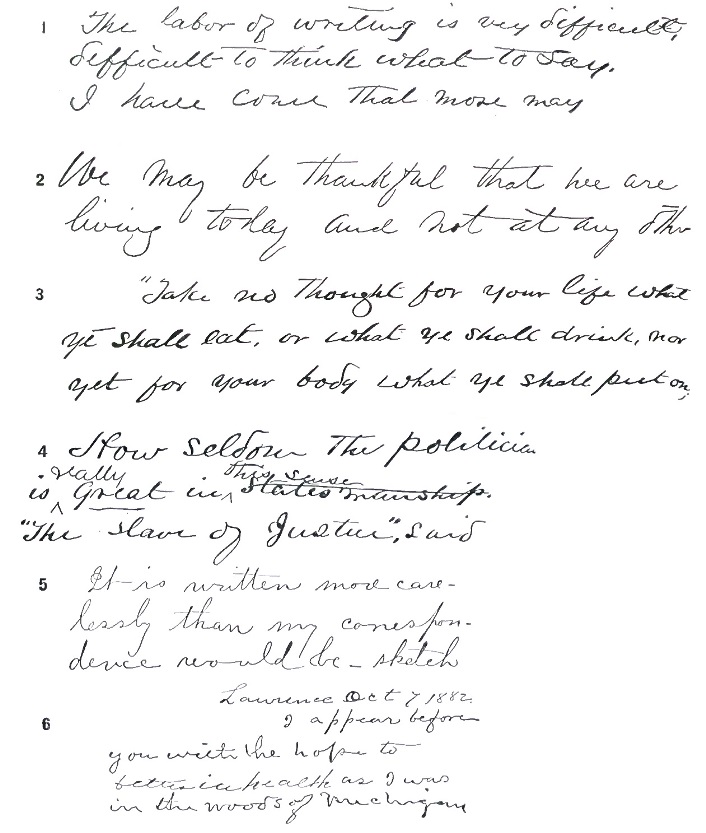
The examination of chest, abdomen, and of the urine was negative. I could not find anywhere evidence of anæsthesia, hyperæsthesia, or paræsthesia, general or local. The reaction of the muscles to the faradic current seemed normal. By ophthalmoscope and otherwise the eyes showed only the emmetropia already referred to. Hearing was also normal, as well as the other special senses. In a close examination I could at first not discover anything about his speech more than an extreme deliberation in articulation, which might perhaps have been natural to some scholarly men, but which I afterward learned had been only of recent origin, and increasing. It was more pronounced after the patient became a little wearied, and then I found that he could not articulate a long word with several labials and linguals without manifest difficulty. I gave him a sheet of paper and asked him to write from top to bottom. He could not think of anything to write. When I told him to put down the text of his sermon of the previous day, he could not possibly remember it; no more could he call to mind a sentence or a sentiment from it. What he wrote is marked No. 1. His normal handwriting, No. 2, is of the date of 1881. Nos. 3 and 4 were copied from an old sermon a few weeks previous to his visit to me, and are taken respectively from the first page and the next to the last of the copy. The facts may be observed that the old handwriting is quite free, with an easy sweep of the pen. In the copy of the sermon the first page shows that the pen is held stiffly and tightly, and that the lines are not made with as steady a movement of the hand as in the old handwriting. The lower lines on the first page are a trifle worse than the upper, and pretty much like the second and third pages, from which there is progressive deterioration to the end. The page written in my office was very carefully done, and, under the circumstances, is marked by such muscular unsteadiness and evidence of mental impairment and enfeebled memory as to be almost, if not quite, of itself pathognomonic of general paralysis.
FIG. 15.
I purposely made no remark to the patient, and he made no inquiry, about diagnosis or treatment. He would have missed his train, although there was a clock in my office, had I not reminded him of the late hour, whereupon he made all his arrangements with care, good judgment, and accuracy, and reached his home safely. As he walked briskly down the even sidewalk I doubt whether any one, even a physician, would have remarked any unsteadiness or anything abnormal about his gait. If he had been followed a few blocks, until the idea of catching his train had ceased to stimulate him, and after he had reached the crowded thoroughfares of the city, especially as he stepped up and down curbstones or walked slowly to avoid teams at crossings, a close examination would undoubtedly have shown the defects in gait already pointed out.
Mr. ——'s wife had noticed that her husband did not raise his feet as of old in walking—that he walked as if they were heavy, but under the influence of coca wine or a decided mental stimulus he walked apparently as well as ever for a short distance. She had noticed a slight impairment in memory, an increased fractiousness, a diminished ability to appreciate things in their proper light, a changeability in his moods and mental state, a scarcely-observed but noticeable neglect or oversight of little customary duties, occasional passionate outbreaks from trifling causes, a disposition to laugh and cry easily; and that often he did and said unwonted foolish little things, like attributing increased flow of urine to his liver, wearing two starched shirts, announcing the Sunday evening service; but she had not considered any of the symptoms as evidence of disease, especially as he kept accounts, attended to his preaching, etc., and showed no manifest indications of a disturbed or impaired mind. She had remarked a decided change in the character of his handwriting, also an unusual deliberateness in speech, but no indistinctness or hesitation, although his voice had become less clear. He had had no delusions, illusions, hallucinations, or unreasonable ideas. It was for the weakness in his legs that she asked my advice.
I found that the mental and cerebral symptoms in this case had been overlooked, and that the weakness in the legs had been attributed to spinal concussion, for which a favorable prognosis had been given.
I examined the patient after he had been away from home nine days, preaching two Sundays, and making many new acquaintances in the mean while, besides having travelled nearly two hundred miles by rail, so that he was fatigued. After three weeks' complete rest I saw him at his house. The knee-jerk was increased as compared with the previous examination. Otherwise the symptoms had so ameliorated that some of them could be brought out only after a long and patient examination, and the rest had to be accepted as a matter of history of the case. I had his photograph taken, and by comparing it with another taken three years previously his family noticed what was quite obvious in that light, but what had thus far been overlooked—namely, that the facial muscles had lost very much in expression.
The specimen of handwriting marked 5 is of a gentleman in whom the paralytic speech is quite evident after a half hour's talk, but quite masked in the beginning of a conversation, when rested. It is written with care, after a long rest, and, as compared with his former writing when done with equal care, there is seen only a wider separation of the letters. Its general appearance, on casual inspection, is better than that of his ordinary writing before his illness, as that was hurried and careless. But the second or third page brings out the ataxia distinctly. It shows how well a general paralytic, under the influence of rest and quiet, may control certain groups of muscles—how completely the ataxia may be concealed under an ordinary examination; and yet the symptoms in his case may be clearly brought out by the method just described. The tongue was quite tremulous.
The writer of No. 6 was more advanced in general paralysis, but had been thought not to be ataxic, from the fact that he had been able to write a single word pretty well. His few lines are quite characteristic of a general paralytic. Although he was in my office in Boston, he dated his statement from his home, and wrote the word Lawrence not badly for a man not in the habit of writing much. Seeing me for the first time, he addressed me as Friend Folsom, and he signed his name by his old army title of nearly twenty years before—corporal.
The characteristic writing in advanced general paralysis, irregular, distorted, full of omissions of letters and words, and finally illegible, may be seen in the textbooks on insanity.
It very rarely happens that the onset and early progress of general paralysis are so sudden and rapid that there is no prodromal period or that it is very short.
The symptoms of well-marked general paralysis include four tolerably distinct types, as follows: (1) The demented and paralytic; (2) the hypochondriacal; (3) with melancholia; (4) with exaltation and mania. There are mixed cases in which some or all of these forms occur. The period of invasion or prodromal period, be it short or long, has, as a rule (not always), gone by when the disease has arrived at a point in its progress to be definitely placed in any or several of these four types.
The demented form of general paralysis is the most common, and is also that in which the greatest increase has been noticed during the last decade, whether from more accurate diagnosis or by reason of an actually greater proportion, probably to a certain extent due to both causes. It consists in a very slowly-advancing mental impairment, making progress side by side with muscular loss of control and power, which may continue several months or years before their importance is appreciated, the vaso-motor disturbances not being so marked as in more acute forms of the disease, and the changes in the mental state and bodily strength from week to week being so slight as to escape observation. Attacks of dizziness, petit mal, and epileptiform seizures are quite common in this type of general paralysis. In one of my cases a lawyer in the third year of the disease was retained as counsel in a will case involving over a million dollars, when he fell repeatedly in the streets, and when his occasional, indeed frequent, mental lapses were so apparent to his partners that they did not allow any of his business letters to leave the office without being first inspected by them. Mental excitement, maniacal symptoms, and delusions of grandeur rarely occur, except as transient attacks, until the final stages. The patient commonly realizes that something is the matter with him until he becomes quite demented, and can often describe his mental state and general symptoms quite intelligently, although rarely with a full appreciation of their extent and import. He easily persuades himself that it is not worth while to take steps for medical treatment, and keeps on with his work until some distinct failure in his mental or physical powers, usually a sense of malaise, muscular pains, a feeling of exhaustion, convinces him and his friends that a physician should be consulted. Perhaps he goes to some health-resort or water-cure, or tries rest and recreation in travel, still thinking his case not an important one, until he seeks medical advice to please his family or friends. He may say that he is only tired mentally and physically.
In the hypochondriacal form of general paralysis, vaso-motor disturbances, flushed or pale face, headache, defective circulation, and various abnormal sensations referred to the peripheral nerves and internal organs are associated with a hypochondriacal mental state, which is also marked by an evident mental impairment, manifested in an almost childish changeability of complaints. Grand delusions and great mental and motor excitement do not, as a rule, appear until the later stages, but the hypochondriacal form is less subacute than the demented.
In general paralysis with melancholia the sad delusions are apt to be associated with some form of expansive ideas or to be transformed into them at some stages of the disease, although the classical delusions of grandeur are a late symptom.
The maniacal form of general paralysis with the délire de grandeur is the disease as described by Calmeil. Mental exhilaration and delusions of personal importance are its conspicuous features. It may develop at any time in the course of the other three forms just mentioned; its prodromal period may be such as has been described, usually shorter, or the symptoms may be of excitement and maniacal from the beginning. It is the general paralysis of the books until within recent years.
It is doubtful whether these four forms of general paralysis depend upon any pathological basis which can now be determined, but their recognition is practically important for an early diagnosis, and they differ from each other very little in their later and final stages. They constitute what is known as the descending form of general paralysis, in the majority of cases of which descending degeneration of the lateral columns of the spinal cord or posterior spinal sclerosis, or both, appear, secondary to the brain disease.
In the ascending form of general paralysis there are posterior spinal sclerosis and the usual symptoms of that condition—which are described in another article of this work—from one year to a dozen or more years before there are indications of dementia.
In the first stage of general paralysis, although a distinct loss of power is an early symptom, it is not so striking in its manifestations as loss of control. The moral obliquity and the mental lapses seem entirely out of proportion to the general mental impairment. What seems moral perversion is often strictly so, but oftener it depends upon a want of attention or appreciation of the facts in the case, which can be aroused if there is opportunity for it. There is a clear inability to use the force that the mind has. The foolish credulity and readiness to be duped are often only a temporary condition. There is, at the same time, an inability to co-ordinate the muscles to a striking degree at a time when there is still only slight impairment of the muscular strength, or inversely, and the co-ordinating power may improve up to a certain point, while the muscular impairment goes on. This ataxia is first noticed in those muscles requiring the nicest adjustment for their usual work, the penman's and the pianist's fingers, the proofreader's eyes, the singer's throat. But it may be for a long time very slight or not easily detected.
Although this muscular ataxia may be observed, even if not constantly, in the prodromal period of general paralysis, it is usually well marked only when the symptoms have become well developed. There is also a fibrillary tremor of one group of muscles or of one set of fibres after another when these muscles are exerted, and increasing as they become wearied, as they soon do, from the exercise. The handwriting may show no conspicuous fault at the top of the page, and at the bottom be full of evidences of muscular tremor and unsteadiness, or a single word may be written without conspicuous fault, and a few lines serve to show ataxia of the muscles used in writing. In beginning to read there may be only the most trifling want of clearness of tone and steadiness of articulation, noticeable only to the most practised ear, which after a number of minutes becomes a distinct harshness of voice or evident stumbling over linguals and labials, or hesitation in speech, which may seem like the utterance of a person slightly under the influence of wine or with lips cold from frosty air. The hesitancy of speech is due partly to a slower flow of ideas than in health, an impaired power of attention to the subject in hand, a diminished creative power or expression of thoughts, but also to a distinct ataxia, an inability to promptly co-ordinate the muscles required to perform the act. The difficulty in reading is partly mental and in part due to inco-ordination of the muscles governing the eyes as well as those of articulation.
These muscular defects and mental inefficiencies, when slight, may be hardly detected after the patient has had a prolonged rest and is quiet and calm. After some emotional irritation, weariness, sleeplessness, vaso-motor disturbances, or congestive attacks they become very pronounced. After several weeks of absolute rest, with the patient still at rest, it may be impossible for a time to find any trace of mental defect or muscular deficiency until the patient has again been put to the strain following some effort. They are very much increased after epileptiform or apoplectiform attacks, which, however, are uncommon so early in the case.
In the progress of the disease, as the mental impairment increases, the reaction of the nervous system to external conditions becomes less active, the mind weakens, the loss of flesh may be, at least in part, regained, a great portion of the irritability and active symptoms disappears, and as the patient grows worse he may seem for a while to his friends to improve.
The leading symptoms of general paralysis of the insane are—(1) vaso-motor, (2) mental, (3) physical.
The vaso-motor symptoms consist in a progressive paresis or lessened power, which in the progress of the disease advances to complete arterial paralysis—at first a functional disorder of impaired innervation, and finally organic. They are marked early by rapid changes in the cerebral circulation, a diminished arterial tension, with occasional or frequent attacks of vertigo, dizziness, or faintness, confusion and incoherence that may amount to a transient dementia, localized and general elevation or depression of the bodily temperature; frequent attacks of congestion or at long intervals, with a flushed face or transient cerebral anæmia, may be marked by sharp emotional disturbances, fits of temper, irritability, maniacal excitement, loss of self-control, etc., or by epileptiform and apoplectiform seizures of various degrees of severity, with or without temporary or transient loss of muscular power, local or of the monoplegic, hemiplegic, or paraplegic nature, of a much less severe character than similar attacks later in the disease, due in part also to organic changes. The circumscribed loss of power of the vessels of the skin leads to various functional disturbances, and finally to paralysis, involving bed-sores, etc. Cyanosis, neuroparalytic hyperæmia of the lungs, bladder, and intestines, cold feet, œdema of the skin, local sweatings, etc. are final evidences of vaso-motor paralysis. Throughout the disease, at least nearly to the end, this vaso-motor paresis and paralysis causes marked variations in the mental state which are too rapid to be accounted for by organic changes.
After there is evidence of definite atrophic and degenerative disease in the brain, as indicated by great mental impairment and muscular paralysis, the mental and physical symptoms may be subject to great changes, without any apparent cause but vaso-motor disturbances, and alternating rapidly from extreme intellectual confusion and absence of mind to a clear, even if temporary, mental state. Less extreme changes in the condition of the mind are common.
The mental symptoms, after the disease is pronounced, consist in an intensification of those already mentioned as characterizing the prodromal period—in an increase in the loss of power of control over all mental operations and in the loss of mental power, the two symptoms making progress side by side. In the form of the disease attended with maniacal excitement the prodromal period is usually shorter than in the others, but may last several years. After the prodromal period has passed the mental impairment increases, so that the judgment, memory, power of attention and expression grow progressively worse; and this impairment constitutes the only characteristic mental state universally present in all stages of general paralysis of the insane—namely, progressive dementia. The accidental symptoms may be those belonging to any type of insanity except logical systematized delusions. They very rarely simulate the states of mental defect and degeneration.
If there are delusions of persecution, they are marked by a degree of confusion or incoherence not compatible with logical inference. The state of melancholia may change rapidly to mania, and the demented form may at an hour's notice become the excited. Where the symptoms of mental exaltation and depression alternate, resembling folie circulaire, the alternation is less regular than in alternating insanity properly speaking; hallucinations of sight and hearing and of all the special senses are quite common, although, as a rule, rather late symptoms, and then confused and often only partially intelligible. There are also all sorts of illusions and delusions.
The impairment of the sense of right and wrong becomes quite marked; the patient loses the sense of property and ownership. In no other disease could the reported case occur of a man, to outward appearance well, going up to a policeman and asking his assistance in rolling off a barrel of liquor which belonged to some one else, and which he meant to appropriate. For this reason what seem to be thefts are very common, and although by that time there is striking mental impairment, it may not be obvious to every-day people. Almost every other moral obliquity occurs, particularly a tendency to drunkenness and every possible violation of the proprieties and laws regarding property and the sexual function. It is all done, too, in such a foolish way that the insanity would be apparent to almost any intelligent person before whom the facts might be fully and clearly placed. There may be a curious consciousness in the patient of the fact that something is the matter with him, and a most extraordinary unconsciousness of what an inordinate fool he is acting. If he can be made to see what folly he is committing, perhaps a few moments later he is saying that he was n-ever b-better in his life. The emotions change most rapidly, and an adroit examiner will have his patient crying over some trifle one moment, and another moment laughing over something equally inconsequent. The prevailing mental state changes as rapidly as the emotions. Violent anger, outbursts of passion, penitence, amusement do not succeed each other more rapidly than indifference, melancholy, and exaltation.
The suicidal idea is common in general paralytics before they become very demented; the suicidal impulse is rarely strong enough to result in anything more than futile attempts at self-destruction. Suicide by deliberation is also rare, for even when it is meditated the weakened, indecisive mind usually fails to prepare adequate plans for its successful issue. Homicidal attempts are not to be expected as a rule, except in the delirium of the states of maniacal excitement or in an outburst of anger for a fancied wrong or deliberately for some trifling reason. Even from suicide and homicide a practised physician or attendant will easily turn the general paralytic who is not maniacal to some amusing or silly thought. He has become credulous, simple-minded, and easily moulded to an expert's wishes, so far as his general conduct is concerned, and yet at any moment he is capable of a furious mania or a violent storm of passion, which after cerebral congestive attacks may be long and severe. Sometimes these symptoms just described may be very pronounced at night and not especially troublesome during the daytime. I have had patients who were dangerous, violent, noisy, deluded at night, and entirely quiet by day, for several months.
The mental state is of progressive impairment. The ideas flow slowly, and there is slowness or hesitation in speech in giving utterance to them, even to the degree of amnesic aphasia. Word-blindness occurs, and word-deafness and the various disturbances of speech associated with the several forms of aphasia. After the dementia is very marked there is often a most extraordinary variation in it. The patient may be confused, incoherent, and to appearance hardly capable of sustained thought, but soon quite able to perform a business transaction. The friends say of such patients, “He is crazy to-day,” or “To-day he is sane;” and this quite independent of the marked increase in the dementia which occurs from organic changes, epileptiform and apoplectiform attacks, after which the advance in the mental impairment is rapid and great. Accompanying dizzy and congestive attacks there is a temporary dementia which may be over in an hour or two.
The patient may recall many long-past events fairly well when he cannot find his way to the dinner-table without blundering, when he does not know morning from afternoon, and after he is unable to dress and undress himself without constant remindings or even actual help. Such paralytics wander off and die of exposure, are picked up by the police as having lost their way or as not knowing where their home is, or fall into some fatal danger from which they have not mind enough to extricate themselves. When the mental impairment has reached this point the lack of mind shows itself in a lack of facial expression, which is so characteristic of the disease that with a practised eye it is recognized as far as the countenance can be distinctly seen; and from this point the progress is commonly quite rapid to absolute dementia, entire inability to form or express thoughts, too little intellect to even attend to the daily natural wants, and a descent to the lowest possible plane of vegetative life, and then death.
At some time or other in the history of general paralysis delusions of grandeur, a general feeling of personal expansiveness or extreme self-satisfaction, may be confidently looked for. In the melancholic and hypochondriacal forms of the disease, as has already been mentioned, they are late symptoms; in the demented type they occur only, for the most part, near the final stage of absolute dementia; and in the excited form they are usually found from the beginning or at least developing from a general feeling of bien-être. They may vary from what would pass as inordinate, silly conceit to a wildness of delirium which stops hardly short of infinity. The patient is the greatest financier, the handsomest man, the best runner, can out-box the champion pugilist, can write the finest sermons. Delusions of this degree, especially in women, are apt to refer to the reproductive faculty or to the qualities which please the opposite sex. One man can make a million dollars a day writing poetry; another is building cities of solid gold; another owns all the railroads in the country, is king over all the earth, god over God; another is running express-trains over his bridge across the Atlantic or has a doctor who comes to see him in a balloon. There is often a depth of vulgarity and obscenity about the delusions which is rarely seen in other diseases. When the grand delusions appear in the melancholic form, they are apt to be tinged with gloom, as of a queen whose diamonds are withheld from her, a lover who is kept from his princess bride, etc. In the hypochondriacal form it may be a crystal liver, a silver stomach, a brain of solid gold, etc.
Delusions of personal belittlement, called micromania, sometimes follow or alternate with the megalomania.
Maniacal excitement is a late symptom in the demented, hypochondriacal, and melancholic forms of general paralysis; and it rarely occurs in them except in the final months of the disease, unless as a direct sequence of congestive, epileptiform, or apoplectiform attacks, and then it lasts usually from a few hours to several days. These attacks may occur at any time without any warning whatever, and may be attended with fury or stupor also. As a matter of fact, they are very rare at an early stage except in the excited form of general paralysis, of which they are a pretty constant symptom until marked dementia has appeared, and they may continue to the end. The fury of these maniacal attacks is of the most furious and maddest kind, blind, the most utterly regardless of consequences of any kind of insane excitement, and without the intelligence even of the acute maniac.
The ability to recognize his own mental state is sometimes retained by the patient, at certain times at least, to a quite late stage in the disease, so that he learns to call his visions hallucinations and his strange fancies delusions. He may even agree that his illusions are all nonsense, that the disease is in his brain. The so-called lucid intervals are not uncommon until the final stage of absolute dementia, when attention, memory, judgment, conception, connection of ideas, imagination, desires, the exercise of the senses, general sensibility, after becoming more and more imperfect are at last completely suspended. The moral sense and finer feelings had gone long before.
Although the story of the mind's decay in general paralysis is a comparatively short one, from a few weeks to four or five years for the prodromal period, and then an average of two or three years for the rest, but varying from a few weeks to a rare extreme of twenty years, there may be at any stage of the disease, except at the very end, a more or less complete remission lasting from a few months to ten years. It is dangerous to say, therefore, that there is any degree of dementia which may not be temporarily at least, or in some part, recovered from. Most of the reported cures of general paralysis have been at last proved to be simply remissions, which may be partial or so complete as to leave no trace to the most practised observer. It is not uncommon to see a remission of six months or a year or two, in which the patient can lead a quiet life; it is seldom that he undertakes responsibilities without bringing the remission rapidly to an end. There are a few cases where active business has been resumed and followed successfully for several years. But there is apt even then to be some deterioration in character, which may amount to an actual moral insanity. An arrest in the downward progress, so that the symptoms remain for a considerable time without essential change, is not very uncommon, and may occur at any stage of the disease.
The physical symptoms of general paralysis consist in impaired control over the muscles, diminished power of co-ordinating them, followed at once by progressive muscular enfeeblement ending in complete paralysis.
The ataxia first shows itself in the finer muscles—of the eye, of the fingers, of articulation. There is a little hesitancy or rather deliberateness of speech, the voice loses its fine quality, the intonation may be slightly nasal. Instead of contracting smoothly and evenly as in health, the muscles show a hardly noticeable jerkiness; an irregular fibrillary tremor is seen when they are exerted to their utmost and held in a state of extreme tension for several moments. In attempts to steady the handwriting the patient forms his letters slowly, makes them larger than usual, or tries to hurry over the letters, making them smaller. The coarser muscles show ataxic symptoms much later. It is observed by the patient or his friends that he does not walk off with his usual rapid gait, and the effort to co-ordinate his muscles produces an early or unusual fatigue, which may be associated with general muscular pain. Extreme soreness and pain, following the course of some one or more of the main nerve-trunks, may be most persistent and obstinate to treatment, lasting for several years, limiting the motion of the limb, sometimes beginning a year or two before other symptoms are observed. Sooner or later, especially after a little weariness or excitement, there are observed at times, not constantly, indistinctness or an occasional trip in enunciating linguals and labials, a tremor in the handwriting, a slight unsteadiness in the gait. When the tongue is protruded as far as possible, when the hands and arms are stretched out, when the muscles of facial expression are exerted, in standing with feet together with closed eyes, a decided muscular tremor and unsteadiness are remarked. These muscular symptoms soon become constant, although they may be so slight as to be well marked only by some unusual test, such as prolonged use after excitement or fatigue, and the ataxia may diminish, the gait, speech, or handwriting may improve, while muscular power is growing progressively less.
In walking the feet are not raised as usual, the steps are shorter, the legs are kept wider apart; turning about is accomplished in a very deliberate way, such as to suggest an insecure feeling; movements like dancing are impossible. Going up and down stairs is difficult; the whole foot is rested carefully on each step, and the head and shoulders are held stiffly, so as to maintain the balance. The muscular movements are generally uneven and tremulous, and yet the strength may not be so very much impaired, although perhaps available only for short periods at a time. Even these symptoms may so improve by a few days' quiet, or even by a night's rest, as to quite throw the physician off his guard unless a thorough examination is made. The patient, too, on an even floor or sidewalk may walk so as not to attract attention, and yet in a new place, over a rough surface, or in the attempt to perform difficult or rapid movements, exhibit striking ataxia and feebleness of gait. In starting off with a definite purpose he may for a short distance walk quite well, as he may do under the influence of a glass of wine.
From this point the progress is usually rapid. The handwriting becomes more and more tremulous, unsteady, full of omissions of letters and words, disjointed, disconnected, and finally illegible; the articulation more thick, stammering, hesitating, indistinct, unintelligible; the gait staggering, shuffling, straddling, uncertain, unsteady, even to causing frequent falls. There may be still a considerable degree of strength for a single short effort, but the co-ordination is so imperfect as to make it avail little. The voice, for instance, may be loud and forcible, but the co-ordination sufficient for only a short explosive utterance of one syllable, and then quite an interval before the force can be concentrated for the next. Progressive muscular paresis becomes finally absolute paralysis.
Remissions in the physical symptoms follow the same general laws as in the mental symptoms, but are not so complete, and there may be an arrest in their progress also.
In all stages of the disease, especially the later, there may be almost any of the symptoms observed which occur in the various functional and organic diseases of the nervous system. The hyperæsthesia, local or general, may be most absolute, or the anæsthesia so complete that acts of self-mutilation ordinarily causing exquisite pain are performed without apparent suffering. Any motor ganglia, any nerve, any tissue, may degenerate, giving rise to various degrees of impairment up to total destruction of function—of the optic nerve, causing blindness; of the auditory, deafness; of the olfactory, glosso-pharyngeal, or any of the cranial or spinal nerves.
The pupils may be of normal size. They may be of normal or sluggish accommodation to light and distance, or there may be dilatation or contraction of either or both pupils and no response to light or accommodation. The pinhole pupil is not uncommon. There may be neuro-retinitis, atrophy of the disc, neuritis, nystagmus, diplopia, amblyopia, hemianopsia, color-blindness, ptosis, conjugate deviation of both eyes, or paralysis of any of the ocular muscles. The paralysis of one of the muscles of the eyeball may be one of the earliest and most persistent symptoms. The optic neuritis or atrophy may also occur early, but seldom appears in time to aid in a doubtful diagnosis.
Sugar has in a few cases been found in the urine; albumen is not uncommon.
The sexual function is commonly exaggerated in the early stages, then diminished, lost, and finally returns in the stage of absolute loss of self-respect and self-control, although it may be impaired from the beginning or not materially changed at first. There may be temporary or persistent incontinence or retention of urine.
At first there is a marked loss of flesh, then a gain. As the muscles lose in power they increase in size, with an interstitial degeneration. The deposit of fat is sometimes enormous. In the final stage there is emaciation.
The convulsive attacks usually are of the nature of cortical epilepsy, or at least commonly begin as such. They are associated with and followed by a considerable rise in temperature—from two to seven degrees F.—and are immediately succeeded by marked increase in the severity of the symptoms, both mental and physical, especially if the attacks follow each other in rapid succession or last for a number of days. They may be due to hemorrhage, embolism, or effusion, and be marked by any or all of the usual symptoms and sequences of those conditions, permanent or transient. General and aural vertigo are not uncommon.
The muscular tremor before the last stages varies in different muscles—excessive perhaps in the tongue, moderate in the fingers, and so on. It may also seem slight as compared with the other symptoms, or, on the other hand, be enormously exaggerated in certain groups of muscles out of all proportion to all other indications. At the end extreme and constant tremulousness accompanies every voluntary movement.
Spastic paralysis, muscular tension, contractures, rigidity of the most persistent character seem at times to be under the influence of the will, although of cortical origin and in a certain sense automatic, like convulsions.
The knee-jerk is changed in somewhat more than half the cases, a little oftener exaggerated than abolished; but sometimes the reflexes are enormously increased all over the body, so that a strong puff of air in the face even will set the arms and legs going like a jumping-jack. I have twice seen the patellar reflex abolished in one leg, and so marked in the other as to seem to me exaggerated.24 I have also known it to disappear absolutely in both legs two weeks after it had been found to be excessively exaggerated. It also varies under conditions of rest, fatigue, excitement, etc. Intense pain in the joints occurs, and I have found it where the knee-jerk was exaggerated, in one case giving rise in a physician to the delusion that his arms and elbows had been resected. This may disappear in time. Charcot's joint disease has been observed.
24 There was no evidence, and there had been no history, of a hemiplegic attack in either case.
In the final stages the bones are fragile and easily break; hemorrhages under the periosteum or perichondrium arise from trifling force or injury, giving rise to hæmatomata, the most common of which are on parts exposed to pressure, etc., as the ear. The patient is confined to his bed, fed like a small child, demented, hardly able to articulate the extravagant delusions which form such a grotesque contrast to his actual state, until the mind is as incapable of forming or receiving ideas as of expressing thoughts; and the body is simply a filthy, helpless mass of humanity, dying of exhaustion or decay, unless lung gangrene, bed-sores superficial and deep, necrobiosis, exhausting diarrhœa, pneumonia, pulmonary consumption, perhaps asphyxia from an epileptic fit or choking, have followed incontinence of urine and feces to the fatal end, or heart failure or apoplexy have closed the scene.
PATHOLOGY AND MORBID ANATOMY.25—General paralysis of the insane is, according to Mendel, following Rokitansky's idea, a connective-tissue disease, affecting the nerve-cells and tissues secondarily, while Tuczek and Wernicke think that the primary disease is of the nerve-elements (primäre Atrophie der Nervenelemente)—a diffuse interstitial cortical encephalitis on the one hand, or a diffuse parenchymatous cortical encephalitis on the other. There is also, in well-marked cases, atrophy of the white substance, due, according to general opinion of pathologists, to primary interstitial encephalitis ending in sclerosis.
25 For a detailed statement of the post-mortem appearances in general paralysis compare Spitzka's Insanity, pp. 218-243; Beiträge zur pathologischen Anatomie und zur Pathologie der Dementia Paralytica, von Dr. Franz Tuczek; Die Progressive Paralyse der Irren, von Dr. E. Mendel; Lehrbuch der Gehirnkrankheiten, von Dr. C. Wernicke, iii. pp. 536-541. Westphal's classical work is not referred to, as his latest views and others of interest are given in a report of a discussion by the German Association of Alienists in the Allgemeine Zeitschrift für Psychiatrie, iv. 1883, pp. 634-638 and 648-654. In the third number of the Neurol. Centralblatt, Mendel reports an autopsy of a patient diagnosticated to have melancholia, who died a violent death, where he thought that he found evidence of the early stage of general paralysis in moderate opacity of the pia mater, with nodules as large as a pin's head in both parietal regions, and in slight indications of diffuse interstitial inflammation of the cortex, the blood-vessels in the frontal convolutions being extensively filled with white blood-corpuscles.
In the majority of cases there is pachymeningitis, often extensive and excessive, with hemorrhages, but which may be no more than is quite commonly found in persons dying of phthisis or chronic nephritis. There is also, usually, leptomeningitis, with adhesions to the cortex, especially of the anterior and antero-lateral portions, so firm that the arachnoid cannot be removed without tearing off portions of the brain; but it is sometimes scarcely observed, and may be no more than is found in persons dying simply of old age. The pia may be in places thickened, opaque, and without adhesions. Ependymitis is usual.
In the terminal stage of general paralysis there is well-marked atrophy (with compensatory serous effusion), which is, as a rule, most marked in the cortex of the brain, but which is of varying degrees in its different portions. Rarely there is scarcely any atrophy of the cortex. The central portion of the brain may be of leathery consistence, but usually shows marked sclerosis, which also may affect its different portions and the different ganglia very differently. The changes resulting from inflammatory, degenerative, and atrophic processes are general and profound.
An opinion is beginning to obtain that general paralysis is primarily a disease of the small cerebral blood-vessels, functional or vaso-motor; and Meynert holds that the transition line between that stage, which he considers curable, and organic disease may be recognized clinically.
In general paralysis, as in other mental diseases, the nervous discharge is accompanied by a greater disturbance in the structure of the gray substance of the brain, a more extensive decompounding of it, and consequently by a more complete exhaustion of nervous force than in healthy mental processes. Longer periods of rest and improved nutrition are therefore necessary to restore healthy function. In general paralysis, as in all other mental diseases dependent upon destructive disease of the brain, there is not only decompounding, but decomposing and disintegrating, of the structure of the brain.
Posterior spinal sclerosis is frequently found. If alone or predominating over sclerosis of the lateral columns of the cord, the knee-jerk is abolished if the morbid process has gone far enough. If descending degeneration of the lateral columns is chiefly found, and is sufficiently advanced, the knee-jerk is increased. At least one of these forms of sclerosis exists in the vast majority of cases.
There is also a distinctly syphilitic disease of the smaller cerebral arteries, together with a diffuse parenchymatous and interstitial encephalitis of syphilitic origin. At present we have no means of differentiating it at the autopsy from general paralysis following a subacute or chronic course, except inferentially from the presence of other evidences of syphilis. It is not always possible, therefore, to distinguish between syphilis and a syphilitic diathesis as the chief factor in diffuse encephalitis.
DIAGNOSIS.—Although a well-marked case of general paralysis is unmistakable, the diagnosis in the early stages or in obscure cases may be extremely difficult. The varying degrees in which the various portions of the cortex, medullary portion, and different ganglia of the brain may be involved in the morbid process naturally give rise to a great variety in the symptoms, mental and physical, sensory and motor, emotional and intellectual, and in the relative preponderance of one or another in individual cases. The usual symptoms of any form of mental disease may for a time obscure the dementia which sooner or later must appear in general paralysis, and which, as has already been said, is the only mental symptom universally present in all cases. This mental impairment must also be associated with progressive muscular loss of power, although the relation of the two symptoms to each other, the degree to which a given amount of the one leads to a fair inference of a certain amount of the other, is liable to the greatest variation, the range of which can only be learned by observation and experience. There is a certain quality to the dementia, as already described, which is often sufficient of itself to establish the diagnosis with a practised physician.
The early mental symptoms may simulate those of cerebral neurasthenia, in which the patient thinks that there is decided mental impairment, although there is no progressive dementia. The tremor in neurasthenia is greater and more universal than in the stage of general paralysis with which it might be confounded, and the subjective symptoms are much more prominent.
Muscular malaise and pains throughout the body give rise to the diagnosis of malaria or rheumatism, in which there may be loss of power, but no ataxia or dementia.
The sclerosis may be predominating or pronounced in the basal ganglia and bulbar nuclei, giving occasion for a hasty diagnosis of labio-glosso-pharyngeal paralysis, until it is found that the clinical history of that disease is not followed. In the same way, any motor or sensory ganglia or nerve-roots may be so early implicated in the degenerative process as to mislead the physician into giving attention to only the local symptoms.
Once I have known the early convulsions of general paralysis in a very self-conscious woman mistaken for hysteria, the mental impairment and physical weakness having been overlooked on account of the prominence of the convulsive attacks and the hysterical symptoms, which may be a complication of any form of insanity in young and middle-aged people, particularly women.
It is not uncommon for the attacks to so thoroughly resemble epilepsy as to be mistaken for it, the dementia not being observed or being supposed to be the ordinary mental deterioration generally following epilepsy. In such cases the progressive dementia, ataxia, and muscular weakness may advance so slowly as to entirely escape observation for a long time, and give rise to the confident diagnosis of epilepsy for five or six years. Epilepsy, however, arising in a vigorous, middle-aged person without evident cause, should always suggest the suspicion of syphilis, cerebral tumor, or general paralysis, when careful scrutiny of all the symptoms will show where it belongs.
Embolisms, hemorrhages, cerebral effusions, more or less diffuse encephalitis from an injury to the head, sometimes give rise to the suspicion of general paralysis, until it is found that its characteristic progressive symptoms do not appear, but chiefly when the history of the case has not been definitely ascertained, or when the usual symptoms of those conditions are not well marked.
Chronic endarteritis, arterio-sclerosis, atheroma of the cerebral arteries may be so diffused as to simulate general paralysis, especially in drunkards and syphilitics, but the symptoms do not advance in the manner characteristic of that disease.
Multiple cerebro-spinal sclerosis of the descending form may be confounded with general paralysis while the symptoms are obscure and consist in change of character, when, indeed, organic disease can only be suspected to be present.
Lead has been known to attack the central nervous system in such a way as to produce an intellectual apathy and muscular weakness somewhat resembling the early stage of the demented form of general paralysis, but without its ataxic symptoms and its regular progress. The presence of lead in the urine, and the marked improvement from the use of iodide of potassium, tonics, and electricity, are sufficient to establish the diagnosis.
Chronic and persistent alcoholism is always attended with some mental impairment, which may so resemble the dementia of general paralysis, with marked moral perversion, mental exaltation, grand delusions, muscular tremor, ataxic symptoms, and impaired muscular power, as to make the diagnosis doubtful for several months, until removal of the cause (alcohol) in the course of time causes the symptoms to so abate as to make the real character of the disease evident.
I have once seen chronic interstitial nephritis without its usual prominent symptoms and with mild uræmic convulsions mistaken for general paralysis.
A tumor of the brain, if not attended with the common symptom of vomiting, may be the cause of convulsions and headache resembling those often seen in general paralysis. Optic neuritis or atrophy is usual in cerebral tumor, but rare in a stage of general paralysis so early that the diagnosis might be doubtful.
Hemorrhagic pachymeningitis also now and then simulates an obscure case of general paralysis in the early stage, but a few weeks at most settle any doubts in the matter.
Although diffuse cerebral syphilis is more apt to be associated with distinctly localized symptoms than the demented form of general paralysis, and although it is characterized by a mental apathy and physical torpor which follow a more regular course with more definite symptoms, resulting in a slow decay, yet there may be doubtful cases in which the differential diagnosis is impossible, and in which antisyphilitic treatment does not throw any light on the subject. Syphilitic new growths, endarteritis, and meningitis may so far improve from the use of mercury or the iodide of potassium as to end in an apparent cure, but in those cases the symptoms are not so marked as to make an exact diagnosis always possible. A distinct syphilitic cachexia is presumptive evidence of syphilitic encephalitis when there is doubt whether the syphilis is the cause or the diathesis.
Profound melancholia is not so often as varying gloom or moderate despondency a symptom of general paralysis. When it is such, there are developed in time the other marks of that disease, and it will only be necessary to hold the diagnosis in reserve for their appearance. The melancholia masks the dementia unless it is very carefully sought for, and the tremor may be as marked in melancholia as in the early stage of general paralysis, but more universal.
Acute mania is not uncommonly mistaken for general paralysis, when, as often happens, the delusions are as expansive and the tremor as great in the mania as in general paralysis; and it may be several months before the differential diagnosis can be made with certainty. In the presence of a high degree of maniacal excitement, with great emotional agitation and muscular tremor, it is difficult to establish the fact of the existence or not of dementia in doubtful cases until it is well developed. Acute mania has been known to constitute the prodromal period of general paralysis for a number of years.
Primary mental deterioration cannot be always differentiated from general paralysis of the demented type in its early stage. After the age of sixty the probabilities are in favor of primary mental deterioration in doubtful cases, but general paralysis occurs—seldom, to be sure—up to the age of sixty-five.
Early senile dementia may simulate general paralysis of the subacute form, but has not its clinical history. General paralysis of the quiet, insidious type and primary mental deterioration have been called premature senility. The three diseased conditions have certain points of similarity, and the pathological processes involved in them do not differ sufficiently to authorize the assumption that they are not closely related, if not simply variations, due to age and other causes, in one morbid process.
Finally, the mental impairment caused by the prolonged use of bromide of potassium and hydrate of chloral has been mistaken for general paralysis, until a critical examination unmistakably showed the presence of the well-known symptoms of those drugs.
In examining the patient it is especially important to avoid leading questions, as in general paralysis and in those conditions which simulate its early stage the mind is in a condition to readily fall into the train of thought suggested to it. The fact should be kept in mind, too, that the symptoms in early general paralysis are so variable as to be sometimes quite evident, and at other times not to be got at with certainty at all or only after long and patient examination; that they sometimes quite disappear under the influence of complete mental and bodily rest; and that in all stages, until near the end, such complete remissions may occur as to make the diagnosis, independent of the history of the case, difficult if not impossible.
A gentleman once committed an offence characteristic of general paralysis in marrying a pretty servant-girl while temporarily away from his home. His wife, daughters, and friends saw that the act was so contrary to his natural character that he was placed in an insane asylum and kept there several weeks under observation for an opinion as to his responsibility. He appeared so well in the absolute quiet and rest that he was declared sane, tried, and sentenced to the State prison, where he showed his marked mental impairment as soon as he was set to work. He could not concentrate his mind sufficiently for the simplest labor, and a couple of years later he was sent to the insane asylum to die, a complete mental and physical wreck, in the late stage of general paralysis.
PROGNOSIS.—The very few reported cures in so common a disease as general paralysis, and the circumstances under which they have been reported, lead to the suspicion that there was an error in diagnosis or that the mistake was made of supposing a remission to be a cure, as has often happened. The course of the disease is more rapid in men than women, and in young persons than in the older. From the galloping cases of a couple of months to those slowly advancing, with long remissions, over twenty years, the average, including the prodromal period, is probably not far from five (perhaps six) years. Collected from asylum statistics, it is given as from two to three years. When I am sure of the diagnosis, I generally say that the patient may die within twenty-four hours (of paralysis of the heart, from suffocation by an accident in an epileptic attack, from choking, from cerebral hemorrhage or effusion, or suddenly with cerebral symptoms of which the autopsy gives no satisfactory explanation), within a short time of intercurrent disease, especially diarrhœa or pneumonia, or that he may live several years, as he probably will, and possibly have a remission, during which he may lead for a while somewhat the same kind of life as other people.
Persons presenting symptoms which can in no way be positively distinguished from those at the beginning of the prodromal period of general paralysis recover, but not many come under the physician's care so early. We are not yet in a position to say whether they were suffering from a mild, transient illness or from what would otherwise have become serious organic disease.
TREATMENT.—Life may be prolonged in general paralysis, and usually is prolonged, by the use of such measures as contribute to the patient's comfort, and which in a general way have already been considered under the head of treatment of mental disease on a previous page.
In my experience, stimulating tonics, wine, and even coffee, increase the morbid cerebral energy of the early stage of the disease, but are sometimes of use later. Cod-liver oil and the hypophosphites do better, and many of the disagreeable symptoms of the period of loss of control over the involuntary muscles are relieved by strychnia. Ergot and the judicious use of the bromides abate the cerebral congestion. Gastro-intestinal disorders, when not controlled by attention to diet, require the usual treatment.
Iodide of potassium in the large or small dose, and mercury, I have never found to benefit those cases of general paralysis with a previous history of syphilis. On the contrary, they have proved debilitating and harmful.
When furious excitement is not relieved by prolonged warm baths, with cool applications to the head if possible, and quiet, chloral is of use, and sometimes opium and its preparations.
Frequently-repeated violent convulsions, the epileptic state, are usually at once mitigated by chloral given by the rectum; the inhalation of nitrite of amyl is reported also to have been of use.
There are few cases in which I find that morphine does not quiet restlessness, calm delusions, abate distressing hallucinations, and make the patient generally more comfortable; and I give it freely, seldom more than twice a day, often almost daily, for two or three years. In this way it can be used in quite moderate doses. Coca also relieves symptoms.
Rest and quiet are most important in all stages of the disease. This can be best accomplished in a quiet private house in the country, which can be made a virtual hospital, and next in a private asylum. But such care is beyond the reach of the vast majority of the insane, to whom the public asylum becomes a necessity. Wherever they are, an orderly life is best for them, with as little irritating interference with their ways or control of them as is possible.
If the results of treatment are in the highest degree unsatisfactory, and consist chiefly in meeting symptoms as they come up, without hope of permanent recovery, it is not impossible that when we can put the patient under treatment at the very beginning of his disease, as we can now do in pulmonary consumption, the prognosis in the former disease may change as much for the better as it has changed in the latter.
A general paralytic is at any time liable to congestive or maniacal attacks of short duration, and so is always, potentially, a dangerous person. In the prodromal period the risk is small; in all stages there will, in the majority of cases, be some warning; but in the developed disease the only safe way is to have some responsible person near at hand, both to prevent the patient from doing harm to others and to save him from injuring himself, whether by intent or through not knowing better than to wander off or fall into all sorts of accidents. In many conditions several should be readily available, or else the security of an asylum must be sought.
In the treatment of general paralysis by society the same rule should obtain as in all forms of insanity—that distinct mental disease is presumptive proof of irresponsibility, or at least of limited responsibility; that a diseased mind means lessened intellectual power throughout and diminished ability to choose the right and avoid the wrong; that there are changes in circulation or nutrition, or some unknown condition in the brain, especially in general paralysis, by virtue of which the mental state and power of self-control vary from time to time, and as a result of which a person seeming responsible one day may have been quite irresponsible some previous day.
INSANITY FROM GROSS LESIONS OF THE BRAIN (tumors, new growths of all kinds, exostoses, spicules or portions of depressed bone, embolisms, hemorrhages, wounds, injuries, cysticerci, etc.) is attended with the usual indications of those conditions which may determine diffuse disorders of the brain, giving rise to any of the symptoms of the various psycho-neuroses and cerebro-psychoses. The lowered mental and moral tone after cerebral hemorrhages is a matter of common observation, and after one an individual is rarely observed to be fully himself again.
The PROGNOSIS is very unfavorable. Although there are rare cases of improvement, the tendency is toward profound dementia.
CEREBRAL SYPHILITIC INSANITY comes either under the head of the insanity last described or belongs to the slowly-advancing dementia with final paralysis already referred to under the head of Diagnosis in General Paralysis, and called by some authorities on mental disease pseudo-paralytic dementia from syphilis.
Antisyphilitic treatment is of value in the first class of cases, and although most of the recoveries end in relapses and incurability, the prolonged use of iodide of potassium seems sometimes to effect a permanent cure. It is claimed that similar treatment is followed by the same result in the cases of dementia with paresis, but the weight of authority, and certainly my own experience, are against that statement.
CHRONIC ALCOHOLIC INSANITY depends upon the vascular and other changes due to abuse of alcohol so long continued that the pathological condition has become organic and incurable. It is commonly associated with delusions of suspicion or persecution. It may be a purely moral insanity, with gross beliefs rather than distinctly insane delusions, and it rarely fails to be at least that when the persistent excessive drinking is kept up until the age of beginning dissolution of the brain. It then gives rise to all sorts of embarrassing complications in regard to property, family relations, and wills. Chronic alcoholic insanity may take the form of mild dementia, by virtue of which the patient cannot control himself, but can be easily kept within bounds of reasonable conduct by various degrees of restraint, from the constant presence of a responsible person to the seclusion of an asylum. In well-marked cases this dementia is associated with muscular weakness, tremor, and exhilaration to such an extent as to simulate general paralysis. It is then called by some—especially French—writers pseudo-paralytic dementia from alcohol.
The condition is susceptible of improvement by removal of the cause, alcohol, and by a carefully-regulated life, hydropathic treatment, etc., but complete recoveries cannot be expected.
SECONDARY DELUSIONAL INSANITY is slowly developed from various mental diseases, incurable or uncured, where the progress to marked dementia is slow, by the persistence of delusions in those forms of insanity characterized by delusions. It is chronic and incurable. In melancholia and mania the mental depression and the exaltation and motor excitement disappear to a great extent, and there are left a slowly-advancing dementia, confusion, and expanding delusions, with apathy or with agitation, for which the asylum is the only safe place unless physical weakness makes the patient harmless. It is either a terminal state in which many forms of insanity end, or a stage through which they pass to terminal dementia. It depends upon incurable, and therefore organic, changes in the brain, like all incurable insanity, although those changes are not yet determined exactly. It might be a question whether chronic delusional insanity properly belongs under the head of Organic Mental Diseases, and a similar criticism may be made regarding terminal dementia. But in this paper no definite classification of insanity is attempted, because our knowledge of the subject is still so indefinite, although the several mental diseases are grouped in a certain order for convenience to the reader and the writer; and this order of course approximately follows natural lines.
TERMINAL DEMENTIA is the end to which most of the insanity not resulting in recovery finally comes. The features marking the disease in its early stages for the most part disappear, leaving all the functions of the mind impaired in all degrees up to total extinction—the whole character on a lower plane. It is the disease which to so great an extent crowds the wards of insane asylums and almshouses with the (1) agitated or (2) apathetic chronic insane, the worst of whom are mental and physical wrecks, squatting on floors, uttering an unintelligible jargon, noisy, filthy, without intelligence for the simplest natural wants. Their chief function, under the prevalent methods of construction and management of lunatic hospitals in most places, is to blight with a certain feeling of hopelessness many of the curable insane who are obliged to go for rest and quiet to institutions where the overwhelming majority of the inmates are manifestly and painfully incurable.
French writers include a great part of chronic delusional insanity (secondary confusional insanity, Wahnsinn, secundäre Verrücktheit) and terminal dementia (Blödsinn) under one head, démence; and with much reason, as it is not always possible to differentiate between the two.