T (continued 3)
Reading edition
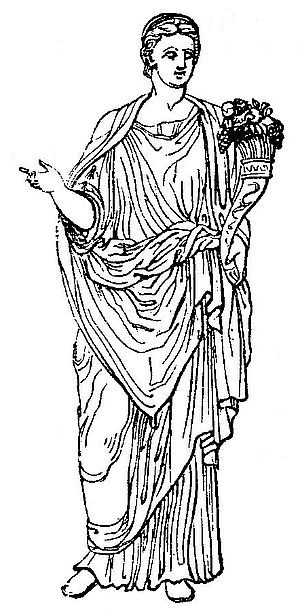
Roman Tunic. (Visconti, Monumenti Gabini, n. 34.)
TŪRĬBŬLUM (θυμιατήριον), a censer. The Greeks and Romans, when they sacrificed, commonly took a little frankincense out of the Acerra and let it fall upon the flaming altar. [Ara.] More rarely they used a censer, by means of which they burnt the incense in greater profusion, and which was in fact a small moveable grate or Foculus. The annexed cut shows the performance of both of these acts at the same time. Winckelmann supposes it to represent Livia, the wife, and Octavia, the sister of Augustus, sacrificing to Mars in gratitude for his safe return from Spain. The censer here represented has two handles for the purpose of carrying it from place to place, and it stands upon feet so that the air might be admitted underneath, and pass upwards through the fuel.
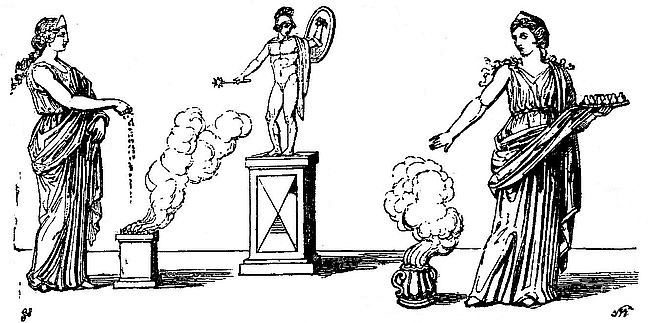
Livia and Octavia Sacrificing. (From an ancient Painting.)
TURMA. [Exercitus, p. 166, b.]
TURRIS (πύργος), a tower. Moveable towers were among the most important engines used in storming a fortified place. They were generally made of beams and planks, and covered, at least on the three sides which were exposed to the besieged, with iron, not only for protection, but also to increase their weight, and thus make them steadier. They were also covered with raw hides and quilts, moistened, and sometimes with alum, to protect them from fire. Their height was such as to overtop the walls, towers, and all other fortifications of the besieged place. They were divided into stories (tabulata or tecta), and hence they are called turres contabulatae. The sides of the towers were pierced with windows, of which there were several to each story. The use of the stories was to receive the engines of war (tormenta). They contained balistae and catapults, and slingers and archers were stationed in them, and on the tops of the towers. In the lowest story was a battering-ram [Aries]; and in the middle one or more bridges (pontes) made of beams and planks, and protected at the sides by hurdles. Scaling-ladders (scalae) were also carried in the towers, and when the missiles had cleared the walls, these bridges and ladders enabled the besiegers to rush upon them. These towers were placed upon wheels (generally 6 or 8), that they might be brought up to the walls. These wheels were placed for security inside of the tower.
TŪTOR. [Curator.]
TYMPĂNUM (τύμπανον), a small drum carried in the hand. Of these, some resembled in all respects a modern tambourine with bells. Others presented a flat circular disk on the upper surface and swelled out beneath like a kettle-drum. Both forms are represented in the cuts below. Tympana were covered with the hides of oxen, or of asses; were beaten with a stick, or with the hand, and were much employed in all wild enthusiastic religious rites, especially the orgies of Bacchus and Cybele.—(2) A solid wheel without spokes, for heavy waggons, such as is shown in the cut on p. 298.
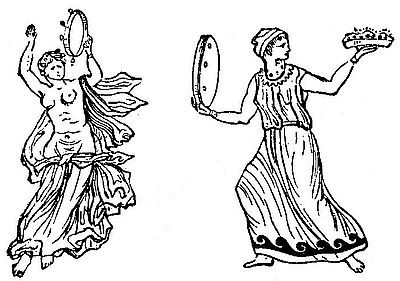
Tympana. (From ancient Paintings.)
TỸRANNUS (τύραννος). In the heroic age all the governments in Greece were monarchical, the king uniting in himself the functions of the priest, the judge, and military chief. In the first two or three centuries following the Trojan war various causes were at work, which led to the abolition, or at least to the limitation, of the kingly power. Emigrations, extinctions of families, disasters in war, civil dissensions, may be reckoned among these causes. Hereditary monarchies became elective; the different functions of the king were distributed; he was called Archon (ἄρχων), Cosmus (κόσμος), or Prytanis (πρύτανις), instead of Basileus (βασιλεύς), and his character was changed no less than his name. Noble and wealthy families began to be considered on a footing of equality with royalty; and thus in process of time sprang up oligarchies or aristocracies, which most of the governments that succeeded the ancient monarchies were in point of fact, though not as yet called by such names. These oligarchies did not possess the elements of social happiness or stability. The principal families contended with each other for the greatest share of power, and were only unanimous in disregarding the rights of those whose station was beneath their own. The people, oppressed by the privileged classes, began to regret the loss of their old paternal form of government; and were ready to assist any one who would attempt to restore it. Thus were opportunities offered to ambitious and designing men to raise themselves, by starting up as the champions of popular right. Discontented nobles were soon found to prosecute schemes of this sort, and they had a greater chance of success, if descended from the ancient royal family. Pisistratus is an example; he was the more acceptable to the people of Athens, as being a descendant of the family of Codrus. Thus in many cities arose that species of monarchy which the Greeks called tyrannis (τυραννίς), which meant only a despotism, or irresponsible dominion of one man; and which frequently was nothing more than a revival of the ancient government, and, though unaccompanied with any recognised hereditary title, or the reverence attached to old name and long prescription, was hailed by the lower orders of people as a good exchange, after suffering under the domination of the oligarchy. All tyrannies, however, were not so acceptable to the majority; and sometimes we find the nobles concurring in the elevation of a despot, to further their own interests. Thus the Syracusan Gamori, who had been expelled by the populace, on receiving the protection of Gelon, sovereign of Gela and Camarina, enabled him to take possession of Syracuse, and establish his kingdom there. Sometimes the conflicting parties in the state, by mutual consent, chose some eminent man, in whom they had confidence, to reconcile their dissensions; investing him with a sort of dictatorial power for that purpose, either for a limited period or otherwise. Such a person they called Aesymnetes (αἰσυμνήτης). The tyrannus must be distinguished, on the one hand, from the aesymnetes, inasmuch as he was not elected by general consent, but commonly owed his elevation to some violent movement or stratagem, such as the creation of a body-guard for him by the people, or the seizure of the citadel; and on the other hand, from the ancient king, whose right depended, not on usurpation, but on inheritance and traditionary acknowledgment. The power of a king might be more absolute than that of a tyrant; as Phidon of Argos is said to have made the royal prerogative greater than it was under his predecessors; yet he was still regarded as a king; for the difference between the two names depended on title and origin, and not on the manner in which the power was exercised. The name of tyrant was originally so far from denoting a person who abused his power, or treated his subjects with cruelty, that Pisistratus is praised for the moderation of his government. Afterwards, when tyrants themselves had become odious, the name also grew to be a word of reproach, just as rex did among the Romans. Among the early tyrants of Greece those most worthy of mention are: Clisthenes of Sicyon, grandfather of the Athenian Clisthenes, in whose family the government continued for a century since its establishment by Orthagoras, about B.C. 672; Cypselus of Corinth, who expelled the Bacchiadae, B.C. 656, and his son Periander, both remarkable for their cruelty; their dynasty lasted between seventy and eighty years; Procles of Epidaurus; Pantaleon of Pisa, who celebrated the thirty-fourth Olympiad, depriving the Eleans of the presidency; Theagenes of Megara, father-in-law to Cylon the Athenian; Pisistratus, whose sons were the last of the early tyrants on the Grecian continent. In Sicily, where tyranny most flourished, the principal were Phalaris of Agrigentum, who established his power in B.C. 568; Theron of Agrigentum; Gelon, already mentioned, who, in conjunction with Theron, defeated Hamilcar the Carthaginian, on the same day on which the battle of Salamis was fought; and Hieron, his brother: the last three celebrated by Pindar. The following also are worthy of notice: Polycrates of Samos; Lygdamis of Naxos; Histiaeus and Aristagoras of Miletus. Perhaps the last mentioned can hardly be classed among the Greek tyrants, as they were connected with the Persian monarchy. The general characteristics of a tyranny were, that it was bound by no laws, and had no recognised limitation to its authority, however it might be restrained in practice by the good disposition of the tyrant himself, or by fear, or by the spirit of the age. It was commonly most odious to the wealthy and noble, whom the tyrant looked upon with jealousy as a check upon his power, and whom he often sought to get rid of by sending them into exile or putting them to death. The tyrant usually kept a body-guard of foreign mercenaries, by aid of whom he controlled the people at home; but he seldom ventured to make war, for fear of giving an opportunity to his subjects to revolt. The causes which led to the decline of tyranny among the Greeks were partly the degeneracy of the tyrants themselves, corrupted by power, indolence, flattery, and bad education; for even where the father set a good example, it was seldom followed by the son; partly the cruelties and excesses of particular men, which brought them all into disrepute; and partly the growing spirit of inquiry among the Greek people, who began to speculate upon political theories, and soon became discontented with a form of government, which had nothing in theory, and little in practice, to recommend it. Few dynasties lasted beyond the third generation. Most of the tyrannies, which flourished before the Persian war, are said to have been overthrown by the exertions of Sparta, jealous, probably, of any innovation upon the old Doric constitution, especially of any tendency to ameliorate the condition of the Periocci, and anxious to extend her own influence over the states of Greece by means of the benefits which she conferred. Upon the fall of tyranny, the various republican forms of government were established, the Dorian states generally favouring oligarchy, the Ionian democracy. Of the tyrants of a later period, the most celebrated are the two Dionysii. The corruption of the Syracusans, their intestine discords, and the fear of the Carthaginian invaders, led to the appointment of Dionysius to the chief military command, with unlimited powers; by means of which he raised himself to the throne, B.C. 406, and reigned for 38 years, leaving his son to succeed him. The younger Dionysius, far inferior in every respect to his father, was expelled by Dion, afterwards regained the throne, and was again expelled by Timoleon, who restored liberty to the various states of Sicily.