T (continued 2)
Reading edition
TORQUES or TORQUIS (στρεπτός), an ornament of gold, twisted spirally and bent into a circular form, which was worn round the neck by men of distinction among the Persians, the Gauls, and other Asiatic and northern nations. It was by taking a collar from a Gallic warrior that T. Manlius obtained the cognomen of Torquatus. Such collars were among the rewards of valour bestowed after an engagement upon those who had most distinguished themselves.
TŎRUS, a bed covered with sheets or blankets, called Toralia.
TRĂBEA. [Toga.]
TRĂGOEDIA (τραγῳδία), tragedy. (1) Greek. The tragedy of the ancient Greeks as well as their comedy confessedly originated in the worship of the god Dionysus. The peculiarity which most strikingly distinguishes the Greek tragedy from that of modern times, is the lyrical or choral part. This was the offspring of the dithyrambic and choral odes from which, as applied to the worship of Dionysus, Greek tragedy took its rise. The name of Tragedy (τραγῳδία) is probably derived from the goatlike appearance of the Satyrs who sang or acted with mimetic gesticulations (ὄρχησις) the old Bacchic songs, with Silenus, the constant companion of Dionysus, for their leader. The Dionysian dithyrambs were sometimes of a gay and at other times of a mournful character: it was from the latter that the stately and solemn tragedy of the Greeks arose. Great improvements were introduced in the dithyramb by Arion, a contemporary of Periander. Before his time the dithyramb was sung in a wild and irregular manner; but he is said to have invented the Cyclic chorus, by which we are to understand that the Dithyramb was danced by a chorus of fifty men round an altar. The choral Dithyrambic songs prevailed to some extent, as all choral poetry did, amongst the Dorians of the Peloponnesus; whence the choral element of the Attic tragedy was always written in the Dorian dialect, thus showing its origin. The lyrical poetry was, however, especially popular at Sicyon and Corinth. In the latter city Arion made his improvements; in the former “tragic choruses,” i.e. dithyrambs of a sad and plaintive character, were very ancient. From the more solemn Dithyrambs then, as improved by Arion, ultimately sprang the dramatic tragedy of Athens, somewhat in the following manner. The choruses were under the direction of a leader or exarchus, who, it may be supposed, came forward separately, and whose part was sometimes taken by the poet himself. We may also conjecture that the exarchus in each case led off by singing or reciting his part in a solo, and that the chorus dancing round the altar then expressed their feelings of joy or sorrow at his story, representing the perils and sufferings of Dionysus, or some hero, as it might be. The subjects of this Dithyrambic tragedy were not, however, always confined to Dionysus. Even Arion wrote Dithyrambs, relating to different heroes, a practice in which he was followed by succeeding poets. It is easy to conceive how the introduction of an actor or speaker independent of the chorus might have been suggested by the exarchs coming forward separately and making short off-hand speeches, whether learnt by heart beforehand, or made on the spur of the moment. [Chorus.] But it is also possible, if not probable, that it was suggested by the rhapsodical recitations of the epic and gnomic poets formerly prevalent in Greece: the gnomic poetry being generally written in Iambic verse, the metre of the Attic dialogue. This however is certain, that the union of the Iambic dialogue with the lyrical chorus took place at Athens under Pisistratus, and that it was attributed to Thespis, a native of Icaria, one of the country demes or parishes of Attica where the worship of Dionysus had long prevailed. The alteration made by him, and which gave to the old tragedy a new and dramatic character, was very simple but very important. He introduced an actor, as it is recorded, for the sake of giving rest to the chorus, and independent of it, in which capacity he probably appeared himself, taking various parts in the same piece, under various disguises, which he was enabled to assume by means of linen masks, the invention of which is attributed to him. Now as a chorus, by means of its leader, could maintain a dialogue with the actor, it is easy to see how with one actor only a dramatic action might be introduced, continued, and concluded, by the speeches between the choral songs expressive of the joy or sorrow of the chorus at the various events of the drama. With respect to the character of the drama of Thespis there has been much doubt: some writers, and especially Bentley, have maintained that his plays were all satyrical and ludicrous, i.e. the plot of them was some story of Bacchus, the chorus consisted principally of satyrs, and the argument was merry. But perhaps the truth is that in the early part of his career Thespis retained the satyrical character of the older tragedy, but afterwards inclined to more serious compositions, which would almost oblige him to discard the Satyrs from his choruses. That he did write serious dramas is intimated by the titles of the plays ascribed to him, as well as by the character of the fragments of Iambic verse quoted by ancient writers as his. It is evident that the introduction of the dialogue must also have caused an alteration in the arrangement of the chorus, which could not remain cyclic or circular, but must have been drawn up in a rectangular form about the thymele or altar of Bacchus in front of the actor, who was elevated on a platform or table (ἐλεός), the forerunner of the stage. The lines of Horace (Ar. Poet. 276):—
“Dicitur et plaustris vexisse poemata Thespis, Quae canerent agerentque peruncti faecibus ora”—
are founded on a misconception of the origin of the Attic tragedy, and the tale about the waggons of Thespis probably arose out of a confusion of the waggon of the comedian Susarion with the platform of the Thespian actor. The first representation of Thespis was in B.C. 535. His immediate successors were the Athenian Choerilus and Phrynichus, the former of whom represented plays as early as B.C. 524. Phrynichus was a pupil of Thespis, and gained his first victory in the dramatic contests B.C. 511. In his works, the lyric or choral element still predominated over the dramatic, and he was distinguished for the sweetness of his melodies, which in the time of the Peloponnesian war were very popular with the admirers of the old style of music. The first use of female masks is also attributed to him, and he so far deviated from the general practice of the Attic tragedians as to write a drama on a subject of contemporary history, the capture of Miletus by the Persians, B.C. 494.—We now come to the first writer of Satyrical dramas, Pratinas of Phlius, a town not far from Sicyon, and which laid claim to the invention of tragedy as well as comedy. For some time previously to this poet, and probably as early as Thespis, tragedy had been gradually departing more and more from its old characteristics, and inclining to heroic fables, to which the chorus of Satyrs was not a fit accompaniment. But the fun and merriment caused by them were too good to be lost. Accordingly the Satyrical drama, distinct from the recent and dramatic tragedy, but suggested by the sportive element of the old Dithyramb, was founded by Pratinas, who however appears to have been surpassed in his own invention by Choerilus. It was always written by tragedians, and generally three tragedies and one Satyrical piece were represented together, which in some instances at least formed a connected whole, called a tetralogy (τετραλογία). The Satyrical piece was acted last, so that the minds of the spectators were agreeably relieved by a merry after-piece at the close of an earnest and engrossing tragedy. The distinguishing feature of this drama was the chorus of Satyrs, in appropriate dresses and masks, and its subjects seem to have been taken from the same class of the adventures of Bacchus and of the heroes as those of tragedy; but of course they were so treated and selected, that the presence of rustic satyrs would seem appropriate. In their jokes and drollery consisted the merriment of the piece; for the kings and heroes who were introduced into their company were not of necessity thereby divested of their epic and legendary character, though they were obliged to conform to their situation and suffer some diminution of dignity, from their position. Hence Horace (Ar. Poet. 231) says:—
“Effutire leves indigna Tragoedia versus Intererit Satyris paulum pudibunda protervis.”—
alluding in the first line to the mythic or epic element of the Satyric drama, which he calls Tragoedia, and in the second representing it as being rather ashamed of its company. The “Cyclops” of Euripides is the only Satyric drama now extant.—The great improvements in tragedy were introduced by Aeschylus. This poet added a second actor, diminished the parts of the chorus, and made the dialogue the principal part of the action. He also availed himself of the aid of Agatharchus, the scene-painter, and improved the costume of his actors by giving them thick-soled boots (ἐμβάται), as well as the masks, which he made more expressive and characteristic. Horace (Ar. Poet. 278) thus alludes to his improvements:—
“personae pallaeque repertor honestae Aeschylus, et modicis instravit pulpita tignis Et docuit magnumque loqui, nitique cothurno.”—
The custom of contending with trilogies (τριλογίαι), or with three plays at a time, is said to have been also introduced by him. In fact he did so much for tragedy, and so completely built it up to its “towering height,” that he was considered the father of it. The subjects of his dramas were not connected with the worship of Dionysus; but rather with the great cycle of Hellenic legends and some of the myths of the Homeric Epos. Accordingly, he said of himself that his dramas were but scraps and fragments from the great feasts of Homer. In the latter part of his life Aeschylus made use of one of the improvements of Sophocles, namely the τριταγωνιστής, or third actor. This was the finishing stroke to the dramatic element of Attic tragedy, which Sophocles is said to have matured by further improvements in costume and scene-painting. Under him tragedy appears with less of sublimity and sternness than in the hands of Aeschylus, but with more of calm grandeur and quiet dignity and touching incident. The plays of Sophocles are the perfection of the Grecian tragic drama, as a work of art and poetic composition in a thoroughly chastened and classic style. In the hands of Euripides tragedy deteriorated not only in dignity, but also in its moral and religious significance. He introduces his heroes in rags and tatters, and busies them with petty affairs, and makes them speak the language of every-day life. As Sophocles said of him, he represented men not as they ought to be, but as they are, without any ideal greatness or poetic character. His dialogues too were little else than the rhetorical and forensic language of his day cleverly put into verse: full of sophistry and quibbling distinctions. One of the peculiarities of his tragedies was the πρόλογος, an introductory monologue, with which some hero or god opens the play, telling who he is, what is the state of affairs, and what has happened up to the time of his address, so as to put the audience in possession of every fact which it might be necessary for them to know: a very business-like proceeding no doubt, but a poor make-shift for artistical skill. The “Deus ex machina,” also, though not always, in a “nodus, tali vindice dignus,” was frequently employed by Euripides to effect the dénoûment of his pieces. The chorus too no longer discharged its proper and high functions either as a representative of the feelings of unprejudiced observers, or, as one of the actors, and a part of the whole, joining in the development of the piece. Many of his choral odes in fact are but remotely connected in subject with the action of the play. Another novelty of Euripides was the use of the monodies or lyrical songs, in which not the chorus, but the principal persons of the drama, declare their emotions and sufferings. Euripides was also the inventor of tragi-comedy. A specimen of the Euripidean tragi-comedy is still extant in the Alcestis, acted B.C. 438, as the last of four pieces, and therefore as a substitute for a Satyrical drama. Though tragic in its form and some of its scenes, it has a mixture of comic and satyric characters (e.g. Hercules) and concludes happily.—The parts which constitute a Greek tragedy, as to its form, are, the prologue, episode, exode, and choral songs; the last divided into the parode and stasimon. The πρόλογος is all that part of a tragedy which precedes the parodos of the chorus, i.e. the first act. The ἐπεισόδιον is all the part between whole choral odes. The ἔξοδος that part which has no choral ode after it. Of the choral part the πάροδος is the first speech of the whole chorus (not broken up into parts): the stasimon is without anapaests and trochees. These two divisions were sung by all the choreutae, but the “songs on the stage” and the κόμμοι by a part only. The commus, which properly means a wailing for the dead, was generally used to express strong excitement, or lively sympathy with grief and suffering, especially by Aeschylus. It was common to the actors and a portion only of the chorus. Again the πάροδος was so named as being the passage-song of the chorus sung while it was advancing to its proper place in the orchestra, and therefore in anapaestic or marching verse: the στάσιμον, as being chaunted by the chorus when standing still in its proper position.—The materials of Greek tragedy were the national mythology,
“Presenting Thebes, or Pelop’s line, Or the tale of Troy divine.”
The exceptions to this were the two historical tragedies, the “Capture of Miletus” by Phrynichus, and the “Persians” of Aeschylus; but they belong to an early period of the art. Hence the plot and story of the Grecian tragedy were of necessity known to the spectators, a circumstance which strongly distinguishes the ancient tragedy from the modern.—The functions of the Chorus in Greek Tragedy were very important, as described by Horace (Ar. Poet. 193),
“Actoris partes chorus officiumque virile Defendat: neu quid medios intercinat actus, Quod non proposito conducat, et haereat apte,” &c.
It often expresses the reflections of a dispassionate and right-minded spectator, and inculcates the lessons of morality and resignation to the will of heaven, taught by the occurrence of the piece in which it is engaged. With respect to the number of the chorus see Chorus.—(2) Roman. The tragedy of the Romans was borrowed from the Greek, but the construction of the Roman theatre afforded no appropriate place for the chorus, which was therefore obliged to appear on the stage, instead of in the orchestra. The first tragic poet and actor at Rome was Livius Andronicus, a Greek by birth, who began to exhibit in B.C. 240. In his monodies (or the lyrical parts sung, not by a chorus, but by one person), it was customary to separate the singing from the mimetic dancing, leaving the latter only to the actor, while the singing was performed by a boy placed near the flute-player (ante tibicinem); so that the dialogue only (diverbia) was left to be spoken by the actors. Livius Andronicus was followed by Naevius, Ennius, Pacuvius, and Attius. These five poets belong to the earlier epoch of Roman tragedy, in which little was written but translations and imitations of the Greek, with occasional insertions of original matter. How they imitated the structure of the choral odes is doubtful—perhaps they never attempted it. In the age of Augustus the writing of tragedies, whether original or imitations, seems to have been quite a fashionable occupation. The emperor himself attempted an Ajax, but did not succeed. One of the principal tragedians of this epoch was Asinius Pollio, to whom the line (Virg. Eclog. viii. 10) applies—
“Sola Sophocleo tua carmina digna cothurno.”
Ovid wrote a tragedy on the subject of Medea. Quintilian says of Varius, who was distinguished in epic as well as tragic poetry, that his Thyestes might be compared with any of the Greek tragedies. Some fragments of this Thyestes are extant, but we have no other remains of the tragedy of the Augustan age. The loss perhaps is not great. The only complete Roman tragedies that have come down to us are the ten attributed to the philosopher Seneca; but whether he wrote any of them or not is a disputed point. To whatever age they belong, they are beyond description bombastic and frigid, utterly unnatural in character and action, full of the most revolting violations of propriety, and barren of all theatrical effect. Still they have had admirers: Heinsius calls the Hippolytus “divine,” and prefers the Troades to the Hecuba of Euripides: even Racine has borrowed from the Hippolytus in Phèdre. Roman tragedians sometimes wrote tragedies on subjects taken from their national history. Pacuvius, e.g. wrote a Paulus, L. Accius a Brutus and a Decius. Curiatius Maternus, also a distinguished orator in the reign of Domitian, wrote a Domitius and a Cato, the latter of which gave offence to the rulers of the state.
TRĀGŬLA. [Hasta.]
TRANSTRA. [Navis.]
TRANSVECTĬO ĔQUĬTUM. [Equites, p. 157.]
TRIĀRĬI. [Exercitus.]
TRĪBŬLA or TRĪBŬLUM (τριβόλος), a corn-drag, consisting of a thick and ponderous wooden board, which was armed underneath with pieces of iron or sharp flints, and drawn over the corn by a yoke of oxen, either the driver or a heavy weight being placed upon it, for the purpose of separating the grain and cutting the straw.
TRĬBŬLUS (τρίβολος), a caltrop, also called murex. When a place was beset with troops, the one party endeavoured to impede the cavalry of the other party, either by throwing before them caltrops, which necessarily lay with one of their four sharp points turned upwards, or by burying the caltrops with one point at the surface of the ground.
TRĬBŪNAL, a raised platform, on which the praetor and judices sat in the Basilica. [Basilica.] There was a tribunal in the camp, which was generally formed of turf, but sometimes, in a stationary camp, of stone, from which the general addressed the soldiers, and where the consul and tribunes of the soldiers administered justice. When the general addressed the army from the tribunal the standards were planted in front of it, and the army placed round it in order. The address itself was called Allocutio.
TRĬBŪNUS, a tribune. This word seems originally to have indicated an officer connected with a tribe (tribus), or who represented a tribe for certain purposes; and this is indeed the character of the officers who were designated by it in the earliest times of Rome, and may be traced also in the later officers of this name.—(1) Tribunes of the three ancient tribes.—At the time when all the Roman citizens were contained in the three tribes of the Ramnes, Tities, and Luceres, each of them was headed by a tribune, and these three tribunes represented their respective tribes in all civil, religious, and military affairs; that is to say, they were in the city the magistrates of the tribes, and performed the sacra on their behalf, and in times of war they were their military commanders. The tribunus celerum was the commander of the celeres, the king’s body-guard, and not the tribune of the tribe of the Ramnes, as is supposed by some modern writers. In what manner the tribunus celerum was appointed is uncertain, but it is probable that he was elected by the tribes; for we find that when the imperium was to be conferred upon the king, the comitia were held under the presidency of the tribunus celerum; and in the absence of the king, to whom this officer was next in rank, he convoked the comitia: it was in an assembly of this kind that Brutus proposed to deprive Tarquinius of the imperium. A law passed under the presidency of the tribunus celerum was called a lex tribunicia, to distinguish it from one passed under the presidency of the king. The tribunes of the three ancient tribes ceased to be appointed when these tribes themselves ceased to exist as political bodies, and when the patricians became incorporated in the local tribes of Servius Tullius. [Tribus.]—(2) Tribunes of the Servian tribes (φύλαρχοι, τριττυάρχοι).—When Servius Tullius divided the commonalty into thirty local tribes, we again find a tribune at the head of these tribes. The duties of these tribunes, who were without doubt the most distinguished persons in their respective districts, appear to have consisted at first in keeping a register of the inhabitants in each district, and of their property, for purposes of taxation, and for levying the troops for the armies. When subsequently the Roman people became exempted from taxes, the main part of their business was taken from them, but they still continued to exist. The tribuni aerarii, who occur down to the end of the republic, were perhaps only the successors of the tribunes of the tribes. When (B.C. 406) the custom of giving pay (stipendium) to the soldiers was introduced, each of the tribuni aerarii had to collect the tributum in his own tribe, and with it to pay the soldiers; and in case they did not fulfil this duty, the soldiers had the right of pignoris capio against them. In later times their duties appear to have been confined to collecting the tributum, which they made over to the military quaestors who paid the soldiers. [Quaestor.] The Lex Aurelia, B.C. 70, called the tribuni aerarii to the exercise of judicial functions, along with the senators and equites, as these tribunes represented the body of the most respectable citizens. But of this distinction they were subsequently deprived by Julius Caesar.—(3) Tribuni Plebis (δήμαρχοι, the office δημαρχία).—The ancient tribunes of the plebeian tribes had undoubtedly the right of convoking the meetings of their tribes, and of maintaining the privileges granted to them by king Servius, and subsequently by the Valerian laws. But this protection was very inadequate against the insatiable ambition and usurpations of the patricians. When the plebeians, impoverished by long wars, and cruelly oppressed by the patricians, at last seceded in B.C. 494 to the Mons Sacer, the patricians were obliged to grant to the plebeians the right of appointing tribunes (tribuni plebis) with more efficient powers to protect their own order than those which were possessed by the heads of the tribes. The purpose for which they were appointed was only to afford protection against any abuse on the part of the patrician magistrates; and that they might be able to afford such protection their persons were declared sacred and inviolable, and it was agreed that whoever invaded this inviolability should be an outlaw, and that his property should be forfeited to the temple of Ceres. A subsequent law enacted that no one should oppose or interrupt a tribune while addressing the people, and that whoever should act contrary to this ordinance should give bail to the tribunes for the payment of whatever fine they should affix to his offence in arraigning him before the commonalty; if he refused to give bail, his life and property were forfeited. The tribunes were thus enabled to afford protection to any one who appealed to the assembly of the commonalty or required any other assistance. They were essentially the representatives and the organs of the plebeian order, and their sphere of action was the comitia tributa. With the patricians and their comitia they had nothing to do. The tribunes themselves, however, were not judges, and could inflict no punishments, but could only propose the imposition of a fine to the commonalty (multam irrogare). The tribunes were thus in their origin only a protecting magistracy of the plebs, but in the course of time their power increased to such a degree that it surpassed that of all other magistrates, and the tribunes then became a magistracy for the whole Roman people, in opposition to the senate and the oligarchical party in general, although they had nothing to do with the administration or the government. During the latter period of the republic they became true tyrants, and may be compared to the national convention of France during the first revolution. At first the number of the tribunes was only two, but soon afterwards they were increased to five, one being taken from each of the five classes, and subsequently to ten, two being taken from each of the five classes. This last number appears to have remained unaltered down to the end of the empire. The tribunes entered upon their office on the 10th of December, but were elected, at least in the time of Cicero, on the 17th of July. It is almost superfluous to state that none but plebeians were eligible to the office of tribune; hence when, towards the end of the republic, patricians wished to obtain the office, they were obliged first to renounce their own order and to become plebeians; hence also under the empire it was thought that the princeps should not be tribune because he was a patrician. But the influence which belonged to this office was too great for the emperors not to covet it. Hence Augustus was made tribune for life. During the republic, however, the old regulation remained in force, even after the tribunes had ceased to be the protectors of the plebs alone. There is only one instance recorded in which patricians were elected to the tribuneship, and this was probably the consequence of an attempt to divide the tribuneship between the two orders. Although nothing appears to be more natural than that the tribunes should originally have been elected by that body of Roman citizens which they represented, yet the subject is involved in considerable obscurity. Some writers state that they were elected by the comitia of the curies; others suppose that they were elected in the comitia of the centuries; but whether they were elected in the latter or in the comitia of the tribes, it is certain that at first the sanction of the curies to the election was at all events necessary. But after the time of the Lex Publilia (B.C. 472) the sanction of the curies is not heard of, and the election of the tribunes was left entirely to the comitia tributa, which were convoked and held for this purpose by the old tribunes previous to the expiration of their office. One of the old tribunes was appointed by lot to preside at the election. As the meeting could not be prolonged after sunset, and the business was to be completed in one day, it sometimes happened that it was obliged to break up before the election was completed, and then those who were elected filled up the legitimate number of the college by cooptatio. But in order to prevent this irregularity, the tribune L. Trebonius, in 448 B.C., got an ordinance passed, according to which the college of the tribunes should never be completed by cooptatio, but the elections should be continued on the second day, if they were not completed on the first, till the number ten was made up. The place where the election of the tribunes was held was originally and lawfully the Forum, afterwards also the Campus Martius, and sometimes the area of the Capitol.—We now proceed to trace the gradual growth of the tribunitian power. Although its original character was merely protection (auxilium or βοήθεια) against patrician magistrates, the plebeians appear early to have regarded their tribunes also as mediators or arbitrators in matters among themselves. The whole power possessed by the college of tribunes was designated by the name tribunicia potestas, and extended at no time farther than one mile beyond the gates of the city; at a greater distance than this they came under the imperium of the magistrates, like every other citizen. As they were the public guardians, it was necessary that every one should have access to them and at any time; hence the doors of their houses were open day and night for all who were in need of help and protection, which they were empowered to afford against any one, even against the highest magistrates. For the same reason a tribune was not allowed to be absent from the city for a whole day, except during the Feriae Latinae, when the whole people were assembled on the Alban Mount. In B.C. 456 the tribunes, in opposition to the consuls, assumed the right of convoking the senate, in order to lay before it a rogation, and discuss the same; for until that time the consuls alone had had the right of laying plebiscita before the senate for approbation. Some years after, B.C. 452, the tribunes demanded of the consuls to request the senate to make a senatusconsultum for the appointment of persons to frame a new legislation; and during the discussions on this subject the tribunes themselves were present in the senate. The written legislation which the tribunes then wished can only have related to their own order; but as such a legislation would only have widened the breach between the two orders, they afterwards gave way to the remonstrances of the patricians, and the new legislation was to embrace both orders. From the second decemvirate the tribuneship was suspended, but was restored after the legislation was completed, and now assumed a different character from the change that had taken place in the tribes. [Tribus.] The tribunes now had the right to be present at the deliberations of the senate; but they did not sit among the senators themselves, but upon benches before the opened doors of the senate house. The inviolability of the tribunes, which had before only rested upon a contract between the two estates, was now sanctioned and confirmed by a law of M. Horatius. As the tribes now also included the patricians and their clients, the tribunes might naturally be asked to interpose on behalf of any citizen, whether patrician or plebeian. Hence the patrician ex-decemvir, Appius Claudius, implored the protection of the tribunes. About this time the tribunes also acquired the right of taking the auspices in the assemblies of the tribes. They also assumed again the right, which they had exercised before the time of the decemvirate, of bringing patricians who had violated the rights of the plebeians before the comitia of the tribes. By the Lex Valeria passed in the Comitia Centuriata (B.C. 449), it was enacted that a plebiscitum, which had been voted by the tribes, should bind the patricians as well. While the college thus gained outwardly new strength every day, a change took place in its internal organisation, which to some extent paralysed its powers. Before B.C. 394, every thing had been decided in the college by a majority; but about this time, we do not know how, a change was introduced, which made the opposition (intercessio) of one tribune sufficient to render a resolution of his colleagues void. This new regulation does not appear in operation till 394 and 393 B.C.; the old one was still applied in B.C. 421 and 415. From their right of appearing in the senate, and of taking part in its discussions, and from their being the representatives of the whole people, they gradually obtained the right of intercession against any action which a magistrate might undertake during the time of his office, and this even without giving any reason for it. Thus we find a tribune preventing a consul from convoking the senate, and preventing the proposal of new laws or elections in the comitia; they interceded against the official functions of the censors; and even against a command issued by the praetor. In the same manner a tribune might place his veto upon an ordinance of the senate; and he could thus either compel the senate to submit the subject to a fresh consideration, or could raise the session. In order to propose a measure to the senate they might themselves convene a meeting, or when it had been convened by a consul they might make their proposal even in opposition to the consul, a right which no other magistrates had in the presence of the consuls. The senate, on the other hand, had itself, in certain cases, recourse to the tribunes. Thus, in B.C. 431 it requested the tribunes to compel the consuls to appoint a dictator, in compliance with a decree of the senate, and the tribunes compelled the consuls, by threatening them with imprisonment, to appoint A. Postumius Tubertus dictator. From this time forward we meet with several instances in which the tribunes compelled the consuls to comply with the decrees of the senate, si non essent in auctoritate senatus, and to execute its commands. In their relation to the senate a change was introduced by the Plebiscitum Atinium, which ordained that a tribune, by virtue of his office, should be a senator. When this plebiscitum was made is uncertain; but we know that in B.C. 170 it was not yet in operation. It probably originated with C. Atinius, who was tribune in B.C. 132. But as the quaestorship, at least in later times, was the office which persons held previously to the tribuneship, and as the quaestorship itself conferred upon a person the right of a senator, the law of Atinius was in most cases superfluous.—In their relation to other magistrates we may observe, that the right of intercessio was not confined to stopping a magistrate in his proceedings, but they might even command their viatores to seize a consul or a censor, to imprison him, or to throw him from the Tarpeian rock. When the tribunes brought an accusation against any one before the people, they had the right of prehensio, but not the right of vocatio, that is, they might command a person to be dragged by their viatores before the comitia, but they could not summon him. They might, as in earlier times, propose a fine to be inflicted upon the person accused before the comitia, but in some cases they dropped this proposal and treated the case as a capital one. The college of tribunes had also the power of making edicts. In cases in which one member of the college opposed a resolution of his colleagues nothing could be done, and the measure was dropped; but this useful check was removed by the example of Tiberius Gracchus, in which a precedent was given for proposing to the people that a tribune obstinately persisting in his veto should be deprived of his office. From the time of the Hortensian law the power of the tribunes had been gradually rising to such a height that at length it was superior to every other in the state. They had acquired the right of proposing to the comitia tributa or the senate measures on nearly all the important affairs of the state, and it would be endless to enumerate the cases in which their power was manifested. Their proposals were indeed usually made ex auctoritate senatus, or had been communicated to and approved by it; but cases in which the people itself had a direct interest, such as a general legal regulation, granting of the franchise, a change in the duties and powers of a magistrate, and others, might be brought before the people, without their having been previously communicated to the senate, though there are also instances of the contrary. Subjects belonging to the administration could not be brought before the tribes without the tribunes having previously received through the consuls the auctoritas of the senate. This, however, was done very frequently, and hence we have mention of a number of plebiscita on matters of administration. It sometimes even occurs that the tribunes brought the question concerning the conclusion of peace before the tribes, and then compelled the senate to ratify the resolution, as expressing the wish of the whole people. Sulla, in his reform of the constitution on the early aristocratic principles, left to the tribunes only the jus auxiliandi, and deprived them of the right of making legislative or other proposals, either to the senate or the comitia, without having previously obtained the sanction of the senate. But this arrangement did not last, for Pompey restored to them their former rights. During the latter period of the republic, when the office of quaestor was in most cases held immediately before that of tribune, the tribunes were generally elected from among the senators, and this continued to be the case under the empire. Sometimes, however, equites also obtained the office, and thereby became members of the senate, where they were considered of equal rank with the quaestors. Tribunes of the people continued to exist down to the fifth century of our era, though their powers became naturally much limited, especially in the reign of Nero. They continued however to have the right of intercession against decrees of the senate, and on behalf of injured individuals.—(4) Tribuni militum cum consulari potestate. When in B.C. 445 the tribune C. Canuleius brought forward the rogation that the consulship should not be confined to either order, the patricians evaded the attempt by a change in the constitution; the powers which had hitherto been united in the consulship were now divided between two new magistrates, viz. the Tribuni militum cum consulari potestate and the censors. Consequently, in B.C. 444, three military tribunes, with consular power, were appointed, and to this office the plebeians were to be equally eligible with the patricians. For the years following, however, the people were to be at liberty, on the proposal of the senate, to decide whether consuls were to be elected according to the old custom, or consular tribunes. Henceforth, for many years, sometimes consuls and sometimes consular tribunes were appointed, and the number of the latter varied from three to four, until in B.C. 405 it was increased to six, and as the censors were regarded as their colleagues, we have sometimes mention of eight tribunes. At last, however, in B.C. 367, the office of these tribunes was abolished by the Licinian law, and the consulship was restored. These consular tribunes were elected in the comitia of the centuries, and undoubtedly with less solemn auspices than the consuls.—(5) Tribuni Militares [Exercitus, p. 169.]
TRĬBUS (φῦλον, φυλή), a tribe. (1) Greek. In the earliest times of Greek history mention is made of people being divided into tribes and clans. Homer speaks of such divisions in terms which seem to imply that they were elements that entered into the composition of every community. A person not included in any clan (ἀφρήτωρ), was regarded as a vagrant or outlaw. These divisions were rather natural than political, depending on family connection, and arising out of those times, when each head of a family exercised a patriarchal sway over its members. The bond was cemented by religious communion, sacrifices and festivals, which all the family or clansmen attended, and at which the chief usually presided.—Of the Dorian race there were originally three tribes, traces of which are found in all the countries which they colonised. Hence they are called by Homer Δωριέες τριχάϊκες. These tribes were the Hylleis (Ὑλλεῖς), Pamphyli (Πάμφυλοι), and Dymanatae or Dymanes (Δυμανάται or Δυμᾶνες). The first derived their name from Hyllus, son of Hercules, the two last from Pamphylus and Dymas, who are said to have fallen in the last expedition when the Dorians took possession of the Peloponnesus. The Hyllean tribe was perhaps the one of highest dignity; but at Sparta there does not appear to have been much distinction, for all the freemen there were by the constitution of Lycurgus on a footing of equality. To these three tribes others were added in different places, either when the Dorians were joined by other foreign allies, or when some of the old inhabitants were admitted to the rank of citizenship or equal privileges. Thus the Cadmean Aegeids are said by Herodotus to have been a great tribe at Sparta, descended (as he says) from Aegeus, grandson of Theras, though others have thought they were incorporated with the three Doric tribes. The subdivision of tribes into phratriae (φρατρίαι) or patrae (πάτραι), genē (γένη), trittyes (τρίττυες), &c. appears to have prevailed in various places. At Sparta each tribe contained ten obae (ὠβαί), a word denoting a local division or district; each obe contained ten triacades (τριακάδες), communities containing thirty families. But very little appears to be known of these divisions, how far they were local, or how far genealogical. After the time of Cleomenes the old system of tribes was changed; new ones were created corresponding to the different quarters of the town, and they seem to have been five in number.—The first Attic tribes that we read of are said to have existed in the reign, or soon after the reign, of Cecrops, and were called Cecropis (Κεκροπίς), Autochthon (Αὐτόχθων), Actaea (Ἀκταία), and Paralia (Παραλία). In the reign of a subsequent king, Cranaus, these names were changed to Cranais (Κραναΐς), Atthis (Ἀτθίς), Mesogaea (Μεσόγαια), and Diacris (Διακρίς). Afterwards we find a new set of names; Dias (Διάς), Athenais (Ἀθηναΐς), Poseidonias (Ποσειδωνιάς), and Hephaestias (Ἡφαιστιάς); evidently derived from the deities who were worshipped in the country. Some of those secondly mentioned, if not all of them, seem to have been geographical divisions; and it is not improbable that, if not independent communities, they were at least connected by a very weak bond of union. But all these tribes were superseded by four others, which were probably founded soon after the Ionic settlement in Attica, and seem to have been adopted by other Ionic colonies out of Greece. The names Geleontes (Γελέοντες), Hopletes (Ὅπλητες), Argades (Ἀργάδεις), Aegicores (Αἰγικορεῖς), are said by Herodotus to have been derived from the sons of Ion, son of Xuthus. Upon this, however, many doubts have been thrown by modern writers. The etymology of the last three names would seem to suggest, that the tribes were so called from the occupations which their respective members followed; the Hopletes being the armed men, or warriors; the Argades, labourers or husbandmen; the Aegicores, goatherds or shepherds. But whatever be the truth with respect to the origin of these tribes, one thing is certain, that before the time of Theseus, whom historians agree in representing as the great founder of the Attic commonwealth, the various people who inhabited the country continued to be disunited and split into factions.—Theseus in some measure changed the relations of the tribes to each other, by introducing a gradation of ranks in each; dividing the people into Eupatridae (Εὐπατρίδαι), Geomori (Γεωμόροι), and Demiurgi (Δημιουργοί), of whom the first were nobles, the second agriculturists or yeomen, the third labourers and mechanics. At the same time, in order to consolidate the national unity, he enlarged the city of Athens, with which he incorporated several smaller towns, made it the seat of government, encouraged the nobles to reside there, and surrendered a part of the royal prerogative in their favour. The tribes or phylae were divided, either in the age of Theseus or soon after, each into three phratriae (φρατρίαι, a term equivalent to fraternities, and analogous in its political relation to the Roman curiae), and each phratria into thirty gene (γένη, equivalent to the Roman Gentes), the members of a genos (γένος) being called gennetae (γεννῆται) or homogalactes (ὁμογαλάκτες). Each genos was distinguished by a particular name of a patronymic form, which was derived from some hero or mythic ancestor. These divisions, though the names seem to import family connection, were in fact artificial; which shows that some advance had now been made towards the establishment of a closer political union. The members of the phratriae and gene had their respective religious rites and festivals, which were preserved long after these communities had lost their political importance, and perhaps prevented them from being altogether dissolved.—After the age of Theseus, the monarchy having been first limited and afterwards abolished, the whole power of the state fell into the hands of the Eupatridae or nobles, who held all civil offices, and had besides the management of religious affairs, and the interpretation of the laws. Attica became agitated by feuds, and we find the people, shortly before the legislation of Solon, divided into three parties, Pediaei (Πεδιαῖοι) or lowlanders, Diacrii (Διάκριοι) or highlanders, and Parali (Πάραλοι) or people of the sea-coast. The first two remind us of the ancient division of tribes, Mesogaea and Diacris; and the three parties appear in some measure to represent the classes established by Theseus, the first being the nobles, whose property lay in the champaign and most fertile part of the country; the second, the smaller landowners and shepherds; the third, the trading and mining class, who had by this time risen in wealth and importance. To appease their discords, Solon was applied to; and thereupon framed his celebrated constitution and code of laws. Here we have only to notice that he retained the four tribes as he found them, but abolished the existing distinctions of rank, or at all events greatly diminished their importance, by introducing his property qualification, or division of the people into Pentacosiomedimni (Πεντακοσιομέδιμνοι), Hippeis (Ἱππεῖς), Zeugitae (Ζευγῖται), and Thetes (Θῆτες). [Census, Greek.] The enactments of Solon continued to be the law at Athens, though in great measure suspended by the tyranny, until the democratic reform effected by Clisthenes. He abolished the old tribes, and created ten new ones, according to a geographical division of Attica, and named after ten of the ancient heroes: Erechtheis, Aegeis, Pandionis, Leontis, Acamantis, Oeneis, Cecropis, Hippothoontis, Aeantis, Antiochis. These tribes were divided each into ten demi (δῆμοι), the number of which was afterwards increased by subdivision; but the arrangement was so made that several demi not contiguous or near to one another were joined to make up a tribe. [Demus.] The object of this arrangement was, that by the breaking of old associations a perfect and lasting revolution might be effected, in the habits and feelings, as well as the political organisation of the people. Solon allowed the ancient phratriae to exist, but they were deprived of all political importance. All foreigners admitted to the citizenship were registered in a phyle and demus, but not in a phratria or genos. The functions which had been discharged by the old tribes were now mostly transferred to the demi. Among others, we may notice that of the forty-eight naucrariae into which the old tribes had been divided for the purpose of taxation, but which now became useless, the taxes being collected on a different system. The reforms of Clisthenes were destined to be permanent. They continued to be in force (with some few interruptions) until the downfall of Athenian independence. The ten tribes were blended with the whole machinery of the constitution. Of the senate of five hundred, fifty were chosen from each tribe. The allotment of dicasts was according to tribes; and the same system of election may be observed in most of the principal offices of state, judicial and magisterial, civil and military, &c. In B.C. 307, Demetrius Poliorcetes increased the number of tribes to twelve by creating two new ones, namely, Antigonias and Demetrias, which afterwards received the names of Ptolemais and Attalis; and a thirteenth was subsequently added by Hadrian, bearing his own name.—(2) Roman. The three ancient Romulian tribes, the Ramnes, Tities, and Luceres, or the Ramnenses, Titienses, and Lucerenses, to which the patricians alone belonged, must be distinguished from the thirty plebeian tribes of Servius Tullius, which were entirely local, four for the city, and twenty-six for the country around Rome. The history and organisation of the three ancient tribes are spoken of under Patricii. They continued of political importance almost down to the period of the decemviral legislation; but after this time they no longer occur in the history of Rome, except as an obsolete institution. The institution and organisation of the thirty plebeian tribes, and their subsequent reduction to twenty by the conquests of Porsena, are spoken of under Plebes. The four city tribes were called by the same names as the regions which they occupied, viz. Suburana, Esquilina, Collina, and Palatina. The names of the sixteen country tribes which continued to belong to Rome after the conquest of Porsena, are in their alphabetical order as follows: Aemilia, Camilia, Cornelia, Fabia, Galeria, Horatia, Lemonia, Menemia, Papiria, Pollia, Popillia, upinia, Romilia, Sergia, Veturia, and Voltinia. As Rome gradually acquired possession of more of the surrounding territory, the number of tribes also was gradually increased. When Appius Claudius, with his numerous train of clients, emigrated to Rome, lands were assigned to them in the district where the Anio flows into the Tiber, and a new tribe, the tribus Claudia, was formed. This tribe was subsequently enlarged, and was then designated by the name Crustumina or Clustumina. This name is the first instance of a country tribe being named after a place, for the sixteen older ones all derived their name from persons or heroes. In B.C. 387, the number of tribes was increased to twenty-five by the addition of four new ones, viz. the Stellatina, Tromentina, Sabatina, and Arniensis. In B.C. 358 two more, the Pomptina and Publilia, were formed of Volscians. In B.C. 332, the censors Q. Publilius Philo and Sp. Postumius increased the number of tribes to twenty-nine, by the addition of the Maecia and Scaptia. In B.C. 318 the Ufentina and Falerina were added. In B.C. 299 two others, the Aniensis and Terentina, were added by the censors, and at last in B.C. 241, the number of tribes was augmented to thirty-five, by the addition of the Quirina and Velina. Eight new tribes were added upon the termination of the Social War, to include the Socii, who then obtained the Roman franchise; but they were afterwards incorporated among the old 35 tribes, which continued to be the number of the tribes to the end of the republic. When the tribes, in their assemblies, transacted any business, a certain order (ordo tribuum) was observed, in which they were called upon to give their votes. The first in the order of succession was the Suburana, and the last the Arniensis. Any person belonging to a tribe had in important documents to add to his own name that of his tribe, in the ablative case. Whether the local tribes, as they were established by the constitution of Servius Tullius, contained only the plebeians, or included the patricians also, is a point on which the opinions of modern scholars are divided: but it appears most probable that down to the decemviral legislation the tribes and their assemblies were entirely plebeian. From the time of the decemviral legislation, the patricians and their clients were undoubtedly incorporated in the tribes. Respecting the assemblies of the tribes, see Comitia Tributa.
TRĬBŪTUM, a tax which was partly applied to cover the expenses of war, and partly those of the fortifications of the city. The usual amount of the tax was one for every thousand of a man’s fortune, though in the time of Cato it was raised to three in a thousand. The tributum was not a property-tax in the strict sense of the word, for the accounts respecting the plebeian debtors clearly imply, that the debts were not deducted in the valuation of a person’s property, so that he had to pay the tributum upon property which was not his own, but which he owed, and for which he had consequently to pay the interest as well. It was a direct tax upon objects without any regard to their produce, like a land or house-tax, which indeed formed the main part of it. That which seems to have made it most oppressive, was its constant fluctuation. It was raised according to the regions or tribes instituted by Servius Tullius, and by the tribunes of these tribes, subsequently called tribuni aerarii. It was not, like the other branches of the public revenue, let out to farm, but being fixed in money it was raised by the tribunes, unless (as was the case after the custom of giving pay to the soldiers was introduced) the soldiers, like the knights, demanded it from the persons themselves who were bound to pay it. [Aes equestre and HORDEARIUM.] When this tax was to be paid, what sum was to be raised, and what portion of every thousand asses of the census, were matters upon which the senate alone had to decide. But when it was decreed, the people might refuse to pay it when they thought it too heavy, or unfairly distributed, or hoped to gain some other advantage by the refusal. In later times the senate sometimes left its regulation to the censors, who often fixed it very arbitrarily. No citizen was exempt from it, but we find that the priests, augurs, and pontiffs made attempts to get rid of it: but this was only an abuse, which did not last. After the war with Macedonia (B.C. 147), when the Roman treasury was filled with the revenues accruing from conquests and from the provinces, the Roman citizens became exempted from paying the tributum, and this state of things lasted down to the consulship of Hirtius and Pansa (43 B.C.), when the tributum was again levied, on account of the exhausted state of the aerarium. After this time it was imposed according to the discretion of the emperors. Respecting the tributum paid by conquered countries and cities, see Vectigalia.
TRICLĪNĬUM, the dining-room of a Roman house, the position of which, relatively to the other parts of the house, is seen in the “house of the Tragic poet” (see p. 144). It was of an oblong shape, and was twice as long as it was broad. The superintendence of the dining-room in a great house was intrusted to a slave called tricliniarcha, who, through other slaves, took care that everything was kept and proceeded in proper order. A triclinium generally contained three couches, and as the usual number of persons occupying each couch was three, the triclinium afforded accommodation for a party of nine. Sometimes, however, as many as four lay on each of the couches. Each man in order to feed himself lay flat upon his breast or nearly so, and stretched out his hand towards the table; but afterwards, when his hunger was satisfied, he turned upon his left side, leaning on his elbow. To this Horace alludes in describing a person sated with a particular dish, and turning in order to repose upon his elbow. (Sat. ii. 4, 39.) We find the relative positions of two persons who lay next to one another, commonly expressed by the prepositions super or supra, and infra. A passage of Livy (xxxix. 43), in which he relates the cruel conduct of the consul L. Quintius Flamininus, shows that infra aliquem cubare was the same as in sinu alicujus cubare, and consequently that each person was considered as below him to whose breast his own head approached. On this principle we are enabled to explain the denominations both of the three couches, and of the three places on each couch.
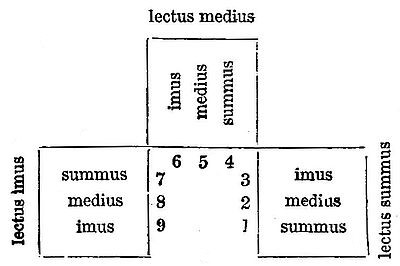
lectus medius
imus
medius
summus
lectus imus lectus summus
summus imus
medius medius
imus summus
Supposing the annexed arrangement to represent the plan of a triclinium, it is evident that, as each guest reclined on his left side, the countenances of all when in this position were directed, first, from No. 1 towards No. 3, then from No. 4 towards No. 6, and lastly, from No. 7 towards No. 9; that the guest No. 1 lay, in the sense explained, above No. 2, No. 3 below No. 2, and so of the rest; and that, going in the same direction, the couch to the right hand was above the others, and the couch to the left hand below the others. It will be found, that in a passage in the eighth satire of the second book of Horace, the guests are enumerated in the order of their accubation—an order exhibited in the annexed diagram.
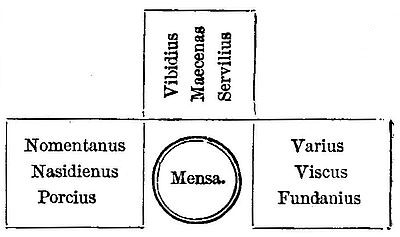
Vibidius
Maecenas
Servilius
Nomentanus Varius
Nasidienus (Mensa) Viscus
Porcius Fundanius
TRĬDENS. [Fuscina.]
TRĬENS. [As.]
TRIĒRARCHĬA (τριήραρχια), one of the extraordinary war services or liturgies at Athens, the object of which was to provide for the equipment and maintenance of the ships of war belonging to the state. The persons who were charged with it were called trierarchs (τριήραρχοι), as being the captains of triremes, though the name was also applied to persons who bore the same charge in other vessels. It existed from very early times in connection with the forty-eight naucraries of Solon, and the fifty of Clisthenes: each of which corporations appears to have been obliged to equip and man a vessel. [Naucraria.] Under the constitution of Clisthenes the ten tribes were at first severally charged with five vessels. This charge was of course superseded by the later forms of the hierarchy. The state furnished the ship, and either the whole or part of the ship’s rigging and furniture, and also pay and provisions for the sailors. The trierarchs were bound to keep in repair the ship and its furniture, and were frequently put to great expense in paying the sailors and supplying them with provisions, when the state did not supply sufficient money for the purpose. Moreover, some trierarchs, whether from ambitious or patriotic motives, put themselves to unnecessary expense in fitting out and rigging their ships, from which the state derived an advantage. The average expense of the trierarchy was 50 minae. In ancient times one person bore the whole charge of the trierarchy, afterwards it was customary for two persons to share it, who were then called syntrierarchs (συντριήραρχοι). When this practice was first introduced is not known, but it was perhaps about the year 412 B.C., after the defeat of the Athenians in Sicily, when the union of two persons for the choregia was first permitted. The syntrierarchy, however, did not entirely supersede the older and single form, being only meant as a relief in case of emergency, when there was not a sufficient number of wealthy citizens to bear the expense singly. In the case of a syntrierarchy the two trierarchs commanded their vessel in turn, six months each, according as they agreed between themselves.—The third form of the trierarchy was connected with, or suggested by, the syntrierarchy. In B.C. 358, the Athenians were unable to procure a sufficient number of legally appointed trierarchs, and accordingly they summoned volunteers. This, however, was but a temporary expedient; and as the actual system was not adequate to the public wants, they determined to manage the trierarchy somewhat in the same way as the property-tax (eisphora), namely, by classes or symmoriae, according to the law of Periander passed in B.C. 358, and which was the primary and original enactment on the subject. With this view 1200 synteleis (συντελεῖς) or partners were appointed, who were probably the wealthiest individuals of the state, according to the census or valuation. These were divided into 20 symmoriae (συμμορίαι) or classes; out of which a number of persons (σώματα) joined for the equipment or rather the maintenance and management of a ship, under the title of a synteleia (συντέλεια) or union. To every ship there was generally assigned a synteleia of fifteen persons of different degrees of wealth, as we may suppose, so that four ships only were provided for by each symmoria of sixty persons. It appears, however, that before Demosthenes carried a new law on this subject (B.C. 340), it had been customary for sixteen persons to unite in a synteleia or company for a ship, who bore the burden in equal shares. This being the case, it follows either that the members of the symmoriae had been by that time raised from 1200 to 1280, or that some alterations had taken place in their internal arrangements, of which no account has come down to us. The superintendence of the whole system was in the hands of the 300 wealthiest members, who were therefore called the “leaders of the symmoriae” (ἡγεμόνες τῶν συμμοριῶν), on whom the burdens of the trierarchy chiefly fell, or rather ought to have fallen. The services performed by individuals under this system appear to have been the same as before: the state still provided the ship’s tackle, and the only duty then of the trierarchs under this system was to keep their vessels in the same repair and order as they received them. But even from this they managed to escape: for the wealthiest members, who had to serve for their synteleia, let out their trierarchies for a talent, and received that amount from their partners (συντελεῖς), so that in reality they paid next to nothing, or, at any rate, not what they ought to have done, considering that the trierarchy was a ground of exemption from other liturgies.—To remedy these abuses Demosthenes carried a law when he was the ἐπιστάτης τοῦ ναυτικοῦ, or the superintendent of the Athenian navy, thereby introducing the Fourth form of the trierarchy. The provisions of the law were as follows: The naval services required from every citizen were to depend upon and be proportional to his property, or rather to his taxable capital, as registered for the symmoriae of the property-tax, the rate being one trireme for every ten talents of taxable capital, up to three triremes and one auxiliary vessel (ὑπηρέσιον) for the largest properties; i.e. no person, however rich, could be required to furnish more. Those who had not ten talents in taxable capital were to club together in synteleiae till they had made up that amount. By this law great changes were effected. All persons paying taxes were rated in proportion to their property, so that the poor were benefited by it, and the state likewise: for, as Demosthenes says, those who had formerly contributed one-sixteenth to the trierarchy of one ship were now trierarchs of two, in which case they must either have served by proxy, or done duty in successive years. He adds, that the consequences were highly beneficial. We do not know the amount of property which rendered a man liable to serve a trierarchy or syntrierarchy, but we read of no instance of liability arising from a property of less value than 500 minae. The appointment to serve under the first and second forms of the trierarchy was made by the strategi, and in case any person was appointed to serve a trierarchy, and thought that any one else (not called upon) was better able to bear it than himself, he offered the latter an exchange of his property [Antidosis] subject to the burden of the trierarchy. In cases of extreme hardship, persons became suppliants to the people, or fled to the altar of Artemis at Munychia. If not ready in time, they were sometimes liable to imprisonment. On the contrary, whoever got his ship ready first was to be rewarded with the “crown of the trierarchy;” so that in this way considerable emulation and competition were produced. Moreover, the trierarchs were ὑπεύθυνοι, or liable to be called to account for their expenditure; though they applied their own property to the service of the state. It has been already stated that the trierarchy was a ground of exemption from the other liturgies, any of which, indeed, gave an exemption, from all the rest during the following year.
TRĬNUNDĬNUM. [Nundinae.]
TRIŌBŎLON (τριώβολον), the fee of three obols, which the Athenian dicasts received. [Dicastae.]
TRĬPOS (τρίπους), a tripod, i.e. any utensil or article of furniture supported upon three feet. More especially (1) A three-legged table.—(2) A pot or caldron, used for boiling meat, and either raised upon a three-legged stand of bronze, or made with its three feet in the same piece.—(3) A bronze altar, not differing probably in its original form from the tall tripod caldron already described. It was from a tripod that the Pythian priestess at Delphi gave responses. [Cortina.] The celebrity of this tripod produced innumerable imitations of it, which were made to be used in sacrifice, and still more frequently to be presented to the treasury both in that place and in many other Greek temples.
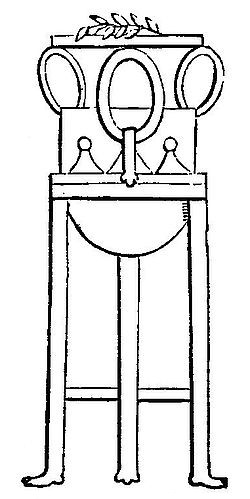
Tripod of Apollo at Delphi. (Böttiger’s Amalthea, vol. i. p. 119.)
TRĬPŬDĬUM. [Auspicium.]
TRIRĒMIS. [Navis.]
TRĬUMPHUS (θρίαμβος), a solemn procession, in which a victorious general entered the city in a chariot drawn by four horses. He was preceded by the captives and spoils taken in war, was followed by his troops, and after passing in state along the Via Sacra, ascended the Capitol to offer sacrifice in the temple of Jupiter. From the beginning of the republic down to the extinction of liberty a regular triumph (justus triumphus) was recognised as the summit of military glory, and was the cherished object of ambition to every Roman general. A triumph might be granted for successful achievements either by land or sea, but the latter were comparatively so rare that we shall for the present defer the consideration of the naval triumph. After any decisive battle had been won, or a province subdued by a series of successful operations, the imperator forwarded to the senate a laurel-wreathed dispatch (literae laureatae), containing an account of his exploits. If the intelligence proved satisfactory, the senate decreed a public thanksgiving. [Supplicatio.] After the war was concluded, the general with his army repaired to Rome, or ordered his army to meet him there on a given day, but did not enter the city. A meeting of the senate was held without the walls, usually in the temple either of Bellona or Apollo, that he might have an opportunity of urging his pretensions in person, and these were then scrutinised and discussed with the most jealous care. The following rules were for the most part rigidly enforced, although the senate assumed the discretionary power of relaxing them in special cases. 1. That no one could be permitted to triumph unless he had held the office of dictator, of consul, or of praetor. The honours granted to Pompey, who triumphed in his 24th year (B.C. 81) before he had held any of the great offices of state, and again ten years afterwards, while still a simple eques, were altogether unprecedented. 2. That the magistrate should have been actually in office both when the victory was gained and when the triumph was to be celebrated. This regulation was insisted upon only during the earlier ages of the commonwealth. Its violation commenced with Q. Publilius Philo, the first person to whom the senate ever granted a prorogatio imperii after the termination of a magistracy, and thenceforward proconsuls and propraetors were permitted to triumph without question. 3. That the war should have been prosecuted or the battle fought under the auspices and in the province and with the troops of the general seeking the triumph. Thus if a victory was gained by the legatus of a general who was absent from the army, the honour of it did not belong to the former, but to the latter, inasmuch as he had the auspices. 4. That at least 5000 of the enemy should have been slain in a single battle, that the advantage should have been positive, and not merely a compensation for some previous disaster, and that the loss on the part of the Romans should have been small compared with that of their adversaries. But still we find many instances of triumphs granted for general results, without reference to the numbers slain in any one engagement. 5. That the war should have been a legitimate contest against public foes, and not a civil contest. Hence Catulus celebrated no triumph over Lepidus, nor Antonius over Catiline, nor Cinna and Marius over their antagonists of the Sullan party, nor Caesar after Pharsalia; and when he did subsequently triumph after his victory over the sons of Pompey, it caused universal disgust. 6. That the dominion of the state should have been extended, and not merely something previously lost regained. The absolute acquisition of territory does not appear to have been essential. 7. That the war should have been brought to a conclusion and the province reduced to a state of peace, so as to permit of the army being withdrawn, the presence of the victorious soldiers being considered indispensable in a triumph. The senate claimed the exclusive right of deliberating upon all these points, and giving or withholding the honour sought, and they for the most part exercised the privilege without question, except in times of great political excitement. The sovereignty of the people, however, in this matter was asserted at a very early date, and a triumph is said to have been voted by the tribes to Valerius and Horatius, the consuls of B.C. 446, in direct opposition to the resolution of the fathers, and in a similar manner to C. Marcius Rutilus the first plebeian dictator, while L. Postumius Megellus, consul B.C. 294, celebrated a triumph, although resisted by the senate and seven out of the ten tribunes. Nay, more, we read of a certain Appius Claudius, consul B.C. 143, who having persisted in celebrating a triumph in defiance of both the senate and people, was accompanied by his daughter (or sister) Claudia, a vestal virgin, and by her interposition saved from being dragged from his chariot by a tribune. A disappointed general, however, seldom ventured to resort to such violent measures, but satisfied himself with going through the forms on the Alban Mount, a practice first introduced by C. Papirius Maso. If the senate gave their consent, they at the same time voted a sum of money towards defraying the necessary expenses, and one of the tribunes ex auctoritate senatus applied for a plebiscitum to permit the imperator to retain his imperium on the day when he entered the city. This last form could not be dispensed with either in an ovation or a triumph, because the imperium conferred by the comitia curiata did not include the city itself, and when a general had once gone forth paludatus, his military power ceased as soon as he re-entered the gates, unless the general law had been previously suspended by a special enactment; and in this manner the resolution of the senate was, as it were, ratified by the plebs. For this reason no one desiring a triumph ever entered the city until the question was decided, since by so doing he would ipso facto have forfeited all claim. We have a remarkable example of this in the case of Cicero, who after his return from Cilicia lingered in the vicinity of Rome day after day, and dragged about his lictors from one place to another, without entering the city, in the vain hope of a triumph.—In later times these pageants were marshalled with extraordinary pomp and splendour, and presented a most gorgeous spectacle. Minute details would necessarily be different according to circumstances, but the general arrangements were as follows. The temples were all thrown open, garlands of flowers decorated every shrine and image, and incense smoked on every altar. Meanwhile the imperator called an assembly of his soldiers, delivered an oration commending their valour, and concluded by distributing rewards to the most distinguished, and a sum of money to each individual, the amount depending on the value of the spoils. He then ascended his triumphal car and advanced to the Porta Triumphalis, where he was met by the whole body of the senate headed by the magistrates. The procession then defiled in the following order. 1. The senate headed by the magistrates. 2. A body of trumpeters. 3. A train of carriages and frames laden with spoils, those articles which were especially remarkable either on account of their beauty or rarity being disposed in such a manner as to be seen distinctly by the crowd. Boards were borne aloft on fercula, on which were painted in large letters the names of vanquished nations and countries. Here, too, models were exhibited in ivory or wood of the cities and forts captured, and pictures of the mountains, rivers, and other great natural features of the subjugated region, with appropriate inscriptions. Gold and silver in coin or bullion, arms, weapons, and horse furniture of every description, statues, pictures, vases, and other works of art, precious stones, elaborately wrought and richly embroidered stuffs, and every object which could be regarded as valuable or curious. 4. A body of flute players. 5. The white bulls or oxen destined for sacrifice, with gilded horns, decorated with infulae and serta, attended by the slaughtering priests with their implements, and followed by the Camilli bearing in their hands paterae and other holy vessels and instruments. 6. Elephants or any other strange animals, natives of the conquered districts. 7. The arms and insignia of the leaders of the foe. 8. The leaders themselves, and such of their kindred as had been taken prisoners, followed by the whole band of inferior captives in fetters. 9. The coronae and other tributes of respect and gratitude bestowed on the imperator by allied kings and states. 10. The lictors of the imperator in single file, their fasces wreathed with laurel. 11. The imperator himself in a circular chariot of a peculiar form, drawn by four horses, which were sometimes, though rarely, white. He was attired in a gold-embroidered robe (toga picta) and flowered tunic (tunica palmata): he bore in his right hand a laurel bough, and in his left a sceptre; his brows were encircled with a wreath of Delphic laurel, in addition to which in ancient times, his body was painted bright red. He was accompanied in his chariot by his children of tender years, and sometimes by very dear or highly honoured friends, while behind him stood a public slave, holding over his head a golden Etruscan crown ornamented with jewels. The presence of a slave in such a place at such a time seems to have been intended to avert invidia and the influence of the evil eye, and for the same purpose a fascinum, a little bell, and a scourge were attached to the vehicle. Tertullian tells us, that the slave ever and anon whispered in the ear of the imperator the warning words Respice post te, hominem memento te, but this statement is not confirmed by any earlier writer. 12. Behind the chariot or on the horses which drew it rode the grown-up sons of the imperator, together with the legati, the tribuni, and the equites, all on horseback. 13. The rear was brought up by the whole body of the infantry in marching order, their spears adorned with laurel, some shouting Io Triumphe, and singing hymns to the gods, while others proclaimed the praises of their leader or indulged in keen sarcasms and coarse ribaldry at his expense, for the most perfect freedom of speech was granted and exercised. Just as the pomp was ascending the Capitoline hill, some of the hostile chiefs were led aside into the adjoining prison and put to death, a custom so barbarous that we could scarcely believe that it existed in a civilised age, were it not attested by the most unquestionable evidence. Pompey, indeed, refrained from perpetrating this atrocity in his third triumph, and Aurelian on like occasion spared Zenobia, but these are quoted as exceptions to the general rule. When it was announced that these murders had been completed, the victims were then sacrificed, an offering from the spoils was presented to Jupiter, the laurel wreath was deposited in the lap of the god, the imperator was entertained at a public feast along with his friends in the temple, and returned home in the evening preceded by torches and pipes, and escorted by a crowd of citizens. The whole of the proceedings, generally speaking, were brought to a close in one day; but when the quantity of plunder was very great, and the troops very numerous, a longer period was required for the exhibition, and thus the triumph of Flaminius continued for three days in succession. But the glories of the imperator did not end with the show, nor even with his life. It was customary (we know not if the practice was invariable) to provide him at the public expense with a site for a house, such mansions being styled triumphales domus. After death his kindred were permitted to deposit his ashes within the walls, and laurel-wreathed statues standing erect in triumphal cars, displayed in the vestibulum of the family mansion, transmitted his fame to posterity.—A Triumphus Navalis appears to have differed in no respect from an ordinary triumph, except that it must have been upon a smaller scale, and would be characterised by the exhibition of beaks of ships and other nautical trophies. The earliest upon record was granted to C. Duillius, who laid the foundation of the supremacy of Rome by sea in the first Punic war; and so elated was he by his success, that during the rest of his life, whenever he returned home at night from supper, he caused flutes to sound and torches to be borne before him. A second naval triumph was celebrated by Lutatius Catulus for his victory off the Insulae Aegates, B.C. 241; a third by Q. Fabius Labeo, B.C. 189, over the Cretans; and a fourth by C. Octavius over King Perseus, without captives and without spoils.—Triumphus Castrensis was a procession of the soldiers through the camp in honour of a tribunus or some officer inferior to the general, who had performed a brilliant exploit. After the extinction of freedom, the emperor being considered as the commander-in-chief of all the armies of the state, every military achievement was understood to be performed under his auspices, and hence, according to the forms of even the ancient constitution, he alone had a legitimate claim to a triumph. This principle was soon fully recognised and acted upon; for although Antonius had granted triumphs to his legati, and his example had been freely followed by Augustus in the early part of his career, yet after the year B.C. 14, he entirely discontinued the practice, and from that time forward triumphs were rarely, if ever, conceded to any except members of the imperial family. But to compensate in some degree for what was then taken away, the custom was introduced of bestowing what were termed Triumphalia Ornamenta, that is, permission to receive the titles bestowed upon and to appear in public with the robes worn by the imperatores of the commonwealth when they triumphed, and to bequeath to descendants triumphal statues. These triumphalia ornamenta are said to have been first bestowed upon Agrippa or upon Tiberius, and ever after were a common mark of the favour of the prince.
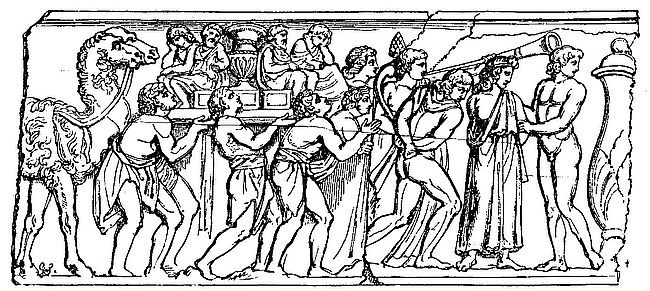
Triumphal Procession. (Zoega, Bassi-rilievi, tav. 9, 76.)
TRĬUMVĬRI, or TRESVĬRI, were either ordinary magistrates or officers, or else extraordinary commissioners, who were frequently appointed at Rome to execute any public office. The following is a list of the most important of both classes.
1. Triumviri Agro Dividundo. [Triumviri Coloniae Deducendae.]
2. Triumviri Capitales were regular magistrates, first appointed about B.C. 292. They were elected by the people, the comitia being held by the praetor. They succeeded to many of the functions of the Quaestores Parricidii. [Quaestor.] It was their duty to inquire into all capital crimes, and to receive informations respecting such, and consequently they apprehended and committed to prison all criminals whom they detected. In conjunction with the aediles, they had to preserve the public peace, to prevent all unlawful assemblies, &c. They enforced the payment of fines due to the state. They had the care of public prisons, and carried into effect the sentence of the law upon criminals. In these points they resembled the magistracy of the Eleven at Athens.
4. Triumviri Coloniae Deducendae were persons appointed to superintend the formation of a colony. They are spoken of under Colonia, p. 99, b. Since they had besides to superintend the distribution of the land to the colonists, we find them also called Triumviri Coloniae Deducendae Agroque Dividundo, and sometimes simply Triumviri Agro Dando.
5. Triumviri Epulones. [Epulones.]
6. Triumviri Equitum Turmas Recognoscendi, or Legendis Equitum Decuriis, were magistrates first appointed by Augustus to revise the lists of the equites, and to admit persons into the order. This was formerly part of the duties of the censors.
7. Triumviri Mensarii. [Mensarii.]
8. Triumviri Monetales. [Moneta.]
9. Triumviri Nocturni were magistrates elected annually, whose chief duty it was to prevent fires by night, and for this purpose they had to go round the city during the night (vigilias circumire). If they neglected their duty they appear to have been accused before the people by the tribunes of the plebs. The time at which this office was instituted is unknown, but it must have been previously to the year B.C. 304. Augustus transferred their duties to the Praefectus Vigilum. [Praefectus Vigilum.]
10. Triumviri Reficiendis Aedibus, extraordinary officers elected in the Comitia Tributa in the time of the second Punic war, were appointed for the purpose of repairing and rebuilding certain temples.
11. Triumviri Reipublicae Constituendae. When the supreme power was shared between Caesar (Octavianus), Antony, and Lepidus, they administered the affairs of the state under the title of Triumviri Reipublicae Constituendae. This office was conferred upon them in B.C. 43, for five years; and on the expiration of the term, in B.C. 38, was conferred upon them again, in B.C. 37, for five years more. The coalition between Julius Caesar, Pompey, and Crassus, in B.C. 60, is usually called the first triumvirate, and that between Octavianus, Antony, and Lepidus, the second; but it must be borne in mind that the former never bore the title of triumviri, nor were invested with any office under that name, whereas the latter were recognised as regular magistrates under the above-mentioned title.
12. Triumviri Sacris Conquirendis Donisque Persignandis, extraordinary officers elected in the Comitia Tributa in the time of the second Punic war, seem to have had to take care that all property given or consecrated to the gods was applied to that purpose.
13. Triumviri Senatus Legendi were magistrates appointed by Augustus to admit persons into the senate. This was previously the duty of the censors.
TRŎCHUS (τροχός), a hoop. The Greek hoop was a bronze ring, and had sometimes bells attached to it. It was impelled by means of a hook with a wooden handle, called clavis, and ἐλατήρ. From the Greeks this custom passed to the Romans, who consequently adopted the Greek term. The following woodcuts from gems exhibit naked youths trundling the hoop by means of the hook or key. They are accompanied by the jar of oil and the laurel branch, the signs of effort and of victory.
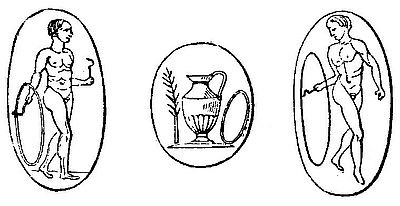
Trochi, Hoops. (From ancient Gems.)
TROJAE LŪDUS. [Circus.]
TRŎPAEUM (τρόπαιον, Att. τροπαῖον), a trophy, a sign and memorial of victory, which was erected on the field of battle where the enemy had turned (τρέπω, τρόπη) to flight; and in case of a victory gained at sea, on the nearest land. The expression for raising or erecting a trophy is τροπαῖον στῆσαι or στήσασθαι, to which may be added ἀπὸ or κατὰ τῶν πολεμίων. When the battle was not decisive, or each party considered it had some claims to the victory, both erected trophies. Trophies usually consisted of the arms, shields, helmets, &c. of the enemy that were defeated; and these were placed on the trunk of a tree, which was fixed on some elevation. The trophy was consecrated to some divinity, with an inscription (ἐπίγραμμα), recording the names of the victors and of the defeated party; whence trophies were regarded as inviolable, which even the enemy were not permitted to remove. Sometimes, however, a people destroyed a trophy, if they considered that the enemy had erected it without sufficient cause. That rankling and hostile feelings might not be perpetuated by the continuance of a trophy, it seems to have been originally part of Greek international law that trophies should be made only of wood, and not of stone or metal, and that they should not be repaired when decayed. It was not, however, uncommon to erect trophies of metal. Pausanias speaks of several which he saw in Greece. The trophies erected to commemorate naval victories were usually ornamented with the beaks or acroteria of ships [Acroterium; Rostra]; and were generally consecrated to Poseidon or Neptune. Sometimes a whole ship was placed as a trophy. The Romans, in early times, never erected any trophies on the field of battle, but carried home the spoils taken in battle, with which they decorated the public buildings, and also the private houses of individuals. [Spolia.] Subsequently, however, the Romans adopted the Greek practice of raising trophies on the field of battle. The first trophies of this kind were erected by Domitius Ahenobarbus and Fabius Maximus in B.C. 121, after their conquest of the Allobroges, when they built at the junction of the Rhone and the Isara towers of white stone, upon which trophies were placed adorned with the spoils of the enemy. Pompey also raised trophies on the Pyrenees after his victories in Spain; Julius Caesar did the same near Ziela, after his victory over Pharnaces; and Drusus, near the Elbe, to commemorate his victory over the Germans. Still, however, it was more common to erect some memorial of the victory at Rome than on the field of battle. The trophies raised by Marius to commemorate his victories over Jugurtha and the Cimbri and Teutoni, which were cast down by Sulla, and restored by Julius Caesar, must have been in the city. In the later times of the republic, and under the empire, the erection of triumphal arches was the most common way of commemorating a victory, many of which remain to the present day. [Arcus.]
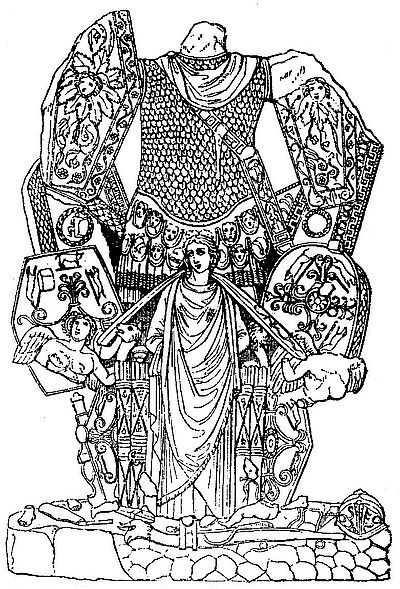
Trophy of Augustus. (Museo Capitolino, vol i. tav. 5.)
TROSSŬLI. [Equites, p. 157, a.]
TRŬA, dim. TRULLA (τορύνη), derived from τρύω, τόρω, &c., to perforate; a large and flat spoon or ladle, pierced with holes; a trowel. The annexed woodcut represents such a ladle. The trulla vinaria seems to have been a species of colander [Colum], used as a wine-strainer.

Trua. (From the House of Pansa at Pompeii.)
TRŬTĬNA (τρυτάνη), a general term, including both libra, a balance, and statera, a steelyard. Payments were originally made by weighing, not by counting. Hence a balance (trutina) was preserved in the temple of Saturn at Rome.
TŬBA (σάλπιγξ), a bronze trumpet, distinguished from the cornu by being straight while the latter was curved. [Cornu.] The tuba was employed in war for signals of every description, at the games and public festivals, and also at the last rites to the dead: those who sounded the trumpet at funerals were termed siticines, and used an instrument of a peculiar form. The tones of the tuba are represented as of a harsh and fear-inspiring character. The invention of the tuba is usually ascribed by ancient writers to the Etruscans. It has been remarked that Homer never introduces the σάλπιγξ in his narrative except in comparisons, which leads us to infer that, although known in his time, it had been but recently introduced into Greece; and it is certain that, notwithstanding its eminently martial character, it was not until a late period used in the armies of the leading states. By the Greek tragedians its Tuscan origin is fully recognised. According to one account it was first fabricated for the Tyrrhenians by Athena, who in consequence was worshipped by the Argives under the title of Σάλπιγξ, while at Rome the tubilustrium, or purification of sacred trumpets, was performed on the last day of the Quinquatrus. [Quinquatrus.] There appears to have been no essential difference in form between the Greek and Roman or Tyrrhenian trumpets. Both were long, straight, bronze tubes, gradually increasing in diameter, and terminating in a bell-shaped aperture.
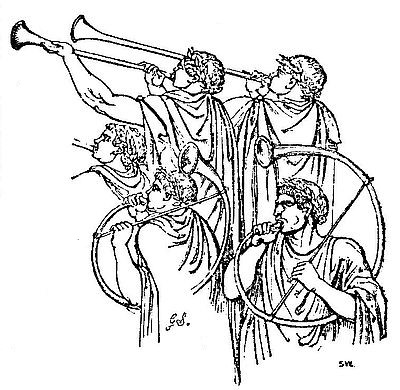
Soldiers blowing Tubae and Cornua. (From Column of Trajan.)
TŬBĬLUSTRIUM. [Quinquatrus.]
TULLIĀNUM. [Carcer.]
TŬMULTUĀRĬI. [Tumultus.]
TŬMULTUS, the name given to a sudden or dangerous war in Italy or Cisalpine Gaul, and the word was supposed by the ancients to be a contraction of timor multus. It was, however, sometimes applied to a sudden or dangerous war elsewhere; but this does not appear to have been a correct use of the word. Cicero says that there might be a war without a tumultus, but not a tumultus without a war; but it must be recollected that the word was also applied to any sudden alarm respecting a war; whence we find a tumultus often spoken of as of less importance than a war, because the results were of less consequence, though the fear might have been much greater than in a regular war. In the case of a tumultus there was a cessation from all business (justitium), and all citizens were obliged to enlist without regard being had to the exemptions (vacationes) from military service, which were enjoyed at other times. As there was not time to enlist the soldiers in the regular manner, the magistrate who was appointed to command the army displayed two banners (vexilla) from the Capitol, one red, to summon the infantry, and the other green, to summon the cavalry, and said, Qui rempublicam salvam vult, me sequatur. Those that assembled took the military oath together, instead of one by one, as was the usual practice, whence they were called conjurati, and their service conjuratio. Soldiers enlisted in this way were termed Tumultuarii or Subitarii.
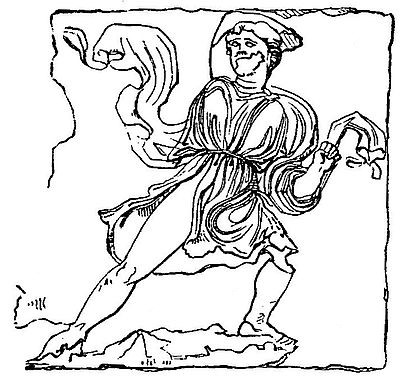
Doric Chiton. (From a Bas-relief in the British Museum.)
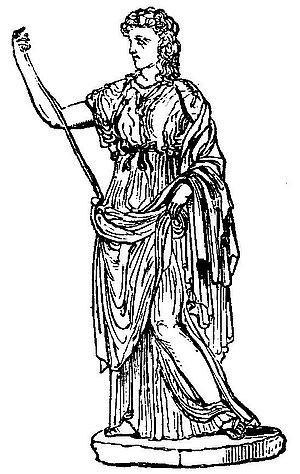
Ionic Chiton. (From a Statue in the British Museum.)
TŬNĬCA (χιτών, dim. χιτωνίσκος, χιτώνιον), an under-garment. (1) Greek. The chiton was the only kind of ἔνδυμα, or under-garment worn by the Greeks. Of this there were two kinds, the Dorian and Ionian. The Dorian chiton, as worn by males, was a short woollen shirt, without sleeves; the Ionian was a long linen garment, with sleeves. The former seems to have been originally worn throughout the whole of Greece; the latter was brought over to Greece by the Ionians of Asia. The Ionic chiton was commonly worn at Athens by men during the Persian wars, but it appears to have entirely gone out of fashion for the male sex about the time of Pericles, from which time the Dorian chiton was the under-garment universally adopted by men through the whole of Greece. The distinction between the Doric and Ionic chiton still continued in the dress of women. The Spartan virgins only wore this one garment, and had no upper kind of clothing, whence it is sometimes called Himation [Pallium] as well as Chiton. They appeared in the company of men without any further covering; but the married women never did so without wearing an upper garment. This Doric chiton was made, as stated above, of woollen stuff; it was without sleeves, and was fastened over both shoulders by clasps or buckles (πόρπαι, περόναι), which were often of considerable size. It was frequently so short as not to reach the knee. It was only joined together on one side, and on the other was left partly open or slit up (σχιστός χίτων), to allow a free motion of the limbs. The following cut represents an Amazon with a chiton of this kind: some parts of the figure appear incomplete, as the original is mutilated. The Ionic chiton, on the contrary, was a long and loose garment, reaching to the feet (ποδήρης), with wide sleeves (κόραι), and was usually made of linen. The sleeves, however, appear generally to have covered only the upper part of the arm; for in ancient works of art we seldom find the sleeve extending farther than the elbow, and sometimes not so far. The sleeves were sometimes slit up, and fastened together with an elegant row of brooches. The Ionic chiton, according to Herodotus, was originally a Carian dress, and passed over to Athens from Ionia, as has been already remarked. The women at Athens originally wore the Doric chiton, but were compelled to change it for the Ionic, after they had killed with the buckles or clasps of their dresses the single Athenian who had returned alive from the expedition against Aegina, because there were no buckles or clasps required in the Ionic dress. The preceding cut represents the Muse Thalia wearing an Ionic chiton. The peplum has fallen off her shoulders, and is held up by the left hand. Both kinds of dress were fastened round the middle with a girdle, and as the Ionic chiton was usually longer than the body, part of it was drawn up so that the dress might not reach farther than the feet, and the part which was so drawn up overhung or overlapped the girdle, and was called κόλπος.—There was a peculiar kind of dress, which seems to have been a species of double chiton, called Diplois (διπλοΐς), Diploidion (διπλοΐδιον), and Hemidiploidion (ἡμιδιπλοΐδιον).
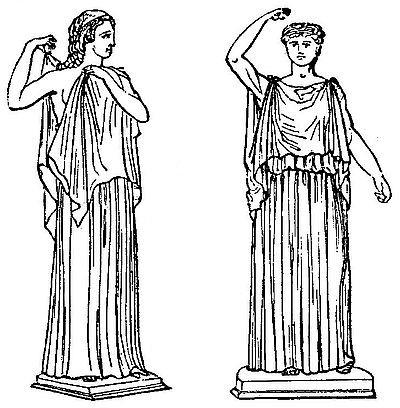
Diploidia, double Chitons. (Museo Borbonico, vol. ii. tav. 4, 6.)
It appears not to have been a separate article of dress, but merely the upper part of the cloth forming the chiton, which was larger than was required for the ordinary chiton, and was therefore thrown over the front and back. The following cuts will give a clearer idea of the form of this garment than any description. Since the Diploidion was fastened over the shoulders by means of buckles or clasps, it was called Epomis (ἐπωμίς), which is supposed by some writers to have been only the end of the garment fastened on the shoulder. The chiton was worn by men next their skin; but females were accustomed to wear a chemise (χιτώνιον) under their chiton. It was the practice among most of the Greeks to wear an himation, or outer garment, over the chiton, but frequently the chiton was worn alone. A person who wore only a chiton was called μονοχίτων (οἰοχίτων in Homer), an epithet given to the Spartan virgins. In the some way, a person who wore only an himation, or outer garment, was called ἀχίτων. The Athenian youths, in the earlier times, wore only the chiton, and when it became the fashion, in the Peloponnesian war, to wear an outer garment over it, it was regarded as a mark of effeminacy.—(2) Roman. The Tunica of the Romans, like the Greek chiton, was a woollen under-garment, over which the toga was worn. It was the Indumentum or Indutus, as opposed to the Amictus, the general term for the toga, pallium, or any other outer garment. [Amictus.] The Romans are said to have had no other clothing originally but the toga; and when the tunic was first introduced, it was merely a short garment without sleeves, and was called Colobium. It was considered a mark of effeminacy for men to wear tunics with long sleeves (manicatae) and reaching to the feet (talares). The tunic was girded (cincta) with a belt or girdle around the waist, but it was usually worn loose, without being girded, when a person was at home, or wished to be at his ease. Hence we find the terms cinctus, praecinctus, and succinctus, applied, like the Greek εὔζωνος, to an active and diligent person, and discinctus to one who was idle or dissolute. The form of the tunic, as worn by men, is represented in many woodcuts in this work. In works of art it usually terminates a little above the knee; it has short sleeves, covering only the upper part of the arm, and is girded at the waist: the sleeves sometimes, though less frequently, extend to the hands.—Both sexes at Rome usually wore two tunics, an outer and an under, the latter of which was worn next the skin, and corresponds to our shirt and chemise. The under tunics were called Subucula and Indusium, the former of which is supposed to be the name of the under tunic of the men, and the latter of that of the women: but this is not certain. The word Interula was of later origin, and seems to have been applied equally to the under tunic of both sexes. It is doubtful whether the Supparus or Supparum was an outer or an under garment. Persons sometimes wore several tunics, as a protection against cold: Augustus wore four in the winter, besides a subucula. As the dress of a man usually consisted of an under tunic, an outer tunic, and the toga, so that of a woman, in like manner, consisted of an under tunic, an outer tunic, and the palla. The outer tunic of the Roman matron was properly called stola [Stola], and is represented in the woodcut on p. 355; but the annexed woodcut, which represents a Roman empress in the character of Concordia, or Abundantia, gives a better idea of its form. Over the tunic or stola the palla is thrown in many folds, but the shape of the former is still distinctly shown. The tunics of women were larger and longer than those of men, and always had sleeves; but in ancient paintings and statues we seldom find the sleeves covering more than the upper part of the arm. Sometimes the tunics were adorned with golden ornaments called Leria. Poor people, who could not afford to purchase a toga, wore the tunic alone, whence we find the common people called Tunicati. A person who wore only his tunic was frequently called Nudus. Respecting the clavus latus and the clavus angustus, worn on the tunics of the senators and equites respectively, see Clavus Latus, Clavus Angustus. When a triumph was celebrated, the conqueror wore, together with an embroidered toga (Toga picta), a flowered tunic (Tunica palmata), also called Tunica Jovis, because it was taken from the temple of Jupiter Capitolinus. Tunics of this kind were sent as presents to foreign kings by the senate.