C (continued 2)
Reading edition
CHOUS, or CHOEUS (χοῦς or χοεῦς), was equal to the Roman congius, and contained six ξέσται, or sextarii (nearly six pints English). It seems that there was also a smaller measure of the same name, containing two sextarii (nearly two pints English).
CHRŎNOLŎGĬA (χρονολογία), chronology. The Greeks reckoned their years generally according to their magistrates, in the early times according to the years of the reign of their kings, and afterwards according to their annual magistrates. At Athens the year was called by the name of one of the nine archons, who from this circumstance was called ἄρχων ἐπώνυμος, or the archon par excellence; and at Sparta the years were called after one of the five ephors, who for this reason was likewise termed ἐπώνυμος. In Argos time was counted according to the years of the high priestess of Hera, who held her office for life (ἡρεσίς); and the inhabitants of Elis probably reckoned according to the Olympic games, which were celebrated every fifth year during the first full moon which followed after the summer solstice. Thus there was no era which was used by all the Greeks in common for the ordinary purposes of life.—Timaeus, who flourished about B.C. 260, was the first historian who counted the years by Olympiads, each of which contained four years. The beginning of the Olympiads is commonly fixed in the year 3938 of the Julian period, or in B.C. 776. If we want to reduce any given Olympiad to years before Christ, e.g. Ol. 87, we take the number of the Olympiads actually elapsed, that is, 86, multiply it by 4, and deduct the number obtained from 776, so that the first year of the 87th Ol. will be the same as the year 432 B.C. If the number of Olympiads amounts to more than 776 years, that is, if the Olympiad falls after the birth of Christ, the process is the same as before, but from the sum obtained by multiplying the Olympiads by 4, we must deduct the number 776, and what remains is the number of the years after Christ. As the Olympic games were celebrated 293 times, we have 293 Olympic cycles, that is, 1172 years, 776 of which fall before, and 396 after Christ.—Some writers also adopted the Trojan era, the fall of Troy being placed by Eratosthenes and those who adopted this era, in the year B.C. 1184. After the time of Alexander the Great, several other eras were introduced in the kingdoms that arose out of his empire. The first was the Philippic era, sometimes also called the era of Alexander or the era of Edessa; it began on the 12th of November B.C. 324, the date of the accession of Philip Arrhidaeus. The second was the era of the Seleucidae, beginning on the 1st of October B.C. 312, the date of the victory of Seleucus Nicator at Gaza, and of his re-conquest of Babylonia. This era was used very extensively in the East. The Chaldaean era differed from it only by six months, beginning in the spring of B.C. 311. Lastly, the eras of Antioch, of which there were three, but the one most commonly used began in November B.C. 49.—The Romans during the time of the republic reckoned their years by the names of the consuls, which were registered in the Fasti. Along with this era there existed another, used only by the historians. It reckoned the years from the foundation of the city (ab urbe condita); but the year of the foundation of the city was a question of uncertainty among the Romans themselves. M. Terentius Varro placed it on the 21st of April in the third year of the 6th Olympiad, that is, B.C. 753; and this is the era most commonly used. To find out the year B.C. corresponding to the year A.U.C., subtract the year A.U.C. from 754; thus 605 A.U.C. = 149 B.C. To find out the year A.D. corresponding to the year A.U.C., subtract 753 from the year A.U.C.; thus 767 A.U.C. = 14 A.D.
CHRȲSENDĔTA, costly dishes used by the Romans at their entertainments, apparently made of silver, with golden ornaments.
CIDĂRIS. [Tiara.]
CINCTUS GABĪNUS. [Toga.]
CINGŬLUM. [Zona.]
CĬNĔRĀRĬUS. [Calamistrum.]
CĬNĔRES. [Funus.]
CĬNĬFLO. [Calamistrum.]
CIPPUS, a low column, sometimes round, but more frequently rectangular. Cippi were used for various purposes; the decrees of the senate were sometimes inscribed upon them; and with distances engraved upon them, they also served as mile-stones. They were, however, more frequently employed as sepulchral monuments. It was also usual to place at one corner of the burying-ground a cippus, on which the extent of the burying-ground was marked, towards the road (in fronte), and backwards to the fields (in agrum).
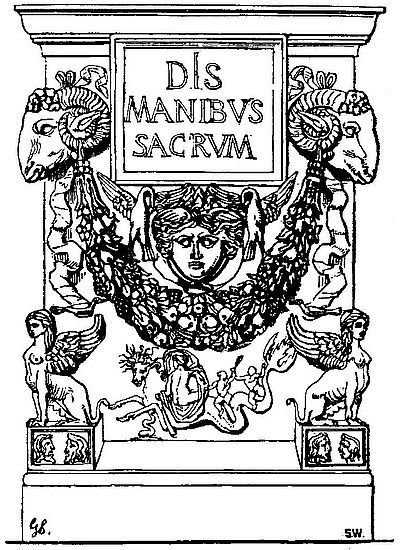
Cippus, in the Vatican.
CIRCENSES LŪDI. [Circus.]
CIRCĬTŌRES, or CIRCŬĬTŌRES. [Castra.]
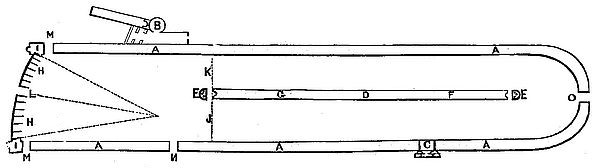
Ground Plan of the Circus.
CIRCUS. When Tarquinius Priscus had taken the town of Apiolae from the Latins, he commemorated his success by an exhibition of races and pugilistic contests in the Murcian valley, between the Palatine and Aventine hills, around which a number of temporary platforms were erected by the patres and equites, called spectacula, fori, or foruli, from their resemblance to the deck of a ship; each one raising a stage for himself, upon which he stood to view the games. This course, with its surrounding scaffoldings, was termed circus; either because the spectators stood round to see the shows, or because the procession and races went round in a circuit. Previously, however, to the death of Tarquin, a permanent building was constructed for the purpose, with regular tiers of seats in the form of a theatre. To this the name of Circus Maximus was subsequently given, as a distinction from the Flaminian and other similar buildings, which it surpassed in extent and splendour; and hence it is often spoken of as the Circus, without any distinguishing epithet. Of the Circus Maximus scarcely a vestige now remains; but this loss is fortunately supplied by the remains of a small circus on the Via Appia, the ground-plan of which is in a state of considerable preservation: it is represented in the annexed cut, and may be taken as a model of all others. Around the double lines (A, A) were arranged the seats (gradus, sedilia, subsellia), as in a theatre, termed collectively the cavea; the lowest of which were separated from the ground by a podium, and the whole divided longitudinally by praecinctiones, and diagonally into cunei, with their vomitoria attached to each. [Amphitheatrum.] Towards the extremity of the upper branch of the cavea, the general outline is broken by an outwork (B), which was probably the pulvinar, or station for the emperor, as it is placed in the best situation for seeing both the commencement and end of the course, and in the most prominent part of the circus. In the opposite branch is observed another interruption to the uniform line of seats (C), betokening also, from its construction, a place of distinction; which might have been assigned to the person at whose expense the games were given (editor spectaculorum). In the centre of the area was a low wall (D) running lengthways down the course, which, from its resemblance to the position of the dorsal bone in the human frame, was termed spina. At each extremity of the spina were placed, upon a base (E, E), three wooden cylinders, of a conical shape, like cypress trees, which were called metae—the goals. Their situation is distinctly seen in the cut on p. 89. The most remarkable objects upon the spina were two columns (F) supporting seven conical balls, which, from their resemblance to eggs, were called ova. Their use was to enable the spectators to count the number of rounds which had been run; and they were seven in number, because seven was the number of the circuits made in each race. As each round was run, one of the ova was either put up or taken down. An egg was adopted for this purpose, in honour of Castor and Pollux. At the other extremity of the spina were two similar columns (G), sustaining dolphins, termed delphinae, or delphinarum columnae, which do not appear to have been intended to be removed, but only placed there as corresponding ornaments to the ova; and the figure of the dolphin was selected in honour of Neptune. These figures are also seen in the cut on p. 89. At the extremity of the circus in which the two horns of the cavea terminate, were placed the stalls for the horses and chariots (H, H), commonly called carceres, but more anciently the whole line of building at this end of the circus was termed oppidum: hence in the circus, of which the plan is given above, we find two towers (I, I) at each end of the carceres. The number of carceres is supposed to have been usually twelve, as in this plan.
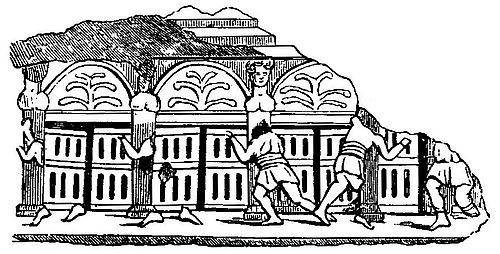
Carceres opening of the Gates. (From a marble at Velletri.)
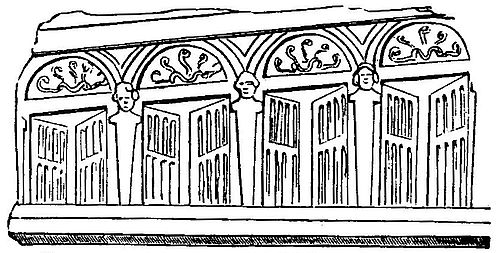
Carceres, with Gates open. (Marble in British Museum.)
They were vaults, closed in front by gates of open wood-work (cancelli), which were opened simultaneously upon the signal being given, by removing a rope attached to pilasters of the kind called Hermae, placed for that purpose between each stall, upon which the gates were immediately thrown open by a number of men, as represented in the preceding woodcut. The cut below represents a set of four carceres, with their Hermae, and cancelli open, as left after the chariots had started; in which the gates are made to open inwards. The preceding account and woodcuts will be sufficient to explain the meaning of the various words by which the carceres were designated in poetical language, namely, claustra, crypta, fauces, ostia, fores carceris, repagula, limina equorum. There were five entrances to the circus; one (L) in the centre of the carceres, called porta pompae, because it was the one through which the Circensian procession entered, and the others at M, M, N, and O. At the entrance of the course, exactly in the direction of the line (J, K), were two small pedestals (hermuli) on each side of the podium, to which was attached a chalked rope (alba linea), for the purpose of making the start fair, precisely as is practised at Rome for the horse-races during Carnival. Thus, when the doors of the carceres were thrown open, if any of the horses rushed out before the others, they were brought up by this rope until the whole were fairly abreast, when it was loosened from one side, and all poured into the course at once. This line was also called calx, and creta. The metae served only to regulate the turnings of the course, the alba linea answered to the starting and winning post of modern days.—From this description the Circus Maximus differed little, except in size and magnificence of embellishment. The numbers which the Circus Maximus was capable of containing are computed at 150,000 by Dionysius, 260,000 by Pliny, and 385,000 by P. Victor, all of which are probably correct, but have reference to different periods of its history. Its length, in the time of Julius Caesar, was three stadia, the width one, and the depth of the buildings occupied half a stadium. When the Circus Maximus was permanently formed by Tarquinius Priscus, each of the thirty curiae had a particular place assigned to it; but as no provision was made for the plebeians in this circus, it is supposed that the Circus Flaminius was designed for the games of the commonalty, who in early times chose their tribunes there, on the Flaminian field. However, in the latter days of the republic, these invidious distinctions were lost, and all classes sat promiscuously in the circus. The seats were then marked off at intervals by a line or groove drawn across them (linea), so that the space included between two lines afforded sitting room for a certain number of spectators. Under the empire, however, the senators and equites were separated from the common people. The seat of the emperor (pulvinar or cubiculum) was most likely in the same situation in the Circus Maximus as in the one above described.—The Circensian games (Ludi Circenses) were first instituted by Romulus, according to the legends, when he wished to attract the Sabine population to Rome, for the purpose of furnishing his own people with wives, and were celebrated in honour of the god Consus, or Neptunus Equestris, from whom they were styled Consuales. But after the construction of the Circus Maximus they were called indiscriminately Circenses, Romani, or Magni. They embraced six kinds of games:—I. Cursus; II. Ludus Trojae; III. Pugna Equestris; IV. Certamen Gymnicum; V. Venatio; VI. Naumachia. The two last were not peculiar to the circus, but were exhibited also in the amphitheatre, or in buildings appropriated for them. The games commenced with a grand procession (Pompa Circensis), in which all those who were about to exhibit in the circus, as well as persons of distinction, bore a part. The statues of the gods formed the most conspicuous feature in the show, which were paraded upon wooden platforms, called fercula and thensae. The former were borne upon the shoulders, as the statues of saints are carried in modern processions; the latter were drawn along upon wheels.—I. Cursus, the races. The carriage usually employed in the circus was drawn by two or four horses (bigae, quadrigae). [Currus.] The usual number of chariots which started for each race was four. The drivers (aurigae, agitatores) were also divided into four companies, each distinguished by a different colour, to represent the four seasons of the year, and called a factio: thus factio prasina, the green, represented the spring; factio russata, red, the summer; factio veneta, azure, the autumn; and factio alba or albata, white, the winter. Originally there were but two factions, albata and russata, and consequently only two chariots started at each race. The driver stood in his car within the reins, which went round his back. This enabled him to throw all his weight against the horses, by leaning backwards; but it greatly enhanced his danger in case of an upset. To avoid this peril, a sort of knife or bill-hook was carried at the waist, for the purpose of cutting the reins in a case of emergency. When all was ready, the doors of the carceres were flung open, and the chariots were formed abreast of the alba linea by men called moratores from their duty; the signal for the start was then given by the person who presided at the games, sometimes by sound of trumpet, or more usually by letting fall a napkin; whence the Circensian games are called spectacula mappae. The alba linea was then cast off, and the race commenced, the extent of which was seven times round the spina, keeping it always on the left. A course of seven circuits was termed unus missus, and twenty-five was the number of races run in each day, the last of which was called missus aerarius, because in early times the expense of it was defrayed by a collection of money (aes) made amongst the people. The victor descended from his car at the conclusion of the race, and ascended the spina, where he received his reward (bravium, from the Greek βραβεῖον), which consisted in a considerable sum of money.
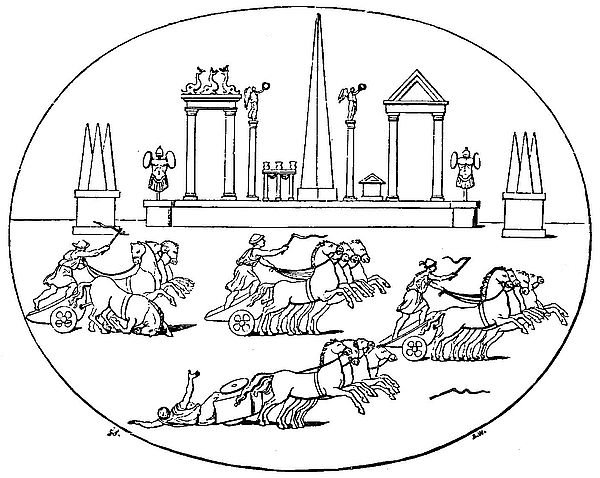
Chariot Race in the Circus. (Florentine Gem.)
The horse-racing followed the same rules as the chariots. The enthusiasm of the Romans for these races exceeded all bounds. Lists of the horses (libella), with their names and colours, and those of the drivers, were handed about, and heavy bets made upon each faction; and sometimes the contests between two parties broke out into open violence and bloody quarrels, until at last the disputes which originated in the circus had nearly lost the Emperor Justinian his crown.—II. Ludus Trojae, a sort of sham-fight, said to have been invented by Aeneas, performed by young men of rank on horseback, and often exhibited by the emperors.—III. Pugna equestris et pedestris, a representation of a battle, upon which occasions a camp was formed in the circus.—IV. Certamen Gymnicum. See Athletae, and the references to the articles there given.—V. [Venatio.]—VI. [Naumachia.]
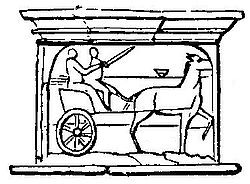
Cisium. (From monument at Igel, near Treves.)
CĬSĬUM, a light open carriage with two wheels, adapted to carry two persons rapidly from place to place. The cisia were quickly drawn by mules. Cicero mentions the case of a messenger who travelled 56 miles in 10 hours in such vehicles, which were kept for hire at the stations along the great roads; a proof that the ancients considered six Roman miles per hour as an extraordinary speed.
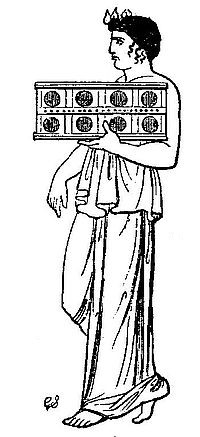
Cista. (From a Painting on a Vase.)

CISTA (κίστη). (1) A small box or chest, in which anything might be placed, but more particularly applied to the small boxes which were carried in procession in the festivals of Demeter and Dionysus. These boxes, which were always kept closed in the public processions, contained sacred things connected with the worship of these deities. In the representations of Dionysiac processions on ancient vases women carrying cistae are frequently introduced.—(2) The ballot-box, into which those who voted in the comitia and in the courts of justice cast their tabellae. It is represented in the annexed cut, and should not be confounded with the situla or sitella, into which sortes or lots were thrown. [Situla.]
CISTŎPHŎRUS (κιστοφόρος), a silver coin, which is supposed to belong to Rhodes, and which was in general circulation in Asia Minor at the time of the conquest of that country by the Romans. It took its name from the device upon it, which was either the sacred chest (cista) of Bacchus, or more probably a flower called κιστός. Its value is extremely uncertain: some writers suppose it to have been worth in our money about 7¼d.
CĬTHĂRA. [Lyra.]
CĪVIS. [Civitas.]
CĪVĬTAS, citizenship. (1) Greek (πολιτεία). Aristotle defines a citizen (πολίτης) to be one who is a partner in the legislative and judicial power (μέτοχος κρίσεως καὶ ἀρχῆς). No definition will equally apply to all the different states of Greece, or to any single state at different times; the above seems to comprehend more or less properly all those whom the common use of language entitled to the name. A state in the heroic ages was the government of a prince; the citizens were his subjects, and derived all their privileges, civil as well as religious, from their nobles and princes. The shadows of a council and assembly were already in existence, but their business was to obey. Upon the whole the notion of citizenship in the heroic ages only existed so far as the condition of aliens or of domestic slaves was its negative. The rise of a dominant class gradually overthrew the monarchies of ancient Greece. Of such a class, the chief characteristics were good birth and the hereditary transmission of privileges, the possession of land, and the performance of military service. To these characters the names gamori (γάμοροι), knights (ἱππεῖς), eupatridae (εὐπατρίδαι), &c. severally correspond. Strictly speaking, these were the only citizens; yet the lower class were quite distinct from bondmen or slaves. It commonly happened that the nobility occupied the fortified towns, while the demus (δῆμος) lived in the country and followed agricultural pursuits: whenever the latter were gathered within the walls, and became seamen or handicraftsmen, the difference of ranks was soon lost, and wealth made the only standard. The quarrels of the nobility among themselves, and the admixture of population arising from immigrations, all tended to raise the lower orders from their political subjection. It must be remembered, too, that the possession of domestic slaves, if it placed them in no new relation to the governing body, at any rate gave them leisure to attend to the higher duties of a citizen, and thus served to increase their political efficiency. During the convulsions which followed the heroic ages, naturalisation was readily granted to all who desired it; as the value of citizenship increased, it was, of course, more sparingly bestowed. The ties of hospitality descended from the prince to the state, and the friendly relations of the Homeric heroes were exchanged for the προξενίαι of a later period. In political intercourse, the importance of these last soon began to be felt, and the Proxenus at Athens, in after times, obtained rights only inferior to actual citizenship. [Hospitium.] The isopolite relation existed, however, on a much more extended scale. Sometimes particular privileges were granted: as ἐπιγαμία, the right of intermarriage; ἔγκτησις, the right of acquiring landed property; ἀτέλεια, immunity from taxation, especially ἀτέλεια μετοικίου, from the tax imposed on resident aliens. All these privileges were included under the general term ἰσοτέλεια, or ἰσοπολίτεια, and the class who obtained them were called ἰσοτελεῖς. They bore the same burthens with the citizens, and could plead in the courts or transact business with the people, without the intervention of a προστάτης, or patron. Respecting the division of the Athenian citizens into tribes, phratriae and demes, see the articles Tribus and Demus.—If we would picture to ourselves the true notion which the Greeks embodied in the word polis (πόλις), we must lay aside all modern ideas respecting the nature and object of a state. With us practically, if not in theory, the essential object of a state hardly embraces more than the protection of life and property. The Greeks, on the other hand, had the most vivid conception of the state as a whole, every part of which was to co-operate to some great end to which all other duties were considered as subordinate. Thus the aim of democracy was said to be liberty; wealth, of oligarchy; and education, of aristocracy. In all governments the endeavour was to draw the social union as close as possible, and it seems to have been with this view that Aristotle laid down a principle which answered well enough to the accidental circumstances of the Grecian states, that a polis must be of a certain size. This unity of purpose was nowhere so fully carried out as in the government of Sparta. The design of Spartan institutions was evidently to unite the governing body among themselves against the superior numbers of the subject population. The division of lands, the syssitia, the education of their youth, all tended to this great object. [Helotes; Perioeci.] In legal rights all Spartans were equal: but there were yet several gradations, which, when once formed, retained their hold on the aristocratic feelings of the people. First, there was the dignity of the Heraclide families; and, connected with this, a certain pre-eminence of the Hyllean tribe. Another distinction was that between the Homoioi (ὅμοιοι) and Hypomeiones (ὑπομείονες), which, in later times, appears to have been considerable. The latter term probably comprehended those citizens who, from degeneracy of manners or other causes, had undergone some kind of civil degradation. To these the Homoioi were opposed, although it is not certain in what the precise difference consisted. All the Spartan citizens were included in the three tribes, Hylleans, Dymanes or Dymanatae, and Pamphilians, each of which was divided into ten obes or phratries. The citizens of Sparta, as of most oligarchical states, were landowners, although this does not seem to have been looked upon as an essential of citizenship.—(2) Roman. Civitas means the whole body of cives, or members, of any given state, and the word is frequently used by the Roman writers to express the rights of a Roman citizen, as distinguished from those of other persons not Roman citizens, as in the phrases, dare civitatem, donare civitate, usurpare civitatem. Some members of a political community (cives) may have more political rights than others; and this was the case at Rome under the republic, in which we find a distinction made between two great classes of Roman citizens, one that had, and another that had not, a share in the sovereign power (optimo jure, non optimo jure cives). That which peculiarly distinguished the higher class, or the optimo jure cives, was the right to vote in a tribe (jus suffragiorum), and the capacity of enjoying magistracy (jus honorum). The inferior class, or the non optimo jure cives, did not possess the above rights, which the Romans called jus publicum, but they only had the jus privatum, which comprehended the jus connubii and jus commercii, and those who had not these had no citizenship.—Under the empire we find the free persons who were within the political limits of the Roman state divided into three great classes. The same division probably existed in an early period of the Roman state, and certainly existed in the time of Cicero. These classes were, Cives, Latini, and Peregrini. Civis is he who possesses the complete rights of a Roman citizen. Peregrinus was incapable of exercising the rights of commercium and connubium, which were the characteristic rights of a Roman citizen; but he had a capacity for making all kinds of contracts which were allowable by the jus gentium. The Latinus was in an intermediate state; he had not the connubium, and consequently he had not the patria potestas nor rights of agnatio; but he had the commercium or the right of acquiring quiritarian ownership, and he had also a capacity for all acts incident to quiritarian ownership, as the power of making a will in Roman form, and of becoming heres under a will. The rights of a Roman citizen were acquired in several ways, but most commonly by a person being born of parents who were Roman citizens. A slave might obtain the civitas by manumission (vindicta), by the census, and by a testamentum, if there was no legal impediment; but it depended on circumstances whether he became a civis Romanus, a Latinus, or in the number of the peregrini dediticii. [Manumissio.] The civitas could be conferred on a foreigner by a lex, as in the case of Archias, who was a civis of Heraclea, a civitas which had a foedus with Rome, and who claimed the civitas Romana under the provisions of a lex of Silvanus and Carbo, B.C. 89. By the provisions of this lex, the person who chose to take the benefit of it was required, within sixty days after the passing of the lex, to signify to the praetor his wish and consent to accept the civitas (profiteri). This lex was intended to give the civitas, under certain limitations, to foreigners who were citizens of foederate states (foederatis civitatibus adscripti). [Foederatae Civitates.] Thus the great mass of the Italians obtained the civitas, and the privileges of the former civitates foederatae were extended to the provinces, first to part of Gaul, and then to Sicily, under the name of Jus Latii or Latinitas. This Latinitas gave a man the right of acquiring the Roman citizenship by having exercised a magistratus in his own civitas; a privilege which belonged to the foederatae civitates of Italy before they obtained the Roman civitas.
CLĀRĬGĀTĬO. [Fetiales.]
CLASSĬCUM. [Cornu.]
CLĀVUS ANNĀLIS. In the early ages of Rome, when letters were yet scarcely in use, the Romans kept a reckoning of their years by driving a nail (clavus), on the ides of each September, into the side walls of the temple of Jupiter Optimus Maximus, which ceremony was performed by the consul or a dictator.
CLĀVUS GŬBERNĀCŬLI. [Navis.]
CLĀVUS LĀTUS, CLĀVUS ANGUSTUS. The clavus, as an article of dress, seems to have been a purple band worn upon the tunic and toga, and was of two fashions, one broad and the other narrow, denominated respectively clavus latus and clavus angustus. The former was a single broad band of purple, extending perpendicularly from the neck down the centre of the tunic; the latter probably consisted of two narrow purple slips, running parallel to each from the top to the bottom of the tunic, one from each shoulder. The latus clavus was a distinctive badge of the senatorian order; and hence it is used to signify the senatorial dignity, and laticlavius, the person who enjoys it. The angustus clavus was the decoration of the equestrian order; but the right of wearing the latus clavus was also given to the children of equestrians, at least in the time of Augustus, as a prelude to entering the senate-house. This, however, was a matter of personal indulgence, and was granted only to persons of very ancient family and corresponding wealth, and then by special favour of the emperor. In such cases the latus clavus was assumed with the toga virilis, and worn until the age arrived at which the young equestrian was admissible into the senate, when it was relinquished and the angustus clavis resumed, if a disinclination on his part, or any other circumstances, prevented him from entering the senate, as was the case with Ovid. But it seems that the latus clavus could be again resumed if the same individual subsequently wished to become a senator, and hence a fickle character is designated as one who is always changing his clavus. The latus clavus is said to have been introduced at Rome by Tullus Hostilius, and to have been adopted by him after his conquest of the Etruscans; nor does it appear to have been confined to any particular class during the earlier periods, but to have been worn by all ranks promiscuously. It was laid aside in public mourning.
CLEPSȲDRA. [Horologium.]
CLĒRŪCHI (κληροῦχοι), the name of Athenian citizens who occupied conquered lands; their possession was called cleruchia (κληρουχία). The Athenian Cleruchi differed from the ἄποικοι or ordinary colonists. The only object of the earlier colonies was to relieve surplus population, or to provide a home for those whom internal quarrels had exiled from their country. Most usually they originated in private enterprise, and became independent of, and lost their interest in, the parent state. On the other hand, it was essential to the very notion of a cleruchia that it should be a public enterprise, and should always retain a connection more or less intimate with Athens herself. The connection with the parent state subsisted in all degrees. Sometimes, as in the case of Lesbos, the holders of land did not reside upon their estates, but let them to the original inhabitants, while themselves remained at Athens. The condition of these cleruchi did not differ from that of Athenian citizens who had estates in Attica. All their political rights they not only retained, but exercised as Athenians. Another case was where the cleruchi resided on their estates, and either with or without the old inhabitants, formed a new community. These still retained the rights of Athenian citizens, which distance only precluded them from exercising: they used the Athenian courts; and if they or their children wished to return to Athens, naturally and of course they regained the exercise of their former privileges. Sometimes, however, the connection might gradually dissolve, and the cleruchi sink into the condition of mere allies, or separate wholly from the mother country. It was to Pericles that Athens was chiefly indebted for the extension and permanence of her colonial settlements. His principal object was to provide for the redundancies of population, and raise the poorer citizens to a fortune becoming the dignity of Athenian citizens. It was of this class of persons that the settlers were chiefly composed; the state provided them with arms, and defrayed the expenses of their journey. The Cleruchiae were lost by the battle of Aegospotami, but partially restored on the revival of Athenian power.
CLĒTĒRES or CLĒTORES (κλητῆρες, κλῆτορες), summoners, were at Athens not official persons, but merely witnesses to the prosecutor that he had served the defendant with a notice of the action brought against him, and the day upon which it would be requisite for him to appear before the proper magistrate.
CLĪBĂNĀRĬI. [Cataphracti.]
CLĬENS is said to contain the same element as the verb cluere, to “hear” or “obey,” and may be accordingly compared with the German word höriger, “a dependant,” from hören, “to hear.” In the earliest times of the Roman state we find a class of persons called clientes, who must not be confounded with the plebeians, from whom they were distinct. The clients were not slaves: they had property of their own and freedom, and appear to have had votes in the comitia centuriata, but they did not possess the full rights of Roman citizens; and the peculiarity of their condition consisted in every client being in a state of dependence upon or subjection to some patrician, who was called his patronus, and to whom he owed certain rights and duties. The patronus, on the other hand, likewise incurred certain obligations towards his client. This relationship between patronus and cliens was expressed by the word clientela, which also expressed the whole body of a man’s clients. The relative rights and duties of the patrons and the clients were, according to Dionysius, as follows:—The patron was the legal adviser of the cliens; he was the client’s guardian and protector, as he was the guardian and protector of his own children; he maintained the client’s suit when he was wronged, and defended him when another complained of being wronged by him: in a word, the patron was the guardian of the client’s interests, both private and public. The client contributed to the marriage portion of the patron’s daughter, if the patron was poor; and to his ransom, or that of his children, if they were taken prisoners; he paid the costs and damages of a suit which the patron lost, and of any penalty in which he was condemned; he bore a part of the patron’s expenses incurred by his discharging public duties, or filling the honourable places in the state. Neither party could accuse the other, or bear testimony against the other, or give his vote against the other. This relationship between patron and client subsisted for many generations, and resembled in all respects the relationship by blood. The relation of a master to his liberated slave (libertus) was expressed by the word patronus, and the libertus was the cliens of his patronus. Distinguished Romans were also the protectors of states and cities, which were in a certain relation of subjection or dependence to Rome. In the time of Cicero we also find patronus in the sense of adviser, advocate, or defender, opposed to cliens in the sense of the person defended or the consultor,—a use of the word which must be referred to the original character of the patronus.
CLĬENTĒLA. [Cliens.]
CLĬPĔUS (ἀσπίς), the large shield worn by the Greeks and Romans, which was originally of a circular form, and is said to have been first used by Proetus and Acrisius of Argos, and therefore is called clipeus Argolicus, and likened to the sun. But the clipeus is often represented in Roman sculpture of an oblong oval, which makes the distinction between the common buckler and that of Argos. The outer rim was termed ἄντυξ by the Greeks; and in the centre was a projection called ὀμφάλος or umbo, which served as a sort of weapon by itself, or caused the missiles of the enemy to glance off from the shield. In the Homeric times, the Greeks merely used a leather strap (τελαμών) to support the shield, but subsequently a handle (ὄχανον or ὀχάνη). The usual form of the clipeus is exhibited in the figure of the Greek warrior on p. 41. When the census was instituted by Servius Tullius at Rome, the first class only used the clipeus, and the second were armed with the scutum [Scutum]; but after the Roman soldiery received pay, the clipeus was discontinued altogether for the scutum.
CLĪTELLAE, a pair of panniers, and therefore only used in the plural number.
CLŎĀCA, a sewer, a drain. Rome was intersected by numerous sewers, some of which were of an immense size: the most celebrated of them was the cloaca maxima, the construction of which is ascribed to Tarquinius Priscus. It was formed by three tiers of arches, one within the other, the innermost of which is a semicircular vault of 14 feet in diameter. The manner of its construction is shown in the preceding cut. Under the republic, the administration of the sewers was entrusted to the censors: but under the empire, particular officers were appointed for that purpose, called cloacarum curatores, who employed condemned criminals in cleansing and repairing them.

Cloaca Maxima at Rome.
CŌA VESTIS, the Coan robe, was a transparent dress, chiefly worn by women of loose reputation. It has been supposed to have been made of silk, because in Cos silk was spun and woven at a very early period.
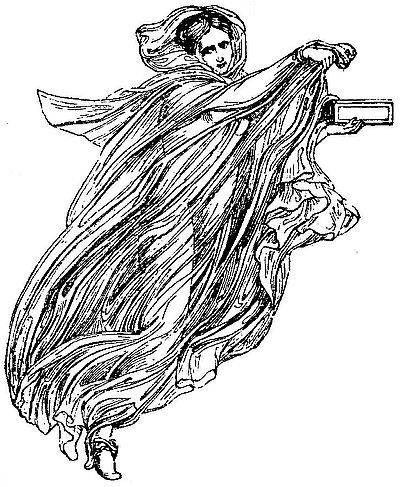
Coa Vestis. (From a Painting at Herculaneum.)
CŎACTOR, the name of collectors of various sorts, e.g. the servants of the publicani, or farmers of the public taxes, who collected the revenues for them, and those who collected the money from the purchasers of things sold at a public auction. Horace informs us that his father was a coactor of this kind. Moreover, the servants of the money-changers were so called, from collecting their debts for them. The “coactores agminis” were the soldiers who brought up the rear of a line of march.
CŎCHLĔA (κοχλίας), which properly means a snail, was also used to signify other things of a spiral form. (1) A screw, used in working clothes-presses, and oil and wine presses.—(2) A spiral pump for raising water, invented by Archimedes, from whom it has ever since been called the Archimedean screw.—(3) A peculiar kind of door through which the wild beasts passed from their dens into the arena of the amphitheatre.
COCHLĔAR. (κοχλιάριον), a kind of spoon, which appears to have terminated with a point at one end, and at the other was broad and hollow like our own spoons. The pointed end was used for drawing snails (cochleae) out of their shells, and eating them, whence it derived its name; and the broader part for eating eggs, &c. Cochlear was also the name given to a small measure like our spoonful.
CŌDEX, identical with caudex, as Claudius and Clodius, claustrum and clostrum, cauda and coda, originally signified the trunk or stem of a tree. The name codex was especially applied to wooden tablets bound together and lined with a coat of wax, for the purpose of writing upon them, and when, at a later age, parchment or paper, or other materials were substituted for wood, and put together in the shape of a book, the name of codex was still given to them. In the time of Cicero we find it also applied to the tablet on which a bill was written. At a still later period, during the time of the emperors, the word was used to express any collection of laws or constitutions of the emperors, whether made by private individuals or by public authority, as the Codex Gregorianus, Codex Theodosianus, and Codex Justinianeus.
COEMPTĬO. [Matrimonium.]
COENA (δεῖπνον), the principal meal of the Greeks and Romans, dinner. (1) Greek. Three names of meals occur in the Iliad and Odyssey—ariston (ἄριστον), deipnon (δεῖπνον), dorpon (δόρπον). The word ariston uniformly means the early, as dorpon does the late meal; but deipnon, on the other hand, is used for either, apparently without any reference to time. In the Homeric age it appears to have been usual to sit during mealtimes. Beef, mutton, and goat’s flesh were the ordinary meats, usually eaten roasted. Cheese, flour, and occasionally fruits, also formed part of the Homeric meals. Bread, brought on in baskets, and salt (ἃλς, to which Homer gives the epithet θεῖος), are mentioned. The Greeks of a later age usually partook of three meals, called acratisma (ἀκράτισμα), ariston, and deipnon. The last, which corresponds to the dorpon of the Homeric poems, was the evening meal or dinner; the ariston was the luncheon; and the acratisma, which answers to the ariston of Homer, was the early meal or breakfast. The acratisma was taken immediately after rising in the morning. It usually consisted of bread, dipped in unmixed wine (ἄκρατος), whence it derived its name. Next followed the ariston or luncheon; but the time at which it was taken is uncertain. It is frequently mentioned in Xenophon’s Anabasis, and appears to have been taken at different times, as would naturally be the case with soldiers in active service. We may conclude from many circumstances that this meal was taken about the middle of the day, and that it answered to the Roman prandium. The ariston was usually a simple meal, but of course varied according to the habits of individuals. The principal meal was the deipnon. It was usually taken rather late in the day, frequently not before sunset. The Athenians were a social people, and were very fond of dining in company. Entertainments were usually given, both in the heroic ages and later times, when sacrifices were offered to the gods, either on public or private occasions; and also on the anniversary of the birthdays of members of the family, or of illustrious persons, whether living or dead. When young men wished to dine together they frequently contributed each a certain sum of money, called symbole (συμβολή), or brought their own provisions with them. When the first plan was adopted, they were said ἀπὸ συμβολῶν δειπνεῖν, and one individual was usually entrusted with the money to procure the provisions, and make all the necessary preparations. This kind of entertainment, in which each guest contributed to the expense, is mentioned in Homer under the name of ἔρανος. An entertainment in which each person brought his own provisions with him, or at least contributed something to the general stock, was called a δεῖπνον ἀπὸ σπυρίδος, because the provisions were brought in baskets.—The most usual kind of entertainments, however, were those in which a person invited his friends to his own house. It was expected that they should come dressed with more than ordinary care, and also have bathed shortly before. As soon as the guests arrived at the house of their host, their shoes or sandals were taken off by the slaves and their feet washed. After their feet had been washed, the guests reclined on the couches. It has already been remarked that Homer never describes persons as reclining, but always as sitting at their meals; but at what time the change was introduced is uncertain. The Dorians of Crete always sat; but the other Greeks reclined. The Greek women and children, however, like the Roman, continued to sit at their meals. [Accubatio.] It was usual for only two persons to recline on each couch. After the guests had placed themselves on the couches, the slaves brought in water to wash their hands. The dinner was then served up; whence we read of τὰς τραπέζας εἰσφέρειν, by which expression we are to understand not merely the dishes, but the tables themselves, which were small enough to be moved with ease. In eating, the Greeks had no knives or forks, but made use of their fingers only, except in eating soups or other liquids, which they partook of by means of a spoon, called μυστίλη, μύστρον, or μύστρος. It would exceed the limits of this work to give an account of the different dishes which were introduced at a Greek dinner, though their number is far below those which were usually partaken of at a Roman entertainment. The most common food among the Greeks was the μάζα, a kind of frumenty or soft cake, which was prepared in different ways. Wheaten or barley bread was the second most usual species of food; it was sometimes made at home, but more usually bought at the market of the ἀρτοπῶλαι or ἀρτοπώλιδες. The vegetables ordinarily eaten were mallows (μαλάχη), lettuces (θρίδαξ), cabbages (ῥάφανοι), beans (κύαμοι), lentils (φακαῖ), &c. Pork was the most favourite animal food, as was the case among the Romans. It is a curious fact, which Plato has remarked, that we never read in Homer of the heroes partaking of fish. In later times, however, fish was one of the most favourite foods of the Greeks. A dinner given by an opulent Athenian usually consisted of two courses, called respectively πρῶται τράπεζαι and δεύτεραι τράπεζαι. The first course embraced the whole of what we consider the dinner, namely, fish, poultry, meat, &c.; the second, which corresponds to our dessert and the Roman bellaria, consisted of different kinds of fruit, sweetmeats, confections, &c. When the first course was finished, the tables were taken away, and water was given to the guests for the purpose of washing their hands. Crowns made of garlands of flowers were also then given to them, as well as various kinds of perfumes. Wine was not drunk till the first course was finished; but as soon as the guests had washed their hands, unmixed wine was introduced in a large goblet, of which each drank a little, after pouring out a small quantity as a libation. This libation was said to be made to the “good spirit” (ἀγαθοῦ δαίμονος), and was usually accompanied with the singing of the paean and the playing of flutes. After this libation mixed wine was brought in, and with their first cup the guests drank to Διὸς Σωτῆρος. With the libations the deipnon closed; and at the introduction of the dessert (δεύτεραι τράπεζαι) the πότος, συμπόσιον or κῶμος commenced, of which an account is given under Symposium.—(2) Roman. As the Roman meals are not always clearly distinguished, it will be convenient to treat of all under the most important one; and we shall confine ourselves to the description of the ordinary life of the middle ranks of society in the Augustan age, noticing incidentally the most remarkable deviations. The meal with which the Roman sometimes began the day was the jentaculum, which was chiefly taken by children, or sick persons, or the luxurious. An irregular meal (if we may so express it) was not likely to have any very regular time: two epigrams of Martial, however, seem to fix the hour at about three or four o’clock in the morning. Bread formed the substantial part of this early breakfast, to which cheese, or dried fruit, as dates and raisins, were sometimes added. Next followed the prandium or luncheon, with persons of simple habits a frugal meal, usually taken about twelve or one o’clock. The coena, or principal meal of the day, corresponding to our “dinner,” was usually taken about three o’clock in the time of Cicero and Augustus, though we read of some persons not dining till near sunset. A Roman dinner at the house of a wealthy man usually consisted of three courses. The first was called promulsis, antecoena, or gustatio, and was made up of all sorts of stimulants to the appetite. Eggs also were so indispensable to the first course that they almost gave a name to it (ab ovo usque ad mala). The frugality of Martial only allowed of lettuce and Sicenian olives; indeed he himself tells us that the promulsis was a refinement of modern luxury. It would far exceed our limits to mention all the dishes which formed the second course of a Roman dinner. Of birds, the Guinea hen (Afra avis), the pheasant (phasiana, so called from Phasis, a river of Colchis), and the thrush, were most in repute; the liver of a capon steeped in milk, and beccaficos (ficedulae) dressed with pepper, were held a delicacy. The peacock, according to Macrobius, was first introduced by Hortensius the orator, at an inaugural supper, and acquired such repute among the Roman gourmands as to be commonly sold for fifty denarii. Other birds are mentioned, as the duck (anas), especially its head and breast; the woodcock (attagen), the turtle, and flamingo (phoenicopterus), the tongue of which, Martial tells us, particularly commended itself to the delicate palate. Of fish, the variety was perhaps still greater; the charr (scarus), the turbot (rhombus), the sturgeon (acipenser), the mullet (mullus), were highly prized, and dressed in the most various fashions. Of solid meat, pork seems to have been the favourite dish, especially sucking pig. Boar’s flesh and venison were also in high repute: the former is described by Juvenal as animal propter convivia natum. Condiments were added to most of these dishes: such were the muria, a kind of pickle made from the tunny fish; the garum sociorum, made from the intestines of the mackerel (scomber), so called because brought from abroad; alec, a sort of brine; faex, the sediment of wine, &c. Several kinds of fungi are mentioned, truffles (boleti), mushrooms (tuberes), which either made dishes by themselves, or formed the garniture for larger dishes. It must not be supposed that the artistes of imperial Rome were at all behind ourselves in the preparation and arrangements of the table. In a large household, the functionaries to whom this important duty was entrusted were four, the butler (promus), the cook (archimagirus), the arranger of the dishes (structor), and the carver (carptor or scissor). Carving was taught as an art, and performed to the sound of music, with appropriate gesticulations.
——“minimo sane discrimine refert, Quo vultu lepores, et quo gallina secetur.”
In the supper of Petronius, a large round tray (ferculum, repositorium) is brought in, with the signs of the zodiac figured all round it, upon each of which the artiste (structor) had placed some appropriate viand, a goose on Aquarius, a pair of scales with tarts (scriblitae) and cheesecakes (placentae) in each scale on Libra, &c. In the middle was placed a hive supported by delicate herbage. Presently four slaves come forward dancing to the sound of music, and take away the upper part of the dish; beneath appear all kinds of dressed meats; a hare with wings to imitate Pegasus, in the middle; and four figures of Marsyas at the corners, pouring hot sauce (garum piperatum) over the fish, that were swimming in the Euripus below. So entirely had the Romans lost all shame of luxury, since the days when Cincius, in supporting the Fannian law, charged his own age with the enormity of introducing the porcus Trojanus, a sort of pudding stuffed with the flesh of other animals.—The third course was the bellaria or dessert, to which Horace alludes when he says of Tigellius ab ovo usque ad mala citaret; it consisted of fruits (which the Romans usually ate uncooked), such as almonds (amygdalae), dried grapes (uvae passae), dates (palmulae, caryotae, dactyli); of sweetmeats and confections, called edulia mellita, dulciaria, such as cheesecakes (cupediae, crustula, liba, placentae, artolagani), almond cakes (coptae), tarts (scriblitae), whence the maker of them was called pistor dulciarius, placentarius, libarius, &c. We will now suppose the table spread and the guests assembled, each with his mappa or napkin, and in his dinner dress, called coenatoria or cubitoria, usually of a bright colour, and variegated with flowers. First they took off their shoes, for fear of soiling the couch, which was often inlaid with ivory or tortoise-shell, and covered with cloth of gold. Next they lay down to eat, the head resting on the left elbow and supported by cushions. There were usually, but not always, three on the same couch, the middle place being esteemed the most honourable. Around the tables stood the servants (ministri) clothed in a tunic, and girt with napkins; some removed the dishes and wiped the tables with a rough cloth, others gave the guests water for their hands, or cooled the room with fans. Here stood an eastern youth behind his master’s couch, ready to answer the noise of the fingers, while others bore a large platter of different kinds of meat to the guests. Dinner was set out in a room called coenatio or diaeta (which two words perhaps conveyed to a Roman ear nearly the same distinction as our dining-room and parlour). The coenatio, in rich men’s houses, was fitted up with great magnificence. Suetonius mentions a supper-room in the golden palace of Nero, constructed like a theatre, with shifting scenes to change with every course. In the midst of the coenatio were set three couches (triclinia), answering in shape to the square, as the long semicircular couches (sigmata) did to the oval tables. An account of the disposition of the couches, and of the place which each guest occupied, is given in the article Triclinium.
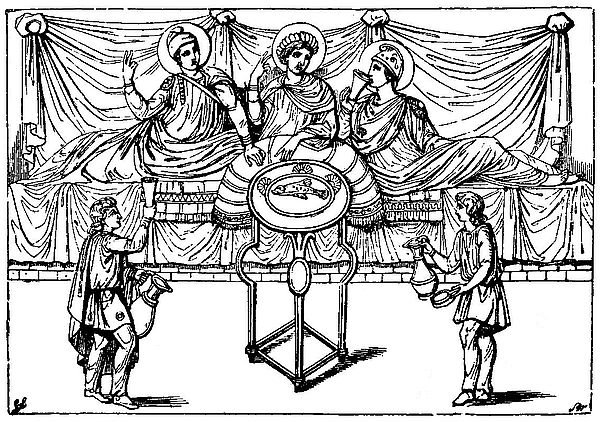
A Feast. (Vatican Virgil MS.)
COENĀCŬLUM. [Domus.]
COENĀTĬO. [Coena.]
COGNĀTI, COGNĀTĬO. The cognatio was the relationship of blood which existed between those who were sprung from a common pair; and all persons so related were called cognati. The foundation of cognatio is a legal marriage. The term cognatus (with some exceptions) comprehends agnatus; an agnatus may be a cognatus, but a cognatus is only an agnatus when his relationship by blood is traced through males. Those who were of the same blood by both parents were sometimes called germani; consanguinei were those who had a common father only; and uterini those who had a common mother only.
COGNĬTOR. [Actio.]
COGNŌMEN. [Nomen.]
CŎHORS. [Exercitus.]
CŌLĂCRĔTAE (κωλακρέται, also called κωλαγρέται), the name of very ancient magistrates at Athens, who had the management of all financial matters in the time of the kings. Cleisthenes deprived them of the charge of the finances, which he transferred to the Apodectae. [Apodectae.] From this time the Colacretae had only to provide for the meals in the Prytaneium, and subsequently to pay the fees to the dicasts, when the practice of paying the dicasts was introduced by Pericles.
COLLĒGĬUM. The persons who formed a collegium were called collegae or sodales. The word collegium properly expressed the notion of several persons being united in any office or for any common purpose; it afterwards came to signify a body of persons, and the union which bound them together. The collegium was the ἑταιρία of the Greeks. The legal notion of a collegium was as follows:—A collegium or corpus, as it was also called, must consist of three persons at least. Persons who legally formed such an association were said corpus habere, which is equivalent to our phrase of being incorporated; and in later times they were said to be corporati, and the body was called a corporatio. Associations of individuals, who were entitled to have a corpus, could hold property in common. Such a body, which was sometimes also called a universitas, was a legal unity. That which was due to the body, was not due to the individuals of it; and that which the body owed, was not the debt of the individuals. The common property of the body was liable to be seized and sold for the debts of the body. It does not appear how collegia were formed, except that some were specially established by legal authority. Other collegia were probably formed by voluntary associations of individuals under the provisions of some general legal authority, such as those of the publicani. Some of these corporate bodies resembled our companies or guilds; such were the fabrorum, pistorum, &c. collegia. Others were of a religious character; such as the pontificum, augurum, fratrum arvalium collegia. Others were bodies concerned about government and administration; as tribunorum plebis, quaestorum, decurionum collegia. According to the definition of a collegium, the consuls being only two in number were not a collegium, though each was called collega with respect to the other, and their union in office was called collegium. When a new member was taken into a collegium, he was said co-optari, and the old members were said with respect to him, recipere in collegium. The mode of filling up vacancies would vary in different collegia. The statement of their rules belongs to the several heads of Augur, Pontifex, &c.
CŎLŌNĬA, a colony, contains the same element as the verb colere, “to cultivate,” and as the word colonus, which probably originally signified a “tiller of the earth.” (1) Greek. The usual Greek words for a colony are ἀποικία and κληρουχία. The latter word, which signified a division of conquered lands among Athenian citizens, and which corresponds in some respects to the Roman colonia, is explained in the article Cleruchi. The earlier Greek colonies, called ἀποικίαι, were usually composed of mere bands of adventurers, who left their native country, with their families and property, to seek a new home for themselves. Some of the colonies, which arose in consequence of foreign invasion or civil wars, were undertaken without any formal consent from the rest of the community; but usually a colony was sent out with the approbation of the mother country, and under the management of a leader (οἰκιστής) appointed by it. But whatever may have been the origin of the colony, it was always considered in a political point of view independent of the mother country, called by the Greeks metropolis (μητρόπολις), the “mother-city,” and entirely emancipated from its control. At the same time, though a colony was in no political subjection to its parent state, it was united to it by the ties of filial affection; and, according to the generally received opinions of the Greeks, its duties to the parent state corresponded to those of a daughter to her mother. Hence, in all matters of common interest, the colony gave precedence to the mother state; and the founder of the colony (οἰκιστής), who might be considered as the representative of the parent state, was usually worshipped, after his death, as a hero. Also, when the colony became in its turn a parent, it usually sought a leader for the colony which it intended to found from the original mother country; and the same feeling of respect was manifested by embassies which were sent to honour the principal festivals of the parent state, and also by bestowing places of honour and other marks of respect upon the ambassadors and other members of the parent state, when they visited the colony at festivals and on similar occasions. The colonists also worshipped in their new settlement the same deities as they had been accustomed to honour in their native country: the sacred fire, which was constantly kept burning on their public hearth, was taken from the Prytaneium of the parent city; and sometimes the priests also were brought from the mother state. In the same spirit, it was considered a violation of sacred ties for a mother country and a colony to make war upon one another. The preceding account of the relations between the Greek colonies and the mother country is supported by the history which Thucydides gives us of the quarrel between Corcyra and Corinth. Corcyra was a colony of Corinth, and Epidamnus a colony of Corcyra; but the leader (οἰκιστής) of the colony of Epidamnus was a Corinthian who was invited from the metropolis Corinth. In course of time, in consequence of civil dissensions, and attacks from the neighbouring barbarians, the Epidamnians apply for aid to Corcyra, but their request is rejected. They next apply to the Corinthians, who took Epidamnus under their protection, thinking, says Thucydides, that the colony was no less theirs than the Corinthians’: and also induced to do so through hatred of the Corcyraeans, because they neglected them though they were colonists; for they did not give to the Corinthians the customary honours and deference in the public solemnities and sacrifices, which the other colonies were wont to pay to the mother country. The Corcyraeans, who had become very powerful by sea, took offence at the Corinthians receiving Epidamnus under their protection, and the result was a war between Corcyra and Corinth. The Corcyraeans sent ambassadors to Athens to ask assistance; and in reply to the objection that they were a colony of Corinth, they said, “that every colony, as long as it is treated kindly, respects the mother country: but when it is injured, is alienated from it; for colonists are not sent out as subjects, but that they may have equal rights with those that remain at home.” It is true that ambitious states, such as Athens, sometimes claimed dominion over other states on the ground of relationship; but as a general rule, colonies may be regarded as independent states, attached to their metropolis by ties of sympathy and common descent, but no further. The case of Potidaea, to which the Corinthians sent annually the chief magistrates (δημιουργοί), appears to have been an exception to the general rule.—(2) Roman. A kind of colonisation seems to have existed among the oldest Italian nations, who, on certain occasions, sent out their superfluous male population, with arms in their hands, to seek for a new home. But these were apparently mere bands of adventurers, and such colonies rather resembled the old Greek colonies, than those by which Rome extended her dominion and her name. Colonies were established by the Romans as far back as the annals or traditions of the city extend, and the practice was continued, without intermission, during the republic and under the empire. Colonies were intended to keep in check a conquered people, and also to repress hostile incursions; and their chief object was originally the extension and preservation of the Roman dominion in Italy. Cicero calls the old Italian colonies the propugnacula imperii. Another object was to increase the power of Rome by increasing the population. Sometimes the immediate object of a colony was to carry off a number of turbulent and discontented persons. Colonies were also established for the purpose of providing for veteran soldiers, a practice which was begun by Sulla, and continued under the emperors; these coloniae were called militares. The old Roman colonies were in the nature of garrisons planted in conquered towns, and the colonists had a portion of the conquered territory (usually a third part) assigned to them. The inhabitants retained the rest of their lands, and lived together with the new settlers, who alone composed the proper colony. The conquered people must at first have been quite a distinct class from, and inferior to, the colonists. No colonia was established without a lex, plebiscitum, or senatusconsultum; a fact which shows that a Roman colony was never a mere body of adventurers, but had a regular organisation by the parent state. When a law was passed for founding a colony, persons were appointed to superintend its formation (coloniam deducere). These persons varied in number, but three was a common number (triumviri ad colonos deducendos). We also read of duumviri, quinqueviri, vigintiviri for the same purpose. The law fixed the quantity of land that was to be distributed, and how much was to be assigned to each person. No Roman could be sent out as a colonist without his free consent, and when the colony was not an inviting one, it was difficult to fill up the number of volunteers. The colonia proceeded to its place of destination in the form of an army (sub vexillo), which is indicated on the coins of some coloniae. An urbs, if one did not already exist, was a necessary part of a new colony, and its limits were marked out by a plough, which is also indicated on ancient coins. The colonia had also a territory, which, whether marked out by the plough or not, was at least marked out by metes and bounds. Thus the urbs and territory of the colonia respectively corresponded to the urbs Roma and its territory. Religious ceremonies always accompanied the foundation of the colony, and the anniversary was afterwards observed. It is stated that a colony could not be sent out to the same place to which a colony had already been sent in due form (auspicato deducta). This merely means, that so long as the colony maintained its existence, there could be no new colony in the same place; a doctrine that would hardly need proof, for a new colony implied a new assignment of lands; but new settlers (novi adscripti) might be sent to occupy colonial lands not already assigned. Indeed it was not unusual for a colony to receive additions, and a colony might be re-established, if it seemed necessary, from any cause. The commissioners appointed to conduct the colony had apparently a profitable office, and the establishment of a new settlement gave employment to numerous functionaries, among whom Cicero enumerates—apparitores, scribae, librarii, praecones, architecti. The foundation of a colony might then, in many cases, not only be a mere party measure, carried for the purpose of gaining popularity, but it would give those in power an opportunity of providing places for many of their friends.—The colonies founded by the Romans were divided into two great classes of colonies of Roman citizens and Latin colonies; names which had no reference to the persons who formed the colonies, but merely indicated their political rights with respect to Rome as members of the colony. The members of a Roman colony (colonia civium Romanorum) preserved all the rights of Roman citizens. The members of a Latin colony (colonia Latina) ceased to have the full rights of Roman citizens. Probably some of the old Latin colonies were established by the Romans in conjunction with other Latin states. After the conquest of Latium, the Romans established colonies, called Latin colonies, in various parts of Italy. Roman citizens, who chose to join such colonies, gave up their civic rights for the more solid advantage of a grant of land, and became Latini. [Civitas.] Such colonies were subject to, and part of, the Roman state; but they did not possess the Roman franchise, and had no political bond among themselves.—The lex Julia, passed B.C. 90, gave the Roman franchise to the members of the Latin colonies and the Socii; and such Latin colonies and states of the Socii were then called municipia, and became complete members of the Roman state. Thus there was then really no difference between these municipia and the Roman coloniae, except in their historical origin: the members of both were Roman citizens, and the Roman law prevailed in both.—In the colonies, as at Rome, the popular assembly had originally the sovereign power; they chose the magistrates, and could even make laws. When the popular assemblies became a mere form in Rome, and the elections were transferred by Tiberius to the senate, the same thing happened in the colonies, whose senates then possessed whatever power had once belonged to the community. The common name of this senate was ordo decurionum; in later times, simply ordo and curia; the members of it were decuriones or curiales. Thus, in the later ages, curia is opposed to senatus, the former being the senate of a colony, and the latter the senate of Rome. But the terms senatus and senator were also applied to the senate and members of the senate of a colony. After the decline of the popular assemblies, the senate had the whole internal administration of a city, conjointly with the magistratus; but only a decurio could be a magistratus, and the choice was made by the decuriones. The highest magistratus of a colonia were the duumviri or quattuorviri, so called, as the members might vary, whose functions may be compared with those of the consulate at Rome before the establishment of the praetorship. The name duumviri seems to have been the most common. Their principal duties were the administration of justice, and accordingly we find on inscriptions “Duumviri J. D.” (juri dicundo), “Quattuorviri J. D.” The name consul also occurs in inscriptions to denote this chief magistracy; and even dictator and praetor occur under the empire and under the republic. The office of the duumviri lasted a year.—In some Italian towns there was a praefectus juri dicundo; he was in the place of, and not co-existent with, the duumviri. The duumviri were, as we have seen, originally chosen by the people; but the praefectus was appointed annually in Rome, and sent to the town called a praefectura, which might be either a municipium or a colonia, for it was only in the matter of the praefectus that a town called a praefectura differed from other Italian towns. Arpinum is called both a municipium and a praefectura; and Cicero, a native of this place, obtained the highest honours that Rome could confer.—The censor, curator, or quinquennalis, all which names denote the same functionary, was also a municipal magistrate, and corresponded to the censor at Rome, and in some cases, perhaps, to the quaestor also. Censors are mentioned in Livy as magistrates of the twelve Latin colonies. The quinquennales were sometimes duumviri, sometimes quattuorviri; but they are always carefully distinguished from the duumviri and quattuorviri J. D.; and their functions were those of censors. They held their office for one year, and during the four intermediate years the functions were not exercised. The office of censor or quinquennalis was higher in rank than that of the duumviri J. D., and it could only be filled by those who had discharged the other offices of the municipality.
CŎLOSSUS (κολοσσός) is used both by the Greeks and Romans to signify a statue larger than life; but as such statues were very common, the word was more frequently applied to designate figures of gigantic dimensions. Such figures were first executed in Egypt, and were afterwards made by the Greeks and Romans. Among the colossal statues of Greece, the most celebrated was the bronze colossus at Rhodes, dedicated to the sun, the height of which was about 90 feet.
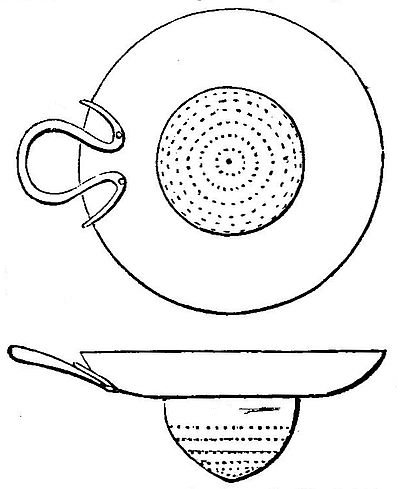
Colum. (Museo Borbonico, vol. viii. pl. 14.)
CŌLUM (ἠθμός), a strainer or colander, was used for straining wine, milk, olive-oil, and other liquids. Those that were used as articles of luxury for straining wine were frequently made of some metal, such as bronze or silver. Occasionally a piece of linen cloth (σάκκος, saccus) was placed over the τρύγοιπος or colum, and the wine (σακκίας, saccatus) filtered through. The use of the saccus was considered objectionable for all delicate wines, since it was believed to injure, if not entirely to destroy their flavour, and in every instance to diminish the strength of the liquor. For this reason it was employed by the dissipated in order that they might be able to swallow a greater quantity without becoming intoxicated. The double purpose of cooling and weakening was effectually accomplished by placing ice or snow in the filter, which under such circumstances became a colum nivarium, or saccus nivarius. The preceding woodcut shows the plan and profile of a silver colum.
CŎLUMBĀRĬUM, a dovecot or pigeon-house, also signified a sepulchral chamber formed to receive the ashes of the lower orders, or dependants of great families; and in the plural, the niches in which the cinerary urns (ollae) were deposited.
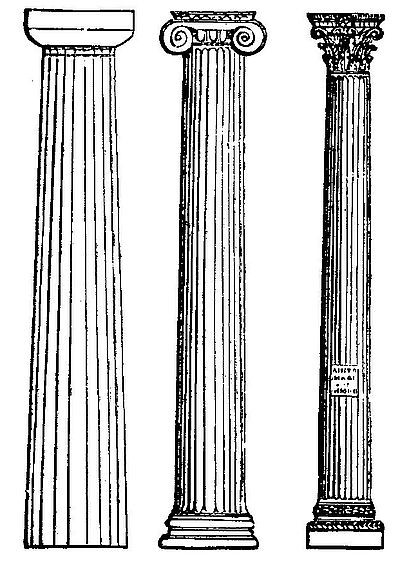
Ancient Columns.
CŎLUMNA (κίων, στύλος), a pillar or column. The use of the trunks of trees placed upright for supporting buildings, unquestionably led to the adoption of similar supports wrought in stone. As the tree required to be based upon a flat square stone, and to have a stone or tile of similar form fixed on its summit to preserve it from decay, so the column was made with a square base, and was covered with an abacus. [Abacus.] Hence the principal parts of which every column consists are three, the base (basis), the shaft (scapus), and the capital (capitulum). In the Doric, which is the oldest style of Greek architecture, we must consider all the columns in the same row as having one common base (podium), whereas in the Ionic and Corinthian each column has a separate base, called spira. The capitals of these two latter orders show, on comparison with the Doric, a much richer style of ornament; and the character of lightness and elegance is further obtained in them by their more slender shaft, its height being much greater in proportion to its thickness. Of all these circumstances some idea may be formed by the inspection of the three accompanying specimens of pillars. The first on the left hand is Doric, the second Ionic, and the third Corinthian. In all the orders the shaft tapers from the bottom towards the top. The shaft was, however, made with a slight swelling in the middle, which was called the entasis. It was, moreover, almost universally channelled or fluted. Columns were used in the interior of buildings, to sustain the beams which supported the ceiling. Rows of columns were often employed within a building, to enclose a space open to the sky. Beams supporting ceilings passed from above the columns to the adjoining walls, so as to form covered passages or ambulatories (στοαί). Such a circuit of columns was called a peristyle (περίστυλον), and the Roman atrium was built upon this plan. The largest and most splendid temples enclosed an open space like an atrium, which was accomplished by placing one peristyle upon another. In such cases, the lower rows of columns being Doric, the upper were sometimes Ionic or Corinthian, the lighter being properly based upon the heavier. A temple so constructed was called hypaethral (ὕπαιθρος). But it was on the exterior of public buildings, and especially of temples, that columns were displayed in the most beautiful combinations, either surrounding the building entirely, or arranged in porticoes on one or more of its fronts. [Templum.] Their original and proper use was, of course, to support the roof of the building; and, amidst all the elaborations of architectural design, this object was still kept in view. On the summit of the row of columns rests the architrave, i.e. chief beam (ἐπιστύλιον, epistylium): above this is the frieze (ζωοφόρος, ζωφόρος, zophorus), in which the most ancient order, namely the Doric, shows, in its triglyphs, what were originally the ends of the cross-beams: in the other orders these ends are generally concealed, and the frieze forms a flat surface, which is frequently ornamented by figures in relief, whence its Greek name. Above the frieze projects the cornice (κορωνίς, coronis or corona), forming a handsome finish to the entablature (for so these three members taken together are called), and also, on the sides of the building, serving to unite the ends of the rafters of the roof. The triangular gable-end of the roof, above the entablature, is called the pediment. [Fastigium.]—Columns in long rows were used in aquaeducts, and single pillars were fixed in harbours for mooring ships.—Single columns were also erected to commemorate persons or events. Among these, some of the most remarkable were the columnae rostratae, called by that name because three ship-beaks proceeded from each side of them, designed to record successful engagements at sea. The most important and celebrated of those which yet remain, is one erected in honour of the consul C. Duillius, on occasion of his victory over the Carthaginian fleet, B.C. 261. Columns were also employed to commemorate the dead. The column on the right hand in the last woodcut exhibits that which the senate erected to the honour of the Emperor Trajan. Similar columns were erected to the memory of many of the Roman emperors.
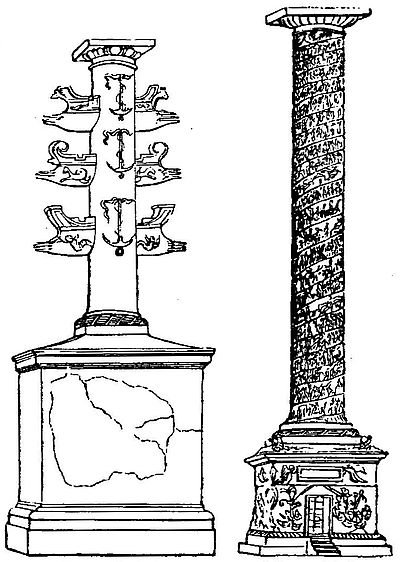
Columna Rostrata. Columna Trajana.
CŎLUMNĀRĬUM, a tax imposed in the time of Julius Caesar upon the pillars that supported a house. The Ostiarium was a similar tax. [Ostiarium.] The columnarium, levied by Metellus Scipio in Syria in B.C. 49-48, was a tax of a similar kind, but was simply an illegal means of extorting money from the provincials.
CŎLUS, a distaff. [Fusus.]
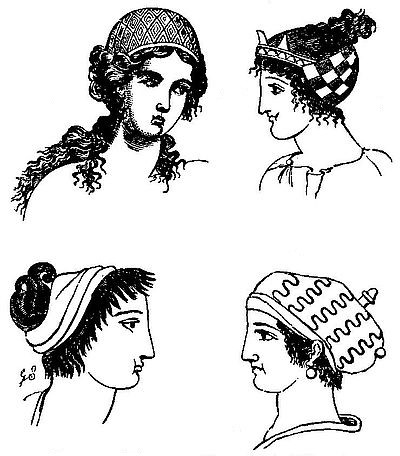
Greek Head-dresses. (From Ancient Vases.)
The left-hand figure on the top wears a κεκρύφαλος proper (reticulum). Of the two bottom figures, the one on the left-hand wears a μίτρα, and the one on the right a σάκκος.]
CŎMA (κόμη, κουρά), the hair. (1) Greek. In the earliest times the Greeks wore their hair long, and thus they are constantly called in Homer καρηκομόωντες Ἀχαιοί. The Spartan boys always had their hair cut quite short (ἐν χρῷ κείροντες); but as soon as they reached the age of puberty (ἔφηβοι), they let it grow long. Before going to battle they combed and dressed it with especial care. It seems that both Spartan men and women tied their hair in a knot over the crown of the head. The custom of the Athenians was different. They wore their hair long in childhood, and cut it off when they reached the age of puberty. The cutting off of the hair, which was always done when a boy became an ἔφηβος, was a solemn act, attended with religious ceremonies. A libation was first offered to Hercules, which was called οἰνιστήρια or οἰνιαστήρια, and the hair after being cut off was dedicated to some deity, usually a river-god. But when the Athenians passed into the age of manhood, they again let their hair grow. In ancient times at Athens the hair was rolled up into a kind of knot on the crown of the head, and fastened with golden clasps in the shape of grasshoppers. This fashion of wearing the hair was called κρωβύλος, and in the case of females κόρυμβος. The heads of females were frequently covered with a kind of band or a coif of net-work. Of these coiffures one was called σφενδόνη, which was a broad band across the forehead, sometimes made of metal, and sometimes of leather, adorned with gold. But the most common kind of head-dress for females was called by the general name of κεκρύφαλος, and this was divided into the three species of κεκρύφαλος, σάκκος, and μίτρα. The κεκρύφαλος, in its narrower sense, was a caul or coif of net-work, corresponding to the Latin reticulum. These hair-nets were frequently made of gold threads, sometimes of silk, or the Elean byssus, and probably of other materials. The σάκκος and the μίτρα were, on the contrary, made of close materials. The σάκκος covered the head entirely like a sack or bag; it was made of various materials, such as silk, byssus, and wool. The μίτρα was a broad band of cloth of different colours, which was wound round the hair, and was worn in various ways. It was originally an Eastern head-dress, and may, therefore, be compared to the modern turban. The Roman calautica or calvatica is said by Servius to have been the same as the mitra, but in a passage in the Digest they are mentioned as if they were distinct.—With respect to the colour of the hair, black was the most frequent, but blonde (ξανθὴ κόμη) was the most prized. In Homer, Achilles, Ulysses, and other heroes are represented with blonde hair. At a later time it seems to have been not unfrequent to dye hair, so as to make it either black or blonde, and this was done by men as well as by women, especially when the hair was growing gray.—(2) Roman. Besides the generic coma we also find the following words signifying the hair: capillus, caesaries, crines, cincinnus, and cirrus, the two last words being used to signify curled hair. In early times the Romans wore their hair long, and hence the Romans of the Augustan age designated their ancestors intonsi and capillati. But after the introduction of barbers into Italy about B.C. 300, it became the practice to wear the hair short. The women, too, originally dressed their hair with great simplicity, but in the Augustan period a variety of different head-dresses came into fashion. Sometimes these head-dresses were raised to a great height by rows of false curls. So much attention did the Roman ladies devote to the dressing of the hair, that they kept slaves especially for this purpose, called ornatrices, and had them instructed by a master in the art. Most of the Greek head-dresses mentioned above were also worn by the Roman ladies; but the mitrae appear to have been confined to prostitutes. One of the simplest modes of wearing the hair was allowing it to fall down in tresses behind, and only confining it by a band encircling the head. [Vitta.] Another favourite plan was platting the hair, and then fastening it behind with a large pin. Blonde hair was as much prized by the Romans as by the Greeks, and hence the Roman ladies used a kind of composition or wash to make it appear this colour (spuma caustica). False hair or wigs (φενάκη, πηνίκη, galerus) were worn both by Greeks and Romans. Among both people likewise in ancient times the hair was cut close in mourning [Funus]; and among both the slaves had their hair cut close as a mark of servitude.
CŌMISSĀTĬO (derived from κῶμος), the name of a drinking entertainment, which took place after the coena, from which, however, it must be distinguished. The comissatio was frequently prolonged to a late hour at night, whence the verb comissari means “to revel,” and the substantive comissator a “reveller,” or “debauchee.”
CŎMĬTĬA. This word is formed from co, cum, or con, and ire, and therefore comitium is a place of meeting, and comitia the meeting itself, or the assembled people. In the Roman constitution the comitia were the ordinary and legal meetings or assemblies of the people, and distinct from the contiones and concilia. All the powers of government were divided at Rome between the senate, the magistrates, and the people in their assemblies. Properly speaking, the people alone (the populus) was the real sovereign by whom the power was delegated to the magistrates and the senate. The sovereign people or populus, however, was not the same at all times. In the earliest times of Rome the populus consisted of the patricians (or patres) only, the plebs and the clients forming no part of the populus, but being without the pale of the state. The original populus was divided into thirty curiae, and the assembly of these curiae (the comitia curiata) was the only assembly in which the populus was represented. A kind of amalgamation of the patricians and the plebs afterwards appeared in the comitia of the centuries, instituted by king Servius Tullius, and henceforth the term populus was applied to the united patricians and plebeians assembled in the comitia centuriata. But Servius had also made a local division of the whole Roman territory into thirty tribes, which held their meetings in assemblies called comitia tributa, which, in the course of time, acquired the character of national assemblies, so that the people thus assembled were likewise designated by the term populus.
We shall examine in order the nature, power, and business of each of these different comitia. (1) Comitia curiata consisted of the members of the thirty curiae, that is, the patricians, who formed exclusively the populus in the early times. They were convened, in the kingly period, by the king himself, or by his tribunus celerum, and in the king’s absence by the praefectus urbi. After the death of a king the comitia were held by the interrex. In the republican period, the president was always one of the high patrician magistrates, viz. a consul, praetor, or dictator. They were called together by lictors or heralds. The votes were given by curiae, each curia having one collective vote; but within a curia each citizen belonging to it had an independent vote, and the majority of the members of a curia determined the vote of the whole curia. The meeting was always held in the comitium. The comitia curiata did not possess much power in the kingly period. They could only be called together when the king (or his representative) chose, and could only determine upon matters which the king submitted to them. The main points upon which the populus had to decide were the election of the king, the passing of laws, declarations of war, the capital punishment of Roman citizens, and, lastly, certain affairs of the curiae and gentes. The priestly officers, such as the Curiones, Flamines Curiales, were likewise either elected by the curiae, or at least inaugurated by them. The right of finally deciding upon the life of Roman citizens (judicia de capite civis Romani) is said to have been given to the populus by king Tullus Hostilius. It must further be remarked, that when the king had been elected, the populus held a second meeting, in which he was formally inducted into his new office. This formality was called lex curiata de imperio, whereby the king received his imperium, together with the right of holding the comitia. Down to the time of Servius Tullius, the comitia curiata were the only popular assemblies of Rome, and remained of course in the undiminished possession of the rights above described; but the constitution of that king brought about a great change, by transferring the principal rights which had hitherto been enjoyed by the curiae to a new national assembly or the comitia centuriata. But while the patricians were obliged to share their rights with the plebeians, they reserved for themselves the very important right of sanctioning or rejecting any measure which had been passed by the centuries. The sanction of decrees passed by the centuries is often expressed by patres auctores fiunt, and down to the time of the Publilian law no decree of the centuries could become law without this sanction. By the Publilian law (B.C. 339) it was enacted that the curiae should give their assent before the vote of the comitia centuriata; so that the veto of the curiae was thus virtually abolished. The comitia curiata thus became a mere formality, and, instead of the thirty curiae themselves giving their votes, the ceremony was performed by thirty lictors. The comitia of the curiae were also called Comitia calata or “the summoned comitia” (from calare, i.e. vocare), when summoned for the purposes mentioned below:—1. On the calends it was proclaimed to the comitia calata on what day of the new month the nones fell, and perhaps also the ides as well as the nature of the other days, namely, whether they were fasti or nefasti, comitiales, feriae, &c., because all these things were known in the early times to the pontiffs exclusively. 2. The inauguration of the flamines, and after the banishment of the kings, also that of the rex sacrorum. 3. The testamenti factio, or the making of a will. 4. The detestatio sacrorum, which was in all probability an act connected with the testamenti factio, that is, a solemn declaration, by which the heir was enjoined to undertake the sacra privata of the testator along with the reception of his property. The comitia calata were summoned by the college of pontiffs, who also presided in them.
(2) Comitia centuriata. The object of the legislation of Servius Tullius was to unite the different elements of which the Roman people consisted, into one great political body, in which power and influence were to be determined by property and age. The whole people was conceived as an army (exercitus), and was therefore divided into two parts, the cavalry (equites), and infantry (pedites). The infantry was divided into five classes, or, as Dionysius has it, into six classes, for he regards the whole body of people, whose property did not come up to the census of the fifth class, as a sixth. The class to which a citizen belonged determined the tributum, or war tax, he had to pay, as well as the kind of service he had to perform in the army and the armour in which he had to serve. But for the purpose of voting in the comitia, each class was subdivided into a number of centuries (centuriae, probably because each was conceived to contain 100 men, though the centuries may have greatly differed in the number of men they contained). Hence the name of Comitia Centuriata. Each century was divided into the seniores and the juniores. Each century, further, was counted as one vote, so that a class had as many votes as it contained centuries. In like manner, the equites were divided into a number of centuries or votes. The two principal authorities on these subdivisions are Livy and Dionysius. The annexed table will show the census as well as the number of centuries or votes assigned to each class.
According to Livy. According to Dionysius.
I. Classis. Census: 100,000 asses. I. Classis. Census: 100 minae.
40 centuriae seniorum. 40 centuriae seniorum.
40 centuriae juniorum. 40 centuriae juniorum.
2 centuriae fabrum.
II. Classis. Census: 75,000 asses. II. Classis. Census: 75 minae.
10 centuriae seniorum. 10 centuriae seniorum.
10 centuriae juniorum. 10 centuriae juniorum.
2 centuriae fabrum (one
voting with the seniores
and the other with the
juniores).
III. Classis. Census: 50,000 asses. III. Classis. Census: 50 minae.
10 centuriae seniorum. 10 centuriae seniorum.
10 centuriae juniorum. 10 centuriae juniorum.
IV. Classis. Census: 25,000 asses. IV. Classis. Census: 25 minae.
10 centuriae seniorum. 10 centuriae seniorum.
10 centuriae juniorum. 10 centuriae juniorum.
2 centuriae cornicinum and
tubicinum (one voting with
the seniores, and the
other with the juniores).
V. Classis. Census: 11,000 asses. V. Classis. Census: 12½ minae.
15 centuriae seniorum. 15 centuriae seniorum.
15 centuriae juniorum. 15 centuriae juniorum.
3 centuriae accensorum, VI. Classis. Census: below 12½
cornicinum, tubicinum. minae.
1 centuria capite censorum. 1 centuria capite censorum.
According to both Dionysius and Livy, the equites voted in eighteen centuries before the seniores of the first class; and hence there were, according to Livy, 194, and, according to Dionysius, 193 centuries or votes. The latter number is the more probable, since Livy’s even number of 194 centuries would have rendered it impossible to obtain an absolute majority. In this manner all Roman citizens, whether patricians or plebeians, who had property to a certain amount, were privileged to take part and vote in the centuriata comitia, and none were excluded except slaves, peregrini, women and the aerarii. The juniores were all men from the age of seventeen to that of forty-six, and the seniores all men from the age of forty-six upwards. The order of voting was arranged in such a manner, that if the eighteen centuries of the equites and the eighty centuries of the first class were agreed upon a measure, the question was decided at once, there being no need for calling upon the other classes to vote. Hence, although all Roman citizens appeared in these comitia on a footing of equality, yet by far the greater power was thrown into the hands of the wealthy.—As regards the functions of the comitia centuriata, they were—(a.) The election of magistrates. The magistrates that were elected by the centuries are the consuls (whence the assembly is called comitia consularia), the praetors (hence comitia praetoria), the military tribunes with consular power, the censors, and the decemvirs. (b.) Legislation. The legislative power of the centuries at first consisted in their passing or rejecting a measure which was brought before them by the presiding magistrate in the form of a senatus consultum, so that the assembly had no right of originating any legislative measure, but voted only upon such as were brought before them as resolutions of the senate. (c.) The decision upon war, on the ground of a senatus consultum, likewise belonged to the centuries. Peace was concluded by a mere senatus consultum, and without any co-operation of the people. (d.) The highest judicial power. The comitia centuriata were in the first place the highest court of appeal, and in the second, they had to try all offences committed against the state; hence, all cases of perduellio and majestas: and no case involving the life of a Roman citizen could be decided by any other court. The sanction of the curiae to the measures of the centuriae has been already explained.—The comitia centuriata could be held only on dies comitiales or fasti, on which it was lawful to transact business with the people, and the number of such days in every year was about 190; but on dies nefasti (that is, dies festi, feriati, comp. Dies), and, at first also on the nundinae, no comitia could be held, until in B.C. 287 the Hortensian law ordained that the nundinae should be regarded as dies fasti.—The place where the centuries met was the Campus Martius, which contained the septa for the voters, a tabernaculum for the president, and the villa publica for the augurs.—The president at the comitia was the same magistrate who convoked them, and this right was a privilege of the consuls, and, in their absence, of the praetors. An interrex and dictator also, or his representative, the magister equitum, might likewise convene and preside at the comitia. One of the main duties devolving upon the president, and which he had to perform before holding the comitia, was to consult the auspices (auspicari). When the auspices were favourable, the people were called together, which was done by three successive and distinct acts: the first was quite a general invitation to come to the assembly (inlicium). At the same time when this invitation was proclaimed circum moeros or de moeris, a horn was blown, which being the more audible signal, is mentioned by some writers alone, and without the inlicium. When upon this signal the people assembled in irregular masses, there followed the second call by the accensus, or the call ad contionem or conventionem; that is, to a regular assembly, and the crowd then separated, grouping themselves according to their classes and ages. Hereupon the consul appeared, ordering the people to come ad comitia centuriata; and led the whole exercitus—for, in these comitia, the Roman people are always conceived as an exercitus—out of the city, to the Campus Martius.—It was customary from the earliest times for an armed force to occupy the Janiculum, when the people were assembled in the Campus Martius, for the purpose of protecting the city against any sudden attack of the neighbouring people; and on the Janiculum a vexillum was hoisted during the whole time that the assembly lasted. This custom continued to be observed even at the time when Rome had no longer anything to fear from the neighbouring tribes.—When the people were thus regularly assembled, the business was commenced with a solemn sacrifice, and a prayer of the president, who then took his seat on his tribunal. The president then opened the business by explaining to the people the subject for which they had been convened, and concluded his exposition with the words, velitis, jubeatis Quirites, e.g. bellum indici, or ut M. Tullio aqua igni interdictum sit, or whatever the subject might be. This formula was the standing one in all comitia, and the whole exposition of the president was called rogatio. When the comitia were assembled for the purpose of an election, the presiding magistrate had to read out the names of the candidates, and might exercise his influence by recommending the one whom he thought most fit for the office in question. If the assembly had been convened for the purpose of passing a legislative measure, the president usually recommended the proposal, or he might grant to others, if they desired it, permission to speak about the measure, either in its favour or against it (Contionem dare). When the comitia acted as a court of justice, the president stated the crime, proposed the punishment to be inflicted upon the offender, and then allowed others to speak either in defence of the accused or against him. When the subject brought before the assembly was sufficiently discussed, the president called upon the people to prepare for voting by the words, ite in suffragium, bene juvantibus diis. He then passed the stream Petronia, and went to the septa.—Respecting the mode of voting, it is commonly supposed that the people were always polled by word of mouth, till the passing of the leges tabellariae about the middle of the second century before Christ, when the ballot by means of tabellae was introduced. [Leges Tabellariae.] It appears, however, that the popular assemblies voted by ballot, as well as by word of mouth, long before the passing of the leges tabellariae, but that instead of using tabellae, they employed stones or pebbles (the Greek ψῆφοι), and that each voter received two stones, one white and the other black, the former to be used in the approval and the latter in the condemnation of a measure. The voting by word of mouth seems to have been adopted in elections and trials, and the use of pebbles to have been confined to the enactment and repeal of laws. Previous to the leges tabellariae, the rogatores, who subsequently collected the written votes, stood at the entrance of the septa, and asked every citizen for his vote, which was taken down, and used to determine the vote of each century. After the introduction of the ballot, if the business was the passing of a law, each citizen was provided with two tabellae, one inscribed V. R. i.e. Uti Rogas, “I vote for the law,” the other inscribed A. i.e. Antiquo, “I am for the old law.” If the business was the election of a magistrate, each citizen was supplied with only one tablet, on which the names of the candidates were written, or the initials of their names; the voter then placed a mark (punctum) against the one for whom he voted, whence puncta are spoken of in the sense of votes. For further particulars respecting the voting in the comitia, see Diribitores and Situla. In judicial assemblies every citizen was provided with three tabellae, one of which was marked with A. i.e. Absolvo, “I acquit;” the second with C. i.e. Condemno, “I condemn;” and the third with N. L. i.e. Non Liquet, “It is not clear to me.” The first of these was called Tabella absolutoria and the second Tabella damnatoria, and hence Cicero calls the former litera salutaris, and the latter litera tristis.—There were in the Campus Martius septa or inclosures (whether they existed from the earliest times is unknown), into which one class of citizens was admitted after another for the purpose of voting. The first that entered were the eighteen centuries of the equites, then followed the first class and so on. It very rarely happened that the lowest class was called upon to vote, as there was no necessity for it, unless the first class did not agree with the equites. After the time when the comitia of the centuries became amalgamated with those of the tribes, a large space near the villa publica was surrounded with an enclosure, and divided into compartments for the several tribes. The whole of this enclosure was called ovile, septa, carceres, or cancelli; and in later times a stone building, containing the whole people, was erected; it was divided into compartments for the classes as well as the tribes and centuries; the access to these compartments was formed by narrow passages called pontes or ponticuli. On entering, the citizens received their tablets, and when they had consulted within the enclosures, they passed out of them again by a pons or ponticulus, at which they threw their vote into a chest (cista) which was watched by rogatores. Hereupon the rogatores collected the tablets, and gave them to the diribitores, who classified and counted the votes, and then handed them over to the custodes, who again checked them off by points marked on a tablet. The order in which the centuries voted was determined in the Servian constitution, in the manner described above; but after the union of the centuries and tribes, the order was determined by lot; and this was a matter of no slight importance, since it frequently happened that the vote of the first determined the manner in which subsequent ones voted. In the case of elections, the successful candidate was proclaimed twice, first by the praeco, and then by the president, and without this renuntiatio the election was not valid. After all the business was done, the president pronounced a prayer, and dismissed the assembly with the word discedite.—Cases are frequently mentioned in which the proceedings of the assembly were disturbed, so that it was necessary to defer the business till another day. This occurred—1, when it was discovered that the auspices had been unfavourable, or when the gods manifested their displeasure by rain, thunder, or lightning; 2, when a tribune interceded; 3, when the sun set before the business was over, for it was a principle that the auspices were valid only for one day from sunrise to sunset; 4, when a morbus comitialis occurred, i.e. when one of the assembled citizens was seized with an epileptic fit; 5, when the vexillum was taken away from the Janiculum, this being a signal which all citizens had to obey; 6, when any tumult or insurrection broke out in the city.