E (continued 2)
Reading edition
Hastati 15 × 60 = 900
Principes 15 × 60 = 900
Triarii, &c. 15 × 3 × 60 = 2700
Centuriones = 150
Vexillarii = 75
——
4725
Third Period. During the wars of the younger Scipio. Polybius describes minutely the method pursued in raising the four legions during this period. Under ordinary circumstances they were levied yearly, two being assigned to each consul. It must be observed that a regular consular army (justus consularis exercitus) no longer consisted of Roman legions only, but as Italy became gradually subjugated, the various states under the dominion of Rome were bound to furnish a contingent, and the number of allies (socii) usually exceeded that of citizens. They were, however, kept perfectly distinct, both in the camp and in the battle field. After the election of consuls was concluded, the first step was to choose the 24 chief officers of the legions, named tribuni militum. The consuls then summoned to the Capitol all citizens eligible for military service. They first divided the 24 tribunes into 4 parties of 6, and the tribes were next summoned in succession by lot. The tribe whose lot came out first being called up, they picked out from it four youths, as nearly matched as possible in age and form; out of these four, the tribunes of the first legion chose one, the tribunes of the second legion one of the remaining three; the tribunes of the third legion, one of the remaining two, and the last fell to the fourth legion. Upon the next tribe being called up, the first choice was given to the tribunes of the second legion, the second choice to those of the third, and the last man fell to the first legion. On the next tribe being called up, the tribunes of the third legion had the first choice, and so on in succession, the object in view being that the four legions should be as nearly alike as possible, not in the number only, but in the quality of the soldiers. This process was continued until the ranks were complete. In ancient times, the cavalry were not chosen until after the infantry levy was concluded, but when Polybius wrote, the cavalry were picked in the first place from the list on which they were enrolled by the censor according to their fortune, and 300 were apportioned to each legion. The levy being completed, the tribunes collected the men belonging to their respective legions, and making one individual stand out from the rest administered to him an oath “that he would obey orders and execute to the best of his ability the command of his officers.” (Sacramento milites adigere s. rogare, sacramentum s. sacramento dicere.) The rest of the soldiers then came forward one by one, and swore to do what the first had bound himself to perform. At the same time the consuls gave notice to the magistrates of those towns in Italy in alliance with Rome, from whom they desired to receive a contingent, of the number which each would be required to furnish, and of the day and place of gathering. The allied cities levied their troops and administered the oath much in the same manner as the Romans, and then sent them forth after appointing a commander and a paymaster. The soldiers having again assembled, the men belonging to each legion were separated into four divisions. 1. 1000 of the youngest and poorest were set apart to form the Velites, the light-armed troops, or skirmishers of the legion. 2. 1200 who came next in age (or who were of the same age with the preceding but more wealthy), formed the Hastati. 3. 1200, consisting of those in the full vigour of manhood, formed the Principes. 4. 600, consisting of the oldest and most experienced, formed the Triarii. When the number of soldiers in the legion exceeded 4000, the first three divisions were increased proportionally, but the number of the Triarii remained always the same. The Hastati, Principes, and Triarii were each divided into ten companies, called Manipuli. The Velites were not divided into companies, but were distributed equally among the Hastati, Principes, and Triarii. Before the division of the three classes into maniples, officers were appointed inferior to the tribunes. 30 men were chosen by merit, 10 from the Hastati, 10 from the Principes, and 10 from the Triarii; and this first choice being completed, 30 more in like manner. These 60 officers, of whom 20 were assigned to each of the three classes, and distributed equally among the maniples, were named centuriones, or ordinum ductores, and each of the 60 chose for himself a Lieutenant (optio), who, being posted in the rear of the company while the centurion was at the head, was named οὐραγός (i.e. Tergiductor) by the Greeks, so that in each maniple there were two centurions and two optiones. Further, the centurions selected out of each maniple two of the bravest and most vigorous men as standard bearers (vexillarii, signiferi). The first elected centurion of the whole had a seat in the military council, and in each maniple the first chosen commanded the right division of the maniple, and the other the left. Each of these subdivisions of the maniple was called centuria. The cavalry were divided into 10 troops (turmae), and out of each of these 3 officers were chosen, named decuriones, who named 3 lieutenants (optiones). In each troop the decurio first chosen commanded the whole troop, and failing him, the second. The infantry furnished by the socii was for the most part equal in number to the Roman legions, the cavalry twice or thrice as numerous, and the whole were divided equally between the two consular armies. Each consul named twelve superior officers, who were termed Praefecti Sociorum, and corresponded to the legionary tribunes. A selection was then made of the best men, to the extent of one-fifth of the infantry and one-third of the cavalry; these were formed into a separate corps under the name of extraordinarii, and on the march and in the camp were always near the person of the consul. The remainder were divided into two equal portions, and were styled respectively the Dextera Ala and the Sinistra Ala [Ala].—Agmen or Line of March. The Extraordinarii Pedites led the van followed by the right wing of the infantry of the allies and the baggage of these two divisions; next came one of the Roman legions with its baggage following; next the other Roman legion with its own baggage, and that of the left wing of the allies, who brought up the rear. The different corps of cavalry sometimes followed immediately behind the infantry to which they were attached, sometimes rode on the flanks of the beasts of burden, at once protecting them and preventing them from straggling. Generally, when advancing through a country in which it was necessary to guard against a sudden onset, the troops, instead of proceeding in a loose straggling column, were kept together in close compact bodies ready to act in any direction at a moment’s warning, and hence an army under these circumstances was said agmine quadrato incedere. Some doubt exists with regard to the force of the term Agmen Pilatum as distinguished from Agmen Quadratum. Varro defines the agmen pilatum as a compact body marching without beasts of burthen. Where the phrase occurs in poetry, it probably denotes merely “columns bristling with spears.” To the preceding particulars from Polybius, the following may be added.
1. The levy (delectus.) According to the principles of the constitution, none were enrolled in the legion, except freeborn citizens (ingenui) above the age of 17, and under the age of 60, possessing not less than 4000 asses: but in times of peculiar difficulty, these conditions were not insisted upon. In such times all formalities were dispensed with, and every man capable of bearing arms was summoned to join in warding off the threatened danger, a force raised under such circumstances being termed subitarius s. tumultuarius exercitus. If citizens between the ages of 17 and 46 did not appear and answer to their names, they might be punished in various ways,—by fine, by imprisonment, by stripes, by confiscation of their property, and even, in extreme cases, by being sold as slaves. At the same time, causes might be alleged which were recognised as forming a legitimate ground for exemption (vacatio justa militiae). Thus, all who had served for the full period of 20 years were relieved from further service, although they might still be within the regular age; and so, in like manner, when they were afflicted by any grievous malady, or disabled by any personal defect, or engaged in any sacred or civil offices which required their constant attendance; but these and similar pleas, although sustained under ordinary circumstances, might be rendered void by a decree of the senate “ne vacationes valerent.” While those who had served for the stipulated period were entitled to immunity for the future, even although within the legal age, and were styled Emeriti, so on the other hand, it appears from some passages in the classics, that persons who had not completed their regular term within the usual limits, might be forced, if required, to serve between the ages of 45 and 50. Towards the close of the republic, and under the empire, when the legions became permanent, the soldier who had served his full time received a regular discharge (missio), together with a bounty (praemium) in money or an allotment of land. The jurists distinguish three kinds of discharge:—1. Missio honesta, granted for length of service. 2. Missio causaria, in consequence of bad health. 3. Missio ignominiosa, when a man was drummed out for bad conduct. It frequently happened that emeriti were induced to continue in the ranks, either from attachment to the person of the general, or from hopes of profit or promotion, and were then called veterani, or when they joined an army, in consequence of a special invitation, evocati.
2. The division of the legion into Cohortes, Manipuli, Centuriae, Signa, Ordines, Contubernia.—(i.) Cohortes. Polybius takes no notice of the Cohort, a division of the legion often mentioned in the Roman writers. When the soldiers of the legion were classified as Velites, Hastati, Principes and Triarii, the cohort contained one maniple of each of the three latter denominations, together with their complement of Velites, so that when the legion contained 4000, each cohort would consist of 60 Triarii, 120 Principes, 120 Hastati, and 100 Velites, in all 400 men. The number of cohorts in a legion being always 10, and the cohorts, during the republic, being all equal to each other, the strength of the cohort varied from time to time with the strength of the legion, and thus at different periods ranged between the limits of 300 and 600. They were regularly numbered from 1 to 10, the centurion of the first century of the first maniple of the first cohort was the guardian of the eagle, and hence the first cohort seems always to have been regarded as superior in dignity to the rest. Late writers, instead of cohortes, prefer the somewhat vague term numeri, which appears in Tacitus and Suetonius, and perhaps even in Cicero. Numeri seems to have signified strictly the muster roll, whence the phrases referre in numeros, distribuere in numeros, and thus served to denote any body of legionaries. Whenever Cohors occurs in the Latin classics in connection with the legion, it always signifies a specific division of the legion; but it is very frequently found, in the general sense of battalion, to denote troops altogether distinct from the legion.—(ii.) Manipulus. The original meaning of this word, which is derived from manus, was a handful or wisp of hay, straw, fern, or the like, and this, according to Roman tradition, affixed to the end of a pole, formed the primitive military standard in the days of Romulus. Hence it was applied to a body of soldiers serving under the same ensign. When the phalanx was resolved into small companies marshalled in open order, these were termed manipuli, and down to a very late period the common soldiers of the legion were designated as manipulares or manipularii, terms equivalent to gregarii milites. When the phalanx was first broken up, it appears that each of the three classes of Hastati, Principes, and Triarii, contained 15 maniples; but before the second Punic war the number of maniples in each of these classes was reduced to 10. Hence it is easy to calculate the number of soldiers in each maniple, according to the varying numbers in the legion, it being always borne in mind that the Triarii never exceeded 600, and that the Velites were not divided into maniples, but distributed equally among the heavy-armed companies.—(iii.) Centuriae. The distribution of soldiers into centuriae must be regarded as coeval with the origin of Rome. Plutarch speaks of the force led by Romulus against Amulius as formed of centuries; and from the close connections between the centuries of Servius Tullius, and the organization of the military force, we cannot hesitate to believe that the term was communicated to the ranks of the phalanx. For a long period after the establishment of the manipular constitution, the legion contained 60 centuries.—(iv.) Signum. This word is used to denote a division of the legion, but it is doubtful whether it signifies a maniple or a century.—(v.) Ordo generally signifies a century, and ordinum ductor is synonymous with centurio, and ducere honestum ordinem means to be one of the principal centurions in a legion.—(vi.) Contubernium. This was the name given under the empire to the body of soldiers who were quartered together in the same tent.
3. Hastati, Principes, Triarii, Pilani, Antepilani, Antesignani, Principia.—The Hastati were so called, from having been armed with a hasta, the Principes from having occupied the front line, the Triarii, otherwise named Pilani, from having been ranged behind the first two lines as a body of reserve and armed with the pilum, while the first two lines were termed collectively Antepilani, from standing in front of the Pilani. In process of time, it came to pass, that these designations no longer expressed the actual condition of the troops to which they were attached. When Polybius wrote, and long before that period, the Hastati were not armed with hastae, but in common with the Principes bore the heavy pilum: on the other hand, the pilani carried hastae and not pila, while the Principes were not drawn up in the front, but formed the second line.—Antesignani. While the Hastati and Principes, taken together, were sometimes termed Antepilani, in contradistinction to the Triarii, so the Hastati alone were sometimes termed Antesignani, in contradistinction to the Principes and Triarii taken together. The term Antesignani having become established as denoting the front ranks in a line of battle, was retained in this general sense long after the Hastati, Principes, and Triarii had disappeared.—Another term employed to denote the front ranks of an army in battle array is Principia, and in this sense must be carefully distinguished from the Principia or chief street in the camp, and from Principia, which in the later writers, such as Ammianus and Vegetius, is equivalent to principales milites. Postsignani does not occur in any author earlier than Ammianus Marcellinus, and therefore need not be illustrated here; the Subsignanus miles of Tacitus seems to be the same with the Vexillarii.
4. Rorarii, Accensi, Ferentarii, Velites, Procubitores.—When the Hastati had, in a great measure, ceased to act as tirailleurs, their place was supplied by the Rorarii, whose method of fighting has been described above (p. 165). The Accensi, as described by Livy, were inferior in equipment to the rorarii, although employed in a similar manner, and seem to have been camp-followers or servants, and hence the name is given to those also who attended upon magistrates or other officials. At a later period the accensi were supernumeraries, who served to fill up any vacancies which occurred in the course of a campaign. Another ancient term for light-armed soldiers was Ferentarii. The Velites, called also Procubitores, because they were employed on outpost duty when the Romans were encamped before an enemy, were first formed into a corps at the siege of Capua, B.C. 211.
5. Officers of the Legion.—Tribuni Militum were the chief officers of the legion. Their number (six) did not vary for many centuries. They were originally chosen by the commanders-in-chief, that is, by the kings in the first instance, and afterwards by the consuls, or a dictator, as the case might be. In B.C. 361 the people assumed to themselves the right of electing either the whole or a certain number; and in B.C. 311 it was ordained that they should choose sixteen for the four legions. In subsequent times the choice of the tribunes was divided between the consuls and the people; but the proportion chosen by each differed at various periods. No one was eligible to the office of tribune who had not served for ten years in the infantry or five in the cavalry; but this rule admitted of exceptions. Augustus introduced certain regulations altogether new. He permitted the sons of senators to wear the tunica laticlavia as soon as they assumed the manly gown, and to commence their military career as tribunes, or as commanders (praefecti) of cavalry. Such persons were the Tribuni Laticlavii.—Centuriones. Next in rank to the Tribunus was the Centurio, who, as the name implies, commanded a century; and the century, being termed also ordo, the centurions were frequently designated ordinum ductores (hence, adimere ordines, offerre ordines, ordines impetrare, ducere honestum ordinem, to be one of the principal centurions, &c.). The chief ordinary duties of the centurions were to drill the soldiers, to inspect their arms, clothing, and food, to watch the execution of the toils imposed, to visit the centinels, and to regulate the conduct of their men, both in the camp and in the field. They also sat as judges in minor offences, and had the power of inflicting corporal punishment, whence their badge of office was a vine sapling, and thus vitis is frequently used to denote the office itself. Of the two centurions in each maniple the one first chosen took the command of the right division, the other of the left. The century to the right was considered as the first century of the maniple, and its commander took precedence probably with the title Prior, his companion to the left being called Posterior, the priores in each of the three divisions of Triarii, Principes, and Hastati being the ten centurions first chosen. So long as these divisions were recognised, all the centurions of the Triarii appear to have ranked before those of the Principes, and all the centurions of the Principes before those of the Hastati. Moreover, since the maniples were numbered in each division from 1 to 10, there was probably a regular progression from the first centurion of the first maniple down to the second centurion of the tenth maniple. The first centurion of the first maniple of the Triarii, originally named Centurio Primus, and afterwards Centurio Primipili, or simply Primipilus, occupied a very conspicuous position. He stood next in rank to the Tribuni militum; he had a seat in the military council; to his charge was committed the eagle of the legion, whence he is sometimes styled Aquilifer, and, under the empire at least, his office was very lucrative. A series of terms connected with these arrangements are furnished by the narrative which Sp. Ligustinus gives of his own career (Liv. xlii. 34). He thus enumerates the various steps of his promotion:—“Mihi T. Quinctius Flamininus decumum ordinem hastatum adsignavit ... me imperator dignum judicavit cui primum hastatum prioris centuriae adsignaret ... a M’. Acilio mihi primus princeps prioris centuriae est adsignatus ... quater intra paucos annos primum pilum duxi.” The gradual ascent from the ranks being to the post of centurion:—1. In the tenth maniple of the Hastati. 2. In the first century of the first maniple of the Hastati. 3. In the first century of the first maniple of the Principes. 4. In the first century of the first maniple of the Triarii.—But even after the distinction between Hastati, Principes, and Triarii was altogether abolished, and they were all blended together in the cohorts, the same nomenclature with regard to the centuries and their commanders was retained, although it is by no means easy to perceive how it was applied. That great differences of rank existed among the centurions is evident from the phrases primores centurionum, primi ordines (i.e. chief centurions), as opposed to inferiores ordines, and infimi ordines, and that promotion from a lower to a higher grade frequently took place, is evident from many passages in ancient authors. The election of optiones, or lieutenants, by the centurions, has been already described.
Fourth Period. From the times of the Gracchi until the downfall of the Republic. After the times of the Gracchi the following changes in military affairs may be noticed:—In the first consulship of Marius the legions were thrown open to citizens of all grades, without distinction of fortune. The whole of the legionaries were armed and equipped in the same manner, all being now furnished with the pilum; and hence we see in Tacitus the pila and gladii of the legionaries, opposed to the hastae and spathae of the auxiliaries. The legionaries when in battle order were no longer arranged in three lines, each consisting of ten maniples, with an open space between each maniple, but in two lines, each consisting of five cohorts, with a space between each cohort. The younger soldiers were no longer placed in the front, but in reserve, the van being composed of veterans, as may be seen from various passages in Caesar. As a necessary result of the above arrangements, the distinction between Hastati, Principes, and Triarii ceased to exist. These names, as applied to particular classes of soldiers, are not found in Caesar, in Tacitus, nor in any writer upon military affairs after the time of Marius. The Velites disappeared. The skirmishers, included under the general term levis armatura, consisted for the most part of foreign mercenaries possessing peculiar skill in the use of some national weapon, such as the Balearic slingers, (funditores), the Cretan archers (sagittarii), and the Moorish dartmen (jaculatores). Troops of this description had, it is true, been employed by the Romans even before the second Punic war, and were denominated levium armatorum (s. armorum) auxilia; but now the levis armatura consisted exclusively of foreigners, were formed into a regular corps under their own officers, and no longer entered into the constitution of the legion. When operations requiring great activity were undertaken, such as could not be performed by mere skirmishers, detachments of legionaries were lightly equipped, and marched without baggage, for these special services; and hence the frequent occurrence of such phrases as expediti, expediti milites, expeditae cohortes, and even expeditae legiones. The cavalry of the legion underwent a change in every respect analogous to that which took place in regard of the light-armed troops. It is evident, from the history of Caesar’s campaigns in Gaul, that the number of Roman equites attached to his army was very small, and that they were chiefly employed as aides-de-camp, and on confidential missions. The bulk of Caesar’s cavalry consisted of foreigners, a fact which becomes strikingly apparent when we read that Ariovistus having stipulated that the Roman general should come to their conference attended by cavalry alone, Caesar, feeling no confidence in his Gaulish horse, dismounted them, and supplied their place by soldiers of the tenth legion. In like manner they ceased to form part of the legion, and from this time forward we find the legions and the cavalry spoken of as completely distinct from each other. After the termination of the Social War, when most of the inhabitants of Italy became Roman citizens, the ancient distinction between the Legiones and the Socii disappeared, and all who had served as Socii became incorporated with the legiones. An army during the last years of the republic and under the earlier emperors consisted of Romanae Legiones et Auxilia s. Auxiliares, the latter term comprehending troops of all kinds, except the legions. Whenever the word socii is applied to troops after the date of the Social War, it is generally to be regarded as equivalent to auxiliares. But the most important change of all was the establishment of the military profession, and the distinction now first introduced between the civilian and the soldier.
Fifth Period. From the establishment of the empire until the age of the Antonines, B.C. 31–A.D. 150. Under the empire a regular army consisted of a certain number of Legiones and of Supplementa, the Supplementa being again divided into the imperial guards, which appear under several different forms, distinguished by different names; and the Auxilia, which were subdivided into Sociae Cohortes and Nationes, the latter being for the most part barbarians. The Legiones, as already remarked, although still composed of persons who enjoyed the privileges of Roman citizens, were now raised almost exclusively in the provinces. The legion was divided into 10 cohorts, and each cohort into 6 centuries; the first cohort, which had the custody of the eagle, was double the size of the others, and contained 960 men, the remaining cohorts contained each 480 men; and consequently each ordinary century 80 men, the total strength of the legion being thus 5280 men.—It is during this period that we first meet with the term Vexillarii or Vexilla, which occurs repeatedly in Tacitus. The vexillarii, or vexilla legionum, were those soldiers who, after having served in the legion for sixteen years, became exauctorati, but continued to serve in company with that legion, under a vexillum of their own, until they received their full discharge. The number attached to each legion was usually about five or six hundred.—The term exauctorare also meant to discharge from military service, but does not appear to have been in use before the Augustan period. It signified both a simple discharge, and a cashiering on account of some crime. During the later period of the empire the latter signification began almost exclusively to prevail.—As to the Praetorian troops, see Praetoriani.—From the time when the cavalry were separated from the legion they were formed into bodies called alae, which varied in number according to circumstances. The Alae were raised in the Roman provinces and consisted, probably, for the most part, of citizens, or at least subjects. But in addition to these every army at this period was attended by squadrons of light horse composed entirely of barbarians; and the chief duty performed by those named above was guiding the pioneers as they performed their labours in advance of the army.—Cohortes peditatae, were battalions raised chiefly in the provinces, composed of Roman citizens, of subjects and allies, or of citizens, allies, and subjects indiscriminately. To this class of troops belonged the cohortes auxiliares, the auxilia cohortium, and the sociorum cohortes, of whom we read in Tacitus, together with a multitude of others recorded in inscriptions and named for the most part from the nations of which they were composed. These cohorts were numbered regularly like the legions.—Cohortes Equitatae differed from the Peditatae in this only, that they were made up of infantry combined with cavalry.—Classici, which we may fairly render Marines, were employed, according to Hyginus, as pioneers. They corresponded to the Navales Socii, under the republic, who were always regarded as inferior to regular soldiers. After the establishment by Augustus of regular permanent fleets at Misenum, Ravenna, and on the coast of Gaul, a large body of men must have been required to man them, who were sometimes called upon to serve as ordinary soldiers.—Nationes were battalions composed entirely of barbarians, or of the most uncivilised among the subjects of Rome, and were probably chiefly employed upon outpost duties.—Urbanae Cohortes. Augustus, in addition to the praetorian cohorts, instituted a force of city guards, amounting to 6000 men divided into four battalions. They are usually distinguished as Cohortes Urbanae or Urbana militia, their quarters, which were within the city, being the Urbana Castra.—Cohortes Vigilum. Augustus also organised a large body of night-watchers, whose chief duty was to act as firemen. They were divided into seven cohorts, in the proportion of one cohort to each two Regiones, were stationed in fourteen guardhouses (excubitoria), and called Cohortes Vigilum. They were commanded by a Praefectus, who was of equestrian rank.
EXĬLĬUM. [Exsilium.]
EXŎDĬA (ἐξόδια, from ἐξ and ὁδός) were old-fashioned and laughable interludes in verse, inserted in other plays, but chiefly in the Atellanae. The exodium seems to have been introduced among the Romans from Italian Greece; but after its introduction it became very popular among the Romans, and continued to be played down to a very late period.
EXŌMIS (ἐξωμίς), a dress which had only a sleeve for the left arm, leaving the right with the shoulder and a part of the breast free, and was for this reason called exomis. The exomis was usually worn by slaves and working people.
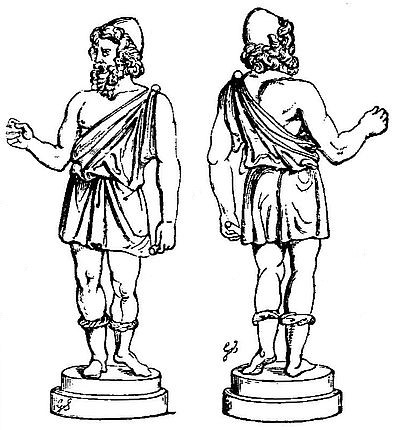
Exomis (Bronze in British Museum).
EXŌMŎSĬA (ἐξωμοσία). Any Athenian citizen when called upon to appear as a witness in a court of justice (κλητεύειν or ἐκκλητεύειν), was obliged by law to obey the summons, unless he could establish by oath that he was unacquainted with the case in question. This oath was called ἐξωμοσία, and the act of taking it was expressed by ἐξόμνυσθαι. A person appointed to a public office was at liberty to decline it, if he could take an oath that the state of his health or other circumstances rendered it impossible for him to fulfil the duties connected with it (ἐξόμνυσθαι τὴν ἀρχὴν, or τὴν χειροτονίαν): and this oath was likewise called ἐξωμοσία, or sometimes ἀπωμοσία.
EXOSTRA (ἐξώστρα, from ἐξωθέω), a theatrical machine, by means of which things which had been concealed behind the curtain on the stage were pushed or rolled forward from behind it, and thus became visible to the spectators.
EXPĔDĪTUS is opposed to impeditus, and signifies unincumbered with armour or with baggage (impedimenta). Hence the epithet was often applied to any portion of the Roman army, when the necessity for haste, or the desire to conduct it with the greatest facility from place to place, made it desirable to leave behind every weight that could be spared.
EXPLŌRĀTŌRES. [Speculatores.]
EXSĔQUĬAE. [Funus.]
EXSĬLĬUM (φυγή), banishment. (1) Greek. Banishment among the Greek states seldom, if ever, appears as a punishment appointed by law for particular offences. We might, indeed, expect this, for the division of Greece into a number of independent states would neither admit of the establishment of penal colonies, as among us, nor of the various kinds of exile which we read of under the Roman emperors. The general term φυγή (flight) was for the most part applied in the case of those who, in order to avoid some punishment or danger, removed from their own country to another. At Athens it took place chiefly in cases of homicide, or murder. An action for wilful murder was brought before the Areiopagus, and for manslaughter before the court of the Ephetae. The accused might, in either case, withdraw himself (φεύγειν) before sentence was passed; but when a criminal evaded the punishment to which an act of murder would have exposed him had he remained in his own land, he was then banished for ever (φεύγει ἀειφυγίαν), and not allowed to return home even when other exiles were restored upon a general amnesty. Demosthenes says, that the word φεύγειν was properly applied to the exile of those who committed murder with malice aforethought, whereas the term μεθίστασθαι was used where the act was not intentional. The property also was confiscated in the former case, but not in the latter. When a verdict of manslaughter was returned, it was usual for the convicted party to leave his country by a certain road, and to remain in exile till he induced some one of the relatives of the slain man to take compassion on him. We are not informed what were the consequences if the relatives of the slain man refused to make a reconciliation; supposing that there was no compulsion, it is reasonable to conclude that the exile was allowed to return after a fixed time. Plato, who is believed to have copied many of his laws from the constitution of Athens, fixes the period of banishment for manslaughter at one year.—Under φυγή, or banishment, as a general term, is comprehended Ostracism, (ὀστρακισμός). Those that were ostracised did not lose their property, and the time, as well as place of their banishment, was fixed. This ostracism is supposed by some to have been instituted by Cleisthenes, after the expulsion of the Peisistratidae; its nature and object are thus explained by Aristotle:—“Democratical states (he observes) used to ostracise, and remove from the city for a definite time, those who appeared to be preeminent above their fellow-citizens, by reason of their wealth, the number of their friends, or any other means of influence.” Ostracism, therefore, was not a punishment for any crime, but rather a precautionary removal of those who possessed sufficient power in the state to excite either envy or fear. Thus Plutarch says, it was a good-natured way of allaying envy by the humiliation of superior dignity and power. The manner of effecting it at Athens was as follows:—A space in the agora was enclosed by barriers, with ten entrances for the ten tribes. By these the tribesmen entered, each with his ostracon (ὄστρακον), or piece of tile (whence the name ostracism), on which was written the name of the individual whom he wished to be ostracised. The nine archons and the senate, i.e. the presidents of that body, superintended the proceedings, and the party who had the greatest number of votes against him, supposing that this number amounted to 6000, was obliged to withdraw (μεταστῆναι) from the city within ten days; if the number of votes did not amount to 6000, nothing was done. Some of the most distinguished men at Athens were removed by ostracism, but recalled when the city found their services indispensable. Among these were Themistocles, Aristeides, and Cimon, son of Miltiades. The last person against whom it was used at Athens was Hyperbolus, a demagogue of low birth and character; but the Athenians thought their own dignity compromised, and ostracism degraded by such an application of it, and accordingly discontinued the practice.—From the ostracism of Athens was copied the Petalism (πεταλισμός) of the Syracusans, so called from the πέταλον, or leaf of the olive, on which was written the name of the person whom they wished to remove from the city. The removal, however, was only for five years; a sufficient time, as they thought, to humble the pride and hopes of the exile. In connection with petalism it may be remarked, that if any one were falsely registered in a demus, or ward, at Athens, his expulsion was called ἐκφυλλοφορία, from the votes being given by leaves. Besides those exiled by law, or ostracised, there was frequently a great number of political exiles in Greece; men who, having distinguished themselves as the leaders of one party, were expelled, or obliged to remove from their native city, when the opposite faction became predominant. They are spoken of as οἱ φεύγοντες or οἱ ἐκπεσόντες, and as οἱ κατελθόντες after their return (ἡ κάθοδος) the word κατάγειν being applied to those who were instrumental in effecting it.—(2) Roman. Banishment as a punishment did not exist in the old Roman state. The aquae et ignis interdictio, which we so frequently read of in the republican period, was in reality not banishment, for it was only a ban, pronounced by the people (by a lex), or by a magistrate in a criminal court, by which a person was deprived of water and of fire; that is, of the first necessaries of life; and its effect was to incapacitate a person from exercising the rights of a citizen; in other words, to deprive him of his citizenship. Such a person might, if he chose, remain at Rome, and submit to the penalty of being an outcast, incapacitated from doing any legal act, and liable to be killed by any one with impunity. To avoid these dangers, a person suffering under such an interdict would naturally withdraw from Rome, and in the earlier republican period, if he withdrew to a state between which and Rome isopolitical relations existed, he would become a citizen of that state. This right was called jus exsulandi with reference to the state to which the person came; with respect to his own state, which he left, he was exsul, and his condition was exsilium; and with respect to the state which he entered, he was inquilinus.[2] In the same way a citizen of such a state had a right of going into exsilium at Rome; and at Rome he might attach himself (applicare se) to a quasi-patronus. Exsilium, instead of being a punishment, would thus rather be a mode of evading punishment; but towards the end of the republic the aquae et ignis interdictio became a regular banishment, since the sentence usually specified certain limits, within which a person was interdicted from fire and water. Thus Cicero was interdicted from fire and water within 400 miles from the city. The punishment was inflicted for various crimes, as vis publica, peculatus, veneficium, &c. Under the empire there were two kinds of exsilium; exsilium properly so called, and relegatio; the great distinction between the two was, that the former deprived a person of his citizenship, while the latter did not. The distinction between exsilium and relegatio existed under the republic. Ovid also describes himself, not as exsul, which he considers a term of reproach, but as relegatus. The chief species of exsilium was the deportatio in insulam or deportatio simply, which was introduced under the emperors in place of the aquae et ignis interdictio. The relegatio merely confined the person within, or excluded him from particular places. In the latter case it was called fuga lata, fuga libera, or liberum exsilium. The relegatus went into banishment; the deportatus was conducted to his place of banishment, sometimes in chains.
FOOTNOTE:
EXTISPEX. [Haruspex.]
EXTRĂORDĬNĀRĬI. [Exercitus, p. 167.]