P (continued 2)
Reading edition
POENA (ποινή), a general name for any punishment of any offence. Multa is the penalty of a particular offence. A Poena was only inflicted when it was imposed by some lex or some other legal authority (quo alio jure). When no poena was imposed, then a multa or penalty might be inflicted.
PŎLĔMARCHUS (πολέμαρχος). Respecting the polemarchus at Athens, see Archon. We read also of polemarchs at Sparta, and in various cities of Boeotia. As their name denotes, they were originally and properly connected with military affairs, being entrusted either with the command of armies abroad, or the superintendence of the war department at home; sometimes with both. The polemarchs of Sparta appear to have ranked next to the king, when on actual service abroad, and were generally of the royal kindred or house (γένος). They commanded single morae, so that they would appear to have been six in number, and sometimes whole armies. They also formed part of the king’s council in war, and of the royal escort called damosia. At Thebes there appear to have been two polemarchs, perhaps elected, annually; and in times of peace they seem to have been invested with the chief executive power of the state, and the command of the city, having its military force under their orders. They are not, however, to be confounded with the Boeotarchs.
PŌLĒTAE (πωλῆται), a board of ten officers, or magistrates, whose duty it was to grant leases of the public lands and mines, and also to let the revenues arising from the customs, taxes, confiscations, and forfeitures. Of such letting the word πωλεῖν (not μισθοῦν) was generally used, and also the correlative words ὠνεῖσθαι and πρίασθαι. One was chosen from each tribe. In the letting of the revenue they were assisted by the managers of the theoric fund (τὸ θεωρικόν), and they acted under the authority of the senate of Five Hundred, who exercised a general control over the financial department of the administration. Resident aliens, who did not pay their residence tax (μετοίκιον), were summoned before them, and, if found to have committed default, were sold.
POLLINCTŌRES. [Funus.]
PŌMOĒRĬUM. This word is compounded of post and moerium (murus), in the same manner as pomeridiem of post and meridiem, and thus signifies a line running by the walls of a town (pone or post muros). But the walls of a town here spoken of are not its actual walls or fortifications, but symbolical walls, and the course of the pomoerium itself was marked by stone pillars, erected at certain intervals. The sacred line of the Roman pomoerium did not prevent the inhabitants from building upon or taking into use any place beyond it, but it was necessary to leave a certain space on each side of it unoccupied, so as not to unhallow it by profane use. Thus we find that the Aventine, although inhabited from early times, was for many centuries not included within the pomoerium. The pomoerium was not the same at all times; as the city increased the pomoerium also was extended; but this extension could, according to ancient usage, only be made by such men as had by their victories over foreign nations increased the boundaries of the empire, and neither could a pomoerium be formed nor altered without the augurs previously consulting the will of the gods by augury: hence the jus pomoerii of the augurs.
POMPA (πομπή), a solemn procession, as on the occasion of a funeral, triumph, &c. It is, however, more particularly applied to the grand procession with which the games of the circus commenced (Pompa Circensis). [Circus.]
PONS (γέφυρα), a bridge. As the rivers of Greece were small, and the use of the arch known to them only to a limited extent, it is probable that the Greek bridges were built entirely of wood, or, at best, were nothing more than a wooden platform supported upon stone piers at each extremity. Pliny mentions a bridge over the Acheron 1000 feet in length; we also know that the island Euboea was joined to Boeotia by a bridge; but the only existing specimen of a Greek bridge is the one over a tributary of the Eurotas. The Romans regularly applied the arch to the construction of bridges, by which they were enabled to erect structures of great beauty and solidity, as well as utility. The width of the passage-way in a Roman bridge was commonly narrow, as compared with modern structures of the same kind, and corresponded with the road (via) leading to and from it. It was divided into three parts. The centre one, for horses and carriages, was denominated agger or iter; and the raised footpaths on each side decursoria, which were enclosed by parapet walls similar in use and appearance to the pluteus in the basilica. There were eight bridges across the Tiber. I. Of these the most celebrated, as well as the most ancient, was the Pons Sublicius, so called because it was built of wood; sublices, in the language of the Formiani, meaning wooden beams. It was built by Ancus Martius, when he united the Janiculum to the city, and was situated at the foot of the Aventine.—II. Pons Palatinus formed the communication between the Palatine and its vicinities and the Janiculum.—III. IV. Pons Fabricius and Pons Cestius were the two which connected the Insula Tiberina with the opposite sides of the river; the first with the city, and the latter with the Janiculum.
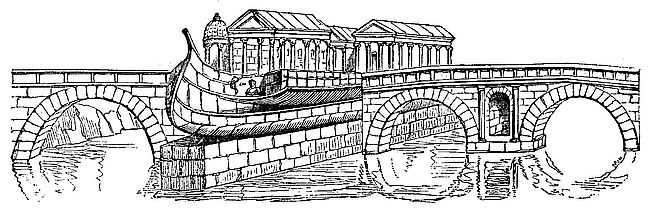
Pons Cestius, and Pons Fabricius, at Rome, with the buildings between restored.
Both are still remaining. They are represented in the preceding woodcut: that on the right hand is the pons Fabricius, and that on the left the pons Cestius.—V. Pons Janiculensis, which led direct to the Janiculum.—VI. Pons Vaticanus, so called because it formed the communication between the Campus Martius and Campus Vaticanus.—
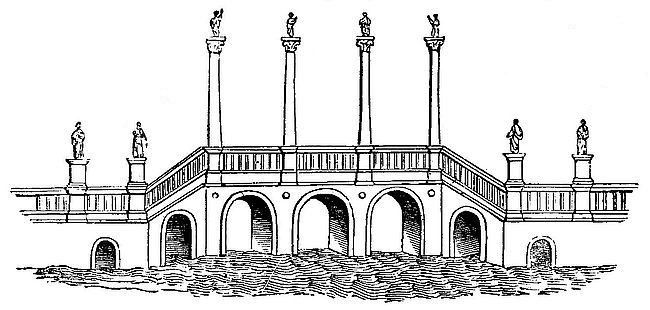
Pons Aelius at Rome.
VII. Pons Aelius, built by Hadrian, which led from the city to the mausoleum of that emperor, now the bridge and castle of St. Angelo.—VIII. Pons Milvius, on the Via Flaminia, now Ponte Molle, was built by Aemilius Scaurus the censor.—The Roman bridges without the city were too many to be enumerated here.
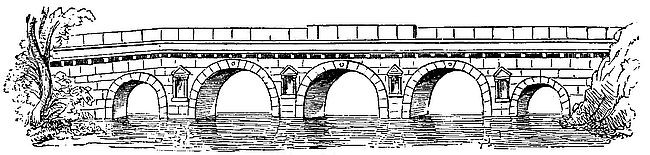
Bridge at Arimmum.
They formed one of the chief embellishments in all the public roads; and their frequent and stupendous remains, still existing in Italy, Portugal, and Spain, attest, even to the present day, the scale of grandeur with which the Roman works of national utility were always carried on.—When the comitia were held, the voters, in order to reach the enclosure called septum and ovile, passed over a wooden platform, elevated above the ground, which was called pons suffragiorum, in order that they might be able to give their votes without confusion or collusion. [Comitia.] Pons is also used to signify the platform (ἐπιβάθρα, ἀποβάθρα), used for embarking in, or disembarking from, a ship.
PONTĬFEX (ἱεροδιδάσκαλος, ἱερονόμος, ἱεροφύλαξ, ἱεροφάντης). The origin of this word is explained in various ways; but it is probably formed from pons and facere (in the signification of the Greek ῥέζειν, to perform a sacrifice), and consequently signifies the priests who offered sacrifices upon the bridge. The ancient sacrifice to which the name thus alludes, is that of the Argei on the sacred or sublician bridge. [Argei.] The Roman pontiffs formed the most illustrious among the great colleges of priests. Their institution, like that of all important matters of religion, was ascribed to Numa. The number of pontiffs appointed by this king was four, and at their head was the pontifex maximus, who is generally not included when the number of pontiffs is mentioned. It is probable that the original number of four pontiffs (not including the pontifex maximus) had reference to the two earliest tribes of the Romans, the Ramnes and Tities, so that each tribe was represented by two pontiffs. In the year B.C. 300 the Ogulnian law raised the number of pontiffs to eight, or, including the pontifex maximus, to nine, and four of them were to be plebeians. The pontifex maximus, however, continued to be a patrician down to the year B.C. 254, when Tib. Coruncanius was the first plebeian who was invested with this dignity. This number of pontiffs remained for a long time unaltered, until in B.C. 81 the dictator Sulla increased it to fifteen, and J. Caesar to sixteen. In both these changes the pontifex maximus is included in the number. During the empire the number varied, though on the whole fifteen appears to have been the regular number. The mode of appointing the pontiffs was also different at different times. It appears that after their institution by Numa, the college had the right of co-optation, that is, if a member of the college died (for all the pontiffs held their office for life), the members met and elected a successor, who, after his election, was inaugurated by the augurs. This election was sometimes called captio. In B.C. 104 a Lex Domitia was passed, which transferred the right of electing the members of the great colleges of priests to the people (probably in the comitia tributa); that is, the people elected a candidate, who was then made a member of the college by the co-optatio of the priests themselves, so that the co-optatio, although still necessary, became a mere matter of form. The Lex Domitia was repealed by Sulla in a Lex Cornelia de Sacerdotiis (B.C. 81), which restored to the great priestly colleges their full right of co-optatio. In B.C. 63 the law of Sulla was abolished, and the Domitian law was restored, but not in its full extent; for it was now determined, that in case of a vacancy the college itself should nominate two candidates, and the people elect one of them. M. Antonius again restored the right of co-optatio to the college. The college of pontiffs had the supreme superintendence of all matters of religion, and of things and persons connected with public as well as private worship. They had the judicial decision in all matters of religion, whether private persons, magistrates, or priests were concerned, and in cases where the existing laws or customs were found defective or insufficient, they made new laws and regulations (decreta pontificum), in which they always followed their own judgment as to what was consistent with the existing customs and usages. The details of these duties and functions were contained in books called libri pontificii or pontificales, commentarii sacrorum or sacrorum pontificalium, which they were said to have received from Numa, and which were sanctioned by Ancus Martius. As to the rights and duties of the pontiffs, it must first of all be borne in mind, that the pontiffs were not priests of any particular divinity, but a college which stood above all other priests, and superintended the whole external worship of the gods. One of their principal duties was the regulation of the sacra, both publica and privata, and to watch that they were observed at the proper times (for which purpose the pontiffs had the whole regulation of the calendar, see Calendarium), and in their proper form. In the management of the sacra publica they were in later times assisted in certain duties by the Triumviri Epulones. [Epulones.] The pontiffs convoked the assembly of the curies (comitia calata or curiata) in cases where priests were to be appointed, and flamines or a rex sacrorum were to be inaugurated; also when wills were to be received, and when a detestatio sacrorum and adoption by adrogatio took place. [Adoptio.] In most cases the sentence of the pontiffs only inflicted a fine upon the offenders; but the person fined had the right of appealing to the people, who might release him from the fine. In regard to the vestal virgins, and the persons who committed incest with them, the pontiffs had criminal jurisdiction, and might pronounce sentence of death. A man who had violated a vestal virgin was, according to an ancient law, scourged to death by the pontifex maximus in the comitium, and it appears that originally neither the vestal virgins nor the male offenders in such a case had any right of appeal. In later times we find that, even when the pontiffs had passed sentence upon vestal virgins, a tribune interfered, and induced the people to appoint a quaestor for the purpose of making a fresh inquiry into the case; and it sometimes happened that after this new trial the sentence of the pontiffs was modified or annulled. Such cases, however, seem to have been mere irregularities, founded upon an abuse of the tribunitian power. In the early times the pontiffs were in the exclusive possession of the civil as well as religious law, until the former was made public by Cn. Flavius. The regulations which served as a guide to the pontiffs in their judicial proceedings, formed a large collection of laws, which was called the jus pontificium, and formed part of the Libri Pontificii. The meetings of the college of pontiffs, to which in some instances the famines and the rex sacrorum were summoned, were held in the curia regia on the Via Sacra, to which was attached the residence of the pontifex maximus and of the rex sacrorum. As the chief pontiff was obliged to live in a domus publica, Augustus, when he assumed this dignity, changed part of his own house into a domus publica. All the pontiffs were in their appearance distinguished by the conic cap, called tutulus or galerus, with an apex upon it, and the toga praetexta. The pontifex maximus was the president of the college, and acted in its name, whence he alone is frequently mentioned in cases in which he must be considered only as the organ of the college. He was generally chosen from among the most distinguished persons, and such as had held a curule magistracy, or were already members of the college. Two of his especial duties were to appoint (capere) the vestal virgins and the flamines [Vestales; Flamen], and to be present at every marriage by confarreatio. When festive games were vowed, or a dedication made, the chief pontiff had to repeat over, before the persons who made the vow or the dedication, the formula in which it was to be performed (praeire verba). During the period of the republic, when the people exercised sovereign power in every respect, we find that if the pontiff, on constitutional or religious grounds, refused to perform this solemnity, he might be compelled by the people. The pontifex maximus wrote down what occurred in his year on tablets, which were hung up in his dwelling for the information of the people, and called Annales Maximi. A pontifex might, like all the members of the great priestly colleges, hold any other military, civil, or priestly office, provided the different offices did not interfere with one another. Thus we find one and the same person being pontiff, augur, and decemvir sacrorum; instances of a pontifex maximus being at the same time consul are very numerous. But whatever might be the civil or military office which a pontifex maximus held beside his pontificate, he was not allowed originally to leave Italy. The college of pontiffs continued to exist until the overthrow of paganism. The emperors themselves were always chief pontiffs, and as such the presidents of the college; hence the title of pontifex maximus (P. M. or PON. M.) appears on several coins of the emperors. If there were several emperors at a time, only one bore the title of pontifex maximus; but in the year A.D. 238 we find that each of the two emperors Maximus and Balbinus assumed this dignity. From the time of Theodosius the emperors no longer appear with the dignity of pontiff; but at last the title was assumed by the Christian bishop of Rome.—There were other pontiffs at Rome, who were distinguished by the epithet Minores. They appear to have been originally only the secretaries of the pontiffs; and when the real pontiffs began to neglect their duties, and to leave the principal business to be done by their secretaries, it became customary to designate these scribes by the name of Pontifices Minores. The number of these secretaries is uncertain.
PŎPA. [Sacrificium.]
PŎPĪNA. [Caupona.]
POPŬLĀRĬA. [Amphitheatrum.]
PŎPŬLUS. [Patricii.]
PŎPŬLĬFŬGĬA or POPLĬFŬGĬA, the day of the people’s flight, was celebrated on the nones of July, according to an ancient tradition, in commemoration of the flight of the people, when the inhabitants of Ficulae, Fidenae, and other places round about, appeared in arms against Rome shortly after the departure of the Gauls, and produced such a panic that the Romans suddenly fled before them. Other writers say that the Populifugia was celebrated in commemoration of the flight of the people before the Tuscans; while others again refer its origin to the flight of the people on the death of Romulus.
PŎRISTAE (πορισταί), magistrates at Athens, who probably levied the extraordinary supplies.
PORTA (πύλη, dim. πυλίς), the gate of a city, citadel, or other open space inclosed by a wall, in contradistinction to Janua, which was the door of a house or any covered edifice. The terms porta and πύλη are often found in the plural, even when applied to a single gate, because it consisted of two leaves. The gates of a city were of course various in their number and position. Thus Megara had 5 gates; Thebes, in Boeotia, had 7; Athens had 8; and Rome 20, or perhaps even more. The jambs of the gate were surmounted, 1. by a lintel, which was large and strong in proportion to the width of the gate. 2. By an arch, as we see exemplified at Pompeii, Paestum, Sepianum, Volterra, Suza, Autun, Besançon, and Treves. 3. At Arpinum, one of the gates now remaining is arched, whilst another is constructed with the stones projecting one beyond another. Gates sometimes had two passages close together, the one designed for carriages entering, and the other for carriages leaving the city. In other instances we find only one gate for carriages, but a smaller one on each side of it (παραπυλίς) for foot-passengers. When there were no sideways, one of the valves of the large gate sometimes contained a wicket (portula, πυλίς: ῥινοπύλη), large enough to admit a single person. The gateway had commonly a chamber (called πυλών) either on one side or on both, which served as the residence of the porter or guard. Statues of the gods were often placed near the gate, or even within it in the barbican, so as to be ready to receive the adoration of those who entered the city.
PORTĬCUS (στοά), a walk covered with a roof, and supported by columns, at least on one side. Such shaded walks and places of resort are almost indispensable in the southern countries of Europe, where people live much in the open air, as a protection from the heat of the sun and from rain. The porticoes attached to the temples were either constructed only in front of them, or went round the whole building, as is the case in the so-called Temple of Theseus at Athens. They were originally intended as places for those persons to assemble and converse in who visited the temple for various purposes. As such temple-porticoes, however, were found too small, or not suited for the various purposes of private and public life, most Grecian towns had independent porticoes, some of which were very extensive; and in most of these stoae, seats (exedrae) were placed, that those who were tired might sit down. They were frequented not only by idle loungers, but also by philosophers, rhetoricians, and other persons fond of intellectual conversation. The Stoic school of philosophy derived its name from the circumstance, that the founder of it used to converse with his disciples in a stoa. The Romans derived their great fondness for such covered walks from the Greeks; and as luxuries among them were carried in everything to a greater extent than in Greece, wealthy Romans had their private porticoes, sometimes in the city itself, and sometimes in their country-seats. In the public porticoes of Rome, which were exceedingly numerous and very extensive (as those around the Forum and the Campus Martius), a variety of business was occasionally transacted: we find that law-suits were conducted here, meetings of the senate held, goods exhibited for sale, &c.
PORTISCŬLUS (κελευστής), an officer in a ship, who gave the signal to the rowers, that they might keep time in rowing. This officer is sometimes called Hortator or Pausarius.
PORTĬTŌRES. [Publicani.]
PORTŌRĬUM, a branch of the regular revenues of the Roman state, consisting of the duties paid on imported and exported goods. A portorium, or duty upon imported goods, appears to have been paid at a very early period, for it is said that Valerius Publicola exempted the plebes from the portoria at the time when the republic was threatened with an invasion by Porsena. The time of its introduction is uncertain; but the abolition of it, ascribed to Publicola, can only have been a temporary measure; and as the expenditure of the republic increased, new portoria must have been introduced. In conquered places, and in the provinces, the import and export duties, which had been paid there before, were generally not only retained, but increased, and appropriated to the aerarium. Sicily, and above all, Asia, furnished to the Roman treasury large sums, which were raised as portoria. In B.C. 60 all the portoria in the ports of Italy were done away with by a Lex Caecilia, but were restored by Julius Caesar and the subsequent emperors. Respecting the amount of the import or export duties we have but little information. In the time of Cicero the portorium in the ports of Sicily was one-twentieth (vicesima) of the value of taxable articles; and it is probable that this was the average sum raised in all the other provinces. In the times of the emperors the ordinary rate of the portorium appears to have been the fortieth part (quadragesima) of the value of imported goods; and at a later period the exorbitant sum of one-eighth (octava) is mentioned. The portorium was, like all other vectigalia, farmed out by the censors to the publicani, who collected it through the portitores. [Vectigalia; Publicani.]
POSSESSĬO. [Ager Publicus.]
POSTĪCUM. [Janua.]
POSTLĪMĬNĬUM, POSTLĪMĬNII JUS. If a Roman citizen during war came into the possession of an enemy, he sustained a diminutio capitis maxima [Caput], and all his civil rights were in abeyance. Being captured by the enemy, he became a slave; but his rights over his children, if he had any, were not destroyed, but were said to be in abeyance (pendere) by virtue of the Jus Postliminii: when he returned, his children were again in his power; and if he died in captivity, they became sui juris. Sometimes by an act of the state a man was given up bound to an enemy, and if the enemy would not receive him, it was a question whether he had the Jus Postliminii. This was the case with Sp. Postumius, who was given up to the Samnites, and with C. Hostilius Mancinus, who was given up to the Numantines; but the better opinion was, that they had no Jus Postliminii, and Mancinus was restored to his civic rights by a lex. It appears that the Jus Postliminii was founded on the fiction of the captive having never been absent from home; a fiction which was of easy application, for, as the captive during his absence could not do any legal act, the interval of captivity was a period of legal non-activity, which was terminated by his showing himself again.
PŎTESTAS. [Patria Potestas.]
PRACTŎRES (πράκτορες), subordinate officers at Athens, who collected the fines and penalties (ἐπιβολάς and τιμήματα) imposed by magistrates and courts of justice, and payable to the state.
PRAECINCTĬO. [Amphitheatrum.]
PRAECŌNES, criers, were employed for various purposes: 1. In sales by auction, they frequently advertised the time, place, and conditions of sale: they seem also to have acted the part of the modern auctioneer, so far as calling out the biddings and amusing the company, though the property was knocked down by the magister auctionis. [Auctio.] 2. In all public assemblies they ordered silence. 3. In the comitia they called the centuries one by one to give their votes, pronounced the vote of each century, and called out the names of those who were elected. They also recited the laws that were to be passed. 4. In trials, they summoned the accuser and the accused, the plaintiff and defendant. 5. In the public games, they invited the people to attend, and proclaimed the victors. 6. In solemn funerals they also invited people to attend by a certain form; hence these funerals were called funera indictiva. 7. When things were lost, they cried them and searched for them. 8. In the infliction of capital punishment, they sometimes conveyed the commands of the magistrates to the lictors. Their office, called Praeconium, appears to have been regarded as rather disreputable: in the time of Cicero a law was passed preventing all persons who had been praecones from becoming decuriones in the municipia. Under the early emperors, however, it became very profitable, which was no doubt partly owing to fees, to which they were entitled in the courts of justice, and partly to the bribes which they received from the suitors, &c.
PRAEDA signifies moveable things taken by an enemy in war. Such things were either distributed by the Imperator among the soldiers or sold by the quaestors, and the produce was brought into the Aerarium. The difference between Praeda and Manubiae is this:—Praeda is the things themselves that are taken in war, and Manubiae is the money realized by their sale. It was the practice to set up a spear at such sales, which was afterwards used at all sales of things by a magistrates in the name of the people. [Sectio.]
PRAEFECTŪRA. [Colonia.]
PRAEFECTUS AERĀRĬI. [Aerarium.]
PRAEFECTUS ANNŌNAE, the praefect of the provisions, especially of the corn-market, was not a regular magistrate under the republic, but was only appointed in cases of extraordinary scarcity, when he seems to have regulated the prices at which corn was to be sold. Augustus created an officer under the title of Praefectus Annonae, who had jurisdiction over all matters appertaining to the corn-market, and, like the Praefectus Vigilum, was chosen from the equites, and was not reckoned among the ordinary magistrates.
PRAEFECTUS ĂQUĀRUM. [Aquae Ductus.]
PRAEFECTUS CASTRŌRUM, praefect of the camp, is first mentioned in the reign of Augustus. There was one to each legion.
PRAEFECTUS CLASSIS, the commander of a fleet. This title was frequently given in the times of the republic to the commander of a fleet; but Augustus appointed two permanent officers with this title, one of whom was stationed at Ravenna on the Adriatic, and the other at Misenum on the Tuscan sea, each having the command of a fleet.
PRAEFECTUS FABRUM. [Fabri.]
PRAEFECTUS JŪRI DĪCUNDO. [Colonia.]
PRAEFECTUS LĔGĬŌNIS. [Exercitus.]
PRAEFECTUS PRAETŌRĬO, was the commander of the troops who guarded the emperor’s person. [Praetoriani.] This office was instituted by Augustus, and was at first only military, and had comparatively small power attached to it; but under Tiberius, who made Sejanus commander of the praetorian troops, it became of much greater importance, till at length the power of these praefects became only second to that of the emperors. From the reign of Severus to that of Diocletian, the praefects, like the vizirs of the east, had the superintendence of all departments of the state, the palace, the army, the finances, and the law: they also had a court in which they decided cases. The office of praefect of the praetorium was not confined to military officers; it was filled by Ulpian and Papinian, and other distinguished jurists. Originally there were two praefects; afterwards sometimes one and sometimes two; from the time of Commodus sometimes three, and even four. They were, as a regular rule, chosen only from the equites; but from the time of Alexander Severus the dignity of senator was always joined with their office.
PRAEFECTUS VĬGĬLUM. [Exercitus, p. 171, a.]
PRAEFECTUS URBI, praefect or warden of the city, was originally called Custos Urbis. The name praefectus urbi does not seem to have been used till after the time of the decemvirs. The dignity of custos urbis, being combined with that of princeps senatus, was conferred by the king, as he had to appoint one of the decem primi as princeps senatus. The functions of the custos urbis, however, were not exercised except in the absence of the king from Rome; and then he acted as the representative of the king: he convoked the senate, held the comitia, if necessary, and on any emergency, might take such measures as he thought proper; in short, he had the imperium in the city. During the kingly period, the office of custos urbis was probably for life. Under the republic, the office, and its name of custos urbis, remained unaltered; but in B.C. 487 it was elevated into a magistracy, to be bestowed by election. The custos urbis was, in all probability, elected by the curiae. Persons of consular rank were alone eligible. In the early period of the republic the custos urbis exercised within the city all the powers of the consuls, if they were absent: he convoked the senate, held the comitia, and, in times of war, even levied civic legions, which were commanded by him. When the office of praetor urbanus was instituted, the wardenship of the city was swallowed up in it; but as the Romans were at all times averse to dropping altogether any of their old institutions, a praefectus urbi, though a mere shadow of the former office, was henceforth appointed every year, only for the time that the consuls were absent from Rome for the purpose of celebrating the Feriae Latinae. This praefectus had neither the power of convoking the senate nor the right of speaking in it; in most cases he was a person below the senatorial age, and was not appointed by the people, but by the consuls. An office very different from this, though bearing the same name, was instituted by Augustus on the suggestion of Maecenas. This new praefectus urbi was a regular and permanent magistrate, whom Augustus invested with all the powers necessary to maintain peace and order in the city. He had the superintendence of butchers, bankers, guardians, theatres, &c.; and to enable him to exercise his power, he had distributed throughout the city a number of milites stationarii, whom we may compare to a modern police. His jurisdiction, however, became gradually extended; and as the powers of the ancient republican praefectus urbi had been swallowed up by the office of the praetor urbanus, so now the power of the praetor urbanus was gradually absorbed by that of the praefectus urbi; and at last there was no appeal from his sentence, except to the person of the princeps himself, while any body might appeal from the sentence of any other city magistrate, and, at a later period, even from that of a governor of a province, to the tribunal of the praefectus urbi.
PRAEFĬCAE. [Funus.]
PRAEJŪDĬCĬUM is used both in the sense of a precedent, in which case it is rather exemplum than praejudicium (res ex paribus causis judicatae); and also in the sense of a preliminary inquiry and determination about something which belongs to the matter in dispute (judiciis ad ipsam causam pertinentibus), from whence also comes the name Praejudicium.
PRAELŪSĬO. [Gladiatores.]
PRAENŌMEN. [Nomen.]
PRAERŎGĀTĪVA TRIBUS. [Comitia, p. 109.]
PRAES, is a surety for one who buys of the state. The goods of a Praes were called Praedia. The Praediator was a person who bought a praedium, that is, a thing given to the state as a security by a praes.
PRAESCRIPTĬO, or rather TEMPŎRIS PRAESCRIPTĬO, signifies the Exceptio or answer which a defendant has to the demand of a plaintiff, founded on the circumstance of the lapse of time. The word has properly no reference to the plaintiff’s loss of right, but to the defendant’s acquisition of a right by which he excludes the plaintiff from prosecuting his suit. This right of a defendant did not exist in the old Roman law.
PRAESES. [Provincia.]
PRAESUL. [Salii.]
PRAETEXTA. [Toga.]
PRAETOR (στρατηγός), was originally a title which designated the consuls as the leaders of the armies of the state. The period and office of the command of the consuls might appropriately be called Praetorium. Praetor was also a title of office among the Latins. The first praetor specially so called was appointed in B.C. 366, and he was chosen only from the patricians, who had this new office created as a kind of indemnification to themselves for being compelled to share the consulship with the plebeians. No plebeian praetor was appointed till the year B.C. 337. The praetor was called collega consulibus, and was elected with the same auspices at the comitia centuriata. The praetorship was originally a kind of third consulship, and the chief functions of the praetor (jus in urbe dicere, jura reddere) were a portion of the functions of the consuls. The praetor sometimes commanded the armies of the state; and while the consuls were absent with the armies, he exercised their functions within the city. He was a magistratus curulis, and he had the imperium, and consequently was one of the magistratus majores: but he owed respect and obedience to the consuls. His insignia of office were six lictors; but at a later period he had only two lictors in Rome. The praetorship was at first given to a consul of the preceding year.—In B.C. 246 another praetor was appointed, whose business was to administer justice in matters in dispute between peregrini, or peregrini and Roman citizens; and accordingly he was called praetor peregrinus. The other praetor was then called praetor urbanus, qui jus inter cives dicit, and sometimes simply praetor urbanus and praetor urbis. The two praetors determined by lot which functions they should respectively exercise. If either of them was at the head of the army, the other performed all the duties of both within the city. Sometimes the military imperium of a praetor was prolonged for a second year. When the territories of the state were extended beyond the limits of Italy, new praetors were made. Thus, two praetors were created B.C. 227, for the administration of Sicily and Sardinia, and two more were added when the two Spanish provinces were formed, B.C. 197. When there were six praetors, two stayed in the city, and the other four went abroad. The senate determined their provinces, which were distributed among them by lot. After the discharge of his judicial functions in the city, a praetor often had the administration of a province, with the title of propraetor. Sulla increased the number of praetors to eight, which Julius Caesar raised successively to ten, twelve, fourteen, and sixteen. Augustus, after several changes, fixed the number at twelve. Under Tiberius there were sixteen. Two praetors were appointed by Claudius for matters relating to fideicommissa, when the business in this department of the law had become considerable, but Titus reduced the number to one; and Nerva added a praetor for the decision of matters between the fiscus and individuals. Thus there were eventually eighteen praetors, who administered justice in the state.—The praetor urbanus was specially named praetor, and he was the first in rank. His duties confined him to Rome, as is implied by the name, and he could only leave the city for ten days at a time. It was part of his duty to superintend the Ludi Apollinares. He was also the chief magistrate for the administration of justice; and to the edicta of the successive praetors the Roman law owes in a great degree its development and improvement. Both the praetor urbanus and the praetor peregrinus had the jus edicendi, and their functions in this respect do not appear to have been limited on the establishment of the imperial power, though it must have been gradually restricted, as the practice of imperial constitutions and rescripts became common. [Edictum.] The chief judicial functions of the praetor in civil matters consisted in giving a judex. [Judex.] It was only in the case of interdicts that he decided in a summary way. [Interdictum.] Proceedings before the praetor were technically said to be in jure. The praetors also presided at trials of criminal matters. These were the quaestiones perpetuae, or the trials for repetundae, ambitus, majestas, and peculatus, which, when there were six praetors, were assigned to four out of the number. Sulla added to these quaestiones those of falsum, de sicariis et veneficis, and de parricidis, and for this purpose he added two, or, according to some accounts, four praetors. On these occasions the praetor presided, but a body of judices determined by a majority of votes the condemnation or acquittal of the accused. [Judex.] The praetor, when he administered justice, sat on a sella curulis in a tribunal, which was that part of the court which was appropriated to the praetor and his assessors and friends, and is opposed to the subsellia, or part occupied by the judices, and others who were present.
PRAETŌRĬA CŎHORS. [Praetoriani.]
PRAETŌRĬĀNI, sc. milites, or praetoriae cohortes, a body of troops instituted by Augustus to protect his person and his power, and called by that name in imitation of the praetoria cohors, or select troops which attended the person of the praetor or general of the Roman army. They originally consisted of nine or ten cohorts, each comprising a thousand men, horse and foot. Augustus, in accordance with his general policy of avoiding the appearance of despotism, stationed only three of these cohorts in the capital, and dispersed the remainder in the adjacent towns of Italy. Tiberius, however, under pretence of introducing a stricter discipline among them, assembled them all at Rome in a permanent camp, which was strongly fortified. Their number was increased by Vitellius to sixteen cohorts, or 16,000 men. The praetorians were distinguished by double pay and especial privileges. Their term of service was originally fixed by Augustus at twelve years, but was afterwards increased to sixteen years; and when they had served their time, each soldier received 20,000 sesterces. They soon became the most powerful body in the state, and, like the janissaries at Constantinople, frequently deposed and elevated emperors according to their pleasure. Even the most powerful of the emperors were obliged to court their favour; and they always obtained a liberal donation upon the accession of each sovereign. After the death of Pertinax (A.D. 193) they even offered the empire for sale, which was purchased by Didius Julianus; but upon the accession of Severus in the same year they were disbanded, on account of the part they had taken in the death of Pertinax, and banished from the city. The emperors, however, could not dispense with guards, and accordingly the praetorians were restored on a new model by Severus, and increased to four times their ancient number. Diocletian reduced their numbers and abolished their privileges; they were still allowed to remain at Rome, but had no longer the guard of the emperor’s person, as he never resided in the capital. Their numbers were again increased by Maxentius; but after his defeat by Constantine, A.D. 312, they were entirely suppressed by the latter, their fortified camp destroyed, and those who had not perished in the battle between Constantine and Maxentius were dispersed among the legions. The commander of the praetorians was called Praefectus Praetorio.
PRAETŌRĬUM, the name of the general’s tent in the camp, and so called because the name of the chief Roman magistrate was originally praetor, and not consul. [Castra.] The officers who attended on the general in the praetorium, and formed his council of war, were called by the same name. The word was also used in several other significations, which were derived from the original one. Thus the residence of a governor of a province was called the praetorium; and the same name was also given to any large house or palace. The camp of the praetorian troops at Rome, and frequently the praetorian troops themselves, were called by this name. [Praetoriani.]
PRANDĬUM. [Coena, p. 96, b.]
PRĒLUM. [Vinum.]
PRĪMĬPĪLUS. [Centurio.]
PRINCEPS JŬVENTŪTIS. [Equites.]
PRINCEPS SĔNĀTUS. [Senatus.]
PRINCĬPES. [Exercitus, p. 168, b.]
PRINCĬPĬA, PRINCĬPĀLIS VIA. [Castra.]
PRĪVĬLĒGĬUM. [Lex.]
PRŎBŎLĒ (προβολή), an accusation of a criminal nature, preferred before the people of Athens in assembly, with a view to obtain their sanction for bringing the charge before a judicial tribunal. The probolé was reserved for those cases where the public had sustained an injury, or where, from the station, power, or influence of the delinquent, the prosecutor might deem it hazardous to proceed in the ordinary way without being authorised by a vote of the sovereign assembly. In this point it differed from the eisangelia, that in the latter the people were called upon either to pronounce final judgment, or to direct some peculiar method of trial; whereas, in the probolé after the judgment of the assembly, the parties proceeded to trial in the usual manner. The cases to which the probolé was applied were, complaints against magistrates for official misconduct of oppression; against those public informers and mischief-makers who were called sycophantae (συκοφάνται); against those who outraged public decency at the religious festivals; and against all such as by evil practices exhibited disaffection to the state.
PRŎBOULEUMA. [Boule.]
PRŎBOULI (πρόβουλοι), a name applicable to any persons who are appointed to consult or take measures for the benefit of the people. Ten probouli were appointed at Athens, after the end of the Sicilian war, to act as a committee of public safety. Their authority did not last much longer than a year; for a year and a half afterwards Pisander and his colleagues established the council of Four Hundred, by which the democracy was overthrown.
PRŌCONSUL (ἀνθύπατος), an officer who acted in the place of a consul, without holding the office of consul itself. The proconsul, however, was generally one who had held the office of consul, so that the proconsulship was a continuation, though a modified one, of the consulship. The first time when the imperium of a consul was prolonged, was in B.C. 327, in the case of Q. Publilius Philo, whose return to Rome would have been followed by the loss of most of the advantages that had been gained in his campaign. The power of proconsul was conferred by a senatusconsultum and plebiscitum, and was nearly equal to that of a regular consul, for he had the imperium and jurisdictio, but it differed inasmuch as it did not extend over the city and its immediate vicinity, and was conferred, without the auspicia, by a mere decree of the senate and people, and not in the comitia for elections. When the number of Roman provinces had become great, it was customary for the consuls, who during the latter period of the republic spent the year of their consulship at Rome, to undertake at its close the conduct of a war in a province, or its peaceful administration, with the title of proconsuls. There are some extraordinary cases on record in which a man obtained a province with the title of proconsul without having held the consulship before. The first case of this kind occurred in B.C. 211, when young P. Cornelius Scipio was created proconsul of Spain in the comitia centuriata.
PRŌCŪRĀTOR, a person who has the management of any business committed to him by another. Thus it is applied to a person who maintains or defends an action on behalf of another, or, as we should say, an attorney [Actio]: to a steward in a family [Calculator]: to an officer in the provinces belonging to the Caesar, who attended to the duties discharged by the quaestor in the other provinces [Provincia]: to an officer engaged in the administration of the fiscus [Fiscus]: and to various other officers under the empire.
PRŌDĬGĬUM, in its widest acceptation, denotes any sign by which the gods indicated to men a future event, whether good or evil, and thus includes omens and auguries of every description. It is, however, generally employed in a more restricted sense, to signify some strange incident or wonderful appearance which was supposed to herald the approach of misfortune, and happened under such circumstances as to announce that the calamity was impending over a whole community or nation rather than over private individuals. The word may be considered synonymous with ostentum, monstrum, portentum. Since prodigies were viewed as direct manifestations of the wrath of heaven, it was believed that this wrath might be appeased by prayers and sacrifices duly offered to the offended powers. This being a matter which deeply concerned the public welfare, the necessary rites were in ancient times regularly performed, under the direction of the pontifices, by the consuls before they left the city, the solemnities being called procuratio prodigiorum.
PRODŎSĬA (προδοσία) included not only every species of treason, but also every such crime as (in the opinion of the Greeks) would amount to a betraying or desertion of the interest of a man’s country. The highest sort of treason was the attempt to establish a despotism (τυραννίς), or to subvert the constitution (καταλύειν τὴν πολιτείαν), and in democracies καταλύειν τὸν δῆμον or τὸ πλῆθος. Other kinds of treason were a secret correspondence with a foreign enemy; a betraying of an important trust, such, as a fleet, army, or fortress, a desertion of post, a disobedience of orders, or any other act of treachery, or breach of duty in the public service. But not only would overt acts of disobedience or treachery amount to the crime of προδοσία, but also the neglect to perform those active duties which the Greeks in general expected of every good citizen. Cowardice in battle (δειλία) would be an instance of this kind; so would any breach of the oath taken by the ἔφηβοι at Athens; or any line of conduct for which a charge of disaffection to the people (μισοδημία) might be successfully maintained. The regular punishment appointed by the law for most kinds of treason appears to have been death, which, no doubt, might be mitigated by decree of the people, as in the case of Miltiades and many others. The goods of traitors, who suffered death, were confiscated, and their houses razed to the ground; nor were they permitted to be buried in the country, but had their bodies cast out in some place on the confines of Attica and Megara. Therefore it was that the bones of Themistocles, who had been condemned for treason, were brought over and buried secretly by his friends. The posterity of a traitor became ἄτιμοι, and those of a tyrant were liable to share the fate of their ancestor.
PRŎĔDRI. [Boule.]
PRŌFESTI DĬES. [Dies.]
PRŌLĒTĀRĬI. [Caput.]
PRŎMĒTHEIA (προμήθεια), a festival celebrated at Athens in honour of Prometheus. It was one of the five Attic festivals, which were held with a torch-race in the Ceramicus [comp. Lampadephoria], for which the gymnasiarchs had to supply the youths from the gymnasia. Prometheus himself was believed to have instituted this torch-race, whence he was called the torch-bearer.
PRŌMULSIS. [Coena, p. 96, b.]
PRŌNŬBAE, PRŌNŬBI. [Matrimonium.]
PROPRAETOR. [Praetor.]
PRŎPỸLAEA (προπύλαια), the entrance to a temple, or sacred enclosure, consisted of a gateway flanked by buildings, whence the plural form of the word. The Egyptian temples generally had magnificent propylaea, consisting of a pair of oblong truncated pyramids of solid masonry, the faces of which were sculptured with hieroglyphics. In Greek, except when the Egyptian temples are spoken of, the word is generally used to signify the entrance to the Acropolis of Athens, which was executed under the administration of Pericles.
PRŌQUAESTOR. [Quaestor.]
PRŌRA. [Navis, p. 263.]
PRŌSCĒNĬUM. [Theatrum.]
PRŌSCRIPTĬO. The verb proscribere properly signifies to exhibit a thing for sale by means of a bill or advertisement. But in the time of Sulla it assumed a very different meaning, for he applied it to a measure of his own invention (B.C. 82), namely, the sale of the property of those who were put to death at his command, and who were themselves called proscripti. After this example of a proscription had once been set, it was readily adopted by those in power during the civil commotions of subsequent years. In the proscription of Antonius, Caesar, and Lepidus (B.C. 43), Cicero and some of the most distinguished Romans were put to death.
PRŎSTĂTĒS (προστάτης). [Libertus.]
PRŎSTĂTĒS TOU DĒMOU (προστάτης τοῦ δήμου), a leader of the people, denoted at Athens and in other democratical states, a person who by his character and eloquence placed himself at the head of the people, and whose opinion had the greatest sway amongst them: such was Pericles. It appears, however, that προστάτης τοῦ δήμου was also the title of a public officer in those Dorian states in which the government was democratical.
PRŎTHESMĬA (προθεσμία), the term limited for bringing actions and prosecutions at Athens. The Athenian expression προθεσμίας νόμος corresponds to our statute of limitations. The time for commencing actions to recover debts, or compensation for injuries, appears to have been limited to five years at Athens.
PRŌVINCĬA. This word is merely a shortened form of providentia, and was frequently used in the sense of “a duty” or “matter entrusted to a person.” But it is ordinarily employed to denote a part of the Roman dominion beyond Italy, which had a regular organisation, and was under Roman administration. Livy likewise uses the word to denote a district or enemy’s country, which was assigned to a general as the field of his operations, before the establishment of any provincial governments.—The Roman state in its complete development consisted of two parts with a distinct organisation, Italia and the Provinciae. There were no Provinciae in this sense of the word till the Romans had extended their conquests beyond Italy; and Sicily was the first country that was made a Roman province: Sardinia was made a province B.C. 235. The Roman province of Gallia Ulterior in the time of Caesar was sometimes designated simply by the term Provincia, a name which has been perpetuated in the modern Provence. A conquered country received its provincial organisation either from the Roman commander, whose acts required the approval of the senate; or the government was organised by the commander and a body of commissioners appointed by the senate out of their own number. The mode of dealing with a conquered country was not uniform. When constituted a provincia, it did not become to all purposes an integral part of the Roman state; it retained its national existence, though it lost its sovereignty. The organisation of Sicily was completed by P. Rupilius with the aid of ten legates. The island was formed into two districts, with Syracuse for the chief town of the eastern and Lilybaeum of the western district: the whole island was administered by a governor annually sent from Rome. He was assisted by two quaestors, and was accompanied by a train of praecones, scribae, haruspices, and other persons, who formed his cohors. The quaestors received from the Roman aerarium the necessary sums for the administration of the island, and they also collected the taxes, except those which were farmed by the censors at Rome. One quaestor resided at Lilybaeum, and the other with the governor or praetor at Syracuse. For the administration of justice the island was divided into Fora or Conventus, which were territorial divisions. [Conventus.] The island was bound to furnish and maintain soldiers and sailors for the service of Rome, and to pay tributum for the carrying on of wars. The governor could take provisions for the use of himself and his cohors on condition of paying for them. The Roman state had also the portoria which were let to farm to Romans at Rome. The governor had complete jurisdictio in the island, with the imperium and potestas. He could delegate these powers to his quaestors, but there was always an appeal to him, and for this and other purposes he made circuits through the different conventus.—Such was the organisation of Sicilia as a province, which may be taken as a sample of the general character of Roman provincial government. The governor, upon entering on his duties, published an edict, which was often framed upon the Edictum Urbanum. Cicero, when proconsul of Cilicia, says that on some matters he framed an edict of his own, and that as to others he referred to the Edicta Urbana. There was one great distinction between Italy and the provinces as to the nature of property in land. Provincial land could not be an object of Quiritarian ownership, and it was accordingly appropriately called Possessio. Provincial land could be transferred without the forms required in the case of Italian land, but it was subject to the payment of a land-tax (vectigal).—The Roman provinces up to the battle of Actium are: Sicilia, Sardinia et Corsica; Hispania Citerior et Ulterior; Gallia Citerior; Gallia Narbonensis et Comata; Illyricum; Macedonia; Achaia; Asia; Cilicia; Syria; Bithynia et Pontus; Cyprus; Africa; Cyrenaica et Creta; Numidia; Mauritania. Those of a subsequent date, which were either new or arose from division, are: Rhaetia; Noricum; Pannonia; Moesia; Dacia; Britannia; Mauritania Caesariensis and Tingitana; Aegyptus; Cappadocia; Galatia; Rhodus; Lycia; Commagene; Judaea; Arabia; Mesopotamia; Armenia; Assyria.—At first praetors were appointed as governors of provinces, but afterwards they were appointed to the government of provinces, upon the expiration of their year of office at Rome, and with the title of propraetores. In the later times of the republic, the consuls also, after the expiration of their year of office, received the government of a province, with the title of proconsules: such provinces were called consulares. The provinces were generally distributed by lot, but the distribution was sometimes arranged by agreement among the persons entitled to them. By a Sempronian Lex the proconsular provinces were annually determined before the election of the consuls, the object of which was to prevent all disputes. A senatus consultum of the year 55 B.C. provided that no consul or praetor should have a province till after the expiration of five years from the time of his consulship or praetorship. A province was generally held for a year, but the time was often prolonged. When a new governor arrived in his province, his predecessor was required to leave it within thirty days. The governor of a province had originally to account at Rome (ad urbem) for his administration, from his own books and those of his quaestors; but after the passing of a Lex Julia, B.C. 61, he was bound to deposit two copies of his accounts (rationes) in the two chief cities of his province, and to forward one (totidem verbis) to the aerarium. If the governor misconducted himself in the administration of the province, the provincials applied to the Roman senate, and to the powerful Romans who were their patroni. The offences of repetundae and peculatus were the usual grounds of complaint by the provincials; and if a governor had betrayed the interests of the state, he was also liable to the penalties attached to majestas. Quaestiones were established for inquiries into these offences; yet it was not always an easy matter to bring a guilty governor to the punishment that he deserved.—With the establishment of the imperial power under Augustus, a considerable change was made in the administration of the provinces. Augustus took the charge of those provinces where a large military force was required; the rest were left to the care of the senate and the Roman people. Accordingly we find in the older jurists the division of provinciae into those which were propriae populi Romani, and those which were propriae Caesaris; and this division, with some modifications, continued to the third century. The senatorian provinces were distributed among consulares and those who had filled the office of praetor, two provinces being given to the consulares and the rest to the praetorii: these governors were called proconsules, or praesides, which latter is the usual term employed by the old jurists for a provincial governor. The praesides had the jurisdictio of the praetor urbanus and the praetor peregrinus: and their quaestors had the same jurisdiction that the curule aediles had at Rome. The imperial provinces were governed by legati Caesaris, with praetorian power, the proconsular power being in the Caesar himself, and the legati being his deputies and representatives. The legati were selected from those who had been consuls or praetors, or from the senators. They held their office and their power at the pleasure of the emperor; and he delegated to them both military command and jurisdictio, just as a proconsul in the republican period delegated these powers to his legati. These legati had also legati under them. No quaestors were sent to the provinces of the Caesar. In place of the quaestors, there were procuratores Caesaris, who were either equites or freedmen of the Caesar. Egypt was governed by an eques with the title of praefectus. The procuratores looked after the taxes, paid the troops, and generally were intrusted with the interests of the fiscus. Judaea, which was a part of the province of Syria, was governed by a procurator, who had the powers of a legatus. It appears that there were also procuratores Caesaris in the senatorian provinces, who collected certain dues of the fiscus, which were independent of what was due to the aerarium. The regular taxes, as in the republican period, were the poll-tax and land-tax. The taxation was founded on a census of persons and property, which was established by Augustus. The portoria and other dues were farmed by the publicani, as in the republican period.
PRŌVŎCĀTĬO. [Appellatio.]
PRŌVŎCĀTŌRES. [Gladiatores.]
PROXĔNUS (πρόξενος). [Hospitium.]
PRỸTĂNEIUM (πρυτανεῖον), the public hall or town-hall in a Greek state. The prytaneia of the ancient Greek states and cities were to the communities living around them, what private houses were to the families which occupied them. Just as the house of each family was its home, so was the prytaneium of every state or city the common home of its members or inhabitants. This correspondence between the prytaneium or home of the city, and the private home of a man’s family, was at Athens very remarkable. A perpetual fire was kept burning on the public altar of the city in the prytaneium, just as in private houses a fire was kept up on the domestic altar in the inner court of the house. Moreover, the city of Athens exercised in its prytaneium the duties of hospitality, both to its own citizens and to strangers. Thus foreign ambassadors were entertained here, as well as Athenian envoys, on their return home from a successful or well-conducted mission. Here, too, were entertained from day to day the successive prytanes or presidents of the senate, together with those citizens who, whether from personal or ancestral services to the state, were honoured with what was called the σίτησις ἐν πρυτανείῳ, or the privilege of taking their meals there at the public cost. This was granted sometimes for a limited period, sometimes for life, in which latter case the parties enjoying it were called ἀείσιτοι. Moreover, from the ever-burning fire of the prytaneium, or home of a mother state, was carried the sacred fire which was to be kept burning in the prytaneia of her colonies; and if it happened that this was ever extinguished, the flame was rekindled from the prytaneium of the parent city. Lastly, a prytaneium was also a distinguishing mark of an independent state. The prytaneium of Athens lay under the Acropolis on its northern side (near the ἀγορά), and was, as its name denotes, originally the place of assembly of the prytanes; in the earliest times it probably stood on the Acropolis. Officers called prytanes (πρυτανεῖς) were entrusted with the chief magistracy in several states of Greece, as Corcyra, Corinth, Miletus. At Athens they were in early times probably a magistracy of the second rank in the state (next to the archon), acting as judges in various cases (perhaps in conjunction with him), and sitting in the prytaneium. That this was the case is rendered probable by the fact, that even in after-times the fees paid into court by plaintiff and defendant, before they could proceed to trial, and received by the dicasts, were called prytaneia.
PRỸTĂNES. [Prytaneium; Boule.]
PSĒPHISMA. [Boule; Nomothetes.]
PSĒPHUS (ψῆφος), a ball of stone, used by the Athenian dicasts in giving their verdict. [Cadiscus.] Hence ψηφίζεσθαι and its various derivatives are used so often to signify voting, determining, &c.
PSEUDENGRĂPHĒS GRĂPHĒ (ψευδεγγραφῆς γραφή). The name of every state debtor at Athens was entered in a register by the praetores, whose duty it was to collect the debts, and erase the name of the party when he had paid it. If they made a false entry, either wilfully, or upon the suggestion of another person, the aggrieved party might institute a prosecution against them, or against the person upon whose suggestion it was made. Such prosecution was called γραφὴ ψευδεγγραφῆς. It would lie also, where a man was registered as debtor for more than was really due from him.
PSEUDŎCLĒTEIAS GRĂPHĒ (ψευδοκλητείας γραφή), a prosecution against one, who had appeared as a witness (κλητήρ or κλήτωρ) to prove that a defendant had been duly summoned, and thereby enabled the plaintiff to get a judgment by default. The false witness (κλητήρ) was liable to be criminally prosecuted, and punished at the discretion of the court. The γραφὴ ψευδοκλητείας came before the Thesmothetae, and the question at the trial simply was, whether the defendant in the former cause had been summoned or not.
PSĪLI (ψιλοί). [Arma.]
PSYCTĒR (ψυκτήρ, dim. ψυκτηρίδιον), a wine-cooler, was sometimes made of bronze or silver. One of earthenware is preserved in the Museum of Antiquities at Copenhagen. It consists of one deep vessel for holding ice, which is fixed within another for holding wine. The wine was poured in at the top. It thus surrounded the vessel of ice and was cooled by the contact. It was drawn off so as to fill the drinking-cups by means of a cock at the bottom.
PŪBES, PŪBERTAS. [Impubes; Infans.]
PUBLĬCĀNI, farmers of the public revenues of the Roman state (vectigalia). Their name is formed from publicum, which signifies all that belongs to the state, and is sometimes used by Roman writers as synonymous with vectigal. The revenues which Rome derived from conquered countries, consisting chiefly of tolls, tithes, harbour duties, the scriptura, or the tax which was paid for the use of the public pasture lands, and the duties paid for the use of mines and salt-works (salinae), were let out, or, as the Romans expressed it, were sold by the censors in Rome itself to the highest bidder. This sale generally took place in the month of Quinctilis, and was made for a lustrum. The terms on which the revenues were let, were fixed by the censors in the so-called leges censoriae. The people or the senate, however, sometimes modified the terms fixed by the censors, in order to raise the credit of the publicani; and in some cases even the tribunes of the people interfered in this branch of the administration. The tithes raised in the province of Sicily alone, with the exception of those of wine, oil, and garden produce, were not sold at Rome, but in the districts of Sicily itself, according to a practice established by Hiero. The persons who undertook the farming of the public revenue of course belonged to the wealthiest Romans, and during the latter period of the republic they belonged almost exclusively to the equestrian order. Their wealth and consequent influence may be seen from the fact, that as early as the second Punic war, after the battle of Cannae, when the aerarium was entirely exhausted, the publicani advanced large sums of money to the state, on condition of repayment after the end of the war. The words equites and publicani are sometimes used as synonymous. The publicani had to give security to the state for the sum at which they bought one or more branches of the revenue in a province; but as for this reason the property of even the wealthiest individual must have been inadequate, a number of equites generally united together, and formed a company (socii, societas, or corpus), which was recognised by the state, and by which they were enabled to carry on their undertakings upon a large scale. Such companies appear as early as the second Punic war. The shares which each partner of such a company took in the business were called partes, and if they were small, particulae. The responsible person in each company, and the one who contracted with the state, was called manceps [Manceps]; but there was also a magister to manage the business of each society, who resided at Rome, and kept an extensive correspondence with the agents in the provinces. He seems to have held his office only for one year; his representative in the provinces was called sub magistro, who had to travel about, and superintend the actual business of collecting the revenues. Nobody but a Roman citizen was allowed to become a member of a company of publicani; freedmen and slaves were excluded. No Roman magistrate, however, or governor of a province, was allowed to take any share whatever in a company of publicani, a regulation which was chiefly intended as a protection against the oppression of the provincials. The collection of the taxes in the provinces was performed by an inferior class of men, who were said operas publicanis dare, or esse in operis societatis. They were engaged by the publicani, and consisted of freemen as well as slaves, Romans as well as provincials. The separate branches of the public revenue in the provinces (decumae, portoria, scriptura, and the revenues from the mines and salt-works) were mostly leased to separate companies of publicani; whence they were distinguished by names derived from that particular branch which they had taken in farm; e.g. decumani, pecuarii or scripturarii, salinarii or mancipes salinarum, &c. [Decumae; Portorium; Salinas; Scriptura.] The portitores were not publicani properly so called, but only their servants engaged in examining the goods imported or exported, and levying the custom-duties upon them. They belonged to the same class as the publicans of the New Testament.
PUBLĬCUM. [Publicani.]
PŬGĬLĀTUS (πύξ, πυγμή, πυγμαχία, πυγμοσύνη), boxing, was one of the earliest athletic games among the Greeks, and is frequently mentioned in Homer. In the earliest times boxers (pugiles, πύκται) fought naked, with the exception of a girdle (ζῶμα) round their loins; but this was not used when boxing was introduced at Olympia, as the contests in wrestling and racing had been carried on there by persons entirely naked ever since Ol. 15. Respecting the leathern thongs with which pugilists surrounded their fists, see Cestus, where its various forms are illustrated by woodcuts. The Ionians, especially those of Samos, were at all times more distinguished pugilists than the Dorians, and at Sparta boxing is said to have been forbidden by the laws of Lycurgus. But the ancients generally considered boxing as a useful training for military purposes, and a part of education no less important than any other gymnastic exercise.
PŬGILLĀRES. [Tabulae.]
PŬGĬO (μάχαιρα), a dagger; a two-edged knife, commonly of bronze, with the hand in many cases variously ornamented or enriched.
PULLĀRĬUS. [Auspicium.]
PULPĬTUM. [Theatrum.]
PULVĪNAR, a couch provided with cushions or pillows (pulvini), on which the Romans placed the statues of the gods at the Lectisternia. [Epulones; Lectisternium.] There was also a pulvinar, on which the images of the gods were laid, in the Circus.
PŪPILLA, PŪPILLUS, the name given to every impubes not in the power of their father, but subject to a guardian. [Impubes; Tutela.]
PUPPIS. [Navis.]
PŬTĔAL, properly means the enclosure surrounding the opening of a well, to protect persons from falling into it. It was either round or square, and seems usually to have been of the height of three or four feet from the ground. It was the practice in some cases to surround a sacred place with an enclosure open at the top, and such enclosures, from the great similarity they bore to putealia, were called by this name. There were two such places in the Roman forum; one of these was called Puteal Libonis or Scribonianum, because a chapel (sacellum) in that place had been struck by lightning, and Scribonius Libo expiated it by proper ceremonies, and erected a puteal around it, open at the top, to preserve the memory of the place. The form of this puteal is preserved on several coins of the Scribonian gens. This puteal seems to have been near the atrium of Vesta, and was a common place of meeting for usurers. The other puteal was in the comitium, on the left side of the senate-house, and in it were deposited the whetstone and razor of Attus Navius.
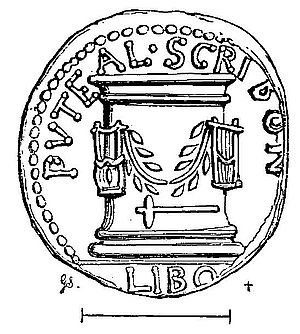
Puteal on a Coin of the Scribonia Gens. (British Museum.)
PUTĬCŬLI. [Funus.]
PỸANEPSIA (πυανέψια), a festival celebrated at Athens every year on the seventh of Pyanepsion, in honour of Apollo, said to have been instituted by Theseus after his return from Crete. The festival, as well as the month in which it took place, are said to have derived their names from πύαμος, another form for κύαμος, i.e. pulse or beans, which were cooked at this season and carried about.
PỸLĂGŎRAE. [Amphictyones.]
PỸRA. [Funus.]
PYRRHĬCA. [Saltatio.]
PȲTHĬA (πύθια), one of the four great national festivals of the Greeks. It was celebrated in the neighbourhood of Delphi, anciently called Pytho, in honour of Apollo, Artemis, and Leto. The place of this solemnity was the Crissaean plain, which for this purpose contained a hippodromus or race-course, a stadium of 1000 feet in length, and a theatre, in which the musical contests took place. The Pythian games were, according to most legends, instituted by Apollo himself. They were originally perhaps nothing more than a religious panegyris, occasioned by the oracle of Delphi, and the sacred games are said to have been at first only a musical contest, which consisted in singing a hymn to the honour of the Pythian god, with the accompaniment of the cithara. They must, on account of the celebrity of the Delphic oracle, have become a national festival for all the Greeks at a very early period, and gradually all the various contests were introduced which occur in the Olympic games. [Olympia.] Down to Ol. 48. the Delphians had been the agonothetae at the Pythian games; but in the third year of this Olympiad, after the Crissaean war, the Amphictyons took the management under their care, and appointed certain persons, called Epimeletae (ἐπιμεληταί), to conduct them. Some of the ancients date the institution of the Pythian games from this time. Previous to Ol. 48. the Pythian games had been an ἐνναετηρίς, that is, they had been celebrated at the end of every eighth year; but in Ol. 48. 3. they became, like the Olympia, a πενταετηρίς, i.e. they were held at the end of every fourth year; and a Pythiad, therefore, from the time that it was used as an aera, comprehended a space of four years, commencing with the third year of every Olympiad. They were in all probability held in the spring, and took place in the month of Bucatius, which corresponded to the Attic Munychion.
PȲTHĬI (πύθιοι), four persons appointed by the Spartan kings, two by each, as messengers to the temple of Delphi. Their office was highly honourable and important; they were always the messmates of the Spartan kings.
PYXIS, dim. PYXĬDŬLA (πύξις, dim. πυξίδιον), a casket; a jewel-box. The caskets in which the ladies of ancient times kept their jewels and other ornaments, were made of gold, silver, ivory, mother-of-pearl, tortoise-shell, &c. They were also much enriched with sculpture. The annexed woodcut represents a very plain jewel-box, out of which a dove is extracting a riband or fillet.
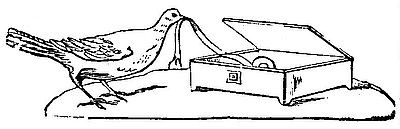
Pyxis, jewel-box. (From a Painting at Herculaneum.)