C (continued 3)
Reading edition
(3) Comitia tributa. These assemblies likewise were called into existence by the constitution of Servius Tullius, who divided the Roman territory into thirty local tribes. It is a disputed question whether the patricians were originally included in these tribes; but, whether they were or not, it is certain, that by far the majority of the people in the tribes were plebeians, and that, consequently, the character of these assemblies was essentially plebeian. After the decemvirate, the patricians had certainly the right of voting in the assemblies of the tribes, which were then also convened by the higher magistrates. The assemblies of the tribes had originally only a local power; they were intended to collect the tributum, and to furnish the contingents for the army; they may further have discussed the internal affairs of each tribe, such as the making or keeping up of roads, wells, and the like. But their influence gradually increased, and they at length acquired the following powers:—1. The election of the inferior magistrates, whose office it was to protect the commonalty or to superintend the affairs of the tribes. Hence the tribunes of the plebs were elected in the comitia tributa. In like manner, the aediles were elected by them, though the curule aediles were elected at a different time from the plebeian aediles and under the presidency of a consul. At a still later time, the quaestors and tribunes of the soldiers, who had before been appointed by the consuls, were appointed in the assemblies of the tribes. The proconsuls to be sent into the provinces, and the prolongation of the imperium for a magistrate who was already in a province, were likewise points which were determined by the tribes in later times. The inferior magistrates elected by the tribes are:—the triumviri capitales, triumviri monetales, the curatores viarum, decemviri litibus judicandis, tribuni aerarii, magistri vicorum et pagorum, praefecti annonae, duumviri navales, quinqueviri muris turribusque reficiendis, triumviri coloniae deducendae, triumviri, quatuorviri, &c., mensarii, and lastly, after the Domitian law, B.C. 104, also the members of colleges of priests. The pontifex maximus had been elected by the people from an earlier time. 2. The legislative power of the comitia tributa was at first very insignificant, for all they could do was to make regulations concerning the local affairs of the tribes. But after a time, when the tribes began to be the real representatives of the people, matters affecting the whole people also were brought before them by the tribunes, which, framed as resolutions, were laid before the senate, where they might either be sanctioned or rejected. This practice of the tributa comitia gradually acquired for them the right of taking the initiative in any measure, or the right of originating measures, until, in B.C. 449, this right was recognised and sanctioned by a law of L. Valerius Publicola and M. Horatius Barbatus. This law gave to the decrees passed by the tribes the power of a real lex, binding upon the whole people, provided they obtained the sanction of the senate and the populus, that is, the people assembled in the comitia curiata or in the comitia centuriata. In B.C. 339, the Publilian law enacted ut plebiscita omnes Quirites tenerent. This law was either a re-enactment of the one passed in B.C. 449, or contained a more detailed specification of the cases in which plebiscita should be binding upon the whole nation, or, lastly, it made their validity independent of the sanction of other comitia, so that nothing would be required except the assent of the senate. In B.C. 287, the Hortensian law was passed, which seems to have been only a revival and a confirmation of the two preceding laws, for it was framed in almost the same terms; but it may also be, that the Hortensian law made the plebiscita independent of the sanction of the senate, so that henceforth the comitia tributa were quite independent in their legislative character. 3. The judicial power of the comitia tributa was much more limited than that of the comitia centuriata, inasmuch as they could take cognizance only of offences against the majesty of the people, while all crimes committed against the state were brought before the centuries. Even patricians, when they had offended against the commonalty or its members, were tried and fined by the tribes. This again constitutes a difference between the judicial power of the centuries and that of the tribes, for the former could inflict capital punishment, but the latter only fines. The comitia tributa might assemble either within or without the city, but not farther from it than 1000 paces, because the power of the tribunes did not extend farther. For elections the Campus Martius was usually chosen, but sometimes also the forum, the Capitol, or the Circus Flaminius. The presidents were commonly the tribunes, who were supported by the aediles, and no matter could be brought before the tribes without the knowledge and consent of the tribunes. As the comitia tributa, however, more and more assumed the character of national assemblies, the higher magistrates also sometimes acted as presidents, though perhaps not without previously obtaining the permission of the tribunes. The preparations for the comitia tributa were less formal and solemn than for those of the centuries. In the case of elections, the candidates had to give in their names, and the president communicated them to the people. When a legislative measure was to be brought before the assembly, a tribune made the people acquainted with it in contiones, and that on the three preceding nundines. The same was the case when the people were to meet as a court of justice. The auspicia were not consulted for the comitia of the tribes, but the spectio alone was sufficient, and the tribunes had the right of obnuntiatio. In the comitia the tribune who had been chosen to preside sat on the tribunal supported by his colleagues, and laid before the people the subject of the meeting, concluding with the words velitis, jubeatis Quirites. The bill was never read by the tribune himself, but by a praeco, and then began the debates, in which persons might either oppose or recommend the measure, though private persons had to ask the tribunes for permission to speak. When the discussion was over the president called upon the people ite in suffragium, as at the comitia centuriata. They then formed themselves into their tribes, which, like the centuries, ascertained their own votes in enclosures (septa). Which of the 35 tribes was to give its vote first, was determined by lot, and that tribe was called praerogativa or principium (the others were termed jure vocatae). The vote of the first tribe was given by some person of distinction whose name was mentioned in the plebiscitum, if it was of a legislative nature. The manner of collecting the votes was, on the whole, the same as in the comitia centuriata. The announcing of the result of the votes was the renuntiatio. If it so happened that two candidates had the same number of votes, the question was decided by drawing lots. The circumstances which might cause the meeting to break up and defer its business till another day, are the same as those which put an end to the comitia centuriata.
(4) The comitia centuriata mixed with the comitia tributa.—The Servian constitution was retained unaltered so long as no great change took place in the republic; but when the coinage and the standard of property had become altered, when the constitution of the army had been placed on a different footing, and, above all, when the plebeians began to be recognized as a great and essential element in the Roman state, it must have been found inconvenient to leave to the equites and the first class so great a preponderance in the comitia of the centuries, and it became necessary to secure more power and influence to the democratic element. A change, therefore, took place, and the comitia centuriata became mixed with the comitia tributa; but neither the time nor the exact nature of this change is accurately ascertained. Some refer it to the censorship of C. Flaminius, B.C. 220, others to that of Q. Fabius and P. Decius, B.C. 304. But there is evidence that it must be assigned to even an earlier date than this, for the (tribus) praerogativa is mentioned as early as B.C. 396 in the election of the consular tribunes, where the pure comitia tributa cannot be meant, and a centuria praerogativa is a thing unknown. With regard to the manner of the change, the most probable opinion is, that the citizens of each tribe were divided into five property classes, each consisting of seniores and juniores, so that each of the 35 tribes contained ten centuries, and all the tribes together 350 centuries. According to this new arrangement, the five ancient classes, divided into seniores and juniores, continued to exist as before, but henceforth they were most closely united with the tribes, whereas before the tribes had been mere local divisions and entirely independent of property. The union now effected was that the classes became subdivisions of the tribes, and that accordingly centuries occur both in the classes and in the tribes. Each tribe contained ten centuries, two of the first class (one of the seniores and one of the juniores), two of the second (likewise seniores and juniores), two of the third, two of the fourth, and two of the fifth class. The equites were likewise divided according to tribes and centuries, and they seem to have voted with the first class, and to have been in fact included in it, so as to be called centuries of the first class. The centuries of the cornicines, tubicines and fabri, which are no longer mentioned, probably ceased to exist as distinct centuries. The voting by tribes can hardly be conceived, except in those cases in which the ten centuries of every tribe were unanimous; this may have been the case very often, and when it was so, the tribus praerogativa was certainly the tribe chosen by lot to give its unanimous vote first. But if there was any difference of opinion among the centuries making up a tribe, the true majority could only be ascertained by choosing by lot one of the 70 centuriae of the first class to give its vote first, or rather it was decided by lot from which tribe the two centuries of the first class were to be taken to give their vote first. (Hence the plural praerogativae.) The tribe, moreover, to which those centuries belonged which voted first, was itself likewise called tribus praerogativa. Of the two centuries, again, that of seniores gave its vote before the juniores, and in the documents both were called by the name of their tribe, as Galeria juniorum, i.e. the juniores of the first class in the tribus Galeria, Aniensis juniorum, Veturia juniorum. As soon as the praerogativa had voted, the renuntiatio took place, and the remaining centuries then deliberated whether they should vote the same way or not. When this was done all the centuries of the first tribe proceeded to vote at once, for there would not have been time for the 350 centuries to vote one after another, as was done by the 193 centuries in the comitia centuriata.—These comitia of the centuries combined with the tribes were far more democratical than the comitia of the centuries; they continued to be held, and preserved their power along with the comitia tributa, even after the latter had acquired their supreme importance in the republic. During the time of the moral and political corruption of the Romans, the latter appear to have been chiefly attended by the populace, which was guided by the tribunes, and the wealthier and more respectable citizens had little influence in them. When the libertini and all the Italians were incorporated in the old thirty-five tribes, and when the political corruption had reached its height, no trace of the sedate and moderate character was left by which the comitia tributa had been distinguished in former times. Under Augustus the comitia still sanctioned new laws and elected magistrates, but their whole proceedings were a mere farce, for they could not venture to elect any other persons than those recommended by the emperor. Tiberius deprived the people even of this shadow of their former power, and conferred the power of election upon the senate. When the elections were made by the senate the result was announced to the people assembled as comitia centuriata or tributa. Legislation was taken away from the comitia entirely, and was completely in the hands of the senate and the emperor. From this time the comitia may be said to have ceased to exist, as all the sovereign power formerly possessed by the people was conferred upon the emperor by the lex regia. [Lex Regia.]
COMMĔĀTUS, a furlough, or leave of absence from the army for a certain time.
COMMENTĀRĬUS or COMMENTĀRĬUM, a book of memoirs or memorandum-book, whence the expression Caesaris Commentarii. It is also used for a lawyer’s brief, the notes of a speech, &c.
COMMERCĬUM. [Civitas (Roman).]
CŌMOEDĬA (κωμῳδία), comedy. (1) Greek. Comedy took its rise at the vintage festivals of Dionysus. It originated with those who led off the phallic songs of the band of revellers (κῶμος), who at the vintage festivals of Dionysus gave expression to the feelings of exuberant joy and merriment which were regarded as appropriate to the occasion, by parading about, partly on foot, partly in waggons, with the symbol of the productive powers of nature, singing a wild, jovial song in honour of Dionysus and his companions. These songs were commonly interspersed with, or followed by petulant, extemporal witticisms with which the revellers assailed the bystanders. This origin of comedy is indicated by the name κωμῳδία, which undoubtedly means “the song of the κῶμος,” though it has sometimes been derived from κώμη, as if the meaning were “a village song.” It was among the Dorians that comedy first assumed any thing of a regular shape. The Megarians, both in the mother country and in Sicily, claimed to be considered as its originators, and so far as the comedy of Athens is concerned, the claim of the former appears well founded. Among the Athenians the first attempts at comedy were made at Icaria by Susarion, a native of Megara, about B.C. 578. Susarion no doubt substituted for the more ancient improvisations of the chorus and its leader premeditated compositions. There would seem also to have been some kind of poetical contest, for we learn that the prize for the successful poet was a basket of figs and a jar of wine. It was also the practice of those who took part in the comus to smear their faces with wine-lees, either to prevent their features from being recognised, or to give themselves a more grotesque appearance. Hence comedy came to be called τρυγῳδία, or lee-song. Others connected the name with the circumstance of a jar of new wine (τρύξ) being the prize for the successful poet. It was, however, in Sicily, that comedy was earliest brought to something like perfection. Epicharmus was the first writer who gave it a new form, and introduced a regular plot. In his efforts he appears to have been associated with Phormis, a somewhat older contemporary. The Megarians in Sicily claimed the honour of the invention of comedy, on account of Epicharmus having lived in Megara before he went to Syracuse. In Attica, the first comic poet of any importance whom we hear of after Susarion is Chionides, who is said to have brought out plays in B.C. 488. Euetes, Euxenides, and Myllus were probably contemporaries of Chionides; he was followed by Magnes and Ecphantides. Their compositions, however, seem to have been little but the reproduction of the old Megaric farce of Susarion, differing, no doubt, in form, by the introduction of an actor or actors, separate from the chorus, in imitation of the improvements that had been made in tragedy.—That branch of the Attic drama which was called the Old Comedy, begins properly with Cratinus, who was to comedy very much what Aeschylus was to tragedy. The old comedy has been described as the comedy of caricature, and such indeed it was, but it was also a great deal more. As it appeared in the hands of its great masters Cratinus, Hermippus, Eupolis, and especially Aristophanes, its main characteristic was that it was throughout political. Everything that bore upon the political or social interests of the Athenians furnished materials for it. The old Attic comedy lasted from Ol. 80 to Ol. 94 (B.C. 458-404). From Cratinus to Theopompus there were forty-one poets, fourteen of whom preceded Aristophanes. The later pieces of Aristophanes belong to the Middle rather than to the Old Comedy. The chorus in a comedy consisted of twenty-four. [Chorus.] The dance of the chorus was the κόρδαξ, the movements of which were capricious and licentious, consisting partly in a reeling to and fro, in imitation of a drunken man, and in various unseemly and immodest gestures. Comedies have choric songs, but no στάσιμα, or songs between acts. The most important of the choral parts was the Parabasis, when the actors having left the stage, the chorus, which was ordinarily divided into four rows, containing six each, and was turned towards the stage, turned round, and advancing towards the spectators delivered an address to them in the name of the poet, either on public topics of general interest, or on matters which concerned the poet personally, criticising his rivals and calling attention to his merits; the address having nothing whatever to do with the action of the play. The parabasis was not universally introduced: three plays of Aristophanes, the Ecclesiazusae, Lysistrata, and Plutus, have none. As the old Attic comedy was the offspring of the political and social vigour and freedom of the age during which it flourished, it naturally declined and ceased with the decline and overthrow of the freedom and vigour which were necessary for its development.—It was replaced by a comedy of a somewhat different style, which was known as the Middle Comedy, the age of which lasted from the end of the Peloponnesian war to the overthrow of liberty by Philip of Macedon. (Ol. 94-110.) The comedy of this period found its materials in satirizing classes of people instead of individuals, in criticising the systems and merits of philosophers and literary men, and in parodies of the compositions of living and earlier poets, and travesties of mythological subjects. It formed a transition from the old to the new comedy, and approximated to the latter in the greater attention to the construction of plots which seem frequently to have been founded on amorous intrigues, and in the absence of that wild grotesqueness which marked the old comedy. As regards its external form, the plays of the middle comedy, generally speaking, had neither parabasis nor chorus. The most celebrated authors of the middle comedy were Antiphanes and Alexis.—The New Comedy was a further development of the last mentioned kind. It answered as nearly as may be to the modern comedy of manners or character. Dropping for the most part personal allusions, caricature, ridicule, and parody, which, in a more general form than in the old comedy, had maintained their ground in the middle comedy, the poets of the new comedy made it their business to reproduce in a generalized form a picture of the every-day life of those by whom they were surrounded. There were various standing characters which found a place in most plays, such as we find in the plays of Plautus and Terence, the leno perjurus, amator fervidus, servulus callidus, amica illudens, sodalis opitulator, miles proeliator, parasitus edax, parentes tenaces, meretrices procaces. In the new comedy there was no chorus. It flourished from about B.C. 340 to B.C. 260. The poets of the new comedy amounted to 64 in number. The most distinguished was Menander.—(2) Roman.—The accounts of the early stages of comic poetry among the Romans are scanty. Scenic entertainments were introduced at Rome in B.C. 363 from Etruria, where it would seem they were a familiar amusement. Tuscan players (ludiones), who were fetched from Etruria, exhibited a sort of pantomimic dance to the music of a flute, without any song accompanying their dance, and without regular dramatic gesticulation. The amusement became popular, and was imitated by the young Romans, who improved upon the original entertainment by uniting with it extemporaneous mutual raillery, composed in a rude irregular measure, a species of diversion which had been long known among the Romans at their agrarian festivals under the name of Fescennina [Fescennina]. It was 123 years after the first introduction of these scenic performances before the improvement was introduced of having a regular plot. This advance was made by Livius Andronicus, a native of Magna Graecia, in B.C. 240. His pieces, which were both tragedies and comedies, were merely adaptations of Greek dramas. The representation of regular plays of this sort was now left to those who were histriones by profession, and who were very commonly either foreigners or slaves; the free-born youth of Rome confined their own scenic performances to the older, irregular farces, which long maintained their ground, and were subsequently called exodia. [Exodia; Satura.] Livius, as was common at that time, was himself an actor in his own pieces. The first imitator of the dramatic works of Livius Andronicus was Cn. Naevius, a native of Campania. He composed both tragedies and comedies, which were either translations or imitations of those of Greek writers. The most distinguished successors of Naevius were Plautus, who chiefly imitated Epicharmus, and Terence, whose materials were drawn mostly from Menander, Diphilus, Philemon, and Apollodorus. The comedy of the Romans was throughout but an imitation of that of the Greeks, and chiefly of the new comedy. Where the characters were ostensibly Greek, and the scene laid in Athens or some other Greek town, the comedies were termed palliatae. All the comedies of Terence and Plautus belong to this class. When the story and characters were Roman, the plays were called togatae. But the fabulae togatae were in fact little else than Greek comedies clothed in a Latin dress.
The togatae were divided into two classes, the trabeatae and tabernariae, according as the subject was taken from high or from low life. In the comediae palliatae, the costume of the ordinary actors was the Greek pallium. The plays which bore the name of praetextatae, were not so much tragedies as historical plays. It is a mistake to represent them as comedies. There was a species of tragi-comedy, named from the poet who introduced that style Rhinthonica. A tragedy the argument of which was Greek was termed crepidata. The mimes are sometimes classed with the Latin comedies. [Mimus.] The mimes differed from the comedies in little more than the predominance of the mimic representation over the dialogue. Latin comedies had no chorus, any more than the dramas of the new comedy, of which they were for the most part imitations. Like them, too, they were introduced by a prologue, which answered some of the purposes of the parabasis of the old comedy, so far as bespeaking the good will of the spectators, and defending the poet against his rivals and enemies. It also communicated so much information as was necessary to understand the story of the play. The prologue was commonly spoken by one of the players, or, perhaps, by the manager of the troop. Respecting the Atellanae fabulae see that article.
COMPĬTĀLĬA, also called LŪDI COMPĬTĀLĬCĬI, a festival celebrated once a year in honour of the lares compitales, to whom sacrifices were offered at the places where two or more ways met. In the time of Augustus, the ludi compitalicii had gone out of fashion, but were restored by him. The compitalia belonged to the feriae conceptivae, that is, festivals which were celebrated on days appointed annually by the magistrates or priests. The exact day on which this festival was celebrated appears to have varied, though it was always in the winter, generally at the beginning of January.
COMPLŪVĬUM. [Domus.]
CONCĬLĬUM generally has the same meaning as conventus or conventio, but the technical import of concilium in the Roman constitution was an assembly of a portion of the people as distinct from the general assemblies or comitia. Accordingly, as the comitia tributa embraced only a portion of the Roman people, viz. the plebeians, these comitia are often designated by the term concilia plebis. Concilium is also used by Latin writers to denote the assemblies or meetings of confederate towns or nations, at which either their deputies alone or any of the citizens met who had time and inclination, and thus formed a representative assembly. Such an assembly or diet is commonly designated as commune concilium, or τὸ κοινόν, e.g. Achaeorum, Aetolorum, Boeotorum, Macedoniae, and the like.
CONFARRĔĀTĬO. [Matrimonium.]
CONGĬĀRĬUM (scil. vas, from congius), a vessel containing a congius. [Congius.] In the early times of the Roman republic the congius was the usual measure of oil or wine which was, on certain occasions, distributed among the people; and thus congiarium became a name for liberal donations to the people, in general, whether consisting of oil, wine, corn, money, or other things, while donations made to the soldiers were called donativa, though they were sometimes also termed congiaria. Many coins of the Roman emperors were struck in commemoration of such congiaria. Congiarium was, moreover, occasionally used simply to designate a present or a pension given by a person of high rank, or a prince, to his friends.
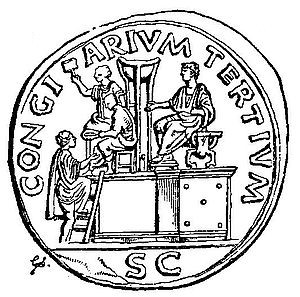
Congiarium. (Coin of Trajan.)
CONGĬUS, a Roman liquid measure, which contained six sextarii, or the eighth part of the amphora (nearly six pints Eng.) It was equal to the larger chous of the Greeks.
CONNUBĬUM. [Matrimonium.]
CŌNŌPĒUM (κωνωπεῖον), a gnat or musquito-curtain, i.e. a covering made to be expanded over beds and couches to keep away gnats and other flying insects, so called from κώνωψ, a gnat. Conopeum is the origin of the English word canopy.
CONQUĪSĪTŌRES, persons employed to go about the country and impress soldiers, when there was a difficulty in completing a levy. Sometimes commissioners were appointed by a decree of the senate for the purpose of making a conquisitio.
CONSANGUĬNĔI. [Cognati.]
CONSĔCRĀTĬO. [Apotheosis.]
CONSĬLĬUM. [Conventus.]
CONSUĀLĬA, a festival, with games, celebrated by the Romans, according to Ovid and others, in honour of Consus, the god of secret deliberations, or, according to Livy, of Neptunus Equestris. Some writers, however, say that Neptunus Equestris and Consus were only different names for one and the same deity. It was solemnised every year in the circus, by the symbolical ceremony of uncovering an altar dedicated to the god, which was buried in the earth. For Romulus, who was considered as the founder of the festival, was said to have discovered an altar in the earth on that spot. The solemnity took place on the 21st of August with horse and chariot races, and libations were poured into the flames which consumed the sacrifices. During these festive games horses and mules were not allowed to do any work, and were adorned with garlands of flowers. It was at their first celebration that, according to the ancient legend, the Sabine maidens were carried off.
CONSUL (ὕπατος), the title of the two chief officers or magistrates of the Roman republic. The word is probably composed of con and sul, which contains the same root as the verb salio, so that consules signifies “those who come together,” just as praesul means “one who goes before,” and exsul, “one who goes out.” The consulship is said to have been instituted upon the expulsion of the kings in B.C. 509, when the kingly power was transferred to two magistrates, whose office lasted only for one year, that it might not degenerate into tyranny by being vested longer in the same persons; and for the same reason two were appointed instead of one king, as neither could undertake anything unless it was sanctioned and approved by his colleague. Their original title was praetores, or commanders of the armies, but this was changed into that of consules in B.C. 449, and the latter title remained in use until the latest periods of the Roman empire.—The consuls were at first elected from the patricians exclusively. Their office was suspended in B.C. 451, and its functions were performed by ten high commissioners (decemviri), appointed to frame a code of laws. On the re-establishment of the consulship in B.C. 449, the tribunes proposed that one of the consuls should be chosen from the plebeians, but this was strenuously resisted by the patricians, and a compromise effected by suspending the consular office, and creating in its stead military tribunes (tribuni militum) with consular power, who might be elected indifferently both from the patricians and plebeians. They were first appointed in B.C. 444. The plebeians, however, were not satisfied with this concession, and still endeavoured to attain the higher dignity of the consulship. At length, after a serious and long-protracted struggle between the two orders, it was enacted by the Licinian law, in B.C. 367, that henceforth the consulship should be divided between the patricians and plebeians, and that one of the consuls should always be a plebeian. Accordingly, in B.C. 366 L. Sextius was elected the first plebeian consul. This law, however, was not always observed, and it still frequently happened that both consuls were patricians, until, in later times, when the difference between the two orders had entirely ceased, and the plebeians were on a footing of perfect equality with the patricians, the consuls were elected from both orders indiscriminately.—During the later periods of the republic it was customary for persons to pass through several subordinate magistracies before they were elected consuls, though this rule was departed from in many particular cases. The age at which a person was eligible to the consulship was fixed in B.C. 180, by the lex annalis [Lex Annalis], at 43.—The election of the consuls always took place in the comitia of the centuries, some time before the expiration of the official year of the actual consuls, and the election was conducted either by the actual consuls themselves, or by an interrex or a dictator, and the persons elected, until they entered upon their office, were called consules designati. While they were designati, they were in reality no more than private persons, but still they might exercise considerable influence upon public affairs, for in the senate they were asked for their opinion first. If they had been guilty of any illegal act, either before or during their election, such as bribery (ambitus), they were liable to prosecution, and the election might be declared void.—The time at which the old consuls laid down their office and the consules designati entered upon theirs, differed at different times. The first consuls are said to have entered upon their office in October, then we find mention of the 1st of August, of the ides of December, the 1st of July, and very frequently of the ides of March, until, in B.C. 153, it became an established rule for the consuls to enter upon their duties on the 1st of January; and this custom remained down to the end of the republic. On that day the senators, equites, and citizens of all classes conducted in a procession (deductio or processus consularis) the new magistrates from their residence to the capitol, where, if the auspices were favourable, the consuls offered up sacrifices, and were inaugurated. From thence the procession went to the curia, where the senate assembled, and where the consuls returned thanks for their election. There they might also speak on any subject that was of importance to the republic, such as peace and war, the distribution of provinces, the general condition of the state, the feriae Latinae, and the like. During the first five days of their office they had to convoke a contio, and publicly to take a solemn oath, by which, in the earliest times, they pledged themselves not to allow any one to assume regal power at Rome, but afterwards only to maintain the laws of the republic (in leges jurare). On the expiration of their office they had to take another oath, stating that they had faithfully obeyed the laws, and not done anything against the constitution. The new consuls on entering upon their office usually invited their friends to a banquet. When a consul died during his year of office, his colleague immediately convoked the comitia to elect a new one. A consul thus elected to fill a vacancy was called consul suffectus, but his powers were not equal to those of an ordinary consul, for he could not preside at the elections of other magistrates, not even in the case of the death of his colleague. In the latter case, as well as when the consuls were prevented by illness or other circumstances, the comitia were held by an interrex or a dictator.—The outward distinctions of the consuls were, with few exceptions, the same as those which had formerly belonged to the kings. The principal distinction was the twelve lictors with the fasces, who preceded the consuls; but the axes did not appear in the fasces within the city. This outward sign of their power was taken by the consuls in turn every month, and while one consul was preceded by the twelve lictors with their fasces, the other was during the same month preceded by an accensus, and followed by the lictors; and the one was called during that month consul major, and the other consul minor. Other distinctions of the consuls were the curule chair (sella curulis), and the toga with the purple hem (toga praetexta). The ivory sceptre (scipio or sceptrum) and purple toga were not distinctions of the consuls in general, but only when they celebrated a triumph. Under the empire a consul was sometimes distinguished by the senate with a sceptre bearing an eagle on the top, but his regular ensigns consisted of the toga picta, the trabea, and the fasces, both within and without the city.—The consuls were the highest ordinary magistrates at Rome. Their power was at first quite equal to that of the kings, except that it was limited to one year, and that the office of high priest, which had been vested in the king, was at the very beginning detached from the consulship, and given to the rex sacrorum or rex sacrificulus. Yet the auspicia majora continued to belong to the consuls. This regal power of the consuls, however, was gradually curtailed by various laws, especially by the institution of the tribunes of the plebs, whose province it was to protect the plebeians against the unjust or oppressive commands of the patrician magistrates. Nay, in the course of time, whole branches of the consular power were detached from it; the reason for which was, that, as the patricians were compelled to allow the plebeians a share in the highest magistracy, they stripped it of as much of its original power as they could, and reserved these detached portions for themselves. In this manner the censorship was detached from the consulship in B.C. 443, and the praetorship in B.C. 367. But notwithstanding all this, the consuls remained the highest magistrates, and all other magistrates, except the tribunes of the plebs, were obliged to obey their commands, and show them great outward respect. The functions of the consuls during the time of the republic may be conveniently described under the following heads:—1. They were in all civil matters the heads of the state, being invested with the imperium, which emanated from the sovereign people, and which they held during the time of their office. In this capacity they had the right of convoking both the senate and the assembly of the people; they presided in each (in the comitia of the curies as well as in those of the centuries), and they took care that the resolutions of the senate and people were carried into effect. They might also convoke contiones, whenever they thought it necessary. In the senate they conducted the discussions, and put the questions to the vote, thus exercising the greatest influence upon all matters which were brought before the senate either by themselves or by others. When a decree was passed by the senate, the consuls were usually commissioned to see that it was carried into effect; though there are also instances of the consuls opposing a decree of the senate. 2. The supreme command of the armies belonged to the consuls alone by virtue of their imperium. Accordingly, when a war was decreed, they were ordered by a senatus consultum to levy the troops, whose number was determined by the senate, and they appointed most of the other military officers. While at the head of their armies they had full power of life and death over their soldiers, who, on their enrolment, had to take an oath (sacramentum) to be faithful and obedient to the commands of the consuls. When the consuls had entered upon their office, the senate assigned them their provinces, that is, their spheres of action, and the consuls either settled between themselves which province each was to have, or, which was more common, they drew lots. Usually one consul remained at Rome, while the other went out at the head of the army: sometimes both left the city, and carried on war in different quarters; and sometimes, when the danger was very pressing, both consuls commanded the armies against one and the same enemy. If it was deemed advisable, the imperium of one or of both consuls was prolonged for the particular province in which they were engaged, in which case they had the title of proconsuls [Proconsul], and their successors either remained at Rome, or were engaged in other quarters. During the latter period of the republic the consuls remained at Rome during the time of their office, and on its expiration they had a foreign province (in the real sense of the word) assigned to them, where they undertook either the peaceful administration, or carried on war against internal or external enemies. While in their provinces, both the consuls and proconsuls had the power of life and death over the provincials, for they were looked upon there as the chief military commanders; and the provincials, being peregrini, did not enjoy the privileges of Roman citizens. 3. The supreme jurisdiction was part of the consular imperium, and as such vested in the consuls so long as there were no praetors. In civil cases they administered justice to the patricians as well as plebeians, either acting themselves as judices, or appointing others as judices and arbitri. In criminal cases there appears from early times to have been this difference: that patricians charged with capital offences were tried by the curies, while the plebeians came under the jurisdiction of the consuls, whose power, however, was in this case rather limited, partly by the intercession of the tribunes of the people, and partly by the right of appeal (provocatio) from the sentence of the consuls. The consuls might, further, summon any citizen before their tribunal, and, in case of disobedience, seize him (prendere), and fine him up to a certain amount. After the institution of the praetorship, the consuls no longer possessed any regular ordinary jurisdiction; and whenever they exercised it, it was an exception to the general custom, and only by a special command of the senate. 4. Previous to the institution of the censorship the consuls had to perform all the functions which afterwards belonged to the censors: they were accordingly the highest officers of finance, held the census, drew up the lists of the senators, equites, &c. After the establishment of the censorship they still retained the general superintendence of the public economy, inasmuch as they had the keys of the aerarium, and as the quaestors or paymasters were dependent on them. But still in the management of the finances the consuls were at all times under the control of the senate. 5. In all relations with foreign states the consuls were the representatives of the Roman republic. Hence they might conclude peace or treaties with foreign nations, which had, however, to be sanctioned by the senate and people at Rome; and unless this sanction was obtained a treaty was void. They received foreign ambassadors, and introduced them into the senate, and in short all negotiations with foreign princes or nations passed through their hands. 6. In matters connected with their own official functions, the consuls, like all other magistrates, had the power of issuing proclamations or orders (edicta), which might be binding either for the occasion only, or remain in force permanently.—Although the consular power had been gradually diminished, it was in cases of imminent danger restored to its original and full extent, by a decree of the senate calling upon the consuls videant ne quid res publica detrimenti capiat. In such cases the consuls received sovereign power, but they were responsible for the manner in which they had exercised it.—It has already been observed, that to avoid collision and confusion, the two consuls did not possess the same power at the same time, but that each had the imperium every other month. The one who possessed it, as the consul major, exercised all the rights of the office, though he always consulted his colleague. In the earliest times it was customary for the elder of the two consuls to take the imperium first, afterwards the one who had had the greater number of votes at the election, and had therefore been proclaimed (renuntiare) first. In the time of Augustus it was enacted that the consul who had most children should take precedence of the other; and some distinction of rank continued to be observed down to the latest times of the empire.—Towards the end of the republic the consulship lost its power and importance. The first severe blow it received was from Julius Caesar, the dictator, for he received the consulship in addition to his dictatorship, or he arbitrarily ordered others to be elected, who were mere nominal officers, and were allowed to do nothing without his sanction. He himself was elected consul at first for five, then for ten years, and at last for life. Under Augustus the consulship was a mere shadow of what it had been: the consuls no longer held their office for a whole year, but usually for a few months only; and hence it happened that sometimes one year saw six, twelve, or even twenty-five consuls. Those who were elected the first in the year ranked higher than the rest, and their names alone were used to mark the year, according to the ancient custom of the Romans of marking the date of an event by the names of the consuls of the year in which the event occurred. During the last period of the empire it became the practice to have titular or honorary consuls, who were elected by the senate and confirmed by the emperor. Constantine appointed two consuls, one for Rome and another for Constantinople, who held their office for a whole year, and whose functions were only those of chief justices. All the other consuls were designated as honorarii or consulares. But though the consulship had thus become almost an empty title, it was still regarded as the highest dignity in the empire, and as the object of the greatest ambition. It was connected with very great expenses, partly on account of the public games which a consul had to provide, and partly on account of the large donations he had to make to the people. The last consul at Rome was Decimus Theodorus Paulinus, A.D. 536, and at Constantinople, Flavius Basilius junior, A.D. 541.
CONSŬLARIS, signified, under the republic, a person who had held the office of consul; but under the empire, it was the title of many magistrates and public officers, who enjoyed the insignia of consular dignity, without having filled the office of consul. Thus we find commanders of armies and governors of provinces called Consulares under the empire.
CONTĬO, a contraction for conventio, that is, a meeting, or a conventus. In the technical sense, however, a contio was an assembly of the people at Rome convened by a magistrate for the purpose of making the people acquainted with measures which were to be brought before the next comitia, and of working upon them either to support or oppose the measure. But no question of any kind could be decided by a contio, and this constitutes the difference between contiones and comitia. Still contiones were also convened for other purposes, e.g. of persuading the people to take part in a war, or of bringing complaints against a party in the republic. Every magistrate had the right to convene contiones, but it was most frequently exercised by the consuls and tribunes, and the latter more especially exercised a great influence over the people in and through these contiones. A magistrate who was higher in rank than the one who had convened a contio, had the right to order the people to disperse, if he disapproved of the object. It should be remarked, that the term contio is also used to designate the speeches and harangues addressed to the people in an assembly, and that in a loose mode of speaking, contio denotes any assembly of the people.
CONTŬBERNĀLES (σύσκηνοι), signified originally men who served in the same army and lived in the same tent. The word is derived from taberna (afterwards tabernaculum), which was the original name for a military tent, as it was made of boards (tabulae). Each tent was occupied by ten soldiers (contubernales), with a subordinate officer at their head, who was called decanus, and in later times caput contubernii. Young Romans of illustrious families used to accompany a distinguished general on his expeditions, or to his province, for the purpose of gaining under his superintendence a practical training in the art of war, or in the administration of public affairs, and were, like soldiers living in the same tent, called his contubernales. In a still wider sense, the name contubernales was applied to persons connected by ties of intimate friendship, and living under the same roof; and hence, when a freeman and a slave, or two slaves, who were not allowed to contract a legal marriage, lived together as husband and wife, they were called contubernales; and their connection, as well as their place of residence, contubernium.
CONTŬBERNĬUM. [Contubernales.]
CONVĔNĪRE IN MĂNUM. [Matrimonium.]
CONVENTUS, was the name applied to the whole body of Roman citizens who were either permanently or for a time settled in a province. In order to facilitate the administration of justice, a province was divided into a number of districts or circuits, each of which was called conventus, forum, or jurisdictio. Roman citizens living in a province were entirely under the jurisdiction of the proconsul; and at certain times of the year, fixed by the proconsul, they assembled in the chief town of the district, and this meeting bore the name of conventus (σύνοδος). Hence the expressions—conventus agere, peragere, convocare, dimittere. At this conventus litigant parties applied to the proconsul, who selected a number of judges from the conventus to try their causes. The proconsul himself presided at the trials, and pronounced the sentence according to the views of the judges, who were his assessors (consilium or consiliarii). These conventus appear to have been generally held after the proconsul had settled the military affairs of the province; at least, when Caesar was proconsul of Gaul, he made it a regular practice to hold the conventus after his armies had retired to their winter quarters.
CONVĪVĬUM. [Symposium.]
CŎPHĬNUS (κόφινος, Engl. coffin), a large kind of wicker basket, made of willow branches. It would seem that it was used by the Greeks as a basket or cage for birds. The Romans used it for agricultural purposes, and it sometimes formed a kind of portable hot-bed. Juvenal, when speaking of the Jews, uses the expression cophinus et foenum (a truss of hay), figuratively to designate their poverty.
CORBIS, dim. CORBŬLA, CORBĬCŬLA, a basket of very peculiar form and common use among the Romans, both for agricultural and other purposes. It was made of osiers twisted together, and was of a conical or pyramidal shape. A basket answering precisely to this description, both in form and material, is still to be seen in every-day use among the Campanian peasantry, which is called in the language of the country “la corbella.”
CORBĪTAE, merchantmen of the larger class, so called because they hung out a corbis at the mast-head for a sign. They were also termed onerariae; and hence Plautus, in order to designate the voracious appetites of some women, says, “Corbitam cibi comesse possunt.”
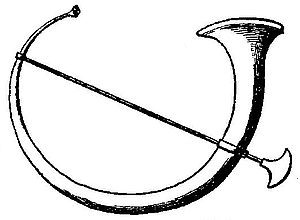
Cornu. (Bartholini de Tibiis.)
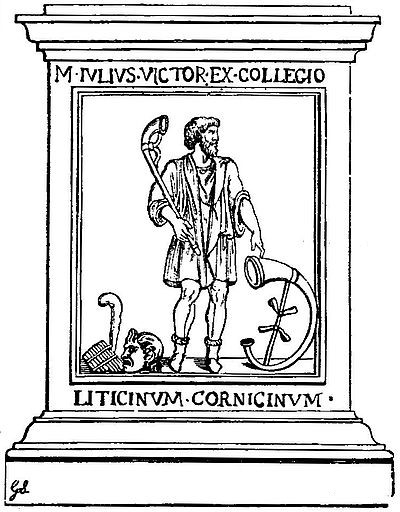
Altar of Julius Victor. (Bartoli, Pict. Ant., p. 76.)
CORNU, a wind instrument, anciently made of horn, but afterwards of brass. Like the tuba, it differed from the tibia in being a larger and more powerful instrument, and from the tuba itself, in being curved nearly in the shape of a C, with a cross-piece to steady the instrument for the convenience of the performer. Hence Ovid says (Met. i. 98):
“Non tuba directi, non aeris cornua flexi.”
The classicum, which originally meant a signal, rather than the musical instrument which gave the signal, was usually sounded with the cornu.
“Sonuit reflexo classicum cornu, Lituusque adunco stridulos cantus Elisit aere.” (Sen. Oed. 734.)
The Cornicines and Liticines, the persons who blew the Cornu and Lituus, formed a collegium. In the preceding cut, M. Julius Victor, a member of the Collegium, holds a lituus in his right hand, and touches with his left a cornu on the ground. See engraving under Tuba.
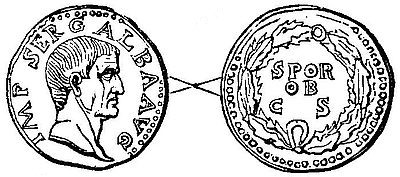
Corona Civica, on a Coin of the Emperor Galba. SPQR OB CS = Senatus Populusque Romanus ob civem servatum.
CŎRŌNA (στέφανος), a crown, that is, a circular ornament of metal, leaves, or flowers, worn by the ancients round the head or neck, and used as a festive as well as funereal decoration, and as a reward of talent, military or naval prowess, and civil worth. Its first introduction as an honorary reward is attributable to the athletic games, in some of which it was bestowed as a prize upon the victor. It was the only reward contended for by the Spartans in their gymnic contests, and was worn by them when going to battle. The Romans refined upon the practice of the Greeks, and invented a great variety of crowns formed of different materials, each with a separate appellation, and appropriated to a particular purpose.—I. Corona Obsidionalis. Amongst the honorary crowns bestowed by the Romans for military achievements, the most difficult of attainment, and the one which conferred the highest honour, was the corona obsidionalis, presented by a beleaguered army after its liberation to the general who broke up the siege. It was made of grass, or weeds and wild flowers, thence called corona graminea, and graminea obsidionalis, gathered from the spot on which the beleaguered army had been enclosed.—II. Corona Civica, the second in honour and importance, was presented to the soldier who had preserved the life of a Roman citizen in battle. It was made of the leaves of the oak. The soldier who had acquired this crown had a place reserved next to the senate at all the public spectacles; and they, as well as the rest of the company, rose up upon his entrance. He was freed from all public burthens, as were also his father, and his paternal grandfather; and the person who owed his life to him was bound, ever after, to cherish his preserver as a parent, and afford him all such offices as were due from a son to his father.—III. Corona Navalis or Rostrata, called also Classica. It is difficult to determine whether these were two distinct crowns, or only two denominations for the same one. It seems probable that the navalis corona, besides being a generic term, was inferior in dignity to the latter, and given to the sailor who first boarded an enemy’s ship; whereas the rostrata was given to a commander who destroyed the whole fleet, or gained any very signal victory. At all events, they were both made of gold; and one at least (rostrata) decorated with the beaks of ships like the rostra in the forum. The Athenians likewise bestowed golden crowns for naval services; sometimes upon the person who got his trireme first equipped, and at others upon the captain who had his vessel in the best order.—IV. Corona Muralis, was presented by the general to the first man who scaled the wall of a besieged city. It was made of gold, and decorated with turrets.—V. Corona Castrensis or Vallaris, was presented to the first soldier who surmounted the vallum, and forced an entrance into the enemy’s camp. This crown was made of gold, and ornamented with the palisades (valli) used in forming an entrenchment.—VI. Corona Triumphalis. There were three sorts of triumphal crowns: the first was made of laurel or bay leaves, and was worn round the head of the commander during his triumph; the second was of gold, which, being too large and massive to be worn, was held over the head of the general during his triumph, by a public officer. This crown, as well as the former one, was presented to the victorious general by his army. The third kind, likewise of gold and of great value, was sent as a present from the provinces to the commander. [Aurum Coronarium.]—VII. Corona Ovalis, was given to a commander who obtained only an ovation. It was made of myrtle.—VIII. Corona Oleagina, was made of the olive leaf, and conferred upon the soldiers as well as their commanders.—The Greeks in general made but little use of crowns as rewards of valour in the earlier periods of their history, except as prizes in the athletic contests; but previous to the time of Alexander, crowns of gold were profusely distributed, amongst the Athenians at least, for every trifling feat, whether civil, naval, or military, which, though lavished without much discrimination as far as regards the character of the receiving parties, were still subjected to certain legal restrictions in respect of the time, place, and mode in which they were conferred. They could not be presented but in the public assemblies, and with the consent, that is by suffrage, of the people, or by the senators in their council, or by the tribes to their own members, or by the δημόται to members of their own δῆμος. According to the statement of Aeschines, the people could not lawfully present crowns in any place except in their assembly, nor the senators except in the senate-house; nor, according to the same authority, in the theatre, which is, however, denied by Demosthenes; nor at the public games, and if any crier there proclaimed the crowns he was subject to atimia. Neither could any person holding an office receive a crown whilst he was ὑπεύθυνος, that is, before he had passed his accounts.—The second class of crowns were emblematical and not honorary, and the adoption of them was not regulated by law, but custom. Of these there were also several kinds.—I. Corona Sacerdotalis, was worn by the priests (sacerdotes), with the exception of the pontifex maximus and his minister (camillus), as well as the bystanders, when officiating at the sacrifice. It does not appear to have been confined to any one material.—II. Corona Funebris and Sepulchralis. The Greeks first set the example of crowning the dead with chaplets of leaves and flowers, which was imitated by the Romans. Garlands of flowers were also placed upon the bier, or scattered from the windows under which the procession passed, or entwined about the cinerary urn, or as a decoration to the tomb. In Greece these crowns were commonly made of parsley.—III. Corona Convivialis. The use of chaplets at festive entertainments sprung likewise from Greece. They were of various shrubs and flowers, such as roses (which were the choicest), violets, myrtle, ivy, philyra, and even parsley.—IV. Corona Nuptialis. The bridal wreath was also of Greek origin, among whom it was made of flowers plucked by the bride herself, and not bought, which was of ill omen. Amongst the Romans it was made of verbena, also gathered by the bride herself, and worn under the flammeum, with which the bride was always enveloped. The bridegroom also wore a chaplet. The doors of his house were likewise decorated with garlands, and also the bridal couch.—V. Corona Natalitia, the chaplet suspended over the door of the vestibule, both in the houses of Athens and Rome, in which a child was born. At Athens, when the infant was male, the crown was made of olive; when female, of wool. At Rome it was of laurel, ivy, or parsley.
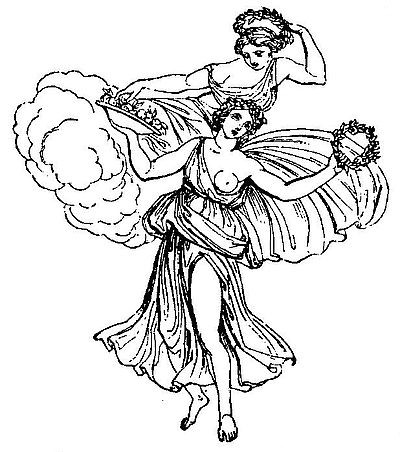
Females with Crowns. (From an ancient Painting.)
CŎRŌNIS (κορωνίς), the cornice of an entablature, is properly a Greek word signifying anything curved. It is also used by Latin writers, but the genuine Latin word for a cornice is corona or coronix.
CORTĪNA, the name of the table or hollow slab, supported by a tripod, upon which the priestess at Delphi sat to deliver her responses; and hence the word is used for the oracle itself. The Romans made tables of marble or bronze after the pattern of the Delphian tripod, which they used as we do our sideboards, for the purpose of displaying their plate at an entertainment. These were termed cortinae Delphicae, or Delphicae simply.
CŎRỸBANTĬCA (κορυβαντικά), a festival and mysteries celebrated at Cnossus in Crete, by the Corybantes. (See Class. Dict., Corybantes.)
CŎRYMBUS (κόρυμβος). [Coma.]
CORVUS, a sort of crane, used by C. Duilius against the Carthaginian fleet in the battle fought off Mylae, in Sicily (B.C. 260). The Romans, we are told, being unused to the sea, saw that their only chance of victory was by bringing a sea-fight to resemble one on land. For this purpose they invented a machine, of which Polybius has left a minute description. In the fore part of the ship a round pole was fixed perpendicularly, twenty-four feet in height and about nine inches in diameter; at the top of this was a pivot, upon which a ladder was set, thirty-six feet in length and four in breadth. The ladder was guarded by cross-beams, fastened to the upright pole by a ring of wood, which turned with the pivot above. Along the ladder a rope was passed, one end of which took hold of the corvus by means of a ring. The corvus itself was a strong piece of iron, with a spike at the end, which was raised or lowered by drawing in or letting out the rope. When an enemy’s ship drew near, the machine was turned outwards, by means of the pivot, in the direction of the assailant. Another part of the machine was a breast-work, let down from the ladder, and serving as a bridge, on which to board the enemy’s vessel. By means of these cranes the Carthaginian ships were either broken or closely locked with the Roman, and Duilius gained a complete victory.
CŌRȲTOS or CŌRȲTUS (γωρυτός, κωρυτός), [Arcus.]
COSMĒTAE, a class of slaves among the Romans, whose duty it was to dress and adorn ladies.
COSMI (κοσμοί), the supreme magistrates in Crete, were ten in number, and were chosen, not from the body of the people, but from certain γένη or houses, which were probably of more pure Doric or Achaean descent than their neighbours. The first of them in rank was called protocosmus, and gave his name to the year. They commanded in war, and also conducted the business of the state with the representatives and ambassadors of other cities. Their period of office was a year; but any of them during that time might resign, and was also liable to deposition by his colleagues. In some cases, too, they might be indicted for neglect of their duties. On the whole, we may conclude that they formed the executive and chief power in most of the cities of Crete.
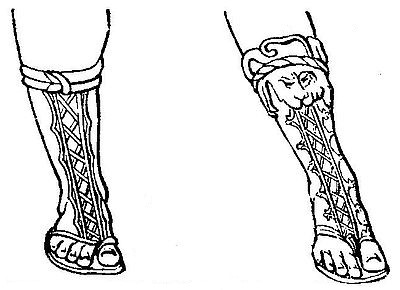
Cothurnus. (From Statues of Artemis—Diana.)
CŎTHURNUS (κόθορνος), a boot. Its essential distinction was its height; it rose above the middle of the leg, so as to surround the calf, and sometimes it reached as high as the knees. It was worn principally by horsemen, by hunters, and by men of rank and authority. The sole of the cothurnus was commonly of the ordinary thickness; but it was sometimes made much thicker than usual, probably by the insertion of slices of cork. The object was, to add to the apparent stature of the wearer; and this was done in the case of the actors in Athenian tragedy, who had the soles made unusually thick as one of the methods adopted in order to magnify their whole appearance. Hence tragedy in general was called cothurnus. As the cothurnus was commonly worn in hunting, it is represented as part of the costume of Artemis (Diana).
COTTĂBUS (κότταβος), a social game which was introduced from Sicily into Greece, where it became one of the favourite amusements of young people after their repasts. The simplest way in which it originally was played was this:—One of the company threw out of a goblet a certain quantity of wine, at a certain distance, into a metal basin. While he was doing this, he either thought of or pronounced the name of his mistress; and if all the wine fell in the basin, and with a full sound, it was a good sign for the lover. This simple amusement soon assumed a variety of different characters, and became, in some instances, a regular contest, with prizes for the victor. One of the most celebrated modes in which it was carried on is called δι’ ὀξυβάφων. A basin was filled with water, with small empty cups (ὀξύβαφα) swimming upon it. Into these the young men, one after another, threw the remnant of the wine from their goblets, and he who had the good fortune to drown most of the bowls obtained the prize, consisting either of simple cakes, sweetmeats, or sesame-cakes.
CŎTYTTĬA (κοττύτια), a festival which was originally celebrated by the Edonians of Thrace, in honour of a goddess called Cotys, or Cotytto. It was held at night. The worship of Cotys, together with the festival of the Cotyttia, was adopted by several Greek states, chiefly those which were induced by their commercial interest to maintain friendly relations with Thrace. The festivals of this goddess were notorious among the ancients for the dissolute manner and the debaucheries with which they were celebrated.
CŎTỸLA (κοτύλη), a measure of capacity among the Romans and Greeks: by the former it was also called hemina; by the latter, τρυβλίον and ἡμίνα or ἡμίμνα. It was the half of the sextarius or ξέστης, and contained 6 cyathi, or nearly half a pint English.
CŎVĪNUS (Celtic, kowain), a kind of car, the spokes of which were armed with long sickles, and which was used as a scythe-chariot chiefly by the ancient Belgians and Britons. The Romans designated, by the name of covinus, a kind of travelling carriage, which seems to have been covered on all sides with the exception of the front. It had no seat for a driver, but was conducted by the traveller himself, who sat inside. The covinarii (this word occurs only in Tacitus) seem to have constituted a regular and distinct part of a British army. Compare Essedum.
CRĀTER (κρατήρ, Ionic κρητήρ, from κεράννυμι, I mix), a vessel in which the wine, according to the custom of the ancients, who very seldom drank it pure, was mixed with water, and from which the cups were filled. Craters were among the first things on the embellishment of which the ancient artists exercised their skill; and the number of craters dedicated in temples seems everywhere to have been very great.
CRĔPĬDA (κρηπίς), a slipper. Slippers were worn with the pallium, not with the toga, and were properly characteristic of the Greeks, though adopted from them by the Romans.
CRĪMEN. Though this word occurs so frequently, it is not easy to fix its meaning. Crimen is often equivalent to accusatio (κατηγορία); but it frequently means an act which is legally punishable. Those delicta which were punishable according to special leges, senatus consulta, and constitutiones, and were prosecuted in judicia publica by an accusatio publica, were more especially called crimina; and the penalties in case of conviction were loss of life, of freedom, of civitas, and the consequent infamia, and sometimes pecuniary penalties also.
CRISTA. [Galea.]
CRĬTES (κριτής), a judge, was the name applied by the Greeks to any person who did not judge of a thing like a δικαστής, according to positive laws, but according to his own sense of justice and equity. But at Athens a number of κριταί was chosen by ballot from a number of selected candidates at every celebration of the Dionysia: they were called οἱ κριταί, κατ’ ἐξοχήν. Their office was to judge of the merit of the different choruses and dramatic poems, and to award the prizes to the victors. Their number was five for comedy and the same number for tragedy, one being taken from every tribe.
CRŌBỸLUS. [Coma.]
CRŎCŌTA (sc. vestis, κροκωτὸν sc. ἱμάτιον, or κροκωτὸς sc. χιτών), was a kind of gala-dress, chiefly worn by women on solemn occasions, and in Greece especially, at the festival of the Dionysia. Its name was derived from crocus, one of the favourite colours of the Greek ladies.
CRŎTĂLUM. [Cymbalum.]
CRUSTA. [Caelatura.]
CRUX (σταυρός, σκόλοψ), an instrument of capital punishment, used by several ancient nations, especially the Romans and Carthaginians. Crucifixion was of two kinds, the less usual sort being rather impalement than what we should describe by the word crucifixion, as the criminal was transfixed by a pole, which passed through the back and spine and came out at the mouth. The cross was of several kinds; one in the shape of an X, called crux Andreana, because tradition reports St. Andrew to have suffered upon it; another was formed like a T. The third, and most common sort, was made of two pieces of wood crossed, so as to make four right angles. It was on this, according to the unanimous testimony of the fathers, that our Saviour suffered. The punishment, as is well known, was chiefly inflicted on slaves, and the worst kind of malefactors. The criminal, after sentence pronounced, carried his cross to the place of execution; a custom mentioned in the Gospels. Scourging appears to have formed a part of this, as of other capital punishments among the Romans; but the scourging of our Saviour is not to be regarded in this light, for it was inflicted before sentence was pronounced. The criminal was next stripped of his clothes and nailed or bound to the cross. The latter was the more painful method, as the sufferer was left to die of hunger. Instances are recorded of persons who survived nine days. It was usual to leave the body on the cross after death. The breaking of the legs of the thieves, mentioned in the Gospels, was accidental; because, by the Jewish law, it is expressly remarked, the bodies could not remain on the cross during the Sabbath-day.
CRYPTA (from κρύπτειν, to conceal), a crypt. Amongst the Romans, any long narrow vault, whether wholly or partially below the level of the earth, is expressed by this term. The specific senses of the word are:—(1) A covered portico or arcade; called more definitely crypto-porticus, because it was not supported by open columns like the ordinary portico, but closed at the sides, with windows only for the admission of light and air.—(2) A grotto, particularly one open at both extremities, forming what in modern language is denominated a “tunnel.” A subterranean vault used for any secret worship was also called crypta.—(3) When the practice of consuming the body by fire was relinquished [Funus], and a number of bodies was consigned to one place of burial, as the catacombs for instance, this common tomb was called crypta.
CRYPTEIA (κρυπτεία), the name of an atrocious practice at Sparta, said to have been introduced by Lycurgus. The following is the description given of the crypteia. The ephors, at intervals, selected from among the young Spartans, those who appeared to be best qualified for the task, and sent them in various directions all over the country, provided with daggers and their necessary food. During the day-time, these young men concealed themselves; but at night they broke forth into the high-roads, and massacred those of the helots whom they met, or whom they thought proper.
CŬBĬCŬLĀRĬI, slaves who had the care of the sleeping and dwelling rooms. Faithful slaves were always selected for this office, as they had, to a certain extent, the care of their master’s person. It was the duty of the cubicularii to introduce visitors to their master.
CŬBĬCŬLUM usually means a sleeping and dwelling room in a Roman house [Domus], but it is also applied to the pavilion or tent in which the Roman emperors were accustomed to witness the public games. It appears to have been so called, because the emperors were accustomed to recline in the cubicula, instead of sitting, as was anciently the practice, in a sella curulis.
CŬBĬTUS (πῆχυς), a Greek and Roman measure of length, originally the length of the human arm from the elbow to the wrist, or to the knuckle of the middle finger. It was equal to a foot and a half, which gives 1 foot 5·4744 inches Eng. for the Roman, and 1 foot 6·2016 inches for the Greek cubit.
CŬCULLUS, a cowl. As the cowl was intended to be used in the open air, and to be drawn over the head to protect it from the injuries of the weather, instead of a hat or cap, it was attached only to garments of the coarsest kind. The cucullus was also used by persons in the higher circles of society, when they wished to go abroad without being known.
CŪDO or CŪDON, a skull-cap made of leather or of the rough shaggy fur of any wild animal, such as were worn by the velites of the Roman armies, and apparently synonymous with galerus or galericulus.
CŪLĔUS, or CULLĔUS, a Roman measure, which was used for estimating the produce of vineyards. It was the largest liquid measure used by the Romans, containing 20 amphorae, or 118 gallons, 7·546 pints.
CŬLĪNA. [Domus, p. 143.]
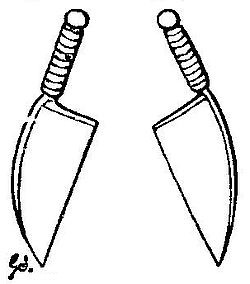
Cultri (From Tombstone of a Cultrarius.)
CULTER (μάχαιρα, κοπίς, or σφαγίς), a knife with only one edge, which formed a straight line. The blade was pointed, and its back curved. It was used for a variety of purposes, but chiefly for killing animals either in the slaughter-house, or in hunting, or at the altars of the gods. The priest who conducted a sacrifice never killed the victim himself; but one of his ministri, appointed for that purpose, who was called either by the general name minister, or the more specific popa or cultrarius.
CULTRĀRĬUS. [Culter.]
CŬNĔUS was the name applied to a body of foot soldiers, drawn up in the form of a wedge, for the purpose of breaking through an enemy’s line. The common soldiers called it a caput porcinum, or pig’s head. The name cuneus was also applied to the compartments of seats in circular or semi-circular theatres, which were so arranged as to converge to the centre of the theatre, and diverge towards the external walls of the building, with passages between each compartment.
CŬNĪCŬLUS (ὑπόνομος), a mine or passage underground, was so called from its resemblance to the burrowing of a rabbit. Fidenae and Veii are said to have been taken by mines, which opened, one of them into the citadel, the other into the temple of Juno.
CŪPA, a wine-vat, a vessel very much like the dolium, and used for the same purpose, namely, to receive the fresh must, and to contain it during the process of fermentation. The inferior wines were drawn for drinking from the cupa, without being bottled in amphorae, and hence the term vinum de cupa. The cupa was either made of earthenware, like the dolium, or of wood, and covered with pitch. It was also used for fruits and corn, forming rafts, and containing combustibles in war, and even for a sarcophagus.
CŪRĀTOR. Till a Roman youth attained the age of puberty, which was generally fixed at fourteen years of age, he was incapable of any legal act, and was under the authority of a tutor or guardian; but with the attainment of the age of puberty, he became capable of performing every legal act, and was freed from the control of his tutor. As, however, a person of that tender age was liable to be imposed upon, the lex Plaetoria enacted that every person between the time of puberty and twenty-five years of age should be under the protection of a curator. The date of this lex is not known, though it is certain that the law existed when Plautus wrote (about B.C. 200), who speaks of it as the lex quina vicemaria. This law established a distinction of age, which was of great practical importance, by forming the citizens into two classes, those above and those below twenty-five years of age (minores viginti quinque annis). A person under the last-mentioned age was sometimes simply called minor. The object of the lex was to protect persons under twenty-five years of age against all fraud (dolus). A person who wasted his property (prodigus), and a person of unsound mind (furiosus, demens), were also placed under the care of a curator.
CŪRĀTŌRES were public officers of various kinds under the Roman empire, such as the curatores annonae, the curatores ludorum, the curatores regionum, &c.
CŪRĬA, signifies both a division of the Roman people and the place of assembly for such a division. Each of the three ancient Romulian tribes, the Ramnes, Tities, and Luceres, was subdivided into 10 curiae, so that the whole body of the populus or the patricians was divided into 30 curiae. The plebeians had no connection whatever with the curiae. All the members of the different gentes belonging to one curia were called, in respect of one another, curiales. The division into curiae was of great political importance in the earliest times of Rome, for the curiae alone contained the citizens, and their assembly alone was the legitimate representative of the whole people. [Comitia curiata.] Each curia as a corporation had its peculiar sacra, and besides the gods of the state, they worshipped other divinities and with peculiar rites and ceremonies. For such religious purposes each curia had its own place of worship, called curia, in which the curiales assembled for the purpose of discussing political, financial, religious and other matters. The religious affairs of each curia were taken care of by a priest, Curio, who was assisted by another called curialis Flamen. As there were 30 curiae, there were likewise 30 curiones, who formed a college of priests, presided over by one of them, called Curio Maximus. The 30 curiae had each its distinct name, which are said to have been derived from the names of the Sabine women who had been carried off by the Romans, though it is evident that some derived their names from certain districts or from ancient eponymous heroes. Curia is also used to designate the place in which the senate held its meetings, such as curia Hostilia, curia Julia, curia Pompeii, and from this there gradually arose the custom of calling the senate itself in the Italian towns curia, but never the senate of Rome. The official residence of the Salii, which was dedicated to Mars, was likewise styled curia.
CŪRIĀTA CŎMĬTĬA. [Comitia.]
CŪRĬO. [Curia.]
CŪRĬUS (κύριος), signified generally at Athens the person responsible for the welfare of such members of a family as the law presumed to be incapable of protecting themselves; as, for instance, minors and slaves, and women of all ages.
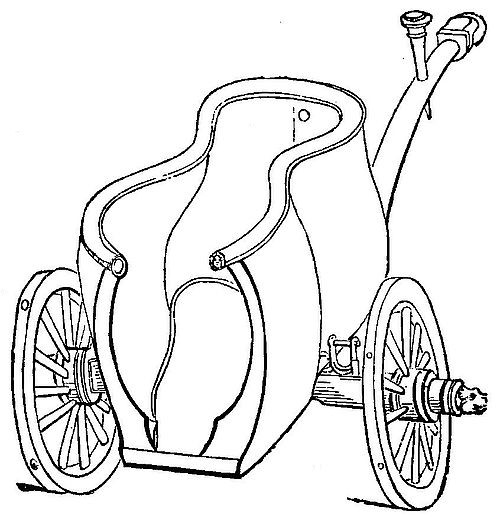
Currus. (Ancient Chariot preserved in the Vatican.)
CURRUS (ἅρμα), a chariot, a car. These terms appear to have denoted those two-wheeled vehicles for the carriage of persons, which were open overhead, thus differing from the carpentum, and closed in front, in which they differed from the cisium. The most essential articles in the construction of the currus were, 1. The rim (ἄντυξ) [Antyx]. 2. The axle (ἄξων, axis). 3. The wheels (κύκλα, τροχοί, rotae), which revolved upon the axle, and were prevented from coming off by the insertion of pins (ἔμβολοι) into the extremities of the axles. The parts of the wheel were:—(a) The nave (πλήμνη, modiolus). (b) The spokes (κνῆμαι, literally, the legs, radii.) (c) The felly (ἴτυς). (d) The tire (ἐπίσωτρον, canthus). 4. The pole (ῥυμός, temo). All the parts above mentioned are seen in the preceding cut of an ancient chariot. The Greeks and Romans appear never to have used more than one pole and one yoke, and the currus thus constructed was commonly drawn by two horses, which were attached to it by their necks, and therefore called δίζυγες ἵπποι, συνωρίς, gemini jugales, equi bijuges, &c. If a third horse was added, as was not unfrequently the case, it was fastened by traces. The horse so attached was called παρήορος, παράσειρος, σειραφόρος, in Latin, funalis, and is opposed to the ζυγῖται or ζύγιοι, the yoke-horses. The ἵππος παρήορος is placed on the right of the two yoke-horses. (See woodcut.) The Latin name for a chariot and pair was biga, generally bigae. When a third horse was added, it was called triga.
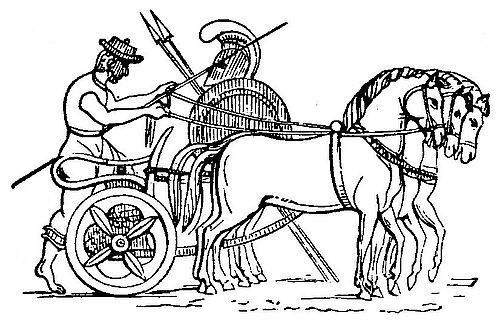
Triga. (From a Painting on a Vase.)
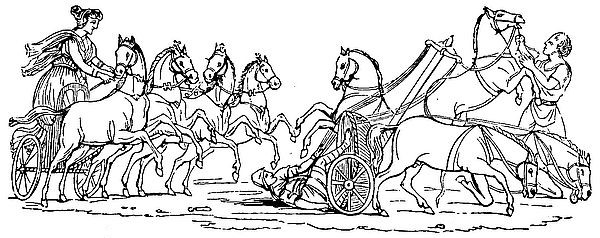
Quadrigae. (From Paintings on a Vase and a Terra-cotta.)
A chariot and four was called quadriga, generally quadrigae; in Greek, τετραορία or τέθριππος. The horses were commonly harnessed in a quadriga after the manner already represented, the two strongest horses being placed under the yoke, and the two others fastened on each side by means of ropes. This is clearly seen in the two quadrigae figured below, especially in the one on the right hand. It represents a chariot overthrown in passing the goal at the circus. The charioteer having fallen backwards, the pole and yoke are thrown upwards into the air; the two trace-horses have fallen on their knees, and the two yoke-horses are prancing on their hind legs.—The currus was adapted to carry two persons, and on this account was called in Greek δίφρος. One of the two was of course the driver. He was called ἡνίοχος, because he held the reins, and his companion παραβάτης, from going by his side or near him. In the Homeric ages, chariots were commonly employed on the field of battle. The men of rank all took their chariots with them, and in an engagement placed themselves in front. Chariots were not much used by the Romans. The most splendid kind were the quadrigae, in which the Roman generals and emperors rode when they triumphed. The body of the triumphal car was cylindrical, as we often see it represented on medals. It was enriched with gold and ivory. The utmost skill of the painter and the sculptor was employed to enhance its beauty and splendour. The triumphal car had in general no pole, the horses being led by men who were stationed at their heads.
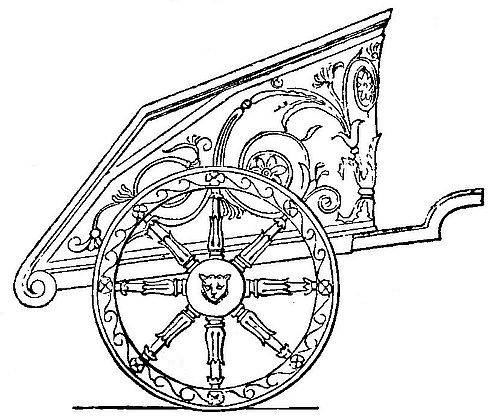
Marble Chariot in the Vatican.
CURSŌRES, slaves whose duty it was to run before the carriage of their masters. They first came into fashion in the first century of the Christian aera. The word cursores was also applied to all slaves whom their masters employed in carrying letters, messages, &c.
CURSUS. [Circus.]
CŬRŪLIS SELLA. [Sella Curulis.]
CUSTŌDES. [Comitia.]
CUSTŌDES, CUSTŌDĬAE. [Castra.]
CUSTOS URBIS. [Praefectus Urbi.]
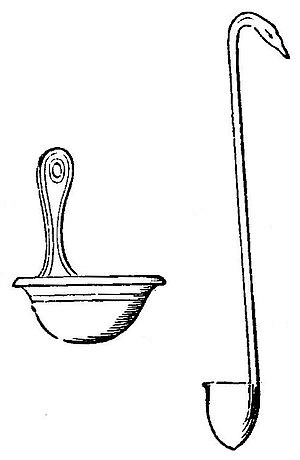
Cyathi. (Museo Borbonico, vol. iv. pl. 12.)
CỸĂTHUS (κύαθος), a Greek and Roman liquid measure, containing one-twelfth of the sextarius, or ·0825 of a pint English. The form of the cyathus used at banquets was that of a small ladle, by means of which the wine was conveyed into the drinking-cups from the large vessel (crater) in which it was mixed. Two of these cyathi are represented in the preceding woodcut. The cyathus was also the name given to a cup holding the same quantity as the measure. Hence Horace says (Carm. iii. 8. 13):
“Sume, Maecenas, cyathos amici Sospitis centum.”
CYCLAS (κυκλάς), a circular robe worn by women, to the bottom of which a border was affixed, inlaid with gold. It appears to have been usually made of some thin material.
CȲMA (κῦμα), in architecture, an ogee, a wave-shaped moulding, consisting of two curves, the one concave and the other convex. There were two forms, the cyma recta, which was concave above, and convex below, thus, , and the cyma reversa, which was convex above and concave below, thus . The diminutive cymatium or cumatium (κυμάτιον) is also used, and is indeed the more common name.


CYMBA (κύμβη) is derived from κύμβος, a hollow, and is employed to signify any small kind of boat used on lakes, rivers, &c. It appears to have been much the same as the acatium and scapha.
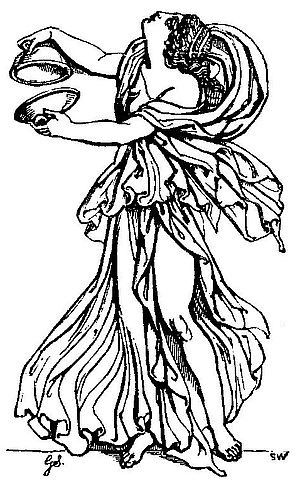
Cymbala. (From a Bas-relief in the Vatican.)
CYMBĂLUM (κύμβαλον), a musical instrument, in the shape of two half globes, which were held one in each hand by the performer, and played by being struck against each other. The word is derived from κύμβος, a hollow. The cymbal was a very ancient instrument, being used in the worship of Cybelé, Bacchus, Juno, and all the earlier deities of the Grecian and Roman mythology. It probably came from the East. The crotalum (κρόταλον) was a kind of cymbal. It appears to have been a split reed or cane, which clattered when shaken with the hand. Women who played on the crotalum were termed crotalistriae. Such was Virgil’s Copa:
“Crispum sub crotalo docta movere latus.”
The line alludes to the dance with crotala (similar to castanets).—For sistrum, which some have referred to the class of cymbala, see Sistrum.
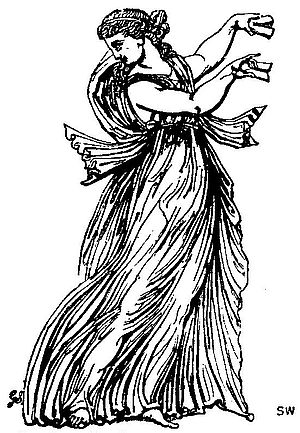
Crotala. (Borghese Vase now in the Louvre.)