S (continued 2)
Reading edition
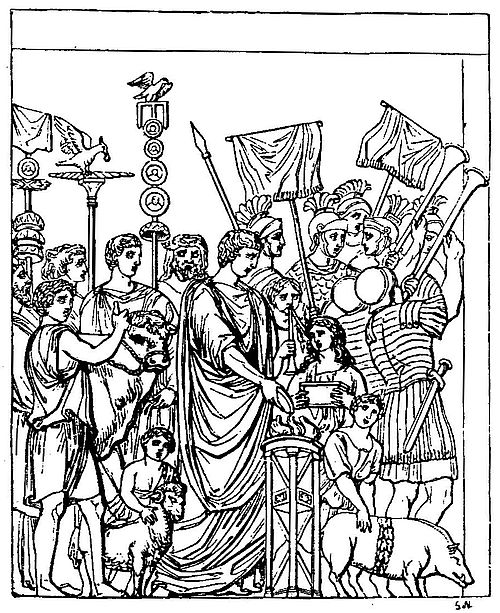
Military Standards. (Bellori, Vet. Arc. Aug.)
SĬLĬCERNĬUM. [Funus.]
SIMPŬLUM or SIMPŬVĬUM, the name of a small cup used in sacrifices, by which libations of wine were offered to the gods. It is represented on the coin figured under Secespita. There was a proverbial expression excitare fluctus in simpulo, “to make much ado about nothing.”
SĪPĂRĬUM, a piece of tapestry stretched on a frame, which rose before the stage of the theatre, and consequently answered the purpose of the drop-scene with us, although, contrary to our practice, it was depressed when the play began, so as to go below the level of the stage (aulaea premuntur), and was raised again when the performance was concluded (tolluntur). It appears that human figures were represented upon it, whose feet seemed to rest upon the stage when this screen was drawn up. These figures were sometimes those of Britons woven in the canvass, and raising their arms in the attitude of lifting up a purple curtain, so as to be introduced in the same manner as Atlantes, Persae, and Caryatides. [Caryatides.] In a more general sense, siparium denoted any piece of cloth or canvass stretched upon a frame.
SISTRUM (σεῖστρον), a mystical instrument of music, used by the ancient Egyptians in their ceremonies, and especially in the worship of Isis. It was held in the right hand (see cut), and shaken, from which circumstance it derived its name. The introduction of the worship of Isis into Italy shortly before the commencement of the Christian aera made the Romans familiar with this instrument.
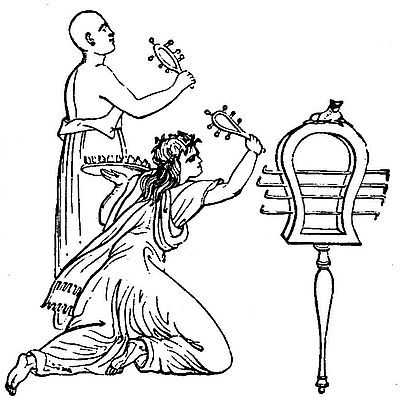
Sistra. (The two figures on the left hand from paintings found at Portici; the right-hand figure represents a Sistrum formerly belonging to the library of St. Genovefa at Paris.)
SĬTELLA. [Situla.]
SĪTŎPHỸLĂCES (σιτοφύλακες), a board of officers, chosen by lot, at Athens. They were at first three, afterwards increased to fifteen, of whom ten were for the city, five for the Peiraeus. Their business was partly to watch the arrival of the corn ships, take account of the quantity imported, and see that the import laws were duly observed; partly to watch the sales of corn in the market, and take care that the prices were fair and reasonable, and none but legal weights and measures used by the factors; in which respect their duties were much the same as those of the Agoranomi and Metronomi with regard to other saleable articles.
SĪTOS (σῖτος), corn. The soil of Attica, though favourable to the production of figs, olives, and grapes, was not so favourable for corn; and accordingly a large quantity of corn was annually imported. Exportation was entirely prohibited, nor was any Athenian or resident alien allowed to carry corn to any other place than Athens. Whoever did so, was punishable with death. Of the corn brought into the Athenian port two-thirds was to be brought into the city and sold there. No one might lend money on a ship that did not sail with an express condition to bring a return cargo, part of it corn, to Athens. Strict regulations were made with respect to the sale of corn in the market. Conspiracies among the corn-dealers (σιτοπῶλαι) to buy up the corn (συνωνεῖσθαι), or raise the price (συνιστάναι τὰς τιμὰς), were punished with death. The sale of corn was placed under the supervision of a special board of officers called Sitophylaces (σιτοφύλακες), while that of all other marketable commodities was superintended by the agoranomi. It was their business to see that meal and bread were of the proper quality, and sold at the legal weight and price. Notwithstanding these careful provisions, scarcities (σιτοδεῖαι) frequently occurred at Athens. The state then made great efforts to supply the wants of the people by importing large quantities of corn, and selling it at a low price. Public granaries were kept in the Odeum, Pompeum, Long Porch, and naval storehouse near the sea. Sitonae (σιτῶναι) were appointed to get in the supply and manage the sale. Persons called apodectae (ἀποδέκται) received the corn, measured it out, and distributed it in certain quantities.
SĪTOU DĬCĒ (σίτου δίκη). If anything happened to sever a marriage contract, the husband or his representative was bound to repay the marriage portion (προῖξ); or, if he failed to do so, he was liable to pay interest upon it at the rate of eighteen per cent. per annum. A woman’s fortune was usually secured by a mortgage of the husband’s property; but whether this was so or not, her guardian might bring an action against the party who unjustly withheld it; δίκη προικὸς, to recover the principal, δίκη σίτου, for the interest. The interest was called σῖτος (alimony or maintenance), because it was the income out of which the woman had to be maintained. The word σῖτος is often used generally for provisions, just as we use the word bread.
SĬTŬLA, dim. SĬTELLA (ὑδρία), was probably a bucket or pail for drawing and carrying water, but was more usually applied to the vessel from which lots were drawn. The diminutive sitella, however, was more commonly used in this signification. It appears that the vessel was filled with water (as among the Greeks, whence the word ὑδρία), and that the lots (sortes) were made of wood; and as, though increasing in size below, it had a narrow neck, only one lot could come to the top of the water at the same time, when it was shaken. The vessel used for drawing lots was also called urna or orca as well as Situla or Sitella. It is important to understand the difference in meaning, between Sitella and Cista, in their use in the comitia and courts of justice, since they have been frequently confounded. The Sitella was the urn, from which the names of the tribes or centuries were drawn out by lot, so that each might have its proper place in voting, and the Cista was the ballot-box into which the tabellae were cast in voting. The Cista seems to have been made of wicker or similar work.

Cista. Sitella.
SOCCUS, dim. SOCCŬLUS, was nearly if not altogether equivalent in meaning to Crepida, and denoted a slipper or low shoe, which did not fit closely, and was not fastened by any tie. The Soccus was worn by comic actors, and was in this respect opposed to the Cothurnus.
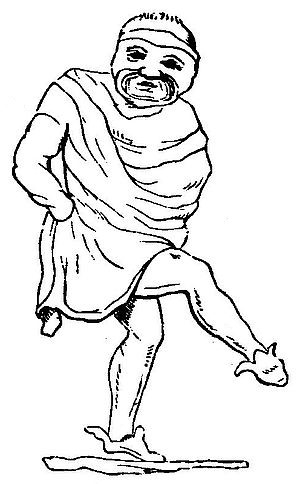
Socci, slippers, worn by a Mimus or Buffoon. (From an ancient Painting.)
SŎCĬI (σύμμαχοι). In the early times, when Rome formed equal alliances with any of the surrounding nations, these nations were called Socii. After the dissolution of the Latin league, when the name Latini, or Nomen Latinum, was artificially applied to a great number of Italians, only a few of whom were real inhabitants of the old Latin towns, and the majority of whom had been made Latins by the will and the law of Rome, there necessarily arose a difference between these Latins and the Socii, and the expression Socii Nomen Latinum is one of the old asyndeta, instead of Socii et Nomen Latinum. The Italian allies again must be distinguished from foreign allies. The Italian allies consisted, for the most part, of such nations as had either been conquered by the Romans, or had come under their dominion through other circumstances. When such nations formed an alliance with Rome, they generally retained their own laws; or if they were not allowed this privilege at first, they usually obtained it subsequently. The condition of the Italian allies varied, and mainly depended upon the manner in which they had come under the Roman dominion; but in reality they were always dependent upon Rome. The following are the principal duties which the Italian Socii had to perform towards Rome: they had to send subsidies in troops, money, corn, ships, and other things, whenever Rome demanded them. The number of troops requisite for completing or increasing the Roman armies was decreed every year by the senate, and the consuls fixed the amount which each allied nation had to send; in proportion to its population capable of bearing arms, of which each nation was obliged to draw up accurate lists, called formulae. The consul also appointed the place and time at which the troops of the socii, each part under its own leader, had to meet him and his legions. The infantry of the allies in a consular army was usually equal in numbers to that of the Romans; the cavalry was generally three times the number of the Romans: but these numerical proportions were not always observed. The consuls appointed twelve praefects as commanders of the socii, and their power answered to that of the twelve military tribunes in the consular legions. These praefects, who were probably taken from the allies themselves, and not from the Romans, selected a third of the cavalry, and a fifth of the infantry of the socii, who formed a select detachment for extraordinary cases, and who were called the extraordinarii. The remaining body of the socii was then divided into two parts, called the right and the left wing. The infantry of the wings was, as usual, divided into cohorts, and the cavalry into turmae. In some cases also legions were formed of the socii. Pay and clothing were given to the allied troops by the states or towns to which they belonged, and which appointed quaestors or paymasters for this purpose: but Rome furnished them with provisions at the expense of the republic: the infantry received the same as the Roman infantry, but the cavalry only received two-thirds of what was given to the Roman cavalry. In the distribution of the spoil and of conquered lands they frequently received the same share as the Romans. They were never allowed to take up arms of their own accord, and disputes among them were settled by the senate. Notwithstanding all this, the socii fell gradually under the arbitrary rule of the senate and the magistrates of Rome; and after the year B.C. 173, it even became customary for magistrates, when they travelled through Italy, to demand of the authorities of allied towns to pay homage to them, to provide them with a residence, and to furnish them with beasts of burden when they continued their journey. The only way for the allies to obtain any protection against such arbitrary proceedings, was to enter into a kind of clientela with some influential and powerful Roman. Socii who revolted against Rome were frequently punished with the loss of their freedom, or of the honour of serving in the Roman armies. Such punishments however varied according to circumstances. After the civitas had been granted to all the Italians by the Lex Julia de Civitate (B.C. 90), the relation of the Italian socii to Rome ceased. But Rome had long before this event applied the name Socii to foreign nations also which were allied with Rome, though the meaning of the word in this case differed from that of the Socii Italici. There were two principal kinds of alliances with foreign nations: 1. foedus aequum, such as might be concluded either after a war in which neither party had gained a decisive victory, or with a nation with which Rome had never been at war; 2. a foedus iniquum, when a foreign nation conquered by the Romans was obliged to form the alliance on any terms proposed by the conquerors. In the latter case the foreign nation was to some extent subject to Rome, and obliged to comply with anything that Rome might demand. But all foreign socii, whether they had an equal or unequal alliance, were obliged to send subsidies in troops when Rome demanded them; these troops, however, did not, like those of the Italian socii, serve in the line, but were employed as light-armed soldiers, and were called milites auxiliares, auxiliarii, auxilia, or sometimes auxilia externa. Towards the end of the republic all the Roman allies, whether they were nations or kings, sank down to the condition of mere subjects or vassals of Rome, whose freedom and independence consisted in nothing but a name. [Compare Foederatae Civitates.]
SŎDĀLĬTĬUM. [Ambitus.]
SŌLĀRIUM. [Horologium.]
SŎLĔA was the simplest kind of sandal [Sandalium], consisting of a sole with little more to fasten it to the foot than a strap across the instep.
SŎLĬDUS. [Aurum.]
SOLĬTAURĪLĬA. [Sacrificium; Lustratio; and woodcut on p. 343.]
SOPHRŌNISTAE. [Gymnasium.]
SORTES, lots. It was a frequent practice among the Italian nations to endeavour to ascertain a knowledge of future events by drawing lots (sortes): in many of the ancient Italian temples the will of the gods was consulted in this way, as at Praeneste, Caere, &c. These sortes or lots were usually little tablets or counters, made of wood or other materials, and were commonly thrown into a sitella or urn, filled with water, as is explained under Situla. The lots were sometimes thrown like dice. The name of sortes was in fact given to anything used to determine chances, and was also applied to any verbal response of an oracle. Various things were written upon the lots according to circumstances, as for instance the names of the persons using them, &c.: it seems to have been a favourite practice in later times to write the verses of illustrious poets upon little tablets, and to draw them out of the urn like other lots, the verses which a person thus obtained being supposed to be applicable to him.
SPĔCŬLĀRĬA. [Domus.]
SPĔCŬLĀTŌRES, or EXPLŌRĀTŌRES, were scouts or spies sent before an army, to reconnoitre the ground and observe the movements of the enemy. Under the emperors there was a body of troops called Speculatores, who formed part of the praetorian cohorts, and had the especial care of the emperor’s person.
SPĔCŬLUM (κάτοπτρον, ἔσοπτρον, ἔνοπτρον), a mirror, a looking-glass. The looking-glasses of the ancients were usually made of metal, at first of a composition of tin and copper, but afterwards more frequently of silver. The ancients seem to have had glass mirrors also like ours, consisting of a glass plate covered at the back with a thin leaf of metal. They were manufactured as early as the time of Pliny at the celebrated glass-houses of Sidon, but they must have been inferior to those of metal, since they never came into general use, and are never mentioned by ancient writers among costly pieces of furniture, whereas metal mirrors frequently are. Looking-glasses were generally small, and such as could be carried in the hand. Instead of their being fixed so as to be hung against the wall or to stand upon the table or floor, they were generally held by female slaves before their mistresses when dressing.
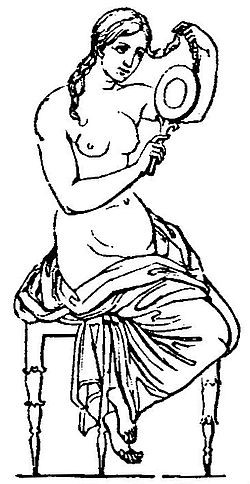
Looking-glass held by a Nymph. (From a Painting at Herculaneum.)
SPĔCUS. [Aquae Ductus.]
SPHAERISTĒRIUM. [Gymnasium.]
SPĪCŬLUM. [Hasta.]
SPĪRA (σπεῖρα), dim. SPĪRŬLA, the base of a column. This member did not exist in the Doric order of Greek architecture, but was always present in the Ionic and Corinthian, and, besides the bases properly belonging to those orders, there was one called the Attic, which may be regarded as a variety of the Ionic [Atticurges]. In the Ionic and Attic the base commonly consisted of two tori (torus superior and torus inferior) divided by a scotia (τρόχιλος), and in the Corinthian of two tori divided by two scotiae. The upper torus was often fluted (ῥαβδωτός), and surmounted by an astragal [Astragalus], as in the left-hand figure of the annexed woodcut, which shows the form of the base in the Ionic temple of Panops on the Ilissus. The right-hand figure in the same woodcut shows the corresponding part in the temple of Minerva Polias at Athens. In this the upper torus is wrought with a plaited ornament, perhaps designed to represent a rope or cable. In these two temples the spira rests not upon a plinth (plinthus, πλίνθος), but on a podium.
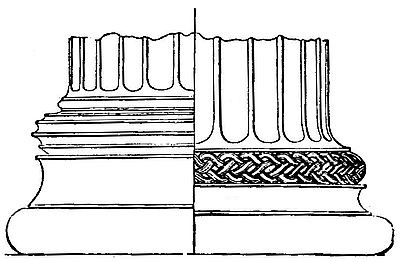
Spirae (bases) of Columns. (From ancient Columns.)
SPŎLĬA. Four words are commonly employed to denote booty taken in war, Praeda, anubiae, Exuviae, Spolia. Of these Praeda bears the most comprehensive meaning, being used for plunder of every description. Manubiae would seem strictly to signify that portion of the spoil which fell to the share of the commander-in-chief, the proceeds of which were frequently applied to the erection of some public building. Exuviae indicates anything stripped from the person of a foe, while Spolia, properly speaking, ought to be confined to armour and weapons, although both words are applied loosely to trophies, such as chariots, standards, beaks of ships and the like, which might be preserved and displayed. Spoils collected on the battlefield after an engagement, or found in a captured town, were employed to decorate the temples of the gods, triumphal arches, porticoes, and other places of public resort, and sometimes in the hour of extreme need served to arm the people; but those which were gained by individual prowess were considered the undoubted property of the successful combatant, and were exhibited in the most conspicuous part of his dwelling, being hung up in the atrium, suspended from the door-posts, or arranged in the vestibulum, with appropriate inscriptions. They were regarded as peculiarly sacred, so that even if the house was sold the new possessor was not permitted to remove them. But while on the one hand it was unlawful to remove spoils, so it was forbidden to replace or repair them when they had fallen down or become decayed through age; the object of this regulation being doubtless to guard against the frauds of false pretenders. Of all spoils the most important were the spolia opima, a term applied to those only which the commander-in-chief of a Roman army stripped in a field of battle from the leader of the foe. Plutarch expressly asserts that Roman history up to his own time afforded but three examples of the spolia opima. The first were said to have been won by Romulus from Acro, king of the Caeninenses, the second by Aulus Cornelius Cossus from Lar Tolumnius, king of the Veientes, the third by M. Claudius Marcellus from Viridomarus, king of the Gaesatae. In all these cases, in accordance with the original institution, the spoils were dedicated to Jupiter Feretrius.
SPONSA, SPONSUS, SPONSĀLĬA. [Matrimonium.]
SPORTŬLA. In the days of Roman freedom, clients were in the habit of testifying respect for their patron by thronging his atrium at an early hour, and escorting him to places of public resort when he went abroad. As an acknowledgment of these courtesies, some of the number were usually invited to partake of the evening meal. After the extinction of liberty, the presence of such guests, who had now lost all political importance, was soon regarded as an irksome restraint, while at the same time many of the noble and wealthy were unwilling to sacrifice the pompous display of a numerous body of retainers. Hence the practice was introduced under the empire of bestowing on each client, when he presented himself for his morning visit, a certain portion of food as a substitute and compensation for the occasional invitation to a regular supper (coena recta), and this dole, being carried off in a little basket provided for the purpose, received the name of sportula. For the sake of convenience it soon became common to give an equivalent in money, the sum established by general usage being a hundred quadrantes. The donation in money, however, did not entirely supersede the sportula given in kind, for we find in Juvenal a lively description of a great man’s vestibule crowded with dependents, each attended by a slave bearing a portable kitchen to receive the viands and keep them hot while they were carried home. Under the empire great numbers of the lower orders derived their whole sustenance, and the funds for ordinary expenditure, exclusively from this source, while even the highborn did not scruple to increase their incomes by taking advantage of the ostentatious profusion of the rich and vain.
STĂDĬUM (ὁ στάδιος and τὸ στάδιον), a Greek measure of length, and the chief one used for itinerary distances. It was equal to 600 Greek or 625 Roman feet, or to 125 Roman paces; and the Roman mile contained 8 stadia. Hence the stadium contained 606 feet 9 inches English. This standard prevailed throughout Greece, under the name of the Olympic stadium, so called because it was the exact length of the stadium or foot-race course at Olympia, measured between the pillars at the two extremities of the course. The first use of the measure seems to be contemporaneous with the formation of the stadium at Olympia when the Olympic games were revived by Iphitus (B.C. 884 or 828). This distance doubled formed the δίαυλος, the ἱππικον was 4 stadia, and the δόλιχος is differently stated at 6, 7, 8, 12, 20, and 24 stadia. A day’s journey by land was reckoned at 200 or 180 stadia, or for an army 150 stadia. The stadium at Olympia was used not only for the foot-race, but also for the other contests which were added to the games from time to time [Olympia], except the horse-races, for which a place was set apart, of a similar form with the stadium, but larger; this was called the Hippodrome (ἱππόδρομος). The name stadium was also given to all other places throughout Greece wherever games were celebrated. The stadium was an oblong area terminated at one end by a straight line, at the other by a semicircle having the breadth of the stadium for its base. Round this area were ranges of seats rising above one another in steps.
STĀTĒR (στατῆρ), which means simply a standard (in this case both of weight and more particularly of money), was the name of the principal gold coin of Greece, which was also called Chrysus (χρυσοῦς). The stater is said to have been first coined in Lydia by Croesus, and probably did not differ materially from the stater which was afterwards current in Greece, and which was equal in weight to two drachmae, and in value to twenty. The Macedonian stater, which was the one most in use after the time of Philip and his son Alexander the Great, was of the value of about 1l. 3s. 6d. In calculating the value of the stater in our money the ratio of gold to silver must not be overlooked. Thus the stater of Alexander, which we have valued, according to the present worth of gold, at 1l. 3s. 6d., passed for twenty drachmae, which, according to the present value of silver, were worth only 16s. 3d. But the former is the true worth of the stater, the difference arising from the greater value of silver in ancient times than now.
STĂTĬŌNES. [Castra.]
STĂTOR, a public servant, who attended on the Roman magistrates in the provinces. The Statores seem to have derived their name from standing by the side of the magistrate, and thus being at hand to execute all his commands; they appear to have been chiefly employed in carrying letters and messages.
STĀTŬĀRĬA ARS is in its proper sense the art of making statues or busts, whether they consist of stone or metal or other materials, and includes the art of making the various kinds of reliefs (alto, basso, and mezzo relievo). These arts in their infant state existed among the Greeks from time immemorial. There is no material applicable to statuary which was not used by the Greeks. As soft clay is capable of being shaped without difficulty into any form, and is easily dried, either by being exposed to the sun or by being baked, we may consider this substance to have been the earliest material of which figures were made. The name plastic art (ἡ πλαστική), by which the ancients sometimes designate the art of statuary, properly signifies to form or shape a thing of clay. The second material was wood, and figures made of wood were called ξόανα, from ξέω, “polish” or “carve.” It was chiefly used for making images of the gods, and probably more on account of the facility of working in it, than for any other reason. Stone was little used in statuary during the early ages of Greece, though it was not altogether unknown, as we may infer from the relief on the Lion-gate of Mycenae. In Italy, where the soft peperino afforded an easy material for working, stone appears to have been used at an earlier period and more commonly than in Greece. But in the historical times the Greeks used all the principal varieties of marble for their statues. Different kinds of marble and of different colours were sometimes used in one and the same statue, in which case the work is called Polylithic statuary. Bronze (χάλκος, aes), silver, and gold were used profusely in the state of society described in the Homeric poems. At that period, however, and long after, the works executed in metal were made by means of the hammer, and the different pieces were joined together by pins, rivets, cramps, or other mechanical fastenings, and, as the art advanced, by a kind of glue, cement, or solder. Iron came into use much later, and the art of casting both bronze and iron is ascribed to Rhoecus and to Theodoras of Samos. Ivory was employed at a later period than any of the before-mentioned materials, and then was highly valued both for its beauty and rarity. In its application to statuary, ivory was generally combined with gold, and was used for the parts representing the flesh. The history of ancient art, and of statuary in particular, may be divided into five periods.
I. First Period, from the earliest times till about 580 B.C.—Three kinds of artists may be distinguished in the mythical period. The first consists of gods and daemons; such as Athena, Hephaestus, the Phrygian or Dardanian Dactyli, and the Cabiri. The second contains whole tribes of men distinguished from others by the mysterious possession of superior skill in the practice of the arts, such as the Telchines and the Cyclopes. The third consists of individuals who are indeed described as human beings, but yet are nothing more than personifications of particular branches of art, or the representatives of families of artists. Of the latter the most celebrated is Daedalus, whose name indicates nothing but a smith, or an artist in general, and who is himself the mythical ancestor of a numerous family of artists (Daedalids), which can be traced from the time of Homer to that of Plato, for even Socrates is said to have been a descendant of this family. Smilis (from σμίλη, a carving-knife) exercised his art in Samos, Aegina, and other places, and some remarkable works were attributed to him. Endoeus of Athens is called a disciple of Daedalus. According to the popular traditions of Greece, there was no period in which the gods were not represented in some form or other, and there is no doubt that for a long time there existed no other statues in Greece than those of the gods. The earliest representations of the gods, however, were only symbolic. The presence of a god was indicated by the simplest and most shapeless symbols, such as unhewn blocks of stone (λίθοι ἀργοί), and by simple pillars or pieces of wood. The general name for a representation of a god not consisting of such a rude symbol was ἄγαλμα. In the Homeric poems there are sufficient traces of the existence of statues of the gods; but they probably did not display any artistic beauty. The only work of art which has come down to us from the heroic age is the relief above the ancient gate of Mycenae, representing two lions standing on their hind legs, with a sort of pillar between them (woodcut under Murus). The time which elapsed between the composition of the Homeric poems and the beginning of the fifth century before our aera may be termed the age of discovery; for nearly all the inventions, upon the application of which the development of the arts is dependent, are assigned to this period. Glaucus of Chios or Samos is said to have invented the art of soldering metal (σιδήρου κόλλησις). The two artists most celebrated for their discoveries were the two brothers Telecles and Theodoras of Samos, about the time of Polycrates. They invented the art of casting figures of metal. During the whole of this period, though marble and bronze began to be extensively applied, yet wood was more generally used for representations of the gods. These statues were painted [Pictura], and in most cases dressed in the most gorgeous attire. The style in which they are executed is called the archaic or the hieratic style. The figures are stiff and clumsy, the countenances have little or no individuality, the eyes long and small, and the outer angles turned a little upwards; the mouth, which is likewise drawn upwards at the two corners, has a smiling appearance. The hair is carefully worked, but looks stiff and wiry, and hangs generally down in straight lines, which are curled at the ends. The arms hang down the sides of the body, unless the figure carries something in its hands. The drapery is likewise stiff, and the folds are very symmetrical and worked with little regard to nature.
II. Second Period, from 580 to 480 B.C.—The number of artists who flourished during this period is truly astonishing. The Ionians of Asia Minor and the islanders of the Aegean, who had previously been in advance of the other Greeks in the exercise of the fine arts, had their last flourishing period from 560 to 528 B.C. Works in metal were produced in high perfection in Samos, in Aegina and Argos, while Chios gained the greatest reputation from its possessing the earliest great school of sculptors in marble, in which Bupalus and Anthermus were the most distinguished about 540 B.C. Their works were scattered over various parts of Greece, and their value may be inferred from the fact that Augustus adorned with them the pediment of the temple of Apollo on the Palatine. Sicyon also possessed a celebrated school of sculptors in marble, and about 580 B.C. Dipoenus and Scyllis, who had come from Crete, were at the head of it, and executed several marble statues of gods. Respecting Magna Graecia and Sicily we know few particulars, though it appears that the arts here went on improving and continued to be in advance of the mother-country. The most celebrated artists in southern Italy were Dameas of Croton, and Pythagoras of Rhegium. In Athens the arts made great progress under the patronage of the Pisistratids. The most celebrated among the Athenian sculptors of this period were Critias and Hegias, or Hegesias, both distinguished for their works in bronze. The former of them made in 477 B.C. the statues of Harmodius and Aristogiton. Argos also distinguished itself, and it is a curious circumstance, that the greatest Attic artists with whom the third period opens, and who brought the Attic art to its culminating point, are disciples of the Argive Ageladas (about 516 B.C.) In the statues of the gods (ἀγάλματα), which were made for temples as objects of worship, the hieratic style was more or less conscientiously retained, and it is therefore not in these statues that we have to seek for proofs of the progress of art. But even in temple-statues wood began to give way to other and better materials. Besides bronze, marble also, and ivory and gold were now applied to statues of the gods, and it was not uncommon to form the body of a statue of wood, and to make its head, arms, and feet of stone (ἀκρόλιθοι), or to cover the whole of such a wooden figure with ivory and gold. From the statues of the gods erected for worship we must distinguish those statues which were dedicated in temples as ἀναθήματα, and which now became customary instead of craters, tripods, &c. In these the artists were not only not bound to any traditional or conventional forms, but were, like the poets, allowed to make free use of mythological subjects, to add, and to omit, or to modify the stories, so as to render them more adapted for their artistic purposes. A third class of statues, which were erected during this period in great numbers, were those of the victors in the national games, and, though more rarely, of other distinguished persons (ἀνδριάντες). Those of the latter kind appear generally to have been portraits (εἰκόνες, statuae iconicae). The first iconic statues of Harmodius and Aristogiton were made by Antenor in 509 B.C., and in 477 B.C. new statues of the same persons were made by Critias. It was also at the period we are now describing that it became customary to adorn the pediments, friezes, and other parts of temples with reliefs or groups of statues of marble. We still possess two great works of this kind which are sufficient to show their general character during this period. 1. The Selinuntine Marbles, or the metopes of two temples on the acropolis of Selinus in Sicily, which were discovered in 1823, and are at present in the Museum of Palermo. 2. The Aeginetan Marbles, which were discovered in 1812 in the island of Aegina, and are now at Munich. They consist of eleven statues, which adorned two pediments of a temple of Athena, and represent the goddess leading the Aeacids against Troy, and contain manifest allusions to the war of the Greeks with the Persians.
III. Third Period, from 480 to 336 B.C.—During this period Athens was the centre of the fine arts in Greece. Statuary went hand in hand with the other arts and with literature: it became emancipated from its ancient fetters, from the stiffness and conventional forms of former times, and reached its culminating point in the sublime and mighty works of Phidias. His career begins about 452 B.C. The genius of this artist was so great and so generally recognised, that all the great works which were executed in the age of Pericles were placed under his direction, and thus the whole host of artists who were at that time assembled at Athens were engaged in working out his designs and ideas. Of these we have still some remains:—1. Parts of the eighteen sculptured metopes, together with the frieze of the small sides of the cella of the temple of Theseus. Ten of the metopes represent the exploits of Hercules, and the eight others those of Theseus. The figures in the frieze are manifestly gods, but their meaning is uncertain. Casts of these figures are in the British Museum. 2. A considerable number of the metopes of the Parthenon, which are all adorned with reliefs in marble, a great part of the frieze of the cella, some colossal figures, and a number of fragments of the two pediments of this temple. The greater part of these works is now in the British Museum, where they are collected under the name of the Elgin Marbles. Besides the sculptures of these temples, there are also similar ornaments of other temples extant, which show the influence which the school of Phidias exercised in various parts of Greece. Of these the most important are, the Phigalian marbles, which belonged to the temple of Apollo Epicurius, built about 436 B.C., by Ictinus. They were discovered in 1812, and consist of twenty-three plates of marble belonging to the inner frieze of the cella. They are now in the British Museum. The subjects represented in them are fights with Centaurs and Amazons, and one plate shows Apollo and Artemis drawn in a chariot by stags. About the same time that the Attic school rose to its highest perfection under Phidias, the school of Argos was likewise raised to its summit by Polycletus. The art of making bronze statues of athletes was carried by him to the greatest perfection: ideal youthful and manly beauty was the sphere in which he excelled. One of his statues, a youthful Doryphorus, was made with such accurate observation of the proportions of the parts of the body, that it was looked upon by the ancient artists as a canon of rules on this point. Myron of Eleutherae, about 432 B.C., adhered to a closer imitation of nature than Polycletus, and as far as the impression upon the senses was concerned, his works were most pleasing. The cow of Myron in bronze was celebrated in all antiquity. The change which took place after the Peloponnesian war in the public mind at Athens could not fail to show its influence upon the arts also. It was especially Scopas of Paros and Praxiteles of Athens, about one generation after Myron and Polycletus, who gave the reflex of their time in their productions. Their works expressed the softer feelings and an excited state of mind, such as would make a strong impression upon and captivate the senses of the beholders. Both were distinguished as sculptors in marble, and both worked in the same style; the legendary circles to which most of their ideal productions belong are those of Dionysus and Aphrodite, a fact which also shows the character of the age. Cephissodorus and Timarchus were sons of Praxiteles. There were several works of the former at Rome in the time of Pliny; he made his art subservient to passions and sensual desires. Most of the above-mentioned artists, however widely their works differed from those of the school of Phidias, may yet be regarded as having only continued and developed its principles of art in a certain direction; but towards the end of this period Euphranor and Lysippus of Sicyon carried out the principles of the Argive school of Polycletus. Their principal object was to represent the highest possible degree of physical beauty and of athletic and heroic power. The chief characteristic of Lysippus and his school is a close imitation of nature, which even contrived to represent bodily defects in some interesting manner, as in his statues of Alexander.
IV. Fourth Period, from 336 to 146 B.C.—During the first fifty years of this period the schools of Praxiteles and Lysippus continued to flourish, especially in works of bronze; but after this time bronze statues were seldom made, until the art was carried on with new vigour at Athens about the end of the period. The school of Lysippus gave rise to that of Rhodes, where his disciple Chares formed the most celebrated among the hundred colossal statues of the sun. It was seventy cubits high, and partly of metal. It stood near the harbour, and was thrown down by an earthquake about 225 B.C. Antiquarians assign to this part of the fourth period several very beautiful works still extant, as the magnificent group of Laocoon and his sons, which was discovered in 1506 near the baths of Titus, and is at present at Rome. This is, next to the Niobe, the most beautiful group among the extant works of ancient art; it was according to Pliny the work of three Rhodian artists: Agesander, Polydorus, and Athenodorus. The celebrated Farnesian bull is likewise the work of two Rhodian artists, Apollonius and Tauriscus. In the various kingdoms which arose out of the conquests of Alexander the arts were more or less cultivated. Not only were the great master-works of former times copied to adorn the new capitals, but new schools of artists sprang up in several of them. At Pergamus the celebrated groups were composed which represented the victories of Attalus and Eumenes over the Gauls. It is believed by some that the so-called dying gladiator at Rome is a statue of a Gaul, which originally belonged to one of these groups. The Borghese gladiator in the Louvre is supposed to be the work of an Ephesian Agasias, and to have originally formed a part of such a battle-scene. About the close of this period, and for more than a century afterwards, the Romans, in the conquest of the countries where the arts had flourished, made it a regular practice to carry away the works of art. The triumphs over Philip, Antiochus, the Aetolians, the Gauls in Asia, Perseus, Pseudo-Philip, and above all the taking of Corinth, and subsequently the victories over Mithridates and Cleopatra, filled the Roman temples and porticoes with the greatest variety of works of art. The sacrilegious plunder of temples and the carrying away of the sacred statues from the public sanctuaries became afterwards a common practice. The manner in which Verres acted in Sicily is but one of many instances of the extent to which these robberies were carried on. The emperors, especially Augustus, Caligula, and Nero, followed these examples, and the immense number of statues which, notwithstanding all this, remained at Rhodes, Delphi, Athens, and Olympia, is truly astonishing.—We can only briefly advert to the history of statuary among the Etruscans and Romans down to the year 146 B.C. The Etruscans were on the whole an industrious and enterprising people. With the works of Grecian art they must have become acquainted at an early time through their intercourse with the Greeks of southern Italy, whose influence upon the art of the Etruscans is evident in numerous cases. The whole range of the fine arts was cultivated by the Etruscans at an early period. Statuary in clay (which here supplied the place of wood, ξόανα, used in Greece) and in bronze appears to have acquired a high degree of perfection. In 267 B.C. no fewer than 2000 bronze statues are said to have existed at Volsinii, and numerous works of Etruscan art are still extant, which show great vigour and life, though they do not possess a very high degree of beauty. Some of their statues are worked in a Greek style; others are of a character peculiar to themselves, and entirely different from works of Grecian art, being stiff and ugly: others again are exaggerated and forced in their movements and attitudes, and resemble the figures which we meet with in the representations of Asiatic nations. The Romans previously to the time of the first Tarquin are said to have had no images of the gods; and for a long time afterwards their statues of gods in clay or wood were made by Etruscan artists. During the early part of the republic the works executed at Rome were altogether of a useful and practical, and not of an ornamental character; and statuary was in consequence little cultivated. But in the course of time the senate and the people, as well as foreign states which desired to show their gratitude to some Roman, began to erect bronze statues to distinguished persons in the Forum and other places.
V. fifth period, from B.C. 146 to the fall of the Western Empire.—During this period Rome was the capital of nearly the whole of the ancient world, not through its intellectual superiority, but by its military and political power. But it nevertheless became the centre of art and literature, as the artists resorted thither from all parts of the empire for the purpose of seeking employment in the houses of the great. The mass of the people, however, had as little taste for and were as little concerned about the arts as ever. In the time of Nero, who did much for the arts, we meet with Zenodorus, a founder of metal statues, who was commissioned by the emperor to execute a colossal statue of 110 feet high, representing Nero as the Sun. In the reign of Hadrian the arts seem to begin a new aera. He himself was undoubtedly a real lover of art, and encouraged it not only at Rome, but in Greece and Asia Minor. The great Villa of Hadrian below Tivoli, the ruins of which cover an extent of ten Roman miles in circumference, was richer in works of art than any other place in Italy. Here more works of art have been dug out of the ground than anywhere else within the same compass. Some statues executed at this time are worthy of the highest admiration. Foremost among these stand the statues and busts of Antinous, for whom the emperor entertained a passionate partiality, and who was represented in innumerable works of art. The colossal bust of Antinous in the Louvre is reckoned one of the finest works of ancient art, and is placed by some critics on an equality with the best works that Greece has produced. There are also some very good works in red marble which are referred to this period, as that material is not known to have been used before the age of Hadrian. As the arts had received such encouragement and brought forth such fruits in the reign of Hadrian, the effects remained visible for some time during the reigns of the Antonines. The frieze of a temple, which the senate caused to be erected to Antoninus Pius and Faustina, is adorned with griffins and vessels of very exquisite workmanship. The best among the extant works of this time are the equestrian statue of M. Aurelius of gilt bronze, which stands on the Capitol, and the column of M. Aurelius with reliefs representing scenes of his war against the Marcomanni. After the time of the Antonines the symptoms of decline in the arts became more and more visible. The most numerous works continued to be busts and statues of the emperors, but the best among them are not free from affectation and mannerism. In the time of Caracalla many statues were made, especially of Alexander the Great. Alexander Severus was a great admirer of statues, not from a genuine love of art, but because he delighted in the representations of great and good men. The reliefs on the triumphal arch of Septimius Severus, representing his victories over the Parthians, Arabs, and Adiabenians, have scarcely any artistic merits. Art now declined with great rapidity: busts and statues were more seldom made than before, and are awkward and poor; the hair is frequently indicated by nothing else but holes bored in the stone. The reliefs on the sarcophagi gradually become monotonous and lifeless. The reliefs on the arch of Constantine, which are not taken from that of Trajan, are perfectly rude and worthless, and those on the column of Theodosius were not better. Before concluding, it remains to say a few words on the destruction of ancient works of art. During the latter part of the reign of Constantine many statues of the gods were destroyed, and not long after his time a systematic destruction began, which under Theodosius spread to all parts of the empire. The spirit of destruction, however, was not directed against works of art in general and as such, but only against the pagan idols. The opinion, therefore, which is entertained by some, that the losses we have sustained in works of ancient art, are mainly attributable to the introduction of Christianity, is too sweeping and general. Of the same character is another opinion, according to which the final decay of ancient art was a consequence of the spiritual nature of the new religion. The coincidence of the general introduction of Christianity with the decay of the arts is merely accidental. That the early Christians did not despise the arts as such, is clear from several facts. We know that they erected statues to their martyrs, of which we have a specimen in that of St. Hippolytus in the Vatican library. The numerous works, lastly, which have been found in the Christian catacombs at Rome, might alone be a sufficient proof that the early Christians were not hostile towards the representation of the heroes of their religion in works of art. In fact, Christianity during the middle ages became as much the mother of the arts of modern times, as the religion of Greece was the mother of ancient art. Another very general and yet incorrect notion is, that the northern barbarians after the conquest of Rome intentionally destroyed works of art. This opinion is not supported by any of the contemporary historians, nor is it at all probable. The barbarians were only anxious to carry with them the most precious treasures in order to enrich themselves; a statue must have been an object of indifference to them. What perished, perished naturally by the circumstances and calamities of the times. In times of need bronze statues were melted down and the material used for other purposes; marble statues were frequently broken to pieces and used for building materials. If we consider the history of Rome during the first centuries after the conquest of Italy by the Germans, we have every reason to wonder that so many specimens of ancient art have come down to our times. The greatest destruction, at one time, of ancient works of art is supposed to have occurred at the taking of Constantinople, in the beginning of the thirteenth century. Among the few works saved from this devastation are the celebrated bronze horses which now decorate the exterior of St. Mark’s church at Venice. They have been ascribed, but without sufficient authority, to Lysippus.
STĬLUS or STỸLUS is in all probability the same word with the Greek στύλος, and conveys the general idea of an object tapering like an architectural column. It signifies, (1) An iron instrument, resembling a pencil in size and shape, used for writing upon waxed tablets. At one end it was sharpened to a point for scratching the characters upon the wax, while the other end, being flat and circular, served to render the surface of the tablets smooth again, and so to obliterate what had been written. Thus, vertere stilum means to erase, and hence to correct. The stylus was also termed graphium, and the case in which it was kept graphiarium.—(2) A sharp stake or spike placed in pitfalls before an entrenchment, to embarrass the progress of an attacking enemy.
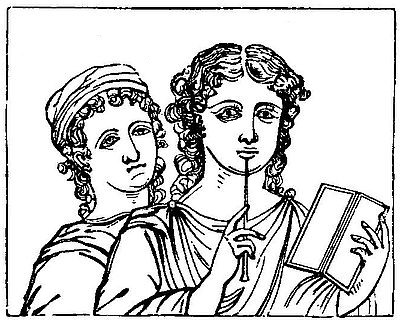
Stilus. (Museo Borbonico, vol. vi. tav. 35.)
STIPENDĬĀRĬI. The stipendiariae urbes of the Roman provinces were so denominated, as being subject to the payment of a fixed money-tribute, stipendium, in contradistinction to the vectigales, who paid a certain portion as a tenth or twentieth of the produce of their lands, their cattle, or customs. The word stipendium was used to signify the tribute paid, as it was originally imposed for and afterwards appropriated to the purpose of furnishing the Roman soldiers with pay. The condition of the urbes stipendiariae is generally thought to have been more honourable than that of the vectigales, but the distinction between the two terms was not always observed. The word stipendiarius is also applied to a person who receives a fixed salary or pay, as a stipendiarius miles.
STĪPENDĬUM, a pension or pay, from stipem and pendo, because before silver was coined at Rome the copper-money in use was paid by weight and not by tale. According to Livy, the practice of giving pay to the Roman soldiers was not introduced till B.C. 405, on the occasion of the taking of Tarracina or Anxur. It is probable, however, that they received pay before this time, but, since it was not paid regularly, its first institution was referred to this year. In B.C. 403 a certain amount of pay was assigned to the knights also, or Equites, p. 156, b. This, however, had reference to the citizens who possessed an equestrian fortune, but had no horse (equus publicus) assigned to them by the state, for it had always been customary for the knights of the 18 centuries to receive pay out of the common treasury, in the shape of an allowance for the purchase of a horse, and a yearly pension of 2000 asses for its keep. [Aes Equestre; Aes Hordearium.] In the time of the republic the pay of a legionary soldier amounted to two oboli, or 3⅓ asses; a centurion received double, and an eques or horseman triple. Polybius states that foot soldiers also received in corn every month an allowance (demensum) of ⅔ of an Attic medimnus, or about 2 bushels of wheat: the horsemen 7 medimni of barley and 2 of wheat. The infantry of the allies received the same allowance as the Roman: the horsemen 1⅓ medimni of wheat and 5 of barley. But there was this difference, that the allied forces received their allowances as a gratuity; the Roman soldiers, on the contrary, had deducted from their pay the money value of whatever they received in corn, armour, or clothes. There was indeed a law passed by C. Gracchus, which provided that besides their pay the soldiers should receive from the treasury an allowance for clothes; but this law seems either to have been repealed or to have fallen into disuse. The pay was doubled for the legionaries by Julius Caesar before the civil war. He also gave them corn whenever he had the means, without any restrictions. Under Augustus it appears to have been raised to 10 asses a day (three times the original sum). It was still further increased by Domitian. The praetorian cohorts received twice as much as the legionaries.
STŎLA, a female dress worn over the tunic; it came as low as the ankles or feet, and was fastened round the body by a girdle, leaving above the breast broad folds. The tunic did not reach much below the knee, but the essential distinction between the tunic and stola seems to have been that the latter always had an instita or flounce sewed to the bottom and reaching to the instep. Over the stola the palla or pallium was worn [Pallium], as we see in the cut annexed. The stola was the characteristic dress of the Roman matrons, as the toga was of the Roman men. Hence the meretrices were not allowed to wear it, but only a dark-coloured toga; and accordingly Horace speaks of the matrona in contradistinction to the togata. For the same reason, women who had been divorced from their husbands on account of adultery, were not allowed to wear the stola, but only the toga.
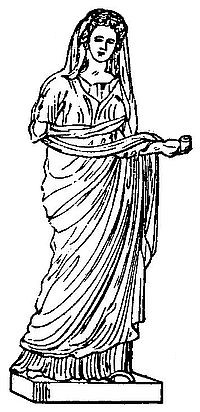
Stola, female dress. (Museo Borbonico, vol. iii. tav. 37.)
STRĂTĒGUS (στρατηγός), general. This office and title seems to have been more especially peculiar to the democratic states of ancient Greece: we read of them, for instance, at Athens, Tarentum, Syracuse, Argos, and Thurii; and when the tyrants of the Ionian cities in Asia Minor were deposed by Aristagoras, he established strategi in their room, to act as chief magistrates. The strategi at Athens were instituted after the remodelling of the constitution by Clisthenes, to discharge the duties which had in former times been performed either by the king or the archon polemarchus. They were ten in number, one for each of the ten tribes, and chosen by the suffrages (χειροτονία) of the people. Before entering on their duties they were required to submit to a docimasia, or examination of their character; and no one was eligible to the office unless he had legitimate children, and was possessed of landed property in Attica. They were, as their name denotes, entrusted with the command on military expeditions, with the superintendence of all warlike preparations, and with the regulation of all matters in any way connected with the war department of the state. They levied and enlisted the soldiers, either personally or with the assistance of the taxiarchs. They were entrusted with the collection and management of the property-taxes (εἰσφοραί) raised for the purposes of war; and also presided over the courts of justice in which any disputes connected with this subject or the trierarchy were decided. They nominated from year to year persons to serve as trierarchs. They had the power of convening extraordinary assemblies of the people in cases of emergency. But their most important trust was the command in war, and it depended upon circumstances to how many of the number it was given. At Marathon all the ten were present, and the chief command came to each of them in turn. The archon polemarchus also was there associated with them, and, according to the ancient custom, his vote in a council of war was equal to that of any of the generals. Usually, however, three only were sent out; one of these (τρίτος αὐτός) was considered as the commander-in-chief, but his colleagues had an equal voice in a council of war. The military chiefs of the Aetolian and Achaean leagues were also called strategi. The Achaean strategi had the power of convening a general assembly of the league on extraordinary occasions. Greek writers on Roman affairs give the name of strategi to the praetors.
STRĒNA, a present given on a festive day, and for the sake of good omen. It was chiefly applied to a new year’s gift, to a present made on the calends of January. In accordance with a senatusconsultum, new year’s gifts had to be presented to Augustus in the Capitol, even when he was absent.
STRĬGIL. [Balneum.]
STRŎPHĬUM (ταινία, ταινίδιον, ἀπόδεσμος), a girdle or belt worn by women round the breast and over the inner tunic or chemise. It appears to have been usually made of leather.
STUPRUM. [Adulterium.]
SUBSIGNĀNI, privileged soldiers in the time of the empire, who fought under a standard by themselves, and did not form part of the legion. They seem to have been the same as the vexillarii.
SUFFRĀGĬA SEX. [Equites.]
SUFFRĀGĬUM, a vote. At Athens the voting in the popular assemblies and the courts of justice was either by show of hands (χειροτονία) or by ballot (ψῆφος). Respecting the mode of voting at Rome, see Comitia, p. 107, and Leges Tabellariae.
SUGGESTUS, means in general any elevated place made of materials heaped up (sub and gero), and is specially applied: (1) To the stage or pulpit from which the orators addressed the people in the comitia. [Rostra.]—(2) To the elevation from which a general addressed the soldiers.—(3) To the elevated seat from which the emperor beheld the public games, also called cubiculum. [Cubiculum.]
SUOVĔTAURĪLĬA. [Sacrificium, p. 325; Lustratio; and woodcut on p. 343.]
SUPPĂRUM. [Navis, p. 267, b.]
SUPPLĬCĀTĬO, a solemn thanksgiving or supplication to the gods, decreed by the senate, when all the temples were opened, and the statues of the gods frequently placed in public upon couches (pulvinaria), to which the people offered up their thanksgivings and prayers. [Lectisternium.] A supplicatio was decreed for two different reasons. 1. As a thanksgiving, when a great victory had been gained: it was usually decreed as soon as official intelligence of the victory had been received by a letter from the general in command. The number of days during which it was to last was proportioned to the importance of the victory. Sometimes it was decreed for only one day, but more commonly for three or five days. A supplication of ten days was first decreed in honour of Pompey at the conclusion of the war with Mithridates, and one of fifteen days after the victory over the Belgae by Caesar, an honour which had never been granted to any one before. Subsequently a supplicatio of twenty days was decreed after his conquest of Vercingetorix. A supplicatio was usually regarded as a prelude to a triumph, but it was not always followed by one. This honour was conferred upon Cicero on account of his suppression of the conspiracy of Catiline, which had never been decreed to any one before in a civil capacity (togatus).—2. A supplicatio, a solemn supplication and humiliation, was also decreed in times of public danger and distress, and on account of prodigies, to avert the anger of the gods.
SȲCŎPHANTĒS (συκοφάντης). At an early period in Attic history a law was made prohibiting the exportation of figs. Whether it was made in a time of dearth, or through the foolish policy of preserving to the natives the most valuable of their productions, we cannot say. It appears, however, that the law continued in force long after the cause of its enactment, or the general belief of its utility, had ceased to exist; and Attic fig-growers exported their fruit in spite of prohibitions and penalties. To inform against a man for so doing was considered harsh and vexatious; as all people are apt to think that obsolete statutes may be infringed with impunity. Hence the term συκοφαντεῖν, which originally signified to lay an information against another for exporting figs, came to be applied to all ill-natured, malicious, groundless, and vexatious accusations. Sycophantes in the time of Aristophanes and Demosthenes designated a person of a peculiar class, not capable of being described by any single word in our language, but well understood and appreciated by an Athenian. He had not much in common with our sycophant, but was a happy compound of the common barrator, informer, pettifogger, busybody, rogue, liar, and slanderer. The Athenian law permitted any citizen (τὸν βουλόμενον) to give information against public offenders, and prosecute them in courts of justice. It was the policy of the legislator to encourage the detection of crime, and a reward (such as half the penalty) was frequently given to the successful accuser. Such a power, with such a temptation, was likely to be abused, unless checked by the force of public opinion, or the vigilance of the judicial tribunals. Unfortunately, the character of the Athenian democracy and the temper of the judges furnished additional incentives to the informer. Eminent statesmen, orators, generals, magistrates, and all persons of wealth and influence were regarded with jealousy by the people. The more causes came into court, the more fees accrued to the judges, and fines and confiscations enriched the public treasury. The prosecutor therefore in public causes, as well as the plaintiff in civil, was looked on with a more favourable eye than the defendant, and the chances of success made the employment a lucrative one. It was not always necessary to go to trial, or even to commence legal proceedings. The timid defendant was glad to compromise the cause, and the conscious delinquent to avert the threat of a prosecution, by paying a sum of money to his opponent. Thriving informers found it not very difficult to procure witnesses, and the profits were divided between them.
SȲLAE (σῦλαι). When a Greek state, or any of its members, had received an injury or insult from some other state or some of its members, and the former was unwilling, or not in a condition, to declare open war, it was not unusual to give a commission, or grant public authority to individuals to make reprisals. This was called σύλας, or σῦλα, διδόναι. This ancient practice may be compared with the modern one of granting letters of marque and reprisal.
SYLLOGEIS (συλλογεῖς), usually called Συλλογεῖς τοῦ δήμου, or the Collectors of the People, were special commissioners at Athens, who made out a list of the property of the oligarchs previously to its confiscation.
SYMBOLAEON, SỸNALLAGMA, SYNTHĒCĒ (συμβόλαιον, συνάλλαγμα, συνθήκη), are all words used to signify a contract, but are distinguishable from one another. Συμβόλαιον is used of contracts and bargains between private persons, and peculiarly of loans of money. Thus, συμβαλεῖν εἰς ἀνδράποδον is, to lend upon the security of a slave. Συνάλλαγμα signifies any matter negotiated or transacted between two or more persons, whether a contract or anything else. Συνθήκη is used of more solemn and important contracts, not only of those made between private individuals, but also of treaties and conventions between kings and states.
SYMPŎSĬUM (συμπόσιον, comissatio, convivium), a drinking-party. The symposium must be distinguished from the deipnon (δεῖπνον), for though drinking almost always followed a dinner-party, yet the former was regarded as entirely distinct from the latter, was regulated by different customs, and frequently received the addition of many guests, who were not present at the dinner. For the Greeks did not usually drink at their dinner, and it was not till the conclusion of the meal that wine was introduced. Symposia were very frequent at Athens. Their enjoyment was heightened by agreeable conversation, by the introduction of music and dancing, and by games and amusements of various kinds: sometimes, too, philosophical subjects were discussed at them. The symposia of Plato and Xenophon give us a lively idea of such entertainments at Athens. The name itself shows, that the enjoyment of drinking was the main object of the symposia: wine from the juice of the grape (οἴνος ἀμπέλινος) was the only drink partaken of by the Greeks, with the exception of water. The wine was almost invariably mixed with water, and to drink it unmixed (ἄκρατον) was considered a characteristic of barbarians. The mixture was made in a large vessel called the Crater, from which it was conveyed into the drinking-cups. The guests at a symposium reclined on couches, and were crowned with garlands of flowers. A master of the revels (ἄρχων τῆς πόσεως, συμποσίαρχος, or βασιλεύς) was usually chosen to conduct the symposium, whose commands the whole company had to obey, and who regulated the whole order of the entertainment, proposed the amusements, &c. The same practice prevailed among the Romans, and their symposiarch was called Magister, or Rex Convivii, or the Arbiter Bibendi. The choice was generally determined by the throwing of astragali or tali. The proportion in which the wine and water were mixed was fixed by him, and also how much each of the company was to drink, for it was not usually left to the option of each of the company to drink as much or as little as he pleased. The cups were always carried round from right to left (ἐπὶ δεξιά), and the same order was observed in the conversation, and in everything that took place in the entertainment. The company frequently drank to the health of one another, and each did it especially to the one to whom he handed the same cup. Respecting the games and amusements by which the symposia were enlivened, it is unnecessary to say much here, as most of them are described in separate articles in this work. Enigmas or riddles (αἰνίγματα or γρῖφοι) were among the most usual and favourite modes of diversion. Each of the company proposed one in turn to his right-hand neighbour; if he solved it, he was rewarded with a crown, a garland, a cake, or something of a similar kind, and sometimes with a kiss; if he failed, he had to drink a cup of unmixed wine, or of wine mixed with salt water, at one draught. The cottabos was also another favourite game at symposia, and was played at in various ways. [Cottabus.] Representations of symposia are very common on ancient vases. Two guests usually reclined on each couch (κλίνη), as is explained on p. 95, but sometimes there were five persons on one couch. A drinking-party among the Romans was sometimes called convivium, but the word comissatio more nearly corresponds to the Greek symposium. [Comissatio.] The Romans, however, usually drank during their dinner (coena), which they frequently prolonged during many hours, in the later times of the republic and under the empire. Their customs connected with drinking differed little from those of the Greeks, and have been incidentally noticed above.
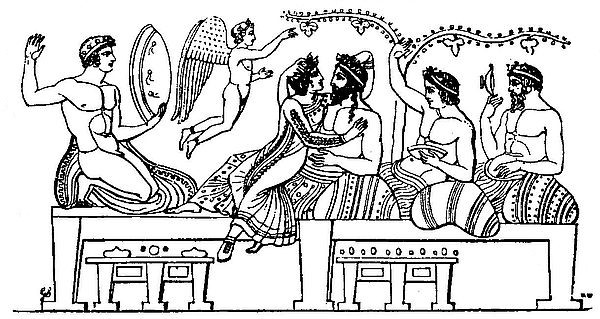
Symposium (From a Painting on a Vase.)
SYNDĬCUS (σύνδικος), an advocate, is frequently used as synonymous with the word synegorus (συνήγορος), to denote any one who pleads the cause of another, whether in a court of justice or elsewhere, but was peculiarly applied to those orators who were sent by the state to plead the cause of their countrymen before a foreign tribunal. Aeschines, for example, was appointed to plead before the Amphictyonic council on the subject of the Delian temple; but a certain discovery having been made, not very creditable to his patriotism, the court of Arciopagus took upon themselves to remove him, and appoint Hyperides in his stead. There were other syndici, who acted rather as magistrates or judges than as advocates, though they probably derived their name from the circumstance of their being appointed to protect the interests of the state. These were extraordinary functionaries, created from time to time to exercise a jurisdiction in disputes concerning confiscated property.
SỸNĔDRI (σύνεδροι), a name given to the members of any council, or any body of men who sat together to consult or deliberate. The congress of Greeks at Salamis is called συνέδριον. Frequent reference is made to the general assembly of the Greeks, τὸ κοινὸν τῶν Ἑλλήνων συνέδριον, at Corinth, Thermopylae, or elsewhere. The congress of the states belonging to the new Athenian alliance, formed after B.C. 377, was called συνέδριον, and the deputies σύνεδροι, and the sums furnished by the allies συντάξεις, in order to avoid the old and hateful name of φόρος or tribute. The name of συνέδριον was given at Athens to any magisterial or official body, as to the court of Areiopagus, or to the place where they transacted business, their board or council-room.
SỸNĒGŎRUS (συνήγορος). In causes of importance, wherein the state was materially interested, more especially in those which were brought before the court upon an εἰσαγγελία, it was usual to appoint public advocates (called συνήγοροι, σύνδικοι, or κατήγοροι) to manage the prosecution. In ordinary cases however the accuser or prosecutor (κατήγορος) was a distinct person from the συνήγορος, who acted only as auxiliary to him. It might be, indeed, that the συνήγορος performed the most important part at the trial, or it might be that he performed a subordinate part, making only a short speech in support of the prosecution, which was called ἐπίλογος. But however this might be, he was in point of law an auxiliary only, and was neither entitled to a share of the reward (if any) given by the law to a successful accuser, nor liable, on the other hand, to a penalty of a thousand drachms, or the ἀτιμία consequent upon a failure to get a fifth part of the votes. The fee of a drachm (τὸ συνηγορικόν) mentioned by Aristophanes was probably the sum paid to the public advocate whenever he was employed on behalf of the state. There appears to have been (at least at one period) a regular appointment of συνήγοροι, ten in number. For what purpose they were appointed, is a matter about which we have no certain information: but it is not unreasonable to suppose that these ten συνήγοροι were no other than the public advocates who were employed to conduct state prosecutions.
SYNGRĂPHĒ (συγγραφή), signifies a written contract: whereas συνθήκη and συμβόλαιον do not necessarily import that the contract is in writing; and ὁμολογία is, strictly speaking, a verbal agreement. At Athens important contracts were usually reduced to writing; such as leases (μισθώσεις), loans of money, and all executory agreements, where certain conditions were to be performed. The whole was contained in a little tablet of wax or wood (βιβλίον or γραμματεῖον, sometimes double, δίπτυχον), which was sealed, and deposited with some third person, mutually agreed on between the parties.
SỸNOIKĬA (συνοίκια).—(1) A festival celebrated every year at Athens on the 16th of Hecatombaeon in honour of Athena. It was believed to have been instituted by Theseus to commemorate the concentration of the government of the various towns of Attica at Athens.—(2) A house adapted to hold several families, a lodging-house, insula, as the Romans would say. The lodging-houses were let mostly to foreigners who came to Athens on business, and especially to the μέτοικοι, whom the law did not allow to acquire real property, and who therefore could not purchase houses of their own. The rent was commonly paid by the month. Lodging-houses were frequently taken on speculation by persons called ναύκληροι or σταθμοῦχοι, who made a profit by underletting them.
SYNTHĔSIS, a garment frequently worn at dinner, and sometimes also on other occasions. As it was inconvenient to wear the toga at table, on account of its many folds, it was customary to have dresses especially appropriated to this purpose, called vestes coenatoriae, or coenatoria, accubitoria, or syntheses. The synthesis appears to have been a kind of tunic, an indumentum rather than an amictus. [Amictus.] That it was, however, an easy and comfortable kind of dress, as we should say, seems to be evident from its use at table above mentioned, and also from its being worn by all classes at the Saturnalia, a season of universal relaxation and enjoyment. More than this respecting its form we cannot say; it was usually dyed with some colour, and was not white, like the toga.
SȲRINX (σύριγξ), the Pan’s pipe, or Pandean pipe, was the appropriate musical instrument of the Arcadian and other Grecian shepherds, and was regarded by them as the invention of Pan, their tutelary god. When the Roman poets had occasion to mention it, they called it fistula. It was formed in general of seven hollow stems of cane or reed, fitted together by means of wax, having been previously cut to the proper lengths, and adjusted so as to form an octave; but sometimes nine were admitted, giving an equal number of notes. A syrinx of eight reeds is represented on p. 278.
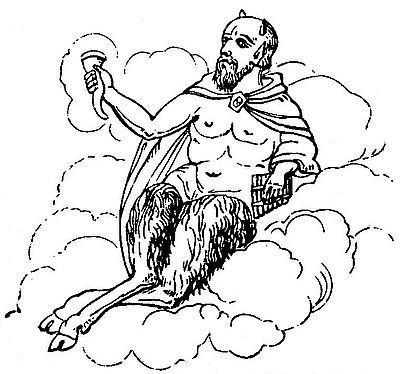
Pan with a Syrinx. (Mus. Worsleyanum, pl. 9.)
SYRMA (σύρμα), which properly means that which is drawn or dragged (from σύρω), is applied to a dress with a train. It was more especially the name of the dress worn by the tragic actors, which had a train to it trailing upon the ground. Hence we find syrma used metaphorically for tragedy itself.
SYSSĪTĬA (συσσίτια). The custom of taking the principal meal of the day in public prevailed extensively amongst the Greeks from very early ages, but more particularly in Crete and at Sparta. The Cretan name for the syssitia was Andreia (ἀνδρεῖα), the singular of which is used to denote the building or public hall where they were given. This title affords of itself a sufficient indication that they were confined to men and youths only. All the adult citizens partook of the public meals amongst the Cretans, and were divided into companies or “messes,” called hetaeriae (ἑταιρίαι), or sometimes andreia. The syssitia of the Cretans were distinguished by simplicity and temperance. They always sat at their tables, even in later times, when the custom of reclining had been introduced at Sparta. In most of the Cretan cities, the expenses of the syssitia were defrayed out of the revenues of the public lands, and the tribute paid by the perioeci, the money arising from which was applied partly to the service of the gods, and partly to the maintenance of all the citizens, both male and female; so that in this respect there might be no difference between the rich and the poor. The Spartan syssitia were in the main so similar to those of Crete, that one was said to be borrowed from the other. They differed from the Cretan in the following respects. The expenses of the tables at Sparta were not defrayed out of the public revenues, but every head of a family was obliged to contribute a certain portion at his own cost and charge; those who were not able to do so were excluded from the public tables. The guests were divided into companies, generally of fifteen persons each, and all vacancies were filled up by ballot, in which unanimous consent was indispensable for election. No persons, not even the kings, were excused from attendance at the public tables, except for some satisfactory reason, as when engaged in a sacrifice, or a chase, in which latter case the individual was required to send a present to his table. Each person was supplied with a cup of mixed wine, which was filled again when required: but drinking to excess was prohibited at Sparta as well as in Crete. The repast was of a plain and simple character, and the contribution of each member of a mess (φειδίτης) was settled by law. The principal dish was the black broth (μέλας ζωμός), with pork. Moreover, the entertainment was enlivened by cheerful conversation, though on public matters. Singing also was frequently introduced. The arrangements were under the superintendence of the polemarchs.