E
Reading edition
ECCLĒSĬA (ἐκκλησία), the name of the general assembly of the citizens at Athens, in which they met to discuss and determine upon matters of public interest, and which was therefore the sovereign power in the state. These assemblies were either ordinary (νόμιμοι or κυρίαι), and held four times in each prytany, or extraordinary, that is, specially convened, upon any sudden emergency, and therefore called σύγκλητοι. The place in which they were anciently held was the agora. Afterwards they were transferred to the Pnyx, and at last to the great theatre of Dionysus, and other places. The most usual place, however, was the Pnyx, which was situated to the west of the Areiopagus, on a slope connected with Mount Lycabettus, and partly at least within the walls of the city. It was semicircular in form, with a boundary wall part rock and part masonry, and an area of about 12,000 square yards. On the north the ground was filled up and paved with large stones, so as to get a level surface on the slope. Towards this side, and close to the wall, was the bema (βῆμα), a stone platform or hustings ten or eleven feet high, with an ascent of steps. The position of the bema was such as to command a view of the sea from behind, and of the Propylaea and Parthenon in front, and we may be sure that the Athenian orators would often rouse the national feelings of their hearers by pointing to the assemblage of magnificent edifices, “monuments of Athenian gratitude and glory,” which they had in view from the Pnyx.—The right of convening the people was generally vested in the prytanes or presidents of the council of Five Hundred [see Boulé], but in cases of sudden emergency, and especially during wars, the strategi also had the power of calling extraordinary meetings, for which, however, the consent of the senate appears to have been necessary. The prytanes not only gave a previous notice of the day of assembly, and published a programme of the subjects to be discussed, but also, it appears, sent a crier round to collect the citizens. All persons who did not obey the call were subject to a fine, and six magistrates called lexiarchs were appointed, whose duty it was to take care that the people attended the meetings, and to levy fines on those who refused to do so. With a view to this, whenever an assembly was to be held, certain public slaves (Σκύθαι or τοξόται) were sent round to sweep the agora, and other places of public resort, with a rope coloured with vermilion. The different persons whom these ropemen met, were driven by them towards the ecclesia, and those who refused to go were marked by the rope and fined. An additional inducement to attend, with the poorer classes, was the μισθὸς ἐκκλησιαστικός, or pay which they received for it. The payment was originally an obolus, but was afterwards raised to three. The right of attending was enjoyed by all legitimate citizens who were of the proper age (generally supposed to be twenty, certainly not less than eighteen), and not labouring under any atimia, or loss of civil rights.—In the article Boulé it is explained who the prytanes and the proedri were; and we may here remark, that it was the duty of the proedri of the same tribe, under the presidency of their chairman (ὁ ἐπιστάτης), to lay before the people the subjects to be discussed; to read, or cause to be read, the previous bill (τὸ προβούλευμα) of the senate, without which no measure could be brought before the ecclesia, and to give permission to the speakers to address the people. The officers who acted under them, were the crier (ὁ κήρυξ), and the Scythian bowmen.—Previous, however, to the commencement of any business, the place was purified by the offering of sacrifices, and then the gods were implored in a prayer to bless the proceedings of the meeting. The privilege of addressing the assembly was not confined to any class or age among those who had the right to be present: all, without any distinction, were invited to do so by the proclamation, Τίς ἀγορεύειν βούλεται, which was made by the crier after the proedri had gone through the necessary preliminaries, and laid the subject of discussion before the meeting; for though, according to the institutions of Solon, those persons who were above fifty years of age ought to have been called upon to speak first, this regulation had in later times become quite obsolete. The speakers are sometimes simply called οἱ παρίοντες, and appear to have worn a crown of myrtle on their heads while addressing the assembly. The most influential and practised speakers of the assembly were generally distinguished by the name of ῥήτορες. After the speakers had concluded, any one was at liberty to propose a decree, whether drawn up beforehand or framed in the meeting, which, however, it was necessary to present to the proedri, that they might see, in conjunction with the nomophylaces, whether there was contained in it anything injurious to the state, or contrary to the existing laws. If not, it was read by the crier; though, even after the reading, the chairman could prevent it being put to the vote, unless his opposition was overborne by threats and clamours. Private individuals also could do the same, by engaging upon oath (ὑπωμοσία) to bring against the author of any measure they might object to, an accusation called a γραφὴ παράνομων. If, however, the chairman refused to submit any question to the decision of the people, he might be proceeded against by endeixis; and if he allowed the people to vote upon a proposal which was contrary to existing constitutional laws, he was in some cases liable to atimia. If, on the contrary, no opposition of this sort was offered to a proposed decree, the votes of the people were taken, by the permission of the chairman and with the consent of the rest of the proedri. The decision of the people was given either by show of hands, or by ballot, i.e. by casting pebbles into urns (καδίσκοι); the former was expressed by the word χειροτονεῖν, the latter by ψηφίζεσθαι, although the two terms are frequently confounded. The more usual method of voting was by show of hands, as being more expeditious and convenient (χειροτονία). Vote by ballot, on the other hand, was only used in a few special cases determined by law; as, for instance, when a proposition was made for allowing those who had suffered atimia to appeal to the people for restitution of their former rights; or for inflicting extraordinary punishments on atrocious offenders, and generally, upon any matter which affected private persons. In cases of this sort it was settled by law, that a decree should not be valid unless six thousand citizens at least voted in favour of it. This was by far the majority of those citizens who were in the habit of attending; for, in time of war, the number never amounted to five thousand, and in time of peace seldom to ten thousand.—The determination or decree of the people was called a ψήφισμα, which properly signifies a law proposed to an assembly, and approved of by the people. Respecting the form for drawing up a ψήφισμα, see Boulé.—When the business was over, the order for the dismissal of the assembly was given by the prytanes, through the proclamation of the crier; and as it was not customary to continue meetings, which usually began early in the morning, till after sunset, if one day were not sufficient for the completion of any business, it was adjourned to the next. But an assembly was sometimes broken up, if any one, whether a magistrate or private individual, declared that he saw an unfavourable omen, or perceived thunder and lightning. The sudden appearance of rain also, or the shock of an earthquake, or any natural phenomenon of the kind called διοσημίαι, was a sufficient reason for the hasty adjournment of an assembly.
ECCLETI. [Homoei.]
ECDĬCUS (ἔκδικος), the name of an officer in many of the towns of Asia Minor during the Roman dominion, whose principal duty was the care of the public money, and the prosecution of all parties who owed money to the state.
ECMARTȲRĬA (ἐκμαρτυρία), signifies the deposition of a witness at Athens, who, by reason of absence abroad, or illness, was unable to attend in court. His statement was taken down in writing, in the presence of persons expressly appointed to receive it, and afterwards, upon their swearing to its identity, was read as evidence in the cause.
ĒDICTUM. The Jus Edicendi, or power of making edicts, belonged to the higher magistratus populi Romani, but it was principally exercised by the two praetors, the praetor urbanus, and the praetor peregrinus, whose jurisdiction was exercised in the provinces by the praeses. The curule aediles likewise made many edicts; and tribunes, censors, and pontifices also promulgated edicts relating to the matters of their respective jurisdictions. The edicta were among the sources of Roman law. The edictum may be described generally as a rule promulgated by a magistratus on entering on his office, which was done by writing it on an album and exhibiting it in a conspicuous place. As the office of a magistratus was annual, the rules promulgated by a predecessor were not binding on a successor, but he might confirm or adopt the rules of his predecessor, and introduce them into his own edict, and hence such adopted rules were called edictum ralatitium, or vetus, as opposed to edictum novum. A repentinum edictum was that rule which was made (prout res incidit) for the occasion. A perpetuum edictum was that rule which was made by the magistratus on entering upon office, and which was intended to apply to all cases to which it was applicable during the year of his office: hence it was sometimes called also annua lex. Until it became the practice for magistratus to adopt the edicta of their predecessors, the edicta could not form a body of permanent binding rules; but when this practice became common, the edicta (edictum tralatitium) soon constituted a large body of law, which was practically of as much importance as any other part of the law.
EICOSTĒ (εἰκοστή), a tax or duty of one-twentieth (five per cent.) upon all commodities exported or imported by sea in the states of the allies subject to Athens. This tax was first imposed B.C. 413, in the place of the direct tribute which had up to this time been paid by the subject allies; and the change was made with the hope of raising a greater revenue. This tax, like all others, was farmed, and the farmers of it were called εἰκοστολόγοι.
EIRĒN or ĪRĒN (εἴρην or ἴρην), the name given to the Spartan youth when he attained the age of twenty. At the age of eighteen he emerged from childhood, and was called μελλείρην. When he had attained his twentieth year, he began to exercise a direct influence over his juniors, and was entrusted with the command of troops in battle. The word appears to have originally signified a commander. The ἰρένες mentioned in Herodotus, in connection with the battle of Plataeae, were certainly not youths, but commanders.
EISANGĔLĬA (εἰσαγγελία), signifies, in its primary and most general sense, a denunciation of any kind, but, much more usually, an information laid before the council or the assembly of the people, and the consequent impeachment and trial of state criminals at Athens under novel or extraordinary circumstances. Among these were the occasions upon which manifest crimes were alleged to have been committed, and yet of such a nature as the existing laws had failed to anticipate, or at least describe specifically (ἄγραφα ἀδικήματα), the result of which omission would have been, but for the enactment by which the accusations in question might be preferred (νόμος εἰσαγγελτικός), that a prosecutor would not have known to what magistrate to apply; that a magistrate, if applied to, could not with safety have accepted the indictment or brought it into court; and that, in short, there would have been a total failure of justice.
EISITĒRĬA (εἰσιτήρια, scil. ἱερά), sacrifices offered at Athens by the senate before the session began, in honour of the Θεοὶ Βουλαῖοι, i.e. Zeus and Athena.
EISPHŎRA (εἰσφορά), an extraordinary tax on property, raised at Athens, whenever the means of the state were not sufficient to carry on a war. It is not quite certain when this property-tax was introduced; but it seems to have come first into general use about B.C. 428. It could never be raised without a decree of the people, who also assigned the amount required; and the strategi, or generals, superintended its collection, and presided in the courts where disputes connected with, or arising from, the levying of the tax were settled. The usual expressions for paying this property-tax are: εἰσφέρειν χρήματα, εἰσφέρειν εἰς τὸν πόλεμον, εἰς τὴν σωτηρίαν τῆς πόλεως, εἰσφορὰς εἰσφέρειν, and those who paid it were called οἱ εἰσφέροντες. The census of Solon was at first the standard according to which the eisphora was raised, until in B.C. 377 a new census was instituted, in which the people, for the purpose of fixing the rates of the property-tax, were divided into a number of symmoriae (συμμορίαι) or classes, similar to those which were afterwards made for the trierarchy. Each of the ten tribes or phylae, appointed 120 of its wealthier citizens; and the whole number of persons included in the symmoriae was thus 1200, who were considered as the representatives of the whole republic. This body of 1200 was divided into four classes, each consisting of 300. The first class, or the richest, were the leaders of the symmoriae (ἡγεμόνες συμμοριῶν), and are often called the three hundred. They probably conducted the proceedings of the symmoriae, and they, or, which is more likely, the demarchs, had to value the taxable property. Other officers were appointed to make out the lists of the rates, and were called ἐπιγραφεῖς, διαγραφεῖς or ἐκλογεῖς. When the wants of the state were pressing, the 300 leaders advanced the money to the others, who paid it back to the 300 at the regular time. The first class probably consisted of persons who possessed property from 12 talents upwards; the second class, of persons who possessed property from 6 talents and upwards, but under 12; the third class, of persons who possessed property from 2 talents upwards, but under 6; the fourth class, of persons who possessed property from 25 minae upwards, but under 2 talents. The rate of taxation was higher or lower according to the wants of the republic at the time; we have accounts of rates of a 12th, a 50th, a 100th, and a 500th part of the taxable property. If any one thought that his property was taxed higher than that of another man on whom juster claims could be made, he had the right to call upon this person to take the office in his stead, or to submit to a complete exchange of property. [Antidosis.] No Athenian, on the other hand, if belonging to the tax-paying classes, could be exempt from the eisphora, not even the descendants of Harmodius and Aristogeiton.
ĒLECTRUM (ἤλεκτρος and ἤλεκτρον), is used by the ancient writers in two different senses, either for amber or for a mixture of metals composed of gold and silver. In Homer and Hesiod, it has, in all probability, the former meaning. The earliest passage of any Greek writer, in which the word is certainly used for the metal, is in the Antigone of Sophocles (1038). This alludes to native electrum; but the compound was also made artificially. Pliny states that when gold contains a fifth part of silver, it is called electrum; that it is found in veins of gold; and that it is also made by art: if, he adds, it contains more than a fifth of silver, it becomes too brittle to be malleable. But Isidorus mentions electrum composed of three parts gold, and one of silver. Electrum was used for plate, and the other similar purposes for which gold and silver were employed. It was also used as a material for money. Lampridius tells us, that Alexander Severus struck coins of it; and coins are in existence, of this metal, struck by the kings of Bosporus, by Syracuse, and by other Greek states.
ĔLEUSĪNĬA (ἐλευσίνια), a festival and mysteries, originally celebrated only at Eleusis in Attica, in honour of Demeter and Persephone. The Eleusinian mysteries, or the mysteries, as they were sometimes called, were the holiest and most venerable of all that were celebrated in Greece. Various traditions were current among the Greeks respecting the author of these mysteries: for, while some considered Eumolpus or Musaeus to be their founder, others stated that they had been introduced from Egypt by Erechtheus, who at a time of scarcity provided his country with corn from Egypt, and imported from the same quarter the sacred rites and mysteries of Eleusis. A third tradition attributed the institution to Demeter herself, who, when wandering about in search of her daughter, Persephone, was believed to have come to Attica, in the reign of Erechtheus, to have supplied its inhabitants with corn, and to have instituted the mysteries at Eleusis. This last opinion seems to have been the most common among the ancients, and in subsequent times a stone was shown near the well Callichoros at Eleusis, on which the goddess, overwhelmed with grief and fatigue, was believed to have rested on her arrival in Attica. All the accounts and allusions in ancient writers seem to warrant the conclusion, that the legends concerning the introduction of the Eleusinia are descriptions of a period when the inhabitants of Attica were becoming acquainted with the benefits of agriculture, and of a regularly constituted form of society.—In the reign of Erechtheus a war is said to have broken out between the Athenians and Eleusinians; and when the latter were defeated, they acknowledged the supremacy of Athens in everything except the mysteries, which they wished to conduct and regulate for themselves. Thus the superintendence remained with the descendants of Eumolpus [Eumolpidae], the daughters of the Eleusinian king Celeus, and a third class of priests, the Ceryces, who seem likewise to have been connected with the family of Eumolpus, though they themselves traced their origin to Hermes and Aglauros.—At the time when the local governments of the several townships of Attica were concentrated at Athens, the capital became also the centre of religion, and several deities who had hitherto only enjoyed a local worship, were now raised to the rank of national gods. This seems also to have been the case with the Eleusinian goddess, for in the reign of Theseus we find mention of a temple at Athens, called Eleusinion, probably the new and national sanctuary of Demeter. Her priests and priestesses now became naturally attached to the national temple of the capital, though her original place of worship at Eleusis, with which so many sacred associations were connected, still retained its importance and its special share in the celebration of the national solemnities.—We must distinguish between the greater Eleusinia, which were celebrated at Athens and Eleusis, and the lesser, which were held at Agrae on the Ilissus. The lesser Eleusinia were only a preparation (προκάθαρσις or προάγνευσις) for the real mysteries. They were held every year in the month of Anthesterion, and, according to some accounts, in honour of Persephone alone. Those who were initiated in them bore the name of Mystae (μύσται), and had to wait at least another year before they could be admitted to the great mysteries. The principal rites of this first stage of initiation consisted in the sacrifice of a sow, which the mystae seem to have first washed in the Cantharus, and in the purification by a priest, who bore the name of Hydranos (Ὑδρανός). The mystae had also to take an oath of secrecy, which was administered to them by the Mystagogus (μυσταγωγός, also called ἱεροφάντης or προφήτης), and they received some kind of preparatory instruction, which enabled them afterwards to understand the mysteries which were revealed to them in the great Eleusinia.—The great mysteries were celebrated every year in the month of Boedromion, during nine days, from the 15th to the 23rd, both at Athens and Eleusis. The initiated were called ἐπόπται or ἔφυροι. On the first day, those who had been initiated in the lesser Eleusinia, assembled at Athens. On the second day the mystae went in solemn procession to the sea-coast, where they underwent a purification. Of the third day scarcely anything is known with certainty; we are only told that it was a day of fasting, and that in the evening a frugal meal was taken, which consisted of cakes made of sesame and honey. On the fourth day the καλάθος κάθοδος seems to have taken place. This was a procession with a basket containing pomegranates and poppy-seeds; it was carried on a waggon drawn by oxen, and women followed with small mystic cases in their hands. On the fifth day, which appears to have been called the torch day (ἡ τῶν λαμπάδων ἡμέρα), the mystae, led by the δᾳδοῦχος, went in the evening with torches to the temple of Demeter at Eleusis, where they seem to have remained during the following night. This rite was probably a symbolical representation of Demeter wandering about in search of Persephone. The sixth day, called Iacchos, was the most solemn of all. The statue of Iacchos, son of Demeter, adorned with a garland of myrtle and bearing a torch in his hand, was carried along the sacred road amidst joyous shouts and songs, from the Cerameicus to Eleusis. This solemn procession was accompanied by great numbers of followers and spectators. During the night from the sixth to the seventh day the mystae remained at Eleusis, and were initiated into the last mysteries (ἐποπτεία). Those who were neither ἐπόπται nor μύσται were sent away by a herald. The mystae now repeated the oath of secrecy which had been administered to them at the lesser Eleusinia, underwent a new purification, and then they were led by the mystagogus in the darkness of night into the lighted interior of the sanctuary (φωταγωγία), and were allowed to see (αὐτοψία) what none except the epoptae ever beheld. The awful and horrible manner in which the initiation is described by later, especially Christian writers, seems partly to proceed from their ignorance of its real character, partly from their horror of and aversion to these pagan rites. The more ancient writers always abstained from entering upon any description of the subject. Each individual, after his initiation, is said to have been dismissed by the words κόγξ, ὄμπαξ, in order to make room for other mystae. On the seventh day the initiated returned to Athens amid various kinds of raillery and jests, especially at the bridge over the Cephisus, where they sat down to rest, and poured forth their ridicule on those who passed by. Hence the words γεφυρίζειν and γεφυρισμός. These σκώμματα seem, like the procession with torches to Eleusis, to have been dramatical and symbolical representations of the jests by which, according to the ancient legend, Iambe or Baubo had dispelled the grief of the goddess and made her smile. We may here observe, that probably the whole history of Demeter and Persephone was in some way or other symbolically represented at the Eleusinia. The eighth day, called Epidauria (Ἐπιδαύρια), was a kind of additional day for those who by some accident had come too late, or had been prevented from being initiated on the sixth day. It was said to have been added to the original number of days, when Asclepius, coming over from Epidaurus to be initiated, arrived too late, and the Athenians, not to disappoint the god, added an eighth day. The ninth and last day bore the name of πλημοχοαί, from a peculiar kind of vessel called πλημοχοή, which is described as a small kind of κότυλος. Two of these vessels were on this day filled with water or wine, and the contents of the one thrown to the east, and those of the other to the west, while those who performed this rite uttered some mystical words.—The Eleusinian mysteries long survived the independence of Greece. Attempts to suppress them were made by the emperor Valentinian, but he met with strong opposition, and they seem to have continued down to the time of the elder Theodosius. Respecting the secret doctrines which were revealed in them to the initiated, nothing certain is known. The general belief of the ancients was, that they opened to man a comforting prospect of a future state. But this feature does not seem to have been originally connected with these mysteries, and was probably added to them at the period which followed the opening of a regular intercourse between Greece and Egypt, when some of the speculative doctrines of the latter country, and of the East, may have been introduced into the mysteries, and hallowed by the names of the venerable bards of the mythical age. This supposition would also account, in some measure, for the legend of their introduction from Egypt. In modern times many attempts have been made to discover the nature of the mysteries revealed to the initiated, but the results have been as various and as fanciful as might be expected. The most sober and probable view is that, according to which, “they were the remains of a worship which preceded the rise of the Hellenic mythology and its attendant rites, grounded on a view of nature, less fanciful, more earnest, and better fitted to awaken both philosophical thought and religious feeling.”
ĔLEUTHĔRĬA (ἐλευθέρια), the feast of liberty, a festival which the Greeks, after the battle of Plataeae (479 B.C.), instituted in honour of Zeus Eleutherios (the deliverer). It was intended not merely to be a token of their gratitude to the god to whom they believed themselves to be indebted for their victory over the barbarians, but also as a bond of union among themselves; for, in an assembly of all the Greeks, Aristeides carried a decree that delegates (πρόβουλοι καὶ θεωροί) from all the Greek states should assemble every year at Plataeae for the celebration of the Eleutheria. The town itself was at the same time declared sacred and inviolable, as long as its citizens offered the annual sacrifices which were then instituted on behalf of Greece. Every fifth year these solemnities were celebrated with contests, in which the victors were rewarded with chaplets.
ELLŌTĬA or HELLŌTĬA (ἐλλώτια or ἑλλώτια), a festival with a torch race celebrated at Corinth in honour of Athena as a goddess of fire.
ĒMANCĬPĀTĬO, was an act by which the patria potestas was dissolved in the lifetime of the parent, and it was so called because it was in the form of a sale (mancipatio). By the laws of the Twelve Tables it was necessary that a son should be sold three times in order to be released from the paternal power, or to be sui juris. In the case of daughters and grandchildren, one sale was sufficient. The father transferred the son by the form of a sale to another person, who manumitted him, upon which he returned into the power of the father. This was repeated, and with the like result. After a third sale, the paternal power was extinguished, but the son was re-sold to the parent, who then manumitted him, and so acquired the rights of a patron over his emancipated son, which would otherwise have belonged to the purchaser who gave him his final manumission.
EMBAS (ἐμβάς), a shoe worn by men, and which appears to have been the most common kind of shoe worn at Athens. Pollux says that it was invented by the Thracians, and that it was like the low cothurnus. The embas was also worn by the Boeotians, and probably in other parts of Greece.
EMBĂTEIA (ἐμβατεία). In Attic law this word (like the corresponding English one, entry), was used to denote a formal taking possession of real property. Thus, when a son entered upon the land left him by his father, he was said ἐμβατεύειν or βαδίζειν εἰς τὰ πατρῳα, and thereupon he became seised, or possessed of his inheritance. If any one disturbed him in the enjoyment of this property, with an intention to dispute the title, he might maintain an action of ejectment, ἐξούλης δίκη. Before entry he could not maintain such action.
EMBLĒMA (ἔμβλημα, ἔμπαισμα), an inlaid ornament. The art of inlaying was employed in producing beautiful works of two descriptions, viz.;—1st, those which resembled our marquetry, buhl, and Florentine mosaics; and 2dly, those in which crusts (crustae), exquisitely wrought in bas-relief and of precious materials, were fastened upon the surface of vessels or other pieces of furniture. To the latter class of productions belonged the cups and plates which Verres obtained by violence from the Sicilians, and from which he removed the emblems for the purpose of having them set in gold instead of silver.
ĒMĔRĬTI, the name given to those Roman soldiers who had served out their time, and had exemption (vacatio) from military service. The usual time of service was twenty years for the legionary soldiers, and sixteen for the praetorians. At the end of their period of service they received a bounty or reward (emeritum), either in lands or money, or in both.
ĒMISSĀRĬUM (ὑπόνομος), a channel, natural or artificial, by which an outlet is formed to carry off any stagnant body of water. Such channels may be either open or underground; but the most remarkable works of the kind are of the latter description, as they carry off the waters of lakes surrounded by hills. In Greece, the most striking example is presented by the subterraneous channels which carry off the waters of the lake Copais in Boeotia, which were partly natural and partly artificial. Some works of this kind are among the most remarkable efforts of Roman ingenuity. Remains still exist to show that the lakes Trasimene, Albano, Nemi, and Fucino, were all drained by means of emissaria, the last of which is still nearly perfect, and open to inspection, having been partially cleared by the present king of Naples. Julius Caesar is said to have first conceived the idea of this stupendous undertaking, which was carried into effect by the Emperor Claudius.
EMMĒNI DĬKAE (ἔμμηνοι δίκαι), suits in the Athenian courts, which were not allowed to be pending above a month. This regulation was confined to those subjects which required a speedy decision; and of these the most important were disputes respecting commerce (ἐμπορικαὶ δίκαι). All causes relating to mines (μεταλλικαὶ δίκαι) were also ἔμμηνοι δίκαι, as well as those relating to ἔρανοι. [Erani.]
EMPŎRĬUM (τὸ ἐμπόριον), a place for wholesale trade in commodities carried by sea. The name is sometimes applied to a sea-port town, but it properly signifies only a particular place in such a town. The word is derived from ἔμπορος, which signifies in Homer a person who sails as a passenger in a ship belonging to another person; but in later writers it signifies the merchant or wholesale dealer, and differs from κάπηλος, the retail dealer. The emporium at Athens was under the inspection of certain officers, who were elected annually (ἐπιμεληταὶ τοῦ ἐμπορίου).
ENCAUSTĬCA. [Pictura.]
ENCTĒSIS (ἔγκτησις), the right of possessing landed property and houses (ἔγκτησις γῆς καὶ οἰκίας) in a foreign country, which was frequently granted by one Greek state to another, or to separate individuals of another state. Ἐγκτήματα were such possessions in a foreign country, or in a different δῆμος from that to which an Athenian belonged by birth.
ENDEIXIS (ἔνδειξις), properly denotes a prosecution instituted against such persons as were alleged to have exercised rights or held offices while labouring under a peculiar disqualification. The same form of action was available against the chairman of the proedri (ἐπιστάτης), who wrongly refused to take the votes of the people in the assembly; against malefactors, especially murderers; traitors, ambassadors accused of malversation, and persons who furnished supplies to the enemy during war. The first step taken by the prosecutor was to lay his information in writing, also called endeixis, before the proper magistrate, who then arrested, or held to bail, the person criminated, and took the usual steps for bringing him to trial. There is great obscurity with respect to the punishment which followed condemnation. The accuser, if unsuccessful, was responsible for bringing a malicious charge (ψευδοῦς ἐνδείξεως ὑπεύθυνος).
ENDRŎMIS (ἐνδρομίς), a thick, coarse blanket, manufactured in Gaul, and called “endromis” because those who had been exercising in the stadium (ἐν δρόμῳ) threw it over them to obviate the effects of sudden exposure when they were heated. Notwithstanding its coarse and shaggy appearance, it was worn on other occasions as a protection from the cold by rich and fashionable persons at Rome.
ENSIS. [Gladius.]
ENTĂSIS (ἔντασις). The most ancient columns now existing, diminish immediately and regularly from the base to the neck, so that the edge forms a straight line—a mode of construction which is wanting in grace and apparent solidity. To correct this, a swelling outline, called entasis, was given to the shaft, which seems to have been the first step towards combining grace and grandeur in the Doric column.
EPANGĔLĬA (ἐπαγγελία). If a citizen of Athens had incurred atimia, the privilege of taking part or speaking in the public assembly was forfeited. But as it sometimes might happen that a person, though not formally declared atimus, had committed such crimes as would, on accusation, draw upon him this punishment, it was of course desirable that such individuals, like real atimi, should be excluded from the exercise of the rights of citizens. Whenever, therefore, such a person ventured to speak in the assembly, any Athenian citizen had the right to come forward in the assembly itself and demand of him to establish his right to speak by a trial or examination of his conduct (δοκιμασία τοῦ βίου), and this demand, denouncement, or threat, was called epangelia, or epangelia docimasias (ἐπαγγελία δοκιμασίας). The impeached individual was then compelled to desist from speaking, and to submit to a scrutiny into his conduct, and, if he was convicted, a formal declaration of atimia followed.
EPARITI (ἐπάριτοι), the name of the standing army in Arcadia, which was formed to preserve the independence of the Arcadian towns, when they became united as one state after the defeat of the Spartans at Leuctra. They were 5000 in number, and were paid by the state.
EPHĒBUS (ἔφηβος), the name of Athenian youths after they had attained the age of 18. The state of ephebeia (ἐφηβεία) lasted for two years, till the youths had attained the age of 20, when they became men, and were admitted to share all the rights and duties of citizens, for which the law did not prescribe a more advanced age. Before a youth was enrolled among the ephebi, he had to undergo a docimasia (δοκιμασία), the object of which was partly to ascertain whether he was the son of Athenian citizens, or adopted by a citizen, and partly whether his body was sufficiently developed and strong to undertake the duties which now devolved upon him. After the docimasia the young men received in the assembly a shield and a lance; but those whose fathers had fallen in the defence of their country received a complete suit of armour in the theatre. It seems to have been on this occasion that the ephebi took an oath in the temple of Artemis Aglauros, by which they pledged themselves never to disgrace their arms or to desert their comrades; to fight to the last in the defence of their country, its altars and hearths; to leave their country not in a worse but in a better state than they found it; to obey the magistrates and the laws; to resist all attempts to subvert the institutions of Attica; and finally, to respect the religion of their forefathers. This solemnity took place towards the close of the year, and the festive season bore the name of ephebia (ἐφήβια). The external distinction of the ephebi consisted in the chlamys and the petasus. During the two years of the ephebeia, which may be considered as a kind of apprenticeship in arms, and in which the young men prepared themselves for the higher duties of full citizens, they were generally sent into the country, under the name of peripoli (περίπολοι), to keep watch in the towns and fortresses, on the coast and frontier, and to perform other duties which might be necessary for the protection of Attica.
ĔPHĒGĒSIS (ἐφήγησις), denotes the method of proceeding against such criminals as were liable to be summarily arrested by a private citizen [Apagoge] when the prosecutor was unwilling to expose himself to personal risk in apprehending the offender. Under these circumstances he made an application to the proper magistrate, and conducted him and his officers to the spot where the capture was to be effected.
ĔPHĔTAE (ἐφέται), the name of certain judges at Athens, who tried cases of homicide. They were fifty-one in number, selected from noble families, and more than fifty years of age. They formed a tribunal of great antiquity, and were in existence before the legislation of Solon, but, as the state became more and more democratical, their duties became unimportant and almost antiquated. The Ephetae once sat in one or other of the five courts, according to the nature of the causes they had to try. In historical times, however, they sat in four only, called respectively the court by the Palladium (τὸ ἐπὶ Παλλαδίῳ), by the Delphinium (τὸ ἐπὶ Δελφινίῳ), by the Prytaneium (τὸ ἐπὶ Πρυτανείῳ), and the court at Phreatto or Zea (τὸ ἐν Φρεαττοῖ). At the first of these courts they tried cases of unintentional, at the second, of intentional but justifiable homicide. At the Prytaneium, by a strange custom, somewhat analogous to the imposition of a deodand, they passed sentence upon the instrument of murder when the perpetrator of the act was not known. In the court at Phreatto, on the sea shore at the Peiraeeus, they tried such persons as were charged with wilful murder during a temporary exile for unintentional homicide.
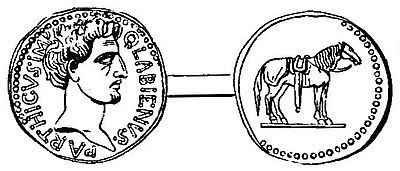
Ephippium, Saddle. (Coin of Labienus.)
ĔPHIPPĬUM (ἀστράβη, ἐφίππιον, ἐφίππειον), a saddle. Although the Greeks occasionally rode without any saddle, yet they commonly used one, and from them the name, together with the thing, was borrowed by the Romans. The ancient saddles appear, indeed, to have been thus far different from ours, that the cover stretched upon the hard frame was probably of stuffed or padded cloth rather than leather, and that the saddle was, as it were, a cushion fitted to the horse’s back. Pendent cloths ( στρώματα, strata) were always attached to it so as to cover the sides of the animal; but it was not provided with stirrups. The saddle with the pendent cloths is exhibited in the annexed coin. The term “Ephippium” was in later times in part supplanted by the word “sella,” and the more specific expression “sella equestris.”
ĔPHŎRI (ἔφοροι). Magistrates called Ephori or overseers were common to many Dorian constitutions in times of remote antiquity; but the Ephori of Sparta are the most celebrated of them all. The origin of the Spartan ephori is quite uncertain, but their office in the historical times was a kind of counterpoise to the kings and council, and in that respect peculiar to Sparta alone of the Dorian states. Their number, five, appears to have been always the same, and was probably connected with the five divisions of the town of Sparta, namely, the four κῶμαι, Limnae, Mesoa, Pitana, Cynosura, and the Πόλις or city properly so called, around which the κῶμαι lay. They were elected from and by the people, without any qualification of age or property, and without undergoing any scrutiny; so that the people enjoyed through them a participation in the highest magistracy of the state. They entered upon office at the autumnal solstice, and the first in rank of the five gave his name to the year, which was called after him in all civil transactions. They possessed judicial authority in civil suits, and also a general superintendence over the morals and domestic economy of the nation, which in the hands of able men would soon prove an instrument of unlimited power. Their jurisdiction and power were still further increased by the privilege of instituting scrutinies (εὔθυναι) into the conduct of all the magistrates. Even the kings themselves could be brought before their tribunal (as Cleomenes was for bribery). In extreme cases, the ephors were also competent to lay an accusation against the kings as well as the other magistrates, and bring them to a capital trial before the great court of justice. In later times the power of the ephors was greatly increased; and this increase appears to have been principally owing to the fact, that they put themselves in connection with the assembly of the people, convened its meetings, laid measures before it, and were constituted its agents and representatives. When this connection arose is matter of conjecture. The power which such a connection gave would, more than anything else, enable them to encroach on the royal authority, and make themselves virtually supreme in the state. Accordingly, we find that they transacted business with foreign ambassadors; dismissed them from the state; decided upon the government of dependent cities; subscribed in the presence of other persons to treaties of peace; and in time of war sent out troops when they thought necessary. In all these capacities the ephors acted as the representatives of the nation, and the agents of the public assembly, being in fact the executive of the state. In course of time the kings became completely under their control. For example, they fined Agesilaus on the vague charge of trying to make himself popular, and interfered even with the domestic arrangements of other kings. In the field the kings were followed by two ephors, who belonged to the council of war; the three who remained at home received the booty in charge, and paid it into the treasury, which was under the superintendence of the whole College of Five. But the ephors had still another prerogative, based on a religious foundation, which enabled them to effect a temporary deposition of the kings. Once in eight years, as we are told, they chose a calm and cloudless night to observe the heavens, and if there was any appearance of a falling meteor, it was believed to be a sign that the gods were displeased with the kings, who were accordingly suspended from their functions until an oracle allowed of their restoration. The outward symbols of supreme authority also were assumed by the ephors; and they alone kept their seats while the kings passed; whereas it was not considered below the dignity of the kings to rise in honour of the ephors. When Agis and Cleomenes undertook to restore the old constitution, it was necessary for them to overthrow the ephoralty, and accordingly Cleomenes murdered the ephors for the time being, and abolished the office (B.C. 225); it was, however, restored under the Romans.
ĔPĬBĂTAE (ἐπιβάται), were soldiers or marines appointed to defend the vessels in the Athenian navy, and were entirely distinct from the rowers, and also from the land soldiers, such as hoplitae, peltasts, and cavalry. It appears that the ordinary number of epibatae on board a trireme was ten. The epibatae were usually taken from the thetes, or fourth class of Athenian citizens. The term is sometimes also applied by the Roman writers to the marines, but they are more usually called classiarii milites. The latter term, however, is also applied to the rowers or sailors as well as the marines.
ĔPĬBŎLĒ (ἐπιβολή), a fine imposed by a magistrate, or other official person or body, for a misdemeanour. The various magistrates at Athens had (each in his own department) a summary penal jurisdiction; i.e. for certain offences they might inflict a pecuniary mulct or fine, not exceeding a fixed amount; if the offender deserved further punishment, it was their duty to bring him before a judicial tribunal. These epibolae are to be distinguished from the penalties awarded by a jury or court of law (τιμήματα) upon a formal prosecution.
ĔPĬCLĒRUS (ἐπίκληρος, heiress), the name given to the daughter of an Athenian citizen, who had no son to inherit his estate. It was deemed an object of importance at Athens to preserve the family name and property of every citizen. This was effected, where a man had no child, by adoption (εἰσποίησις); if he had a daughter, the inheritance was transmitted through her to a grandson, who would take the name of the maternal ancestor. If the father died intestate, the heiress had not the choice of a husband, but was bound to marry her nearest relation, not in the ascending line. When there was but one daughter, she was called ἐπίκληρος ἐπὶ παντὶ τῷ οἴκῳ. If there were more, they inherited equally, like our co-parceners; and were severally married to relatives, the nearest having the first choice.
ĔPĬDŎSEIS (ἐπιδόσεις), voluntary contributions, either in money, arms, or ships, which were made by the Athenian citizens in order to meet the extraordinary demands of the state. When the expenses of the state were greater than its revenue, it was usual for the prytaneis to summon an assembly of the people, and after explaining the necessities of the state, to call upon the citizens to contribute according to their means. Those who were willing to contribute then rose and mentioned what they would give; while those who were unwilling to give any thing remained silent, or retired privately from the assembly.
ĔPĬMĔLĒTAE (ἐπιμεληταί), the names of various magistrates and functionaries at Athens.—(1) Ἐπιμελητὴς τῆς κοινῆς προσόδου, more usually called ταμίας, the treasurer or manager of the public revenue. [Tamias.]—(2) Ἐπιμεληταὶ τῶν μοριῶν Ἐλαιῶν, were persons chosen from among the Areopagites to take care of the sacred olive trees.—(3) Ἐπιμεληταὶ τοῦ Ἐμπορίου, were the overseers of the emporium. [Emporium.] They were ten in number, and were elected yearly by lot. They had the entire management of the emporium, and had jurisdiction in all breaches of the commercial laws.—(4) Ἐπιμεληταὶ τῶν Μυστηρίων, were, in connection with the king archon, the managers of the Eleusinian mysteries. They were elected by open vote, and were four in number.—(5) Ἐπιμεληταὶ τῶν νεωρίων, the inspectors of the dockyards, were ten in number.—(6) Ἐπιμεληταὶ τῶν φυλῶν, the inspectors of the φυλαὶ or tribes. [Tribus.]
ĔPISCŎPI (ἐπίσκοποι), inspectors, who were sometimes sent by the Athenians to subject states. They were also called φύλακες. It appears that these Episcopi received a salary at the cost of the cities over which they presided.
ĔPISTĂTĒS (ἐπιστάτης).—(1) The chairman of the senate and assembly of the people, respecting whose duties see Boulé and Ecclesia.—(2) The name of the directors of the public works. (Ἐπισταταὶ τῶν δημοσίων ἔργων).
ĔPISTŎLEUS (ἐπιστολεύς), the officer second in rank in the Spartan fleet, who succeeded to the command if any thing happened to the navarchus (ναυάρχος) or admiral. When the Chians and the other allies of Sparta on the Asiatic coast sent to Sparta to request that Lysander might be again appointed to the command of the navy, he was sent with the title of epistoleus, because the laws of Sparta did not permit the same person to hold the office of navarchus twice.
ĔPISTȲLĬUM (ἐπιστύλιον), properly, as the name implies, the architrave, or lower member of an entablature, which lies immediately over the columns. The word is sometimes also used for the whole of the entablature.
ĔPĬTRŎPUS (ἐπίτροπος), the name at Athens of a guardian of orphan children. Of such guardians there were at Athens three kinds: first, those appointed in the will of the deceased father; secondly, the next of kin, whom the law designated as tutores legitimi in default of such appointment, and who required the authorization of the archon to enable them to act; and lastly, such persons as the archon selected if there were no next of kin living to undertake the office. The duties of the guardian comprehended the education, maintenance, and protection of the ward, the assertion of his rights, and the safe custody and profitable disposition of his inheritance during his minority, besides making a proper provision for the widow if she remained in the house of her late husband.
ĔPŌBĔLIA (ἐπωβελία), as its etymology implies, at the rate of one obolus for a drachma, or one in six, was payable on the assessment (τίμημα) of several private causes, and sometimes in a case of phasis, by the litigant that failed to obtain the votes of one-fifth of the dicasts.
ĔPŌNỸMUS. [Archon.]
ĔPOPTAE (ἐπόπται). [Eleusinia.]
ĔPŬLŌNES, who were originally three in number (triumviri epulones), were first created in B.C. 196, to attend to the Epulum Jovis, and the banquets given in honour of the other gods; which duty had originally belonged to the pontifices. Their number was afterwards increased to seven, and they were called septemviri epulones or septemviri epulonum. The epulones formed a collegium, and were one of the four great religious corporations at Rome; the other three were those of the Pontifices, Augures, and Quindecemviri.
ĔPŬLUM JŎVIS. [Epulones.]
ĔQUĪRĬA, horse-races, which are said to have been instituted by Romulus in honour of Mars, and were celebrated in the Campus Martius. There were two festivals of this name; of which one was celebrated A.D. III. Cal. Mart., and the other prid. Id. Mart.
ĔQUĬTES, horsemen. Romulus is said to have formed three centuries of equites; and these were the same as the 300 Celeres, whom he kept about his person in peace and war. A century was taken from each of the three tribes, the Ramnes, Titienses, and Luceres. Tarquinius Priscus added three more, under the title of Ramnes, Titienses, and Luceres posteriores. These were the six patrician centuries of equites, often referred to under the name of the sex suffragia. To these Servius Tullius added twelve more centuries, for admission into which, property and not birth was the qualification. These twelve centuries might therefore contain plebeians, but they do not appear to have been restricted to plebeians, since we have no reason for believing that the six old centuries contained the whole body of patricians. A property qualification was apparently also necessary by the Servian constitution for admission into the six centuries. We may therefore suppose that those patricians who were included in the six old centuries were allowed by the Servian constitution to continue in them, if they possessed the requisite property; and that all other persons in the state, whether patricians or plebeians, who possessed the requisite property, were admitted into the twelve new centuries. We are not told the amount of property necessary to entitle a person to a place among the equites, but it was probably the same as in the latter times of the republic, that is, four times that of the first class. [Comitia, p. 105.] Property, however, was not the only qualification; for in the ancient times of the republic no one was admitted among the equestrian centuries unless his character was unblemished, and his father and grandfather had been born freemen. Each of the equites received a horse from the state (equus publicus), or money to purchase one, as well as a sum of money for its annual support; the expense of its support was defrayed by the orphans and unmarried females; since, in a military state, it could not be esteemed unjust, that the women and the children were to contribute largely for those who fought in behalf of them and of the commonwealth. The purchase-money for a knight’s horse was called aes equestre, and its annual provision aes hordearium. The former amounted, according to Livy, to 10,000 asses, and the latter to 2000.—All the equites, of whom we have been speaking, received a horse from the state, and were included in the 18 equestrian centuries of the Servian constitution; but in course of time, we read of another class of equites in Roman history, who did not receive a horse from the state, and who were not included in the 18 centuries. This latter class is first mentioned by Livy, in his account of the siege of Veii, B.C. 403. He says that during the siege, when the Romans had at one time suffered great disasters, all those citizens who had an equestrian fortune, and no horse allotted to them, volunteered to serve with their own horses; and he adds, that from this time equites first began to serve with their own horses. The state paid them, as a kind of compensation for serving with their own horses. The foot soldiers had received pay a few years before; and two years afterwards, B.C. 401, the pay of the equites was made three-fold that of the infantry. From the year B.C. 403, there were therefore two classes of Roman knights: one who received horses from the state, and are therefore frequently called equites equo publico, and sometimes Flexumines or Trossuli, and another class, who served, when they were required, with their own horses, but were not classed among the 18 centuries. As they served on horseback they were called equites; and when spoken of in opposition to cavalry, which did not consist of Roman citizens, they were also called equites Romani; but they had no legal claim to the name of equites, since in ancient times this title was strictly confined to those who received horses from the state.—The reason of this distinction of two classes arose from the fact, that the number of equites in the 18 centuries was fixed from the time of Servius Tullius. As vacancies occurred in them, the descendants of those who were originally enrolled succeeded to their places, provided they had not dissipated their property. But in course of time, as population and wealth increased, the number of persons who possessed an equestrian fortune, also increased greatly; and as the ancestors of these persons had not been enrolled in the 18 centuries, they could not receive horses from the state, and were therefore allowed the privilege of serving with their own horses among the cavalry, instead of the infantry, as they would otherwise have been obliged to have done.—The inspection of the equites who received horses from the state belonged to the censors, who had the power of depriving an eques of his horse, and reducing him to the condition of an aerarian, and also of giving the vacant horse to the most distinguished of the equites who had previously served at their own expense. For these purposes they made during their censorship a public inspection, in the forum, of all the knights who possessed public horses (equitatum recognoscere). The tribes were taken in order, and each knight was summoned by name. Every one, as his name was called, walked past the censors, leading his horse. If the censors had no fault to find either with the character of the knight or the equipments of his horse, they ordered him to pass on (traducere equum); but if on the contrary they considered him unworthy of his rank, they struck him out of the list of knights, and deprived him of his horse, or ordered him to sell it, with the intention no doubt that the person thus degraded should refund to the state the money which had been advanced to him for its purchase.—This review of the equites by the censors must not be confounded with the Equitum Transvectio, which was a solemn procession of the body every year on the Ides of Quintilis (July). The procession started from the temple of Mars outside the city, and passed through the city over the forum, and by the temple of the Dioscuri. On this occasion the equites were always crowned with olive chaplets, and wore their state dress, the trabea, with all the honourable distinctions which they had gained in battle. According to Livy, this annual procession was first established by the censors Q. Fabius and P. Decius, B.C. 304; but according to Dionysius it was instituted after the defeat of the Latins near the lake Regillus, of which an account was brought to Rome by the Dioscuri.—It may be asked how long did the knight retain his public horse, and a vote in the equestrian century to which he belonged? On this subject we have no positive information; but as those equites, who served with their own horses, were only obliged to serve for ten years (stipendia) under the age of 46, we may presume that the same rule extended to those who served with the public horses, provided they wished to give up the service. For it is certain that in the ancient times of the republic a knight might retain his horse as long as he pleased, even after he had entered the senate, provided he continued able to discharge the duties of a knight. Thus the two censors, M. Livius Salinator and C. Claudius Nero, in B.C. 204, were also equites, and L. Scipio Asiaticus, who was deprived of his horse by the censors in B.C. 185, had himself been censor in B.C. 191. But during the later times of the republic the knights were obliged to give up their horses on entering the senate, and consequently ceased to belong to the equestrian centuries. It thus naturally came to pass, that the greater number of the equites equo publico, after the exclusion of senators from the equestrian centuries, were young men.—The equestrian centuries, of which we have hitherto been treating, were only regarded as a division of the army: they did not form a distinct class or ordo in the constitution. The community, in a political point of view, was divided only into patricians and plebeians, and the equestrian centuries were composed of both. But in the year B.C. 123, a new class, called the Ordo Equestris, was formed in the state by the Lex Sempronia, which was introduced by C. Gracchus. By this law, or one passed a few years afterwards, every person who was to be chosen judex was required to be above 30 and under 60 years of age, to have either an equus publicus, or to be qualified by his fortune to possess one, and not to be a senator. The number of judices, who were required yearly, was chosen from this class by the praetor urbanus. As the name of equites had been originally extended from those who possessed the public horses to those who served with their own horses, it now came to be applied to all those persons who were qualified by their fortune to act as judices, in which sense the word is usually used by Cicero. After the reform of Sulla, which entirely deprived the equestrian order of the right of being chosen as judices, and the passing of the Lex Aurelia (B.C. 70), which ordained that the judices should be chosen from the senators, equites, and tribuni aerarii, the influence of the order, says Pliny, was still maintained by the publicani, or farmers of the public taxes. We find that the publicani were almost always called equites, not because any particular rank was necessary in order to obtain from the state the farming of the taxes, but because the state was not accustomed to let them to any one who did not possess a considerable fortune. Thus the publicani are frequently spoken of by Cicero as identical with the equestrian order. The consulship of Cicero, and the active part which the knights then took in suppressing the conspiracy of Catiline, tended still further to increase the power and influence of the equestrian order; and “from that time,” says Pliny, “it became a third body (corpus) in the state, and, to the title of Senatus Populusque Romanus, there began to be added Et Equestris Ordo.” In B.C. 63, a distinction was conferred upon them, which tended to separate them still further from the plebs. By the Lex Roscia Othonis, passed in that year, the first fourteen seats in the theatre behind the orchestra were given to the equites. They also possessed the right of wearing the Clavus Angustus [Clavus], and subsequently obtained the privilege of wearing a gold ring, which was originally confined to the equites equo publico. The number of equites increased greatly under the early emperors, and all persons were admitted into the order, provided they possessed the requisite property, without any inquiry into their character, or into the free birth of their father and grandfather. The order in consequence gradually began to lose all the consideration which it had acquired during the later times of the republic.—Augustus formed a select class of equites, consisting of those equites who possessed the property of a senator, and the old requirement of free birth up to the grandfather. He permitted this class to wear the latus clavus; and also allowed the tribunes of the plebs to be chosen from them, as well as the senators, and gave them the option, at the termination of their office, to remain in the senate or return to the equestrian order. This class of knights was distinguished by the special title illustres (sometimes insignes and splendidi) equites Romani. The formation of this distinct class tended to lower the others still more in public estimation. In the ninth year of the reign of Tiberius, an attempt was made to improve the order by requiring the old qualifications of free birth up to the grandfather, and by strictly forbidding any one to wear the gold ring unless he possessed this qualification. This regulation, however, was of little avail, as the emperors frequently admitted freedmen into the equestrian order. When private persons were no longer appointed judices, the necessity for a distinct class in the community, like the equestrian order, ceased entirely; and the gold ring came at length to be worn by all free citizens. Even slaves, after their manumission, were allowed to wear it by special permission from the emperor, which appears to have been usually granted provided the patronus consented.—Having thus traced the history of the equestrian order to its final extinction as a distinct class in the community, we must now return to the equites equo publico, who formed the 18 equestrian centuries. This class still existed during the latter years of the republic, but had entirely ceased to serve as horse-soldiers in the army. The cavalry of the Roman legions no longer consisted, as in the time of Polybius, of Roman equites, but their place was supplied by the cavalry of the allied states. It is evident that Caesar in his Gallic wars possessed no Roman cavalry. When he went to an interview with Ariovistus, and was obliged to take cavalry with him, we are told that he did not dare to trust his safety to the Gallic cavalry, and therefore mounted his legionary soldiers upon their horses. The Roman equites are, however, frequently mentioned in the Gallic and civil wars, but never as common soldiers; they were officers attached to the staff of the general, or commanded the cavalry of the allies, or sometimes the legions.—After the year B.C. 50, there were no censors in the state, and it would therefore follow that for some years no review of the body took place, and that the vacancies were not filled up. When Augustus, however, took upon himself, in B.C. 29, the praefectura morum, he frequently reviewed the troops of equites, and restored the long neglected custom of the solemn procession (transvectio). From this time these equites formed an honourable corps, from which all the higher officers in the army and the chief magistrates in the state were chosen. Admission into this body was equivalent to an introduction into public life, and was therefore esteemed a great privilege. If a young man was not admitted into this body, he was excluded from all civil offices of any importance, except in municipal towns; and also from all rank in the army, with the exception of centurion. All those equites, who were not employed in actual service, were obliged to reside at Rome, where they were allowed to fill the lower magistracies, which entitled a person to admission into the senate. They were divided into six turmae, each of which was commanded by an officer, who is frequently mentioned in inscriptions as Sevir equitum Rom. turmae I. II., &c., or commonly Sevir turmae or Sevir turmarum equitum Romanorum. From the time that the equites bestowed the title of principes juventutis upon Caius and Lucius Caesar, the grandsons of Augustus, it became the custom to confer this title, as well as that of sevir, upon the probable successor to the throne, when he first entered into public life, and was presented with an equus publicus. The practice of filling all the higher offices in the state from these equites appears to have continued as long as Rome was the centre of the government and the residence of the emperor. After the time of Diocletian, the equites became only a city guard, under the command of the praefectus vigilum; but they still retained, in the time of Valentinianus and Valens, A.D. 364, the second rank in the city, and were not subject to corporal punishment. Respecting the Magister Equitum, see Dictator.
ĔQUŬLĔUS or ĔCŬLĔUS, an instrument of torture, which is supposed to have been so called because it was in the form of a horse.
ĔRĂNI (ἔρανοι), were clubs or societies, established for charitable, convivial, commercial, or political purposes. Unions of this kind were called by the general name of ἑταιρίαι, and were often converted to mischievous ends, such as bribery, overawing the public assembly, or influencing courts of justice. In the days of the Roman empire friendly societies, under the name of erani, were frequent among the Greek cities, but were looked on with suspicion by the emperors, as leading to political combinations. The gilds, or fraternities for mutual aid, among the ancient Saxons, resembled the erani of the Greeks.
ERGASTŬLUM, a private prison attached to most Roman farms, where the slaves were made to work in chains. The slaves confined in an ergastulum were also employed to cultivate the fields in chains. Slaves who had displeased their masters were punished by imprisonment in the ergastulum; and in the same place all slaves, who could not be depended upon or were barbarous in their habits, were regularly kept.
ĒRĪCĬUS, a military engine full of sharp spikes, which was placed by the gate of the camp to prevent the approach of the enemy.
ĔRŌTĬA or ĔRŌTĬDĬA (ἐρώτια or ἐρωτίδια), the most solemn of all the festivals celebrated in the Boeotian town of Thespiae. It took place every fifth year, and in honour of Eros, the principal divinity of the Thespians. Respecting the particulars nothing is known, except that it was solemnised with contests in music and gymnastics.
ESSĔDĀRĬI. [Essedum.]
ESSĔDA, or ESSĔDUM (from the Celtic Ess, a carriage), the name of a chariot used, especially in war, by the Britons, the Gauls, and the Germans. It was built very strongly, was open before instead of behind, like the Greek war-chariot, and had a wide pole, so that the owner was able, whenever he pleased, to run along the pole, and even to raise himself upon the yoke, and then to retreat with the greatest speed into the body of the car, which he drove with extraordinary swiftness and skill. It appears also that these cars were purposely made as noisy as possible, probably by the creaking and clanging of the wheels; and that this was done in order to strike dismay into the enemy. The warriors who drove these chariots were called essedarii. Having been captured, they were sometimes exhibited in the gladiatorial shows at Rome, and seem to have been great favourites with the people. The essedum was adopted for purposes of convenience and luxury among the Romans. As used by the Romans, the essedum may have differed from the cisium in this; that the cisium was drawn by one horse (see cut, p. 90), the essedum always by a pair.
EUMOLPĬDAE (εὐμολπίδαι), the most distinguished and venerable among the priestly families in Attica. They were devoted to the service of Demeter at Athens and Eleusis, and were said to be the descendants of the Thracian bard Eumolpus, who, according to some legends, had introduced the Eleusinian mysteries into Attica. The high priest of the Eleusinian goddess (ἱεροφάντης or μυσταγωγός), who conducted the celebration of her mysteries and the initiation of the mystae, was always a member of the family of the Eumolpidae, as Eumolpus himself was believed to have been the first hierophant. The hierophant was attended by four epimeletae (ἐπιμεληταί), one of whom likewise belonged to the family of the Eumolpidae. The Eumolpidae had on certain occasions to offer up prayers for the welfare of the state. They had likewise judicial power in cases where religion was violated. The law according to which they pronounced their sentence, and of which they had the exclusive possession, was not written, but handed down by tradition; and the Eumolpidae alone had the right to interpret it, whence they are sometimes called Exegetae (ἐξηγηταί). In cases for which the law had made no provisions, they acted according to their own discretion. In some cases, when a person was convicted of gross violation of the public institutions of his country, the people, besides sending the offender into exile, added a clause in their verdict that a curse should be pronounced upon him by the Eumolpidae. But the Eumolpidae could pronounce such a curse only at the command of the people, and might afterwards be compelled by the people to revoke it, and purify the person whom they had cursed before.
EUPATRĬDAE (εὐπατρίδαι), descended from noble ancestors, is the name by which in early times the nobility of Attica was designated. In the division of the inhabitants of Attica into three classes, which is ascribed to Theseus, the Eupatridae were the first class, and thus formed a compact order of nobles, united by their interests, rights, and privileges. They were in the exclusive possession of all the civil and religious offices in the state, ordered the affairs of religion, and interpreted the laws human and divine. The king was thus only the first among his equals, and only distinguished from them by the duration of his office. By the legislation of Solon, the political power and influence of the Eupatridae as an order was broken, and property instead of birth was made the standard of political rights. But as Solon, like all ancient legislators, abstained from abolishing any of the religious institutions, those families of the Eupatridae, in which certain priestly offices and functions were hereditary, retained these distinctions down to a very late period of Grecian history.
EURĪPUS. [Amphitheatrum.]
EUTHȲNĒ (εὐθύνη). All public officers at Athens were accountable for their conduct and the manner in which they acquitted themselves of their official duties. The judges in the popular court seem to have been the only authorities who were not responsible, for they were themselves the representatives of the people, and would therefore, in theory, have been responsible to themselves. This account, which officers had to give after the time of their office was over, was called εὐθύνη, and the officers subject to it, ὑπεύθυνοι, and after they had gone through the euthyne, they became ἀνεύθυνοι. Every public officer had to render his account within thirty days after the expiration of his office, and at the time when he submitted to the euthyne any citizen had the right to come forward and impeach him. The officers before whom the accounts were given were at Athens ten in number, called εὔθυνοι or λογισταί, in other places ἐξετασταί or συνήγοροι.
ĒVŎCĀTI. [Exercitus.]
EXAUCTŌRĬTAS. [Exercitus.]
EXAUGŬRĀTĬO, the act of changing a sacred thing into a profane one, or of taking away from it the sacred character which it had received by inauguratio, consecratio, or dedicatio. Such an act was performed by the augurs, and never without consulting the pleasure of the gods, by augurium.
EXCŬBĬAE. [Castra.]
EXCŬBĬTŌRES, which properly means watchmen or sentinels of any kind, was the name more particularly given to the soldiers of the cohort who guarded the palace of the Roman emperor.
EXEDRA (ἐξέδρα), which properly signifies a seat out of doors, came to be used for a chamber furnished with seats, and opening into a portico, where people met to enjoy conversation; such as the rooms attached to a gymnasium, which were used for the lectures and disputations of the rhetoricians and philosophers. In old Greek the word λέσχη appears to have had a similar meaning; but the ordinary use of the word is for a larger and more public place of resort than the ἐξέδρα. [Lesche.] Among the Romans the word had a wider meaning, answering to both the Greek terms, ἐξέδρα and λέσχη.
EXĒGĒTAE (ἐξηγηταί, interpreters) is the name of the Eumolpidae, by which they were designated as the interpreters of the laws relating to religion and of the sacred rites. [Eumolpidae.] The name ἐξηγητής was also applied to those persons who served as guides (ciceroni) to the visitors in the most remarkable towns and places of Greece.
EXERCĬTŌRĬA ACTĬO, an action granted by the edict against the exercitor navis. By the term navis was understood any vessel, whether used for the navigation of rivers, lakes, or the sea. The exercitor navis is the person to whom all the ship’s gains and earnings (obventiones et reditus) belong, whether he is the owner, or has hired the ship (per aversionem) from the owner for a time definite or indefinite.
EXERCĬTUS (στρατός), army. (1) Greek.
1. Spartan Army.—In all the states of Greece, in the earliest as in later times, the general type of their military organisation was the phalanx, a body of troops in close array with a long spear as their principal weapon. It was among the Dorians, and especially among the Spartans, that this type was most rigidly adhered to. The strength of their military array consisted in the heavy-armed infantry (ὁπλίται). They attached comparatively small importance to their cavalry, which was always inferior. Indeed, the Thessalians and Boeotians were the only Greek people who distinguished themselves much for their cavalry; scarcely any other states had territories adapted for the evolutions of cavalry. The whole life of a Spartan was little else than either the preparation for or the practice of war. The result was, that in the strictness of their discipline, the precision and facility with which they performed their military evolutions, and the skill and power with which they used their weapons, the Spartans were unrivalled among the Greeks. The heavy-armed infantry of the Spartan armies was composed partly of genuine Spartan citizens, partly of Perioeci. Every Spartan citizen was liable to military service (ἔμφρουρος) from the age of twenty to the age of sixty years. They were divided into six divisions called μόραι, under the command or superintendence of a polemarch, each mora being subdivided into four λόχοι (commanded by λοχαγοί), each λόχος into two πεντηκοστύες (headed by πεντηκοστῆρες), each πεντηκοστύς into two ἐνωμοτίαι (headed by enomotarchs). The ἐνωμοτίαι were so called from the men composing them being bound together by a common oath. These were not merely divisions of troops engaged in actual military expeditions. The whole body of citizens at all times formed an army, whether they were congregated at head-quarters in Sparta, or a portion of them were detached on foreign service. The strength of a mora on actual service, of course, varied, according to circumstances. To judge by the name pentecostys, the normal number of a mora would have been 400; but 500, 600, and 900 are mentioned as the number of men in a mora on different occasions. When in the field, each mora of infantry was attended by a mora of cavalry, consisting at the most of 100 men, and commanded by an hipparmost (ἱππαρμοστής). Plutarch mentions squadrons (οὐλαμοί) of fifty, which may possibly be the same divisions. The cavalry seems merely to have been employed to protect the flanks, and but little regard was paid to it. The corps of 300 ἱππεῖς formed a sort of body-guard for the king, and consisted of the flower of the young soldiers. Though called horsemen, they fought on foot. A Spartan army, divided as above described, was drawn up in the dense array of the phalanx, the depth of which depended upon circumstances. An ἐνωμοτία sometimes made but a single file, sometimes was drawn up in three or six files (ζύγα). The enomotarch stood at the head of his file (πρωτοστάτης), or at the head of the right-hand file, if the enomotia was broken up into more than one. The last man was called οὐραγός. It was a matter of great importance that he, like the enomotarch, should be a man of strength and skill, as in certain evolutions he would have to lead the movements. The commander-in-chief, who was usually the king, had his station sometimes in the centre, more commonly on the right wing. The commands of the general were issued in the first place to the polemarchs, by these to the lochagi, by these again to the pentecosteres, by the latter to the enomotarchs, and by these last to their respective divisions. From the orderly manner in which this was done, commands were transmitted with great rapidity: every soldier, in fact, regulating the movements of the man behind him, every two being connected together as πρωτοστάτης and ἐπιστάτης. In later times the king was usually accompanied by two ephors, as controllers and advisers. These, with the polemarchs, the four Pythii, three peers (ὅμοιοι), who had to provide for the necessities of the king in war, the laphyropolae and some other officers, constituted what was called the damosia of the king. The Spartan hoplites were accompanied in the field by helots, partly in the capacity of attendants, partly to serve as light-armed troops. The number attached to an army was probably not uniform. At Plataeae each Spartan was accompanied by seven helots; but that was probably an extraordinary case. One helot in particular of those attached to each Spartan was called his θεράπων, and performed the functions of an armourer or shieldbearer. Xenophon calls them ὑπασπισταί. In extraordinary cases, helots served as hoplites, and in that case it was usual to give them their liberty. A separate troop in the Lacedaemonian army was formed by the Sciritae (Σκιρῖται), originally, no doubt, inhabitants of the district Sciritis. The arms of the phalanx consisted of the long spear and a short sword (ξυήλη). The chief part of the defensive armour was the large brazen shield, which covered the body from the shoulder to the knee, suspended, as in ancient times, by a thong round the neck, and managed by a simple handle or ring (πόρπαξ). Besides this, they had the ordinary armour of the hoplite [Arma]. The heavy-armed soldiers wore a scarlet uniform. The Spartan encampments were circular. Only the heavy-armed were stationed within them, the cavalry being placed to look out, and the helots being kept as much as possible outside. Preparatory to a battle the Spartan soldier dressed his hair and crowned himself as others would do for a feast. The signal for attack was given not by the trumpet, but by the music of flutes, and sometimes also of the lyre and cithara, to which the men sang the battle song (παιὰν ἐμβατήριος). The object of the music was not so much to inspirit the men, as simply to regulate the march of the phalanx. This rhythmical regularity of movement was a point to which the Spartans attached great importance.
2. Athenian Army.—In Athens, the military system was in its leading principles the same as among the Spartans, though differing in detail, and carried out with less exactness; inasmuch as when Athens became powerful, greater attention was paid to the navy. Of the four classes into which the citizens were arranged by the constitution of Solon, the citizens of the first and second served as cavalry, or as commanders of the infantry (still it need not be assumed that the ἱππεῖς never served as heavy-armed infantry), those of the third class (ζευγῖται) formed the heavy-armed infantry. The Thetes served either as light-armed troops on land, or on board the ships. The same general principles remained when the constitution was remodelled by Cleisthenes. The cavalry service continued to be compulsory on the wealthier class. Every citizen was liable to service from his eighteenth to his sixtieth year. On reaching their eighteenth year, the young citizens were formally enrolled εἰς τὴν ληξιαρχικὸν γραμματεῖον, and received a shield and spear in a public assembly of the people, binding themselves by oath to perform rightly the duties of a citizen and a soldier. During the first two years, they were only liable to service in Attica itself, chiefly as garrison soldiers in the different fortresses in the country. During this period, they were called περίπολοι. Members of the senate during the period of their office, farmers of the revenue, choreutae at the Dionysia during the festival, in later times, traders by sea also, were exempted from military service. Any one bound to serve who attempted to avoid doing so, was liable to a sentence of ἀτιμία. The resident aliens commonly served as heavy-armed soldiers, especially for the purpose of garrisoning the city. They were prohibited from serving as cavalry. Slaves were only employed as soldiers in cases of great necessity. Of the details of the Athenian military organisation, we have no distinct accounts as we have of those of Sparta. The heavy-armed troops, as was the universal practice in Greece, fought in phalanx order. They were arranged in bodies in a manner dependent on the political divisions of the citizens. The soldiers of each tribe (φυλή) formed a separate body in the army, also called a tribe, and these bodies stood in some preconcerted order. It seems that the name of one division was τάξις, and of another λόχος, but in what relations these stood to the φυλή, and to each other, we do not learn. Every hoplite was accompanied by an attendant (ὑπηρέτης) to take charge of his baggage, and carry his shield on a march. Each horseman also had a servant, called ἱπποκόμος, to attend to his horse. For the command of the army, there were chosen every year ten generals [Strategi], and ten taxiarchs [Taxiarchi], and for the cavalry, two hipparchs (ἵππαρχοι) and ten phylarchs (φύλαρχοι). Respecting the military functions of the ἄρχων πολέμαρχος, see the article Archon. The number of strategi sent with an army was not uniform. Three was a common number. Sometimes one was invested with the supreme command; at other times, they either took the command in turn (as at Marathon), or conducted their operations by common consent (as in the Sicilian expedition). The practice of paying the troops when upon service was first introduced by Pericles. The pay consisted partly of wages (μισθός), partly of provisions, or, more commonly, provision-money (σιτηρέσιον). The ordinary μισθός of a hoplite was two obols a day. The σιτηρέσιον amounted to two obols more. Hence, the life of a soldier was called, proverbially, τετρωβόλου βίος. Officers received twice as much; horsemen, three times; generals, four times as much. The horsemen received pay even in time of peace, that they might always be in readiness, and also a sum of money for their outfit (κατάστασις). As regards the military strength of the Athenians, we find 10,000 heavy-armed soldiers at Marathon, 8,000 heavy-armed, and as many light-armed at Plataeae; and at the beginning of the Peloponnesian war there were 18,000 heavy-armed ready for foreign service, and 16,000 consisting of those beyond the limits of the ordinary military age and of the metoeci, for garrison service. It was the natural result of the national character of the Athenians and their democratical constitution, that military discipline was much less stringent among them than among the Spartans, and after defeat especially it was often found extremely difficult to maintain it. The generals had some power of punishing military offences on the spot, but for the greater number of such offences a species of court-martial was held, consisting of persons who had served in the army to which the offender belonged, and presided over by the strategi. Various rewards also were held out for those who especially distinguished themselves for their courage or conduct, in the shape of chaplets, statues, &c. The Peltastae (πελτασταί), so called from the kind of shield which they wore [Pelta], were a class of troops of which we hear very little before the end of the Peloponnesian war. The Athenian general Iphicrates introduced some important improvements in the mode of arming them, combining as far as possible the peculiar advantages of heavy (ὁπλῖται) and light armed (ψιλοί) troops. He substituted a linen corslet for the coat of mail worn by the hoplites, and lessened the shield, while he doubled the length of the spear and sword. He even took the pains to introduce for them an improved sort of shoe, called after him Ἰφικρατίδες. This equipment proved very effective. The almost total destruction of a mora of Lacedaemonian heavy-armed troops by a body of peltastae under the command of Iphicrates was an exploit that became very famous. When the use of mercenary troops became general, Athenian citizens seldom served except as volunteers, and then in but small numbers. The employment of mercenaries led to considerable alterations in the military system of Greece. War came to be studied as an art, and Greek generals, rising above the old simple rules of warfare, became tacticians. Epaminondas was the first who adopted the method of charging in column, concentrating his attack upon one point of the hostile line, so as to throw the whole into confusion by breaking through it.
3. Macedonian Army.—Philip, king of Macedonia, made several improvements in the arms and arrangement of the phalanx. The spear (σάρισσα or σάρισα), with which the soldiers of the Macedonian phalanx were armed, was 24 feet long; but the ordinary length was 21 feet, and the lines were arranged at such distances that the spears of the fifth rank projected three feet beyond the first, so that every man in the front rank was protected by five spears. Besides the spear they carried a short sword. The shield was very large and covered nearly the whole body, so that on favourable ground an impenetrable front was presented to the enemy. The soldiers were also defended by helmets, coats of mail, and greaves; so that any thing like rapid movement was impossible. The ordinary depth of the phalanx was sixteen files, though depths of eight and of thirty-two are also mentioned. Each file of sixteen was called λόχος. Two lochi made a dilochia; two dilochiae made a τετραρχία, consisting of sixty-four men; two tetrarchies made a τάξις; two τάξεις a σύνταγμα or ξεναγία, to which were attached five supernumeraries, a herald, an ensign, a trumpeter, a servant, and an officer to bring up the rear (οὐραγός); two syntagmata formed a pentacosiarchia, two of which made a χιλιαρχία, containing 1024 men; two chiliarchies made a τέλος, and two τέλη made a phalangarchia or phalanx in the narrower sense of the word, the normal number of which would therefore be 4096. It was commanded by a polemarch or strategus; four such bodies formed the larger phalanx, the normal number of which would be 16,384. When drawn up, the two middle sections constituted what was termed the ὀμφαλός, the others being called κέρατα or wings. The phalanx soldiers in the army of Alexander amounted to 18,000, and were divided not into four, but into six divisions, each named after a Macedonian province, from which it was to derive its recruits. These bodies are oftener called τάξεις than φάλαγγες by the historians, and their leaders taxiarchs or strategi. The phalanx of Antiochus consisted of 16,000 men, and was formed into ten divisions (μέρη) of 1600 each, arranged 50 broad and 32 deep. The phalanx, of course, became all but useless, if its ranks were broken. It required, therefore, level and open ground, so that its operations were restricted to very narrow limits; and being incapable of rapid movement, it became almost helpless in the face of an active enemy, unless accompanied by a sufficient number of cavalry and light troops. The light-armed troops were arranged in files (λόχοι) eight deep. Four lochi formed a σύστασις, and then larger divisions were successively formed, each being the double of the one below it; the largest (called ἐπίταγμα), consisting of 8192 men. The cavalry (according to Aelianus), were arranged in an analogous manner, the lowest division or squadron (ἴλη), containing 64 men, and the successive larger divisions being each the double of that below it; the highest (ἐπίταγμα) containing 4096. Both Philip and Alexander attached great importance to the cavalry, which, in their armies, consisted partly of Macedonians, and partly of Thessalians. The Macedonian horsemen were the flower of the young nobles. They amounted to about 1200 in number, forming eight squadrons, and, under the name ἕταιροι, formed a sort of body-guard for the king. The Thessalian cavalry consisted chiefly of the elite of the wealthier class of the Thessalians, but included also a number of Grecian youth from other states. There was also a guard of foot soldiers (ὑπασπισταί), whom we find greatly distinguishing themselves in the campaigns of Alexander. They seem to be identical with the πεζέταιροι, of whom we find mention. They amounted to about 3000 men, arranged in six battalions (τάξεις). There was also a troop called Argyraspids, from the silver with which their shields were ornamented. They seem to have been a species of peltastae. Alexander also organised a kind of troops called διμάχαι, who were something intermediate between cavalry and infantry, being designed to fight on horseback or on foot, as circumstances required. It is in the time of Alexander the Great, that we first meet with artillery in the train of a Grecian army. His balistae and catapeltae were frequently employed with great effect, as, for instance, at the passage of the Jaxartes.
(2) Roman. General Remarks on the Legion.—The name Legio is coeval with the foundation of Rome, and denoted a body of troops, which, although subdivided into several smaller bodies, was regarded as forming an organised whole. It was not equivalent to what we call a regiment, inasmuch as it contained troops of all arms, infantry, cavalry, and, when military engines were extensively employed, artillery also; it might thus, so far, be regarded as a complete army, but on the other hand the number of soldiers in a legion was fixed within certain limits, never much exceeding 6000, and hence when war was carried on upon a large scale, a single army, under the command of one general, frequently contained two, three, or more legions, besides a large number of auxiliaries of various denominations. The legion for many centuries was composed exclusively of Roman citizens. By the ordinances of Servius Tullius those alone who were enrolled in the five classes were eligible, and one of the greatest changes introduced by Marius (B.C. 107) was the admission of all orders of citizens, including the lowest, into the ranks. Up to the year B.C. 107, no one was permitted to serve among the regular troops of the state, except those who were regarded as possessing a strong personal interest in the stability of the commonwealth; but the principle having been at this period abandoned, the privilege was extended after the close of the Social War (B.C. 87) to nearly the whole of the free population of Italy, and by the famous edict of Caracalla (or perhaps of M. Aurelius), to the whole Roman world. Long before this, however, the legions were raised chiefly in the provinces; but it does not appear that the admission of foreigners not subjects was ever practised upon a large scale until the reign of the second Claudius (A.D. 268-270), who incorporated a large body of vanquished Goths, and of Probus (A.D. 276-282), who distributed 16,000 Germans among legionary and frontier battalions. From this time forward what had originally been the leading characteristic of the legion was rapidly obliterated, so that under Diocletian, Constantine, and their successors, the best soldiers in the Roman armies were barbarians. The practice of granting pensions for long service in the shape of donations of land was first introduced upon a large scale after the Mithridatic wars. Hence, when Augustus, in compliance with the advice of Maecenas, determined to provide for the security of the distant provinces, and for tranquil submission at home by the establishment of a powerful standing army, he found the public mind in a great degree prepared for such a measure, and the distinction between soldier and civilian unknown, or at least not recognised before, became from this time forward as broadly marked as in the most pure military despotisms of ancient or modern times. The legions were originally numbered according to the order in which they were raised. As they became permanent, the same numbers remained attached to the same corps, which were moreover distinguished by various epithets of which we have early examples in the Legio Martia, and the Legio Quinta Alauda. [Alauda.] Several legions bore the same number: thus there were four Firsts, five Seconds, and five Thirds. The total number of legions under Augustus was twenty-five, under Alexander Severus thirty-two, but during the civil wars the number was far greater.—The number of soldiers who, at different periods, were contained in a legion, does not appear to have been absolutely fixed, but to have varied within moderate limits. Under Romulus the legion contained 3000 foot soldiers. It is highly probable that some change may have been introduced by Servius Tullius, but, in so far as numbers are concerned, we have no evidence. From the expulsion of the Kings until the second year of the second Punic War, the regular number may be fixed at 4000 or 4200 infantry. From the latter period until the consulship of Marius the ordinary number may be fixed at from 5000 to 5200. For some centuries after Marius the numbers varied from 5000 to 6200, generally approaching to the higher limit. Amid all the variations with regard to the infantry, 300 horsemen formed the regular complement (justus equitatus) of the legion. When troops were raised for a service which required special arrangements, the number of horsemen was sometimes increased beyond 300. It must be observed, however, that these remarks with regard to the cavalry apply only to the period before Marius. We now proceed to consider the organisation of the legion at five different periods.
First Period. Servius Tullius. The legion of Servius is so closely connected with the Comitia Centuriata that it has already been discussed in a former article [Comitia], and it is only necessary to repeat here that it was a phalanx equipped in the Greek fashion, the front ranks being furnished with a complete suit of armour, their weapons being long spears, and their chief defence the round Argolic shield (clipeus).
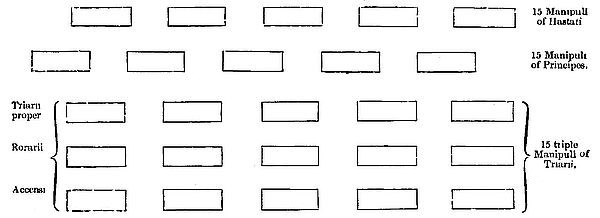
15 Manipuli of Hastati.
15 Manipuli of Principes.
Triarii proper { } 15 triple
Rorarii { } Manipuli
Accensi { } of Triarii.
Second Period. The Great Latin War, B.C. 340. Our authority for this period is Livy (viii. 8). The legion in B.C. 340 had almost entirely discarded the tactics of the phalanx. It was now drawn up in three, or perhaps we ought to say, in five lines. The soldiers of the first line, called Hastati, consisted of youths in the first bloom of manhood distributed into 15 companies or maniples (manipuli), a moderate space being left between each. The maniple contained 60 privates, 2 centurions (centuriones), and a standard bearer (vexillarius); two-thirds were heavily armed and bore the scutum or large oblong shield, the remainder carried only a spear (hasta) and light javelins (gaesa), The second line, the Principes, was composed of men in the full vigour of life, divided in like manner into 15 maniples, all heavily armed (scutati omnes). The two lines of the Hastati and Principes taken together amounted to 30 maniples, and formed the Antepilani. The third line, the Triarii, composed of tried veterans, was also in 15 divisions, but each of these was triple, containing 3 manipuli, 180 privates, 6 centurions, and 3 vexillarii. In these triple manipuli the veterans or triarii proper formed the front ranks; immediately behind them stood the Rorarii, inferior in age and prowess, while the Accensi or supernumeraries, less trustworthy than either, were posted in the extreme rear. The battle array may be thus represented. The fight was commenced by the Rorarii, so called because the light missiles which they sprinkled among the foe were like the drops which are the forerunners of the thunder shower, who, running forwards between the ranks of the antepilani, acted as tirailleurs; when they were driven in they returned to their station behind the triarii, and the battle began in earnest by the onset of the hastati; if they were unable to make any impression they retired between the ranks of the principes, who now advanced and bore the brunt of the combat, supported by the hastati, who had rallied in their rear. If the principes also failed to make an impression, they retired through the openings between the maniples of the triarii, who up to this time had been crouched on the ground (hence called subsidiarii), but now arose to make the last effort (whence the phrase rem ad triarios redisse). No longer retaining the open order of the two first lines, they closed up their ranks so as to present an unbroken line of heavy-armed veterans in front, while the rorarii and accensi, pressing up from behind, gave weight and consistency to the mass,—an arrangement bearing evidence to a lingering predilection for the principle of the phalanx, and exhibiting, just as we might expect at that period, the Roman tactics in their transition state. It must be observed that the words ordo, manipulus, vexillum, although generally kept distinct, are throughout the chapter used as synonymous. Livy concludes by saying, that four legions were commonly levied, each consisting of 5000 infantry and 300 horse. We must suppose that he speaks in round numbers in so far as the infantry are concerned, for according to his own calculations the numbers will stand thus:—