A (continued 2)
Reading edition
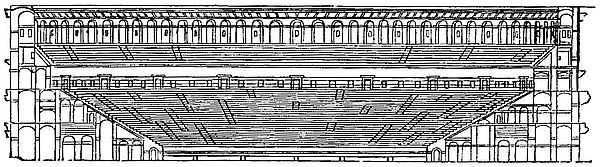
Longitudinal Section of the Flavian Amphitheatre.
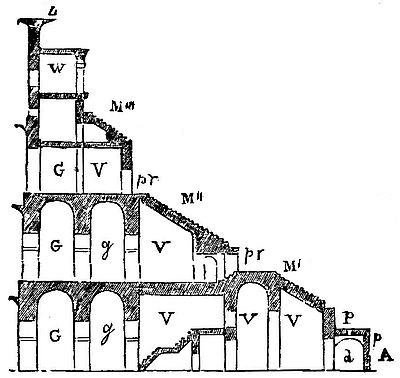
Elevation of one side of the preceding Section.
EXPLANATION.
A, The arena.
p, The wall or podium inclosing it.
P, The podium itself, on which were chairs, or seats, for the senators, &c.
M′, The first maenianum, or slope of benches, for the equestrian order.
M″, The second maenianum.
M‴, The third maenianum, elevated considerably above the preceding one, and appropriated to the pullati.
W, The colonnade, or gallery, which contained seats for women.
E, The narrow gallery round the summit of the interior, for the attendants who worked the velarium.
pr, pr, The præcinctiones, or landings, at the top of the first and second maenianum; in the pavement of which were grated apertures, at intervals, to admit light into the vomitoria beneath them.
V V V V, Vomitoria.
G G G, The three external galleries through the circumference of the building, open to the arcades of the exterior.
g g, Inner gallery.
The situation and arrangement of the staircases, &c., are not expressed, as they could not be rendered intelligible without plans at various levels of the building.
AMPHĬTHĔĀTRUM, an amphitheatre, was a place for the exhibition of public shows of combatants, wild beasts, and naval engagements, and was entirely surrounded with seats for the spectators; whereas, in those for dramatic performances, the seats were arranged in a semicircle facing the stage. An amphitheatre is therefore frequently described as a double theatre, consisting of two such semicircles, or halves, joined together, the spaces allotted to their orchestras becoming the inner inclosure, or area, termed the arena. The form, however, of the ancient amphitheatres was not a circle, but invariably an ellipse. Gladiatorial shows and combats of wild beasts (venationes) were first exhibited in the forum and the circus; and it appears that the ancient custom was still preserved till the time of Julius Caesar. The first building in the form of an amphitheatre is said to have been erected by C. Scribonius Curio, one of Caesar’s partisans; but the account which is given of this building sounds rather fabulous. It is said to have consisted of two wooden theatres, made to revolve on pivots, in such a manner that they could, by means of windlasses and machinery, be turned round face to face, so as to form one building. Soon after Caesar himself erected, in the Campus Martius, a stationary amphitheatre, made of wood; to which building the name of amphitheatrum was for the first time given. The first stone amphitheatre was built by Statilius Taurus, in the Campus Martius, at the desire of Augustus. This was the only stone amphitheatre at Rome till the time of Vespasian. One was commenced by Caligula, but was not continued by Claudius. The one erected by Nero in the Campus Martius was only a temporary building, made of wood. The amphitheatre of Statilius Taurus was burnt in the fire of Rome in the time of Nero; and hence, as a new one was needed, Vespasian commenced the celebrated Amphitheatrum Flavium in the middle of the city, in the valley between the Caelian, the Esquiline, and the Velia, on the spot originally occupied by the lake or large pond attached to Nero’s palace. Vespasian did not live to finish it. It was dedicated by Titus in A.D. 80, but was not completely finished, till the reign of Domitian. This immense edifice, which is even yet comparatively entire, covered nearly six acres of ground, and was capable of containing about 87,000 spectators. It is called at the present day the Colosseum or Colisaeum. The interior of an amphitheatre was divided into three parts, the arena, podium, and gradus. The clear open space in the centre of the amphitheatre was called the arena, because it was covered with sand, or sawdust, to prevent the gladiators from slipping, and to absorb the blood. The size of the arena was not always the same in proportion to the size of the amphitheatre, but its average proportion was one-third of the shorter diameter of the building. The arena was surrounded by a wall distinguished by the name of podium; although such appellation, perhaps, rather belongs to merely the upper part of it, forming the parapet, or balcony, before the first or lowermost seats, nearest to the arena. The arena, therefore, was no more than an open oval court, surrounded by a wall about fifteen feet high; a height considered necessary, in order to render the spectators perfectly secure from the attacks of wild beasts. There were four principal entrances leading into the arena; two at the ends of each axis or diameter of it, to which as many passages led directly from the exterior of the building; besides secondary ones, intervening between them, and communicating with the corridors beneath the seats on the podium. The wall or enclosure of the arena is supposed to have been faced with marble, more or less sumptuous; besides which, there appears to have been, in some instances at least, a sort of net-work affixed to the top of the podium, consisting of railing, or rather open trellis-work of metal. As a further defence, ditches, called euripi, sometimes surrounded the arena. The term podium was also applied to the terrace, or gallery itself, immediately above the arena, which was no wider than to be capable of containing two, or at the most, three ranges of moveable seats, or chairs. This, as being by far the best situation for distinctly viewing the sports in the arena, and also more commodiously accessible than the seats higher up, was the place set apart for senators and other persons of distinction, such as foreign ambassadors; and it was here, also, that the emperor himself used to sit, in an elevated place, called suggestus or cubiculum, and likewise the person who exhibited the games on a place elevated like a pulpit or tribunal (editoris tribunal). Above the podium were the gradus, or seats of the other spectators, which were divided into maeniana, or stories. The first maenianum, consisting of fourteen rows of stone or marble seats, was appropriated to the equestrian order. The seats appropriated to the senators and equites were covered with cushions, which were first used in the time of Caligula. Then, after an interval or space, termed a praecinctio, and forming a continued landing-place from the several staircases in it, succeeded the second maenianum, where were the seats called popularia, for the third class of spectators, or the populus. Behind this was the second praecinctio, bounded by a rather high wall; above which was the third maenianum, where there were only wooden benches for the pullati, or common people. The next and last division, namely, that in the highest part of the building, consisted of a colonnade, or gallery, where females were allowed to witness the spectacles of the amphitheatre, but some parts of it were also occupied by the pullati. Each maenianum was not only divided from the other by the praecinctio, but was intersected at intervals by spaces for passages left between the seats, called scalae, or scalaria; and the portion between two such passages was called cuneus, because the space gradually widened like a wedge, from the podium to the top of the building. The entrances to the seats from the outer porticoes were called vomitoria. At the very summit was the narrow platform for the men who had to attend to the velarium, or awning, by which the building was covered as a defence against the sun and rain. The velarium appears usually to have been made of wool, but more costly materials were sometimes employed. The first of the preceding cuts represents a longitudinal section of the Flavian amphitheatre, and the second, which is on a larger scale, a part of the above section, including the exterior wall, and the seats included between that and the arena. It will serve to convey an idea of the leading form and general disposition of the interior. For an account of the gladiatorial contests, and the shows of wild beasts, exhibited in the amphitheatre, see Gladiatores, Naumachia, and Venatio.
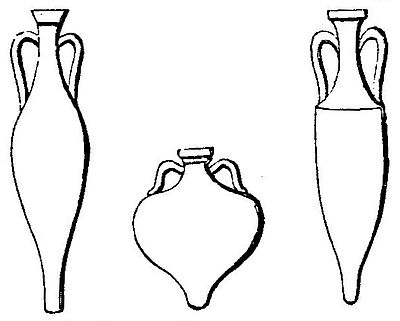
Amphorae. (British Museum.)
AMPHŎRA (ἀμφορεύς), a vessel used for holding wine, oil, honey, &c. The following cut represents amphorae in the British Museum. They are of various forms and sizes; in general they are tall and narrow, with a small neck, and a handle on each side of the neck (whence the name, from ἀμφί, on both sides, and φέρω, to carry), and terminating at the bottom in a point, which was let into a stand or stuck in the ground, so that the vessel stood upright: several amphorae have been found in this position in the cellars at Pompeii. Amphorae were commonly made of earthenware. Homer mentions amphorae of gold and stone, and the Egyptians had them of brass; glass vessels of this form have been found at Pompeii. The most common use of the amphora, both among the Greeks and the Romans, was for keeping wine. The cork was covered with pitch or gypsum, and (among the Romans) on the outside the title of the wine was painted, the date of the vintage being marked by the names of the consuls then in office; or, when the jars were of glass, little tickets (pittoria, tesserae) were suspended from them, indicating these particulars.—The Greek amphoreus and the Roman amphora were also names of fixed measures. The amphoreus, which was also called metretes (μετρητής) and cadus (κάδος), was equal to three Roman urnae = 8 gallons, 7·365 pints, imperial measure. The Roman amphora was two-thirds of the amphoreus, and was equal to 2 urnae = 8 congii = to 5 gallons, 7·577 pints; its solid content was exactly a Roman cubic foot.
AMPLĬĀTĬO, an adjournment of a trial, which took place when the judices after hearing the evidence of the advocates were unable to come to a satisfactory conclusion. This they expressed by giving in the tablets, on which were the letters N. L. (non liquet), and the praetor, by pronouncing the word amplius, thereupon adjourned the trial to any day he chose. The defendant and the cause were then said ampliari.
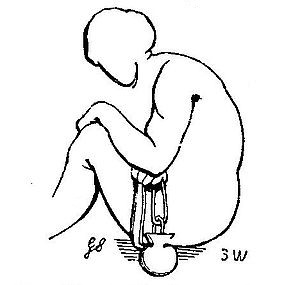
Ampulla. (Sketched by G. Scharf from a relief at Athens, discovered in 1840.)
AMPULLA (λήκυθος, βομβύλιος), a bottle, usually made among the Romans either of glass or earthenware, rarely of more valuable materials. Ampullae were more or less globular. From their round and swollen shape, the word was used by Horace to indicate grand and turgid but empty language. (“Projicit ampullas et sesquipedalia verba,” Ar. Poet. 97.) Ampullae are frequently mentioned in connection with the bath, since every Roman took with him to the bath a bottle of oil for anointing the body after bathing. The dealer in bottles was called ampullarius.
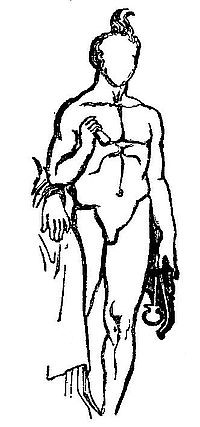
Ampulla. (From a tomb at Myra in Lycia.)
AMPYX (ἄμπυξ, ἀμπυκτήρ, Lat. frontale), a frontal, a broad band or plate of metal, which ladies of rank wore above the forehead as part of the head-dress. The frontal of a horse was called by the same name. The annexed cut exhibits the frontal on the head of Pegasus, in contrast with the corresponding ornament as shown on the heads of two females.
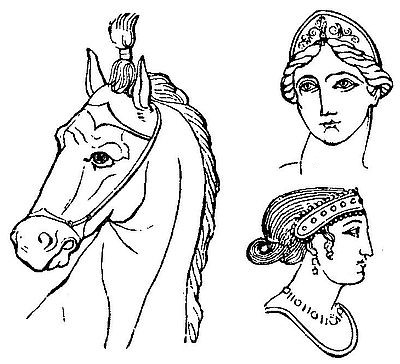
Ampyces, Frontlets. (From Paintings on Vases.)
ĂMŬLĒTUM (περίαπτον, περίαμμα, φυλακτήριον), an amulet. This word in Arabic (hamalet) means that which is suspended. It was probably brought into Europe by Arabian merchants, together with the articles to which it was applied. An amulet was any object,—a stone, a plant, an artificial production, or a piece of writing,—which was suspended from the neck, or tied to any part of the body, for the purpose of warding off calamities and securing advantages of any kind. Faith in the virtues of amulets was almost universal in the ancient world, so that the art of medicine consisted in a very considerable degree of directions for their application.
ĂMUSSIS or ĂMUSSĬUM, a carpenter’s and mason’s instrument, the use of which was to obtain a true plane surface.
ĂNĂCEIA (ἀνάκεια, or ἀνάκειον), a festival of the Dioscuri or Anactes (Ἄνακτες), as they were called at Athens. These heroes, however, received the most distinguished honours in the Dorian and Achaean states, where it may be supposed that every town celebrated a festival in their honour, though not under the name of Anaceia.
ĂNACRĬSIS (ἀνάκρισις), an examination, was used to signify the pleadings preparatory to a trial at Athens, the object of which was to determine, generally, if the action would lie. The magistrates were said ἀνακρίνειν τὴν δίκην or τοὺς ἀντιδίκους, and the parties ἀνακρίνεσθαι. The process consisted in the production of proofs, of which there were five kinds:—1. The laws; 2. Written documents; 3. Testimonies of witnesses present (μαρτυρίαι), or affidavits of absent witnesses (ἐκμαρτυρίαι); 4. Depositions of slaves extorted by the rack; 5. The oath of the parties. All these proofs were committed to writing, and placed in a box secured by a seal (ἐχῖνος) till they were produced at the trial. If the evidence produced at the anacrisis was so clear and convincing that there could not remain any doubt, the magistrate could decide the question without sending the cause to be tried before the dicasts: this was called diamartyria (διαμαρτυρία). The archons were the proper officers for holding the anacrisis; they are represented by Athena (Minerva), in the Eumenides of Aeschylus, where there is a poetical sketch of the process in the law courts. For an account of the anacrisis or examination, which each archon underwent previously to entering on office, see Archon.
ĂNĂGLỸPHA or ĂNĂGLYPTA (ἀνάγλυφα, ἀνάγλυπτα), chased or embossed vessels made of bronze or of the precious metals, which derived their name from the work on them being in relief, and not engraved.
ĂNĂGNOSTĒS, a slave, whose duty it was to read or repeat passages from books during an entertainment, and also at other times.
ĂNĂGŌGĬA (ἀναγώγια), a festival celebrated at Eryx, in Sicily, in honour of Aphrodite. The inhabitants of the place believed that, during this festival, the goddess went over into Africa.
ĂNĂTŎCISMUS. [Fenus.]
ANCĪLE. [Salii.]
ANCŎRA. [Navis.]
ANDĂBĂTA. [Gladiator.]
ANDRŎGĔŌNIA (ἀνδρογεώνια), a festival with games, held every year in the Cerameicus at Athens, in honour of the hero Androgeus, son of Minos, who had overcome all his adversaries in the festive games of the Panathenaea, and was afterwards killed by his jealous rivals.
ANDRŎLEPSĬA (ἀνδροληψία or ἀνδρολήψιον), a legal means by which the Athenians were enabled to take vengeance upon a community in which an Athenian citizen had been murdered, by seizing three individuals of that state or city, as hostages, until satisfaction was given.
ANDRŌNĪTIS. [Domus, Greek.]
ANGĂRĪA (ἀγγαρεία, Hdt. ἀγγαρήϊον), a word borrowed from the Persians, signifying a system of posting by relays of horses, which was used among that people, and which, according to Xenophon, was established by Cyrus. The term was adopted by the Romans under the empire to signify compulsory service in forwarding the messages of the state. The Roman angaria, also called angariarum exhibitio or praestatio, included the maintenance and supply, not only of horses, but of ships and messengers, in forwarding both letters and burdens; it is defined as a personale munus; and there was no ground of exemption from it allowed, except by the favour of the emperor.
ANGĬPORTUS, or ANGĬPORTUM, a narrow lane between two rows of houses, which might either be what the French call a cul-de-sac, or it might terminate at both ends in some public street.
ANGUSTICLĀVĬI. [Clavus.]
ANNĀLES MAXĬMI. [Pontifex.]
ANNŌNA (from annus, like pomona from pomum).—(1) The produce of the year in corn, fruit, wine, &c., and hence,—(2) provisions in general, especially the corn, which, in the later years of the republic, was collected in the storehouses of the state, and sold to the poor at a cheap rate in times of scarcity; and which, under the emperors, was distributed to the people gratuitously, or given as pay and rewards;—(3) the price of provisions;—(4) a soldier’s allowance of provisions for a certain time. The word is used also in the plural for yearly or monthly distributions of pay in corn, &c.
ANNŬLUS (δακτύλιος), a ring. It is probable that the custom of wearing rings was very early introduced into Greece from Asia, where it appears to have been almost universal. They were worn not merely as ornaments, but as articles for use, as the ring always served as a seal. A seal was called sphragis (σφραγίς), and hence this name was given to the ring itself, and also to the gem or stone for a ring in which figures were engraved. Rings in Greece were mostly worn on the fourth finger (παράμεσος). At Rome, the custom of wearing rings was believed to have been introduced by the Sabines, who were described in the early legends as wearing golden rings with precious stones of great beauty. But, whenever introduced at Rome, it is certain that they were at first always of iron; that they were destined for the same purpose as in Greece, namely, to be used as seals; and that every free Roman had a right to use such a ring. This iron ring was worn down to the last period of the republic by such men as loved the simplicity of the good old times. In the course of time, however, it became customary for all the senators, chief magistrates, and at last for the equites also, to wear a golden seal-ring. The right of wearing a gold ring, which was subsequently called the jus annuli aurei, or the jus annulorum, remained for several centuries at Rome the exclusive privilege of senators, magistrates, and equites, while all other persons continued to wear iron ones. During the empire the right of granting the annulus aureus belonged to the emperors, and some of them were not very scrupulous in conferring this privilege. Augustus gave it to Mena, a freedman, and to Antonius Musa, a physician. The emperors Severus and Aurelian conferred the right of wearing golden rings upon all Roman soldiers; and Justinian at length allowed all the citizens of the empire, whether ingenui or libertini, to wear such rings. The ring of a Roman emperor was a kind of state seal, and the emperor sometimes allowed the use of it to such persons as he wished to be regarded as his representatives. During the republic and the early times of the empire the jus annuli seems to have made a person ingenuus (if he was a libertus), and to have raised him to the rank of eques, provided he had the requisite equestrian census, and it was probably never granted to any one who did not possess this census. Those who lost their property, or were found guilty of a criminal offence, lost the jus annuli. The principal value of a ring consisted in the gem set in it, or rather in the workmanship of the engraver. The stone most frequently used was the onyx (σαρδῶνος, σαρδόνυξ), on account of its various colours, of which the artist made the most skilful use. In the art of engraving upon gems the ancients far surpassed anything that modern times can boast of. The devices engraved upon rings were very various: they were portraits of ancestors or of friends, subjects connected with mythology; and in many cases a person had engraved upon his seal some symbolical allusion to the real or mythical history of his family. The bezel or part of the ring which contained the gem was called pala. With the increasing love of luxury and show, the Romans, as well as the Greeks, covered their fingers with rings. Some persons also wore rings of immoderate size, and others used different rings for summer and winter. Much superstition appears to have been connected with rings, especially in the East and in Greece. Some persons made it a lucrative trade to sell rings which were believed to possess magic powers, and to preserve the wearers from external danger.
ANNUS. [Calendarium.]
ANQUĪSĪTĬO, signified, in criminal trials at Rome, the investigation of the facts of the case with reference to the penalty that was to be imposed: accordingly the phrases pecunia capitis or capitis anquirere are used. Under the emperors the term anquisitio lost its original meaning, and was employed to indicate an accusation in general; in which sense it also occurs even in the times of the republic.
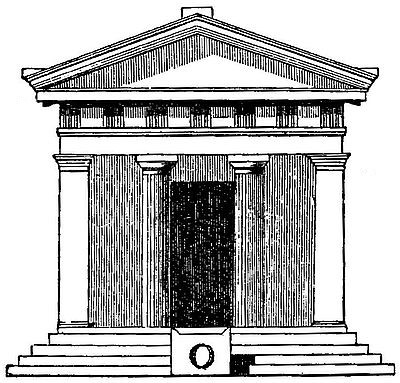
Temple in Antis. (Temple of Artemis at Eleusia.)
ANTAE (παραστάδες), square pillars, which were commonly joined to the side-walls of a building, being placed on each side of the door, so as to assist in forming the portico. These terms are seldom found except in the plural; because the purpose served by antae required that they should be erected corresponding to each other and supporting the extremities of the same roof. The temple in antis was one of the simplest kind. It had in front antae attached to the walls which inclosed the cella; and in the middle, between the antae, two columns supporting the architrave.
ANTĔAMBŬLŌNES, slaves who were accustomed to go before their masters, in order to make way for them through the crowd. The term anteambulones was also given to the clients, who were accustomed to walk before their patroni, when the latter appeared in public.
ANTĔCESSŌRES, called also ANTĔCURSŌRES, horse-soldiers, who were accustomed to precede an army on march, in order to choose a suitable place for the camp, and to make the necessary provisions for the army. They do not appear to have been merely scouts, like the speculatores.
ANTĔCOENA. [Coena.]
ANTĔFIXA, terra-cottas, which exhibited various ornamental designs, and were used in architecture to cover the frieze (zophorus) of the entablature. These terra-cottas do not appear to have been used among the Greeks, but were probably Etruscan in their origin, and were thence taken for the decoration of Roman buildings. The name antefixa is evidently derived from the circumstance that they were fixed before the buildings which they adorned. Cato, the censor, complained that the Romans of his time began to despise ornaments of this description, and to prefer the marble friezes of Athens and Corinth. The rising taste which Cato deplored may account for the superior beauty of the antefixa preserved in the British Museum, which were discovered at Rome.
ANTENNA. [Navis.]
ANTĔPĪLĀNI. [Exercitus.]
ANTĔSIGNĀNI. [Exercitus.]
ANTHESPHŎRĬA (ἀνθεσφόρια), a flower-festival, principally celebrated in Sicily, in honour of Demeter and Persephone, in commemoration of the return of Persephone to her mother in the beginning of spring.
ANTHESTĒRĬA. [Dionysia.]
ANTĬDŎSIS (ἀντίδοσις), in its literal and general meaning, “an exchange,” was, in the language of the Attic courts, peculiarly applied to proceedings under a law which is said to have originated with Solon. By this, a citizen nominated to perform a leiturgia, such as a trierarchy or choregia, or to rank among the property-tax payers, in a class disproportioned to his means, was empowered to call upon any qualified person not so charged to take the office in his stead, or submit to a complete exchange of property, the charge in question of course attaching to the first party, if the exchange were finally effected. For the proceedings the courts were opened at a stated time every year by the magistrates that had official cognisance of the particular subject; such as the strategi in cases of trierarchy and rating to the property-taxes, and the archon in those of choregia.
ANTĬGRĂPHE (ἀντιγραφή) originally signified the writing put in by the defendant, his “plea” in all causes whether public or private, in answer to the indictment or bill of the prosecutor. It is, however, also applied to the bill or indictment of the plaintiff or accuser.
ĀNTLĬA (ἄντλια), any machine for raising water, a pump. The most important of these machines were:—(1) The tympanum; a tread-wheel, worked by men treading on it.—(2) A wheel having wooden boxes or buckets, so arranged as to form steps for those who trod the wheel.—(3) The chain pump.—(4) The cochlea, or Archimedes’s screw.—(5) The ctesibica machina, or forcing-pump.—Criminals were condemned to the antlia or tread-mill. The antlia with which Martial (ix. 19) watered his garden, was probably the pole and bucket universally employed in Italy, Greece, and Egypt. The pole is curved, as shown in the annexed figure; because it is the stem of a fir or some other tapering tree.
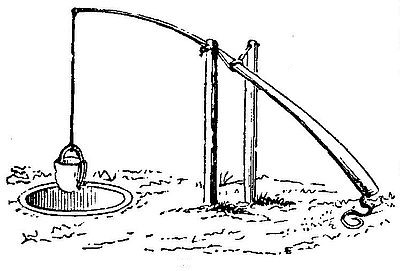
Antlia.
ANTYX (ἄντυξ), the rim or border of any thing, especially of a shield or chariot. The rim of the large round shield of the ancient Greeks was thinner than the part which it enclosed; but on the other hand, the antyx of a chariot must have been thicker than the body to which it gave both form and strength. In front of the chariot the antyx was often raised above the body, into the form of a curvature, which served the purpose of a hook to hang the reins upon.
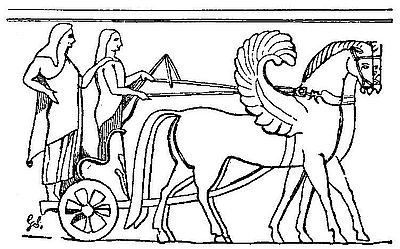
Antyx. (From an Etruscan tomb.)
ĂPĂGŌGĒ (ἀπαγωγή), a summary process, allowed in certain cases by the Athenian law. The term denotes not merely the act of apprehending a culprit caught in ipso facto, but also the written information delivered to the magistrate, urging his apprehension. The cases in which the apagoge was most generally allowed were those of theft, murder, ill-usage of parents, &c.
ĂPĂTŪRĬA (ἀπατούρια) was a political festival, which the Athenians had in common with all the Greeks of the Ionian name, with the exception of those of Colophon and Ephesus. It was celebrated in the month of Pyanepsion, and lasted for three days. The name ἀπατούρια is not derived from ἀπατᾶν, to deceive, but is composed of ἀ = ἅμα and πατύρια, which is perfectly consistent with what Xenophon says of the festival, that when it is celebrated the fathers and relations assemble together. According to this derivation, it is the festival at which the phratriae met to discuss and settle their own affairs. But, as every citizen was a member of a phratria, the festival extended over the whole nation, who assembled according to phratriae. The festival lasted three days. The third day was the most important; for on that day, children born in that year, in the families of the phratriae, or such as were not yet registered, were taken by their fathers, or in their absence by their representatives (κύριοι), before the assembled members of the phratria. For every child a sheep or a goat was sacrificed. The father, or he who supplied his place, was obliged to establish by oath that the child was the offspring of free-born parents, and citizens of Athens. After the victim was sacrificed, the phratores gave their votes, which they took from the altar of Zeus Phratrius. When the majority voted against the reception, the cause might be tried before one of the courts of Athens; and if the claims of the child were found unobjectionable, its name, as well as that of the father, was entered into the register of the phratria, and those who had wished to effect the exclusion of the child were liable to be punished.
ĂPERTA NĀVIS. [Navis.]
ĂPEX, a cap worn by the flamines and salii at Rome. The essential part of the apex, to which alone the name properly belonged, was a pointed piece of olive-wood, the base of which was surrounded with a lock of wool. This was worn on the top of the head, and was held there either by fillets only, or, as was more commonly the case, by the aid of a cap which fitted the head, and was also fastened by means of two strings or bands. The albogalerus, a white cap made of the skin of a white victim sacrificed to Jupiter, and worn by the flamen dialis, had the apex fastened to it by means of an olive twig.
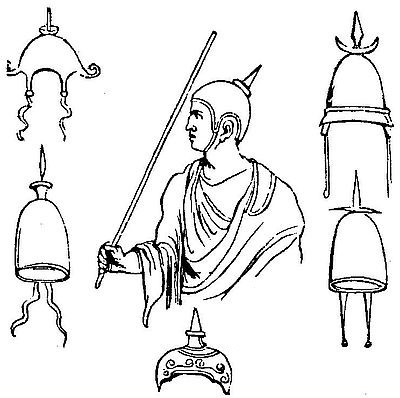
Apices, caps worn by the Salii. (From bas-reliefs and coins.)
APHLASTON (ἄφλαστον). [Navis.]
ĂPHRACTUS. [Navis.]
ĂPHRŎDĪSĬA (ἀφροδίσια) were festivals celebrated in honour of Aphrodité, in a great number of towns in Greece, but particularly in the island of Cyprus. Her most ancient temple was at Paphos. No bloody sacrifices were allowed to be offered to her, but only pure fire, flowers, and incense.
APLUSTRE. [Navis.]
ĂPŎCLĒTI (ἀποκλητοὶ). [Aetolicum Foedus.]
ĂPODECTAE (ἀποδέκται), public officers at Athens, who were introduced by Cleisthenes in the place of the ancient colacretae (κωλακρέται). They were ten in number, one for each tribe, and their duty was to collect all the ordinary taxes, and distribute them among the separate branches of the administration which were entitled to them.
ĂPŎGRĂPHĒ (ἀπογραφή), literally, “a list, or register;” signified also, (1) An accusation in public matters, more particularly when there were several defendants. It differed but little, if at all, from the ordinary graphe.—(2) A solemn protest or assertion in writing before a magistrate, to the intent that it might be preserved by him till it was required to be given in evidence.—(3) A specification of property, said to belong to the state, but actually in the possession of a private person; which specification was made with a view to the confiscation of such property to the state.
ĂPOLLĬNĀRES LŪDI. [Ludi Apollinares.]
ĂPOLLŌNĬA (ἀπολλώνια), the name of a propitiatory festival solemnized at Sicyon, in honour of Apollo and Artemis.
ĂPŎPHŎRĒTA (ἀποφόρητα) were presents, which were given to friends at the end of an entertainment to take home with them. These presents appear to have been usually given on festival days, especially during the Saturnalia.
ĂPORRHĒTA (ἀπόῤῥητα), literally “things forbidden,” has two peculiar, but widely different, acceptations in the Attic dialect. In one of these it implies contraband goods; in the other, it denotes certain contumelious epithets, from the application of which both the living and the dead were protected by special laws.
ĂPŎSTŎLEUS (ἀποστολεύς), the name of a public officer at Athens. There were ten magistrates of this name, and their duty was to see that the ships were properly equipped and provided by those who were bound to discharge the trierarchy. They had the power, in certain cases, of imprisoning the trierarchs who neglected to furnish the ships properly.
ĂPŎTHĒCA (ἀποθήκη), a place in the upper part of the house, in which the Romans frequently placed the earthen amphorae in which their wines were deposited. This place, which was quite different from the cella vinaria, was above the fumarium; since it was thought that the passage of the smoke through the room tended greatly to increase the flavour of the wine. The position of the apotheca explains the expression in Horace (Carm. ii. 21, 7), Descende, testa.
ĂPŎTHĔŌSIS (ἀποθέωσις), the enrolment of a mortal among the gods. The mythology of Greece contains numerous instances of the deification of mortals; but in the republican times of Greece we find few examples of such deification. The inhabitants of Amphipolis, however, offered sacrifices to Brasidas after his death. In the Greek kingdoms, which arose in the East on the dismemberment of the empire of Alexander, it appears to have been not uncommon for the successor to the throne to offer divine honours to the former sovereign. Such an apotheosis of Ptolemy, king of Egypt, is described by Theocritus in his 17th Idyl. The term apotheosis, among the Romans, properly signified the elevation of a deceased emperor to divine honours. This practice, which was common upon the death of almost all the emperors, appears to have arisen from the opinion which was generally entertained among the Romans, that the souls or manes of their ancestors became deities; and as it was common for children to worship the manes of their fathers, so it was natural for divine honours to be publicly paid to a deceased emperor, who was regarded as the parent of his country. This apotheosis of an emperor was usually called consecratio; and the emperor who received the honour of an apotheosis was usually said in deorum numerum referri, or consecrari, and whenever he is spoken of after his death, the title of divus is prefixed to his name. The funeral pile on which the body of the deceased emperor was burnt, was constructed of several stories in the form of chambers rising one above another, and in the highest an eagle was placed, which was let loose as the fire began to burn, and which was supposed to carry the soul of the emperor from earth to heaven.
APPĀRĬTOR, the general name for a public servant of the magistrates at Rome, namely, the Accensus, Carnifex, Coactor, Interpres, Lictor, Praeco, Scriba, Stator, Viator, of whom an account is given in separate articles. They were called apparitores because they were at hand to execute the commands of the magistrates (quod iis apparebant). Their service or attendance was called apparitio.
APPELLĀTĬO, appeal.—(1) Greek (ἔφεσις or ἀναδικία.) Owing to the constitution of the Athenian tribunals, each of which was generally appropriated to its peculiar subjects of cognisance, and therefore could not be considered as homogeneous with or subordinate to any other, there was little opportunity for bringing appeals properly so called. It is to be observed also, that in general a cause was finally and irrevocably decided by the verdict of the dicasts (δίκη αὐτοτελής). There were only a few exceptions in which appeals and new trials might be resorted to.—(2) Roman. The word appellatio, and the corresponding verb appellare, are used in the early Roman writers to express the application of an individual to a magistrate, and particularly to a tribune, in order to protect himself from some wrong inflicted, or threatened to be inflicted. It is distinguished from provocatio, which in the early writers is used to signify an appeal to the populus in a matter affecting life. It would seem that the provocatio was an ancient right of the Roman citizens. The surviving Horatius, who murdered his sister, appealed from the duumviri to the populus. The decemviri took away the provocatio; but it was restored by the Lex Valeria et Horatia, B.C. 449, in the year after the decemvirate, and it was at the same time enacted, that in future no magistrate should be made from whom there should be no appeal. On this Livy remarks, that the plebs were now protected by the provocatio and the tribunicium auxilium; this latter term has reference to the appellatio properly so called. The complete phrase to express the provocatio is provocare ad populum; and the phrase which expresses the appellatio is appellare ad, &c.
APSIS or ABSIS (ἁψίς), in architecture, signified first, any building or portion of a building of a circular form or vaulted, and more especially the circular and vaulted end of a Basilica.
ĂQUAE DUCTUS (ὑδραγωγία), literally, a water-conduit, but the word is used especially for the magnificent structures by means of which Rome and other cities of the Roman empire were supplied with water. A Roman aqueduct, often called simply aqua, may be described in general terms as a channel, constructed as nearly as possible with a regular declivity from the source whence the water was derived to the place where it was delivered, carried through hills by means of tunnels, and over valleys upon a substruction of solid masonry or arches. The aqueduct is mentioned by Strabo as among the structures which were neglected by the Greeks, and first brought into use by the Romans. Springs (κρῆναι, κρουνοί) were sufficiently abundant in Greece to supply the great cities with water; and they were frequently converted into public fountains by the formation of a head for their waters, and the erection of an ornamental superstructure. Of this we have an example in the Enneacrunos at Athens, which was constructed by Peisistratus and his sons. The Romans were in a very different position, with respect to the supply of water, from most of the Greek cities. They, at first, had recourse to the Tiber, and to wells sunk in the city; but the water obtained from those sources was very unwholesome, and must soon have proved insufficient, from the growth of the population. It was this necessity that led to the invention of aqueducts, in order to bring pure water from the hills which surround the Campagna. The number of aqueducts was gradually increased, partly at the public expense, and partly by the munificence of individuals, till, in the fourth century of the Christian era, they amounted to fourteen. Of these only four belong to the time of the republic, while five were built in the reigns of Augustus and Claudius.—1. The Aqua Appia, begun by the censor Appius Claudius Caecus in B.C. 313. Its sources were near the Via Praenestina, between the seventh and eighth mile-stones.—2. The Anio Vetus was commenced forty years later, B.C. 273, by the censor M. Curius Dentatus, and was finished by M. Fulvius Flaccus. The water was derived from the river Anio, above Tibur, at a distance of 20 Roman miles from the city; but, on account of its windings, its actual length was 43 miles.—3. The Aqua Marcia, one of the most important of the whole, was built by the praetor Q. Marcius Rex, by command of the senate, in B.C. 144. It commenced at the side of the Via Valeria, 36 miles from Rome.—4. The Aqua Tepula, built by the censors Cn. Servilius Caepio and L. Cassius Longinus in B.C. 127, began at a spot in the Lucullan or Tusculan land, two miles to the right of the tenth milestone on the Via Latina. It was afterwards connected with.—5. The Aqua Julia, built by Agrippa in his aedileship, B.C. 33. It was conducted from a source two miles to the right of the twelfth milestone on the Via Latina, first to the Aqua Tepula, in which it was merged as far as the reservoir (piscina) on the Via Latina, seven miles from Rome. From this reservoir the water was carried along two distinct channels, on the same substructions; the lower channel being called the Aqua Tepula, and the upper the Aqua Julia; and this double aqueduct again was united with the Aqua Marcia, over the watercourse of which the other two were carried.—6. The Aqua Virgo, built by Agrippa, to supply his baths. From a source in a marshy spot by the 8th milestone on the Via Collatina, it was conducted by a very circuitous route.—7. The Aqua Alsietina (sometimes called also Aqua Augusta), on the other side of the Tiber, was constructed by Augustus from the Lacus Alsietinus (Lago di Martignano), which lay 6500 passus to the right of the 14th milestone on the Via Claudia.—8, 9. The two most magnificent aqueducts were the Aqua Claudia and the Anio Novus (or Aqua Aniena Nova), both commenced by Caligula in A.D. 36, and finished by Claudius in A.D. 50. The water of the Aqua Claudia was derived from two copious and excellent springs, near the 38th milestone on the Via Sublacensis. Its length was nearly 46½ miles. The Anio Novus began at the 42nd milestone. It was the longest and the highest of all the aqueducts, its length being nearly 59 miles, and some of its arches 109 feet high. In the neighbourhood of the city these two aqueducts were united, forming two channels on the same arches, the Claudia below and the Anio Novus above. These nine aqueducts were all that existed in the time of Frontinus, who was the curator of the aqueducts in the reigns of Nerva and Trajan. There was also another aqueduct, not reckoned with the nine, because its waters were no longer brought all the way to Rome, viz.: 10. The Aqua Crabra.—The following were of later construction. 11. The Aqua Trajana, brought by Trajan from the Lacus Sabatinus (now Bracciano).—12. The Aqua Alexandrina, constructed by Alexander Severus; its source was in the lands of Tusculum, about 14 miles from Rome.—13. The Aqua Septimiana, built by Septimius Severus, was perhaps only a branch of the Aqua Julia.—14. The Aqua Algentia had its source at M. Algidus by the Via Tusculana. Its builder is unknown.—Great pains were taken by successive emperors to preserve and repair the aqueducts. From the Gothic wars downwards, they have for the most part shared the fate of the other great Roman works of architecture; their situation and purpose rendering them peculiarly exposed to injury in war; but still their remains form the most striking features of the Campagna, over which their lines of ruined arches, clothed with ivy and the wild fig-tree, radiate in various directions.

Triple Aqueduct.
Three of them still serve for their ancient use. They are—(1.) The Acqua Vergine, the ancient Aqua Virgo. (2.) The Acqua Felice, named after the conventual name of its restorer Sixtus V. (Fra Felice), is, probably, a part of the ancient Aqua Claudia, though some take it for the Alexandrina. (3.) The Acqua Paola, the ancient Alsietina.—The following woodcut represents a restored section of the triple aqueduct of Agrippa:—a. the Aqua Marcia; b. the Aqua Tepula; c. the Aqua Julia. The two latter are of brick and vaulted over. The air-vents are also shown.—The channel of an aqueduct (specus, canalis) was a trough of brick or stone, lined with cement, and covered with a coping, which was almost always arched; and the water either ran directly through this trough, or it was carried through pipes laid along the trough. These pipes were of lead, or terra-cotta (fictiles), and sometimes, for the sake of economy, of leather. At convenient points on the course of the aqueduct, and especially near the middle and end, there was generally a reservoir (piscina, piscina limosa) in which the water might deposit any sediment that it contained. The water was received, when it reached the walls of the city, in a vast reservoir called castellum, which formed the head of water and also served the purpose of a meter. From this principal castellum the water flowed into other castella, whence it was distributed for public and private use. The term castellum is sometimes also applied to the intermediate reservoirs already mentioned. During the republic, the censors and aediles had the superintendence of the aqueducts. Augustus first established curatores (or praefecti) aquarum, who were invested with considerable authority. They were attended outside the city by two lictors, three public slaves, a secretary, and other attendants. In the time of Nerva and Trajan, 460 slaves were constantly employed under the orders of the curatores aquarum in attending to the aqueducts. They consisted of:—1. The villici, whose duty it was to attend to the pipes and calices. 2. The castellarii, who had the superintendence of all the castella, both within and without the city. 3. The circuitores, so called because they had to go from post to post, to examine into the state of the works, and also to keep watch over the labourers employed upon them. 4. The silicarii, or paviours. 5. The tectores, or masons. These and other workmen appear to have been included under the general term of Aquarii.
ĂQUAE ET IGNIS INTERDICTĬO. [Exsilium.]
ĂQUĀRĬI, slaves who carried water for bathing, &c., into the female apartments. The aquarii were also public officers who attended to the aqueducts. [Aquae Ductus.]
ĂQUĬLA. [Signa Militaria.]
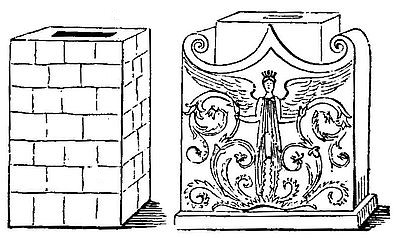
Arae, Altars.
ĀRA (βωμός, θυτήριον), an altar. Ara was a general term denoting any structure elevated above the ground, and used to receive upon it offerings made to the gods. Altare, probably contracted from alta ara, was properly restricted to the larger, higher, and more expensive structures. Four specimens of ancient altars are given below; the two in the former woodcut are square, and those in the latter round, which is the less common form. At the top of three of the above altars we see the hole intended to receive the fire (ἐσχαρίς, ἐσχάρα): the fourth was probably intended for the offering of fruits or other gifts, which were presented to the gods without fire. When the altars were prepared for sacrifice, they were commonly decorated with garlands or festoons. These were composed of certain kinds of leaves and flowers, which were considered consecrated to such uses, and were called verbenae. The altars constructed with most labour and skill belonged to temples; and they were erected either before the temple or within the cella of the temple, and principally before the statue of the divinity to whom it was dedicated. The altars in the area before the temple were altars of burnt-offerings, at which animal sacrifices (victimae, σφάγια, ἱερεῖα) were presented: only incense was burnt, or cakes and bloodless sacrifices offered on the altars within the building.
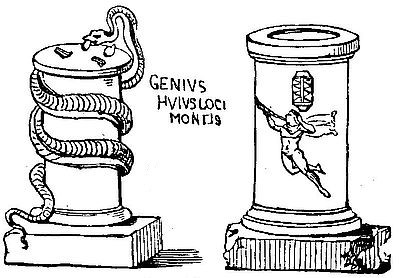
Arae, Altars.
ĂRĀTRUM (ἄροτρον), a plough. Among the Greeks and Romans the three most essential parts of the plough were,—the plough-tail (γύης, buris, bura), the share-beam (ἔλυμα, dens, dentale), that is, the piece of wood to which the share is fixed, and the pole (ῥυμός], ἱστοβοεύς, temo). In the time and country of Virgil it was the custom to force a tree into the crooked form of the buris, or plough-tail. The upper end of the buris being held by the ploughman, the lower part, below its junction with the pole, was used to hold the dentale or share-beam, which was either sheathed with metal, or driven bare into the ground, according to circumstances. The term vomer was sometimes applied to the end of the dentale. To these three parts, the two following are added in the description of the plough by Virgil:—1. The earth-boards, or mould-boards (aures), rising on each side, bending outwardly in such a manner as to throw on either hand the soil which had been previously loosened and raised by the share, and adjusted to the share-beam (dentale), which was made double for the purpose of receiving them. 2. The handle (stiva). Virgil describes this part as used to turn the plough at the end of the furrow; and it is defined by an ancient commentator on Virgil as the “handle by which the plough is directed.” It is probable that as the dentalia, the two share-beams, were in the form of the Greek letter Λ, which Virgil describes by duplici dorso, the buris was fastened to the left share-beam and the stiva to the right, so that the plough of Virgil was more like the modern Lancashire plough, which is commonly held behind with both hands. Sometimes, however, the stiva was used alone and instead of the buris or tail. In place of stiva the term capulus is sometimes employed. The only other part of the plough requiring notice is the coulter (culter), which was used by the Romans as it is with us. It was inserted into the pole so as to depend vertically before the share, cutting through the roots which came in its way, and thus preparing for the more complete overturning of the soil by the share. Two small wheels were also added to some ploughs. The plough, as described by Virgil, corresponds in all essential particulars with the plough now used about Mantua and Venice. The Greeks and Romans usually ploughed their land three times for each crop. The first ploughing was called proscindere, or novare (νεοῦσθαι, νεάζεσθαι); the second offringere, or iterare; and the third, lirare, or tertiare. The field which underwent the “proscissio” was called vervactum or novale (νεός), and in this process the coulter was employed, because the fresh surface was entangled with numberless roots which required to be divided before the soil could be turned up by the share. The term “offringere” from ob and frangere, was applied to the second ploughing; because the long parallel clods already turned up were broken and cut across, by drawing the plough through them at right angles to its former direction. The field which underwent this process was called ager iteratus. After the second ploughing the sower cast his seed. Also the clods were often, though not always, broken still further by a wooden mallet, or by harrowing (occatio). The Roman ploughman then, for the first time, attached the earth-boards to his share. The effect of this adjustment was to divide the level surface of the “ager iteratus” into ridges. These were called porcae, and also lirae, whence came the verb lirare, to make ridges, and also delirare, to decline from the straight line. The earth-boards, by throwing the earth to each side in the manner already explained, both covered the newly-scattered seed, and formed between the ridges furrows (αὔλακες, sulci) for carrying off the water. In this state the field was called seges and τρίπολος. When the ancients ploughed three times only, it was done in the spring, summer, and autumn of the same year. But in order to obtain a still heavier crop, both the Greeks and the Romans ploughed four times, the proscissio being performed in the latter part of the preceding year, so that between one crop and another two whole years intervened.
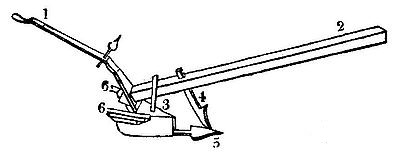
Aratrum, Plough (now used at Mantua).
1. Buris. 2. Temo. 3. Dentale.
4. Culter. 5. Vomer. 6 6. Aures.
ARBĬTER. [Judex.]
ARCA (κιβωτός). (1) A chest, in which the Romans were accustomed to place their money; and the phrase ex arca solvere had the meaning of paying in ready money. The term arcae was usually applied to the chests in which the rich kept their money, and was opposed to the smaller loculi, sacculus, and crumena.—(2) The coffin in which persons were buried, or the bier on which the corpse was placed previously to burial.—(3) A strong cell made of oak, in which criminals and slaves were confined.
ARCĔRA, a covered carriage or litter, spread with cloths, which was used in ancient times in Rome, to carry the aged and infirm. It is said to have obtained the name of arcera on account of its resemblance to an arca, or chest.
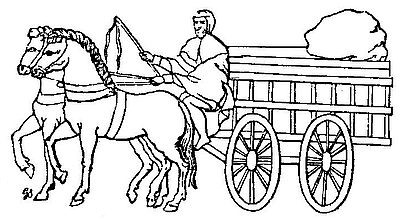
Arcera. (Ginzrot, Wagen, Tav. 19, fig. 2.)
ARCHEION (ἀρχεῖον) properly means any public place belonging to the magistrates, but is more particularly applied to the archive office, where the decrees of the people and other state documents were preserved. This office is sometimes merely called τὸ δημοσίον. At Athens the archives were kept in the temple of the mother of the gods (μήτρῳον), and the charge of it was entrusted to the president (ἐπιστάτης) of the senate of the Five-hundred.
ARCHĬĀTER (ἀρχίατρος), a medical title under the Roman emperors, the exact signification of which has been the subject of much discussion, but which most probably means “the chief of the physicians.” The first person whom we find bearing this title is Andromachus, physician to Nero. In after times the order appears to have been divided, and we find two distinct classes of archiatri, viz., those of the palace and those of the people.
ARCHĬMĪMUS. [Mimus.]
ARCHĬTECTŪRA ( ἀρχιτεκτονία, ἀρχιτεκτονική), architecture. The necessity for a habitation, and the attempt to adorn those habitations which were intended for the gods, are the two causes from which the art derives its existence. In early times little attention was paid to domestic architecture. The resources of the art were lavished upon the temples of the gods; and hence the greater part of the history of Grecian architecture is inseparably connected with that of the temple, and has its proper place under Templum, and the subordinate headings, such as Columna, &c. But, though the first rise of architecture, as a fine art, is connected with the temple, yet, viewed as the science of construction, it must have been employed, even earlier, for other purposes, such as the erection of fortifications, palaces, treasuries, and other works of utility. Accordingly, it is the general opinion of antiquaries, that the very earliest edifices, of which we have any remains, are the so-called Cyclopean works, in which we see huge unsquared blocks of stone built together in the best way that their shapes would allow. [Murus.] In addition to these, however, there are other purposes for which architecture, still using the term in its lower sense, would be required in a very early stage of political society; such as the general arrangement of cities, the provision of a place for the transaction of public business, with the necessary edifices appertaining to it [Agora, Forum], and the whole class of works which we embrace under the head of civil engineering, such as those for drainage [Cloaca, Emissarius], for communication [Via, Pons], and for the supply of water [Aquae ductus]. Almost equally necessary are places devoted to public exercise, health, and amusement, Gymnasium, Stadium, Hippodromus, Circus, Balneum, Theatrum, Amphitheatrum. Lastly, the skill of the architect has been from the earliest times employed to preserve the memory of departed men and past events; and hence we have the various works of monumental and triumphal architecture, which are described under the heads Funus, Arcus, Columna. The history of architecture may be divided into five periods. The first, which is chiefly mythical, comes down to the time of Cypselus, Ol. 30, B.C. 660: the second period comes down to the termination of the Persian war, Ol. 75. 2, B.C. 478: the third is the brilliant period from the end of the Persian war to the death of Alexander the Great, Ol. 114, B.C. 323: the fourth period extends to the battle of Actium, B.C. 31: the fifth period embraces the architecture of the Roman empire till it became mingled with the Gothic. Strongly fortified cities, palaces, and treasuries are the chief works of the earlier part of the first period; and to it may be referred most of the so-called Cyclopean remains; while the era of the Dorian invasion marks, in all probability, the commencement of the Dorian style of temple architecture. In the second period the art made rapid advances under the powerful patronage of the aristocracies in some cities, as at Sparta, and of the tyrants in others, as Cypselus at Corinth, Theagnes at Megara, Cleisthenes at Sicyon, the Peisistratids at Athens, and Polycrates at Samos. Architecture now assumed decidedly the character of a fine art, and became associated with the sister arts of sculpture and painting, which are essential to its development. Magnificent temples sprung up in all the principal Greek cities; and while the Doric order was brought almost, if not quite, to perfection, in Greece Proper, in the Doric colonies of Asia Minor, and in Central Italy and Sicily, the Ionic order appeared, already perfect at its first invention, in the great temple of Artemis at Ephesus. The ruins still existing at Paestum, Syracuse, Agrigentum, Selinus, Aegina, and other places, are imperishable monuments of this period. To it also belong the great works of the Roman kings. The commencement of the third and most brilliant period of the art was signalized by the rebuilding of Athens, the establishment of regular principles for the laying out of cities by Hippodamus of Miletus, and the great works of the age of Pericles, by the contemporaries of Phidias, at Athens, Eleusis, and Olympia. The first part of the fourth period saw the extension of the Greek architecture over the countries conquered by Alexander, and, in the West, the commencement of the new style, which arose from the imitation, with some alterations, of the Greek forms by Roman architects, to which the conquest of Greece gave, of course, a new impulse. By the time of Augustus, Rome was adorned with every kind of public and private edifice, surrounded by villas, and furnished with roads and aqueducts; and these various erections were adorned by the forms of Grecian art; but already Vitruvius begins to complain that the purity of that art is corrupted by the intermixture of heterogeneous forms. This process of deterioration went on rapidly during the fifth period, though combined at first with increasing magnificence in the scale and number of the buildings erected. The early part of this period is made illustrious by the numerous works of Augustus and his successors, especially the Flavii, Nerva, Trajan, Hadrian, and the Antonines, at Rome and in the provinces; but from the time of the Antonines the decline of the art was rapid and decided. In one department a new impulse was given to architecture by the rise of Christian churches, which were generally built on the model of the Roman Basilica. One of the most splendid specimens of Christian architecture is the church of S. Sophia at Constantinople, built in the reign of Justinian, A.D. 537, and restored, after its partial destruction by an earthquake, in 554. But, long before this time, the Greco-Roman style had become thoroughly corrupted, and that new style, which is called the Byzantine, had arisen out of the mixture of Roman architecture with ideas derived from the Northern nations.
ARCHITHĔŌRUS (ἀρχιθέωρος). [Delia.]
ARCHON (ἄρχων). The government of Athens began with monarchy, and, after passing through a dynasty[1] and aristocracy, ended in democracy. Of the kings of Athens, considered as the capital of Attica, Theseus may be said to have been the first; for to him, whether as a real individual or a representative of a certain period, is attributed the union of the different and independent states of Attica under one head. The last was Codrus; in acknowledgment of whose patriotism in meeting death for his country, the Athenians are said to have determined that no one should succeed him with the title of king (βασιλεύς). It seems, however, equally probable that it was the nobles who availed themselves of the opportunity to serve their own interests, by abolishing the kingly power for another, the possessors of which they called Archontes (ἄρχοντες) or rulers. These for some time continued to be like the kings of the house of Codrus, appointed for life: still an important point was gained by the nobles, the office being made accountable (ὑπεύθυνος), which of course implies that the nobility had some control over it. This state of things lasted for twelve reigns of archons. The next step was to limit the continuance of the office to ten years, still confining it to the Medontidae, or house of Codrus, so as to establish what the Greeks called a dynasty, till the archonship of Eryxias, the last archon of that family elected as such. At the end of his ten years (B.C. 684), a much greater change took place: the archonship was made annual, and its various duties divided among a college of nine, chosen by suffrage (χειροτονία) from the Eupatridae, or Patricians, and no longer elected from the Medontidae exclusively. This arrangement lasted till the time of Solon, who still continued the election by suffrage, but made the qualification for office depend, not on birth, but property. The election by lot is believed to have been introduced by Cleisthenes (B.C. 508). The last change is supposed to have been made by Aristides, who after the battle of Plataeae (B.C. 479) abolished the property qualification, throwing open the archonship and other magistracies to all the citizens; that is, to the Thetes, as well as the other classes, the former of whom were not allowed by Solon’s laws to hold any magistracy at all. Still, after the removal of the old restrictions, some security was left to insure respectability; for, previously to an archon entering on office, he underwent an examination, called the anacrisis (ἀνάκρισις), as to his being a legitimate and a good citizen, a good son, and qualified in point of property, but the latter limitation was either done away with by Aristides, or soon became obsolete. Yet, even after passing a satisfactory anacrisis, each of the archons, in common with other magistrates, was liable to be deposed on complaint of misconduct made before the people, at the first regular assembly in each prytany. On such an occasion the epicheirotonia (ἐπιχειροτονία), as it was called, took place: and we read that in one case the whole college of archons was deprived of office (ἀποχειροτονεῖσθαι). In consequence of the democratical tendency of the assembly and courts of justice established by Solon, the archons lost the great political power which they at one time possessed. They became, in fact, not as of old directors of the government, but merely municipal magistrates, exercising functions and bearing titles described below. It has been already stated, that the duties of the single archon were shared by a college of nine. The first, or president of this body, was called Archon, by way of pre-eminence, or Archon Eponymus (ἄρχων ἐπώνυμος), from the year being distinguished by and registered in his name. The second was styled Archon Basileus (ἄρχων βασιλεύς), or the King Archon; the third Polemarchus (πολέμαρχος), or commander-in-chief; the remaining six, Thesmothetae (θεσμοθέται), or legislators. As regards the duties of the archons, it is sometimes difficult to distinguish what belonged to them individually, and what collectively. It seems that a considerable portion of the judicial functions of the ancient kings devolved upon the Archon Eponymus, who was also constituted a sort of state protector of those who were unable to defend themselves. Thus he was to superintend orphans, heiresses, families losing their representatives, widows left pregnant, and to see that they were not wronged in any way. This archon had also the superintendence of the greater Dionysia, and the Thargelia. The functions of the King Archon were almost all connected with religion; his distinguishing title shows that he was considered a representative of the old kings in their capacity of high priest, as the Rex Sacrificulus was at Rome. Thus he presided at the Lenaea, or older Dionysia; superintended the mysteries and the games called Lampadephoriae, and had to offer up sacrifices and prayers in the Eleusinium, both at Athens and Eleusis. Moreover, indictments for impiety, and controversies about the priesthood, were laid before him; and, in cases of murder, he brought the trial into the court of the areiopagus, and voted with its members. His wife, also, who was called Basilissa (βασίλισσα), had to offer certain sacrifices, and therefore it was required that she should be a citizen of pure blood, without stain or blemish. The Polemarch was originally, as his name denotes, the commander-in-chief, and we find him discharging military duties as late as the battle of Marathon, in conjunction with the ten Strategi; he there took, like the kings of old, the command of the right wing of the army. This, however, seems to be the last occasion on record of this magistrate appointed by lot being invested with such important functions; and in after ages we find that his duties ceased to be military, having been, in a great measure, transferred to the protection and superintendence of the resident aliens, so that he resembled in many respects the praetor peregrinus at Rome. Thus, all actions affecting aliens, the isoteles and proxeni were brought before him previously to trial. Moreover, it was the polemarch’s duty to offer the yearly sacrifice to Artemis, in commemoration of the vow made by Callimachus, at Marathon, and to arrange the funeral games in honour of those who fell in war. The six Thesmothetae were extensively connected with the administration of justice, and appear to have been called legislators, because, in the absence of a written code, they might be said to make laws, or thesmi (θεσμοί), in the ancient language of Athens, though in reality they only explained them. They were required to review, every year, the whole body of laws, that they might detect any inconsistencies or superfluities, and discover whether any laws which were abrogated were in the public records amongst the rest. Their report was submitted to the people, who referred the necessary alterations to a legislative committee chosen for the purpose, and called Nomothetae (νομοθέται). The chief part of the duties of the thesmothetae consisted in receiving informations, and bringing cases to trial in the courts of law, of the days of sitting in which they gave public notice. They did not try them themselves, but seem to have constituted a sort of grand jury, or inquest. The trial itself took place before the Dicastae. [Dicastae.] It is necessary to be cautious in our interpretation of the words ἀρχή and ἄρχοντες, since they have a double meaning in the Attic orators, sometimes referring to the archons peculiarly so called, and sometimes to any other magistracy. The archons had various privileges and honours. The greatest of the former was the exemption from the trierarchies—a boon not allowed even to the successors of Harmodius and Aristogeiton. As a mark of their office, they wore a chaplet or crown of myrtle; and if any one struck or abused one of the archons, when wearing this badge of office, he became atimus (ἄτιμος), or infamous in the fullest extent, thereby losing his civic rights. The archons, at the close of their year of service, were admitted among the members of the areiopagus. [Areiopagus.]
FOOTNOTE:
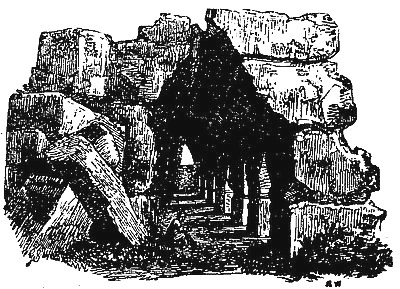
Arch of Tiryns. (Gell’s Itinerary, pl. 16.)
ARCUS (also fornix), an arch. A true arch is formed of a series of wedge-like stones, or of bricks, supporting each other, and all bound firmly together by their mutual pressure. It would seem that the arch, as thus defined, and as used by the Romans, was not known to the Greeks in the early periods of their history. But they made use of a contrivance, even in the heroic age, by which they were enabled to gain all the advantages of our archway in making corridors, or hollow galleries, and which in appearance resembled the pointed arch, such as is now termed Gothic. This was effected by cutting away the superincumbent stones in the manner already described, at an angle of about 45° with the horizon. The mode of construction and appearance of such arches is represented in the annexed drawing of the walls of Tiryns. The gate of Signia (Segni) in Latium exhibits a similar example. The principle of the true arch seems to have been known to the Romans from the earliest period; it is used in the Cloaca Maxima. It is most probably an Etruscan invention. The use of it constitutes one leading distinction between Greek and Roman architecture, for by its application the Romans were enabled to execute works of far bolder construction than those of the Greeks. The Romans, however, never used any other form of arch than the semicircle. The arcus triumphalis, triumphal arch, was a structure peculiar to the Romans, erected in honour of an individual, or in commemoration of a conquest. Triumphal arches were built across the principal streets of Rome, and, according to the space of their respective localities, consisted of a single archway, or a central one for carriages, and two smaller ones on each side for foot-passengers. Those actually made use of on the occasion of a triumphal entry and procession were merely temporary and hastily erected; and, having served their purpose, were taken down again, and sometimes replaced by others of more durable materials. Stertinius is the first upon record who erected anything of the kind. He built an arch in the Forum Boarium, about B.C. 196, and another in the Circus Maximus, each of which was surmounted by gilt statues. There are twenty-one arches recorded by different writers, as having been erected in the city of Rome, five of which now remain:—1. Arcus Drusi, which was erected to the honour of Claudius Drusus on the Appian way. 2. Arcus Titi, at the foot of the Palatine, which was erected to the honour of Titus, after his conquest of Judaea; the bas-reliefs of this arch represent the spoils from the temple of Jerusalem carried in triumphal procession. 3. Arcus Septimii Severi, which was erected by the senate (A.D. 207) at the end of the Via Sacra, in honour of that emperor and his two sons, Caracalla and Geta, on account of his conquest of the Parthians and Arabians. 4. Arcus Gallieni, erected to the honour of Gallienus by a private individual, M. Aurelius Victor. 5. Arcus Constantini, which was larger than the arch of Titus. As a specimen of the triumphal arches, a drawing of the arch of Drusus is given in the preceding page.
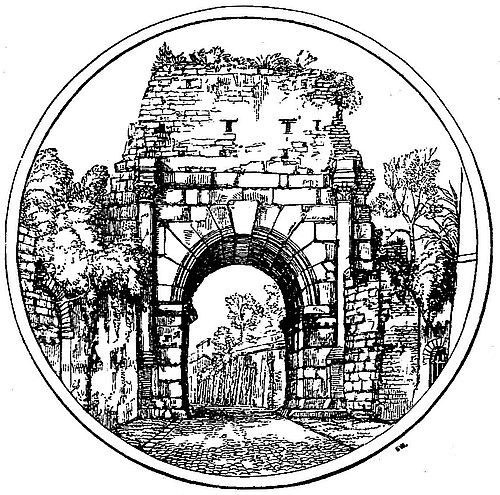
Arch of Drusus at Rome
ARCUS (βιός, τόξον), the bow used for shooting arrows, is one of the most ancient of all weapons, but is characteristic of Asia rather than of Europe. In the Roman armies it was scarcely ever employed except by auxiliaries; and these auxiliaries, called sagittarii, were chiefly Cretes and Arabians. The upper of the two figures below shows the Scythian or Parthian bow unstrung; the lower one represents the usual form of the Grecian bow, which had a double curvature, consisting of two circular portions united by the handle. When not used, the bow was put into a case (τοξοθήκη, γωρυτός, corytus), which was made of leather, and sometimes ornamented. It frequently held the arrows as well as the bow, and on this account is often confounded with the pharetra or quiver.
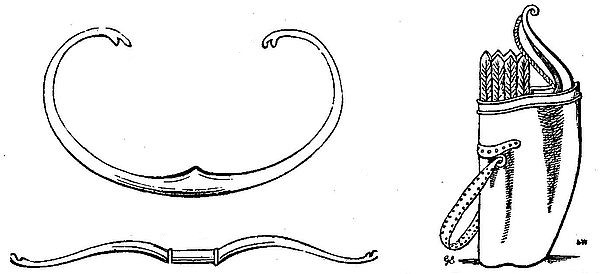
Arcus, Bow. (From paintings on vases.)
Corytus, Bow-case. (From a Relief in the Vatican, Visconti, iv. tav. 43.)
ĀRĔA (ἅλως, or ἁλωά), the threshing-floor, was a raised place in the field, open on all sides to the wind. Great pains were taken to make this floor hard; it was sometimes paved with flint stones, but more usually covered with clay and smoothed with a roller.
ĂREIOPĂGUS (ὁ Ἄρειος πάγος, or hill of Ares) was a rocky eminence, lying to the west of, and not far from the Acropolis at Athens. It was the place of meeting of the council (Ἡ ἐν Ἀρείῳ πάγῳ βουλή), which was sometimes called The Upper Council (Ἡ ἄνω βουλή), to distinguish it from the senate of Five-hundred, which sat in the Cerameicus within the city. It was a body of very remote antiquity, acting as a criminal tribunal, and existed long before the time of Solon, but he so far modified its constitution and sphere of duty, that he may almost be called its founder. What that original constitution was, must in some degree be left to conjecture, though there is every reason to suppose that it was aristocratical, the members being taken, like the ephetae, from the noble patrician families. [Ephetae.] By the legislation of Solon the Areiopagus was composed of the ex-archons, who, after an unexceptionable discharge of their duties, “went up” to the Areiopagus, and became members of it for life, unless expelled for misconduct. As Solon made the qualification for the office of archon to depend not on birth but on property, the council after his time ceased to be aristocratic in constitution; but, as we learn from Attic writers, continued so in spirit. In fact, Solon is said to have formed the two councils, the senate and the Areiopagus, to be a check upon the democracy; that, as he himself expressed it, “the state riding upon them as anchors might be less tossed by storms.” Nay, even after the archons were no longer elected by suffrage, but by lot, and the office was thrown open by Aristides to all the Athenian citizens, the “upper council” still retained its former tone of feeling. Moreover, besides these changes in its constitution, Solon altered and extended its functions. Before his time it was only a criminal court, trying cases of “wilful murder and wounding, of arson and poisoning,” whereas he gave it extensive powers of a censorial and political nature. Thus we learn that he made the council an “overseer of everything, and the guardian of the laws,” empowering it to inquire how any one got his living and to punish the idle; and we are also told that the Areiopagites were “superintendents of good order and decency,” terms as unlimited and undefined as Solon not improbably wished to leave their authority. When heinous crimes had notoriously been committed, but the guilty parties were not known, or no accuser appeared, the Areiopagus inquired into the subject, and reported to the demus. The report or information was called apophasis. This was a duty which they sometimes undertook on their own responsibility, and in the exercise of an old established right, and sometimes on the order of the demus. Nay, to such an extent did they carry their power, that on one occasion they apprehended an individual (Antiphon), who had been acquitted by the general assembly, and again brought him to a trial, which ended in his condemnation and death. Again, we find them revoking an appointment whereby Aeschines was made the advocate of Athens before the Amphictyonic council, and substituting Hyperides in his room. They also had duties connected with religion, one of which was to superintend the sacred olives growing about Athens, and try those who were charged with destroying them; and in general it was their office to punish the impious and irreligious. Independent, then, of its jurisdiction as a criminal court in cases of wilful murder, which Solon continued to the Areiopagus, its influence must have been sufficiently great to have been a considerable obstacle to the aggrandisement of the democracy at the expense of the other parties in the state. Accordingly, we find that Pericles, who was opposed to the aristocracy, resolved to diminish its power and circumscribe its sphere of action. His coadjutor in this work was Ephialtes, a statesman of inflexible integrity, and also a military commander. They experienced much opposition in their attempts, not only in the assembly, but also on the stage, where Aeschylus produced his tragedy of the Eumenides, the object of which was to impress upon the Athenians the dignity, sacredness, and constitutional worth of the institution which Pericles and Ephialtes wished to reform. Still the opposition failed: a decree was carried by which, as Aristotle says, the Areiopagus was “mutilated,” and many of its hereditary rights abolished, though it is difficult to ascertain the precise nature of the alterations which Pericles effected. The jurisdiction of the Areiopagus in cases of murder was still left to them. In such cases the process was as follows:—The king archon brought the case into court, and sat as one of the judges, who were assembled in the open air, probably to guard against any contamination from the criminal. The accuser first came forwards to make a solemn oath that his accusation was true, standing over the slaughtered victims, and imprecating extirpation upon himself and his whole family were it not so. The accused then denied the charge with the same solemnity and form of oath. Each party then stated his case with all possible plainness, keeping strictly to the subject, and not being allowed to appeal in any way to the feelings or passions of the judges. After the first speech, a criminal accused of murder might remove from Athens, and thus avoid the capital punishment fixed by Draco’s Thesmi, which on this point were still in force. Except in cases of parricide, neither the accuser nor the court had power to prevent this; but the party who thus evaded the extreme punishment was not allowed to return home, and when any decree was passed at Athens to legalize the return of exiles, an exception was always made against those who had thus left their country. The Areiopagus continued to exist, in name at least, till a very late period. Thus we find Cicero mentioning the council in his letters; and an individual is spoken of as an Areiopagite under the emperors Gratian and Theodosius (A.D. 380). The case of St. Paul is generally quoted as an instance of the authority of the Areiopagus in religious matters; but the words of the sacred historian do not necessarily imply that he was brought before the council. It may, however, be remarked, that the Areiopagites certainly took cognizance of the introduction of new and unauthorised forms of religious worship, called ἐπίθετα ἱερά, in contradistinction to the πάτρια or older rites of the state.
ĂRĒNA. [Amphitheatrum.]
ĂRĔTĀLŎGI, persons who amused the company at the Roman dinner tables.
ARGĒI, the name given by the pontifices to the places consecrated by Numa for the celebration of religious services. Varro calls them the chapels of the argei, and says they were twenty-seven in number, distributed in the different districts of the city. There was a tradition that these argei were named from the chieftains who came with Hercules, the Argive, to Rome, and occupied the Capitoline, or, as it was anciently called, Saturnian hill. It is impossible to say what is the historical value or meaning of this legend; we may, however, notice its conformity with the statement that Rome was founded by the Pelasgians, with whom the name of Argos was connected. The name argei was also given to certain figures thrown into the Tiber from the Sublician bridge, on the Ides of May in every year. This was done by the pontifices, the vestals, the praetors, and other citizens, after the performance of the customary sacrifices. The images were thirty in number, made of bulrushes, and in the form of men. Ovid makes various suppositions to account for the origin of this rite; we can only conjecture that it was a symbolical offering, to propitiate the gods, and that the number was a representative either of the thirty patrician curiae at Rome, or perhaps of the thirty Latin townships.
ARGENTĀRĬI, bankers or money changers. (1) Greek. The bankers at Athens were called Trapezitae (τραπεζίται), from their tables (τραπεζαι) at which they sat, while carrying on their business, and which were in the market place. Their principal occupation was that of changing money; but they frequently took money, at a moderate premium, from persons who did not like to occupy themselves with the management of their own affairs, and placed it out at interest. Their usual interest was 36 per cent.; a rate that at present scarcely occurs except in cases of money lent on bottomry. The only instance of a bank recognized and conducted on behalf of the state occurs at Byzantium, where at one time it was let by the republic to capitalists to farm. Yet the state probably exercised some kind of superintendence over the private bankers, since it is hardly possible otherwise to account for the unlimited confidence which they enjoyed.—(2) Roman. The Argentarii at Rome must be distinguished from the mensarii and nummularii, or public bankers. [Mensarii.] The argentarii were private persons, who carried on business on their own responsibility, and were not in the service of the republic; but the shops or tabernae about the forum, which they occupied, and in which they transacted their business, were state property. The business of the argentarii may be divided into the following branches. 1. Permutatio, or the exchange of foreign coin for Roman, and in later times the giving of bills of exchange payable in foreign towns. 2. The keeping of sums of money for other persons. Such money might be deposited by the owner merely to save himself the trouble of keeping it and making payments, and in this case it was called depositum; the argentarius then paid no interest, and the money was called vacua pecunia. Or the money was deposited on condition of the argentarius paying interest; in this case the money was called creditum. A payment made through a banker was called per mensam, de mensa, or per mensae scripturam, while a payment made by the debtor in person was a payment ex arca or de domo. An argentarius never paid away any person’s money without being either authorised by him in person or receiving a cheque which was called perscriptio. The argentarii kept accurate accounts in books called codices, tabulae, or rationes, and there is every reason for believing that they were acquainted with what is called in book-keeping double entry. When a party found to be in debt paid what he owed, he had his name effaced (nomen expedire or expungere) from the banker’s books. 3. Their connection with commerce and public auctions. In private sales and purchases, they sometimes acted as agents for either party (interpretes), and sometimes they undertook to sell the whole estate of a person, as an inheritance. At public auctions they were almost invariably present, registering the articles sold, their prices, and purchasers, and receiving the payment from the purchasers. 4. The testing of the genuineness of coins (probatio nummorum). This, however, seems originally to have been a part of the duty of public officers, the mensarii or nummularii, until in the course of time the opinion of an argentarius also came to be looked upon as decisive. 5. The solidorum venditio, that is, the obligation of purchasing from the mint the newly coined money, and circulating it among the people. This branch of their functions occurs only under the empire. The argentarii formed a collegium, divided into societates or corporations, which alone had the right to admit new members of their guild. None but freemen could become members of such a corporation. It has already been observed that the argentarii had their shops round the forum: hence to become bankrupt was expressed by foro cedere, or abire, or foro mergi.
ARGENTUM (ἄργυρος), silver. The relative value of gold and silver differed considerably at different periods in Greek and Roman history. Herodotus mentions it as 13 to 1; Plato, as 12 to 1; Menander, as 10 to 1; and Livy as 10 to 1, about B.C. 189. According to Suetonius, Julius Caesar, on one occasion, exchanged silver for gold in the proportion of 9 to 1; but the most usual proportion under the early Roman emperors was about 12 to 1. The proportion in modern times, since the discovery of the American mines, has varied between 17 to 1 and 14 to 1. In the earliest times the Greeks obtained their silver chiefly as an article of commerce from the Phocaeans and the Samians; but they soon began to work the rich mines of their own country and its islands. The chief mines were in Siphnos, Thessaly, and Attica. In the last-named country, the silver mines of Laurion furnished a most abundant supply, and were generally regarded as the chief source of the wealth of Athens. The Romans obtained most of their silver from the very rich mines of Spain, which had been previously worked by the Phoenicians and Carthaginians, and which, though abandoned for those of Mexico, are still not exhausted. By far the most important use of silver among the Greeks was for money. There are sufficient reasons for believing that, until some time after the end of the Peloponnesian war, the Athenians had no gold currency. [Aurum.] It may be remarked that all the words connected with money are derived from ἄργυρος, and not from χρυσός, as καταργυρόω, “to bribe with money;” ἀργυραμοιβός, “a money changer,” &c.; and ἄργυρος is itself not unfrequently used to signify money in general, as aes is in Latin. At Rome, on the contrary, silver was not coined till B.C. 269, before which period Greek silver was in circulation at Rome; and the principal silver coin of the Romans, the denarius, was borrowed from the Greek drachma. For further details respecting silver money, see Denarius, Drachma. From a very early period, silver was used also in works of art; and the use of it for mere purposes of luxury and ostentation, as in plate, was very general both in Greece and Rome.
ARGỸRASPĬDES (ἀργυράσπιδες), a division of the Macedonian army, who were so called because they carried shields covered with silver plates.
ARGỸROCŎPEION (ἀργυροκοπεῖον), the place where money was coined, the mint, at Athens.
ĂRĬES (κριός), the battering-ram, was used to batter down the walls of besieged cities. It consisted of a large beam, made of the trunk of a tree, especially of a fir or an ash. To one end was fastened a mass of bronze or iron (κεφαλή, ἐμβολή, προτομή), which resembled in its form the head of a ram. The aries in its simplest state was borne and impelled by human hands, without other assistance. In an improved form, the ram was surrounded with iron bands, to which rings were attached for the purpose of suspending it by ropes or chains from a beam fixed transversely over it. By this contrivance the soldiers were relieved from the necessity of supporting the weight of the ram, and could with ease give it a rapid and forcible motion backwards and forwards. The use of this machine was further aided by placing the frame in which it was suspended upon wheels, and also by constructing over it a wooden roof, so as to form a “testudo,” which protected the besieging party from the defensive assaults of the besieged.
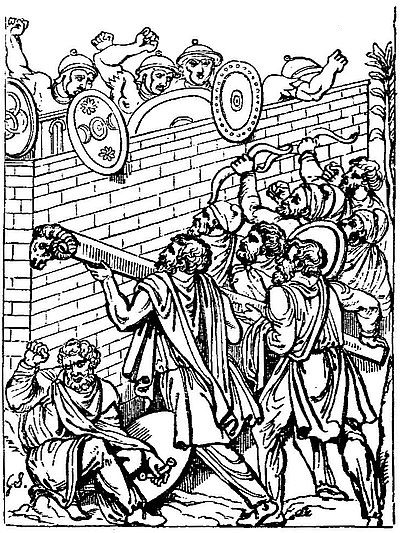
Aries, Battering Ram. (From Column of Trajan.)
ĀRISTOCRĂTĬA (ἀριστοκρατία), signifies literally “the government of the best men,” and as used by Plato, Aristotle, Polybius, &c., it meant the government of a class whose supremacy was founded not on wealth merely, but on personal distinction. That there should be an aristocracy, moreover, it was essential that the administration of affairs should be conducted with a view to the promotion of the general interests, not for the exclusive or predominant advantage of the privileged class As soon as the government ceased to be thus conducted, or whenever the only title to political power in the dominant class was the possession of superior wealth, the constitution was termed an oligarchy (ὀλιγαρχία), which, in the technical use of the term, was always looked upon as a corruption (παρέκβασις) of an aristocracy. In the practical application of the term aristocracy, however, the personal excellence which was held to be a necessary element was not of a higher kind than what, according to the deeply-seated ideas of the Greeks, was commonly hereditary in families of noble birth, and in early times would be the ordinary accompaniments of noble rank, namely, wealth, military skill, and superior education and intelligence. It is to be noted that the word ἀριστοκρατία is never, like the English term aristocracy, the name of a class, but only of a particular political constitution.
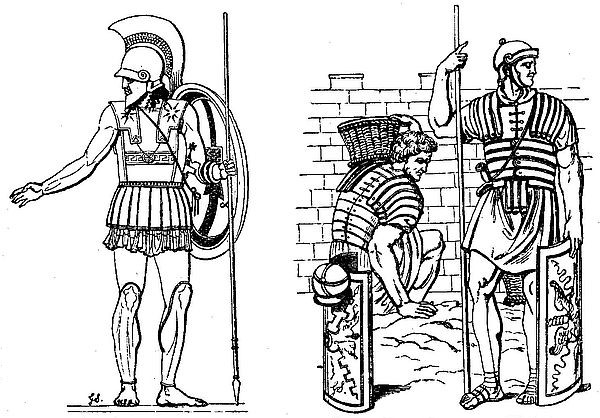
Greek Soldier. (From an ancient vase.)
Roman Soldiers. (From Column of Trajan.)
ARMA, ARMĀTŪRA (ἔντεα, τεύχεα, Hom.; ὅπλα), arms, armour. Homer describes in various passages an entire suit of armour, and we observe that it consisted of the same portions which were used by the Greek soldiers ever after. Moreover, the order of putting them on is always the same. The heavy-armed warrior, having already a tunic around his body, and preparing for combat, puts on—1. his greaves (κνημῖδες, ocreae); 2. his cuirass (θώραξ, lorica), to which belonged the μίτρη underneath, and the zone (ζώνη, ζωστῆρ, cingulum), above; 3. his sword (ξίφος, ensis, gladius), hung on the left side of his body by means of a belt which passed over the right shoulder; 4. the large round shield (σάκος, ἀσπίς, clipeus, scutum), supported in the same manner; 5. his helmet (κόρυς, κυνέη, cassis, galea); 6. he took his spear (ἔγχος, δόρυ, hasta), or in many cases, two spears. The form and use of these portions are described in separate articles, under their Latin names. The annexed cut exhibits them all. Those who were defended in the manner which has now been represented are called by Homer aspistae (ἀσπισταί), from their great shield (ἀσπίς); also angemachi (ἀγχεμάχοι), because they fought hand to hand with their adversaries; but much more commonly promachi (πρόμαχοι), because they occupied the front of the army. In later times, the heavy-armed soldiers were called hoplitae (ὁπλίται), because the term hopla (ὄπλα) more especially denoted the defensive armour, the shield and thorax. By wearing these they were distinguished from the light-armed (ψιλοί, ἄνοπλοι, γυμνοί, γυμνῆται, γυμνῆτες), who, instead of being defended by the shield and thorax, had a much slighter covering, sometimes consisting of skins, and sometimes of leather or cloth; and instead of the sword or lance, they commonly fought with darts, stones, bows and arrows, or slings. Besides the heavy and light-armed soldiers, another description of men, the peltastae (πελτασταί), also formed a part of the Greek army, though we do not hear of them in early times. Instead of the large round shield, they carried a smaller one called the pelté (πέλτη), and in other respects their armour, though heavier and more effective than that of the psili, was much lighter than that of the hoplites. The weapon on which they principally depended was the spear. The Roman legions consisted, as the Greek infantry for the most part did, of heavy and light-armed troops (gravis et levis armatura). The preceding figure represents two heavy-armed Roman soldiers. All the essential parts of the Roman heavy armour (lorica, ensis, clipeus, galea, hasta) are mentioned together, except the spear, in a well-known passage of St. Paul (Eph. vi. 17).
ARMĀRĬUM, originally a place for keeping arms, afterwards a cupboard, in which were kept not only arms, but also clothes, books, money, and other articles of value. The armarium was generally placed in the atrium of the house.
ARMILLA (ψάλιον, ψέλιον, or ψέλλιον, χλιδών, ἀμφιδέα), a bracelet or armlet, worn both by men and women. It was a favourite ornament of the Medes and Persians. Bracelets do not appear to have been worn among the Greeks by the male sex, but Greek ladies had bracelets of various materials, shapes, and styles of ornament. They frequently exhibited the form of snakes, and were in such cases called snakes (ὄφεις) by the Athenians. According to their length, they went once, twice, or thrice round the arm, or even a greater number of times. The Roman generals frequently bestowed armillae upon soldiers for deeds of extraordinary merit.
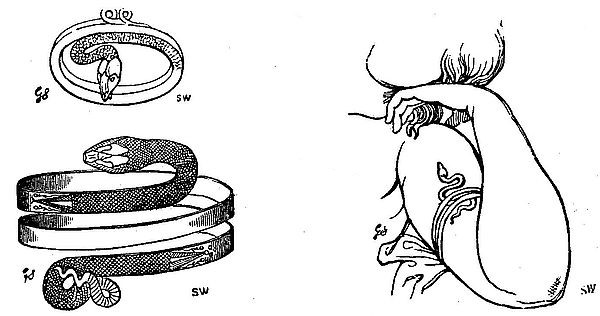
Armillae, Bracelets. (Museo Borbonico, vol. ii. tav. 14 vol. vii. tav. 46.)
Armilla, Bracelet. (On Statue of Sleeping Ariadne in Vatican.)
ARMĬLUSTRĬUM, a Roman festival for the purification of arms. It was celebrated every year on the 19th of October, when the citizens assembled in arms, and offered sacrifices in the place called Armilustrum, or Vicus Armilustri.
ARRA, ARRĂBO, or ARRHA, ARRHABO, was the thing which purchasers and vendors gave to one another, whether it was a sum of money or anything else, as an evidence of the contract being made: it was no essential part of the contract of buying and selling, but only evidence of agreement as to price. The term arrha, in its general sense of an evidence of agreement, was also used on other occasions, as in the case of betrothment (sponsalia). Sometimes the word arrha is used as synonymous with pignus, but this is not the legal meaning of the term.
ARRHĒPHŎRĬA (ἀῤῥηφόρια), a festival celebrated at Athens in honour of Athena (Minerva). Four girls, of between seven and eleven years (ἀῤῥηφόροι, ἐρσηφόροι, ἐῤῥηφόροι), were selected every year by the king archon from the most distinguished families, two of whom superintended the weaving of the sacred peplus of Athena; the two others had to carry the mysterious and sacred vessels of the goddess. These latter remained a whole year on the Acropolis; and when the festival commenced, the priestess of the goddess placed vessels upon their heads, the contents of which were neither known to them nor to the priestess. With these they descended to a natural grotto within the district of Aphrodite in the gardens. Here they deposited the sacred vessels, and carried back something else, which was covered and likewise unknown to them. After this the girls were dismissed and others were chosen to supply their place in the acropolis.
ARRŎGĀTĬO. [Adoptio.]
ARTĂBA (ἀρτάβη), a Persian measure of capacity = 1 medimnus and 3 choenices (Attic) = 102 Roman sextarii = 12 gallons, 5·092 pints.
ARTĔMĪSĬA (ἀρτεμίσια), a festival celebrated at Syracuse in honour of Artemis Potamia and Soteira. It lasted three days, which were principally spent in feasting and amusements, Festivals of the same name, and in honour of the same goddess, were held in many places in Greece, but principally at Delphi.
ARTOPTA. [Pistor.]
ĂRŪRA (ἄρουρα), a Greek measure of surface, mentioned by Herodotus, who says that it is a hundred Egyptian cubits in every direction. Now the Egyptian cubit contained nearly 17¾ inches; therefore the square of 100 by 17¾ inches, i.e. nearly 148 feet, gives the number of square feet (English) in the arura, viz. 21,904.
ĂRUSPEX. [Haruspex.]
ARVĀLES FRĀTRES, formed a college or company of twelve priests, and were so called from offering public sacrifices for the fertility of the fields. That they were of extreme antiquity is proved by the legend which refers their institution to Romulus, of whom it is said, that when his nurse Acca Laurentia lost one of her twelve sons, he allowed himself to be adopted by her in his place, and called himself and the remaining eleven “Fratres Arvales.” We also find a college called the Sodales Titii, and as the latter were confessedly of Sabine origin, and instituted for the purpose of keeping up the Sabine religious rites, it is probable that these colleges corresponded one to the other—the Fratres Arvales being connected with the Latin, and the Sodales Titii with the Sabine element of the Roman state. The office of the fratres arvales was for life, and was not taken away even from an exile or captive. One of their annual duties was to celebrate a three days’ festival in honour of Dea Dia, supposed to be Ceres, sometimes held on the 17th, 19th, and 20th, sometimes on the 27th, 29th, and 30th of May. But besides this festival of the Dea Dia, the fratres arvales were required on various occasions, under the emperors, to make vows and offer up thanksgivings. Under Tiberius, the Fratres Arvales performed sacrifices called the Ambarvalia, at various places on the borders of the ager Romanus, or original territory of Rome; and it is probable that this was a custom handed down from time immemorial, and, moreover, that it was a duty of the priesthood to invoke a blessing on the whole territory of Rome. There were also the private ambarvalia, which were so called from the victim (hostia ambarvalis) that was slain on the occasion being led three times round the corn-fields, before the sickle was put to the corn. This victim was accompanied by a crowd of merry-makers, the reapers and farm-servants dancing and singing, as they marched, the praises of Ceres, and praying for her favour and presence, while they offered her the libations of milk, honey, and wine. This ceremony was also called a lustratio, or purification.
ARX signifies a height within the walls of a city, upon which a citadel was built, and thus came to be applied to the citadel itself. Thus one of the summits of the Capitoline hill at Rome is called Arx. The Arx was the regular place at Rome for taking the auspices, and was hence likewise called auguraculum; or, more probably, the auguraculum was a place in the Arx.
AS, or Libra, a pound, the unit of weight among the Romans. [Libra.]
AS, the unit of value in the Roman and old Italian coinages, was made of copper, or of the mixed metal called Aes. It was originally of the weight of a pound of twelve ounces, whence it was called as libralis and aes grave. The oldest form of the as is that which bears the figure of an animal (a bull, ram, boar, or sow). The next and most common form is that which has the two-faced head of Janus on one side, and the prow of a ship on the other (whence the expression used by Roman boys in tossing up, Capita aut navim.) Pliny informs us, that in the time of the first Punic war (B.C. 264-241), in order to meet the expenses of the state, this weight of a pound was diminished, and asses were struck of the same weight as the sextans (that is, two ounces, or one-sixth of the ancient weight); and that thus the republic paid off its debts, gaining five parts in six; that afterwards, in the second Punic war, in the dictatorship of Q. Fabius Maximus (B.C. 217), asses of one ounce were made, and the denarius was decreed to be equal to sixteen asses, the republic thus gaining one half; but that in military pay the denarius was always given for ten asses; and that soon after, by the Papirian law (about B.C. 191), asses of half an ounce were made. The value of the as, of course, varied with its weight. Before the reduction to two ounces, ten asses were equal to the denarius = about 8½ pence English [Denarius]. Therefore the as = 3·4 farthings. By the reduction the denarius was made equal to sixteen asses; therefore the as = 2⅛ farthings. The as was divided into parts, which were named according to the number of ounces they contained. They were the deunx, dextans, dodrans, bes, septunx, semis, quincunx, triens, quadrans or teruncius, sextans, sescunx or sescuncia, and uncia, consisting respectively of 11, 10, 9, 8, 7, 6, 5, 4, 3, 2, 1½, and 1 ounces. Of these divisions the following were represented by coins; namely, the semis, quincunx, triens, quadrans, sextans, and uncia. After the reduction in the weight of the as, coins were struck of the value of 2, 3, 4, and even 10 asses, which were called respectively dussis or dupondius, tressis, quadrussis, and decussis. Other multiples of the as were denoted by words of similar formation, up to centussis, 100 asses; but most of them do not exist as coins. In certain forms of expression, in which aes is used for money without specifying the denomination, we must understand the as. Thus deni aeris, mille aeris, decies aeris, mean respectively 10, 1000, 1,000,000 asses. The word as was used also for any whole which was to be divided into equal parts; and those parts were called unciae. Thus these words were applied not only to weight and money, but to measures of length, surface, and capacity, to inheritances, interest, houses, farms, and many other things. Hence the phrases haeres ex asse, the heir to a whole estate; haeres ex dodrante, the heir to three-fourths. The as was also called in ancient times assarius (sc. nummus), and in Greek τὸ ἀσσάριον. According to Polybius, the assarius was equal to half the obolus.