C
Reading edition
CĂBEIRĬA (καβείρια), mysteries, festivals, and orgies, solemnised in all places in which the Pelasgian Cabeiri were worshipped, but especially in Samothrace, Imbros, Lemnos, Thebes, Anthedon, Pergamus, and Berytos. Little is known respecting the rites observed in these mysteries, as no one was allowed to divulge them. The most celebrated were those of the island of Samothrace, which, if we may judge from those of Lemnos, were solemnised every year, and lasted for nine days. Persons on their admission seem to have undergone a sort of examination respecting the life they had led hitherto, and were then purified of all their crimes, even if they had committed murder.
CĀDŪCĔUS (κηρύκειον, κηρύκιον), the staff or mace carried by heralds and ambassadors in time of war. This name is also given to the staff with which Hermes or Mercury is usually represented, as is shown in the following figure of that god. From caduceus was formed the word caduceator, which signified a person sent to treat of peace. The persons of the caduceatores were considered sacred.
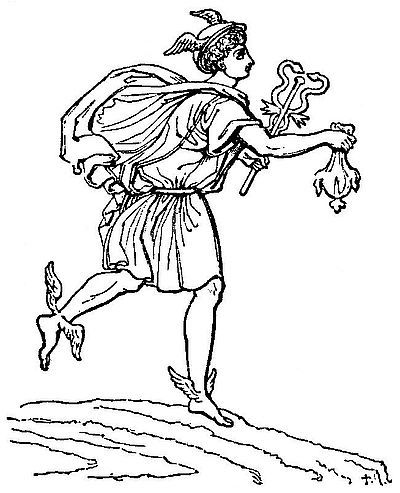
Hermes bearing the Caduceus. (Museo Borbonico, vol. vi. pl. 2.)
CĂDŪCUM. [Bona Caduca.]
CĂDUS (κάδος, κάδδος), a large vessel usually made of earthenware, which was used for keeping wine, drawing water, &c. The name of cadus was sometimes given to the vessel or urn in which the counters or pebbles of the dicasts were put, when they gave their vote on a trial, but the diminutive καδίσκος was more commonly used in this signification.
CAELĀTŪRA (τορευτική), a branch of the fine arts, under which all sorts of ornamental work in metal, except actual statues, appear to be included. The principal processes, which these words were used to designate, seem to have been of three kinds: hammering metal plates into moulds or dies, so as to bring out a raised pattern; engraving the surface of metals with a sharp tool; and working a pattern of one metal upon or into the surface of another: in short, the various processes which we describe by the words chasing, damascening, &c. The objects on which the caelator exercised his art were chiefly weapons and armour—especially shields, chariots, tripods, and other votive offerings, quoits, candelabra, thrones, curule chairs, mirrors, goblets, dishes, and all kinds of gold and silver plate. The ornamental work with which the chaser decorated such objects consisted either of simple running patterns, chiefly in imitation of plants and flowers, or of animals, or of mythological subjects, and, for armour, of battles. The mythological subjects were reserved for the works of the greatest masters of the art: they were generally executed in very high relief (anaglypha). In the finest works, the ornamental pattern was frequently distinct from the vessel, to which it was either fastened permanently, or so that it could be removed at pleasure, the vessel being of silver, and the ornaments of gold, crustae aut emblemata. The art of ornamental metal-work was in an advanced stage of progress among the Greeks of the heroic period, as we see from numerous passages of Homer: but its origin, in the high artistic sense, is to be ascribed to Phidias, and its complete development to Polycletus. In the last age of the Roman Republic, the prevailing wealth and luxury, and the presence of Greek artists at Rome, combined to bring the art more than ever into requisition. After this period it suddenly fell into disuse.
CAELĬBĀTUS. [Aes Uxorium; Lex Julia et Papia Poppaea.]
CAERĬTUM TĂBŬLAE. [Aerarii.]
CAESAR, a title of the Roman emperors, was originally a family name of the Julia gens; it was assumed by Octavianus as the adopted son of the great dictator, C. Julius Caesar, and was by him handed down to his adopted son Tiberius. It continued to be used by Caligula, Claudius, and Nero, as members either by adoption or female descent of Caesar’s family; but although the family became extinct with Nero, succeeding emperors still retained the name as part of their titles, and it was the practice to prefix it to their own names, as for instance, Imperator Caesar Domitianus Augustus. When Hadrian adopted Aelius Varus, he allowed the latter to take the title of Caesar; and from this time, though the title of Augustus continued to be confined to the reigning emperor, that of Caesar was also granted to the second person in the state and the heir presumptive to the throne. [Augustus.]
CĂLĂMISTRUM, an instrument made of iron, and hollow like a reed (calamus), used for curling the hair. For this purpose it was heated, the person who performed the office of heating it in wood ashes (cinis) being called ciniflo, or cinerarius.
CĂLĂMUS, a sort of reed which the ancients used as a pen for writing. The best sorts were got from Aegypt and Cnidus.
CĂLANTĬCA. [Coma.]
CĂLĂTHUS (κάλαθος, also called τάλαρος), usually signified the basket in which women placed their work, and especially the materials for spinning. In the following cut a slave, belonging to the class called quasillariae, is presenting her mistress with the calathus. Baskets of this kind were also used for other purposes, such as for carrying fruits, flowers, &c. The name of calathi was also given to cups for holding wine. Calathus was properly a Greek word, though used by the Latin writers. The Latin word corresponding to it was qualus or quasillus. From quasillus came quasillaria, the name of the slave who spun, and who was considered the meanest of the female slaves.
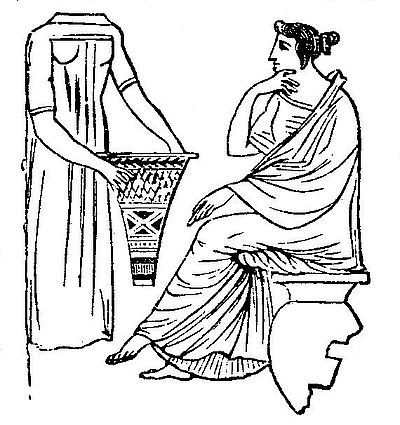
Slave presenting a Calathus. (From a Painting on a Vase.)
CALCĔUS, CALCĔĀMEN, CALCĔĀMENTUM (ὑποδήμα, πέδιλον), a shoe or boot, anything adapted to cover and preserve the feet in walking. The use of shoes was by no means universal among the Greeks and Romans. The Homeric heroes are represented without shoes when armed for battle. Socrates, Phocion, and Cato, frequently went barefoot. The Roman slaves had no shoes. The covering of the feet was removed before reclining at meals. People in grief, as for instance at funerals, frequently went barefooted. Shoes may be divided into those in which the mere sole of a shoe was attached to the sole of the foot by ties or bands, or by a covering for the toes or the instep [Solea; Crepida; Soccus]; and those which ascended higher and higher, according as they covered the ankles, the calf, or the whole of the leg. To calceamenta of the latter kind, i.e. to shoes and boots, as distinguished from sandals and slippers, the term calceus was applied in its proper and restricted sense. There were also other varieties of the calceus according to its adaptation to particular professions or modes of life. Thus the Caliga was principally worn by soldiers; the Pero by labourers and rustics; and the Cothurnus by tragedians, hunters, and horsemen. The calcei probably did not much differ from our shoes, and are exemplified in a painting at Herculaneum, which represents a female wearing bracelets, a wreath of ivy, and a panther’s skin, while she is in the attitude of dancing and playing on the cymbals. The form and colour of the calceus indicated rank and office. Roman senators wore high shoes like buskins, fastened in front with four black thongs. They were also sometimes adorned with a small crescent: we do not find on any ancient statues the crescent, but we may regard the bottom right hand figure in the annexed cut as representing the shoe of a senator. Among the calcei worn by senators, those called mullei, from their resemblance to the scales of the red mullet, were particularly admired; as well as others called alutae, because the leather was softened by the use of alum.
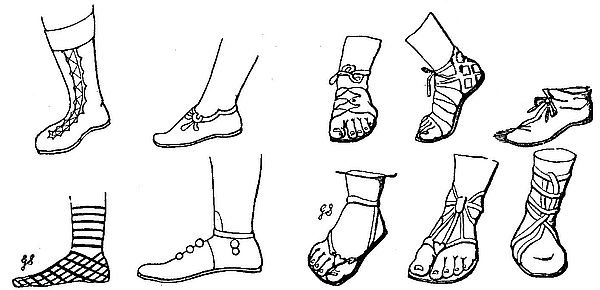
Greek Shoes. (From ancient Vases.)
Roman Shoes. (Museo Borbonico.)
CALCŬLĀTOR (λογιστής), a keeper of accounts in general, and also a teacher of arithmetic. In Roman families of importance there was a calculator or account-keeper, who is, however, more frequently called by the name of dispensator, or procurator: he was a kind of steward.
CALCŬLI, little stones or pebbles, used for various purposes, as, for instance, among the Athenians for voting. Calculi were used in playing a sort of draughts. Subsequently, instead of pebbles, ivory, or silver, or gold, or other men (as we call them) were used; but they still bore the name of calculi. Calculi were also used in reckoning; and hence the phrases calculum ponere, calculum subducere.
CALDĀRĬUM. [Balneum.]
CĂLENDAE or KĂLENDAE. [Calendarium.]
CĂLENDĀRĬUM or KĂLENDĀRĬUM, generally signified an account-book, in which were entered the names of a person’s debtors, with the interest which they had to pay, and it was so called because the interest had to be paid on the calends of each month. The word, however, was also used in the signification of a modern calendar or almanac. (1) Greek Calendar. The Greek year was divided into twelve lunar months, depending on the actual changes of the moon. The first day of the month (νουμηνία) was not the day of the conjunction, but the day on the evening of which the new moon appeared; consequently full moon was the middle of the month. The lunar month consists of twenty-nine days and about thirteen hours; accordingly some months were necessarily reckoned at twenty-nine days, and rather more of them at thirty days. The latter were called full months (πληρεῖς), the former hollow months (κοῖλοι). As the twelve lunar months fell short of the solar year, they were obliged every other year to interpolate an intercalary month (μὴν ἐμβολιμαῖος) of thirty or twenty-nine days. The ordinary year consisted of 354 days, and the interpolated year, therefore, of 384 or 383. This interpolated year (τριέτηρις) was seven days and a half too long, and to correct the error, the intercalary month was from time to time omitted. The Attic year began with the summer solstice: the following is the sequence of the Attic months and the number of days in each:—Hecatombaeon (30), Metageitnion (29), Boedromion (30), Pyanepsion (29), Maemacterion (30), Poseideon (29), Gamelion (30), Anthesterion (29), Elaphebolion (30), Munychion (29), Thargelion (30), Scirophorion (29). The intercalary month was a second Poseideon inserted in the middle of the year. Every Athenian month was divided into three decads. The days of the first decad were designated as ἱσταμένου or ἀρχομένου μηνος, and were counted on regularly from one to ten; thus, δευτέρα ἀρχομένου or ἱσταμένου is “the second day of the month.” The days of the second decad were designated as ἐπὶ δέκα or μεσοῦντος, and were counted on regularly from the 11th to the 20th day, which was called εἴκας. There were two ways of counting the days of the last decad; they were either reckoned onwards from the 20th (thus, πρώτη ἐπὶ εἰκάδι was the 21st), or backwards from the last day, with the addition φθίνοντος, παυομένου, λήγοντος, or ἀπίοντος; thus, the twenty-first day of a hollow month was ἐνάτη φθίνοντος; of a full month, δεκάτη φθίνοντος. The last day of the month was called ἕνη καὶ νέα, “the old and new,” because as the lunar month really consisted of more than twenty-nine and less than thirty days, the last day might be considered as belonging equally to the old and new month. Separate years were designated at Athens by the name of the chief archon, hence called archon eponymus (ἄρχων ἐπώνυμος), or “the name giving archon;” at Sparta, by the first of the ephors; at Argos, by the priestess of Juno, &c.—(2) Roman Calendar. The old Roman, frequently called the Romulian year, consisted of only ten months, which were called Martius, Aprilis, Maius, Junius, Quinctilis, Sextilis, September, October, November, December. That March was the first month in the year is implied in the last six names. Of these months, four, namely, Martius, Maius, Quinctilis, and October, consisted of thirty-one days, the other six of thirty. The four former were distinguished in the latest form of the Roman calendar by having their nones two days later than any of the other months. The symmetry of this arrangement will appear by placing the numbers in succession:—31, 30; 31, 30; 31, 30, 30; 31, 30, 30. The Romulian year therefore consisted of 304 days, and contained thirty-eight nundinae or weeks; every eighth day, under the name of nonae, or nundinae, being especially devoted to religious and other public purposes. Hence we find that the number of dies fasti afterwards retained in the Julian calendar tally exactly with these thirty-eight nundines; besides which, it may be observed that a year of 304 days bears to a solar year of 365 days nearly the ratio of five to six, six of the Romulian years containing 1824, five of the solar years 1825 days; and hence we may explain the origin of the well-known quinquennial period called the lustrum, which ancient writers expressly call an annus magnus; that is, in the modern language of chronology, a cycle. It was consequently the period at which the Romulian and solar years coincided. The next division of the Roman year was said to have been made by Numa Pompilius, who instituted a lunar year of 12 months and 355 days. Livy says that Numa so regulated his lunar year of twelve months by the insertion of intercalary months, that at the end of every nineteenth year (vicesimo anno) it again coincided with the same point in the sun’s course from which it started. It is well known that 19 years constitute a most convenient cycle for the junction of a lunar and solar year. It seems certain that the Romans continued to use a lunar year for some time after the establishment of the republic; and it was probably at the time of the decemviral legislation that the lunar year was abandoned. By the change which was then made the year consisted of 12 months, the length of each of which was as follows:—
Martius, 31 days. September, 29 days.
Aprilis, 29 ” October, 31 ”
Maius, 31 ” November, 29 ”
Junius, 29 ” December, 29 ”
Quinctilis, 31 ” Januarius, 29 ”
Sextilis, 29 ” Februarius, 28 ”
The year thus consisted of 355 days, and this was made to correspond with the solar year by the insertion of an intercalary month (mensis intercalaris or intercalarius), called Mercedonius or Mercidonius. This month of 22 or 23 days seems to have been inserted in alternate years. As the festivals of the Romans were for the most part dependent upon the calendar, the regulation of the latter was entrusted to the college of pontifices, who in early times were chosen exclusively from the body of patricians. It was therefore in the power of the college to add to their other means of oppressing the plebeians, by keeping to themselves the knowledge of the days on which justice could be administered, and assemblies of the people could be held. In the year 304 B.C., one Cn. Flavius, a secretary (scriba) of Appius Claudius, is said fraudulently to have made the Fasti public. The other privilege of regulating the year by the insertion of the intercalary month gave the pontiffs great political power, which they were not backward to employ. Every thing connected with the matter of intercalation was left to their unrestrained pleasure; and the majority of them, on personal grounds, added to or took from the year by capricious intercalations, so as to lengthen or shorten the period during which a magistrate remained in office, and seriously to benefit or injure the farmer of the public revenue. The calendar was thus involved in complete confusion, and accordingly we find that in the time of Cicero the year was three months in advance of the real solar year. At length, in the year B.C. 46, Caesar, now master of the Roman world, employed his authority, as pontifex maximus, in the correction of this serious evil. The account of the way in which he effected this is given by Censorinus:—“The confusion was at last carried so far that C. Caesar, the pontifex maximus, in his third consulate, with Lepidus for his colleague, inserted between November and December two intercalary months of 67 days, the month of February having already received an intercalation of 23 days, and thus made the whole year to consist of 445 days. At the same time he provided against a repetition of similar errors, by casting aside the intercalary month, and adapting the year to the sun’s course. Accordingly, to the 355 days of the previously existing year he added ten days, which he so distributed between the seven months having 29 days that January, Sextilis, and December received two each, the others but one; and these additional days he placed at the end of the several months, no doubt with the wish not to remove the various festivals from those positions in the several months which they had so long occupied. Hence in the present calendar, although there are seven months of 31 days, yet the four months, which from the first possessed that number, are still distinguishable by having their nones on the seventh, the rest having them on the fifth of the month. Lastly, in consideration of the quarter of a day, which he regarded as completing the true year, he established the rule that, at the end of every four years, a single day should be intercalated, where the month had been hitherto inserted, that is, immediately after the terminalia; which day is now called the bissextum.” The mode of denoting the days of the month will cause no difficulty, if it be recollected that the kalends always denote the first of the month; that the nones occur on the seventh of the four months of March, May, Quinctilis or July, and October, and on the fifth of the other months; that the ides always fall eight days later than the nones; and lastly, that the intermediate days are in all cases reckoned backwards upon the Roman principle of counting both extremes. For the month of January the notation will be as follows:—
1. Kal. Jan. 2. a. d. IV. Non. Jan. 3. a. d. III. Non. Jan. 4. Prid. Non. Jan. 5. Non. Jan. 6. a. d. VIII. Id. Jan. 7. a. d. VII. Id. Jan. 8. a. d. VI. Id. Jan. 9. a. d. V. Id. Jan. 10. a. d. IV. Id. Jan. 11. a. d. III. Id. Jan. 12. Prid. Id. Jan. 13. Id. Jan. 14. a. d. XIX. Kal. Feb. 15. a. d. XVIII. Kal. Feb. 16. a. d. XVII. Kal. Feb. 17. a. d. XVI. Kal. Feb. 18. a. d. XV. Kal. Feb. 19. a. d. XIV. Kal. Feb. 20. a. d. XIII. Kal. Feb. 21. a. d. XII. Kal. Feb. 22. a. d. XI. Kal. Feb. 23. a. d. X. Kal. Feb. 24. a. d. IX. Kal. Feb. 25. a. d. VIII. Kal. Feb. 26. a. d. VII. Kal. Feb. 27. a. d. VI. Kal. Feb. 28. a. d. V. Kal. Feb. 29. a. d. IV. Kal. Feb. 30. a. d. III. Kal. Feb. 31. Prid. Kal. Feb.
The letters a d are often, through error, written together, and so confounded with the preposition ad which would have a different meaning, for ad kalendas would signify by, i.e. on or before the kalends. The letters are in fact an abridgment of ante diem, and the full phrase for “on the second of January,” would be ante diem quartum nonas Januarias. The word ante in this expression seems really to belong in sense to nonas, and to be the cause why nonas is an accusative. Whether the phrase kalendae Januarii was ever used by the best writers is doubtful. The words are commonly abbreviated; and those passages where Aprilis, Decembris, &c. occur are of no avail, as they are probably accusatives. The ante may be omitted, in which case the phrase will be die quarto nonarum. In the leap year (to use a modern phrase), the last days of February were called,—
Feb. 23. a. d. VII. Kal. Mart. Feb. 24. a. d. VI. Kal. Mart. posteriorem. Feb. 25. a. d. VI. Kal. Mart. priorem. Feb. 26. a. d. V. Kal. Mart. Feb. 27. a. d. IV. Kal. Mart. Feb. 28. a. d. III. Kal. Mart. Feb. 29. Prid. Kal. Mart.
In which the words prior and posterior are used in reference to the retrograde direction of the reckoning. From the fact that the intercalated year has two days called ante diem sextum, the name bissextile has been applied to it. The term annus bissextilis, however, does not occur in any classical writer, but in place of it the phrase annus bissextus.—The names of two of the months were changed in honour of Julius Caesar and Augustus. Julius was substituted for Quinctilis, the month in which Caesar was born, in the second Julian year, that is, the year of the dictator’s death, for the first Julian year was the first year of the corrected Julian calendar, that is, B.C. 45. The name Augustus in place of Sextilis was introduced by the emperor himself in B.C. 27. The month of September in like manner received the name of Germanicus from the general so called, and the appellation appears to have existed even in the time of Macrobius. Domitian, too, conferred his name upon October; but the old word was restored upon the death of the tyrant.—The Julian calendar supposes the mean tropical year to be 365 d. 6 h.; but this exceeds the real amount by 11′ 12″, the accumulation of which, year after year, caused at last considerable inconvenience. Accordingly, in the year 1582, Pope Gregory XIII. again reformed the calendar. The ten days by which the year had been unduly retarded were struck out by a regulation that the day after the fourth of October in that year should be called the fifteenth; and it was ordered that whereas hitherto an intercalary day had been inserted every four years, for the future three such intercalations in the course of four hundred years should be omitted, viz., in those years which are divisible without remainder by 100, but not by 400. Thus, according to the Julian calendar, the years 1600, 1700, 1800, 1900, 2000, were to be bissextile as before. The bull which effected this change was issued Feb. 24th, 1582. The Protestant parts of Europe resisted what they called a papistical invention for more than a century. In England the Gregorian calendar was first adopted in 1752. In Russia, and those countries which belonged to the Greek church, the Julian year, or old style, as it is called, still prevails. In the ancient calendars the letters A, B, C, D, E, F, G, H, were used for the purpose of fixing the nundines in the week of eight days; precisely in the same way in which the first seven letters are still employed in ecclesiastical calendars, to mark the days of the Christian week.
CĂLĬGA, a strong and heavy sandal worn by the Roman soldiers, but not by the superior officers. Hence the common soldiers, including centurions, were distinguished by the name of caligati. The emperor Caligula received that cognomen when a boy, in consequence of wearing the caliga, and being inured to the life of a common soldier. The cuts on pp. 1, 41, show the difference between the caliga of the common soldier and the calceus worn by men of higher rank.
CĂLIX (κύλιξ). (1) a drinking-cup used at symposia and on similar occasions.—(2) A vessel used in cooking.—(3) A tube in the aquaeducts attached to the extremity of each pipe, where it entered the castellum.
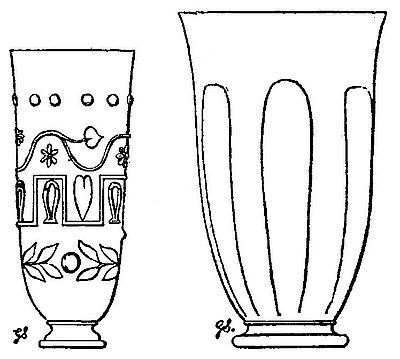
Calices, Drinking-cups. (Museo Borbonico, vol. v. pl. 18.)
CALLIS, a beaten path or track made by the feet of cattle. The sheep-walks in the mountainous parts of Campania and Apulia were the property of the Roman state; and as they were of considerable value, one of the quaestors usually had these calles assigned to him as his province, whence we read of the Callium provincia. His principal duties were to receive the scriptura, or tax paid for the pasturage of the cattle, and to protect life and property in these wild and mountainous districts. When the senate wished to put a slight upon the consuls on one occasion they endeavoured to assign to them as their provinces, the care of the woods (silvae) and sheep-walks (calles).
CALLISTEIA (καλλιστεῖα), a festival, or perhaps merely a part of one, held by the women of Lesbos; at which they assembled in the sanctuary of Hera, and the fairest received the prize of beauty. Similar contests of beauty are said to have been held in other places.
CĀLŌNES, the slaves or servants of the Roman soldiers, so called from carrying wood (κᾶλα) for their use. The word calo, however, was also applied to farm-servants. The calones and lixae are frequently spoken of together, but they were not the same: the latter were freemen, who merely followed the camp for the purposes of gain and merchandise, and were so far from being indispensable to an army, that they were sometimes forbidden to attend it.
CĂLUMNĬA. When an accuser failed in his proof, and the accused party was acquitted, there might be an inquiry into the conduct and motives of the accuser. If the person who made this judicial inquiry found that the accuser had merely acted from error of judgment, he acquitted him in the form non probasti; if he convicted him of evil intention, he declared his sentence in the words calumniatus es, which sentence was followed by the legal punishment. The punishment for calumnia was fixed by the lex Remmia, or as it is sometimes, perhaps incorrectly, named, the lex Memmia. But it is not known when this lex was passed, nor what were its penalties. It appears from Cicero, that the false accuser might be branded on the forehead with the letter K, the initial of Kalumnia. The punishment for calumnia was also exsilium, relegatio in insulam, or loss of rank (ordinis amissio); but probably only in criminal cases, or in matters relating to status.
CĂMĂRA (καμάρα), or CĂMĔRA. (1) A particular kind of arched ceiling, formed by semicircular bands or beams of wood, arranged at small lateral distances, over which a coating of lath and plaster was spread, and the whole covered in by a roof, resembling in construction the hooped awnings in use amongst us.—(2) A small boat used in early times by the people who inhabited the shores of the Palus Maeotis, capable of containing from twenty-five to thirty men. These boats were made to work fore and aft, like the fast-sailing proas of the Indian seas, and continued in use until the age of Tacitus.
CĂMILLI, CĂMILLAE, boys and girls employed in the religious rites and ceremonies of the Romans. They were required to be perfect in form, and sound in health, free born, and with both their parents alive; or, in other words, according to the expression of the Romans, pueri seu puellae ingenui, felicissimi, patrimi matrimique.
CĂMĪNUS. [Domus.]
CAMPESTRE (sc. subligar), a kind of girdle or apron, which the Roman youths wore around their loins, when they exercised naked in the Campus Martius. The campestre was sometimes worn in warm weather, in place of the tunic under the toga.
CAMPUS MARTĬUS. [See Classical Dictionary.]
CĂNĂBUS (κάναβος), a figure of wood in the form of a skeleton, round which the clay or plaster was laid in forming models. Figures of a similar kind, formed to display the muscles and veins, were studied by painters in order to acquire some knowledge of anatomy.
CĀNATHRON (κάναθρον), a carriage, the upper part of which was made of basket-work, or more properly the basket itself, which was fixed in the carriage.
CANCELLĀRĬUS. [Cancelli.]
CANCELLI, lattice-work, placed before a window, a door-way, the tribunal of a judge, or any other place. Hence was derived the word Cancellarius, which originally signified a porter, who stood at the latticed or grated door of the emperor’s palace. The cancellarius also signified a legal scribe or secretary, who sat within the cancelli or lattice-work. The chief scribe or secretary was called Cancellarius κατ’ ἐξοχήν, and was eventually invested with judicial power at Constantinople. From this word has come the modern Chancellor.
CANDĒLA, a candle, made either of wax (cerea), or tallow (sebacea), was used universally by the Romans before the invention of oil lamps (lucernae). In later times candelae were only used by the poorer classes; the houses of the more wealthy were always lighted by lucernae.
CANDĒLABRUM, originally a candlestick, but afterwards the name of a stand for supporting lamps (λυχνοῦχοι), in which signification it most commonly occurs. The candelabra of this kind were usually made to stand upon the ground, and were of a considerable height. The most common kind were made of wood; but those which have been found in Herculaneum and Pompeii are mostly of bronze. Sometimes they were made of the more precious metals, and even of jewels. The candelabra did not always stand upon the ground, but were also placed upon the table. Such candelabra usually consisted of pillars, from the capitals of which several lamps hung down, or of trees, from whose branches lamps also were suspended.
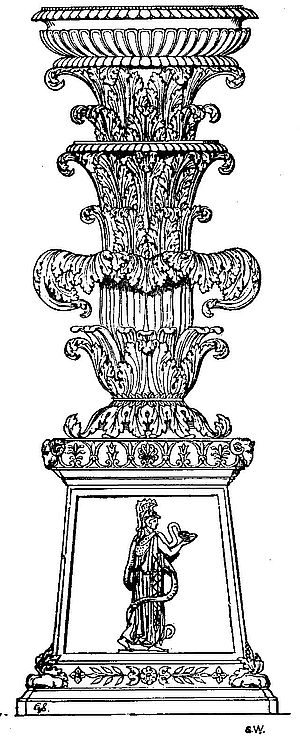
Candelabrum in the Vatican. (Visconti, vol. IV. tav. 5.)
CANDĬDĀTUS. [Ambitus.]
CANDYS (κάνδυς), a robe worn by the Medes and Persians over their trowsers and other garments. It had wide sleeves, and was made of woollen cloth, which was either purple or of some other splendid colour. In the Persepolitan sculptures, from which the annexed figures are taken, nearly all the principal personages wear it.
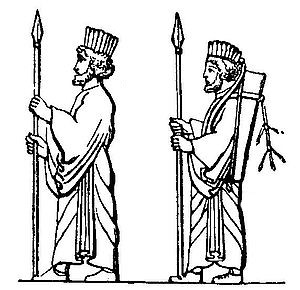
Candys, Persian Cloak. (From Bas-relief at Persepolis.)
CĂNĒPHŎROS (κανηφόρος), a virgin who carried a flat circular basket (κάνεον, canistrum) at sacrifices, in which the chaplet of flowers, the knife to slay the victim, and sometimes the frankincense were deposited. The name, however, was more particularly applied to two virgins of the first Athenian families who were appointed to officiate as canephori at the Panathaenaea. The preceding cut represents the two canephori approaching a candelabrum. Each of them elevates one arm to support the basket while she slightly raises her tunic with the other.
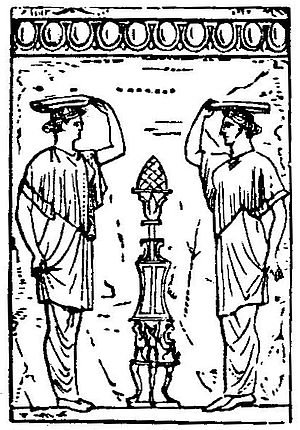
Canephori. (British Museum.)
CANTHĂRUS (κάνθαρος), a kind of drinking cup, furnished with handles. It was the cup sacred to Bacchus, who is frequently represented on ancient vases holding it in his hand.

Cantharus. (From an ancient Vase.)
CANTĬCUM, an interlude between the acts of a Roman comedy, and sometimes, perhaps, of a tragedy. It consisted of flute music, accompanied by a kind of recitative performed by a single actor, or if there were two, the second was not allowed to speak with the first. In the canticum, as violent gesticulation was required, it appears to have been the custom, from the time of Livius Andronicus, for the actor to confine himself to the gesticulation, while another person sang the recitative.
CĂPILLUS. [Coma.]
CĂPISTRUM (φορβειά), a halter, or tie for horses, asses, or other animals, placed round the head or neck, and made of osiers or other fibrous materials. The Greek word φορβειά was also applied to a contrivance used by pipers and trumpeters to compress their mouths and cheeks, and thus to aid them in blowing. It is often seen in works of ancient art, and was said to be the invention of Marsyas. [Tibia.]
CĂPĬTE CENSI. [Caput.]
CĂPĬTIS DĒMĬNŪTĬO. [Caput.]
CĂPĬTŌLĪNI LŪDI. [Ludi.]
CĂPĬTŌLĬUM. [See Class. Dictionary.]
CĂPĬTŬLUM. [Columna.]
CAPSA, or SCRĪNĬUM, a box for holding books among the Romans. These boxes were of a cylindrical form. There does not appear to have been any difference between the capsa and scrinium, except that the latter word was usually applied to those boxes which held a considerable number of rolls. The slaves who had the charge of these book-chests were called capsarii, and also custodes scriniorum; and the slaves who carried in a capsa behind their young masters the books, &c. of the sons of respectable Romans, when they went to school, were called by the same name.
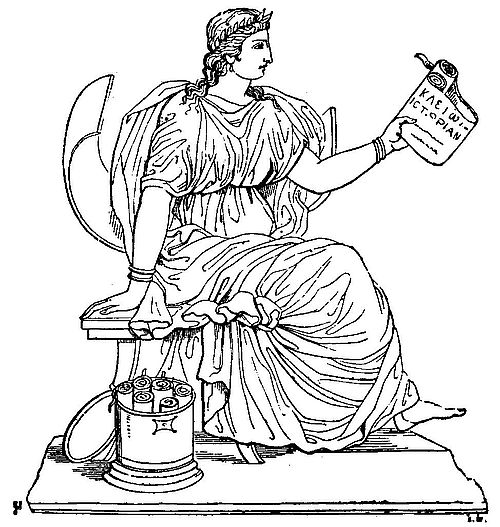
The Muse Clio with a Capsa. (Pitture d’Ercolano, vol. ii. pl. 2.)
CAPSĀRĬI, the name of three different classes of slaves. [Balneum; Capsa.]
CĂPUT, the head. The term “head” is often used by the Roman writers as equivalent to “person,” or “human being.” By an easy transition it was used to signify “life:” thus, capite damnari, plecti, &c., are equivalent to capital punishment. Caput is also used to express a man’s status, or civil condition; and the persons who were registered in the tables of the censor are spoken of as capita, sometimes with the addition of the word civium, and sometimes not. Thus to be registered in the census was the same thing as caput habere: and a slave and a filius familias, in this sense of the word, were said to have no caput. The sixth class of Servius Tullius comprised the proletarii and the capite censi, of whom the latter, having little or no property, were barely rated as so many head of citizens.—He who lost or changed his status was said to be capite minutus, deminutus, or capitis minor. Capitis minutio or deminutio was a change of a person’s status or civil condition, and consisted of three kinds.—A Roman citizen possessed freedom (libertas), citizenship (civitas), and family (familias): the loss of all three constituted the maxima capitis deminutio. This capitis deminutio was sustained by those who refused to be registered at the census, or neglected the registration, and were thence called incensi. The incensus was liable to be sold, and so to lose his liberty. Those who refused to perform military service might also be sold.—The loss of citizenship and family only, as when a man was interdicted from fire and water, was the media capitis deminutio. [Exsilium.]—The change of family by adoption, and by the in manum conventio, was the minima capitis deminutio.—A judicium capitale, or poena capitalis, was one which affected a citizen’s caput.
CĂPUT. [Fenus.]
CĂPUT EXTŌRUM. The Roman soothsayers (haruspices) pretended to a knowledge of coming events from the inspection of the entrails of victims slain for that purpose. The part to which they especially directed their attention was the liver, the convex upper portion of which seems to have been called the caput extorum. Any disease or deficiency in this organ was considered an unfavourable omen; whereas, if healthy and perfect, it was believed to indicate good fortune. If no caput was found, it was a bad sign (nihil tristius accidere potuit); if well defined or double, it was a lucky omen.
CĂRĂCALLA, an outer garment used in Gaul, and not unlike the Roman lacerna. It was first introduced at Rome by the emperor Aurelius Antoninus Bassianus, who compelled all the people that came to court to wear it, whence he obtained the surname of Caracalla. This garment, as worn in Gaul, does not appear to have reached lower than the knee, but Caracalla lengthened it so as to reach the ankle.
CARCER (kerker, German; γοργύρα, Greek), a prison, is connected with ἕρκος and εἵργω, the guttural being interchanged with the aspirate. (1) Greek. Imprisonment was seldom used amongst the Greeks as a legal punishment for offences; they preferred banishment to the expense of keeping prisoners in confinement. The prisons in different countries were called by different names; thus there was the Ceadas (Κεάδας), at Sparta; and, among the Ionians, the Gorgyra (γοργύρα), as at Samos. The prison at Athens was in former times called Desmoterion (δεσμωτήριον), and afterwards, by a sort of euphemism, οἴκημα. It was chiefly used as a guard-house or place of execution, and was under the charge of the public officers called the Eleven.—(2) Roman. A prison was first built at Rome by Ancus Martius, overhanging the forum. This was enlarged by Servius Tullius, who added to it a souterrain, or dungeon, called from him the Tullianum. Sallust describes this as being twelve feet under ground, walled on each side, and arched over with stone work. For a long time this was the only prison at Rome, being, in fact, the “Tower,” or state prison of the city, which was sometimes doubly guarded in times of alarm, and was the chief object of attack in many conspiracies. There were, however, other prisons besides this, though, as we might expect, the words of Roman historians generally refer to this alone. In the Tullianum prisoners were generally executed, and this part of the prison was also called robur.
CARCĔRES. [Circus.]
CARCHĒSĬUM (καρχήσιον). (1) A beaker or drinking-cup, which was used by the Greeks in very early times. It was slightly contracted in the middle, and its two handles extended from the top to the bottom. It was much employed in libations of wine, milk, and honey.—(2) The upper part of the mast of a ship. [Navis.]
CARMENTĀLĬA, a festival celebrated in honour of Carmenta or Carmentis, who is fabled to have been the mother of Evander, who came from Pallantium in Arcadia, and settled in Latium: he was said to have brought with him a knowledge of the arts, and the Latin alphabetical characters as distinguished from the Etruscan. This festival was celebrated annually on the 11th of January. A temple was erected to the same goddess, at the foot of the Capitoline hill, near the Porta Carmentalis, afterwards called Scelerata. The name Carmenta is said to have been given to her from her prophetic character, carmens or carmentis being synonymous with vates. The word is, of course, connected with carmen, as prophecies were generally delivered in verse.
CARNEIA (καρνεῖα), a great national festival, celebrated by the Spartans in honour of Apollo Carneios. The festival began on the seventh day of the month of Carneios = Metageitnion of the Athenians, and lasted for nine days. It was of a warlike character, similar to the Attic Boëdromia. During the time of its celebration nine tents were pitched near the city, in each of which nine men lived in the manner of a military camp, obeying in everything the commands of a herald. The priest conducting the sacrifices at the Carneia was called Agetes (Ἀγητής), whence the festival was sometimes designated by the name Agetoria or Agetoreion (Ἀγητόρια or Ἀγητόρειον), and from each of the Spartan tribes five men (Καρνεᾶται) were chosen as his ministers, whose office lasted four years, during which period they were not allowed to marry. When we read in Herodotus and Thucydides that the Spartans during the celebration of this festival were not allowed to take the field against an enemy, we must remember that this restriction was not peculiar to the Carneia, but common to all the great festivals of the Greeks: traces of it are found even in Homer.
CARNĬFEX, the public executioner at Rome, who executed slaves and foreigners, but not citizens, who were punished in a manner different from slaves. It was also his business to administer the torture. This office was considered so disgraceful, that he was not allowed to reside within the city, but lived without the Porta Metia or Esquilina, near the place destined for the punishment of slaves, called Sestertium under the emperors.
CARPENTUM, a cart; also a two-wheeled carriage, enclosed, and with an arched or sloping cover overhead. The carpentum was used to convey the Roman matrons in the public festal processions; and this was a high distinction, since the use of carriages in the city was entirely forbidden during the whole of the republican period. Hence the privilege of riding in a carpentum in the public festivals was sometimes granted to females of the imperial family. This carriage contained seats for two, and sometimes for three persons, besides the coachman. It was commonly drawn by a pair of mules, but more rarely by oxen or horses, and sometimes by four horses like a quadriga.—Carpenta, or covered carts, were much used by the Britons, the Gauls, and other northern nations. These, together with the carts of the more common form, including baggage-waggons, appear to have been comprehended under the term carri, or carra, which is the Celtic name with a Latin termination. The Gauls took a great multitude of them on their military expeditions, and when they were encamped, arranged them in close order, so as to form extensive lines of circumvallation.
CARRĀGO, a kind of fortification, consisting of a great number of waggons placed round an army. It was employed by barbarous nations, as, for instance, the Scythians, Gauls, and Goths. Carrago also signifies sometimes the baggage of an army.
CARRŪCA, a carriage, the name of which only occurs under the emperors. It appears to have been a species of rheda [Rheda], had four wheels, and was used in travelling. These carriages were sometimes used in Rome by persons of distinction, like the carpenta; in which case they appear to have been covered with plates of bronze, silver, and even gold, which were sometimes ornamented with embossed work.
CARRUS. [Carpentum.]
CĂRỸA or CĂRỸĀTIS (καρύα, καρυατίς), a festival celebrated at Caryae, in Laconia, in honour of Artemis Caryatis. It was celebrated every year by Lacedaemonian maidens with national dances of a very lively kind.
CĂRỸĀTĬDES, female figures used in architecture instead of columns. Their name is usually derived from Caryae, a city in Arcadia, near the Laconian border, the women of which are said to have been reduced to slavery by the Greeks, because Caryae had joined the Persians at the invasion of Greece. But this tale is probably apocryphal. One of the porticos of the Erechtheum at Athens is supported by Caryatides.
CASSIS. [Galea.]
CASTELLUM ĂQUAE. [Aquae Ductus.]
CASTRA. Roman armies never halted for a single night without forming a regular entrenchment, termed castra, capable of receiving within its limits the whole body of fighting men, their beasts of burden, and the baggage. So completely was this recognised as a part of the ordinary duties of each march, that pervenire ad locum tertiis ... quartis ... septuagesimis castris are the established phrases for expressing the number of days occupied in passing from one point to another. Whenever circumstances rendered it expedient for a force to occupy the same ground for any length of time, then the encampment was distinguished as castra stativa. In wild and barbarian lands, where there were no large towns and no tribes on whose faith reliance could be placed, armies, whether of invasion or occupation, were forced to remain constantly in camps. They usually, however, occupied different ground in summer and in winter, whence arose the distinction between castra aestiva and castra hiberna, both alike being stativa. But whether a camp was temporary or permanent, whether tenanted in summer or in winter, the main features of the work were always the same for the same epoch. In hiberna, huts of turf or stone would be substituted for the open tents of the aestiva (hence aedificare hiberna), and in stativa held for long periods the defences would present a more substantial and finished aspect, but the general outline and disposition of the parts were invariable. Polybius has transmitted to us a description of a Roman camp, from which the annexed plan has been drawn up. It is such as would be formed at the close of an ordinary day’s march by a regular consular army consisting of two Roman legions with the full contingent of Socii. Each legion is calculated at 4200 infantry and 300 cavalry; the Socii furnished an equal number of infantry, and twice as many cavalry, so that the whole force would amount to 16,800 foot and 1800 horse. Skill in the selection of a spot for a camp (capere locum castris) was ever considered as a high quality in a general, and we find it recorded among the praises of the most renowned commanders that they were wont in person to perform this duty. Under ordinary circumstances, however, the task was devolved upon one of the military tribunes, and a certain number of centurions appointed from time to time for the purpose. These having gone forward in advance of the army until they reached the place near which it was intended to halt, and having taken a general survey of the ground, selected a spot from whence a good view of the whole proposed area might be obtained. This spot was considerably within the limits of the contemplated enclosure, and was marked by a small white flag. The next object was to ascertain in what direction water and fodder might be most easily and securely provided. These two preliminary points being decided, the business of measuring out the ground (metari castra) commenced, and was executed, as we learn from various sources, with graduated rods (decempedae) by persons denominated metatores. In practice the most important points were marked by white poles, some of which bore flags of various colours, so that the different battalions on reaching the ground could at once discover the place assigned to them.
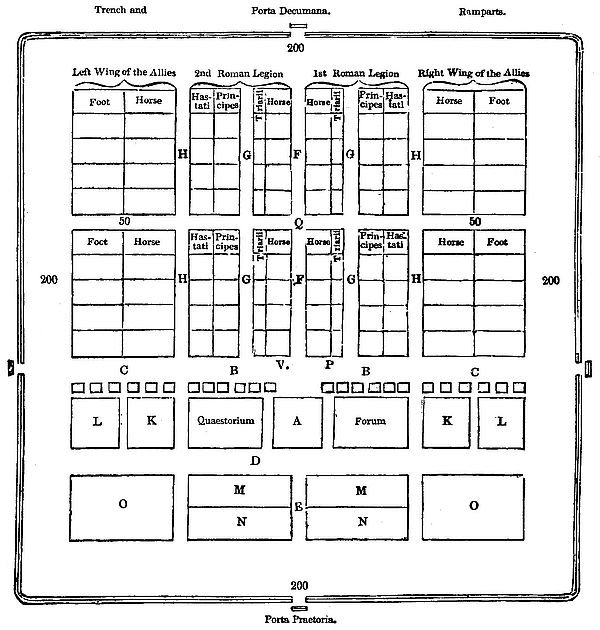
A, praetorium.—B, tents of the tribunes.—C, tents of the praefecti sociorum.—D, street 100 feet wide.—E, F, G, and H, streets 50 feet wide.—L, select foot and volunteers.—K, select horse and volunteers.—M, extraordinary horse of the allies.—N, extraordinary foot of the allies.—O, reserved for occasional auxiliaries.—Q, the street called Quintana, 50 feet wide.—V P, via principalis, 100 feet wide.
The white flag A, which served as the starting point of the whole construction, marked the position of the consul’s tent, or praetorium, so called because praetor was the ancient term for any one invested with supreme command. A square area was left open, extending a hundred feet each way from the praetorium. The camp was divided into two parts, the upper and the lower. The upper part formed about a third of the whole. In it was the praetorium (A) or general’s tent. A part of the praetorium was called the Augurale, as the auguries were there taken by the general. On the right and left of the praetorium were the forum and quaestorium; the former a sort of market-place, the latter appropriated to the quaestor and the camp stores under his superintendence. On the sides of and facing the forum and quaestorium, were stationed select bodies of horse (K) taken from the extraordinaries, with mounted volunteers, who served out of respect to the consul, and were stationed near him. And parallel to these were posted similar bodies of foot-soldiers (L). Before the quaestorium and the forum were the tents of the twelve tribunes of the two legions (B), and before the select bodies of horse and infantry the tents of the praefecti sociorum were probably placed (C). Again, behind the praetorium, the quaestorium, and the forum, ran a street or via (D), 100 feet broad, from one side of the camp to the other. Along the upper side of this street was ranged the main body of the “extraordinary” horse (M): they were separated into two equal parts by a street fifty feet broad (E). At the back of this body of cavalry was posted a similar body of infantry (N), selected from the allies, and facing the opposite way, i.e. towards the ramparts of the camp. The vacant spaces (O) on each side of these troops were reserved for foreigners and occasional auxiliaries. The lower part of the camp was divided from the upper by a street, called the Via Principalis (V P), or Principia, a hundred feet broad. Here the tribunal of the general was erected, from which he harangued the soldiers, and here the tribunes administered justice. Here also the principal standards, the altars of the gods, and the images of the emperors were placed. The lower part of the camp was occupied by the two legions and the troops of the allies according to the arrangement of the preceding cut. Between the ramparts and the tents was left a vacant space of 200 feet on every side, which was useful for many purposes: thus it served for the reception of any booty that was taken, and facilitated the entrance and exit of the army. The camp had four gates, one at the top and bottom, and one at each of the sides; the top or back-gate, which was the side most away from the enemy, was called the decumana. The bottom or the front gate was the practoria, the gates of the sides were the porta principalis dextra, and the porta principalis sinistra. The whole camp was surrounded by a trench (fossa), generally nine feet deep and twelve broad, and a rampart (vallum) made of the earth that was thrown up (agger), with stakes (valli) fixed at the top of it. The labour of this work was so divided, that the allies completed the two sides of the camp alongside of which they were stationed, and the two Roman legions the rest.—In describing the Roman camp and its internal arrangements, we have confined ourselves to the information given by Polybius, which, of course, applies only to his age, and to armies constituted like those he witnessed. When the practice of drawing up the army according to cohorts, ascribed to Marius or Caesar [Exercitus], had superseded the ancient division into maniples, and the distinction of triarii, &c., the internal arrangements of the camp must have been changed accordingly. In each legion the tribunes divided themselves into three sections of two each, and each section in turn undertook for two months the superintendence of all matters connected with the camp. Out of the twenty maniples of Principes and Triarii in each legion, two were appointed to take charge of the broad passage or street called Principia, extending right across the camp in front of the tents of the tribunes. Of the remaining eighteen maniples of Principes and Hastati in each legion, three were assigned by lot to each of the six tribunes, and of these three maniples one in turn rendered each day certain services to the tribune to whom it was specially attached. One maniple was selected each day from the whole legionary force, to keep guard beside the tent of the general. Three sentinels were usually posted at the tents of the quaestor, and of the legati: and by night sentinels kept watch at every maniple, being chosen out of the maniple which they guarded. The Velites mounted guard by day and by night along the whole extent of the vallum: to them also in bodies of ten was committed the charge of the gates, while strong bodies of infantry and cavalry were thrown forward in advance of each gate, to resist any sudden onset, and give timely notice of the approach of the enemy.—Excubiae; excubias agere; excubare; are the general terms used with reference to mounting guard whether by night or by day. Vigiliae; vigilias agere; vigilare; are restricted to night duty: Excubiae and Vigiliae frequently denote not only the service itself, but also the individuals who performed it. Stationes is used specially to denote the advanced posts thrown forward in front of the gates. Custodes or Custodiae the parties who watched the gates themselves, Praesidia the sentinels on the ramparts, but all these words are employed in many other significations also. The duty of going the rounds (Vigilias circuire s. circumire) was committed to the Equites, and for this purpose each legion supplied daily four, picked out from each turma in rotation by the commander of the troop. The eight persons thus selected decided by lot in which watch they should make their rounds, two being assigned to each watch. They then repaired to the tribune, and each individual received a written order specifying the posts which he was to visit, every post being visited in each watch by one or other of the two to whom the watch belonged. Sometimes we find centurions, tribunes, and even the general in chief represented as going the rounds, but, under ordinary circumstances, the duty was performed as we have described. The watchword for the night was not communicated verbally, but by means of a small rectangular tablet of wood (πλατεῖον ἐπιγεγραμμένον—tessera) upon which it was written.—Breaking up a Camp. On the first signal being given by the trumpet, the tents were all struck and the baggage packed, the tents of the general and the tribunes being disposed of before the others were touched. At the second signal the baggage was placed upon the beasts of burden; at the third, the whole army began to move.
CĂTĂLŎGUS (κατάλογος), the catalogue of those persons in Athens who were liable to regular military service. At Athens, those persons alone who possessed a certain amount of property were allowed to serve in the regular infantry, whilst the lowest class, the thetes, had not this privilege. [Census.] Thus the former are called οἱ ἐκ καταλόγου στρατεύοντες, and the latter οἱ ἔξω τοῦ καταλόγου.
CĂTĂPHRACTA. [Lorica.]
CĂTĂPHRACTI (κατάφρακτοι). (1) Heavy-armed cavalry, the horses of which were also covered with defensive armour. Among many of the Eastern nations, who placed their chief dependence upon their cavalry, we find horses protected in this manner; but among the Romans we do not read of any troops of this description till the later times of the empire, when the discipline of the legions was destroyed, and the chief dependence began to be placed on the cavalry. This species of troops was common among the Persians from the earliest times, from whom it was adopted by their Macedonian conquerors. They were called by the Persians clibanarii.—(2) Decked vessels, in opposition to Aphracti.
CĂTĂPĪRĀTĒR (καταπειρατηρία, βολίς), the lead used in sounding (ἐν τῷ βολίζειν), or fathoming the depth of water in navigation. The mode of employing this instrument appears to have been precisely the same as that now in use.
CĂTĂPULTA. [Tormentum.]
CĂTĂRACTA (καταῤῥάκτης), a portcullis, so called because it fell with great force and a loud noise. It was an additional defence, suspended by iron rings and ropes, before the gates of a city, in such a manner that, when the enemy had come up to the gates, the portcullis might be let down so as to shut them in, and to enable the besieged to assail them from above.
CĂTEIA, a missile used in war by the Germans, Gauls, and some of the Italian nations, supposed to resemble the Aclis.
CĂTĒNA, dim. CĂTELLA (ἄλυσις, dim. ἀλύσιον, ἀλυσίδιον), a chain. The chains which were of superior value, either on account of the material or the workmanship, are commonly called catellae (ἀλύσια), the diminutive expressing their fineness and delicacy as well as their minuteness. The specimens of ancient chains which we have in bronze lamps, in scales, and in ornaments for the person, especially necklaces, show a great variety of elegant and ingenious patterns. Besides a plain circle or oval, the separate link is often shaped like the figure 8, or is a bar with a circle at each end, or assumes other forms, some of which are here shown. The links are also found so closely entwined, that the chain resembles platted wire or thread, like the gold chains now manufactured at Venice. This is represented in the lowest figure of the woodcut.

Ancient Chains.
CĂTERVĀRĬI. [Gladiatores.]
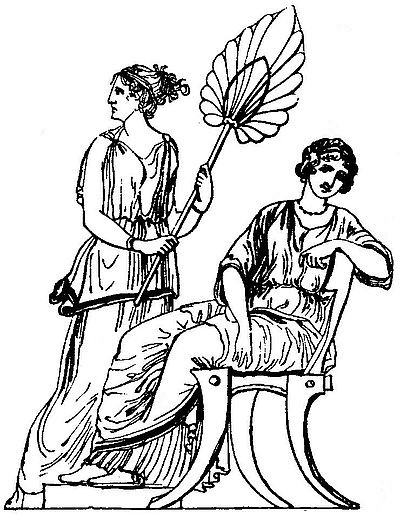
Cathedra. (From a Painting on a Vase.)
CĂTHEDRA, a seat or chair, was more particularly applied to a soft seat used by women, whereas sella signified a seat common to both sexes. The cathedrae were, no doubt, of various forms and sizes; but they usually appear to have had backs to them. On the cathedra in the annexed cut is seated a bride, who is being fanned by a female slave with a fan made of peacock’s feathers. Women were also accustomed to be carried abroad in these cathedrae instead of in lecticae, which practice was sometimes adopted by effeminate persons of the other sex. The word cathedra was also applied to the chair or pulpit from which lectures were read.
CĂTĪNUS, or CĂTĪNUM, a large dish, on which fish and meat were served up at table. Hence Horace speaks of an angustus catinus as an indication of niggardliness on the part of the host.
CĂVAEDĬUM. [Domus.]
CĂVĔA. [Theatrum.]
CAUPŌNA. (1) An inn, where travellers obtained food and lodging; in which sense it answered to the Greek words πανδοκεῖον, καταγώγιον, and κατάλυσις. Inns for the accommodation of persons of all classes existed among the Greeks and Romans, although they were not equal either in size or convenience to similar places in modern times. An inn was also called taberna and taberna diversoria, or simply diversorium or deversorium.—(2) A shop, where wine and ready-dressed meat were sold, thus corresponding to the Greek καπηλεῖον. The person who kept a caupona was called caupo. In Greek κάπηλος signifies in general a retail trader, who sold goods in small quantities; but the word is more particularly applied to a person who sold ready-dressed provisions, and especially wine in small quantities. In these καπηλεῖα only persons of the very lowest class were accustomed to eat and drink. In Rome itself there were, no doubt, inns to accommodate strangers; but these were probably only frequented by the lower classes, since all persons in respectable society could easily find accommodation in the houses of their friends. There were, however, in all parts of the city, numerous houses where wine and ready-dressed provisions were sold. The houses where persons were allowed to eat and drink were usually called popinae and not cauponae; and the keepers of them, popae. They were principally frequented by slaves and the lower classes, and were consequently only furnished with stools to sit upon instead of couches. The Thermopolia, where the calida or warm wine and water was sold, appear to have been the same as the popinae. Many of these popinae were little better than the lupanaria or brothels; whence Horace calls them immundas popinas. The ganeae, which are sometimes mentioned in connection with the popinae, were brothels, whence they are often classed with the lustra. Under the emperors many attempts were made to regulate the popinae, but apparently with little success. All persons who kept inns or houses of public entertainment of any kind were held in low estimation both among the Greeks and Romans. They appear to have fully deserved the bad reputation which they possessed, for they were accustomed to cheat their customers by false weights and measures, and by all the means in their power.
CAUSĬA (καυσία), a hat with a broad brim, which was made of felt, and worn by the Macedonian kings. Its form is seen in the annexed figure. The Romans adopted it from the Macedonians.
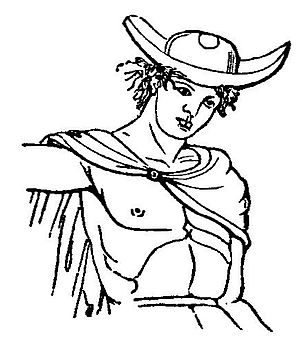
Causia, Hat. (From a Painting on a Vase.)
CAUTĬO, CĂVĒRE. These words are of frequent occurrence, and have a great variety of significations, according to the matter to which they refer. Their general signification is that of security given by one person to another, or security which one person obtains by the advice or assistance of another. The cautio was most frequently a writing, which expressed the object of the parties to it; accordingly the word cautio came to signify both the instrument (chirographum or instrumentum) and the object which it was the purpose of the instrument to secure. Cicero uses the expression cautio chirographi mei. The phrase cavere aliquid alicui expressed the fact of one person giving security to another as to some particular thing or act. The word cautio was also applied to the release which a debtor obtained from his creditor on satisfying his demand; in this sense cautio is equivalent to a modern receipt; it is the debtor’s security against the same demand being made a second time. Thus cavere ab aliquo signifies to obtain this kind of security. Cavere is also applied to express the professional advice and assistance of a lawyer to his client for his conduct in any legal matter. Cavere and its derivatives are also used to express the provisions of a law, by which any thing is forbidden or ordered, as in the phrase, Cautum est lege, &c. It is also used to express the words in a will, by which a testator declares his wish that certain things should be done after his death.
CĔADAS or CAEADAS (κεάδας or καιάδας), a deep cavern or chasm, like the Barathron at Athens, into which the Spartans were accustomed to thrust persons condemned to death.
CĔLĔRES, are said by Livy to have been three hundred horsemen, who formed the body-guard of Romulus both in peace and war. There can, however, be little doubt that these Celeres were not simply the body-guard of the king, but were the same as the equites, or horsemen, a fact which is expressly stated by some writers. [Equites.] The etymology of Celeres is variously given. Some writers derived it from their leader Celer, who was said to have slain Remus, but most writers connected it with the Greek κέλης, in reference to the quickness of their service. The Celeres were under the command of a Tribunus Celerum, who stood in the same relation to the king as the magister equitum did in a subsequent period to the dictator. He occupied the second place in the state, and in the absence of the king had the right of convoking the comitia. Whether he was appointed by the king, or elected by the comitia, has been questioned, but the former is the more probable.
CELLA, in its primary sense, means a store-room of any kind. Of these there were various descriptions, which took their distinguishing denominations from the articles they contained, as, for instance, the cella penuaria or penaria, the cella olearia and cella vinaria. The slave to whom the charge of these stores was intrusted, was called cellarius, or promus, or condus, “quia promit quod conditum est,” and sometimes promus condus and procurator peni. This answers to our butler and housekeeper. Any number of small rooms clustered together like the cells of a honeycomb were also termed cellae; hence the dormitories of slaves and menials are called cellae, and cellae familiaricae, in distinction to a bed-chamber, which was cubiculum. Thus a sleeping-room at a public-house is also termed cella. Cella ostiarii, or janitoris, is the porter’s lodge. In the baths the cella caldaria, tepidaria, and frigidaria, were those which contained respectively the warm, tepid, and cold bath. [Balneae.] The interior of a temple, that is the part included within the outside shell (σηκός), was also called cella. There was sometimes more than one cella within the same peristyle or under the same roof, in which case each cell took the name of the deity whose statue it contained, as cella Jovis, cella Junonis, cella Minervae, as in the temple of Jupiter on the Capitoline.
CĔNOTĂPHĬUM, a cenotaph (κενός and τάφος), was an empty or honorary tomb, erected as a memorial of a person whose body was buried elsewhere, or not found for burial at all.
CENSOR (τιμητής), the name of two magistrates of high rank in the Roman republic. Their office was called Censura (τιμητεία or τιμητία). The Census, which was a register of Roman citizens and of their property, was first established by Servius Tullius, the fifth king of Rome. After the expulsion of the kings it was taken by the consuls; and special magistrates were not appointed for the purpose of taking it till the year B.C. 443. The reason of this alteration was owing to the appointment in the preceding year of tribuni militum with consular power in place of the consuls; and as these tribunes might be plebeians, the patricians deprived the consuls, and consequently their representatives, the tribunes, of the right of taking the census, and entrusted it to two magistrates, called Censores, who were to be chosen exclusively from the patricians. The magistracy continued to be a patrician one till B.C. 351, when C. Marcius Rutilus was the first plebeian censor. Twelve years afterwards, B.C. 339, it was provided by one of the Publilian laws, that one of the censors must necessarily be a plebeian, but it was not till B.C. 280 that a plebeian censor performed the solemn purification of the people (lustrum condidit). In B.C. 131 the two censors were for the first time plebeians.—The censors were elected in the comitia centuriata held under the presidency of a consul. As a general principle, the only persons eligible to the office were those who had previously been consuls; but a few exceptions occur. At first there was no law to prevent a person being censor a second time; but the only person, who was twice elected to the office, was C. Marcius Rutilus in B.C. 265; and he brought forward a law in this year, enacting that no one should be chosen censor a second time, and received in consequence the surname of Censorinus.—The censorship is distinguished from all other Roman magistracies by the length of time during which it was held. The censors were originally chosen for a whole lustrum, that is, a period of five years; but their office was limited to eighteen months, as early as ten years after its institution (B.C. 433), by a law of the dictator Mam. Aemilius Mamercinus. The censors also held a very peculiar position with respect to rank and dignity. No imperium was bestowed upon them, and accordingly they had no lictors. The jus censurae was granted to them by a lex centuriata, and not by the curiae, and in that respect they were inferior in power to the consuls and praetors. But notwithstanding this, the censorship was regarded as the highest dignity in the state, with the exception of the dictatorship; it was a sanctus magistratus, to which the deepest reverence was due. They possessed of course the sella curulis. The funeral of a censor was always conducted with great pomp and splendour, and hence a funus censorium was voted even to the emperors.—The censorship continued in existence for 421 years, namely, from B.C. 443 to B.C. 22; but during this period many lustra passed by without any censor being chosen at all. Its power was limited by one of the laws of the tribune Clodius (B.C. 58). After the year B.C. 22 the emperors discharged the duties of the censorship under the name of Praefectura Morum.—The duties of the censors may be divided into three classes, all of which were however closely connected with one another: I. The Census, or register of the citizens and of their property, in which were included the lectio senatus, and the recognitio equitum; II. The Regimen Morum; and III. The administration of the finances of the state, under which were classed the superintendence of the public buildings and the erection of all new public works.—I. The Census, the first and principal duty of the censors, for which the proper expression is censum agere, was always held in the Campus Martius, and from the year B.C. 435 in a special building called Villa Publica. After the auspicia had been taken, the citizens were summoned by a public crier (praeco) to appear before the censors. Each tribe was called up separately, and every paterfamilias had to appear in person before the censors, who were seated in their curule chairs. The census was conducted ad arbitrium censoris; but the censors laid down certain rules, sometimes called leges censui censendo, in which mention was made of the different kinds of property subject to the census, and in what way their value was to be estimated. According to these laws each citizen had to give an account of himself, of his family, and of his property upon oath, ex animi sententia. First he had to give his full name (praenomen, nomen, and cognomen) and that of his father, or if he were a freedman that of his patron, and he was likewise obliged to state his age. He was then asked, Tu, ex animi tui sententia, uxorem habes? and if married he had to give the name of his wife, and likewise the number, names, and ages of his children, if any. Single women (viduae) and orphans (orbi orbaeque) were represented by their tutores; their names were entered in separate lists, and they were not included in the sum total of capita. After a citizen had stated his name, age, family, &c., he then had to give an account of all his property, so far as it was subject to the census. In making this statement he was said censere or censeri, as a deponent, “to value or estimate himself,” or as a passive “to be valued or estimated:” the censor, who received the statement, was also said censere, as well as accipere censum. Only such things were liable to the census (censui censendo) as were property ex jure Quiritium. Land formed the most important article in the census; next came slaves and cattle. The censors also possessed the right of calling for a return of such objects as had not usually been given in, such as clothing, jewels, and carriages. We can hardly doubt that the censors possessed the power of setting a higher valuation on the property than the citizens themselves had put. The tax (tributum) was usually one per thousand upon the property entered in the books of the censors; but on one occasion the censors, as a punishment, compelled a person to pay eight per thousand (octuplicato censu, Liv. iv. 24). A person who voluntarily absented himself from the census, and thus became incensus, was subject to the severest punishment. It is probable that service in the army was a valid excuse for absence. After the censors had received the names of all the citizens with the amount of their property, they then had to make out the lists of the tribes, and also of the classes and centuries; for by the legislation of Servius Tullius the position of each citizen in the state was determined by the amount of his property. [Comitia Centuriata.] These lists formed a most important part of the Tabulae Censoriae, under which name were included all the documents connected in any way with the discharge of the censors’ duties. These lists, as far at least as they were connected with the finances of the state, were deposited in the aerarium, which was the temple of Saturn; but the regular depository for all the archives of the censors was in earlier times the Atrium Libertatis, near the Villa publica, and in later times the temple of the Nymphs. The censors had also to make out the lists of the senators for the ensuing lustrum, or till new censors were appointed; striking out the names of such as they considered unworthy, and making additions to the body from those who were qualified. [Senatus.] In the same manner they held a review of the equites equo publico, and added and removed names as they judged proper. [Equites.] After the lists had been completed, the number of citizens was counted up, and the sum total announced; and accordingly we find that, in the account of a census, the number of citizens is likewise usually given. They are in such cases spoken of as capita, sometimes with the addition of the word civium, and sometimes not; and hence to be registered in the census was the same thing as caput habere. [Caput.]—II. Regimen Morum. This was the most important branch of the censors’ duties, and the one which caused their office to be the most revered and the most dreaded in the Roman state. It naturally grew out of the right which they possessed of excluding unworthy persons from the lists of citizens. They were constituted the conservators of public and private virtue and morality; they were not simply to prevent crime or particular acts of immorality, but their great object was to maintain the old Roman character and habits, the mos majorum. The proper expression for this branch of their power was regimen morum, which was called in the times of the empire cura or praefectura morum. The punishment inflicted by the censors in the exercise of this branch of their duties was called Nota or Notatio, or Animadversio Censoria. In inflicting it they were guided only by their conscientious convictions of duty; they had to take an oath that they would act neither through partiality nor favour; and in addition to this, they were bound in every case to state in their lists, opposite the name of the guilty citizen, the cause of the punishment inflicted on him,—Subscriptio censoria. The consequence of such a nota was only ignominia and not infamia [Infamia], and the censorial verdict was not a judicium or res judicata, for its effects were not lasting, but might be removed by the following censors, or by a lex. A nota censoria was moreover not valid, unless both censors agreed. The ignominia was thus only a transitory capitis deminutio, which does not appear even to have deprived a magistrate of his office, and certainly did not disqualify persons labouring under it for obtaining a magistracy, for being appointed as judices by the praetor, or for serving in the Roman armies. This superintendence of the conduct of Roman citizens extended so far, that it embraced the whole of the public and private life of the citizens. Thus we have instances of their censuring or punishing persons for not marrying, for breaking a promise of marriage, for divorce, for bad conduct during marriage, for improper education of children, for living in an extravagant and luxurious manner, and for many other irregularities in private life. Their influence was still more powerful in matters connected with the public life of the citizens. Thus we find them censuring or punishing magistrates who were forgetful of the dignity of their office or guilty of bribery, as well as persons who were guilty of improper conduct towards magistrates, of perjury, and of neglect of their duties both in civil and military life. The punishments inflicted by the censors are generally divided into four classes:—1. Motio or ejectio e senatu, or the exclusion of a man from the number of senators. This punishment might either be a simple exclusion from the list of senators, or the person might at the same time be excluded from the tribes and degraded to the rank of an aerarian. The censors in their new lists omitted the names of such senators as they wished to exclude, and in reading these new lists in public, passed over the names of those who were no longer to be senators. Hence the expression praeteriti senatores is equivalent to e senatu ejecti. 2. The ademptio equi, or the taking away the equus publicus from an eques. This punishment might likewise be simple, or combined with the exclusion from the tribes and the degradation to the rank of an aerarian. [Equites.] 3. The motio e tribu, or the exclusion of a person from his tribe. If the further degradation to the rank of an aerarian was combined with the motio e tribu, it was always expressly stated. 4. The fourth punishment was called referre in aerarios or facere aliquem aerarium, and might be inflicted on any person who was thought by the censors to deserve it. [Aerarii.]—III. The Administration of the Finances of the State, was another part of the censors’ office. In the first place the tributum, or property-tax, had to be paid by each citizen according to the amount of his property registered in the census, and, accordingly, the regulation of this tax naturally fell under the jurisdiction of the censors. [Tributum.] They also had the superintendence of all the other revenues of the state, the vectigalia, such as the tithes paid for the public lands, the salt-works, the mines, the customs, &c. [Vectigalia.] All these branches of the revenue the censors were accustomed to let out to the highest bidder for the space of a lustrum or five years. The act of letting was called venditio or locatio, and seems to have taken place in the month of March. The censors also possessed the right, though probably not without the concurrence of the senate, of imposing new vectigalia, and even of selling the land belonging to the state. The censors, however, did not receive the revenues of the state. All the public money was paid into the aerarium, which was entirely under the jurisdiction of the senate; and all disbursements were made by order of this body, which employed the quaestors as its officers. [Aerarium; Senatus.]—In one important department the censors were entrusted with the expenditure of the public money; though the actual payments were no doubt made by the quaestors. The censors had the general superintendence of all the public buildings and works (opera publica); and to meet the expenses connected with this part of their duties, the senate voted them a certain sum of money or certain revenues, to which they were restricted, but which they might at the same time employ according to their discretion. They had to see that the temples and all other public buildings were in a good state of repair (aedes sacras tueri and sarta tecta exigere), that no public places were encroached upon by the occupation of private persons (loca tueri), and that the aquaeducts, roads, drains, &c. were properly attended to. The repairs of the public works and the keeping of them in proper condition were let out by the censors by public auction to the lowest bidder. The persons who undertook the contract were called conductores, mancipes, redemptores, susceptores, &c.; and the duties they had to discharge were specified in the Leges Censoriae. The censors had also to superintend the expenses connected with the worship of the gods. In these respects it is not easy to define with accuracy the respective duties of the censors and aediles: but it may be remarked in general that the superintendence of the aediles had more of a police character, while that of the censors had reference to all financial matters.—After the censors had performed their various duties and taken the census, the lustrum or solemn purification of the people followed. When the censors entered upon their office, they drew lots to see which of them should perform this purification (lustrum facere or condere), but both censors were obliged of course to be present at the ceremony. [Lustrum.]—In the Roman and Latin colonies and in the municipia there were censors, who likewise bore the name of quinquennales. They are spoken of under Colonia. A census was sometimes taken in the provinces, even under the republic; but there seems to have been no general census taken in the provinces till the time of Augustus. At Rome the census still continued to be taken under the empire, but the old ceremonies connected with it were no longer continued, and the ceremony of the lustration was not performed after the time of Vespasian.—The word census, besides the meaning of “valuation” of a person’s estate, has other significations, which must be briefly mentioned: 1. It signified the amount of a person’s property, and hence we read of census senatorius, the estate of a senator; census equestris, the estate of an eques. 2. The lists of the censors. 3. The tax which depended upon the valuation in the census.
CENSUS.—(1) Greek.—The Greek term for a man’s property as ascertained by the census, as well as for the act of ascertaining it, is τίμημα. The only Greek state concerning whose arrangement of the census we have any satisfactory information, is Athens. Previous to the time of Solon no census had been instituted at Athens. According to his census, all citizens were divided into four classes: 1. Pentacosiomedimni (Πεντακοσιομέδιμνοι), or persons possessing landed property which yielded an annual income of at least 500 medimni of dry or liquid produce. 2. Hippeis (Ἱππεῖς), i.e. knights or persons able to keep a war-horse, were those whose lands yielded an annual produce of at least 300 medimni, whence they are also called τριακοσιομέδιμνοι. 3. Zeugitae (Ζευγῖται), i.e. persons able to keep a yoke of oxen (ζεῦγος), were those whose annual income consisted of at least 150 medimni. 4. The Thetes (Θῆτες) contained all the rest of the free population, whose income was below that of the Zeugitae. The constitution of Athens, so long as it was based upon these classes, was a timocracy (τιμοκρατία, or ἀπὸ τιμημάτων πολιτεία). The highest magistracy at Athens, or the archonship, was at first accessible only to persons of the first class, until Aristides threw all the state offices open to all classes indiscriminately. The maintenance of the republic mainly devolved upon the first three classes, the last being exempted from all taxes. As the land in the legislation of Solon was regarded as the capital which yielded an annual income, he regulated his system of taxation by the value of the land, which was treated as the taxable capital. Lists of this taxable property (ἀπογραφαί) were kept at first by the naucrari, who also had to conduct the census, and afterwards by the demarchi.—As property is a fluctuating thing, the census was repeated from time to time, but the periods differed in the various parts of Greece, for in some a census was held every year, and in others every two or four years. At Athens every person had to state the amount of his property, and if there was any doubt about his honesty, it seems that a counter-valuation (ἀντιτίμησις) might be made. This system of taxation according to classes, and based upon the possession of productive estates, underwent a considerable change in the time of the Peloponnesian war, though the divisions into classes themselves continued to be observed for a considerable time after. As the wants of the republic increased, and as many citizens were possessed of large property, without being landed proprietors, the original land-tax was changed into a property-tax. This property-tax was called εἰσφορά, concerning which see Eisphora. Compare Leiturgiae; and for the taxes paid by resident aliens, Metoici.—(2) Roman. [Censor.]
CENTESĬMA, namely pars, or the hundredth part, also called vectigal rerum venalium, or centesima rerum venalium, was a tax of one per cent. levied at Rome and in Italy upon all goods that were exposed for public sale at auctions. It was collected by persons called coactores. This tax was perhaps introduced after the civil war between Marius and Sulla. Its produce was assigned by Augustus to the aerarium militare. Tiberius reduced the tax to one half per cent. (ducentesima), after he had changed Cappadocia into a province, and had thereby increased the revenue of the empire. Caligula in the beginning of his reign abolished the tax altogether for Italy.
CENTUMVĬRI, were judices, who resembled other judices in this respect, that they decided cases under the authority of a magistratus; but they differed from other judices in being a definite body or collegium. This collegium seems to have been divided into four parts, each of which sometimes sat by itself. The origin of the court is unknown. According to an ancient writer, three were chosen out of each tribe, and consequently the whole number out of the 35 tribes would be 105, who, in round numbers, were called the hundred men. If the centumviri were chosen from the tribes, this seems a strong presumption in favour of the high antiquity of the court. It was the practice to set up a spear in the place where the centumviri were sitting, and accordingly the word hasta, or hasta centumviralis, is sometimes used as equivalent to the words judicium centumvirale. The praetor presided in this court. The jurisdiction of the centumviri was chiefly confined to civil matters, but it appears that crimina sometimes came under their cognizance. The younger Pliny, who practised in this court, makes frequent allusions to it in his letters.
CENTŬRĬA. [Exercitus; Comitia.]
CENTŬRĬĀTA CŎMĪTĬA. [Comitia.]
CENTŬRĬO. [Exercitus.]
CENTUSSIS. [As.]
CĒRA (κηρός), wax. For its employment in painting, see Pictura; and for its application as a writing material, see Tabulae and Testamentum.
CĔRĔĀLĬA, a festival celebrated at Rome in honour of Ceres, whose wanderings in search of her lost daughter Proserpine were represented by women, clothed in white, running about with lighted torches. During its continuance, games were celebrated in the Circus Maximus, the spectators of which appeared in white; but on any occasion of public mourning the games and festivals were not celebrated at all, as the matrons could not appear at them except in white. The day of the Cerealia is doubtful; some think it was the ides or 13th of April, others the 7th of the same month.
CĔRĔVĪSĬA, CERVĪSĬA (ζύθος), ale or beer, was almost or altogether unknown to the Greeks and Romans; but it was used very generally by the surrounding nations, whose soil and climate were less favourable to the growth of vines. According to Herodotus, the Egyptians commonly drank “barley wine;” and Diodorus Siculus says that the Egyptian beer was nearly equal to wine in strength and flavour. The Iberians and Thracians, and the people in the north of Asia Minor, instead of drinking their beer out of cups, placed it before them in a large bowl or vase, which was sometimes of gold or silver. This being full to the brim with the grains, as well as the fermented liquor, the guests, when they pledged one another, drank together out of the same bowl by stooping down to it, although, when this token of friendship was not intended, they adopted the more refined method of sucking up the fluid through tubes of cane. The Suevi and other northern nations offered to their gods libations of beer, and expected that to drink it in the presence of Odin would be among the delights of Valhalla.
CĒRŌMA (κήρωμα), the oil mixed with wax (κηρός) with which wrestlers were anointed; also the place where they were anointed, and, in later times, the place where they wrestled.
CĔRŪCHI. [Navis.]
CESTRUM. [Pictura.]
CESTUS. (1) The thongs or bands of leather, which were tied round the hands of boxers, in order to render their blows more powerful (ἱμάντες, or ἱμάντες πυκτικοί). The cestus was used by boxers in the earliest times, and is mentioned in the Iliad; but in the heroic times it consisted merely of thongs of leather, and differed from the cestus used in later times in the public games, which was a most formidable weapon, being frequently covered with knots and nails, and loaded with lead and iron.—(2) A band or tie of any kind, but more particularly the zone or girdle of Venus, on which was represented every thing that could awaken love.
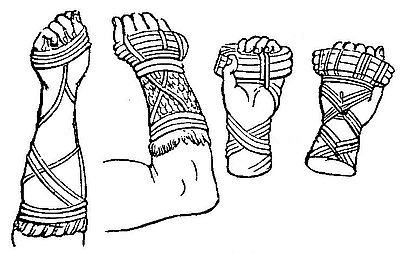
Cestus. (Fabretti, de Col. Traj., p. 261.)
CETRA, or CAETRA, a target, i.e. a small round shield, made of the hide of a quadruped. It formed part of the defensive armour of the Osci, and of the people of Spain, Mauritania, and Britain, and seems to have been much the same as the target of the Scotch Highlanders. The Romans do not appear to have used the cetra; but we find mention of cetratae cohortes levied in the provinces. Livy compares it to the pelta of the Greeks and Macedonians, which was also a small light shield.
CHALCĬOĒCĬA (χαλκιοίκια), an annual festival, with sacrifices, held at Sparta in honour of Athena, surnamed Chalcioecus (Χαλκίοικος), i.e. the goddess of the brazen-house. Young men marched on the occasion in full armour to the temple of the goddess; and the ephors, although not entering the temple, but remaining within its sacred precincts, were obliged to take part in the sacrifice.
CHALCUS (χαλκοῦς), a denomination of Greek copper-money. Bronze or copper (χαλκός) was very little used by the Greeks for money till after the time of Alexander the Great. The χαλκία πονηρὰ at Athens issued in B.C. 406 were a peculiar exception; and they were soon afterwards called in, and the silver currency restored. It is not improbable, however, that the copper coin called χαλκοῦς was in circulation in Athens still earlier. The smallest silver coin at Athens was the quarter-obol, and the χαλκοῦς was the half of that, or the eighth of an obol. Its value was somewhat more than 3-4ths of a farthing. The χαλκοῦς in later times was divided into lepta, of which it contained seven. In later times the obol was coined of copper as well as silver.
CHĂRISTĬA (from χαρίζομαι, to grant a favour or pardon), a solemn feast among the Romans, to which none but relations and members of the same family were invited, in order that any quarrel or disagreement which had arisen amongst them might be made up. The day of celebration was the 19th of February.
CHEIRŎNŎMĬA (χειρονομία), a mimetic movement of the hands, which formed a part of the art of dancing among the Greeks and Romans. In gymnastics it was applied to the movements of the hands in pugilistic combat.
CHEIRŎTŎNĬA (χειροτονία). In the Athenian assemblies two modes of voting were practised, the one by pebbles (ψηφίζεσθαι), the other by a show of hands (χειροτονεῖν). The latter was employed in the election of those magistrates who were chosen in the public assemblies, and who were hence called χειροτονητοί, in voting upon laws, and in some kinds of trials on matters which concerned the people. We frequently find, however, the word ψηφίζεσθαι used where the votes were really given by show of hands. The manner of voting by a show of hands was as follows:—The herald said: “Whoever thinks that Meidias is guilty, let him lift up his hand.” Then those who thought so stretched forth their hands. Then the herald said again: “Whoever thinks that Meidias is not guilty, let him lift up his hand;” and those who were of this opinion stretched forth their hands. The number of hands was counted each time by the herald; and the president, upon the herald’s report, declared on which side the majority voted. It is important to understand clearly the compounds of this word. A vote condemning an accused person is καταχειροτονία: one acquitting him, ἀποχειροτονία; ἐπιχειροτονεῖν is to confirm by a majority of votes: ἐπιχειροτονία τῶν νομῶν was a revision of the laws, which took place at the beginning of every year: ἐπιχειροτονία τῶν ἀρχῶν was a vote taken in the first assembly of each prytany on the conduct of the magistrates; in these cases, those who voted for the confirmation of the law, or for the continuance in office of the magistrate, were said ἐπιχειροτονεῖν, those on the other side ἀποχειροτονεῖν: διαχειροτονία is a vote for one of two alternatives: ἀντιχειροτονεῖν, to vote against a proposition. The compounds of ψηφίζεσθαι have similar meanings.
CHĪRŎGRĂPHUM (χειρόγραφον), meant first, as its derivation implies, a hand-writing or autograph. In this its simple sense, χείρ in Greek and manus in Latin are often substituted for it. From this meaning was easily derived that of a signature to a will or other instrument, especially a note of hand given by a debtor to his creditor.
CHITON (χιτών). [Tunica.]
CHLAENA (χλαῖνα). [Pallium.]
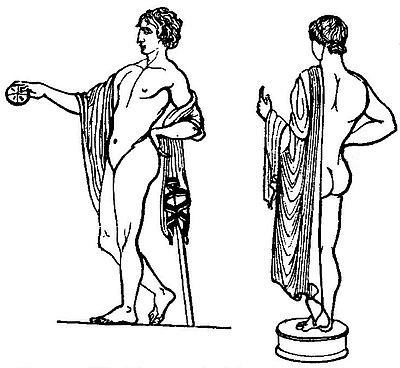
Chlamys. (The Figure on the left from a Painting on a Vase; that on the right from the Brit. Mus.)
CHLĂMỸS (χλαμύς, dim. χλαμύδιον), a scarf, denoted an article of the amictus, or outer raiment of the Greeks. It was for the most part woollen; and it differed from the himation (ἱμάτιον), or cloak, the usual amictus of the male sex, in being smaller, finer, and oblong instead of square, its length being generally about twice its breadth. The scarf does not appear to have been much worn by children. It was generally assumed on reaching adolescence, and was worn by the ephebi from about seventeen to twenty years of age, and hence was called χλαμὺς ἐφηβηική. It was also worn by the military, especially of high rank, over their body armour, and by hunters and travellers, more particularly on horseback. The usual mode of wearing the scarf was to pass one of its shorter sides round the neck, and to fasten it by means of a brooch (fibula), either over the breast (cut, Hasta), in which case it hung down the back, or over the right shoulder, so as to cover the left arm (cut, Causia). In the following cut it is worn again in another way. The aptitude of the scarf to be turned in every possible form around the body, made it useful even for defence. The hunter used to wrap his chlamys about his left arm when pursuing wild animals, and preparing to fight with them. The annexed woodcut exhibits a figure of Neptune armed with the trident in his right hand, and having a chlamys to protect the left. When Diana goes to the chase, as she does not require her scarf for purposes of defence, she draws it from behind over her shoulders, and twists it round her waist so that the belt of her quiver passes across it. (See woodcut.) Among the Romans the scarf came more into use under the emperors. Caligula wore one enriched with gold. Severus, when he was in the country or on an expedition, wore a scarf dyed with the coccus.
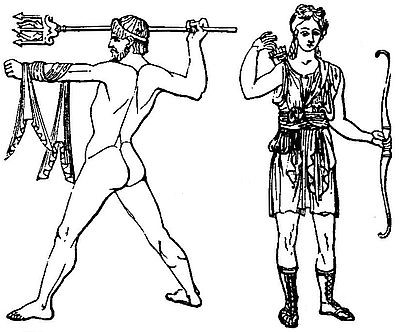
Chlamys. (Neptune from a Coin, and Diana from a Statue in the Vatican.)
CHOENIX (χοῖνιξ), a Greek measure of capacity, the size of which is differently given; it was probably of different sizes in the several states. Some writers make it equal to three cotylae (nearly 1½ pints English); others to four cotylae (nearly 2 pints English); others again make it eight cotylae (nearly 4 pints English).
CHŎRĒGUS (χορηγός), a person who had to bear the expenses of the choregia (χορηγία), one of the regularly recurring state burthens (ἐγκύκλιοι λειτουργίαι) at Athens. The choregus was appointed by his tribe, though we are not informed according to what order. The same person might serve as choregus for two tribes at once; and after B.C. 412 a decree was passed allowing two persons to unite and undertake a choregia together. The duties of the choregia consisted in providing the choruses for tragedies and comedies, the lyric choruses of men and boys, the pyrrhicists, the cyclic choruses, and the choruses of flute-players for the different religious festivals at Athens. When a poet intended to bring out a play, he had to get a chorus assigned him by the archon [Chorus], who nominated a choregus to fulfil the requisite duties. He had first to collect his chorus, and then to procure a teacher (χοροδιδάσκαλος), whom he paid for instructing the choreutae. The chorus were generally maintained, during the period of their instruction, at the expense of the choregus. The choregus who exhibited the best musical or theatrical entertainment received as a prize a tripod, which he had the expense of consecrating, and sometimes he had also to build the monument on which it was placed. There was a whole street at Athens formed by the line of these tripod-temples, and called “The Street of the Tripods.”
CHŎRUS (χορός) probably signified originally a company of dancers dancing in a ring. In later times, a choric performance always implies the singing or musical recitation of a poetical composition, accompanied by appropriate dancing and gesticulation, or at least by a measured march. In all the Dorian states, especially among the Spartans, choral performances were cultivated with great assiduity. Various causes contributed to this, as, for example, their universal employment in the worship of Apollo, the fact that they were not confined to the men, but that women also took part in them, and that many of the dances had a gymnastic character given them, and were employed as a mode of training to martial exercises. [Saltatio.] Hence Doric lyric poetry became almost exclusively choral, which was not the case with the other great school of Greek lyric poetry, the Aeolian; so that the Doric dialect came to be looked upon as the appropriate dialect for choral compositions, and Doric forms were retained by the Athenians even in the choral compositions which were interwoven with their dramas. The instrument commonly used in connection with the Doric choral poetry was the cithara. A great impetus was given to choral poetry by its application to the dithyramb. This ancient Bacchanalian performance seems to have been a hymn sung by one or more of an irregular band of revellers, to the music of the flute. Arion, a contemporary of Periander, was the first who gave a regular choral form to the dithyramb. This chorus, which ordinarily consisted of fifty men or youths, danced in a ring round the altar of Dionysus. Hence such choruses were termed cyclic (κύκλιοι χοροί). With the introduction of a regular choral character, Arion also substituted the cithara for the flute. It was from the dithyramb that the Attic tragedy was developed. For details see Tragoedia. From the time of Sophocles onwards the regular number of the chorus in a tragedy was 15; but it is impossible to arrive at any definite conclusion with regard to the number of the chorus in the early dramas of Aeschylus. The fact that the number of the dithyrambic chorus was 50, and that the mythological number of the Oceanides and Danaides was the same, tempts one to suppose that the chorus in the Prometheus and the Supplices consisted of 50. Most writers, however, agree in thinking that such a number was too large to have been employed. The later chorus of 15 was arranged in a quadrangular form (τετράγωνος). It entered the theatre by the passage to the right of the spectators. [Theatrum.] Its entrance was termed πάροδος; its leaving the stage in the course of the play μετάστασις; its re-entrance ἐπιπάροδος; its exit ἄφοδος. As it entered in three lines, with the spectators on its left, the stage on its right, the middle choreutes of the left row (τρίτος ἀριστέρου) was the Coryphaeus or Hegemon, who in early times at least was not unfrequently the choregus himself. Of course the positions first taken up by the choreutae were only retained till they commenced their evolutions. To guide them in these, lines were marked upon the boards with which the orchestra was floored. The flute as well as the cithara was used as an accompaniment to the choric songs. The dance of the tragic chorus was called ἐμμέλεια.—The ordinary number of the chorus in a comedy was 24. Like the tragic chorus it was arranged in a quadrangular form, and entered the orchestra from opposite sides, according as it was supposed to come from the city or from the country. It consisted sometimes half of male and half of female choreutae. The dance of the comic chorus was the κόρδαξ. In the Satyric drama the chorus consisted of Satyrs: its number is quite uncertain. Its dance was called σίκιννις. When a poet intended to bring forward a play, he had to apply for a chorus (χορὸν αἰτεῖν) to the archons, to the king archon if the play was to be brought forward at the Lenaea, to the archon eponymus if at the great Dionysia. If the play were thought to deserve it, he received a chorus (χορὸν λαμβάνειν), the expenses of which were borne by a choregus. [Choregus.] The poet then either trained (διδάσκειν) the chorus himself, or entrusted that business to a professed chorus trainer (χοροδιδάσκαλος), who usually had an assistant (ὑποδιδάσκαλος). For training the chorus in its evolutions there was also an ὀρχηστοδιδάσκαλος.